Chapter 12 - Fiscal Policy
 Call Kai
 Learn
Learn Practice Test
 Spaced Repetition
 Match
Match Flashcards
 Knowt Play
1/59

Earn XP
Description and Tags
Lecture notes + Textbook notes
Name | Mastery | Learn | Test | Matching | Spaced | Call with Kai |
|---|
No analytics yet
Send a link to your students to track their progress
60 Terms
What is "fiscal policy"?
Changes in government spending and taxes to achieve macroeconomic policy objectives.
government spending or taxation
Who is responsible for fiscal policy?
The federal government controls fiscal policy
Discretionary fiscal policy
Changing government spending, taxes, or transfers to shift the AD curve
What fiscal policy do governments use during a recession?
They use expansionary fiscal policy
Meaning they want to increase aggregate demand, or shift it out to the right
What fiscal policy do governments use during an expansion/boom?
They use contractionary fiscal policy
Meaning they shift AD to the left by decreasing government spending
Automatic Stabilizers
Changes in taxes and transfers kick in (automatically) when income fluctuates
Why are automatic stabilizers called “automatic”?
They work without the government needing to pass new laws.
What is the goal?
Economy returns to long-run eq. after a shcok
What happens to taxes and transfers when GDP falls?
Taxes decrease and transfers (like EI and welfare) increase.
How do automatic stabilizers affect income during a recession?
They prevent income from falling as much.
Monetary policy
Changes in the money supply
How do automatic stabilizers impact aggregate demand (AD)?
They reduce fluctuations in AD.
How does the business cycle change with automatic stabilizers?
Fluctuations become smaller and less extreme.
What happens to AD after a negative shock without automatic stabilizers?
AD shifts left significantly (larger decrease).
What happens to AD after a negative shock with automatic stabilizers?
AD still shifts left, but by a smaller amount.
How do automatic stabilizers affect movement around LRAS?
The economy still fluctuates around LRAS, but with smaller swings.
What is expansionary fiscal policy?
Includes increasing government spending and decreasing taxes to increase aggregate demand.
What is contractionary fiscal policy?
Includes decreasing government spending and increasing taxes to decrease aggregate demand.
Spending multiplier
1/ (1-MPC)
Why does the spending multiplier work?
Initial spending raises income → more consumption → more income
Closed economy AD
Y = C + I + G
Government purchases multiplier formula

Multipliers
Government purchases multiplier
Tax Multiplier
Balanced budget multiplier
Balanced budget multiplier
Suppose that the government wants to increase government spending without increasing the government budget deficit
Used in cases where you want to increase in G and increase T by the same amount
Tax Multiplier Formula
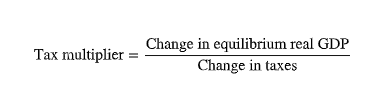
Tax multiplier sign
ALWAYS Negative
Why is tax multiplier negative?
↑ taxes → ↓ consumption
Why is the tax multiplier smaller?
Only part of disposable income is consumed (MPC)
Tax multiplier meaning
Change in GDP from $1 change in taxes
Getting the timing for fiscal policy right can be difficult because….
Control over monetary policy is concentrated in the hands of the Bank of Canada
Even after a change in fiscal policy has been approved, it takes time to implement the policy
Crowding Out
A decline in private expenditures as a result of an increase in government purchases
What happens to interest rates when income (GDP) rises?
Money demand ↑ → interest rates ↑
How do higher interest rates affect private spending?
↓ consumption, ↓ investment, ↓ net exports
Why do net exports fall when interest rates rise?
Higher rates → ↑ demand for CAD → currency appreciates → exports ↓, imports ↑
Crowding out in the short-run
Interest rates rise → some private spending falls → GDP still increases, but less
Crowding out in the long-run
Interest rates rise → private spending fully falls → no increase in GDP
Budget deficit
Government expenditures > Government tax revenue
Budget surplus
Government expenditures < Government tax revenue
Budget deficits occur automatically during recessions for two reasons
Wages and profits fall, causing government tax revenues to fall
Govn. automatically increases its spending on transfer payments (like EI)
The cyclically adjusted budget deficit or surplus
Measures what the deficit or surplus would be if the economy were at potential GDP.
Cyclically adjusted budget deficit or surplus - Expansionary fiscal policy
Should result in a cyclically adjusted budget deficit
What is a cyclically adjusted budget deficit?
Deficit if GDP were at potential
Cyclically adjusted budget deficit or surplus - Contractionary fiscal policy
Should result in a cyclically adjusted budget surplus.
How do automatic deficits help in a recession?
Keep spending higher → reduce severity
Why does tax revenue fall in a recession?
Wages and profits fall
The Federal Government Debt
The total amount the government owes, equal to the sum of all past budget deficits minus surpluses
Tax Wedge
The difference between the pretax and posttax return to an economic activity
Lower tax wedge (lower taxes)
↑ labour supply (people work more)
↑ saving
↑ investment
Higher tax wedge (higher taxes)
↓ labour supply
↓ saving
↓ investment
Effect of cutting taxes on aggregate supply
Increases AS (more economic activity
What is tax simplification?
Making the tax system less complex
How does a complex tax system affect the economy?
Distorts decisions and reduces efficiency
Expansionary policy
Goal: Increase AD
Increase G or decrease T
Contractionary policy
Goal: Decrease AD
further increases in Ad would cause inflation to go up (price level)
Decrease G or increase T
Types of lags
Fiscal policy —> Front-end
Monetary —> Back-end
Policy coordination
BoC --> Monetary policy to increase AD
Federal government --> fiscal policy to decrease AD
What is the difference between federal purchases and federal expenditures?
Federal purchases
Require that the government receive a good or service in return
Federal expenditures
Include transfer payments.

