Chem 102- Exam 2 Illinois State
 Call Kai
 Learn
Learn Practice Test
 Spaced Repetition
 Match
Match Flashcards
 Knowt Play
1/41

There's no tags or description
Looks like no tags are added yet.
Name | Mastery | Learn | Test | Matching | Spaced | Call with Kai |
|---|
No analytics yet
Send a link to your students to track their progress
42 Terms
How does the Law of Conservation of Matter apply to balancing equations?
The total type and number of atoms in the reactants must equal the total type and number of atoms of the products. Atoms rearrange, but atoms are not lost or gained in a chemical reaction. Coefficients are used to balance chemical equations to represent reactions that obey this law
How many items do the following units refer to?
1 pair? 2
1 dozen? 12
1 mole? 6.02 x 10^23
What is the mass in grams on 1 mole of...
Gold, Au- 197.0 g
Bromine, Br2 -1598 g
Calcium Nitrate, Ca(NO3)2- 164.1 g
Remember: Molar mass = mass in grams for 1 mole of a substance1 mole = 6.02 x 10²³ atoms, molecules, or formula units*rounded all mass values to 1 decimal place
An apple contains 12.6 grams of fructose, C6H12O6. How many molecules of fructose is this? WORK
Atomic scale
1 carbon atom is 12.0 amu
Macro scale
A "pile" of carbon atoms is 12.0 g
Molar Mass
The mass in grams of 1 mol of a substance
Stoichiometry helps chemists...
-Predict the amount of product that can be formed from given amounts of reactants.
-Determine the amount of each reactant required to produce a specific amount of product.
- Efficiently scale up or scale down the amount of product made.
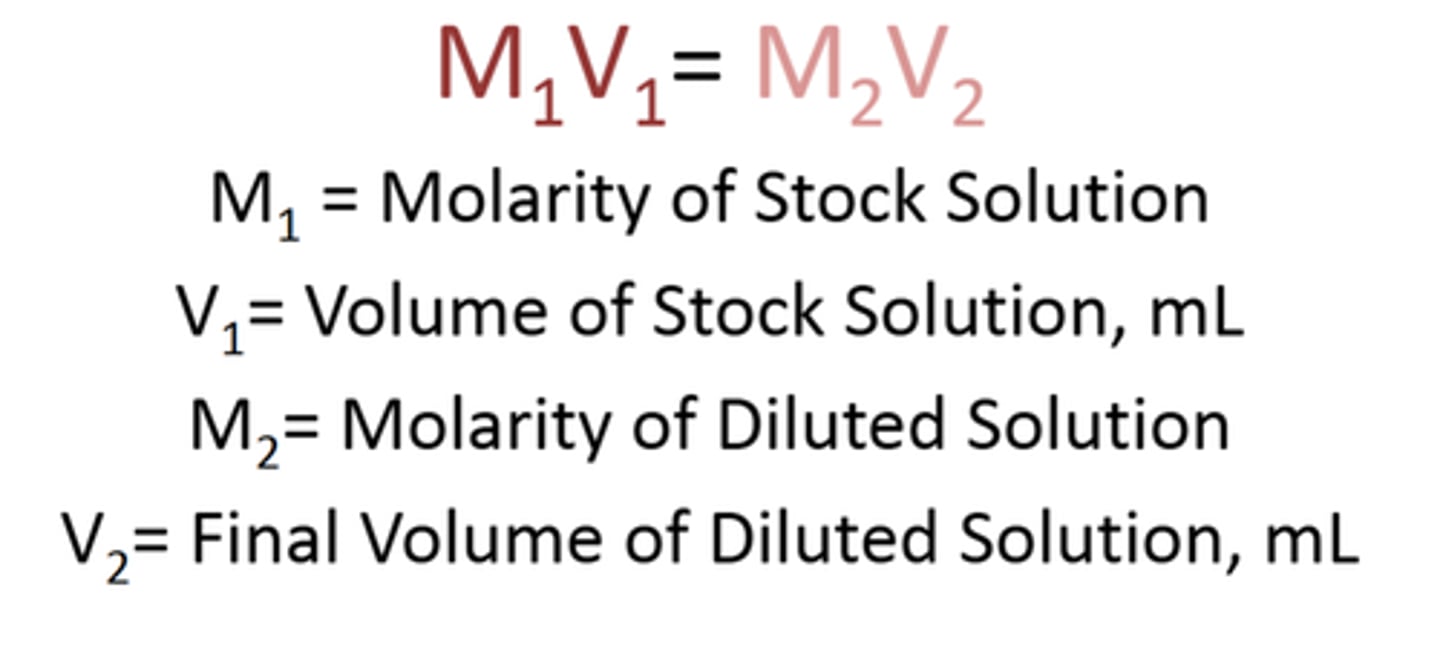
Molarity (M)= = mol solute
_________________
L solution
Factors that affect solubility
1. Nature of the solute and solvent
2. Temperature
3. Pressure (gases)
Temperature and Solubility
Temperature and Solubility IN GENERAL...
• increasing temperature increases the solubility of a solid in a solvent
• increasing the temperature decreases the solubility of a gas in a solvent
Saturation
solution contains the maximum amount of solute that can be dissolved
Unsaturated
solution contains less than the maximum amount of solute that can be dissolved.
Supersaturated
solution contains more thanthe maximum amount of solute that can bedissolved at the specified temperature and/orpressure
pressure and solubility of gases
less gas pressure above the surface of a liquid means that less gas dissolves in the liquid
More gas pressure above the surface of a liquid means that more gas dissolves in the liquid.
Factors affecting the rate of dissolving
1. Temperature
2. Particle size- surface area
3. Stirring
Some observable properties of acids
-Taste sour
- Sting to the touch
-Corrode metals
-React with carbonates
-Can denature proteins
Acids are defined in 3 ways
Arrhenius- Acids release H+ ions in aqueous solutions
Bronsted-Lowry- Acid are proton donors
Lewis-Acids are electron pair acceptors
Acids are substances that produce hydrogen cations in aqueous solution
H* a hydrogen atom has one proton and 1 electron
H+ a hydrogen cation is simply a proton
A hydrogen cation is often referred to as a proton.
A base has been defined three ways
Arrhenius- Bases release OH- ions in aqueous solution.
Bronsted-Lowry- Bases are proton acceptors.
Lewis- Bases are electron pair donors.
Strong Acid/ base Vs. Weak Acid Base
Strong acids and bases when added to water...
• dissociate completely into ions,
•conduct electricity, and
•are strong electrolytes
Pure water is Neutral
In pure water, the ionization of water molecules produces small but equal quantities of H3O+ and OH− ions.
Acidic solutions
Adding an acid to pure water
• increases the [H3O+],
• decreases the [OH−], and
• causes the [H3O+] to exceed 1.0 x 10⁻⁷ M.
Basic Solutions
Adding a base to pure water,
• increases the [OH−],
• decreases the[H3O+], and
• causes the [OH−] to exceed 1.0 x 10⁻⁷ M.
Acidic solutions pH<7.0
Neutral solution pH= 7.0
Basic solution pH>7.0
The uniqueness of Water
• High boiling point
• High heat capacity
• Solid less dense than liquid
• High Surface Tension
Water- The tension is high
Strong intermolecular forces pull surface water molecules inward, forming the smallest surface area possible. At the surface water molecules form strong attractive forces with one another because there are no neighboring water molecules above them to interact with. WATER- The tension is high......
Water in every state
Solid- Fixed volume and retains own shape
Liquid- Fixed volume and adopts shape of container
Gas- adopts volume and shape of container
Where does most of our drinking water come from
Groundwater, local lake, or local river
What are the general steps conducted in most municipal water treatment plants to purify water?
Coagulation (flocculants added to remove suspended particles), Filtration (gravel, sand, and charcoal to remove smaller particles and impurities), Disinfection (chlorine or ozone added to kill harmful microorganisms), Some plants include addition steps- Aeration (to improve taste), fluoride addition, pH adjustment, anticorrosion control
How does the process of distillation purify water?
The solution (impure water) is heated to produce water vapor. The water vapor is then cooled byrunning cold water over the condenser tube to condense the water from a vapor to a liquid. The pure water is collected in a separate flask.22. What are some steps or measures you can take at home to reduce the amount of lead and other contaminants from your potable (drinkable) water? Flush tap for two minutes prior to using water for cooking or drinking. Use cold water. Check and clean faucet screens regularly. Use lead-free plumbing materials. Use a faucet filter or filter water prior to drinking (pitcher, refrigerator).
Organic in chemistry
In chemistry the term organic refers to molecules containing the element carbon
Why is carbon so well suited for life
It readily forms stable bonds to many different elements.
• It forms stable bonds to itself; it can form long linear and branched chain structures and ring structures.
• It possesses several bonding configurations: single, double, triple
Alkanes
-Hydrocarbons with all single bonds are called alkanes.
• Alkanes are said to be saturated with hydrogen atoms.
• Alkanes can be straight chained, branched, or cyclic compounds.
Alkenes are hydrocarbons that contain a double bond. They are unsaturated with hydrogens (have less than the maximum amount).
hydrogenation
The process of hydrogenation adds hydrogen to unsaturated fats, creating saturated fatty acids AND trans fatty acids. This is an example of an addition reaction.
Acid pH
pH <7
Neutral pH
pH=7
Base pH
pH>7
An acid has been defined three ways
Arrhenius- Acids release H+ ions in aqueous solution.
Bronsted-Lowry- Acids are proton donors.
Lewis- Acids are electron pair acceptors
A base has been defined three ways:
Arrhenius- Bases release OH- ions in aqueous solution.
Bronsted-Lowry- Bases are proton acceptors.
Lewis- Bases are electron pair donors.
How to fine molar mass of element
Mass of element x 6.02 x 10^23

