Module A Overview
 Studied by 1 person
 Call Kai
 Learn
Learn Practice Test
 Spaced Repetition
 Match
Match Flashcards
 Knowt Play
 Podcast
1/101

There's no tags or description
Looks like no tags are added yet.
Name | Mastery | Learn | Test | Matching | Spaced | Call with Kai |
|---|
No analytics yet
Send a link to your students to track their progress
102 Terms
What is the normal pH of blood?
7.35-7.45
3 multiple choice options
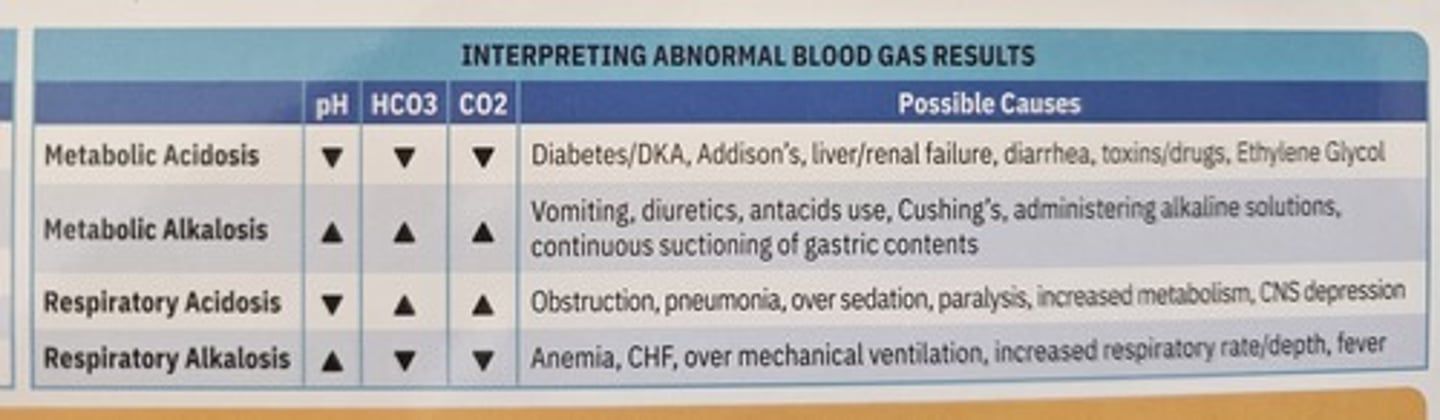
causes of ABG imbalances
See photo
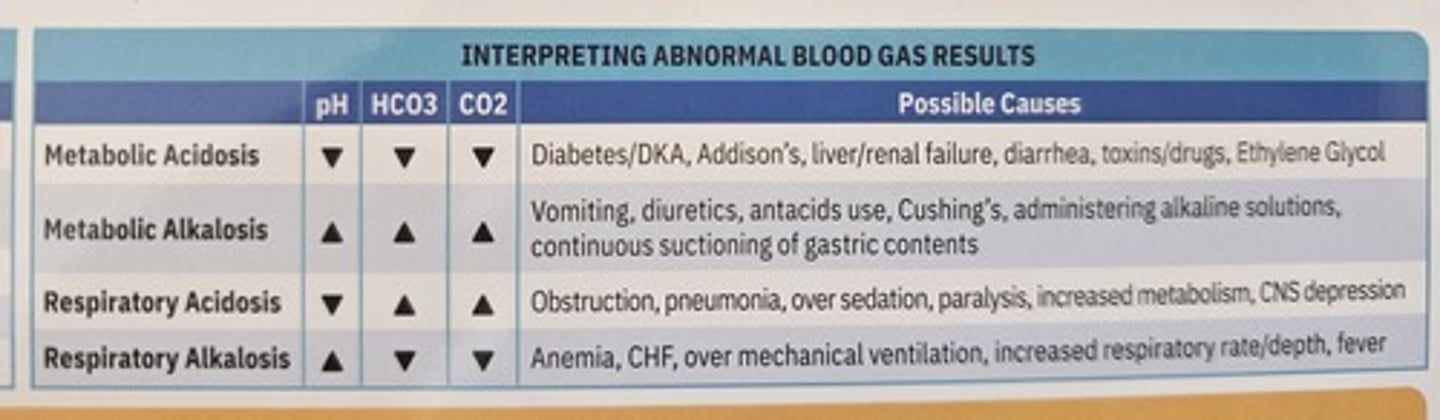
Some metabolic acidosis causes
- diarrhea
- diuretics
- renal insufficiencies
Some metabolic alkalosis causes
- severe vomiting
- gastric suctioning
Some respiratory acidosis causes
- pneumonia
- Acute pulmonary edema
- obstruction
- over sedation
- COPD
Some respiratory alkalosis causes
- anemia
- anxiety
- panic disorder
- hypoxemia
Pure, electrolyte-free water can never be given by IV because it rapidly enters RBCs and causes them to ____________.
rupture
True/False: Isotonic fluids expand the ECF volume, and 1 L of isotonic fluid expands the plasma component of ECF by 1 L
False. - 1 L of isotonic fluid expands the plasma component of ECF by only 0.25 L
1 multiple choice option
Normal saline solution (0.9% sodium chloride) is considered:
isotonic
3 multiple choice options
Hypertonic solutions draw water out of intracellular compartments, causing cellular ____________.
dehydration
True/False: D5W (5% dextrose in water) is unique because it may be both isotonic and hypotonic, as the glucose is rapidly metabolized once given.
True
1 multiple choice option
Signs and symptoms of fluid overload (circulatory overload) include:
Moist crackles in lungs and distended neck veins
3 multiple choice options
True/False: When an extravasation occurs, the nurse should immediately flush the IV line to push the medication into the deeper tissue.
False. - The infusion must be stopped and the provider notified promptly. Flushing is not mentioned as an initial action; specific antidotes or removal of the line may be indicated
1 multiple choice option
What is a reliable means of confirming IV infiltration?
Applying a tourniquet above the infusion site and observing if the drip continues
3 multiple choice options
A clinical disturbance characterized by a low pH due to an increased H+ concentration and a low plasma bicarbonate concentration is known as:
metabolic acidosis
3 multiple choice options
True/False: Normal anion gap metabolic acidosis results from an excessive accumulation of acids.
False- Normal anion gap metabolic acidosis results from the direct loss of bicarbonate. Excessive accumulation of acids causes high anion gap metabolic acidosis
1 multiple choice option
In metabolic acidosis, the lungs compensate for the high H+ concentration through _____________ to decrease the CO2 level.
hyperventilation
Which of the following is a direct cause of normal anion gap metabolic acidosis?
use of diuretics
3 multiple choice options
True/False: A normal anion gap value without potassium in the equation is 8 to 12 mEq/L.
True
1 multiple choice option
Metabolic alkalosis is characterized by:
High pH, low H+ concentration, high plasma bicarbonate
3 multiple choice options
A common cause of metabolic alkalosis is severe vomiting or gastric suction, leading to the loss of stomach _____________.
HCl (hydrogen and chloride ions)
Symptoms of metabolic acidosis include:
Confusion and drowsiness
3 multiple choice options
True/False: When metabolic acidosis is corrected and pH is normalized, potassium typically shifts back into the cells, potentially causing hypokalemia.
True
1 multiple choice option
The bicarbonate-carbonic acid buffer system is the body's major ____________ buffer system.
extracellular
2 multiple choice options
Respiratory acidosis is primarily caused by:
Inadequate excretion of CO2, leading to elevated plasma CO2
3 multiple choice options
In acute respiratory acidosis, an elevated PaCO2 greater than 60 mm Hg causes reflexive cerebrovascular ____________ and increased cerebral blood flow
vasodilation
Which type of renal trauma involves superficial disruption of the cortex, without involvement of the renal medulla and collecting system?
minor laceration
3 multiple choice options
True/False: Gunshot wounds are responsible for the majority of penetrating renal trauma cases.
true
1 multiple choice option
What are key nursing management points for a patient with renal trauma during the first few days after injury?
The patient must be assessed frequently for flank and abdominal pain, muscle spasm, and swelling over the flank. For surgical patients, care of the incision and ensuring adequate fluid intake are important. Instructions on changes to report to the physician (e.g., fever, hematuria, flank pain, decreasing kidney function) and guidelines for gradually increasing activity are also provided.
True/False: Chronic respiratory acidosis commonly occurs with pulmonary diseases such as COPD, including emphysema and chronic bronchitis.
true
1 multiple choice option
Clinical manifestations of acute respiratory acidosis include:
confusion and decreased level of consciousness
3 multiple choice options
Treatment for respiratory acidosis is directed at improving ____________.
ventilation
If mechanical ventilation causes too rapid a loss of CO2 in a patient with respiratory acidosis, what can occur?
Respiratory alkalosis and subsequent seizures
3 multiple choice options
True/False: Respiratory alkalosis is primarily caused by hypoventilation.
False. Respiratory alkalosis occurs by hyperventilation, which causes excessive loss of CO2. Hypoventilation causes CO2 retention and respiratory acidosis
1 multiple choice option
Clinical signs of respiratory alkalosis include lightheadedness, numbness and tingling, and ____________.
tinnitus
Causes of respiratory alkalosis include:
panic disorder
3 multiple choice options
True/False: The kidneys can compensate for acute respiratory alkalosis quickly, within hours.
False. The kidneys take days to compensate for acid-base imbalances. Therefore, in acute respiratory alkalosis, the bicarbonate level may still be normal
1 multiple choice option
Acute Kidney Injury (AKI) is defined as:
Rapid loss of renal function due to damage to the kidneys
3 multiple choice options
A key diagnostic requirement for AKI is a 50% or greater increase in serum _____________ above baseline.
creatinine
True/False: Metabolic acidosis is a potential life-threatening metabolic complication of AKI.
True
1 multiple choice option
Which of the following is a nephrotoxic medication that should be assessed to prevent AKI?
Gentamicin
3 multiple choice options
True/False: Prevention of AKI includes providing adequate hydration to patients at risk for dehydration, such as before and after surgery.
True
1 multiple choice option
Chronic Kidney Disease (CKD) is characterized by kidney damage or a decrease in the glomerular filtration rate lasting for:
3 or more months
3 multiple choice options
Diabetes and ____________ cause approximately 70% of cases of CKD.
hypertension
In early stages of CKD, there can be significant damage to the kidneys without signs or symptoms.
true
1 multiple choice option
A late finding in chronic glomerulonephritis is:
Peripheral neuropathy with diminished deep tendon reflexes
3 multiple choice options
The metabolic acidosis of End-Stage Kidney Disease (ESKD) usually produces no symptoms, but may require sodium bicarbonate supplements or ____________ if it causes symptoms
dialysis
Hemodialysis (HD) is used for:
Acutely ill patients and long-term RRT for advanced CKD/ESKD
3 multiple choice options
True/False: Hemodialysis extracts toxic nitrogenous substances from blood and removes excess fluid.
true
1 multiple choice option
The preferred method of permanent vascular access for dialysis is an _____________ fistula (AVF)
arteriovenous
Which of the following is a common complication of hemodialysis?
hypotension during treatment
3 multiple choice options
In acute nephritic syndrome, the primary presenting features include:
- hematuria
- edema
- azotemia
The most accurate indicator of fluid loss or gain in acutely ill patients with kidney disorders is ______, and a 1-kg weight gain is equal to 1 L of retained fluid
weight
Describe the clinical manifestations of advanced chronic glomerulonephritis affecting the nervous system.
Late in the disease, patients may experience peripheral neuropathy with diminished deep tendon reflexes and neurosensory changes. They can also become confused and demonstrate a limited attention span
Which of the following is considered an outcome-level classification in the RIFLE system for Acute Kidney Injury (AKI)?
ESKD
3 multiple choice options
Prerenal AKI is the result of impaired blood flow that leads to hypoperfusion of the kidney, commonly caused by
- volume depletion
- hypotension
- obstruction of renal vessels
True/False: The most immediate life-threatening imbalance seen in AKI, which dialysis helps correct, is hyperkalemia.
true
1 multiple choice option
Continuous Renal Replacement Therapy (CRRT) is indicated for:
Patients too unstable for traditional HD
3 multiple choice options
In Peritoneal Dialysis (PD), the peritoneal membrane serves as the ____________ membrane
semipermeable
. True/False: Peritonitis is the most common and serious complication of Peritoneal Dialysis (PD), often presenting with cloudy dialysate effluent.
true
1 multiple choice option
Which of the following is a goal of Peritoneal Dialysis?
Re-establish normal fluid and electrolyte balance
3 multiple choice options
Patients on Peritoneal Dialysis need a higher intake of ____________ than healthy adults due to protein loss.
protein
Which renal replacement therapy uses the patient's peritoneal membrane as the semipermeable membrane for fluid and solute exchange?
peritoneal dialysis
3 multiple choice options
_______ is a type of CRRT that provides continuous slow fluid removal (ultrafiltration), making its hemodynamic effects mild and better tolerated by patients with unstable conditions
Continuous Venovenous Hemofiltration (CVVH)
Which of the following is a high priority for nursing management of a hospitalized patient undergoing chronic hemodialysis (HD)?
Protecting the vascular access (fistula or graft).
3 multiple choice options
When a patient needs IV therapy, the rate of administration must be as _________ to avoid volume overload in patients with renal disease or ESKD
slow as possible
After kidney surgery, what is a chief potential complication due to the kidney being a highly vascular organ?
Hemorrhage and shock
3 multiple choice options
Which of the following is a general clinical manifestation of rheumatic diseases?
fatigue
3 multiple choice options
Disease-modifying antirheumatic drugs (DMARDs) have the ability to suppress the autoimmune response and alter disease ____________.
progression
True/False: Rheumatoid factor (RF) is present in many patients with Rheumatoid Arthritis (RA), and its presence alone is sufficient for diagnosis.
False. - While present in many, its presence alone is not diagnostic, and its absence does not rule out the diagnosis
1 multiple choice option
A patient with Rheumatoid Arthritis (RA) is experiencing significant joint pain and inflammation. The nurse understands that non-pharmacologic pain management strategies may include:
Paraffin baths and therapeutic exercises after heat application.
Systemic Lupus Erythematosus (SLE) is an inflammatory, autoimmune disorder where the body's immune system inaccurately recognizes components of the cell's nucleus as foreign, leading to:
Antigen-antibody complexes getting trapped in capillaries
3 multiple choice options
A common clinical manifestation of SLE affecting the skin is photosensitivity, where lesions often worsen during exacerbations and are provoked by sunlight or artificial ____________ light
ultraviolet
True/False: Gout is caused by hyperuricemia, an increased serum uric acid level.
true
1 multiple choice option
Which laboratory test is positive in more than 95% of patients with Systemic Lupus Erythematosus (SLE) and indicates exceptional specificity for the condition?
Antinuclear Antibody (ANA)
Fibromyalgia is a chronic pain syndrome characterized by chronic fatigue, generalized muscle aching, stiffness, and sleep disturbances, with ____________ affected more than men
women
HIV is categorized as a retrovirus, meaning it carries its genetic material in the form of:
RNA
3 multiple choice options
HIV targets cells with ____________ receptors, primarily found on T lymphocytes
CD4+
True/False: Antibodies to HIV can typically be detected after 2-3 weeks, and these antibodies are effective in controlling the virus.
False.- While antibodies can be detected after 2-3 weeks, these antibodies are not controlling the virus
1 multiple choice option
Which of the following body fluids is known to transmit HIV?
seminal fluid
3 multiple choice options
Antiretroviral therapy (ART) is recommended for all HIV-infected patients regardless of their viral load or ____________ count.
CD4+
True/False: One of the goals of ART is to suppress plasma HIV viral load to undetectable levels, which helps prevent HIV transmission.
True
1 multiple choice option
Pneumocystis pneumonia (PCP), a common opportunistic infection in HIV/AIDS, is associated with CD4+ T-lymphocyte cell counts less than:
200 cells/mm3
3 multiple choice options
Post-exposure prophylaxis (PEP) for healthcare providers involves taking antiretroviral medicines as soon as possible, but no more than ____________ hours after possible HIV exposure.
72
True/False: The HIV-positive patient should be advised to avoid unprotected sex with another HIV-seropositive person to prevent cross-infection with different HIV strains, which can increase the severity of infection
true
1 multiple choice option
Which of the following is a psychosocial barrier to ART adherence?
depression
3 multiple choice options
A major sign or symptom of primary immune deficiency disorders (PIDDs) is:
Multiple infections despite aggressive treatment
3 multiple choice options
Patients with antibody deficiency disorders are contraindicated from receiving _______ because they are incapable of generating antibodies and the live substance could cause disease
live vaccines
Describe the modes of transmission of human immune deficiency virus infection.
All of these are correct
3 multiple choice options
True/False: Consistent and correct use of nonlatex condoms made of natural materials like lambskin effectively prevents the sexual transmission of HIV.
False
1 multiple choice option
For HIV-negative people who are at high risk of HIV infection, a prevention method involving taking a specific combination of HIV medicines daily is known as
Pre-exposure prophylaxis (PrEP)
What immediate actions should a healthcare provider take if they experience a possible occupational exposure to HIV, such as a needle stick?
- Alert their supervisor and initiate the occupational exposure reporting system.
- Determine the HIV status of the exposure source if possible
- take antiretroviral medications (Post-Exposure Prophylaxis - PEP) as soon as possible, ideally within 72 hours.
In the context of HIV infection stages, what is the primary characteristic of "Stage 3" that differentiates it from other stages?
A significant drop in CD4+ T-lymphocyte cell count to below 200 cells/mm³, leading to an AIDS diagnosis.
In the context of HIV infection stages, what is the primary characteristic of "Stage 2" that differentiates it from other stages?
when CD4+ T-lymphocyte cells decrease to between 200-499 cells/mm³, previously known as the "symptomatic stage"
HIV is categorized as a retrovirus because it carries its genetic material in the form of:
RNA
3 multiple choice options
The primary goal of antiretroviral therapy (ART) in HIV treatment is to ___________, reduce HIV-associated morbidity, prolong duration and quality of life, and restore and preserve immunologic function
Suppress plasma HIV viral load
Describe the concept of "viral set point" in HIV infection.
- refers to the amount of virus present in the body after the initial burst of viremia subsides and antibodies can be detected.
- varies greatly between patients.
A nursing intervention to improve airway clearance for a patient with HIV/AIDS may include assisting the patient in attaining _____________
semi or high fowler position
Identify two nursing interventions aimed at decreasing a patient's sense of social isolation due to an HIV/AIDS diagnosis.
- provide accurate information about HIV transmission to correct misconceptions and alleviate anxiety.
- Encourage participation in support groups or diversional activities like reading or handcrafts
A hallmark of inflammatory rheumatic diseases is:
Autoimmunity, where the body mistakenly recognizes its own tissue as a foreign antigen
3 multiple choice options
 Note
Note  Flashcards (86)