Intro to AI - Module 1
 Call Kai
 Learn
Learn Practice Test
 Spaced Repetition
 Match
Match Flashcards
 Knowt Play
1/223

Earn XP
Description and Tags
Foundations, History, Machine Learning
Name | Mastery | Learn | Test | Matching | Spaced | Call with Kai | Chat |
|---|
No analytics yet
Send a link to your students to track their progress
224 Terms
AI
The study of systems that
think like humans
think rationally
act like humans
act rationally
AI is wanting to mimic ____
Human's intelligence
but some were more obsessed with "did the machine follow the steps" over "did it do it like a human"
Human decisions aren't always mathematically correct
Foundations of AI - Philosophy
Logic, mind, knowledge
Are there rules on how to draw correct conclusions?
How does the mind come from the brain, since the mind isn't the brain?
Where does knowledge come from, given everyone has different knowledge?
How is Philosophy related to AI?
How does a machine think on its own?
This has to answer why a human does something then we translate it to the machine
Empiricism Philosophy in relation to AI
Belief that nothing significant comes if not sensed, and everything comes from human senses to be significant.
Machine has to sense
Mathematics in AI
Proof, computability, probability
What are the rules to draw correct conclusions?
What can be computed?
How do we deal with uncertainties?
Economics in AI
Maximizing payoffs
How to make decisions aligned with our preferences, even if it can be realized in the future?
How do you make a machine understand this?
Thinking of the utility
Neuroscience in AI
Brain and neurons
How do brains process information?
Psychology in AI
Thought, perception, action
How do humans and animals act?
Why do I do what I do?
Computer Engineering in AI
Developments in hardware
How can we build an efficient computer?
Control Theory in AI
Stable feedback systems
How do artifacts operate on their own control?
When do you start doing an action? When do you stop?
Linguistics in AI
Knowledge representation
Syntax
How does language relate to thought?
Cultural terms
1943-1956: Inception of AI
Boolean circuit model of the brain
Neural network computers
Turing's ideas on machine intelligence
McCarthy (Dartmouth meeting)
1952-1969: Early enthusiasm, great expectations (Look Ma, no hands!)
Early AI programs
Development of logic theorists and general problem solvers
Geometry theorem prover
Checker program
LISP
Problems on limited domains
1966-1973: A Dose of Reality
AI limited by informed introspection (human approaches) and tractability of problems (hard to scale up)
Computational complexity
Neural network research almost disappears
1969-1986: Expert Systems
Early development of knowledge-based systems, specific area of know-how of specific subjects
DENDRAL
MYCIN
R1: DEC (Digital Equipment Corporation)
DENDRAL
Expert system
Infers molecular structure by being fed entire books
MYCIN
Expert system for medical diagnosis of blood infections
Knowledge from books and experts
R1: DEC (digital equipment corporation)
Configuration of computer systems
First commercially successful expert system
Boolean Circuit Model
Model of the brain
Proposed by McCulloch and Pitts
During the inception of AI
Snarc
Neural network computer
Developed by Minsky and Edmonds
Computing Machinery and Intelligence
- Turing
- Inception of AI
- Computer can think like a human
McCarthy
- Dartmouth meeting
- Artificial Intelligence
- 1943-1956: Inception of AI
Logic theorist and General problem solver
- Newell and Simon
- Can think like human
- Concern: can it follow steps like human? can it solve problems like human?
- Early enthusiasm (1952-1969)
Geometry Theorem Prover
- Gelernter
- Early enthusiasm (1952-1969)
Checker Program
- Samuel
- Early enthusiasm (1952-1969)
LISP
- A high-level programming language developed for AI
- Early enthusiasm (1952-1969)
Microworlds
- Limited domains used in early AI research to test theories and programs
- Early enthusiasm (1952-1969)
Computational Complexity
- Complexity of problems limits AI's ability to process data
- Can't deal with more data than what was limited by microworlds
Neural Network Research
A field of study that faced a decline in interest during the 1966-1973 period (Dose of Reality)
AI History 1980-1988
Expert systems industry booms
A lot of people promised that they can make the stuff and deliver it well
Advancements in AI
Improvements in computing power, memory storage, connectivity, and automation that support AI development.
AI History 1988-1993
- Expert system industry busts (AI Winter)
- They failed to make the stuff and they didn't deliver due to many issues
Contemporary AI: 1986 onwards
Neural Networks
Contemporary AI: 1987 onwards
probabilistic reasoning and machine learning
Contemporary AI: 2001 onwards
big data (user info)
Contemporary AI: 2011 onwards
deep learning, computer vision (pixels, lines, colors, position)
Contemporary AI: 2021 onwards
generative AI
Artificial intelligence Defintion
Do it like a human
Define variables like a human would
Hardcoded tech
How would a human respond
Machine learning
Do it based on past experience
Not hardcoded since there are existing models
Input data into it then it will predict as close to an actual answer as possible
Deep learning
Subset of machine learning
Can adjust by itself since it's built in
Layered so it can handle really large data
Works with nested or layered models adjusting based on the evaluation of its own results
Generative AI
Subset of deep learning
Not all deep learning is generative
4 Components of AI (TAHO)
- Technology
- Autonomy
- Human
- Outputs
4 Components of AI (TAHO): Technology
Branch of computer science concerned with automation of intelligent behavior
4 Components of AI (TAHO): Autonomy
Systems that display intelligent behavior by analyzing their environment and taking actions with some degree of autonomy to achieve specific goals
4 Components of AI (TAHO): Human
Ability to perceive, pursue goals, initiate actions and learn from a feedback loop
4 Components of AI (TAHO): Outputs
Technical scientific field devoted to the engineered system that generates outputs like content, forecasts, recommendation of decisions for a given set of human-defined objectives
What can AI do today?
- Robotic vehicles
- Autonomous planning and scheduling - spacecrafts and rovers, logistics and transportation planning, ride-hailing apps
- Machine translation
- Speech recognition
- Recommender systems - Amazon, Walmart, Netflix, YouTube
- Game playing - Deep Blue (chess), AlphaGo, Jeopardy, Poker
- Medicine - disease diagnosis (LYNA for metastatic breast cancer)
- Automated conversation (chatbots)
Systems Acting like Humans
- Turing test
- Natural language
- Knowledge representation
- Multilayer perception
- Automated reasoning
Turing test
Test for intelligent behavior
Interrogator write questions and receives answers
System passes if interrogator can't tell if answers come from a person or not
Example of Turing Test now
CAPTCHA (Completely Automated Public Turing test to tell Computers and Humans Apart)
Automated reasoning
- Follow steps and reach a certain answer, taking note of the context
- Thinking with contextualization
- How can it argue? How can it identify questions (rhetorical, open-ended)?
Systems Thinking like Humans
Formulate a theory of mind and brain
Express the theory in a computer program
2 approaches (thought vs behavior)
2 Approaches of Systems Thinking like Humans
Cognitive science and psychology
Cognitive neuroscience
Cognitive science and psychology
Testing or predicting responses of human subjects
Behavior
Thought and perceptions logic
Cognitive neuroscience
- Observing neurological data
- Actual brain, neuroscience
Rational vs Human Intelligence
Rational = ideal intelligence
Human intelligence isn't always correct
Systems Thinking Rationally
Rational thinking governed by precise "laws of thought"
Systems (in theory) can solve problems using such laws
Laws of Thought
Syllogisms (Premise and conclusion)
Notation and logic
Uncertainty and probability
Systems Acting Rationally
Rational behavior and actions to achieve the best outcome
May or may not involve rational thinking (eg. reflexes)
Subsumes the other approaches
Lends well to science development
AI standard model
Standard model often makes unrealistic assumptions
Objectives and outcomes are fully specified and understood
Specification align with human values and objectives
Possible that the specified objectives are neither complete nor entirely correct
Value alignment problem with beneficial machines
Ensuring agreement between human and agent objectives
EX. ChatGPT, find me the best hotel in south korea but does it really do it well or properly? There is news where the AI agent goes through the transaction of paying. Make sure that your objectives align with the agent
Self-driving car example
- Objective: reach destination safely
- But what about tradeoffs between trip progress and injury risk? Or interactions between other agents/drivers?
- Define tradeoffs that you're amenable to
Value alignment problem
Ensuring agreement between human and agent objectives.
AI Definition
Artificial Intelligence is the study of systems that act rationally. It is the study and construction of agents that "do the right thing".
Intelligent Agents
Anything that perceives and acts on its environment
Whatever the agent does, affects the environment
What the agent perceive comes from the environment
A rational agent carries out an action with the _______ after _______ .
A rational agent carries out an action with the best outcome after considering past and current percepts
Percepts
Content of what the agent perceives of its environment.
Agent Function
A = F(p)
F maps percepts to actions, F : P → A
p = current percept
P = set of all percepts
a = action carried out
A = set of all actions
F = agent function
True or False: An action doesn't depend on all percepts observed so far, just the current percept
False
May depend on all percepts observed so far, not just the current percept
Agent Function but considering all percepts
Ak = F (p0 p1 p2 … pk)
(p0 p1 p2 … pk) = sequence of percepts observed to date
Ak = resulting action carried out
Structure of Agents
Agent = architecture + program
Architecture
Device with sensors and actuators
EX. robotic car, a camera, a PC.
Program
Implements the agent function on the architecture
How do we specify the task environment?
PEAS
P - Performance Measure
E - Environment
A - Actuators
S - Sensors
Performance Measure
Captures agent's aspiration
EX. for a taxi driver: safe, fast, legal, comfy trip, max profit, min impact on other road users
Environment
Context, restrictions
EX. for a taxi driver: roads, other traffic, police, peds, customer, weather
Actuators
Indicate what the agent can carry out
EX. for a taxi driver: accelerate, steering, brake, signal, horn, display, speech
Sensors
Indicate what the agent can perceive
EX. for a taxi driver: camera, radar, speedometer, GPS, engine sensors, accelerometer, microphones, touchscreen
When specifying actuators and sensors, what distinction can be useful to make?
Distinguish the devices from their functions
Actions actuators can carry out or the percepts sensors can detect
Part-Picking Robot Actuator and Sensor
Actuator: jointed arm and hand; actions: pick up or drop part
Sensor: camera; percepts: (detect) type and position of a part
Properties of Environments
Fully VS partially observable
Single-agent VS multi-agent
Deterministic VS stochastic
Episodic VS sequential
Static VS dynamic
Discrete VS continuous
Known VS unknown
Fully VS Partially observable
Does agent have all the info on the environment?
If yes, fully if not, partially
EX. Solitaire is partially observable
EX. Chess is fully observable
Single-agent VS Multi-agent
Do you only have 1 agent tackling the problem or are there more?
And if multiagent, are they competitive or cooperative?
EX. Is there only 1 automated driver or are there more?
Deterministic VS Stochastic
Is the action predictable?
Deterministic: next state is dependent on current state and action
Stochastic: there's a random element
EX. TicTacToe is deterministic
EX. Poker is stochastic
Episodic VS Sequential
Episodic: episodes have distinct goals/objectives, atomic episodes, actions are independent
Sequential: actions are influence on prior action
Static VS Dynamic
Before you make the next action, will the environment change?
Static: environment may change only after an agent's action
Dynamic: environment can change independently of the agent, even while the agent is deliberating
EX. Cross word puzzles = static since actions won't change the environment
EX. taxi driver is dynamic since a lot of things can happen and the environment can change even as you're deliberating
Discrete VS Continuous
Measurements of state, time, percepts, and actions
Discrete: Environment has a finite number of clearly defined states, percepts, or actions.
You can differentiate between state 1 and state 2
Continuous: Environment involves measurements that vary smoothly over a range (state, time, percepts, or actions).
No sharp separation between states
EX. driving a taxi is continuous
Known VS Unknown
If all the rules of the environment are known
EX. Solitaire is known
Crossword Puzzle
Full observable
Single agent
Deterministic
Sequential
Static
Discrete
Image Analysis
Fully observable
Single agent
Deterministic
Episodic
Semi static and Semi dynamic
Continuous
English Tutor
Partially observable
Multi-agent
Stochastic
Sequential
Dynamic
Discrete
Medical Diagnosis
Partially observable
Single agent
Stochastic
Episodic
Dynamic
Continuous
Chess with Clock
Fully observable
Multi agent
Deterministic
Sequential
Semi-static Semi-dynamic
Discrete
Vacuum world: What is the performance measure?
clean both rooms, fewest steps
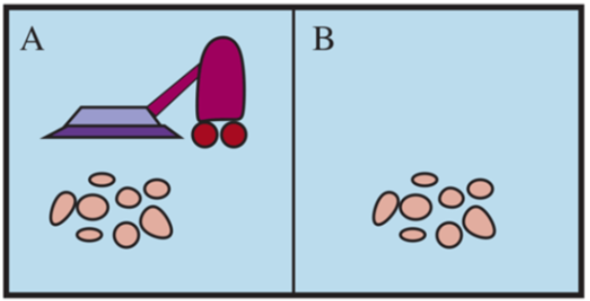
Vacuum world: Properties
Fully observable
Single Agent
Deterministic
Sequential (if room is dirty, move left or right)
Static
Discrete
Known
State Management
The process of determining the next state and action based on the current state and percept.
Types of Agents
Reflex Agent
Reflex Agent with State (Model-based Reflex Agent)
Goal-based Agent
Utility-Based Agent
Learning Agent
Reflex Agent
Current state → current condition → act
Only if environment is fully observable
Function: reflex agent (percept) returns an action
Rules are stored and repeatedly checked
Reflex Agent Algorithm
State ← interpret-input (percept)
Convert raw percept (EX. sensor reading) into internal state (EX. "dirty")
Rule ← rule-match (state, rules)
Look up which rule matches this state
Action ← rule, action
Take the action specified by the rule
Return action
Output the action to environment