Management Skills Final
 Studied by 0 people
 Call Kai
 Learn
Learn Practice Test
 Spaced Repetition
 Match
Match Flashcards
 Knowt Play
1/52

There's no tags or description
Looks like no tags are added yet.
Name | Mastery | Learn | Test | Matching | Spaced | Call with Kai |
|---|
No analytics yet
Send a link to your students to track their progress
53 Terms
Authority
gets compliance
might not generate respect because people are forced to obey the commands of someone who is stronger and has authority over them
positional as it usually comes with a high post and rank.
Influence
gets commitment
generates respect as people act out of their own beliefs and change of heart when they like someone or follow him or her
personal and it is due to who the person is, not what rank he or she holds
Where does influence as a leader come from?
Having something that other normal people don’t have
Strategic thinking, ability to solve problems, and expertise in certain fields
Having others’ interests in heart, even at the sacrifice of one’s own interests
Taking up responsibilities when things don’t work – Dedication to a greater cause and social impact
Positive mindset, energy, resilience, humility
Examples of influence mattering more for those without authority
Getting buy-in for ideas/initiatives (e.g., proposed changes)
Want customers to select your product or service
Work-related requests to peers and supervisors (e.g., additional resources or deadlines)
Guiding others (e.g., supervisors, colleagues and teammates) toward preferred or optimal decisions.
Not simply an art… Can be learned and strategically employed!
Types of Influence Tactics
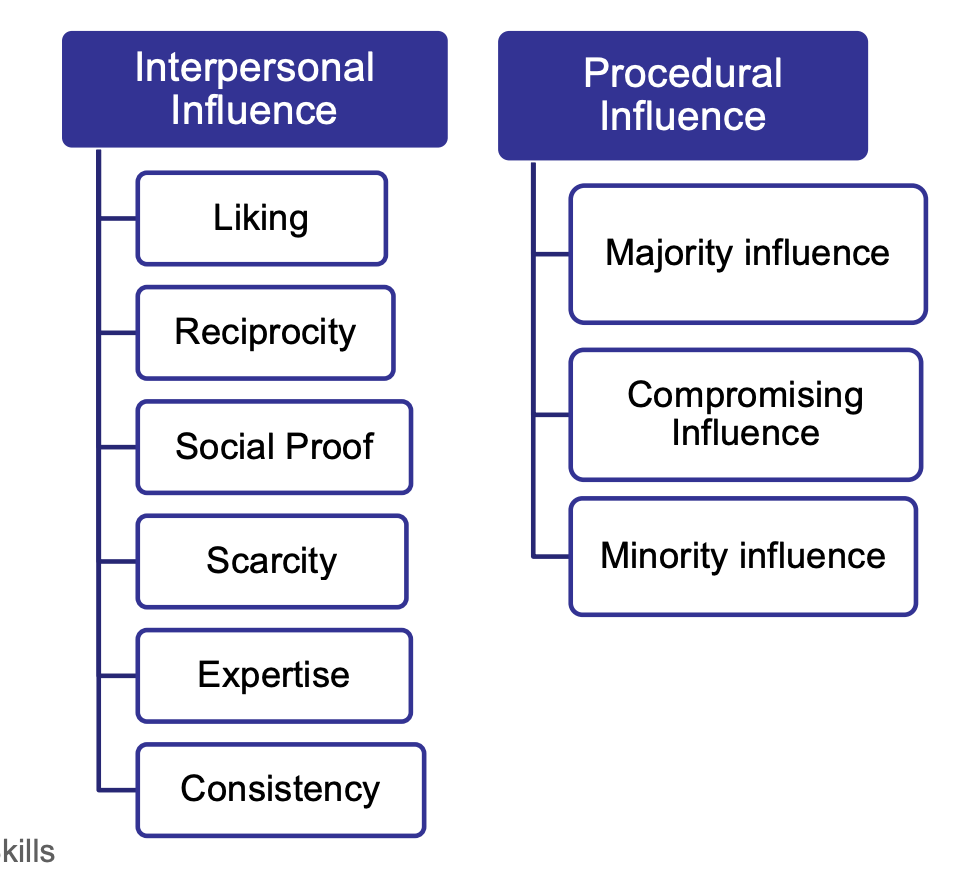
Interpersonal - Influencing other individuals and/or group members
Procedural – Managing the rules or procedures used to exchange information and aggregate individual preferences; Influencing the way that the group as a whole makes decisions or gets things done
Cialdini’s 6 Principles of Influence
Liking
Reciprocity
Social Proof
Consistency
Authority
Scarcity
Key Takeaways:
The six principles should be used in combination to compound their impact.
Learning these principles not only helps you influence others, but also helps you guard against undue influence from others.
Liking
People say yes to people who they like.
Two ways to influence individuals through Liking: Similarity and Praise
For example…
Similarity (e.g., shared interests, backgrounds, values, etc.). Helps create bonds.
Compliments & Praise: research shows that compliments and praise help even when the receiving party knows the compliments and praise are intentional.
Reciprocity
People repay in kind.
People feel obligated to give back the form of behavior they receive
People can elicit the desired behaviors in coworkers and supervisors by displaying it first --- modeling the behavior
Lessons about Giving, Taking, and Reciprocating
Giving drives long-term success for you, but also be smart about how you give, to avoid burnout and being taken advantaged of by takers.
Minimize the disruptions of helping others to your own work: for example: a five-minute favor; allocating time-for-your-own-work and time-forhelping.
Do not emphasize tit-for-tat or demand future return of favor when offering help.
Beware of who you help. Don’t be a sucker.
Social Proof
People follow the lead of similar others
People often follow what similar others are thinking or doing (social evidence)
”We are doing a project for your neighbors, and …”
“90% of our customers chose this additional program of protection”
“Best-selling products” or “mostly bought”
These fortune-500 companies are doing these…
Consistency
People align with their clear commitments
After committing to a position actively, publicly, and voluntarily, people are more willing to comply with requests for behaviors that are consistent with that position
Actively – choice spoken out loud, written down, or made explicitly
Publicly – choice shared with others, either spoken or in writing
Voluntarily – personal ownership is more effective than something forced, coerced, or imposed
Application of consistency principle
“Foot-in-the-door technique”: Tesla’s $500 refundable deposit
Contributions to the American Cancer Society. Two donor requests were made:
Would you be willing to help by giving a donation?
Would you be willing to help by giving a donation? Every penny will help. (much better)
Start from asking for a small favor: “one minute of your time..
Authority/ Expertise
People defer to experts
People are more likely to follow the suggestions of someone who is or appears a legitimate authority.
Establish your credentials or expertise before attempting to exert influence.
Get people with demonstrated expertise onboard
For example…
Uniforms
Advanced degrees or certifications
Experience
Scarcity
People want more of what they can have less of
People see items and opportunities as more valuable as they become less available
For example…
Limited time offer,
Limited in stock (Amazon: only 3 left in stock)
Exclusive discount
If we don’t move now, it would be too late…
Majority Influence
Reason: People want to be liked (normative influence), and people are not sure about their judgment (informational influence)
Strategies: Speak up first; Identify strong alliance and ask them to be advocative
Strategies to counter majority influence: anonymous vote; ensure proper rules of discussion (everyone gets to share and finish their thoughts and cannot be interrupted).
Compromising Influence
Reason: Reciprocity
Strategy: By intentionally advocating for a more extreme position and then a step back; By compromising in other issues (Politics)
Minority Influence
Hard but possible
Rational reasoning and avoid being emotional and defensive
Identifying the weakest link in the chain to build coalition; –
Anonymous vote
Ensure proper norm of communication (no cutting off, show respect)
Frame for common ground: critical to have a solid understanding of your audience, and describe advantages of your perspective and highlight shared benefits
Influence Principles Summary
The Rational Model
Goal is to identify the optimal decision
Assumes that all information is available and complete
Benefits of using this model:
The quality of decisions may be enhanced
It makes the reasoning behind a decision transparent
The Non-Rational Model
Bounded Rationality - decision makers are “bounded” or restricted by a variety of constraints when making decisions (e.g., time, money, technology, resources, etc.). Results in not identifying all alternative solutions.
Satisficing - choosing a solution that meets some minimum qualifications, one that is “good enough”. Satisfactory vs. optimal solution
Garbage Can Model - decision making is sloppy and haphazard. Decisions result from complex interaction of factors: problems, solutions, participants and choice opportunities – all floating randomly inside an organization.
Sometimes, organizations create solutions even before they have a defined problem
Confirmation Bias
The tendency to seek and rely on information that will confirm what we already believe, and to avoid data that will contradict our pre-existing views.
Put another way, we see what we want (or expect) to see.
What does it mean to you?
To Protect Yourself:
Keep asking yourself: are you handling the information that negates your opinion fairly?
Find someone who respects being the devil’s advocate to argue against you
Be honest with yourself & your motives
Don’t ask others leading questions
Confirmation Bias & Polarization of Views
Famous study about people’s attitudes toward the death penalty
People were presented with different data and arguments that speak to the deterrent effects of death penalty and the evidence that counters the deterrent effects.
Examining both studies did not lead to a moderation of views; instead, it led to polarization of people’s views. In other words, they favored the study that confirmed what they already believed. They assimilated data in a biased way.
The Welfare Effects of Social Media (2020), American Economic Review
In a randomized experiment, researchers find that deactivating Facebook for the four weeks before the 2018 US midterm election: (i) reduced both factual news knowledge and political polarization; (ii) increased subjective well-being.
Escalation of Commitment (Sunk Cost Bias)
the tendency to stick to an ineffective course of action when it is unlikely that the bad situation can be reversed
WHY?
People are unwilling, consciously or not, to admit to a mistake
Afraid of damaging self-esteem, and more importantly, public image
Corporate culture might reinforce sunk-cost trap
EX: Banking, Investment Decision, Project Proposal
Availability Bias
Availability bias, also known as the availability heuristic, is a cognitive bias. It causes people to overestimate the likelihood of events that are easily recalled. This tool will explain how this works, provide examples, and explain how to overcome it.
How it works:
Ease of Recall: The brain prioritizes information that's easily accessible, often due to recent exposure, vividness, or emotional impact.
Frequency Estimation: People mistakenly equate ease of recall with the frequency or probability of an event, leading to skewed judgments.
Examples:
Fear of flying: Plane crashes are often sensationalized in the news. This makes them easily recalled and leads people to overestimate the risk of flying, even though statistically, it's safer than driving.
Lottery purchases: Vivid stories of lottery winners and their lifestyles can make winning seem more probable, leading people to buy tickets despite the low odds.
Medical diagnoses: Doctors might misdiagnose a patient based on a recent case they encountered, even if it's a rare condition.
Investment decisions: Investors might be swayed by recent market trends or news headlines, leading them to buy high and sell low, or to overinvest in certain sectors that are currently in the spotlight.
Anchoring Bias
Anchoring bias, also known as the anchoring effect, is a cognitive bias where individuals rely too heavily on the first piece of information offered (the "anchor") when making decisions. This initial piece of information acts as a reference point that influences subsequent judgments, even if it's not necessarily relevant or accurate.
Here is a breakdown of anchoring bias:
Definition: Anchoring bias is the tendency to overemphasize the first piece of information encountered when making decisions, leading to a skewed perception of subsequent information.
How it works: The initial anchor acts as a mental reference point, influencing how new information is interpreted and adjusted to, even if that new information contradicts the anchor.
Examples:
Negotiations: The first offer in a negotiation often sets the anchor, influencing the range of subsequent counteroffers.
Pricing: A high original price for a product can make a discounted price seem like a great deal, even if it's still overpriced.
Estimations: When estimating quantities or values, people tend to be influenced by initial numbers, even if those numbers are arbitrary or irrelevant.
Medical Diagnoses: Doctors might be influenced by initial symptoms or information when making a diagnosis, potentially overlooking other possibilities.
Framing Bias (Gain vs Loss)
The framing effect, or framing bias, is a cognitive bias where people's decisions are influenced by how information is presented (framed), rather than the information itself. It highlights that people may respond differently to the same scenario based on whether it is framed positively or negatively.
Here's a breakdown:
What it is: The framing effect demonstrates how the presentation of choices, whether emphasizing potential gains or losses, can significantly alter people's preferences, even when the underlying options are logically equivalent.
How it works: People tend to avoid risks when options are framed in terms of potential gains, but become more risk-seeking when the same options are framed as potential losses. This is often attributed to loss aversion, the tendency to feel the pain of a loss more strongly than the pleasure of an equivalent gain.
Types of Framing:
Risky Choice Framing: Presents a choice between a certain outcome and a risky option with uncertain results, influencing risk preferences depending on whether it's framed as a gain or loss.
Attribute Framing: Describes a single attribute of an object in a positive or negative way, impacting its evaluation (e.g., 75% lean vs. 25% fat).
Goal Framing: Emphasizes either the positive consequences of performing a behavior or the negative consequences of not performing it, used in persuasion and public health messaging.
Over Confidence
(believing that you are immune to decision-making biases) is often the “mother” of all other biases.
Best of Intentions Case Takeaways
Greater self-awareness of the decision-making biases;
Increased effectiveness of decision-making through balance sheet strategies
The importance of information/assumption validation (garbage-in-garbage-out)
how to execute the decision (using pre-mortem technique) is as important as making the decision
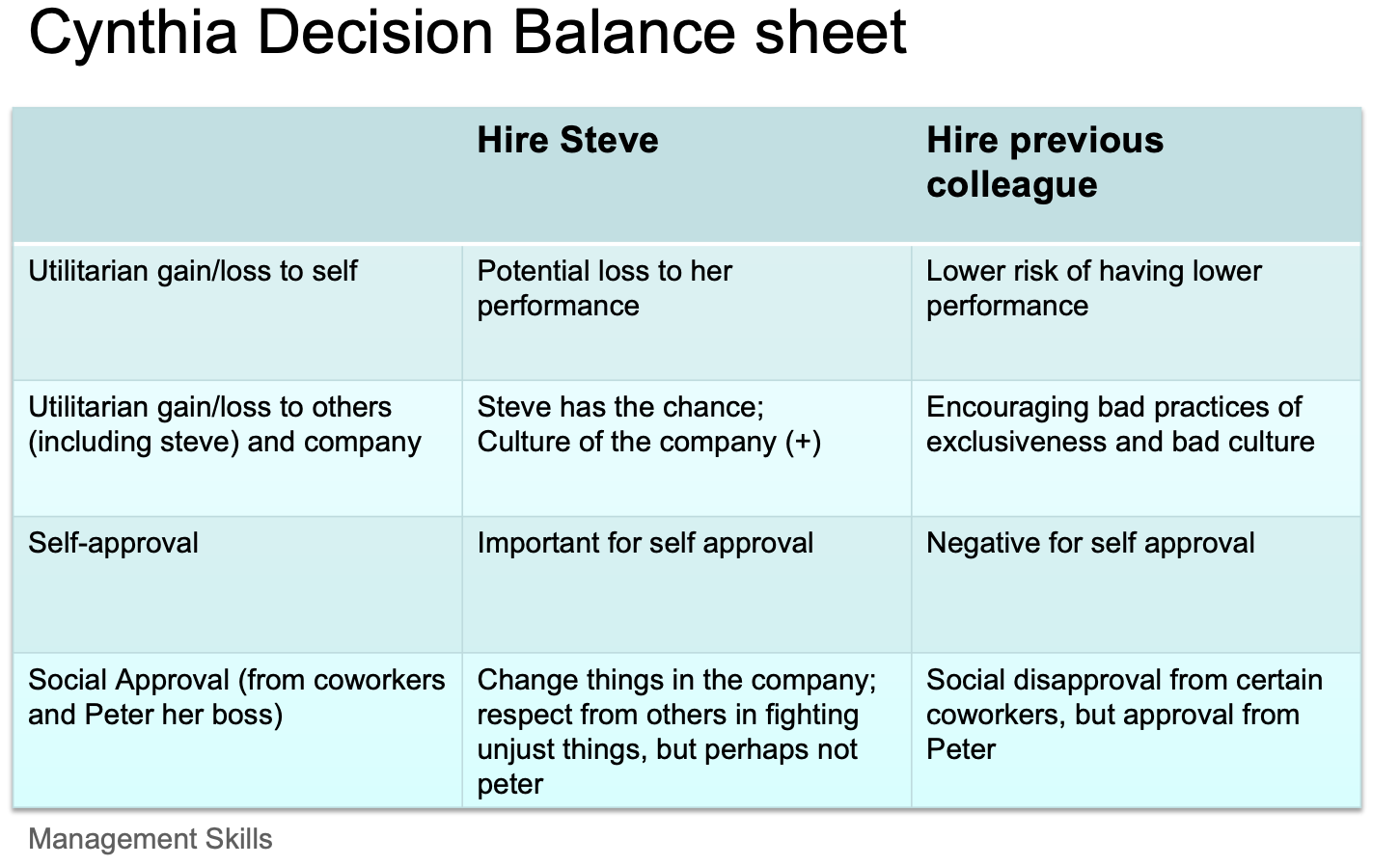
Group Decision Making Obstacles
conformity and groupthink
common information bias
misaligned goals and hidden information
Groupthink
Conformity to authority/majority– A change in belief or behavior in order to agree with the leader or the majority
Reasons:
Informational influence (maybe I’m wrong; I don’t want to look stupid)
Social influence (I don’t want to upset other people and hurt relationships)
Refuse to take up responsibility (what if I am wrong and I get blamed)
Mindsets for Leaders to Reduce Groupthink
Understand what do you want with group discussion: Don’t use team decision making for fake consensus or showing “participative decision making”
Understand your strengths, and face your weaknesses: Less confident leaders are less likely to be open to opposing ideas
Appreciate the value of dissenting opinion without solution: avoid “Don’t bring me questions; bring me solutions”
Recognize that true team decision making process takes time.
Techniques for Leaders to Reduce Groupthink
Leaders do not reveal personal preference upfront
Emphasize team accountability for each decision made and remove individual accountability
UNEARTH, not assign, “Devil’s Advocate” in the team
Anonymous/private voting
Involve only those who care about and will be influenced by the decision in the meeting
Common Information Bias
Groups tend to spend too little time discussing unshared (unique, uncommon) information.
Information held by more members before team discussion has more influence on team judgments than information held by fewer members, independent of the validity of the information
Why the common information bias?
Mutual Enhancement
Discussing shared information feels good!
Members are judged as more task competent & credible after discussing shared instead of unshared information.
Individual confirmation bias
Members prefer to discuss information that is consistent with their preferences (an example of the confirmation bias)
Information Overload
Too much information; too hard to cognitively track everything
What helps counter common information bias?
Whiteboard to organize and integrate information
Team leader is information manager: Increase focus on unique information
Suspend initial judgment § Minimize status differences
Performance Motivation and Team Decision
78 project teams from a Big Four accounting firm that provides audit and related business advisory services, such as supply chain and strategy.
Findings: High-stake project teams have higher work motivation, but achieve sub-optimal performance based on client evaluation.
Characteristics of High Performance Pressure Team
A drive toward consensus
A focus on common knowledge
A shift from learning to project completion
Increased conformity to the status hierarchy
Misaligned Goals
Strategies to Address Misaligned Goals
Foster Psychological Safety (It’s OK that you have self interests)
High levels of psychological safety allow team members to openly share personal goals and concerns, which is critical when interests are not aligned.
It provides opportunities to find win-win or balanced solutions.
Balance
Leaders should actively detect and diffuse political behavior that favors one member’s interests disproportionately
When interests clash severely and stall progress, the leader might need to act as an arbitrator — but must do so transparently and with fairness to maintain legitimacy.
It’s crucial to explain the rationale for decisions and ensure all voices were considered in the process
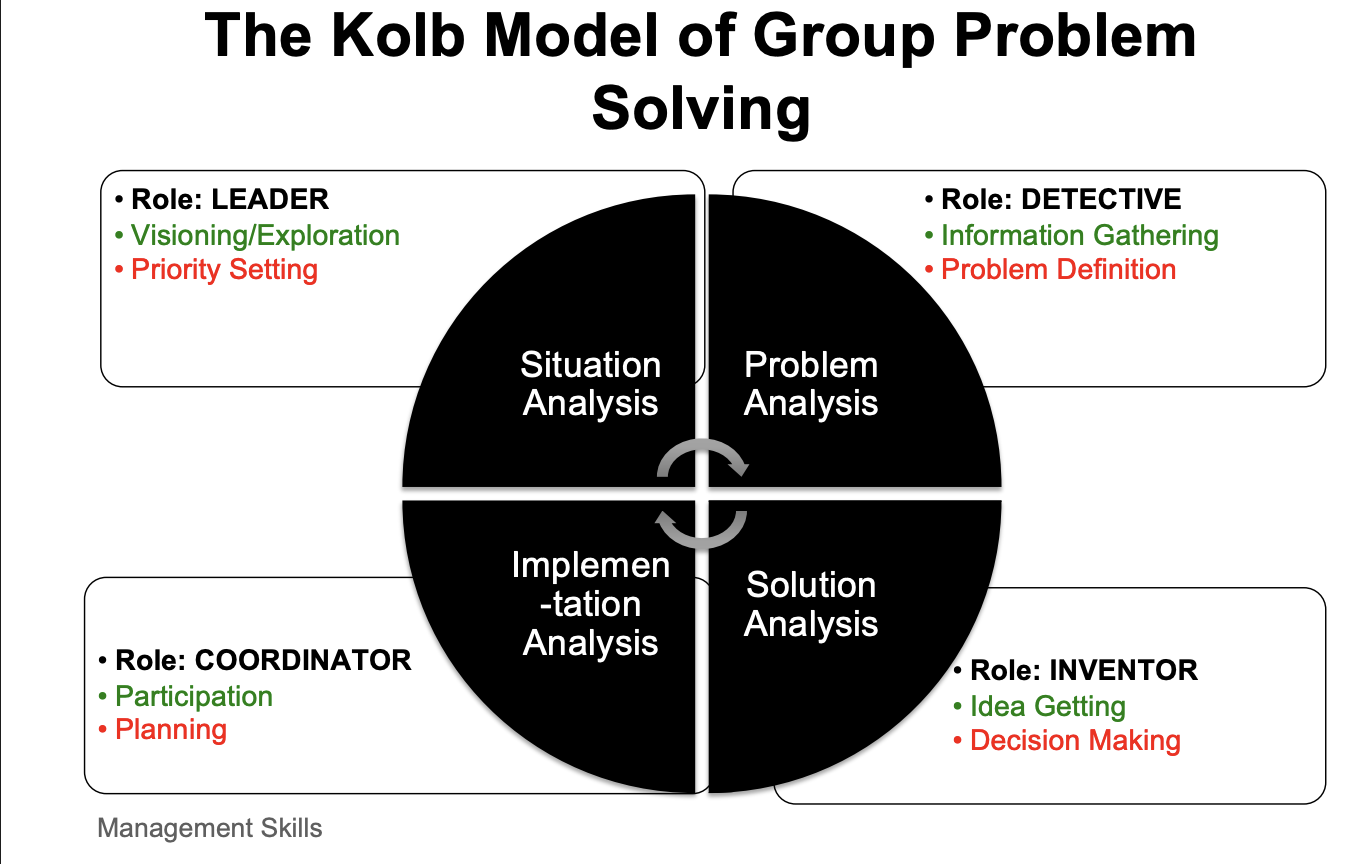
Stages of Problem Solving
Stage 1: Situational Analysis: What’s the Most Important Problem?
Stage 2: Problem Analysis: What are the Causes of the Problem?
Stage 3: Solution Analysis: What’s the Best Solution?
Stage 4: Implementation Analysis: How Do We Implement the Solution?
One of the most common mistakes in problem solving is skipping the situational analysis and jump to the most “salient problem,” and thus tackling the wrong problem.
The Kolb Model of Group Problem Solving
Effective problem solving is characterized by waves of expansions (Green Mode) and contractions (Red Mode).
Green Mode
Believing
Divergence
Creative imagination
Red
Doubting
Convergence
analysis and criticisms
A common group problem solving mistake is too much red mode and too little green mode.
3 conditions for conflict
Miscommunication
Structure
competitions for limited resources
difference in goals or objectives
unclear roles/ goals/ rewards
Personal Variables
personality, emotions, values
Helpful vs Harmful Conflict
C-type conflict, “cognitive conflict” or “task conflict” is conflict about task-related issues.
Focuses attention on the often ignored assumptions that may underlie a particular issue
Encourages innovative thinking and promotes creative solutions to problems
Builds understanding and commitment to the team’s goals and decisions (results in “buy in”)
Improves team effectiveness: MORE focused, creative, integrative and open.
A-type, “affective conflict” or “relational conflict” is about individual issues.
Provokes hostility, distrust, cynicism, and apathy among team members, thereby obstructing open communication and integration
Decreases the likelihood that people will accept final decisions and work together well in the long-term.
Decreases team effectiveness: LESS focused, creative, integrative and open.
Managing Helpful and Harmful Conflict
Prevent harmful conflict
Setting up appropriate reward structure
setting up clear values and norms that matter,
addressing other individual differences and emphasizing respect for differences
Promote helpful conflict, and prevent helpful conflict from spilling over to harmful conflict
establish a safe environment for open yet RESPECTFUL discussion;
promote the norm of “devil’s advocate”
Addressing Conflict
Each conflict managing category reflects varying levels of the following two dimensions:
Assertiveness - the extent to which the individual attempts to satisfy his or her own concerns.
Cooperativeness - the extent to which the individual attempts to satisfy the other person’s concerns.
Ways to Manage Conflict
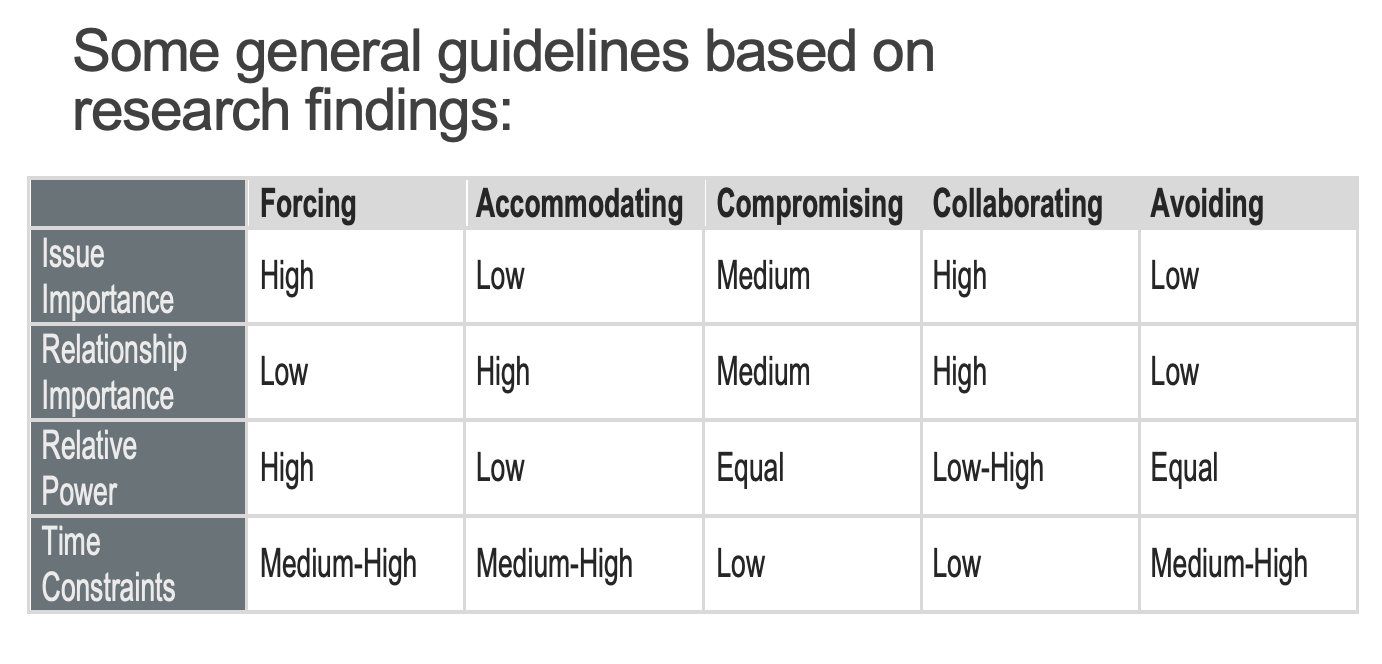
Forcing/ Competing
win/ lose
strong, forceful style
Integrating/ collaborating
win/win
Compromising
middle of the road solution
Avoiding
lose/lose
conflict is not addressed
Accommodating
Lose/win
Each style has its benefits and drawbacks. Go Beyond Individual Preferences and Consider Situational Factors
Importance of Issue to You versus Others
Importance of Relationship to You versus Others
Perceptions of Your Power over The Other Party
Time constraints
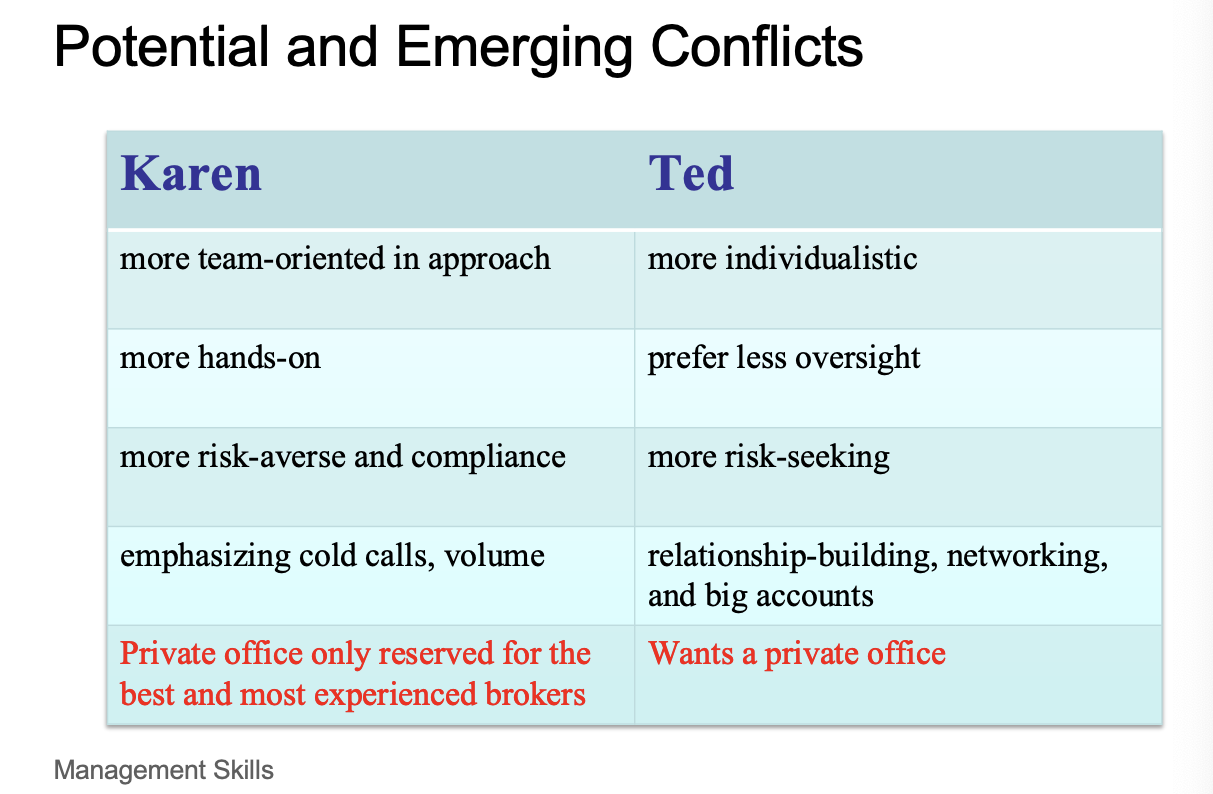
Karen Leary Case Takeaways
Karen and Ted have been avoiding the potential conflict between them until the salient conflict emerged (requesting a private office), which was not healthy.
Have a precise evaluation of issue importance, relationship importance, relative power, and time constraints to adopt the best strategy
Do what needs to be done to counter potential negative consequences
Interests
Underlying concerns that would be affected by the resolution (hidden agenda)
BATNA: Best Alternative To a Negotiated Agreement
Alternative if no agreement reached
The better the BATNA, the more power you have in negotiating
Target Price
Realistic view of getting the highest achievable outcome from a negotiation
Reservation (Resistant) Price
Least favorable point to accept an agreement
“Bottom line” price
For the Buyer, it’s the most they are willing to pay
For the Seller, it’s the least they are willing to sell for
Bargaining Zone (ZOPA) Zone of Possible Agreement
Range between reservation prices
To share or not to share?
Interests: (sometimes share to provide reasons to what you are asking, but never share to show how vulnerable or desperate you are)
Best Alternative To Negotiated Agreement: (sometimes share to make a credible threat of leaving the negotiation, but never share the details of the best alternative unless you are only seeking matching)
Target Price: (never share the real target price; can share the target price higher than your real target price)
Reservation (Resistant) Price: (never share the real reservation price; can share the reservation price higher than your real reservation price)
Negotiation as Value Claiming
Distributive Bargaining
Negotiation that seeks to divide up a “fixed pie” (amount of resources, a price)
It does not necessarily harm relationship; focus on problemsolving
Primary Tactics
Anchoring, but with reasoning
Providing reasonings and evidence.
Tiny but resisting concessions
Guarded information sharing (share to provide reason)
Find out info about the other party (their best alternatives)
Relationship building - A problem-solving mindset rather than an adversarial mindset
Negotiation as Value Creation
Integrative Bargaining (Collaborative approach of conflict management)
Signs of integrative bargaining
Multiple issues exist, OR other issues could be brought together to the issue of discussion
Different parties have different priorities over issues
Negotiation that seeks one or more settlements that can create a “win-win” solution and long-term relationship
Value Creation Tactics
Packaging: Look for multiple issues and differing interests; don’t make concessions, make tradeoffs
Reciprocate voluntarily (by making concessions on things that do not matter much to you but potentially matter more to the other party)
Ask diagnostic questions to uncover the other side’s interests
Share certain information to create common and aligned interests; but only share information selectively
Bolster the sacrifice you make in the concessions, even if it means little to you or you actually are on the same page with the other party (never say, ok, this matters little to me, you can take it; never say, I like this too).
 Note
Note  Flashcards (38)