PE - Migration (Week 7)
 Call Kai
 Learn
Learn Practice Test
 Spaced Repetition
 Match
Match Flashcards
 Knowt Play
1/51

There's no tags or description
Looks like no tags are added yet.
Name | Mastery | Learn | Test | Matching | Spaced | Call with Kai |
|---|
No analytics yet
Send a link to your students to track their progress
52 Terms
Advantage of experimental data
1) avoids issues like stated preferences
2) directly compare effects ( control vs treatment = not quasi-experimental)
3) randomization allows for direct testing (not related to other observed variables)
Facchini, G., Margalit, Y. and Nakata, H. (2022) Countering public opposition to immigration
testing whether attitudes reg. immigration change after being exposed to information that highlight the benefits of immigration of solving domestic problems
Facchini et. al (2022) - contributions
1) experimental design
2) testing longer effect
3) first to focus on benefits of immigration
Facchini et. al (2022) main argument
1) information about benefits has a positive effect on immigration support
2) New information has the strongest effect
Facchini et. al (2022) - contribution experiment
explicitly testing the information mechanism through priming (making issues more salient)
The issue of labor mobility (related to?)
skill transferability (the more specific, the more immobile)
Policy dilemma of labor migration
Economic perspective = labor migration as positive to reduce issue of labor market tightness and aging demographic
Political perspective = Negative attitudes of electorate
International economic integration
how trade openness and migration policy are connected using the same theories
International economic integration - Theories
1) Ohlin-Heckscher
2) Stolper-Samuelson
Connection of Goods/Services and Production Factors
might be substitute in trade openness and labor migration
Heckscher-Ohlin approach to immigration
immigration has no effect on native wages IF
shock is small enough for country to adjust output mix = factor price insensitivity = wages do not change when factor supply changes
Heckscher-Ohlin approach - link to preferences
1) If people assume factor price insensitivity holds = no link between skill and preferences
2) if people suppose output and wage effect = low skill oppose and high skill support
Heckscher-Ohlin - key assumptions
1) national labor market for each factor (no segmented local labor markets)
2) more tradable sectors than primary factors of production
= not all flows of immigrants affect wage
Factoral model approach to immigration
immigration pressures wages of similarly skilled natives nationwide
= negative downward effect
Factoral model (Stolper-Samuelson) - key assumptions
1) national labor market
2) Single aggregate Output sector (= no output mix that helps absorb immigrants)
= any flow of immigrants affects national wage
Factoral model (Stolper-Samuelson) approach - link to preferences
unskilled (skilled) workers nationwide should prefer policies to lower (raise) immigration inflows
Area analysis approach to immigration
immigration pressures wages of similarly skilled natives who reside in gateway communities where immigrants settle
Area analysis - key assumption
1) single output sector
2) distinct, geographically segmented labor markets within a countryA
Area analysis approach - link to preferences
unskilled (skilled) workers in gateway communities should preferences policies to lower (raise) immigrant inflow
Scheve, K.F. and M.J. Slaughter (2001) Labor Market Competition and Individual Preferences over Immigration Policy
determinants of individual preferences over immigration policy in U.S. using three models
1) Ohlin-Heckscher
2) Factoral labor model
3) Area analysis
Scheve, K.F. and M.J. Slaughter (2001) - main findings
1) less-skilled more likely to prefer limiting immigrant inflows
2) Evaluation of immigration = mechanism via changes in wages (Consistent with Heckscher-Ohlin and Factoral labor)
3) No stronger relationship between skills and immigration in high-immigration communities (no support of area analysis model)
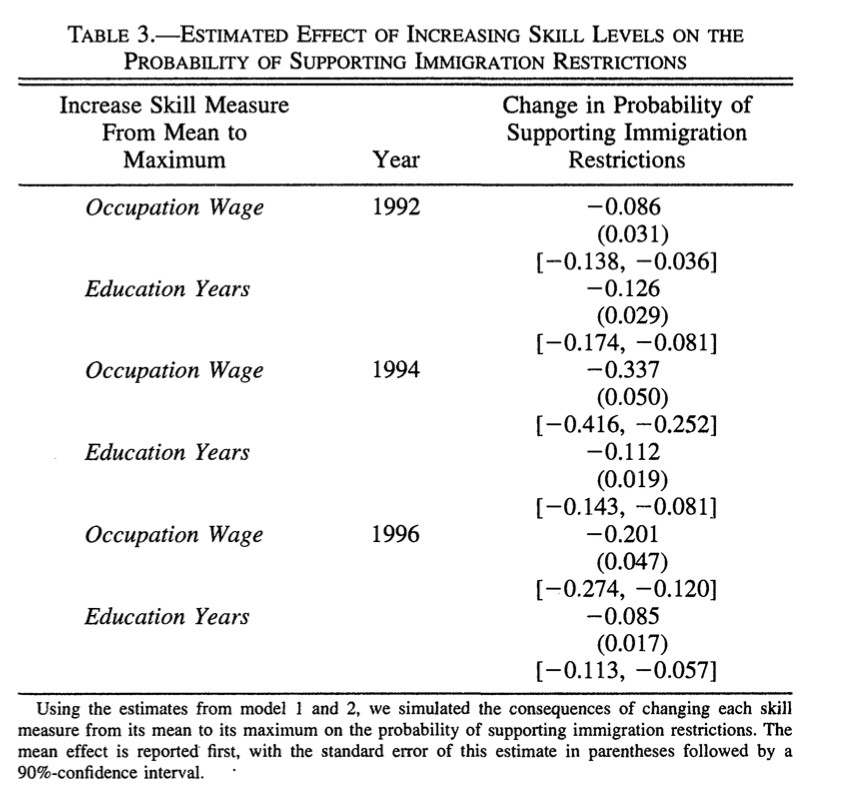
main argument = low skill are less likely to support (HeckscherOhlin & Factoral model)
1) higher skills are strongly and significantly correlated with lower probabilities of supporting immigration restrictions
2) occupation wage = negative effect (=proxy of skills)
= hows mainly low skill workers have a preferences of restrictive immigration policies (tie back to winners and loser of globalization)
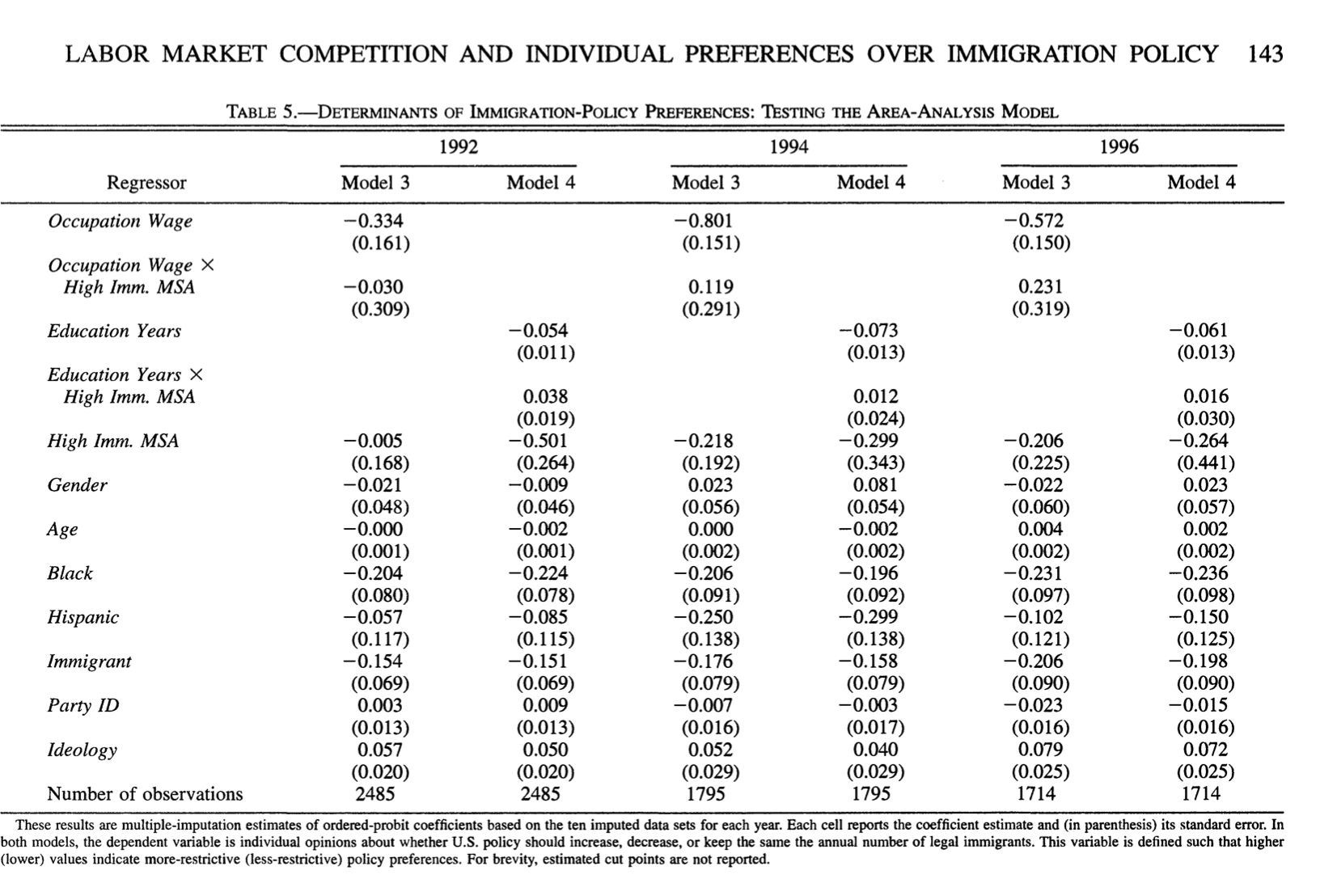
1) Our skill measures are still negatively correlated with preferences at at least the 95% level, but in neither case is High Immigration MSA significantly positive or its interaction with skills significantly negative
2) people living in high-immigration areas do not have a stronger correlation between skills and immigration-policy preferences than do people living elsewhere. This finding is inconsistent with the area-analysis model.
Scheve, K.F. and M.J. Slaughter (2001) - Independent variable
Skill via two measures
1) occupation wage
2) Education years
And
Gate-way communities = High Immigration MSA
Scheve, K.F. and M.J. Slaughter (2001) - Dependent variable
Immigration Opinion
= survey question
= high value indicate preferences for more-restrictive policy
Simple welfare analysis - effect of labor migration
Increase of supply = decrease of wage level
Welfare effects of Labor migration
Welfare gains in both countries
Why does labor migration increase welfare of both countries ?
because of higher levels of production (larger labor supply more production or lower production at higher wages)
Labor migration effects within countries
Distributional effects
= winners and losers acc. to skill (globalization)
How to counter within country issues due to labor migration
compensate losers through redistribution (embedded liberalism theory = Hays (2005))
Effects of Immigration (economic effects in general)
1) labor market effects
2) Budgetary effects
3) Societal effects
Effects of Immigration - labor market effects on welfare
welfare effects related to both wage and employment effects
(larger labor supply = more jobs but at lower wage)
Effects of Immigration - Budgetary effects
Immigrants may receive social benefits and pay taxes
= net effect will reflect on budget
Effects of Immigration - Societal effects
whether political dynamics are related to economic mechanisms or to sociological mechanisms
Migration and Welfare state (zooming in on welfare state)
1) bad risks
2) good risks
Migration and Welfare state - Bad risks
attracted to countries with generous social security (social raids, etc.)
Migration and Welfare state - Good risks
are attracted to countries with low taxes and contributions
Migration and Welfare state - Both risks are at work
downward convergence = social race to the bottom
De Giorgi, G. and M. Pellizzari (2009) Welfare migration in Europe
extent to which welfare generosity affects the location decisions of migrants in the 15 countries of the pre- enlargement Union
De Giorgi, G. and M. Pellizzari (2009) main findings
1) significant but small effect of the generosity of welfare on migration decision
2) migrants are more driven by labor market opportunities than welfare generosity
De Giorgi, G. and M. Pellizzari (2009) - contributions
1) first paper for European context
2) potential benefits of reducing the heterogeneity of welfare provisions across European countries
3) set of assumptions differentiates from other literature
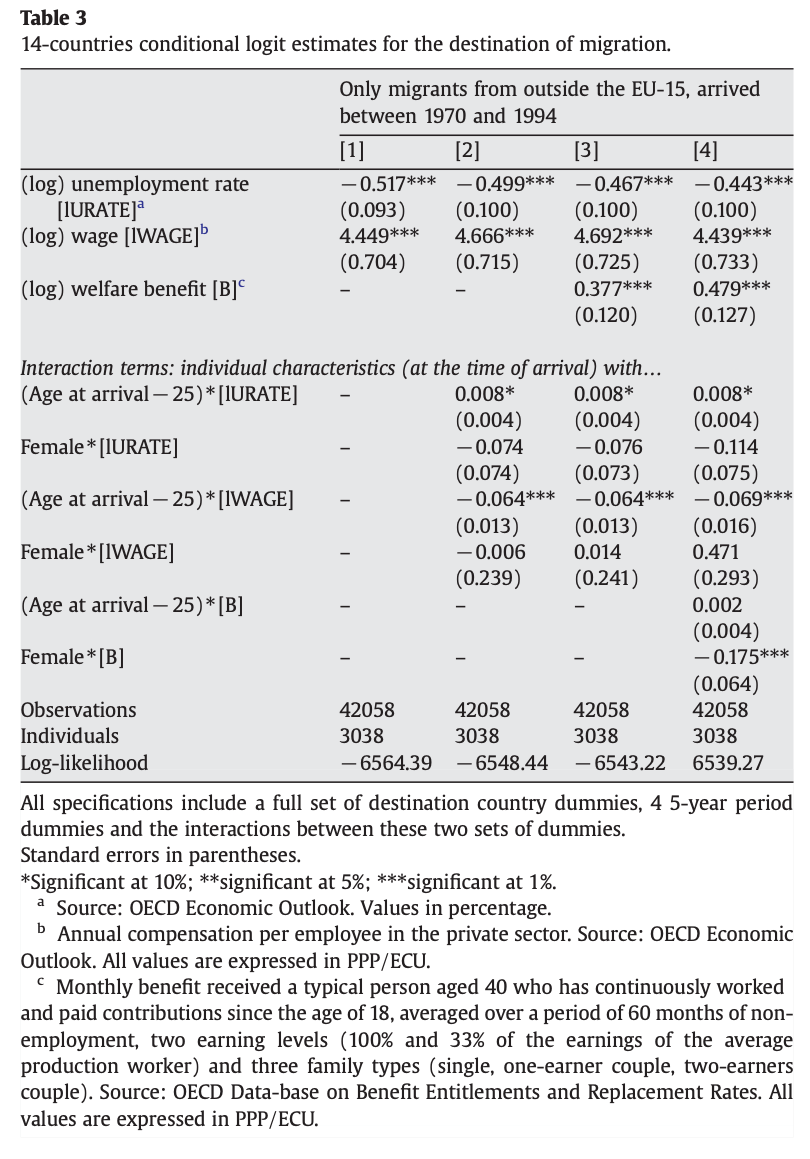
1) do find significant effect for downward convergence but it is 10 times smaller than the effect of wages
= suggest that migrants are more driven by labor market opportunities than welfare generosity
2) positive and significant coefficient, indicating that, indeed, migrants are more likely to move into countries with more generous welfare benefits
3) only the one with the gender dummy is significant, indicating that women are relatively less attracted by high-benefit countries
De Giorgi, G. and M. Pellizzari (2009) - Dependent variable
Migrants from outside EU
De Giorgi, G. and M. Pellizzari (2009) - Independent variable
1) unemployment rate
2) real wage
3) welfare benefit
De Giorgi, G. and M. Pellizzari (2009) - limitations
1) data does not say anything about migration after 2004 = only goes till 2001
2) Education at arrival not captured
3) Final destination of migration not observed
4) Gross Replacement Rates, not net
De Giorgi, G. and M. Pellizzari (2009) - Assumptions
1) decision to migrate has already been taken and the only choice to be made concerns the country of destination
2) destination-specific effects are allowed to change at discrete time intervals
Policy Issues regarding Labor migration
1) How things will develop
2) Tight labor marktes
3) Policies aimed at attracting high-skilled migrants
4) Distinction between contributory vs non-contributory social policies
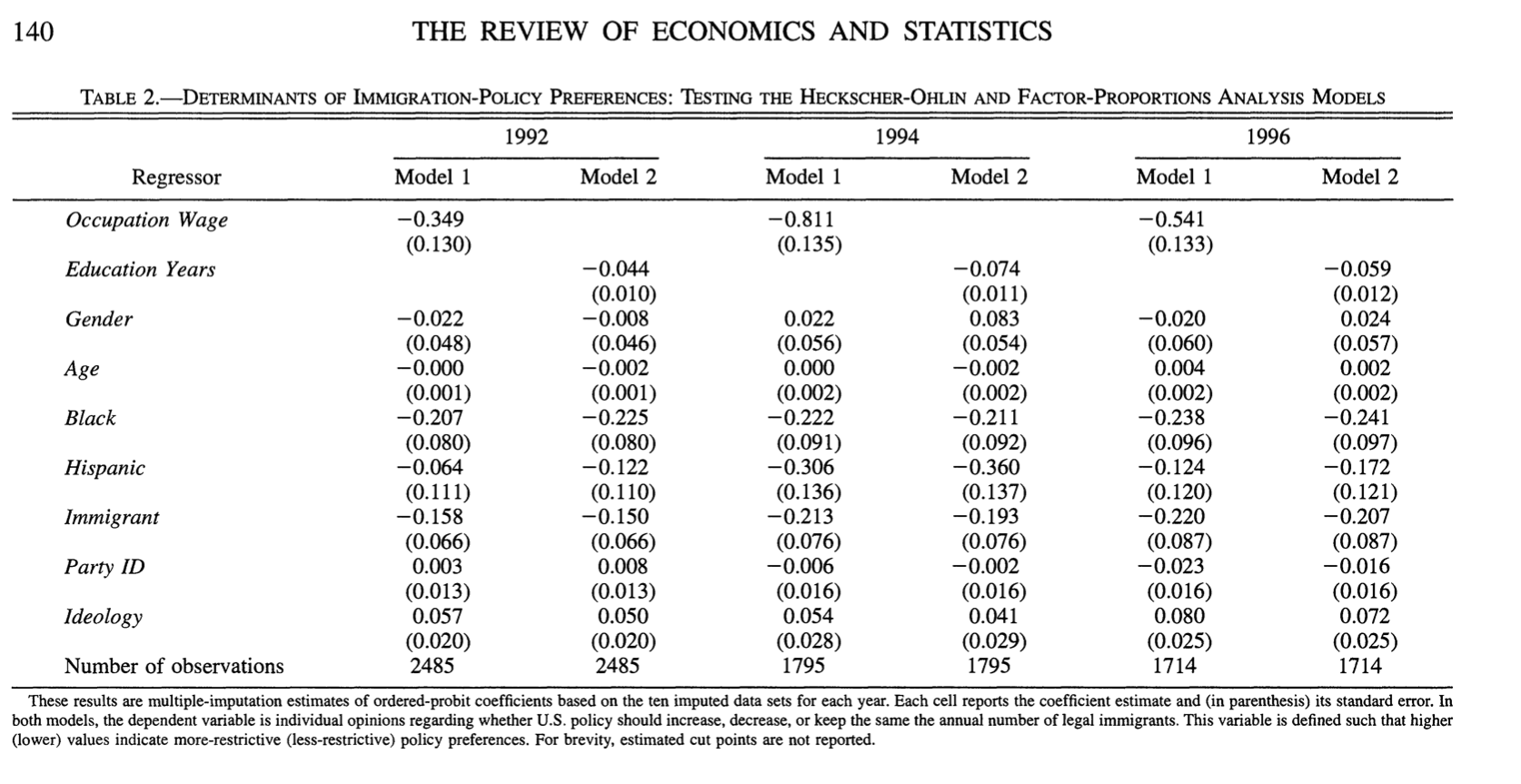
key message of table 2 is that, by either measure, skill levels are significantly correlated with Immigration Opinion at at least the 99% level
= actual coefficient estimates in table 2 identify the qualitative effect on Immigration Opinion of skills and our other regressor
Migration and Welfare state reform
1) Actual budgetary pressure
2) Preventive strategic interactions between countries
3) Policy reactions because of voters
Kvist, J. (2004) Does EU Enlargement Start a Race to the Bottom?
whether Eastern enlargement has led to EU 15 member states to enter strategic interactions implying a race to the bottom
Kvist, J. (2004) - findings
1) little empirical evidence that welfare magnet myth is true
2) BUT strategic interactions of EU15 members if that were true
= All EU 15 member states have either adjusted their social policies or closed their labour market to workers from new member states following enlargement
Kvist, J. (2004) - contribution to literature
1) showing that EU15 states adjusted policies in order to not appear attractive to immigrants
2) redefinition of downward bias as restriction and benefits accessibility and generosity
= strategic interactions

