Ch 3 ISP 205
 Studied by 0 people
 Call Kai
 Learn
Learn Practice Test
 Spaced Repetition
 Match
Match Flashcards
 Knowt Play
1/19

Earn XP
Description and Tags
Name | Mastery | Learn | Test | Matching | Spaced | Call with Kai |
|---|
No analytics yet
Send a link to your students to track their progress
20 Terms
Which of the following best explains why the planets orbit the Sun (rather than falling into the Sun)?
The Sun's gravity is always pulling the planets inward, but the orbital speed of the planets prevents them from falling into the Sun.
higher orbital eccentricity
faster orbital speed
Suppose two comets, comet A and comet B, both orbit the Sun with the same average orbital distance but comet A has a higher orbital eccentricity than comet B. Which comet would, during some portion of its orbit, have the fastest orbital speed?
Comet A
Xoron and Krypton, are orbiting the same star but Xoron has an orbital period that is twice as long as Krypton. Which planet is closer to the star (on average)?
Krypton
The Moon takes roughly 28 days to complete one orbit around Earth. If the Moon's average orbital distance were twice its actual value, its orbital period would be
more than 56 days.
Suppose that as a particular comet orbits around the Sun its maximum orbital speed is twice its minimum speed. What can we say about its orbit?
The comet is twice as far from the Sun at aphelion as at perihelion
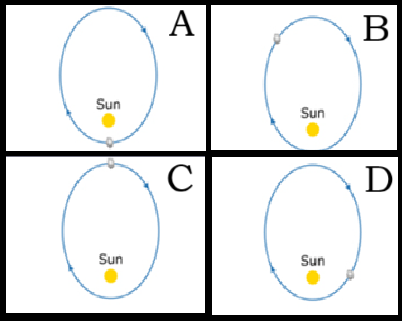
In which position is the object moving at the fastest speed?
A
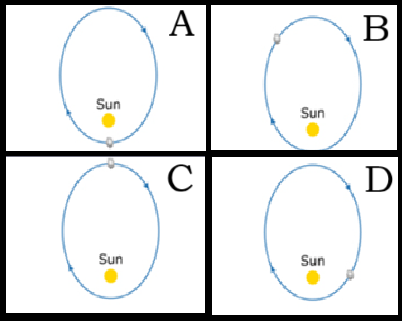
Which position did the object travel the shortest distance?
C
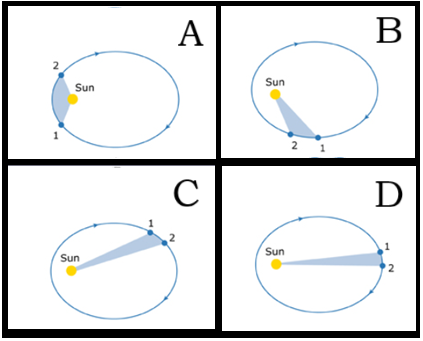
Which position is the object traveling at the fastest speed?
A
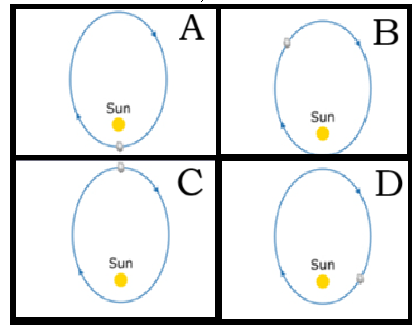
Which position has the largest swept out line?
It will sweep out equal areas in equal time intervals.
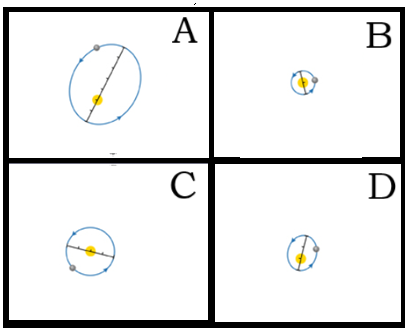
Which Planet has the Shortest orbital distance from the star?
B
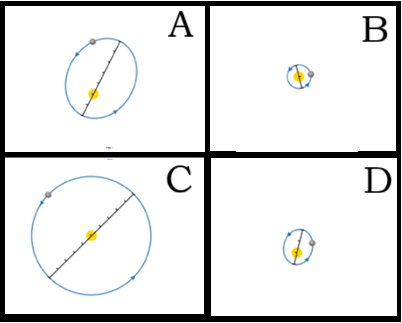
Which Planet has the Slowest orbit?
C
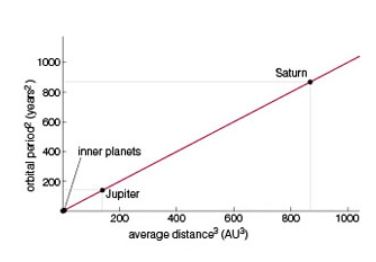
Uranus, not shown on the graph, orbits about 19 AU from the Sun. Based on the graph, its approximate orbital speed is between about __________.
5 and 10 km/s
Imagine that Venus is in its full phase today. What time would the full Venus be highest in the sky?
at noon
When would you expect to see Venus high in the sky at midnight?
never
What is really happening in space during the periods when we see Mars going through apparent retrograde motion?
Earth is passing by Mars in its orbit around the Sun.
 Note
Note  Flashcards (20)