GEOG 1101 - Exam 3
 Call Kai
 Learn
Learn Practice Test
 Spaced Repetition
 Match
Match Flashcards
 Knowt Play
1/80

There's no tags or description
Looks like no tags are added yet.
Name | Mastery | Learn | Test | Matching | Spaced | Call with Kai |
|---|
No analytics yet
Send a link to your students to track their progress
81 Terms
State
A politically organized territory with a permanent population, a defined territory, and a government
Must be recognized by other states
We often think it is natural, but it is the outcome of many encounters between people and places
Result of territoriality (key piece)
Territoriality
To stake out territorial claims to affect, influence, or control people by asserting control over a geographic area
Can occur at multiple scales
Sovereignty
States must have sovereignty
Recognized right to control a territory both politically and militarily
“The State“
In political geography is a place, a territory, and a people
Also a set of institutions and practices
Nation
A group of people with a sense of cultural connection that is not necessarily tied to the existence of a state
It is an “imagined community” because we will never meet all the people in our nation, yet we see ourselves as part of a larger national group
Nation-State
When a nation (group of people) is governed by its own state (territorial political unit)
Assumes the presence of reasonably well-defined, stable nations living contiguously in discrete territories
Multinational State
State with more than one nation inside its borders
Nearly every state in the world is a multinational state
Multistate Nation
When a nation stretches across borders and across states
Stateless nation
When a nation does not have a state
Ex. The Kurds
Boundaries
States typically define their boundaries in a treaty-like legal document in which actual points in the landscape or points of latitude and longitude are described
Cartographers delimit the boundary on maps
If states so desire, they can demarcate the boundary by using steel posts, concrete pillars, fences, or walls
Geometric Boundaries
Drawn using grid systems such as latitude and longitude or township and range
Physical-political Boundaries
Follow an agreed upon feature in the natural landscape
Maritime Borders
United Nations Conventions on the Law of the Seas (UNCLOS) in 1994 established basic principles
States have sovereign control over territorial seas that extend out 12 nautical miles (NM) from their coastlines
States have the right to control fiscal transactions, immigration, and sanitation in the contiguous zone that extends an additional 12 NM
Maritime Borders Cont.
States have control over all resources found in the exclusive economic zone (EEZ) that extends out 200 NM from their coastlines
States have complete control over resources found in their continental shelves, which are defined by distance instead of by geology
International waters, which are considered to be the common heritage of all mankind, to be used by all, start at the end of economic zone (EEZs) and include vast areas of oceans
Boundaries are often in dispute
Definitional
Locational
Operational
Allocational
Definitional Boundary Disputes
Focus on the legal language of the boundary agreement
Locational Boundary Disputes
Center on differences over where the boundary should actually be placed
Definition is not in dispute, but fairness and implementation is contested
Operational Boundary Disputes
Involve neighboring states that differ over the way their border should function
Allocational Boundary Disputes
Are becoming more common as the search for resources intensifies
A conflict between states or parties over the ownership or access to natural resources—such as oil, natural gas, or water—located in a border region
Political Geography
The study of the political organization of the world
Interested in the intersection of power, politics, and place
Can be examined at many scales
Intro to Reapportionment & Gerrymandering (R&G)
Some political systems of representation are geographically anchored
US Democracy is based on territorial representation
Multiple electoral divisions in US: National (President), state (Congress and House), counties, cities, school districts
Electoral Geographers
Examine how the spatial configuration of electoral districts and the voting patterns that emerge in particular elections reflect and influence social and political affairs
US Constitution with R&G
The US Constitution requires a census every 10 years to evaluate the proportion of the population in the House of Representatives District
The number of people in each district is supposed to be roughly the same: ~700,000 people
Reapportionment must happen after the Census because people move and states gain or lose population
Reapportionment
Process by which districts are changed according to population shifts, determined by the Census
The shape of a district often changes to accommodate increases or decreases in population
Reapportionment in GA
After the 2020 Census, the Georgia State Legislature had to redraw district boundaries to adjust for population shifts
New lines provide one more Republican seat
Reapportionment in CA
After the 2020 Census, the California’s Redistricting Commission had to redraw district boundaries to adjust for population shifts; CA lost one seat for the first time in history
New lines created 10 new competitive seats that are projected to favor Democrats
Splitting Minority Votes
“Splitting” minority votes across districts can ensure the majority population controls each district
Response: The Voting Rights Act (1965, amended in 1982)
Outlawed districts that weakened minority voting power
Result: States increased the number of majority-minority districts in the House of Representatives from 27 to 52
How is the Process of R&G?
Reapportionment and redistricting is often a very contentious issue and political process
Gerrymandering
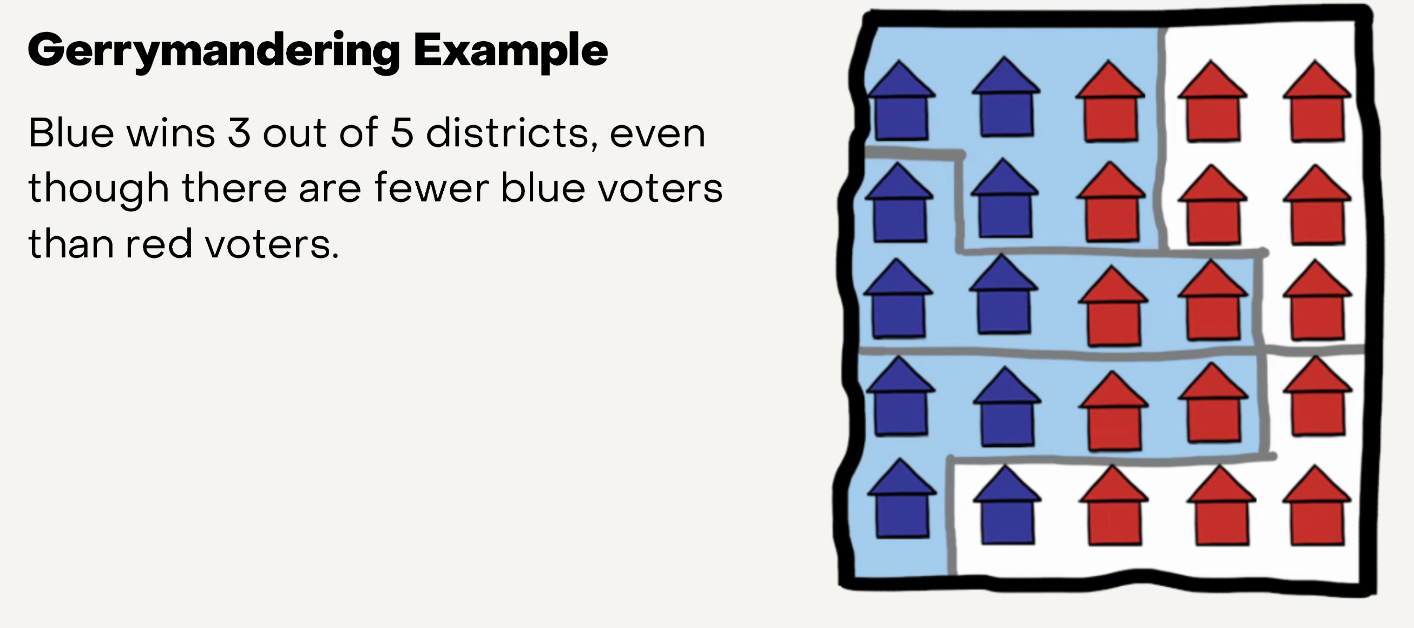
Drawing district lines to favor a particular party or candidate; often results in oddly shaped congressional districts
“Redistricting for Advantage”
Cracking & Packing
“Cracking“
Opposition party divided into many districts
“Packing“
Opposition party concentrated into one (or few) districts
Gerrymandering Cont.
Few districts (10-15%) are “competitive”
Hard to prove gerrymandering
All about the shapes drawn to create districts with roughly the same number of people
different ways to draw the districts
Voter data and mapping allow districts to be drawn in funny shapes to favor one party over another
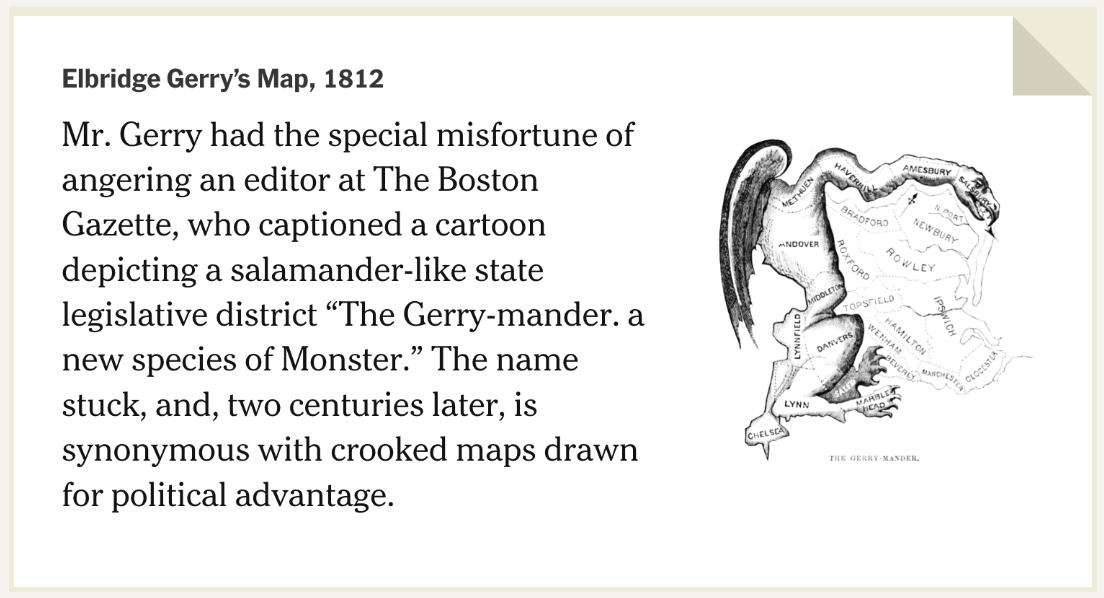
Origin of the term “gerrymandering”
Supranational Organizations
An institution created by three or more states to promote cooperation
History of Global Supranationalism
Started with League of Nations after WWI
United Nations (UN) formed after WWII
Other Supranational Organization
Food & Agriculture Organization (FAO)
World Trade Organization (WTO)
United Nations Educational, Scientific, and Cultural Organization (UNESCO)
United Nations (UN)
Founded in 1945
Currently includes 193 Member States
“One place where the world’s nations can gather together, discuss common problems and find shared solutions”
Regional Supranational Organizations
Example European Union (EU)
27 members
Facilitate stability and economic activity
Retain global prominence
Ease movement
Euro currency
Brexit (British Exit)
United Kingdom withdrawal from the EU
Occurred after a 2016 referendum; only 52% of residents voted to leave
Driven by desires for: greater sovereignty, Stricter immigration control, Less EU bureaucracy
Critics warned of economic damage from leaving the EU’s Market
Nature
Physical universe that includes humans, a social creation
Understandings of nature are a product of different times and needs
Nature & Society
Nature is a reflection of society
Philosophies, belief systems, and ideologies influence how we think about and interact with nature
Examples
Romanticism
Conservation
Environmental Justice
Romanticism with Nature
Emphasized the interdependence of humans and nature
Conservation with Nature
Natural resources should be used thoughtfully and humans should be stewards and not exploiters of nature
Environmental Justice with Nature
All people should have access to safe and healthy communities where they live, work, play, pray, and go to school
Nature & Society Cont.
Society is the “sum of inventions, institutions, and relationships created and reproduced by human beings” across place and time
How society relates to nature varies from place to place and people to people
Nature and society’s relationship is mediated through technology
The extent to which society shapes nature is dependent on technology and its use
What is technology?
Physical objects & artifacts
Activities or processes
Knowledge or know-how
Tools, applications, and understandings are equally critical components of technology
Technology can be both a solution and a problem
Technology Affects the Environment in Three Ways
1. Harvesting of resources
2. Emission of wastes in the manufacturing of goods and services
3. Emissions of waste in the consumption of goods and services
Natural Resources
Materials found in nature and used by humans
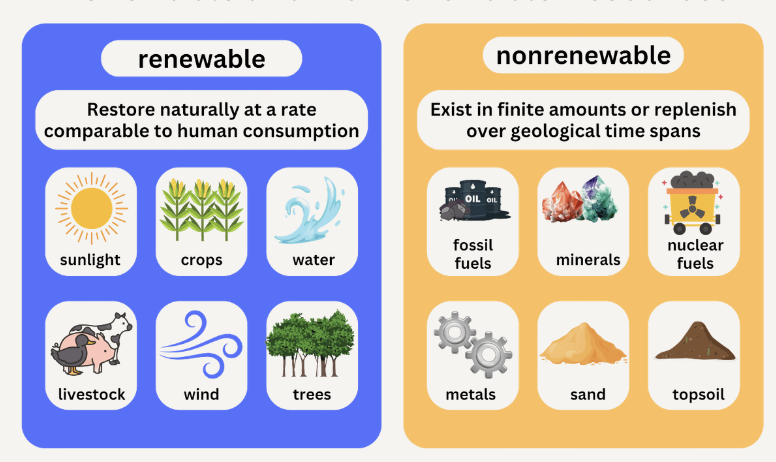
Examples: Plants, water, mineral, trees, fossil fuel, sunshine, wind
Renewable Resources
Resources that are replenished even while being used
Nonrenewable Resources
Resources that have finite quantities
Renewable v. Nonrenewable Resources
Land Use
Ways people use land resources for specific purposes
Grassland, cropland, forest, wetlands, urban/developed
Residential, commercial, industrial, agricultural, recreational
Land Cover
What is on the ground
Grass, trees, pavement, row crops
As land use changes so does land cover
Need to balance different types of land uses and land cover
Forests, Oxygen, & Deforestation
Forests play a critical role in the oxygen cycle
Deforestation is the result of clearing vast tracts of forestland for agriculture and livestock use
Between 2000 and 2013, 10% of all human caused greenhouse gas emissions came from tropical deforestation
Water with Resource Use & Extraction
Humans and technology have a tremendous impact on the water cycle
A Plastic Ocean
70% of the Earth is covered in ocean
10% of the plastic used by humans ends up in the ocean
Plastics do not easily decay
Often ends up in oceans
In the oceans, sunlight, and waves break plastics into millions of smaller pieces called microplastics
Garbage Patches
Ocean currents circling around high-pressure systems gather plastic dumped into the ocean into huge gyres
Great Garbage Patch is located in the North Pacific
Only way to remove the microplastics is with fine-mesh nets, but they would also skim ocean phytoplankton
Resource Extraction
Drilling for oil and natural gas
Mining for elements
Logging
Contributed to the development of innovative technology leading to population growth and increased life expectancy AND has unintended consequences & by products
How does Resource Extraction Contribute to Environmental Degradation
Oceans: Oil and gas exploitation and spills, pollution dumping, overfishing
Land Surfaces: Open-pit mining and mountaintop removal, dams, irrigation projects
Biosphere: Deforestation & vegetation loss
Atmosphere: Air pollution
How Are Environmental Degradation and Its Subsequent Impacts Unevenly Distributed
Rural, Low-Income has highest levels of poor drinking water violations
Love Canal Crisis, New York (1978)
Lova Canal was a predominately white, working-class neighborhood that was built on top of a former chemical dumpsite
Began experiencing severe toxic exposure when heavy rains caused buried chemical waste to leach into homes, backyards, and the local school
Led by Lois Gibbs, the community’s activism drew national attention; aimed at preventing toxic exposure and demanding accountability
Love Canal became the representation of a broader pattern of industrial neglect and environmental harm
Anti-Toxics Movement
Warren County, North Carolina (1982)
Residents along with civil rights and environmental rights groups protested the siting of a hazardous waste landfill
Argued that the county was deliberately targeted because it was predominately Black and poor
Did not stop the landfill, but drew national attention to the issue
Two Landmark Studies Emerged During This Period
US Government Accountability Office (1983), Siting of Hazardous Wast Landfills and their Correlation with Racial and Economic Status of Surround Communities
United Church of Christ (1987), Toxic Waste and Race in the United States
Provided documentation that hazardous waste sites were disproportionately located in low-income communities of color
Environmental Racism
The unequal distribution of environmental benefits and pollution burdens according to race
Environmental Justice
The just treatment and meaningful involvement of all people in environmental decisions, ensuring full protection from disproportionate environmental and health hazards, and equitable access to a healthy, sustainable, and resilient environment
Examples:
Access to clean air and water
Clean and accessible green spaces
Affordable housing
Clean energy
Cancer Alley Louisiana
136 petrochemical plants and 7 oil refineries along an 85 mile stretch of the Mississippi River
Sustainability
Often is dated to the UN World Commission on Environment & Development
Findings were reported in the 1987 Brundtland Report
How can humanity improve the conditions of developing countries without degrading the environment, when the earth has limited resources
Sustainable Development
Development that meets the needs of the present without compromising the ability of future generations to meet their own needs
Sustainable development and sustainability have since become a goal of many programs enacted by both government and nongovernment organizations
UGA Office of Sustainability
Programs for students & employees
Efforts to make campus more sustainable:
Dining Services, UGArden, Green Roof Garden, Campus Pollinators Project, Campus Arboretum, Electric Mobility, Waste Reduction
Research Grants
Research Centers
Off-Campus Programs
Indigenous Self-Determination
Having the power over socio-cultural and political decision-making
Indigenous Environmentalism
1. Relational
2. Socially, culturally, and politically motivated
3. Land & Place-Based
4. Culturally & Ethically Grounded
Relationally of Indigenous Environmentalism
Practice of relationality
Land as a person v. Land as an object
Get later
Human and non-human
Interconnected, resists silos
Across time and place
Socio-Political Indigenous Environmentalism
Ecological sphere is not siloed and separated
Socially, culturally and politically motivated
Epidemic of Missing and Murdered Indigenous Women and Girls and Two-Spirit Relatives
Land-Based Indigenous Environmentalism
Indigenous knowledges, governance systems, ecologies and lifeways are rooted in the land
Caution against pan-Indignity
Indigenous environmentalisms are land and place-based
Resist universalizing solutions
Culturally Driven & Indigenous Environmentalism
Grounded in cultural and ethical practices and protocols
Linked to the land and our governance systems
Ex. Seven Generations Protocol
Prominent Indigenous Environmentalism
Fort Laramie Treaty guaranteed “undisturbed use and occupation” of reservation land
US Treaties are Supreme Laws of the land
Standing Rock Sioux Nation voted that the pipeline was a threat to their very survival
People lived in this camp for months
Created a community and a sense of place grounded in protecting the land and water
Standing Rock as Indigenous Environmentalism
Water protectors as non-human relationality
Fighting for their land as a form of cultural survival
Fighting for treaty rights as a form of political survival
Where Indigenous Environmentalism Take Place
Almost always take place in rural spaces
Places Indigenous peoples into rural, wilderness and reservation spaces
Urban-Native Dichotomy
Terra Nullius: Land that belongs to no one
As cities grew, Indigenous people were often barred to cities
Natives were seen as antithesis to the modern city
Myth of the vanishing Indian is false - Today roughly 70% of Native people live in US cities
Skagit River Hydroelectric Power Project
Three dams: Gorge, Diablo, and Ross
100 year license since 1925
Produced 20% of the utility’s electricity
Project allows for flood control
Natives Views of the Skagit Project
Destruction of river habitat
Lack of fish passage leading to massive salmon and fish losses
Dewatering of the river at sacred sites
Leading to cultural genocide and environmental justice
Salmon is a culturally significant food and the practice

