Section 5.13 Food chain and energy transfer + Energy transfer and productivity
 Studied by 0 people
 Call with Kai
 Learn
Learn Practice Test
 Spaced Repetition
 Match
Match Flashcards
 Knowt Play
1/11

There's no tags or description
Looks like no tags are added yet.
Name | Mastery | Learn | Test | Matching | Spaced | Call with Kai |
|---|
No analytics yet
Send a link to your students to track their progress
12 Terms
Define Producers:
They are photosynthetic organisms that manufacture organic substances using light energy, water, carbon dioxide and mineral ions.
Define Consumers:
They obtain their energy by feeding on other organisms.
Primary consumers: Organisms that feed on producers
Secondary consumers: Organisms that feed on primary consumers
Tertiary consumers: Organisms that feed on secondary consumers
Define Saprobionts:
Decomposers that break down complex materials in dead organisms to simple ones, releasing minerals and elements that can be absorbed by plants and contribute to the recycling.
Define Food chain:
Describes the feeding relationships, where the arrows represent direction of energy flow.
Each stage in the chain is called a trophic level
Define Trophic level
The position of organism in a food chain
Define Biomass and information about biomass
Biomass is the total mass of living material in a specific area at a given time.
Problems with biomass:
Fresh mass is easy to access, however with the varying amounts of water makes it unreliable
If dry mass needs to be measured this means that the organism needs to be killed, so only a small sample is used, and this sample may not be representative.
Units:
grams per meter square
(if volume) grams per cubic meter
The chemical energy stored in dry mass is estimated using calorimeter:
A sample of dry mass is weighed and burnt in pure oxygen within a sealed chamber called bomb.
The bomb is surrounded by a water bath
The heat of combustion causes a temperature rise of the water
As we know the amount of heat energy to raise the temperature of 1kg of water by 1 degree this is measured in kJ/kg OR kJ/g
Factors that effect how much sunlight gets converted to organic matter in plants?
Most of the light energy is reflected
Not all the wavelengths are absorbed
Light doesn’t fall on chlorophyll
A limiting factor such as carbon dioxide and temperature can effect the rate of photosynthesis
The equation for productivity in plants:
NPP = GPP - R
GPP: Is the Gross Primary Production, it is the total quantitiy of chemical energy store in a plant in biomass in a given area or volume.
R: is respiratory losses
NPP: Is the chemical energy store left when taking in respiratory losses
This NPP allows the plant to grow and reproduce, and is also available for other trophic levels in the ecosystem.
Why does only some of the biomass get converted between each trophic level?
Some of the organism is not consumed
Some of the parts consumed cannot be digested and are lost in faeces
Some energy lost in respiration (releasing heat to the surroundings)
Some energy is lost through homeostatsis (regulating body temperature)
What is the Net production of consumers equation
N = I - (F + R)
N is the net production
I is the chemical energy store of ingested food
F is the energy lost in faeces and urine
R is the energy lost in respiration
What can explain the relative ineffiency of energy transfers between trophic levels?
Most food chains only have 4 or 5 trophic level, because inefficient energy to support higher trophic levels
The total mass of organisms in a particular place (biomass) is less at higher trophic levels
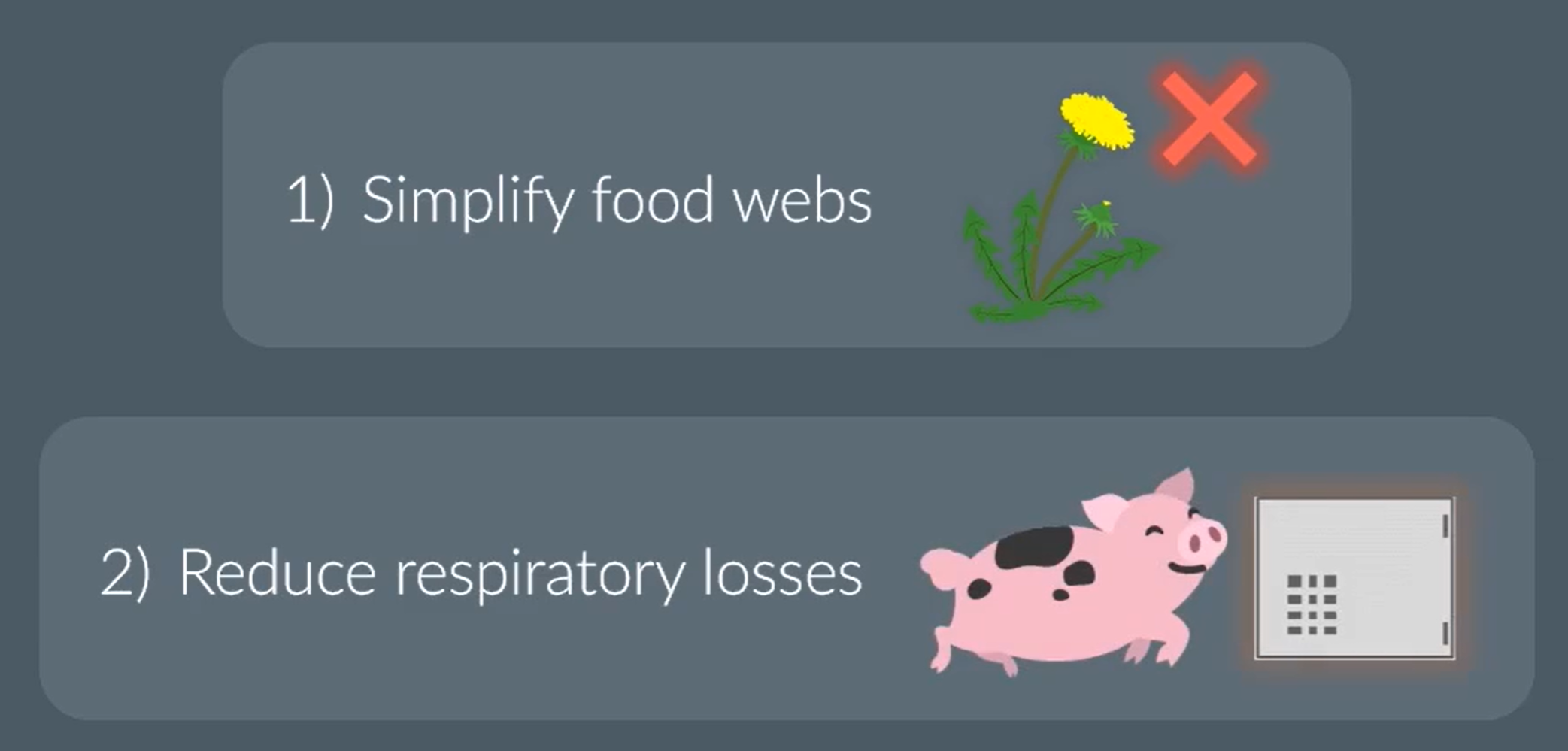
What do farmers do to increase biomass?
Simplify food webs, so there is less competition between crops
Reducing respiratory losses (such as reducing movement, processed food, controlled temeprature rooms)
 Note
Note  Flashcards (37)