HSPA: Chapter 12 - Preparation and Packaging
 Call Kai
 Learn
Learn Practice Test
 Spaced Repetition
 Match
Match Flashcards
 Knowt Play
1/51

There's no tags or description
Looks like no tags are added yet.
Name | Mastery | Learn | Test | Matching | Spaced | Call with Kai |
|---|
No analytics yet
Send a link to your students to track their progress
52 Terms
What is the air pressure in the prep and pack area?
Positive air pressure to ensure that air flows outward instead of into the work area
Why should SPDs make an effort to minimize lint?
Lint can be carried on air currents and deposited anywhere. Microorganisms often adhere to lint. When lint is introduced into the sterile field, it can settle into a wound and cause infection.
What are the primary goals of pack preparation?
Functional, accurate, and neat
What are demagnetizers used for?
When there are instruments that are magnetized, for example needle holders, it may make working with suture needles very difficult. Demagnetizers work by reversing the magnetic field away from the instrument
What is the recommended weight for containerized trays?
25 lbs
What is the proper way of assembling forceps?
All tips should be placed in the same direction
How do we include disposable (single-use) items, such as needles, scalpel blades and suture, in trays?
To sterilize single-use items, the manufacturer's IFU (including resterilization instructions) must be kept on file and carefully followed. If the manufacturer's instructions for resterilization of a single-use item cannot be obtained, the item should not be included inside an in-house sterilized procedure tray.
What is the risk of using prepackaged sterile towels in trays?
Prepackaged sterile towels purchased from an outside vendor or processed in house should not be opened and used on trays because they may super heat within the sterilization cycle. If super heating occurs, the tray they are in (and other trays within the load) will potentially be unsterile.
What is the procedure to launder prepackaged sterile towels?
Prepackaged sterile towels from an outside vendor should not be laundered unless the IFU have been obtained from the towel manufacturer. These towels are usually made of lower-quality material, which makes them single use and not meant for re-laundering
Can towels be resterilized?
Towels should be laundered after sterilization to rehydrate the fibers prior to sterilization.
What is super-heated steam?
Occurs when dry steam becomes too hot compared to saturated steam; dry steam rises to a temperature higher than the boiling point of saturated steam. Due to the lack of moisture, dry steam is not an effective sterilant and will often char or burn items in the sterilizer.
How are gauze sponges used as additional packaging (wicking) material in trays or packs?
Gauze sponges should never be used as additional packaging (wicking) material in trays or packs. Surgical count gauze sponges during procedures, and their counts must be exact. Introducing additional sponges into the OR as packaging material may cause confusion and affect sponge counts, or they may be inserted into the patient's operative site and accidentally retained.
What is a chemical indicator (CI)?
A small, disposable test that helps the user verify that the pack contents were exposed to a sterilant
What are the types of chemical indicators (CIs)?
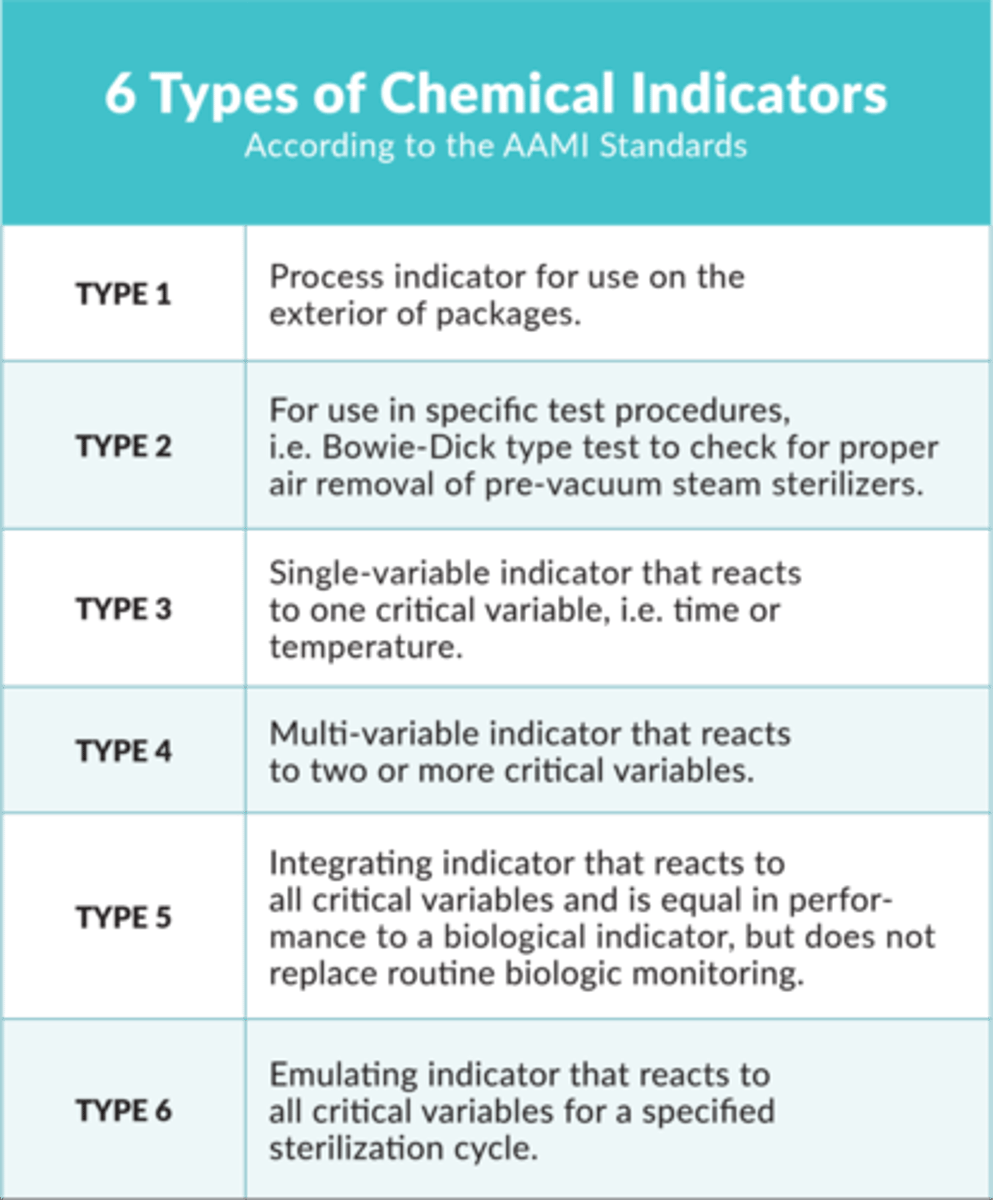
What is a process challenge device (PCD)?
Object that simulates a predetermined set of conditions when used to test sterilizing agent(s)
What are the objectives of the packaging process?
- Allow penetration of the chosen sterilant and be compatible with any other requirements of the specific sterilization process such as drying
- Maintain the sterility of the package contents until the package is opened
- Create a package that can be opened aseptically
What classification does the FDA classify sterilization packaging as?
A class II medical device (a device that presents a potential risk)
What are examples of woven fabric materials?
Muslin, type 140 cotton, calico, and barrier cloth
What are muslin wrappers made out of?
Two-ply fabric fastened together as one wrap
What are other woven fabrics used in sterilization?
Duck cloth, twill, and treated barrier fabrics
Why is canvas not used as a packaging material?
Canvas is not recommended as a packaging material because its tight weave impedes steam penetration and drying
What are rigid container systems made out of?
Anodized aluminum, stainless steel, plastic, or a combination of these materials
What are the types of filters used on rigid container systems?
Disposable )a synthetic spunbond product) or reusable (with ceramic filters or a valve system)
What regulation body regulates rigid containers?
FDA
What are advantages of using rigid sterilisation containers?
- Provide an excellent barrier to microorganisms
- Are easy to use
- Eliminate torn wrappers
- Help protect instruments from damage during processing, storage and transport
What are disadvantages of using rigid sterilisation containers?
- Safety concerns linked to ergonomics
- Additional cycle type may be required to thoroughly dry the container
- Plastic containers may require longer dry times because they lack metal, which produces heat by conduction to help drying
- Additional space may be needed to store those containers that are larger than traditional wrapped containers
- Additional labor may be required since the containers must be cleaned between uses
- Latching mechanisms can break
- Filter retention plates may become dislodged and contaminate instruments
What material is recommended for sterilisation and why?
Disposable/non-woven materials is a popular choice for sterilisation packaging because they have excellent barrier effectiveness and can be discarded after use
When is kraft-type paper used?
Used in steam and ethylene oxide (ETO) sterilization, but cannot be used with hydrogen peroxide
What are the types of combination peel pouches?
Plastic/paper and spun bonded high-density polyethylene (HDPE) combination AKA Tyvek pouches
When are paper/plastic pouches used?
They are used with steam and ETO sterilization processes
When are spun bonded high-density polyethylene (HDPE) combinations AKA Tyvek pouches used?
They are used for low-temperature hydrogen peroxide sterilization
How much space should be allotted between the items in a peel pouch and the sealed edges?
1/4 inch per side of the package
Why do we remove air from the peel pouch when packaging?
Trapped air acts as a barrier to heat, moisture, and sterilant penetration, so it is important to remove as much air as possible before sealing
Where do we adhere the label on a plastic/paper peel pouch?
Paper/plastic pouches must only be labeled on the plastic side or on areas specifically provided by the manufacturer (e.g., on fold-over paper flap seals)
Where is it acceptable to write on a paper/plastic peel pouch?
Writing on the paper side of the pouch will damage the package, which may not be noticeable but can compromise the barrier protection
What are the type of packaging methods?
Wrap within a pouch and double pouches
When are double pouches used?
It may be required for aseptic presentation of multiple items or for instruments having more than one part
When is folding acceptable when double pouching?
It is never acceptable to fold the inner pouch because doing so can interfere with air removal and sterilant penetration
What are the methods of using flat wrap packs?
Sequential and simultaneous
What is the sequential flat-wrapping technique?
The package is wrapped twice and is "a package within a package." This method is used for muslin, Kraft-type paper and single layers of SMS wraps
What is the simultaneous flat-wrapping technique?
The package is only wrapped once but requires a special, double-layered synthetic nonwoven material bound on two or four sides. Since the material is already double layered, the contents are only wrapped once
What is the advantage of sequential wrapping?
It affords a "second chance" for sterile presentation
What is the disadvantage of sequential wrapping?
Sequential wrap requires more time for wrapping and unwrapping
What is the advantage of simultaneous wrap?
Reduced labor costs and increased output in the SPD and OR
What are the types of techniques for wrapping?
Square fold and envelope fold
What information should the package label contain?
- Description of package contents
- Identification of the person that performed the packaging (e.g., the initials of package assembler/packager)
- Lot control number
- Identification of sterilizer and cycle to be used
- Date of sterilization (unless contained in the lot control number)
- Assigned storage location
- The requesting department or surgeon's name may also be included on the label for special-request items
Describe the sterility (time-related) concept.
The package is considered sterile until a specific expiration date is reached
Describe the sterility (event-related) concept.
Items are considered sterile unless the integrity of the packaging is compromised (damaged) or suspected of being compromised, regardless of the sterilization date. This is sometimes abbreviated as ERS.
What are factors affecting event-related sterility (ERS)?
ERS depends on the quality of the wrapper material, handling procedures, storage and transport conditions, and the number of times the package is handled before use
What is a "use by date?"
Packaging material may be dated with a "use by date," meaning it must be sterilized prior to that date, which differs from a sterilization expiration date.
How can we protect packages after sterilization?
Protective packaging plastic overwrap (sometimes called dust covers or sterility maintenance covers) can be applied to packages after sterilization to protect the packages from dust, moisture and other contaminants
What are the dimensions of plastic overwrap AKA dust covers or sterility maintenance covers?
2 to 3 mil thick

