Gilded Traps and Safe Development Paradox
 Studied by 0 people
 Call Kai
 Learn
Learn Practice Test
 Spaced Repetition
 Match
Match Flashcards
 Knowt Play
1/6

There's no tags or description
Looks like no tags are added yet.
Name | Mastery | Learn | Test | Matching | Spaced | Call with Kai |
|---|
No analytics yet
Send a link to your students to track their progress
7 Terms
Gilded Traps
Gilded traps reinforce feedbacks between social and ecological systems in which social drivers (e.g., population growth, globalization, and market demand) increase the value of natural resources, as the ecological state moves closer to a tipping point (a self reinforcing system).
In a gilded trap, it is the consequences of increasing risks of precipitous decline without warning that is of greatest concern, and where the perceived lucrative value of a natural resource drives stakeholders and managers to overlook risks of its unexpected decline, it’s associated with negative social and ecological consequences
Gilded Trap Example
Maine Lobster Fishery: For a long time, lobsters were considered inedible, and were used mainly for fertiliser. However, when this became a commodity, the land value and exploitation of lobster increased greatly around the 1980's. Overtime we can see that lobsters started to replace every other species in the market, forcing the fish out of many ecosystems.
Lobsters became practically a monoculture as they had a steady food of bate, farming of wild lobster. This greatly increases the population. However, if this population was threatened, they are greatly vulnerable (genetically similar) and the economy around the industry would collapse due to their loss.
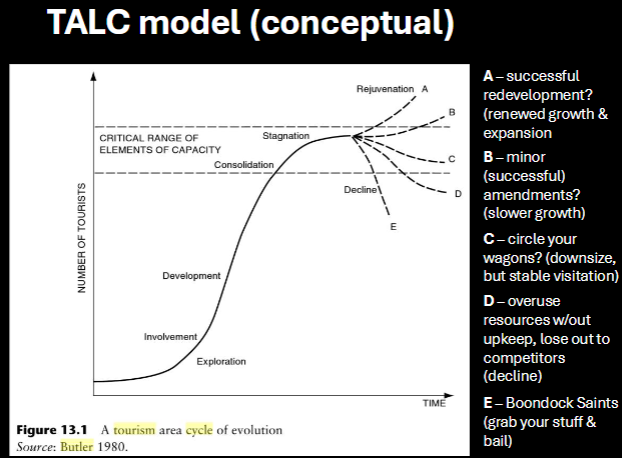
Butler's Tourism Area Life Cycle (TALC Model)
A widely used model to study the evolution of a particular tourism destination. The model suggests that a tourism area evolves through six predictable different stages, namely, exploration, involvement, development, consolidation, stagnation and decline or rejuvenation. In each stage of the life cycle, the destination undergoes a series of changes, and shows how tourism can either benefit or hinder the economy and environment
Safe Development
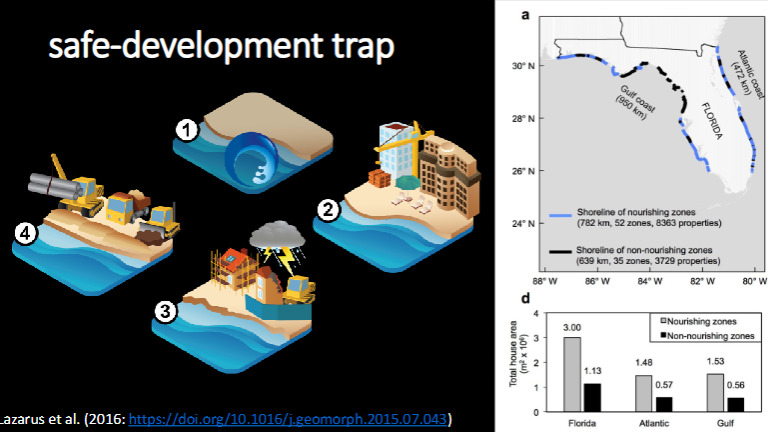
Land exposed to natural hazards can be profitably used if steps are taken to make it safe for human occupancy. Such as measures to mitigate the likelihood of damage (e.g., flood protection) and to deal with residual financial risk (e.g., gov't insurance, relief)
Safe Development Paradox
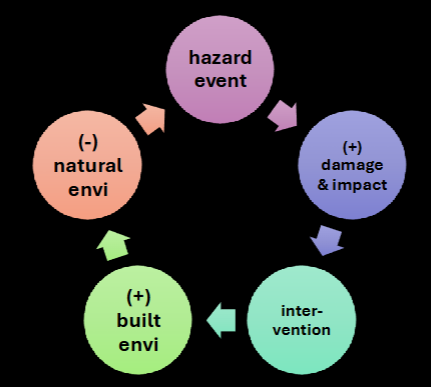
In trying to make hazardous areas safer, the federal government in fact substantially increased the potential for catastrophic property damages and economic loss. It’s the emergence of a positive feedback between hazard protection & built environment
Example of Safe Development Paradox
Natural hazard exists → people move into, build in an area prone to hazard impact → hazard occurs → prompts protection/mitigation/intervention (typically engineering, not relocation) → intervention (engineering works) makes natural environment more fragile (reduced sediment supply, veg protection, etc) and more people settle
Implications of Safe Development Paradox
-Social inequity – subsidies, insurance, support is not evenly distributed
-Some property owners / communities have more access to insurance, capital, aid/support than others
-Actuarial valuation is not objective and typically racialized. Modern legacies of (historical) structural racism that can function as a mechanism for dispossession
 Note
Note  Flashcards (150)