Plague (Yersinia pestis, Serious zoonosis)
 Call Kai
 Learn
Learn Practice Test
 Spaced Repetition
 Match
Match Flashcards
 Knowt Play
1/24

There's no tags or description
Looks like no tags are added yet.
Name | Mastery | Learn | Test | Matching | Spaced | Call with Kai | Chat |
|---|
No analytics yet
Send a link to your students to track their progress
25 Terms
Etiologic Agent
Bacterium Yersinia pestis
Gram negative
Nonmotile
Non-spore-forming
Coccibacillus
Heat intolerant
Can surive in infected fleas, carcasses or other organic material
It is ZOONOTIC
droplets through contact with infected animal
vector-borne
TYPES of PLAGUE
Black Death
Bubonic Plague
Sylvatic Plague
Urban Plague
Ancient History
Many pandemics. First in 542 AD caused 100 million human deaths
human population lower back then
2nd pandemic began in 1346 lasted 3 centuries. Claimed 25 million victims
Last pandemic began in 1894 and lasted until 1930s
Since the last pandemic, foci of infection established in South America, West Africa, South Africa, Madagascar, and Southeast Asia
Early Biowarfare
During the siege of Kaffa in 1346, the attacking Tatar forces hurled plague-infected corpses over city walls to cause an epidemic
Major Trade Routes
Humans have moved this disease around
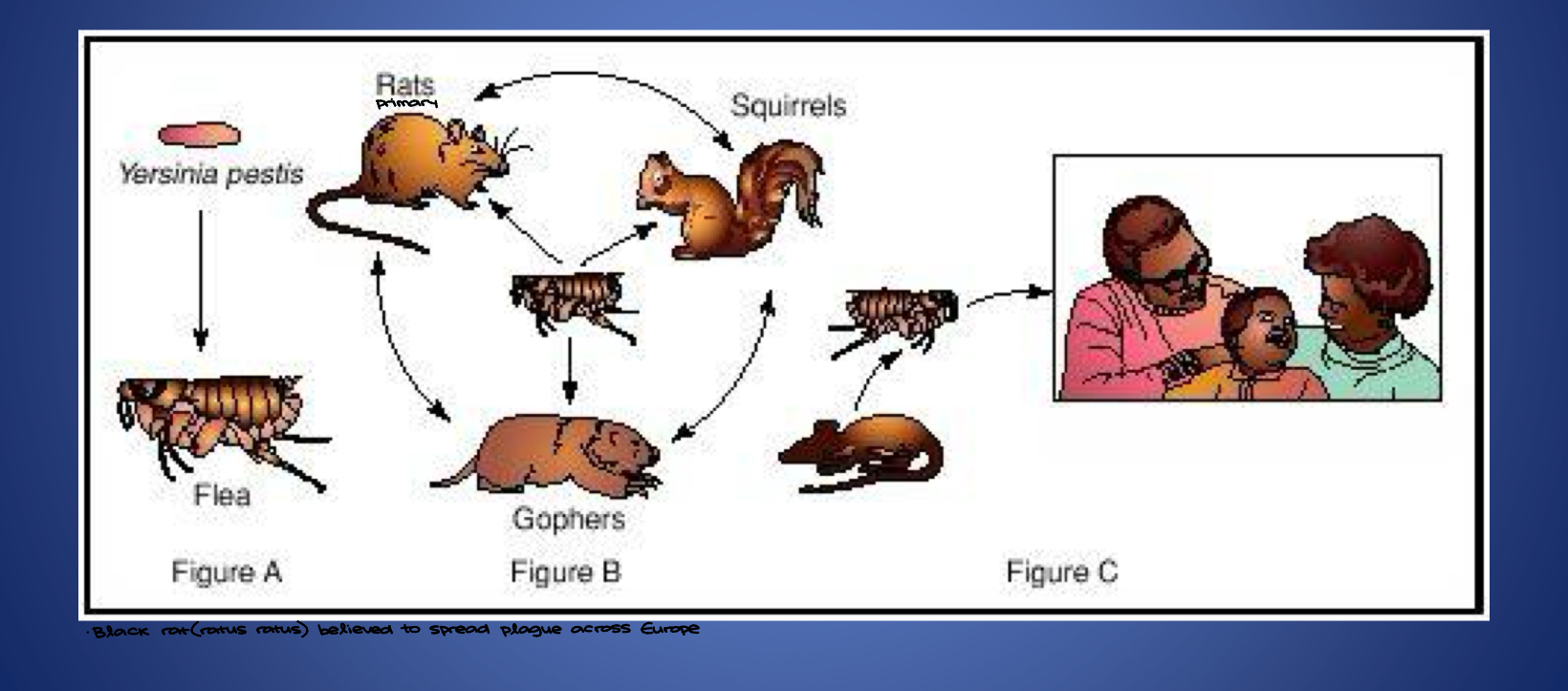
rats were a carrier of plague → ships

Recent History
From 1958 to 1979- nearly 50,000 cases in 30 countries
From 1971 to 1980- in the Americas there were 7,382 cases
Same period- 123 cases in the US
Plague in the US continues to be a problem because of sylvatic plague
cycles in wild animals or in nature
Urban plague under control in most industrialized countries due to rodent control
rats used to live with people
Geographic Distribution
Limited to mostly Western U.S
nobody knows why
Host Distribution
Not normally a disease of domesticated animals (cats very susceptible)
It is a rodent borne (murine) disease
The primary host are wild (sylvatic) and urban (commensal) rodents (230 species)
It is transmitted in nature by fleas
It is zoonotic!
Epidemiology
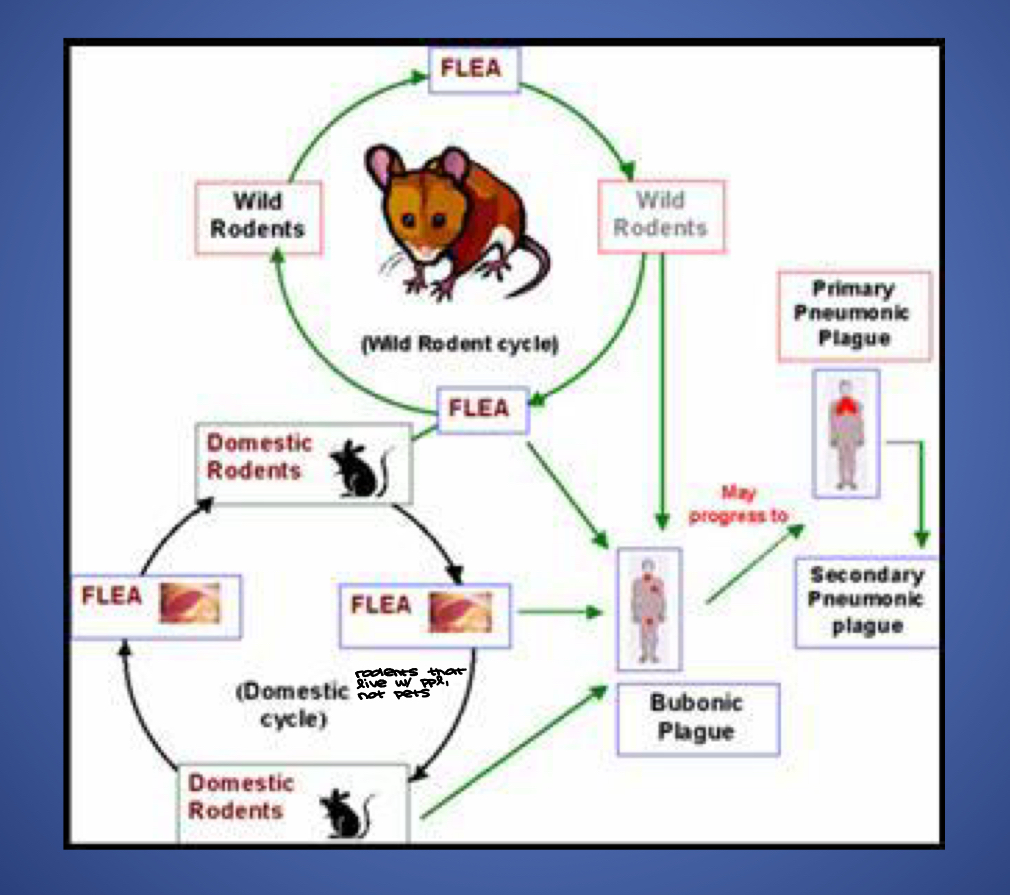
Plague is normally a rodent - flea - rodent cycle
Humans accidentally become involved in the cycle
Humans may be infected by fleas that have fed on infected rodents
Humans may be infected by handling infected animals
Humans can get infected from other animals
Which is NOT a component of One Health?
A. Humans
B. Animals
C. Agent (epidemiologic triad)
D. Environment
Disease Cycle
Disease Cycle Cont.
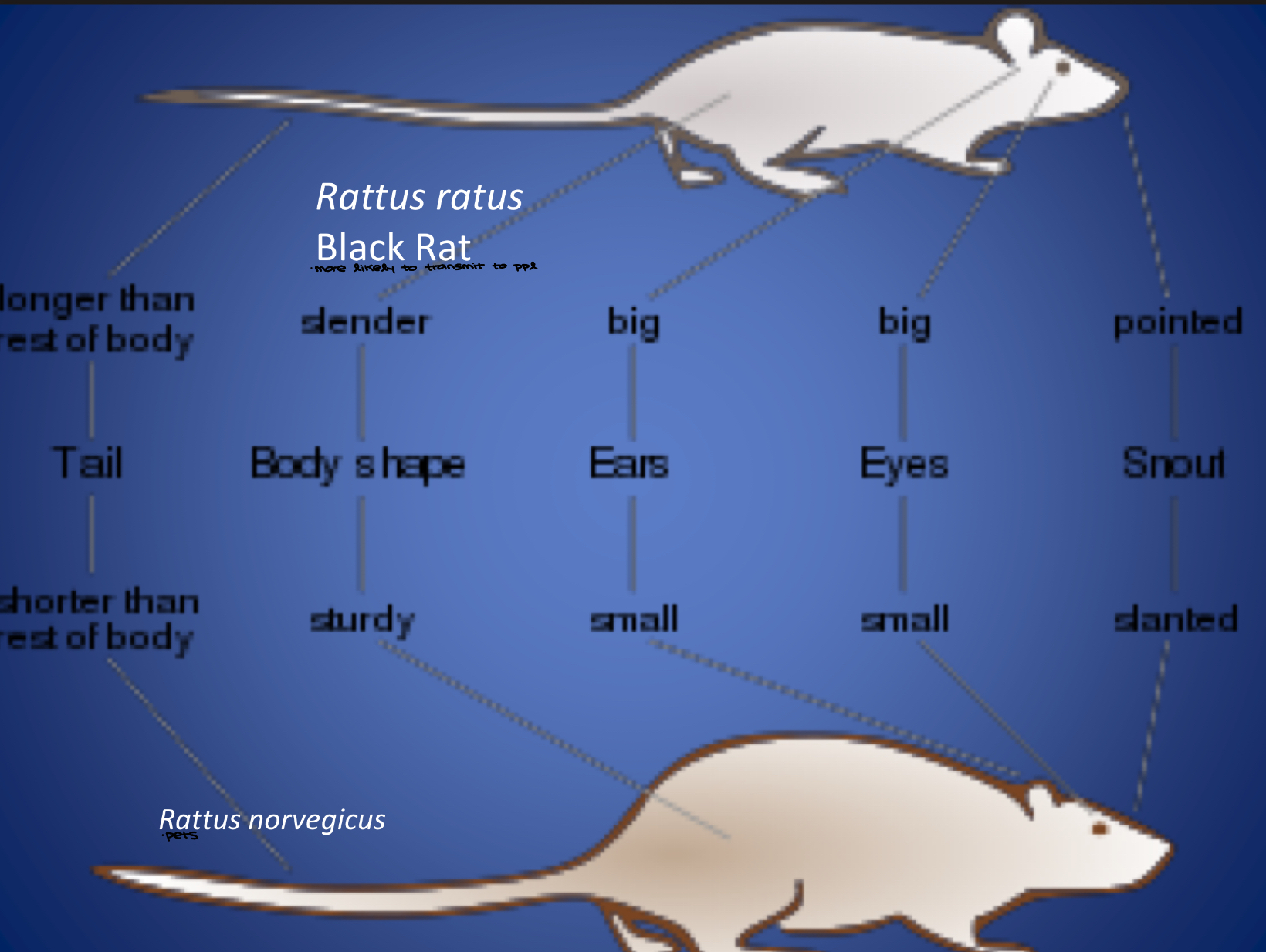
Comparison
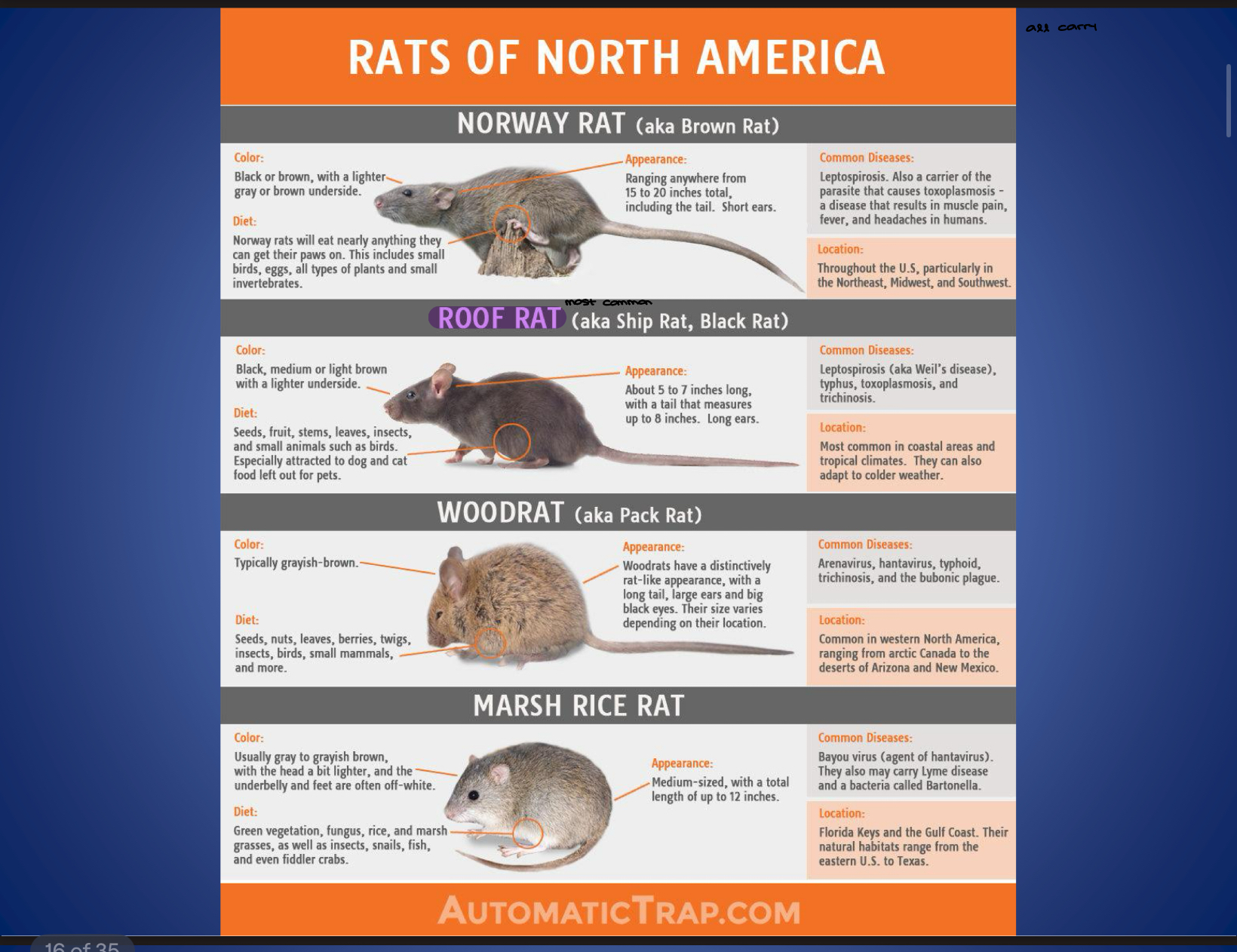
Rats of North America
Plague cycle in a flea
Infected bloodmeal (flea feeds on rodent carrying plague)
cleared from some but multiply in stomach of other
2 days later, stomach has clusters of brown specks w/ Y. pestis
3-9 days later, bacterial masses block ingested blood from reaching stomach
Attempted to refeed, ingested blood mixes w/ bacilli and regurgitated into mammalian host
Fun fact: suggested that as many as 11,000 to 24,000 bacilli are regurgitated into the mammalian host
Plague cycle in wild mammalian host
Flea bite (regurgitation)
Y. pestis spreads to regional lymph node
closest lymph node to wherever that bite occurs
Multiplies to high numbers → formation of bubo
lymph nodes increase in size
Spreads to bloodstream
Affected species
Rats
Humans
Felines
Prairie Dogs
Ground Squirrels
Highly resistant to plague (carnivores)
Domestic dogs, black bears, badgers, coyotes, raccoons and skunks
Common weather pattterns
Epizootics more common during cooler summers (favorable to bacteria) following wet winters (more vegetation → favors rodent population) (SW United States)
Y. pestis prefers lower humidity without excess heat
Black Footed Ferret
Endangered
Diet 98% prairie dogs
can die from plague
left with no food
Distribution of Species
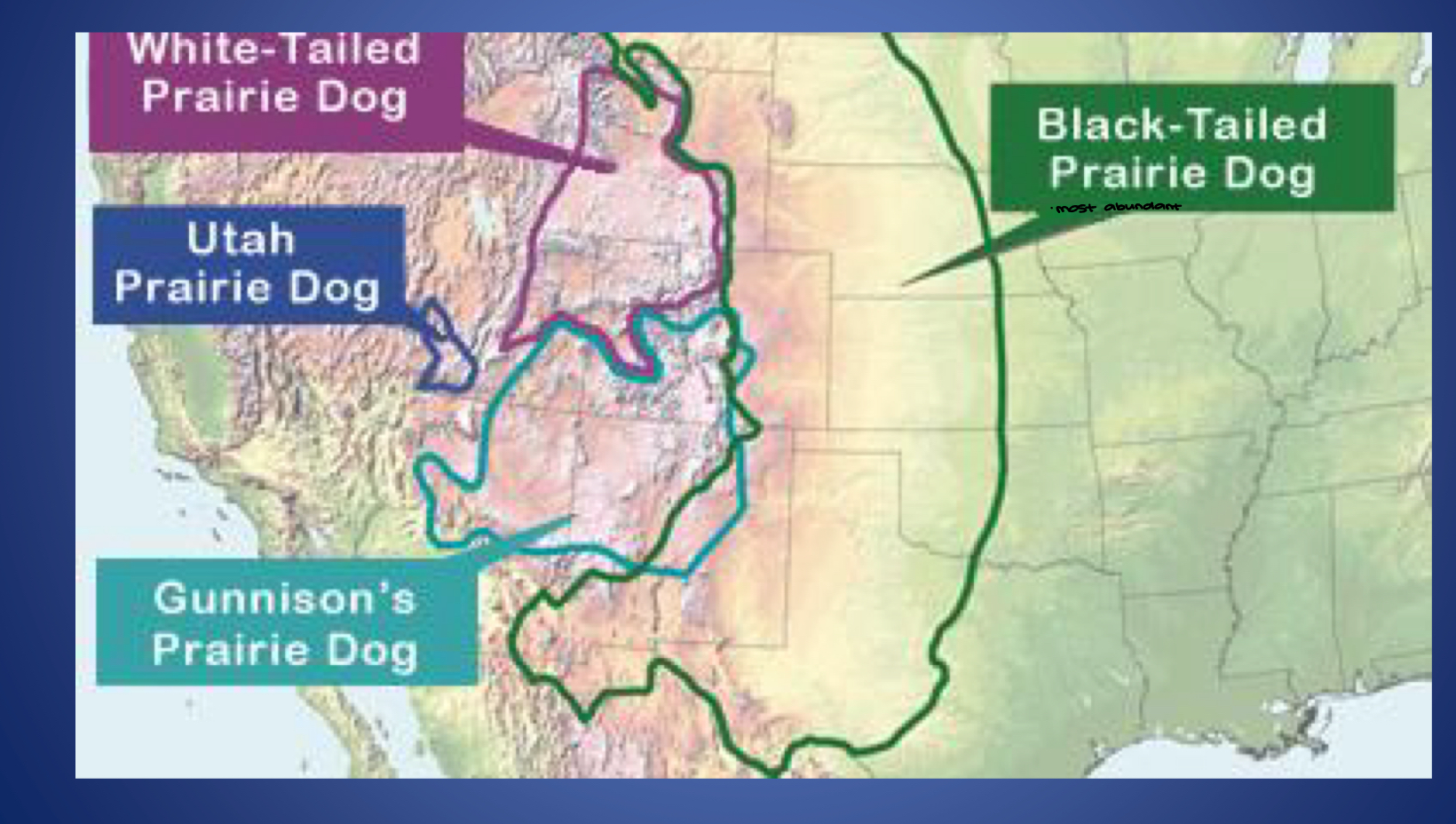
Which species are we least concerned that Plague will limit populations?
A. Black-tailed Prairie Dog (plague more to the west, hotter)
B. White-tailed Prairie Dog
C. Utah Prairie Dog
D. Gunnison’s Prairie Dog
Clinical Forms of Plague (humans and animals)
Primary septicemic (flea bite, directly into blood)
Secondary septicemia possible
more common, bubonic 1st, blood
Bubonic
Pneumonic (lung)
Secondary Pneumonic also possible
Symptoms in Humans
Incubation period 2-6 days
Fever, chills, headache, nausea, diarrhea/constipation, shock, rapid pulse, staggering gait, slurred speech, mental confusion, and prostration (looks like flu)
Septicemic- disease lasts 1-3 days, mortality may be nearly 100% in untreated cases
Bubonic- painful swelling of lymph nodes, mortality from 15-60% in untreated cases (highest chance to survive)
Pneumonic- the most dangerous for human-human transmission, mortality almost as high as Septicemic
Diagnosis/Treatment
Clinical- by signs and symptoms (especially if you have history)
Definitive- by isolation and identification of Yersinia pestis
Prompt treatment with antibiotics (steptomycin, tetracycline)
Prevention and Control
Keep humans away from foci of infection
FIRST Flea control
SECOND Rodent control (not 1st because fleas will find another host (humans))
Inactivated human vaccine for high risk individuals conferred some protection for less than 6 months. No vaccine currently available in USA
Use of sentinel animals such as coyote
used to detect plague