Lecture 4 - Integument Support & Movement
 Studied by 0 people
 Call Kai
 Learn
Learn Practice Test
 Spaced Repetition
 Match
Match Flashcards
 Knowt Play
1/25

There's no tags or description
Looks like no tags are added yet.
Name | Mastery | Learn | Test | Matching | Spaced | Call with Kai |
|---|
No analytics yet
Send a link to your students to track their progress
26 Terms
Integument
The body covering system.
Includes:
Skin
Hair
Associated glands
Modified structures (claws, nails, hooves, horns, antlers)
Skin
Mammalian skin is thicker and more complex than in other vertebrates.
Layers (outside → in): epidermis, dermis (thicker), hypodermis.
Hair
Hair is derived from epidermal tissue.
Thought to evolve from reptilian scales.
Made of keratin.
Each hair is made of 3 layers:
Medulla - core
Cortex - contains pigment
Cuticle - overlapping scales
Hair movement
Each hair follicle has a muscle attached to it, the erector muscle.
When it contracts, hair stands up.
This contraction is called piloerection. It acts as an insulator and warning signal.
Underfur
The bottom layer consisting of wool hairs.
They tend to be shorter, flattened, curly, and denser than the top layer.
Its principal function is thermal insulation and thus thermoregulation.
Guard hair
Outer layer consisting of longer, coarser, and straighter hair.
The visible layer.
Provides water resistance, pigmentation, and protection.
Awn hair
Found between underfur and guard hair. Not present in all mammals.
Hair cycles
Humans shed and replace hair continually.
Most mammals molt twice a year
Coloration
Seasonal color changes:
Brown in summer
White in winter (leukemism)
Specialized hairs
Vibrissae: sensory hairs.
Quills: modified hairs for defense.
The 4 epidermal glands
Eccrine sweat glands - produce watery sweat. Found in hairless areas (footpads).
Apocrine sweat glands - for communication, not cooling. Aid in chemical communication, warning, defense, and attraction.
Sebaceous glands - secrete sebum, a lubricant for waterproofing and hydrating. Can also inhibit growth of microorganisms (bacteria).
Mammary glands - produce milk.
Basic structure of claws, nails, and hooves
Unguis: hard outer layer. Keratin fibers arranged perpendicular to growth. Grows outward from the nail matrix.
Subunguis: soft, flaky layer. Keratin fibers run parallel to growth. Thickens as it moves across the nail bed.
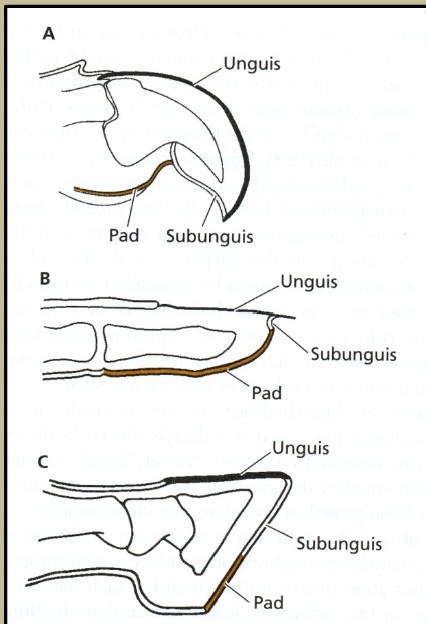
Abscission layer
Every so often, the growth of claws stops and restarts, similar to hair.
3 types of horn like structures
Antlers
True horns
Other horn-like structures (giraffes, rhinos, and pronghorns)
Antlers
Found in the family Cervidae; deer, elk, moose, caribou.
Usually only males have antlers (except in caribou).
Grow from pedicels on the frontal lobes.
Are covered during growth with velvet (vascularized skin) that sheds after breeding season (blood is cut off, it dies, and is rubbed away).
True horns
Found in the family Bovidae; cattle, goats, sheep, bison, antelope.
Permanent, unbranched, and composed of a bony core and keratin sheath.
Grow continuously and are never lost.
Found in all males and many females.
Ossicones
Giraffe “horns”.
Short, permanent, and unbranched.
Covered in skin and hair.
Do not project from the frontal lobes, but lie over the frontal and parietal bones.
Found in both sexes.
What are the 3 major components of the basic skeletal structure?
Skull
Axial skeleton
Appendicular skeleton
Axial skeleton
The central axis of the body.
Includes: skull, vertebrae, rib cage, and sternum.
Appendicular skeleton
Includes the limbs and the girdles that attach them to the body.
There are two types of girdles:
Pectoral girdle (forelimbs)
Pelvic girdle (hindlimbs)
Pectoral girdle
Attaches the forelimbs to the body.
Consist of the scapula (shoulder blade) and clavicle (collarbone).
Pelvic girdle
Attaches the hindlimbs to the body.
Includes the ilium, ischium, and pubis. Together this is called the innominate bone.
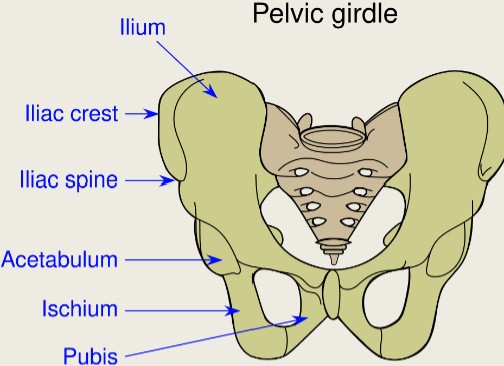
Forearm bones
Humerus - upper arm.
Radius + ulna - forearm
Carpals - wrist
Metacarpals - palm
Phalanges - digits
Hindlimb bones
Femur - thigh
Patella - knee cap
Tibia + fibula - lower leg
Tarsal - ankle
Metatarsals - foot
Phalanges - toes
Foot posture types
Plantigrade - entire foot contacts the ground.
Digitigrade - walk on digits (cats + dogs).
Unguligrade - walk on top of hooves (horses + deer).
Types of locomotion
Cursorial - running.
Graviportal - adapted for large body size; legs directly under body.
Saltatorial - jumping and hopping; elongated hindlimbs.
Fossorial - digging.
Arboreal - climbing, swinging.
Aerial - gliding, true flight.
Aquatic - swimming.
 Note
Note  Flashcards (129)