BIO 222 Lecture1.Blood
 Studied by 0 people
 Call Kai
 Learn
Learn Practice Test
 Spaced Repetition
 Match
Match Flashcards
 Knowt Play
1/154

Earn XP
Description and Tags
BIO 222 Anatomy & Physiology 2
Name | Mastery | Learn | Test | Matching | Spaced | Call with Kai |
|---|
No analytics yet
Send a link to your students to track their progress
155 Terms
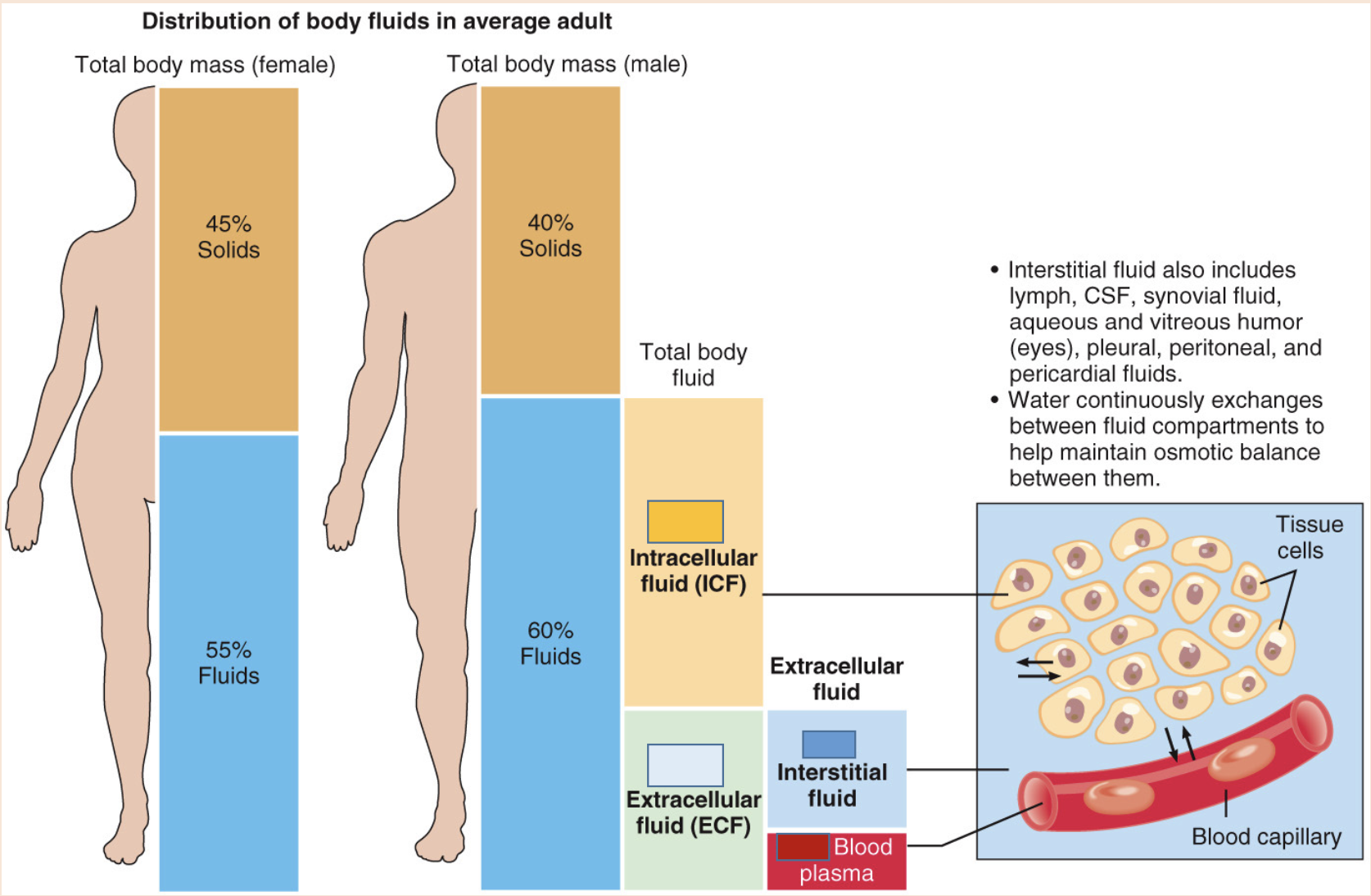
Distribution of body fluids in average adult Total body mass (female)
45% Solids.
55% Fluids.
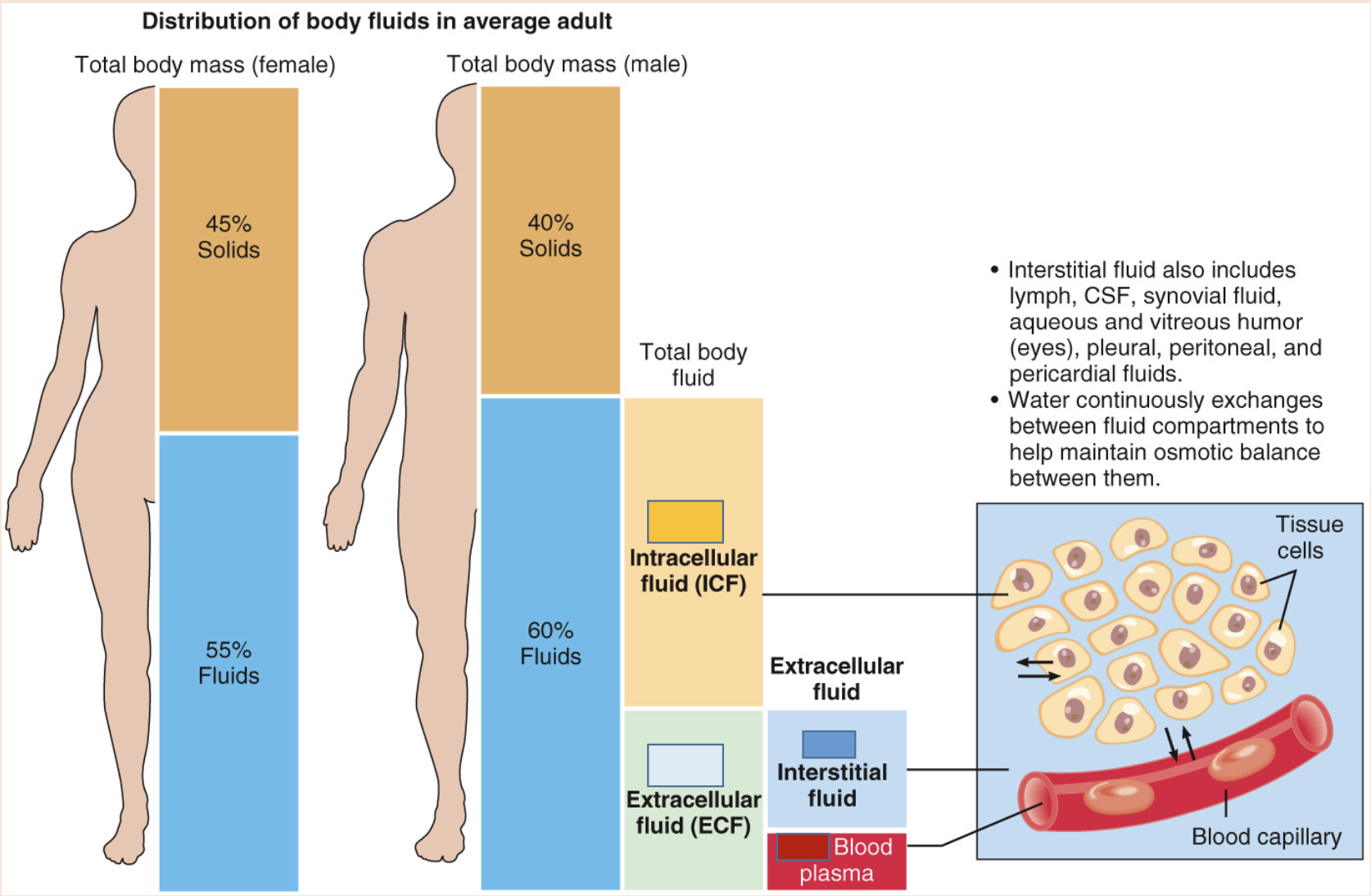
Distribution of body fluids in average adult Total body mass (male)
40% Solids.
60% Fluids.
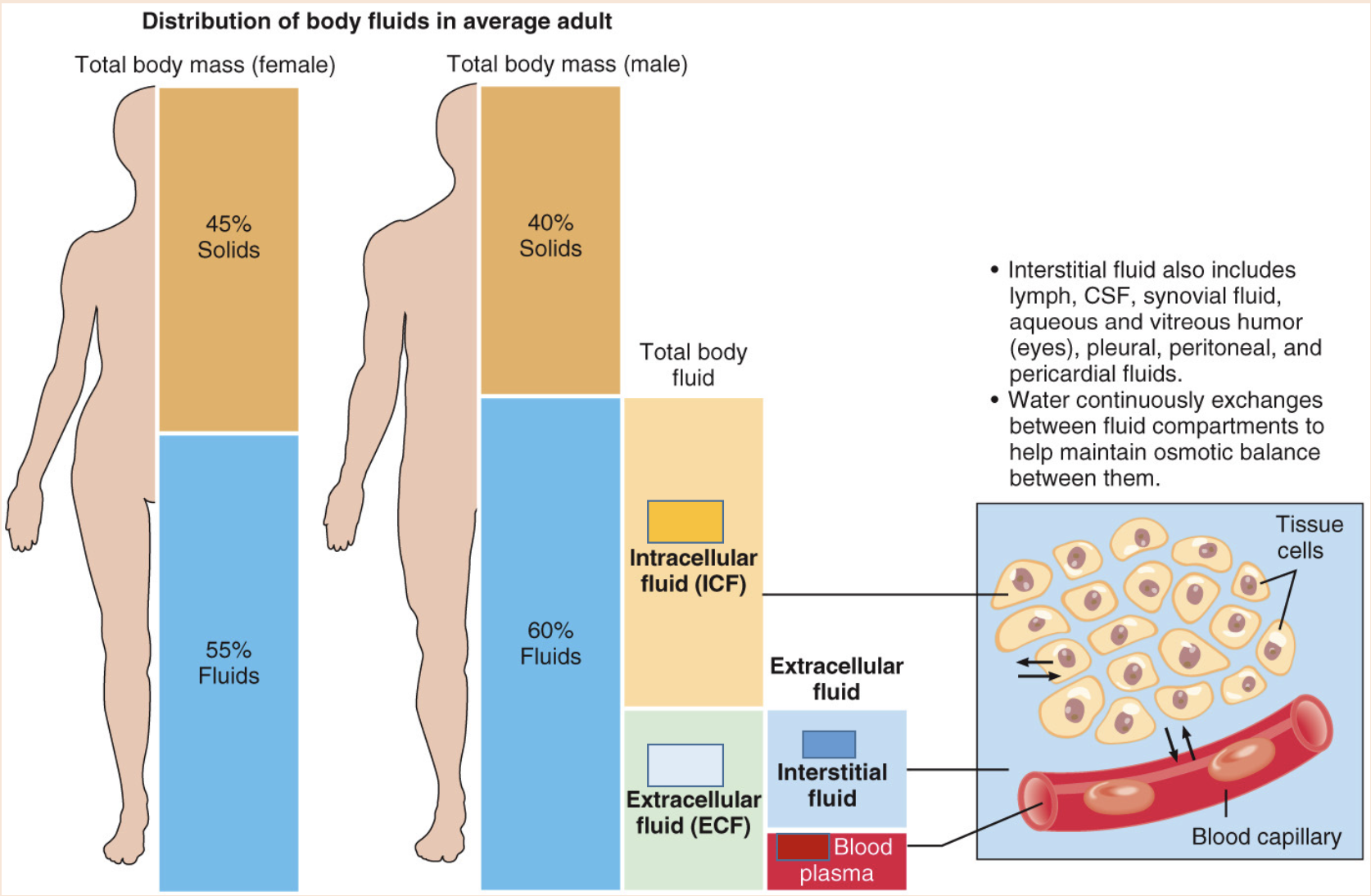
Total body fluid
Intracellular fluid (ICF).
Extracellular fluids (ECF).
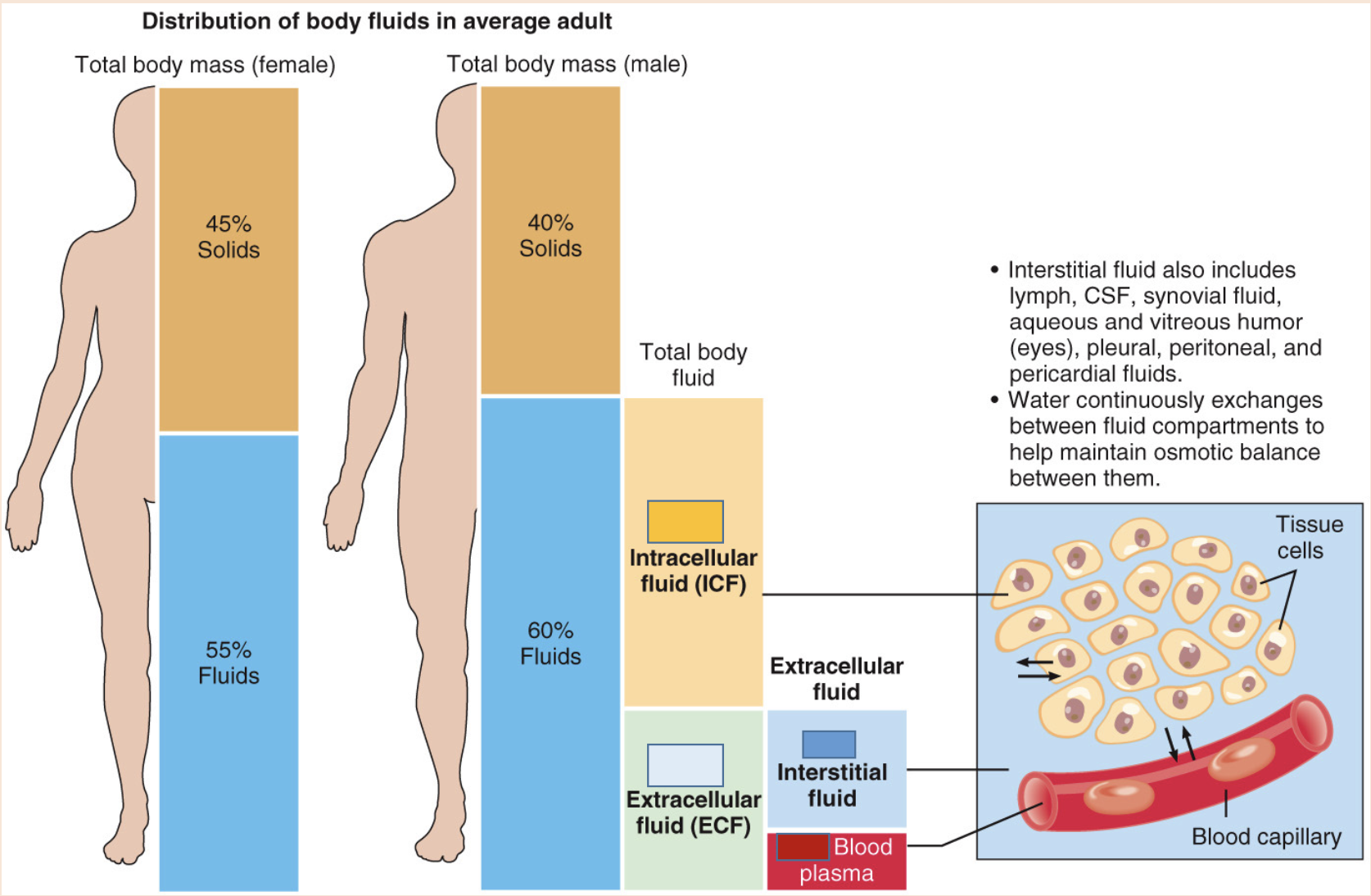
Extracellular fluid
Interstitial fluid.
Blood plasma.
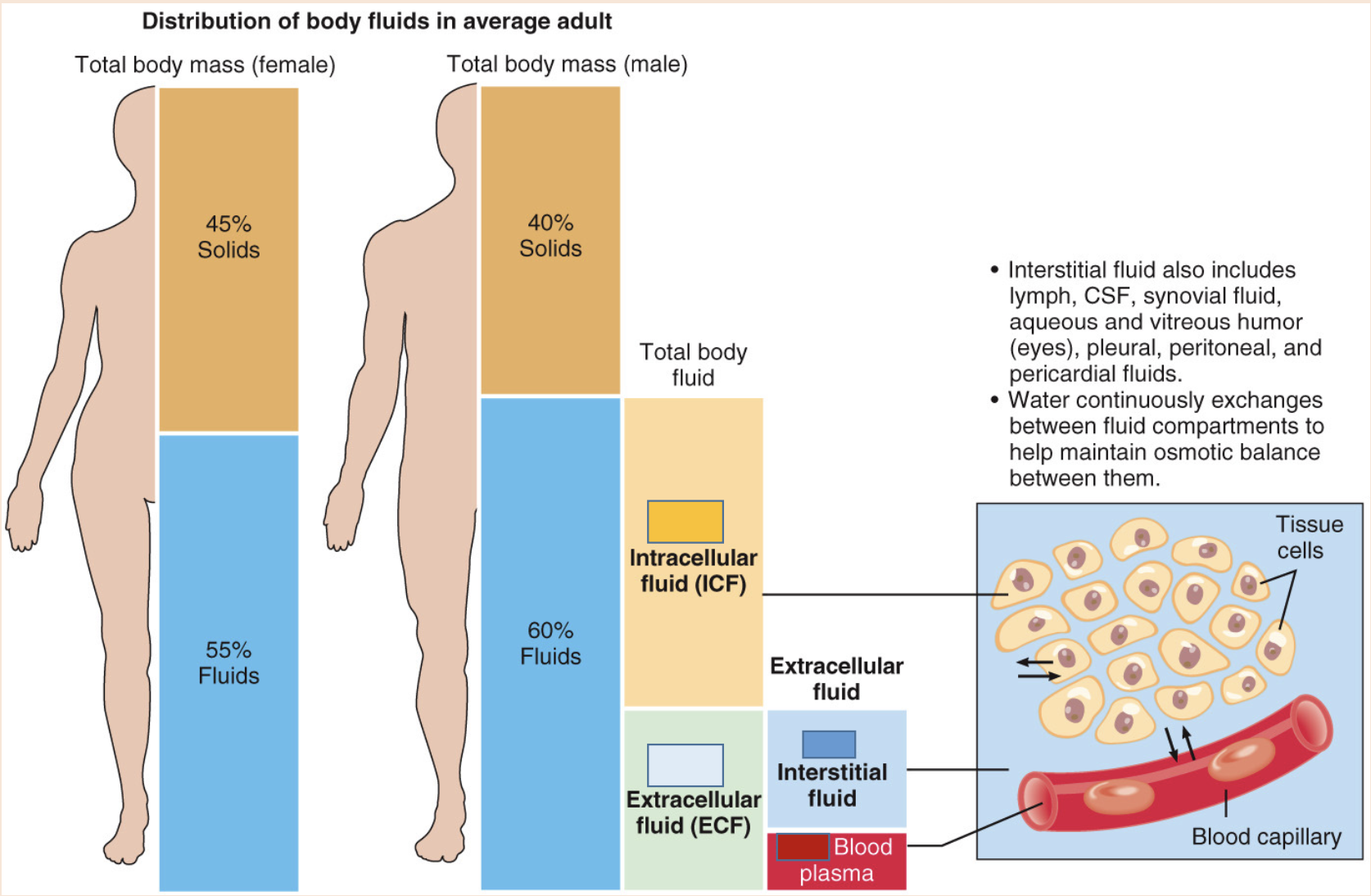
Interstitial fluid also includes
• Lymph.
• CSF.
• Synovial fluid.
• Aqueous and vitreous humor (eye).
• Pleural.
• Peritoneal.
• Pericardial fluids.
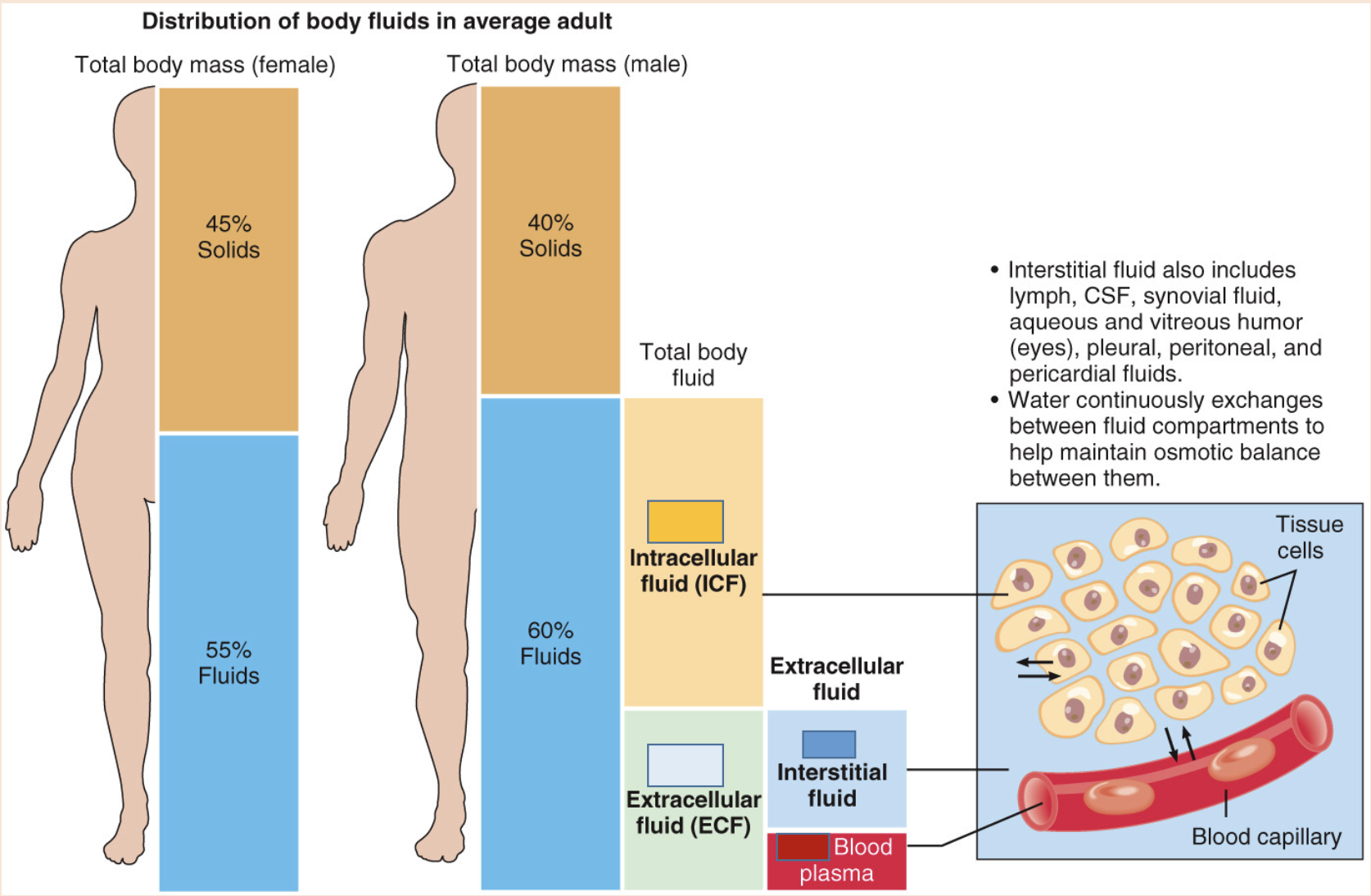
Water continuously exchanges between
Fluid compartments to help maintain osmotic balance between them.
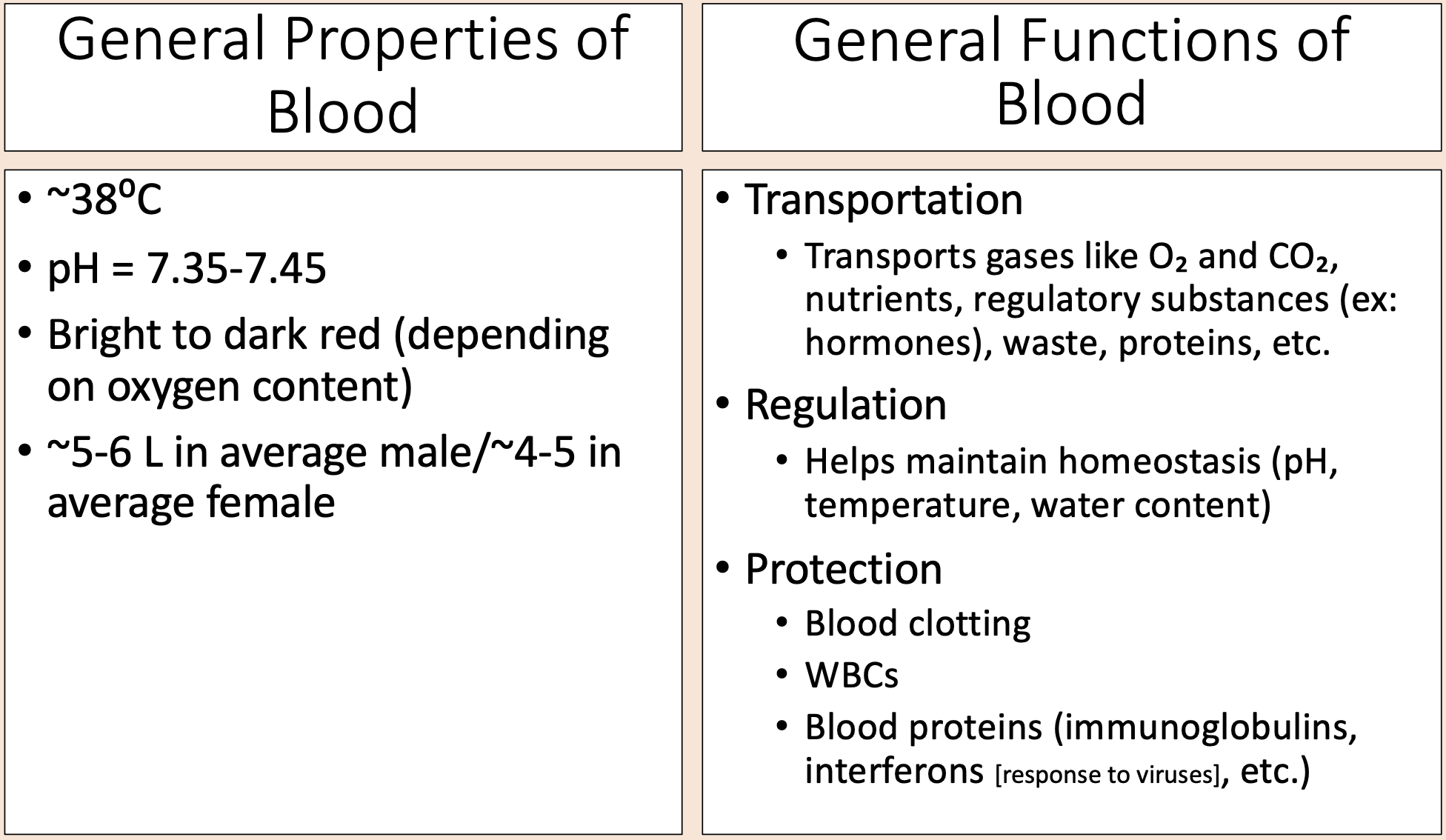
General Properties of Blood
• ~38oC.
• pH = 7.35-7.45.
• Bright to dark red (depending on oxygen content).
• ~5-6 L in average male/~4-5 in average female.
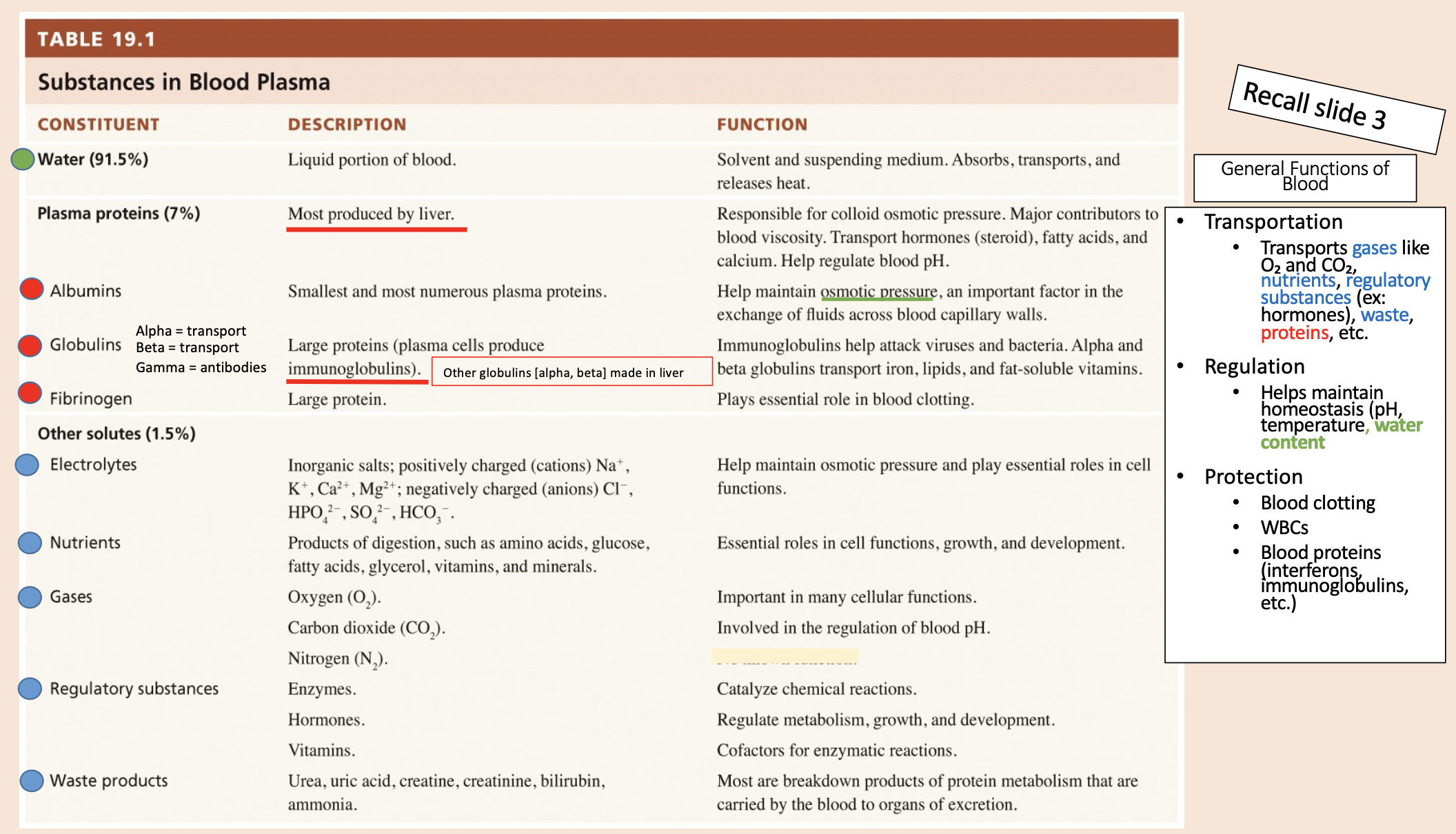
General Functions of Blood
• Transportation.
• Regulation.
• Protection.
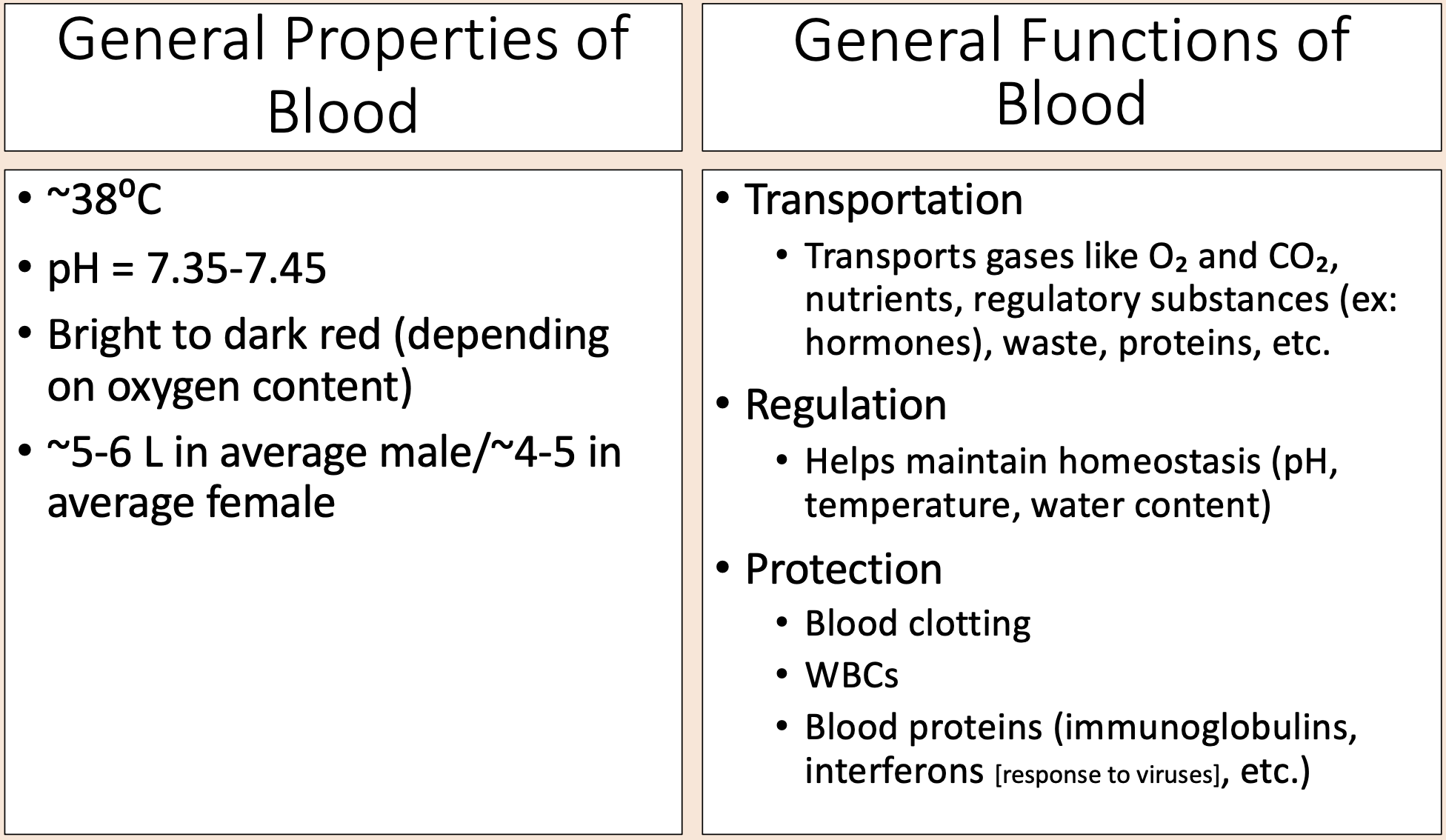
Transportation
Transports gases like O2 and CO2, nutrients, regulatory substances (ex: hormones), waste, proteins, etc.
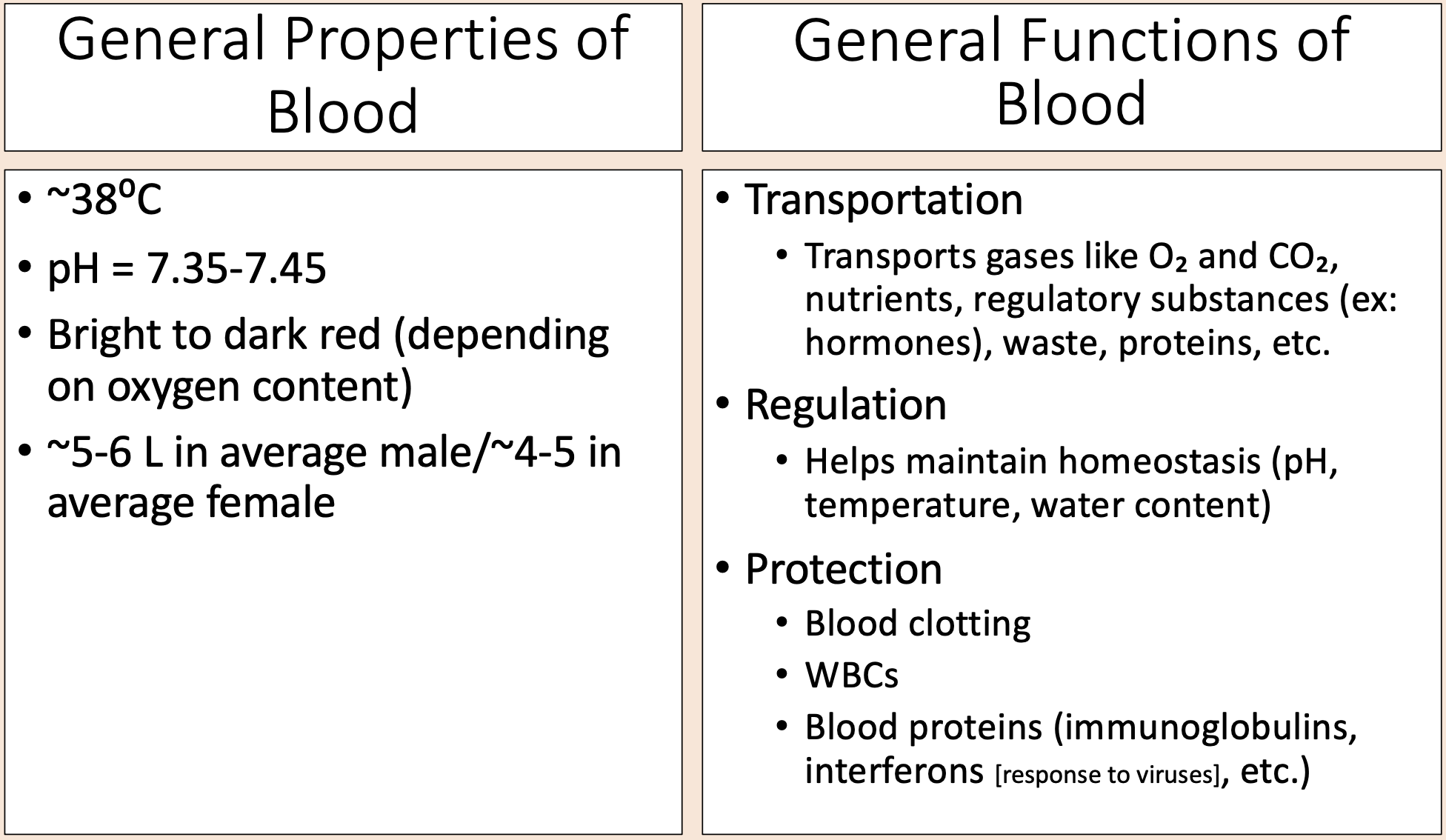
Regulation
Helps maintain homeostasis (pH, temperature, water content).
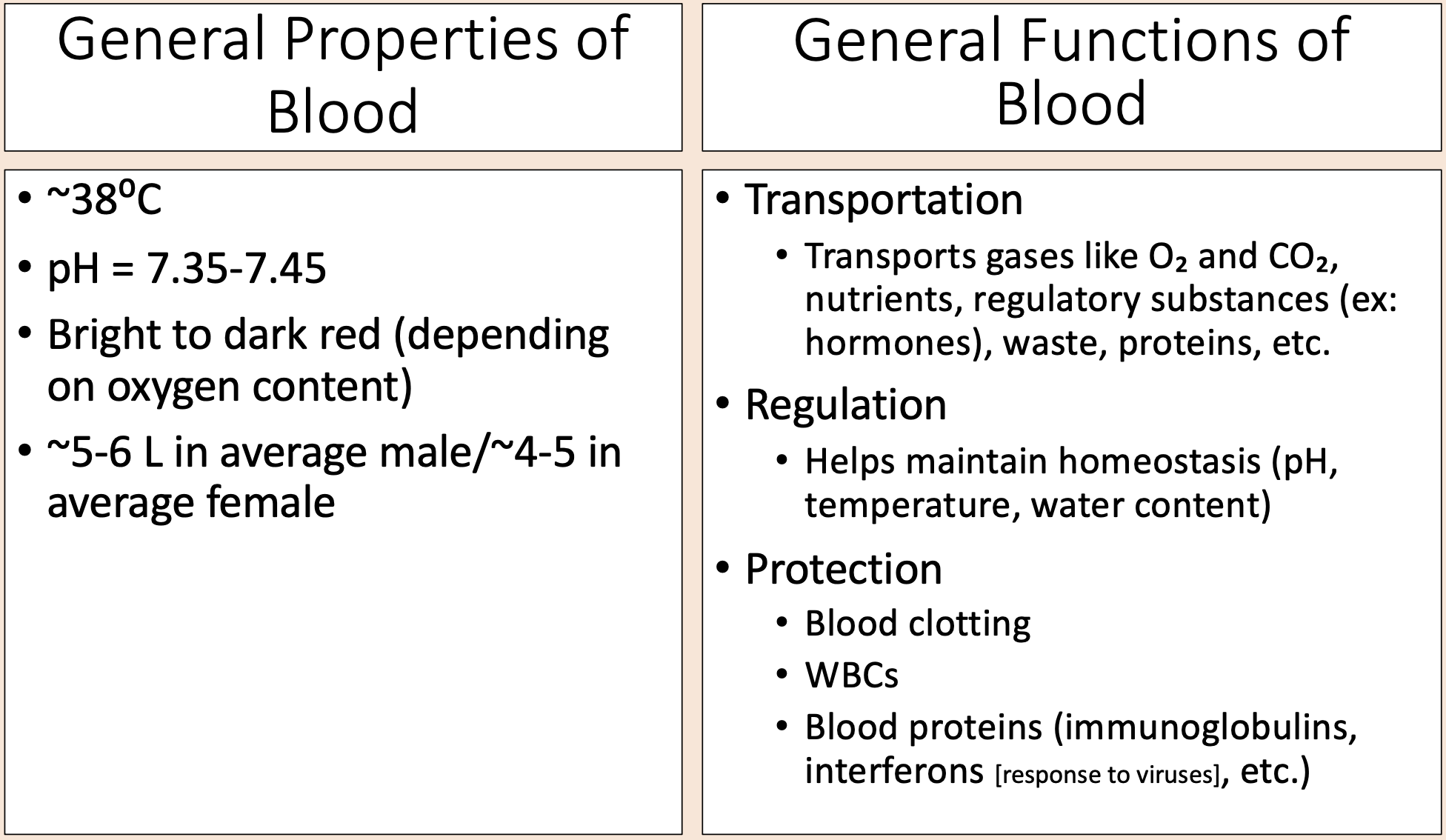
Protection
• Blood clotting.
• WBCs.
• Blood proteins (immunoglobulins, interferons [response to viruses], etc.).
![<p><span>• Blood clotting.</span></p><p><span>• WBCs.</span></p><p><span>• Blood proteins (immunoglobulins, interferons [response to viruses], etc.). </span></p>](https://knowt-user-attachments.s3.amazonaws.com/7cb0aecb-c535-4002-8279-6fe5c3f00c5d.png)
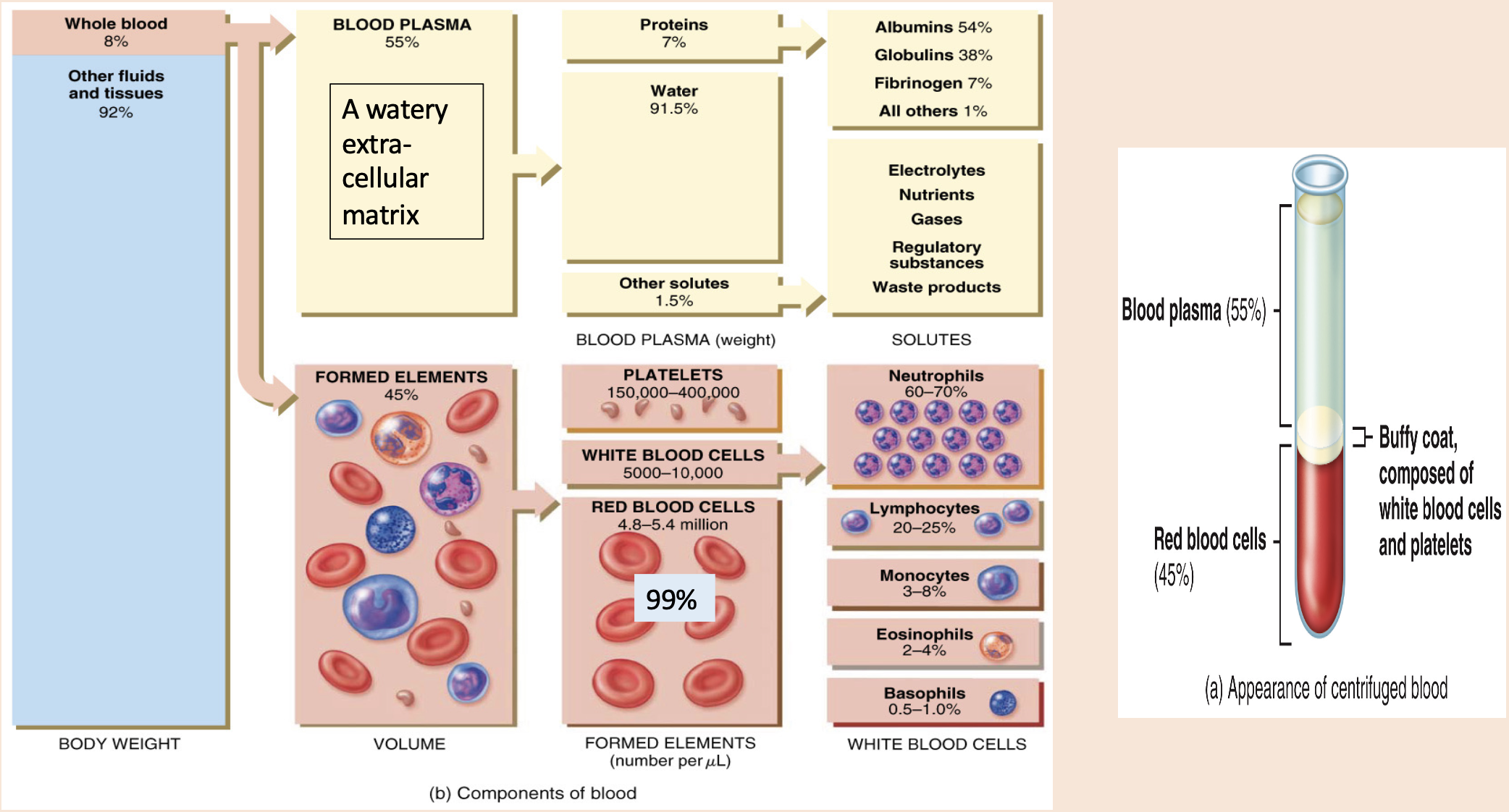
BODY WEIGHT
Whole blood 8%.
Other fluids and tissues 92%.
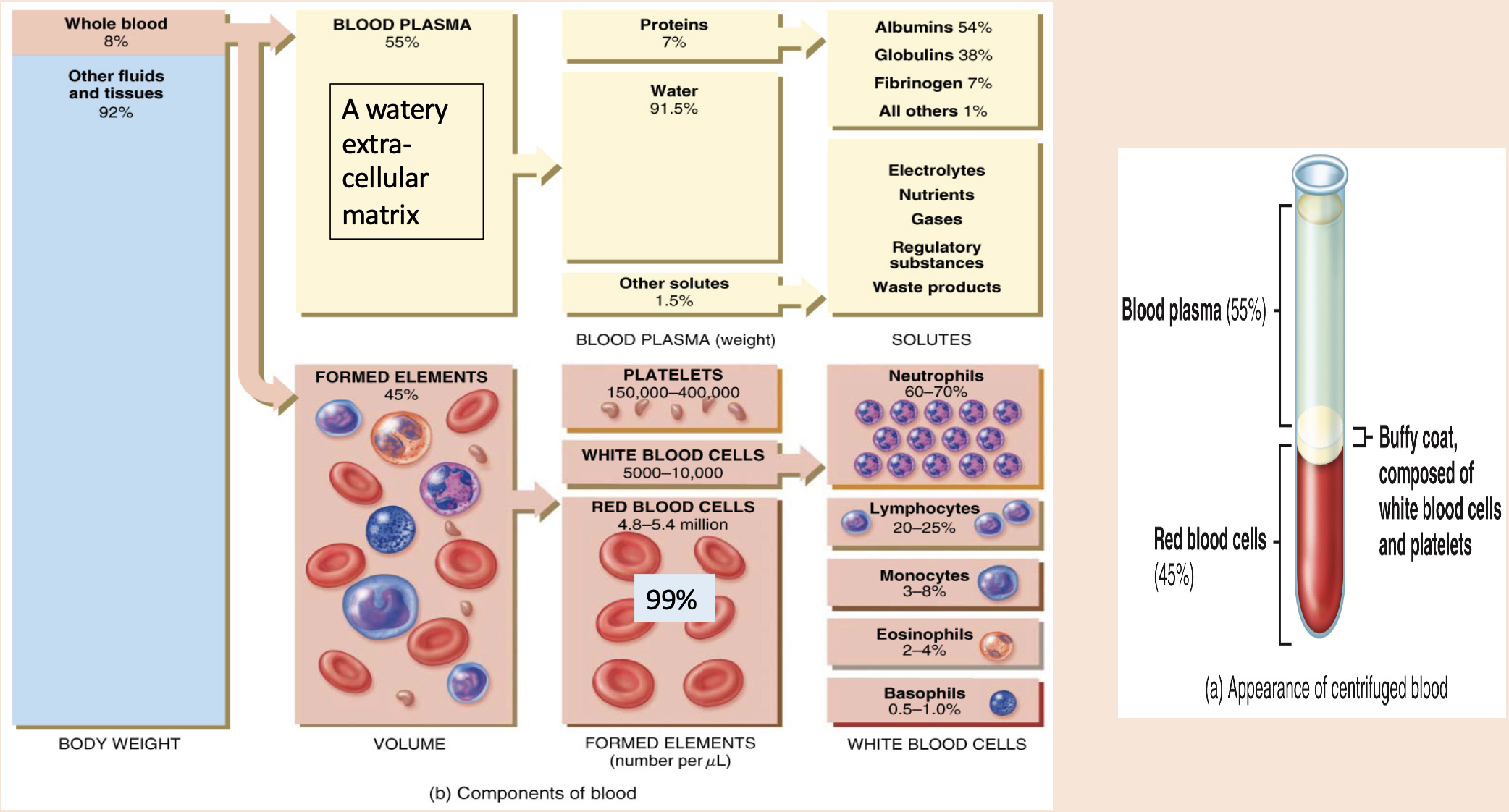
VOLUME
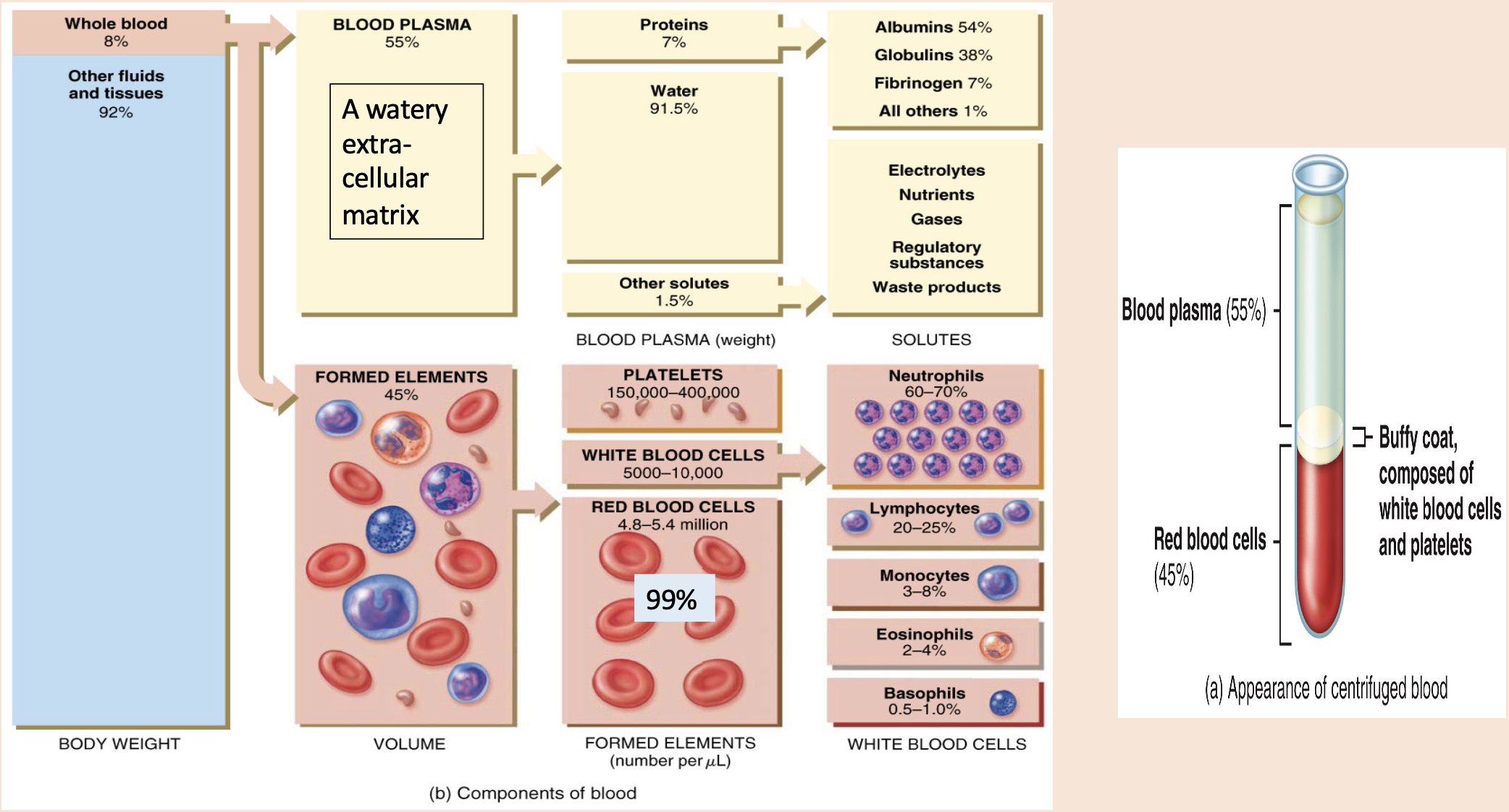
BLOOD PLASMA 55%. A water extracellular matrix.
FORMED ELEMENTS 45%.
BLOOD PLASMA (weight)
Proteins 7%.
Water 91.5%.
Other solutes 1.5%.
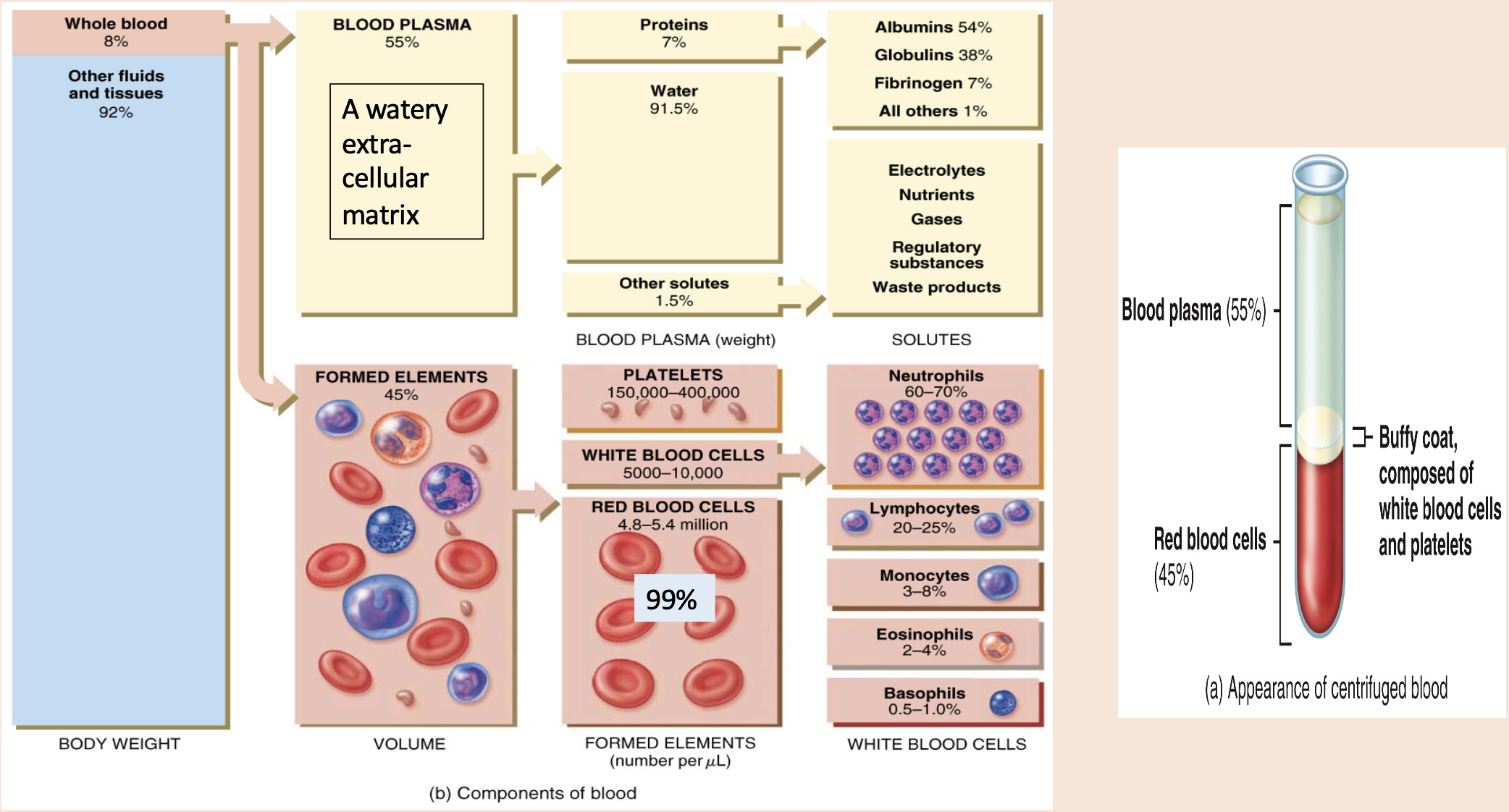
FORMED ELEMENTS (number per uL).
PLATELETS 150,000-400,000.
WHITE BLOOD CELLS 5,000-10,000.
RED BLOOD CELLS 4.8-5.4 MILLION 99%.
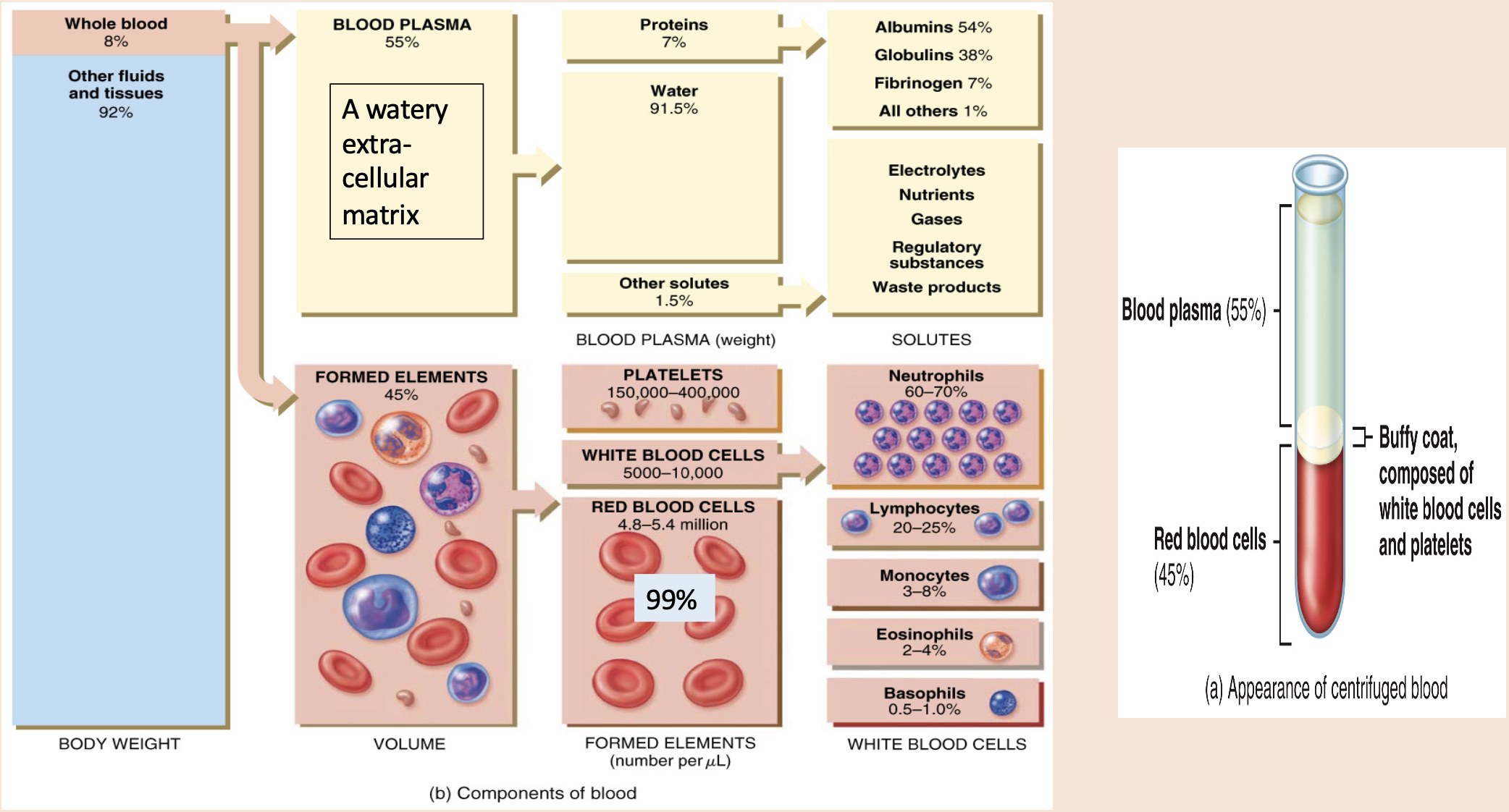
SOLUTES
Proteins.
Albumins 54%.
Globulins 38%.
Fibrinogen 7%.
All others 1%.
Other solutes.
Electrolytes.
Nutrients.
Gases.
Regulatory substances.
Waste products.
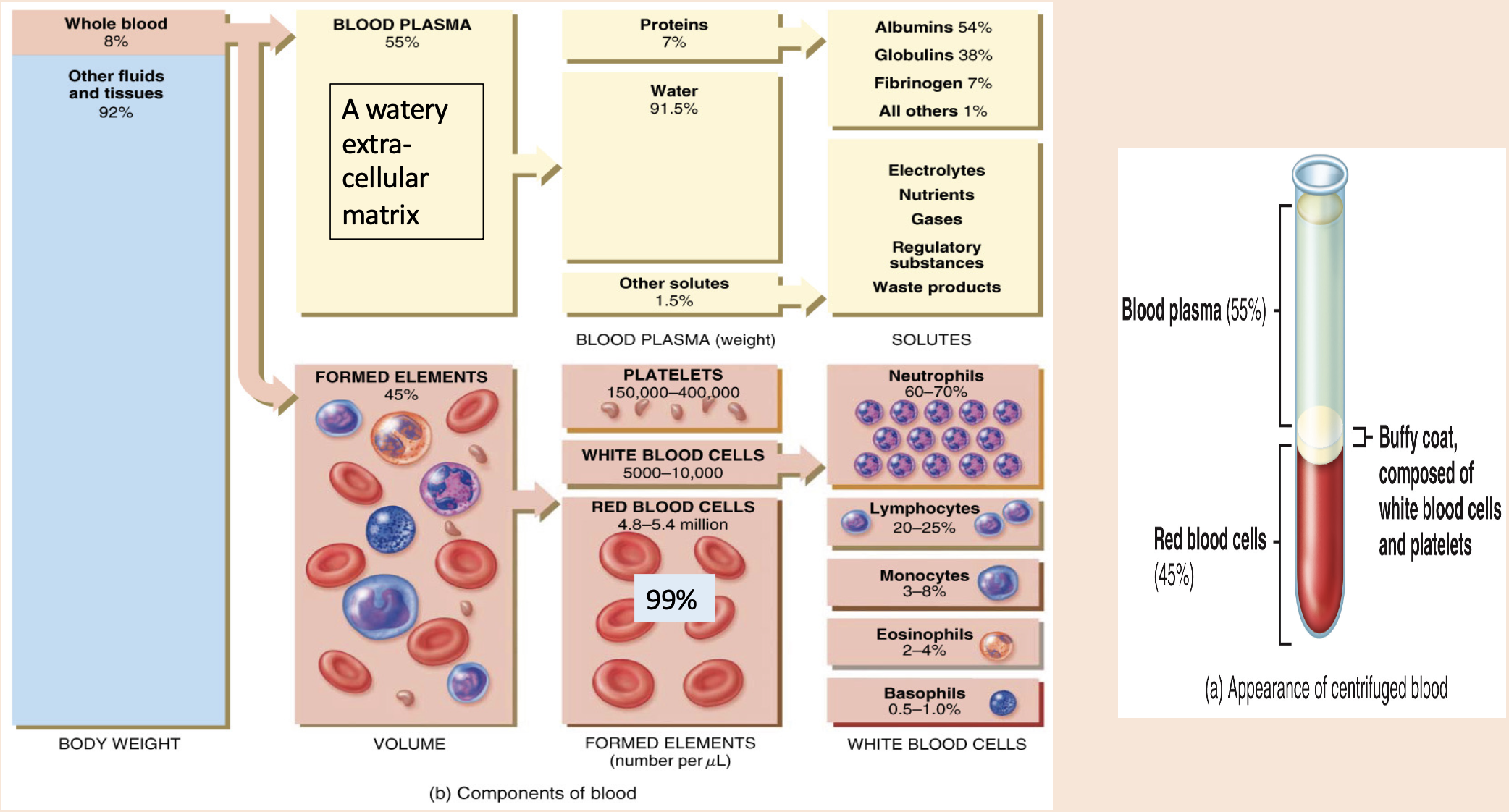
WHITE BLOOD CELLS
Neutrophils 60-70%.
Lymphocytes 20-25%.
Monocytes 3-8%.
Eosinophils 2-4%.
Basophils 0.5-1.0%.
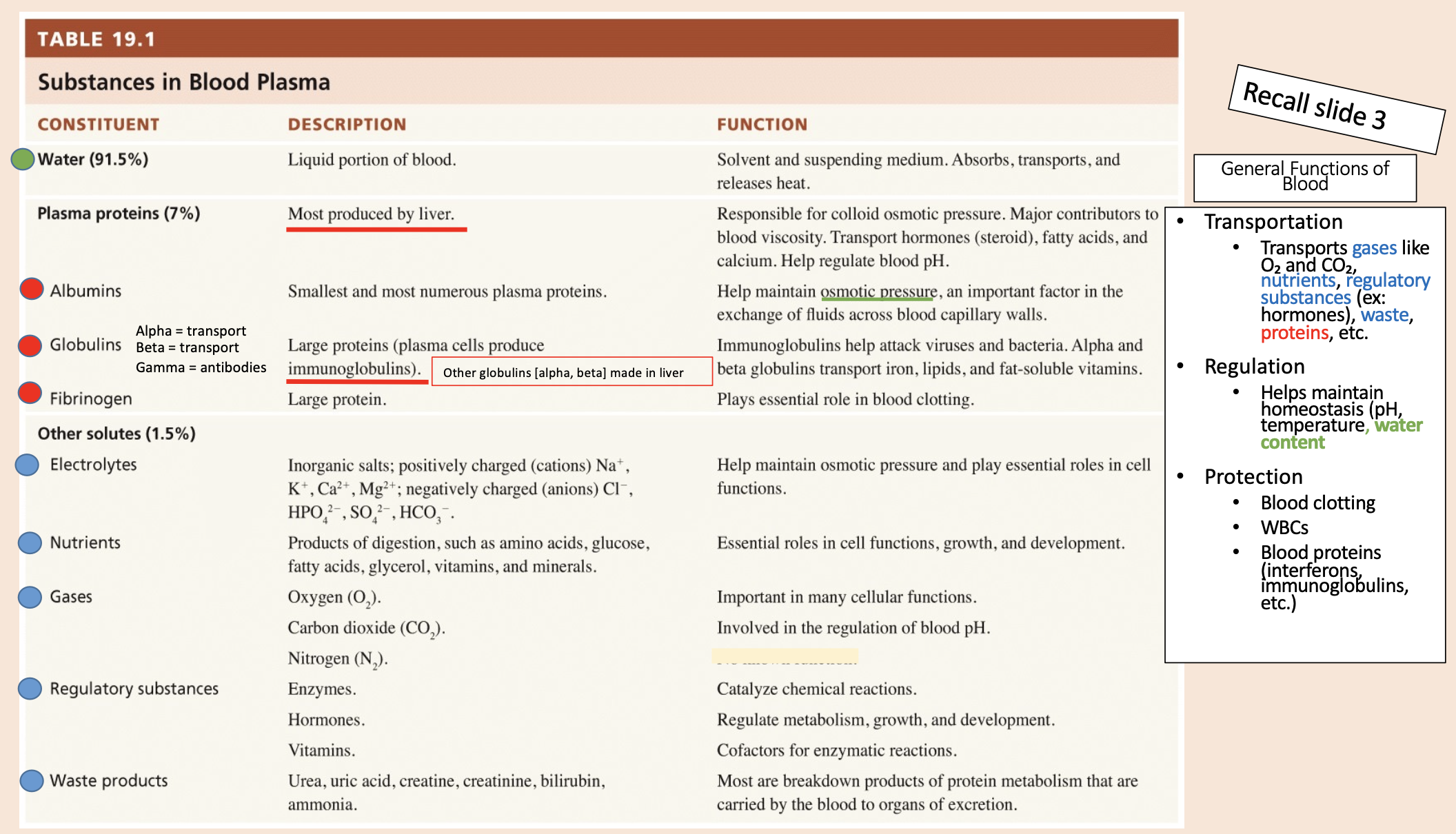
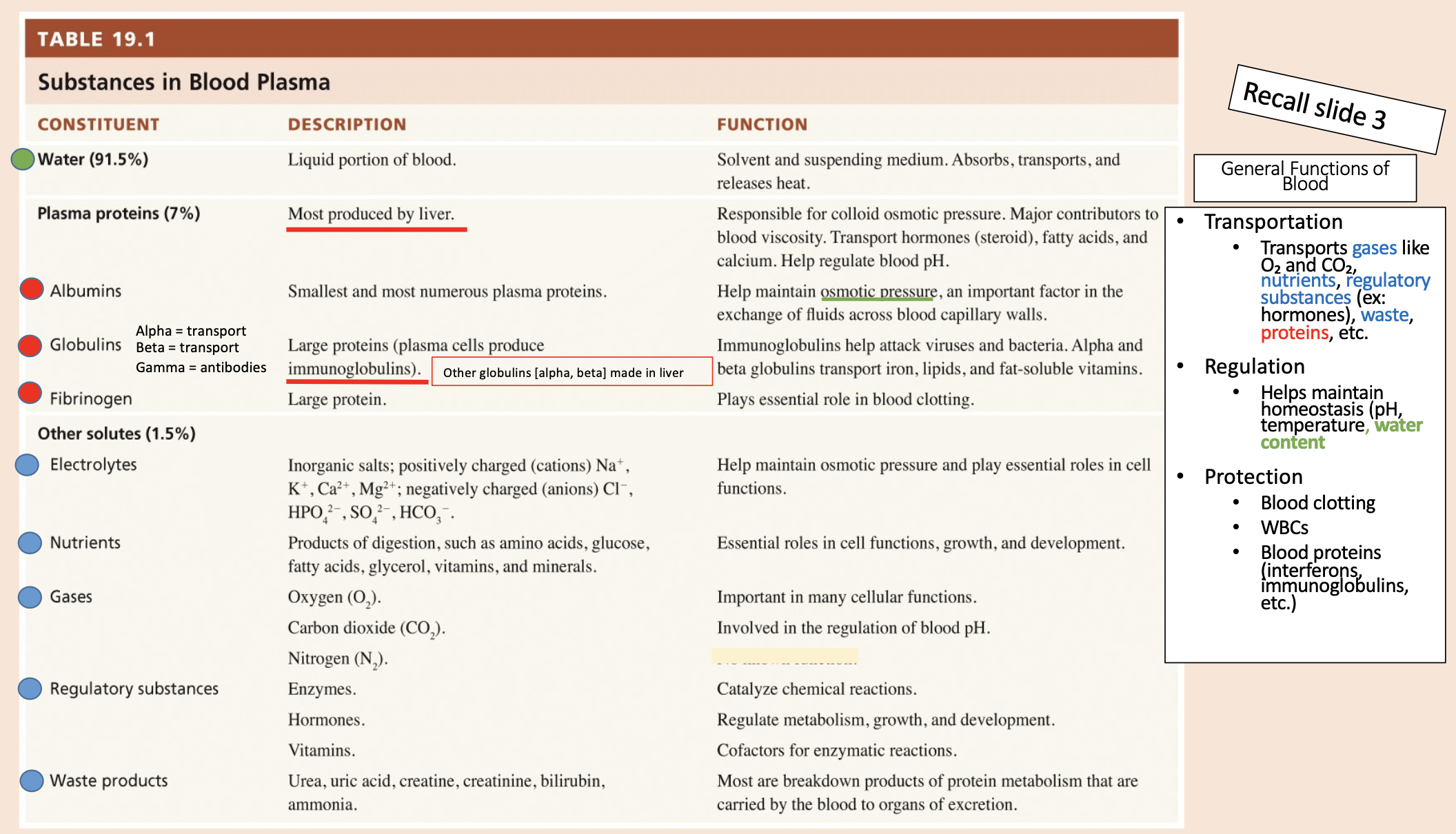
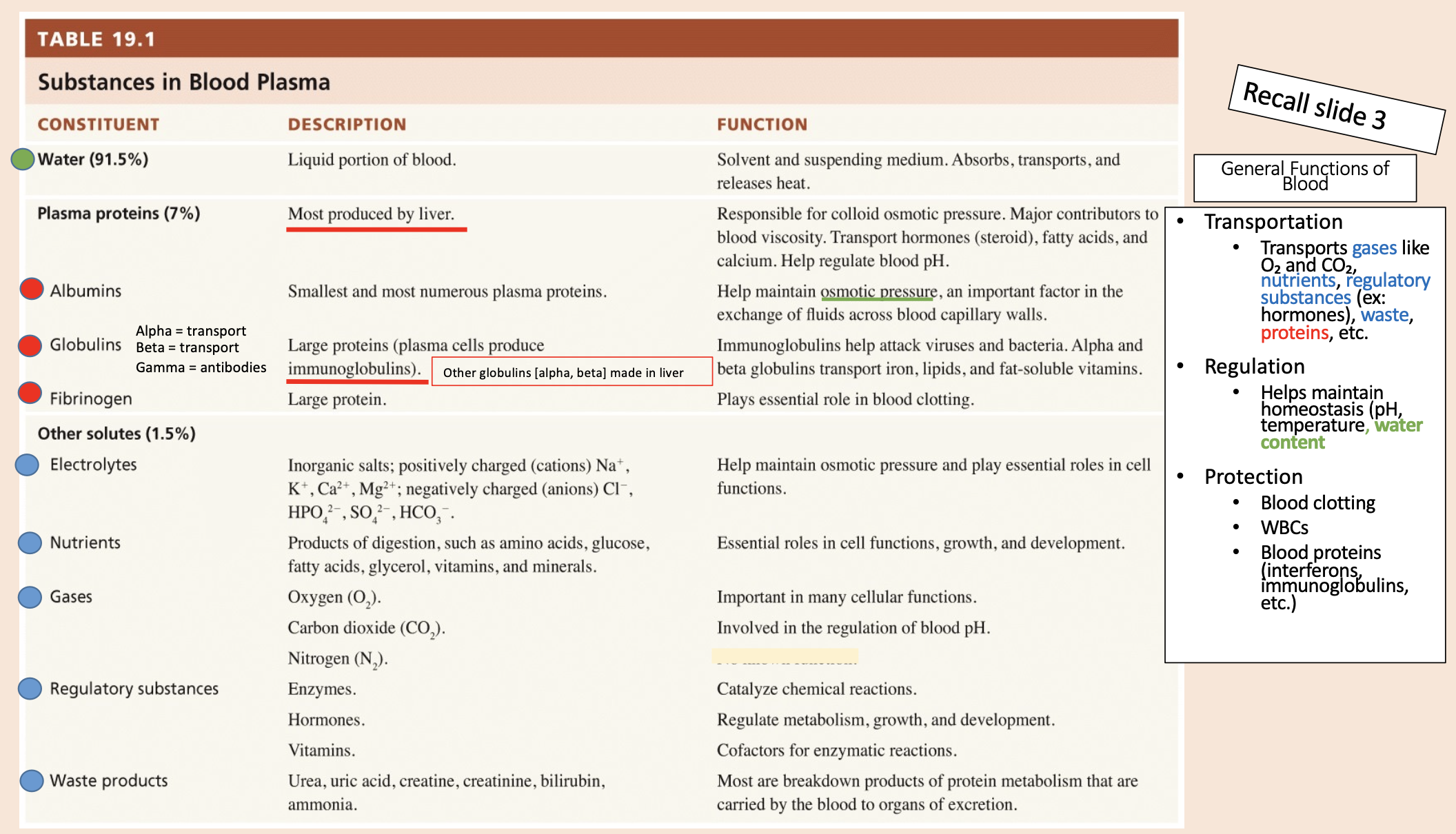
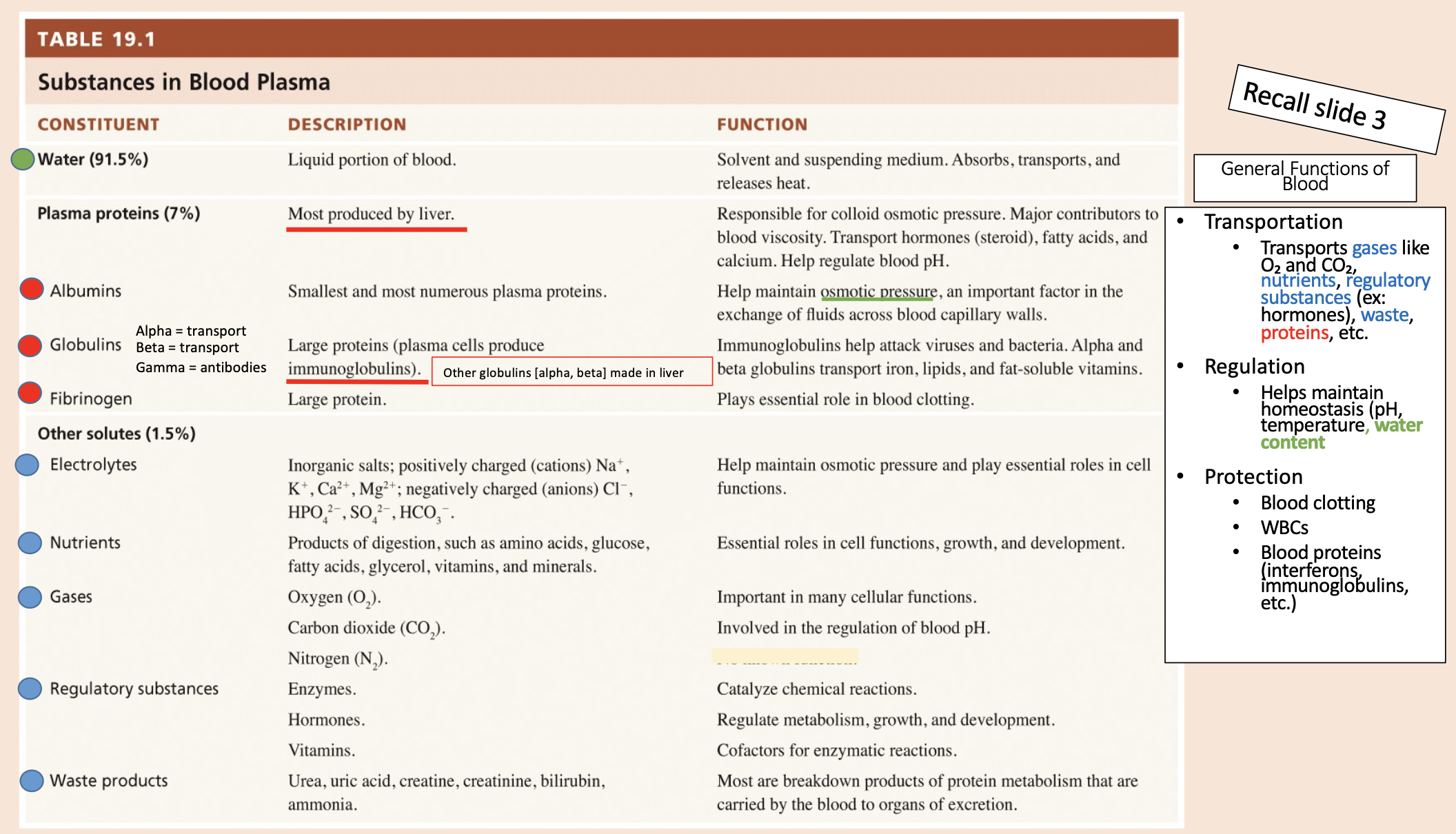
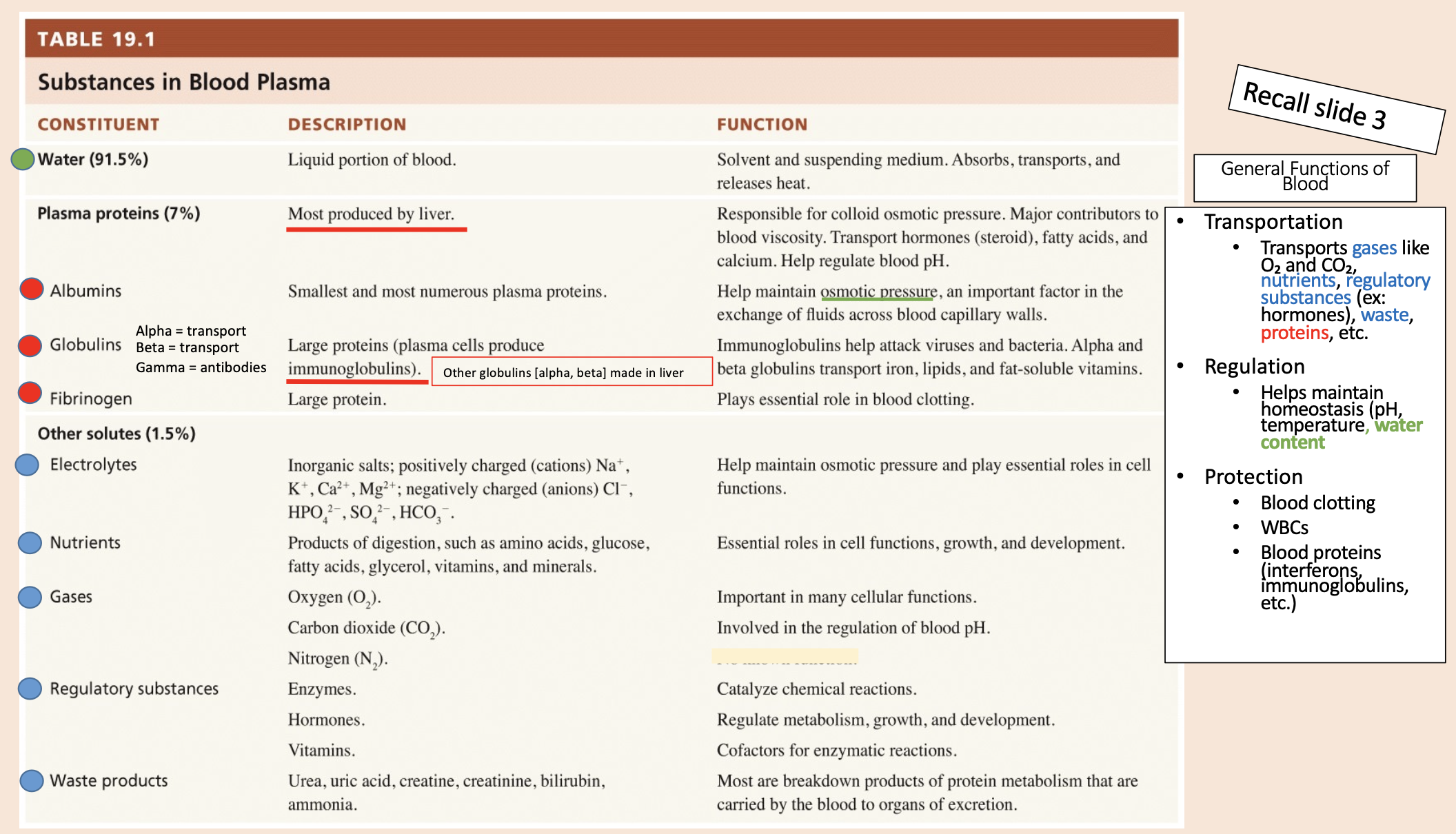
Substances in Blood Plasma
• Water (91.5%).
• Plasma proteins (7%).
• Albumins.
• Globulins.
• Fibrinogen.
• Other Solutes (1.5%).
• Electrolytes.
• Nutrients.
• Gases.
• Regulatory substances.
• Waste products.
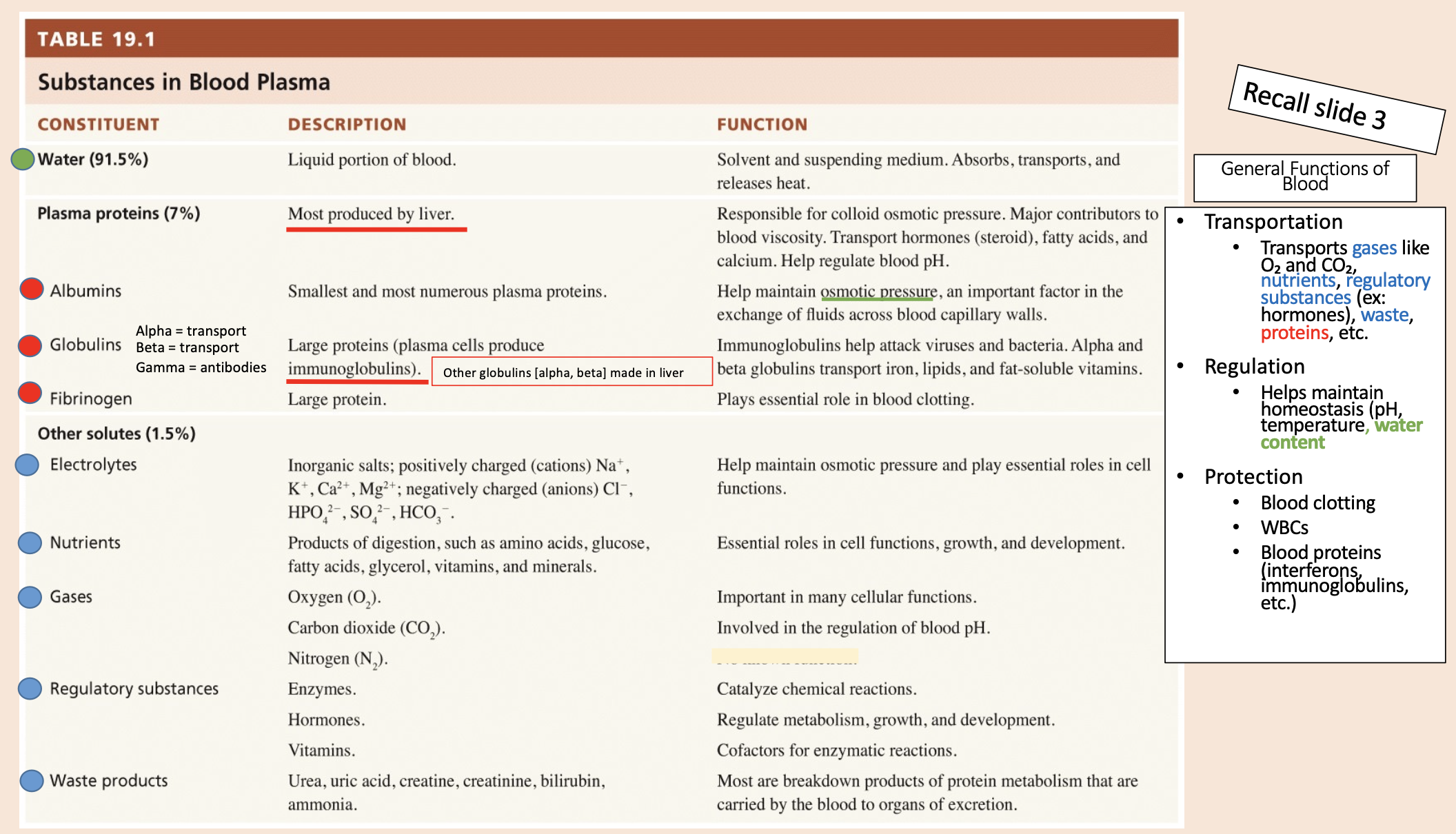
Water (91.5%) Description
Liquid portion of blood.
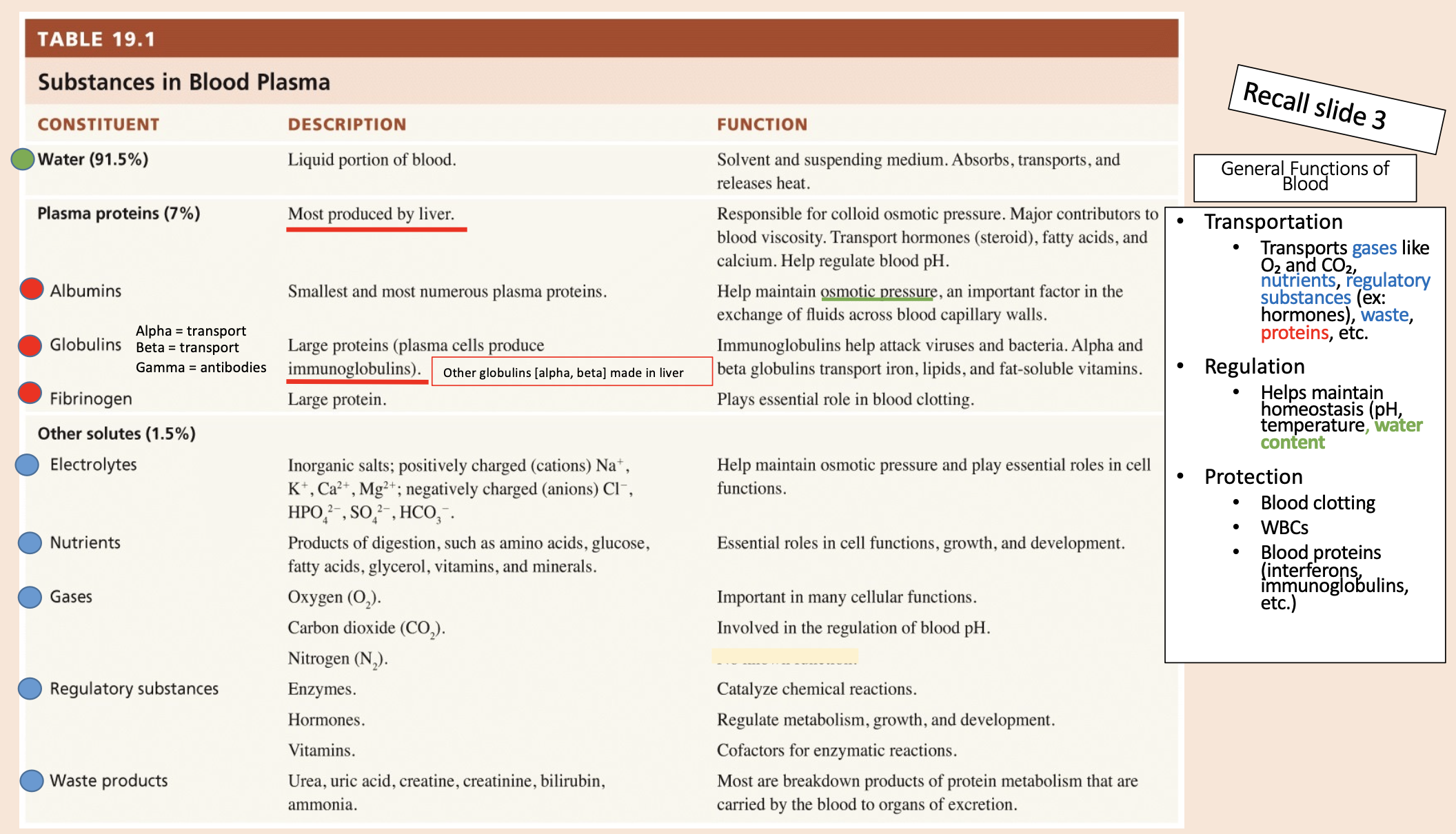
Water (91.5%) Function
Solvent and suspending medium. Absorbs, transports, and releases heat.
Plasma proteins (7%) Description
Most produced by liver.
Plasma proteins (7%) Function
Responsible for colloid osmotic pressure. Major contributors to blood viscosity. Transport hormones (steroid), fatty acids, and calcium. Help regulate blood pH.
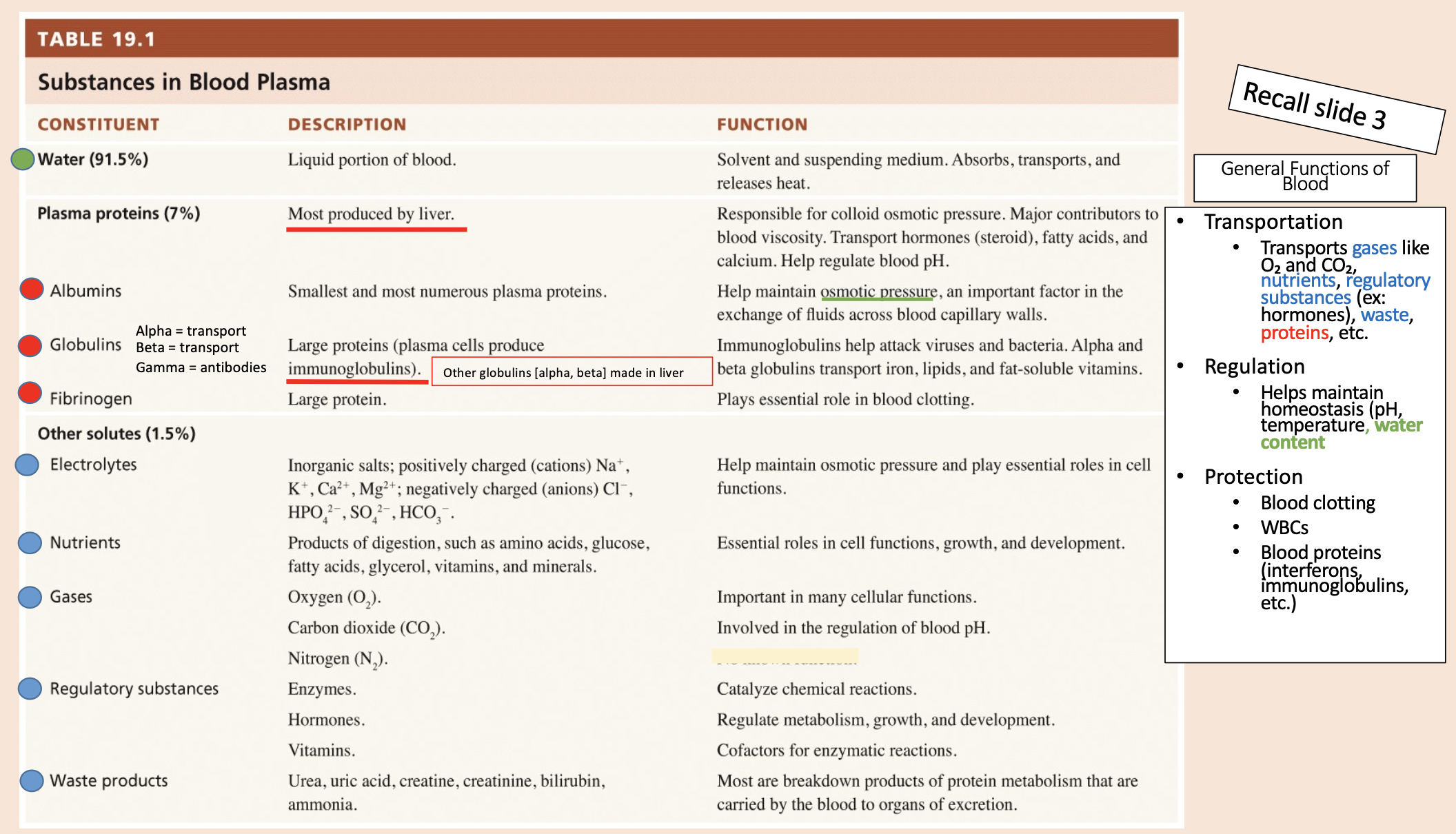
Albumins Description
Smallest and most numerous plasma proteins.
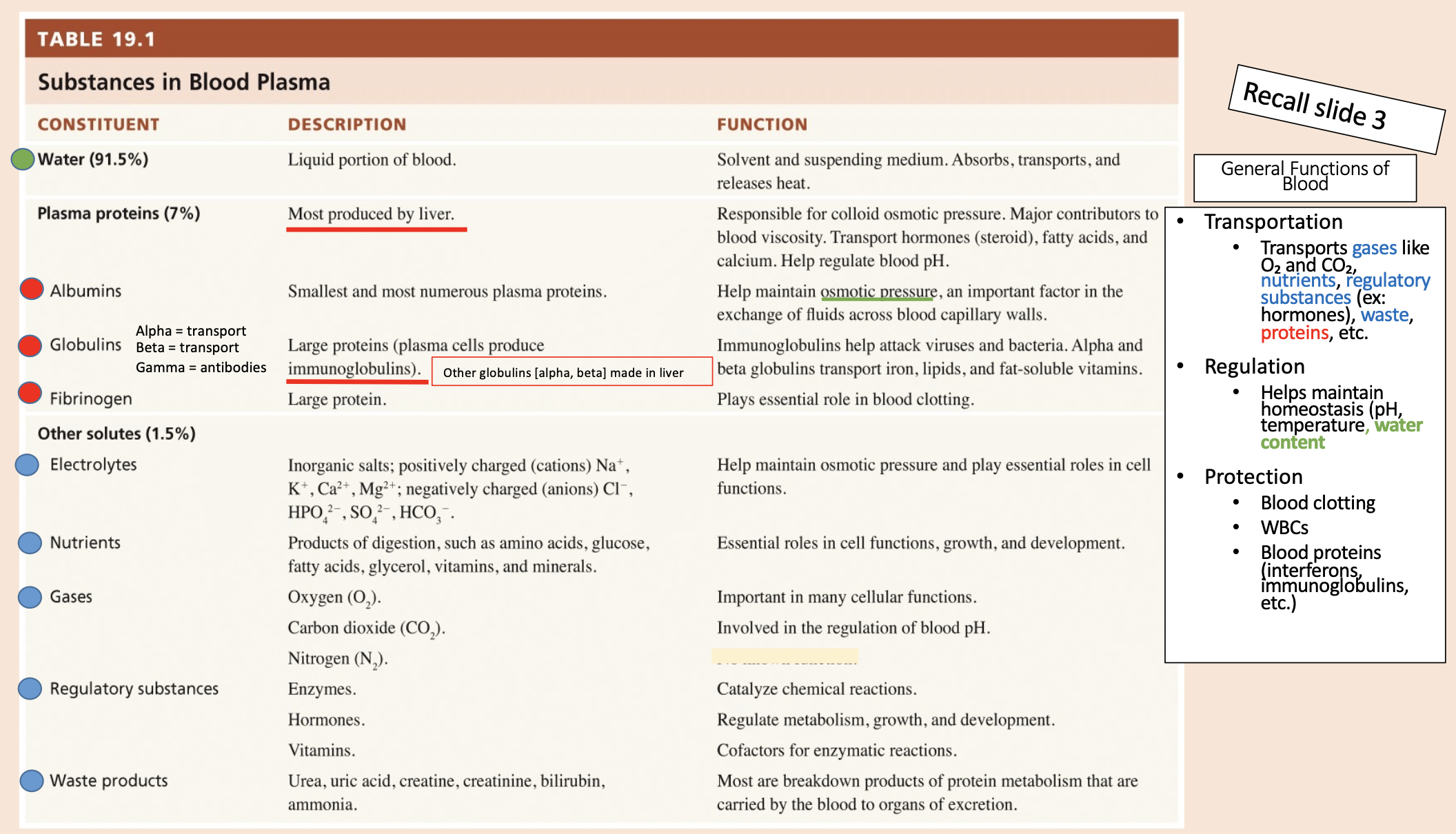
Albumins Function
Help maintain osmotic pressure, an important factor in the exchange of fluids across blood capillary walls.
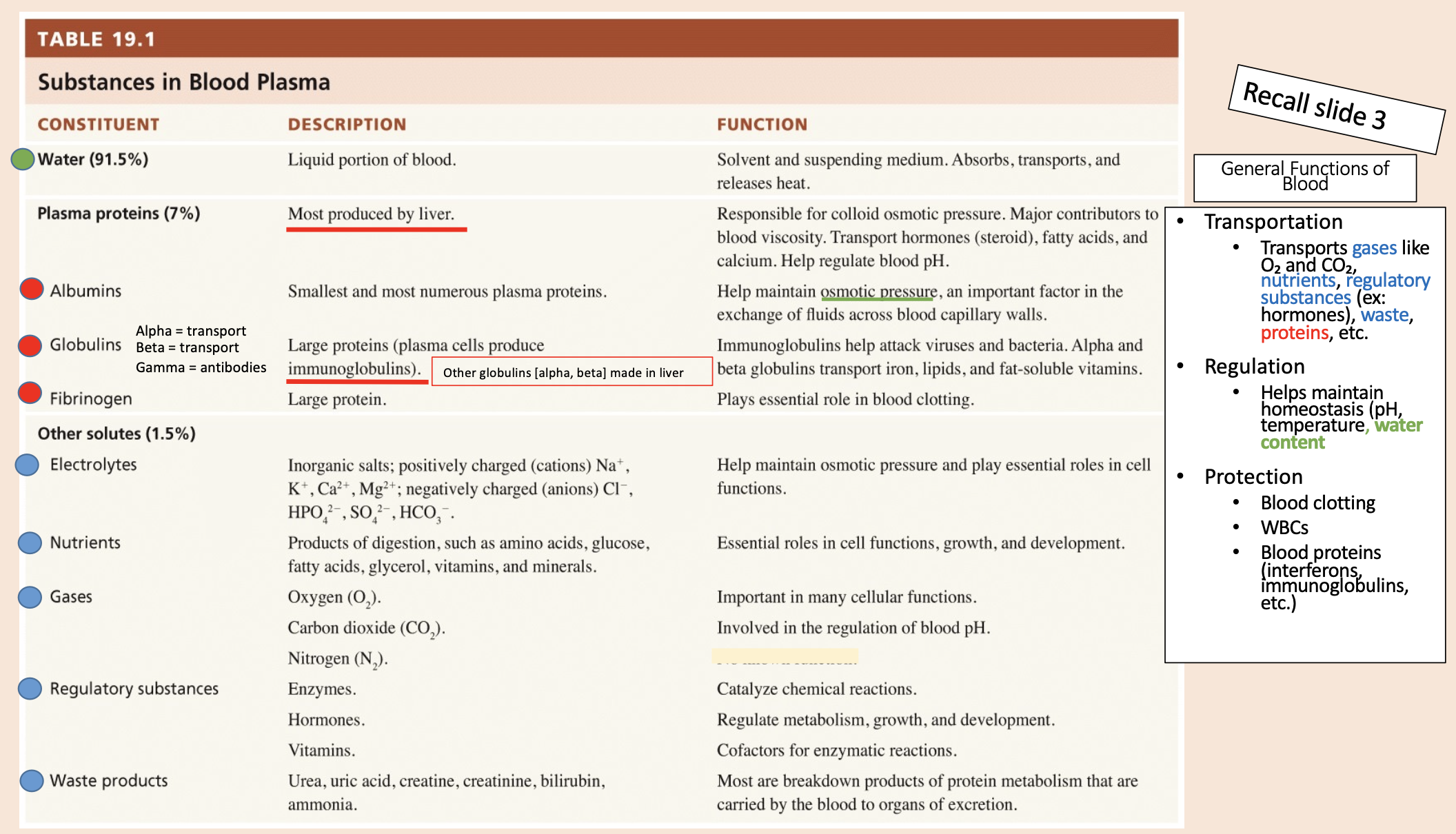
Globulins Alpha
Transport.
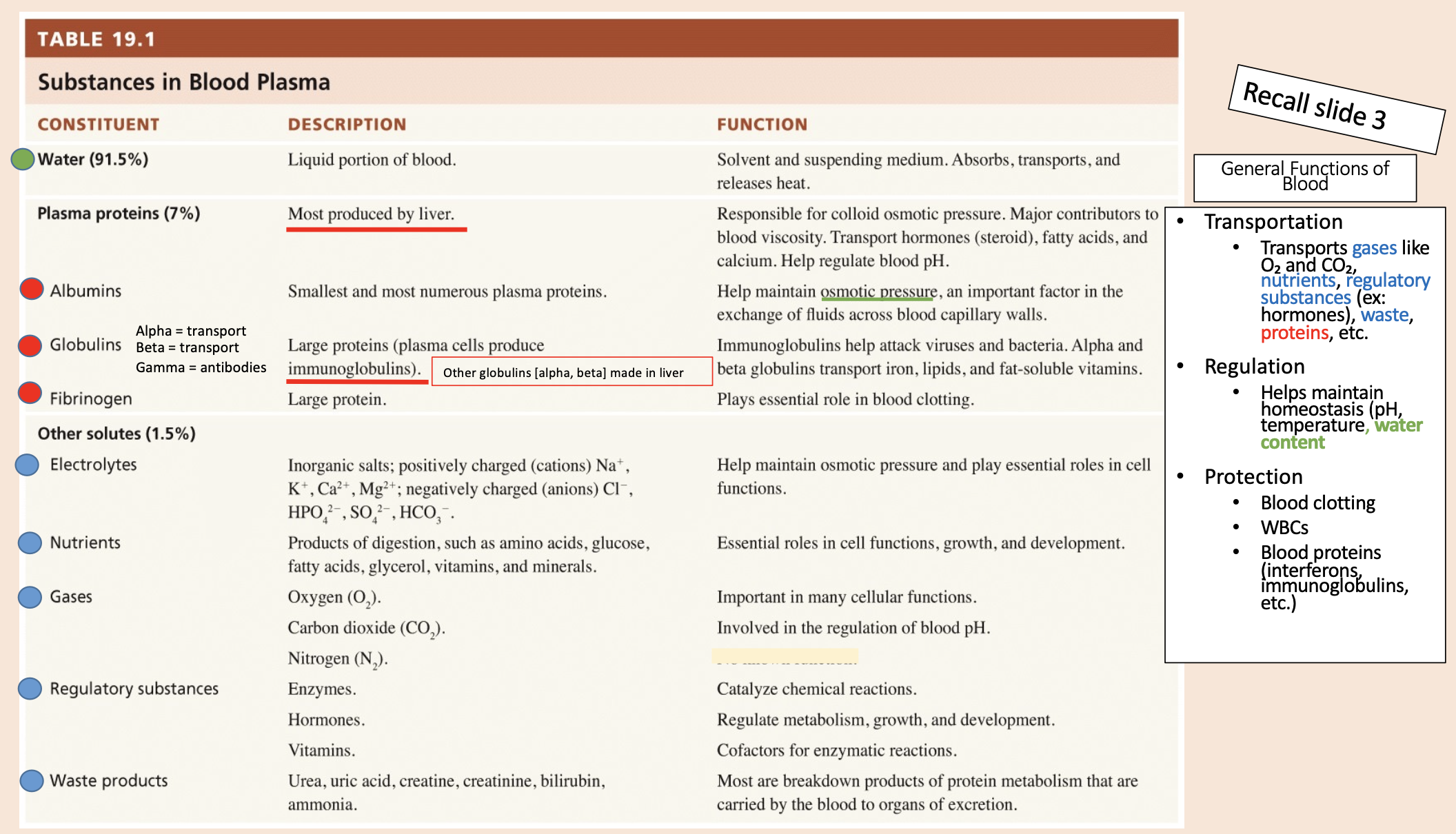
Globulins Beta
Transport.
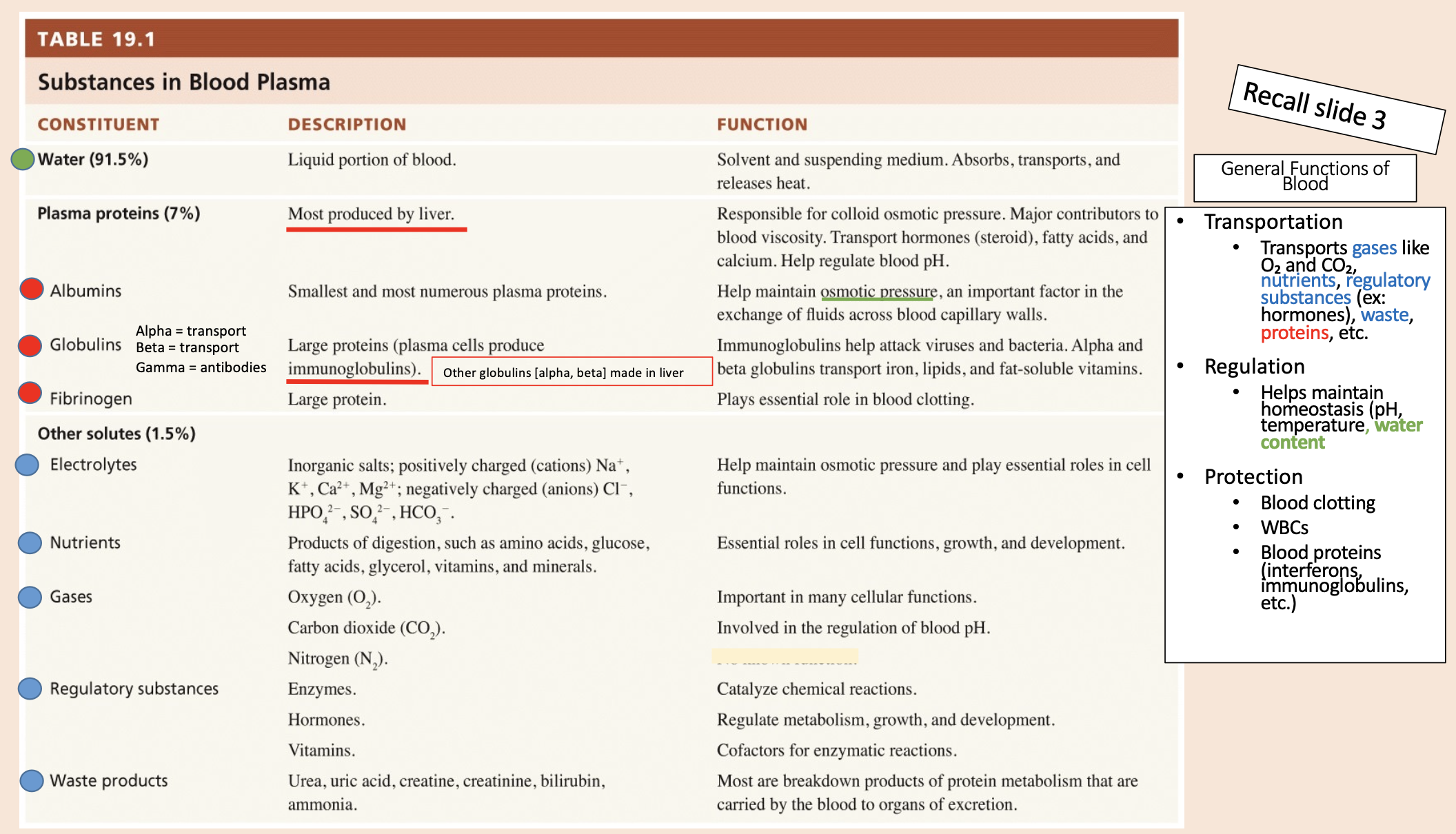
Globulins Gamma
Antibodies.
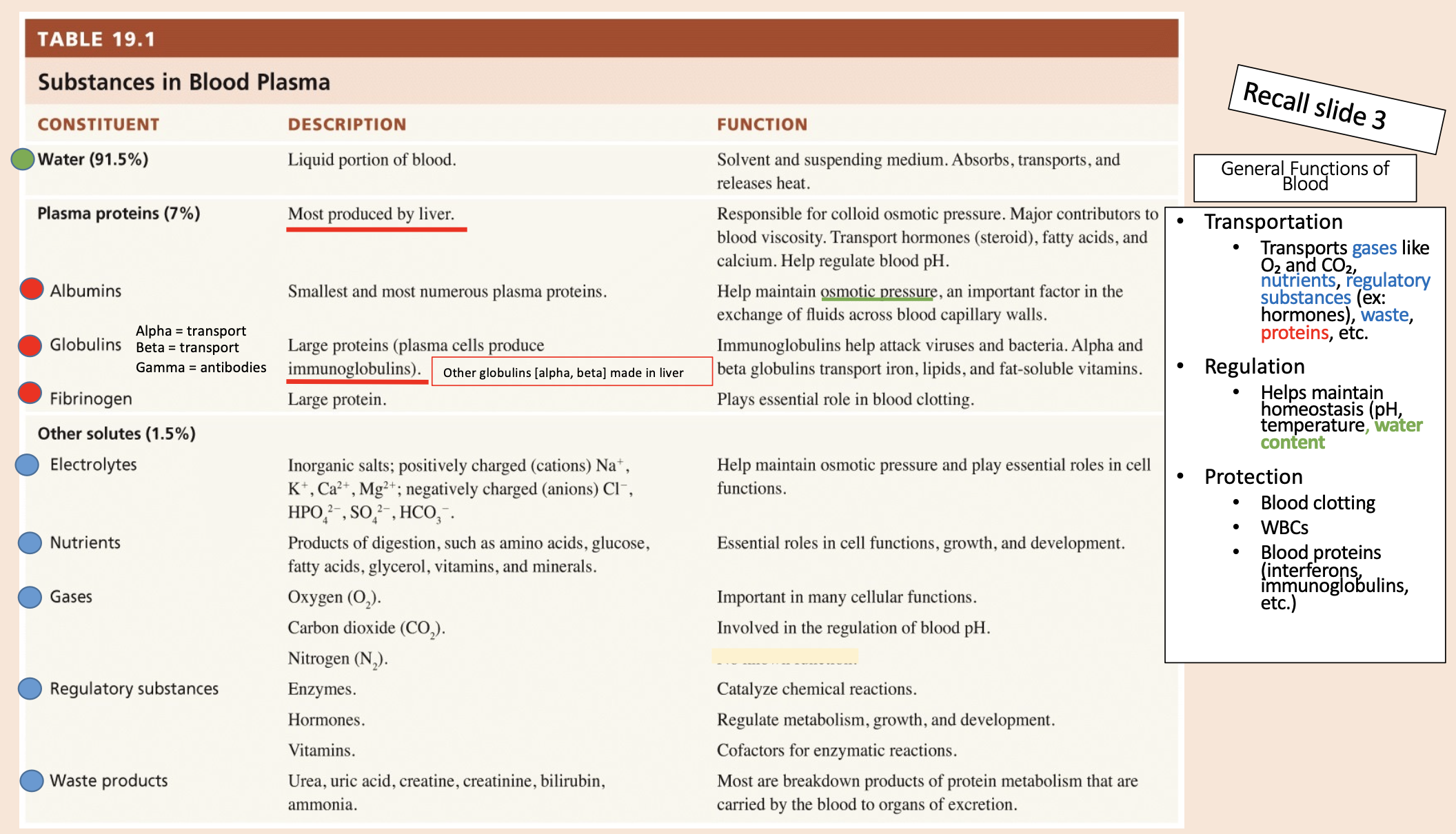
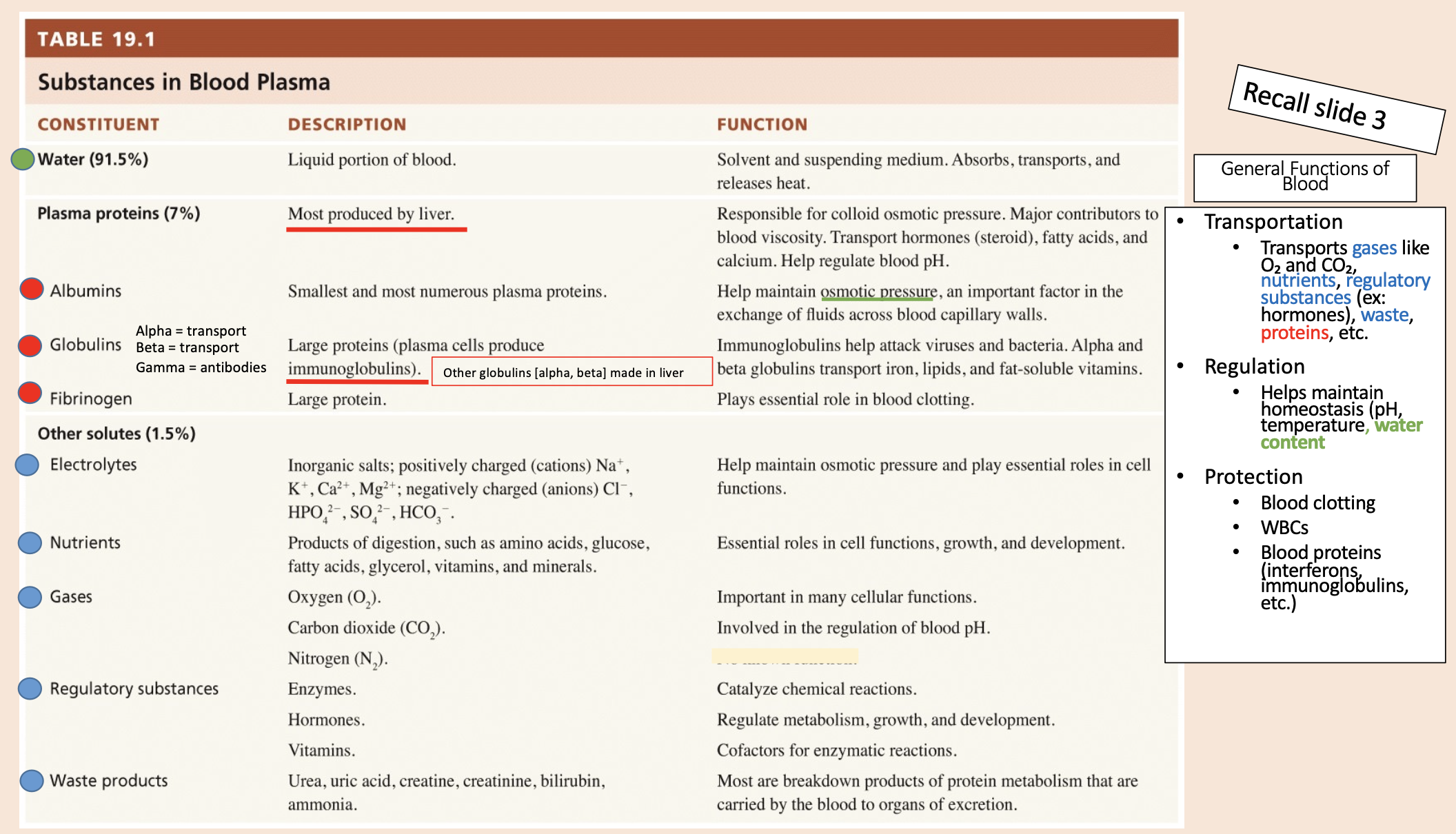
Globulins Description
Large proteins (plasma cells produce immunoglobulins). Other globulins [alpha, beta] made in liver.
![<p>Large proteins (plasma cells produce immunoglobulins). Other globulins [alpha, beta] made in liver. </p>](https://knowt-user-attachments.s3.amazonaws.com/6bcedeeb-2dcb-4f61-91a5-618331c3b3d4.png)
Globulins Function
Immunoglobulins help attack viruses and bacteria. Alpha and beta globulins transport iron, lipids, and fat-soluble vitamins.
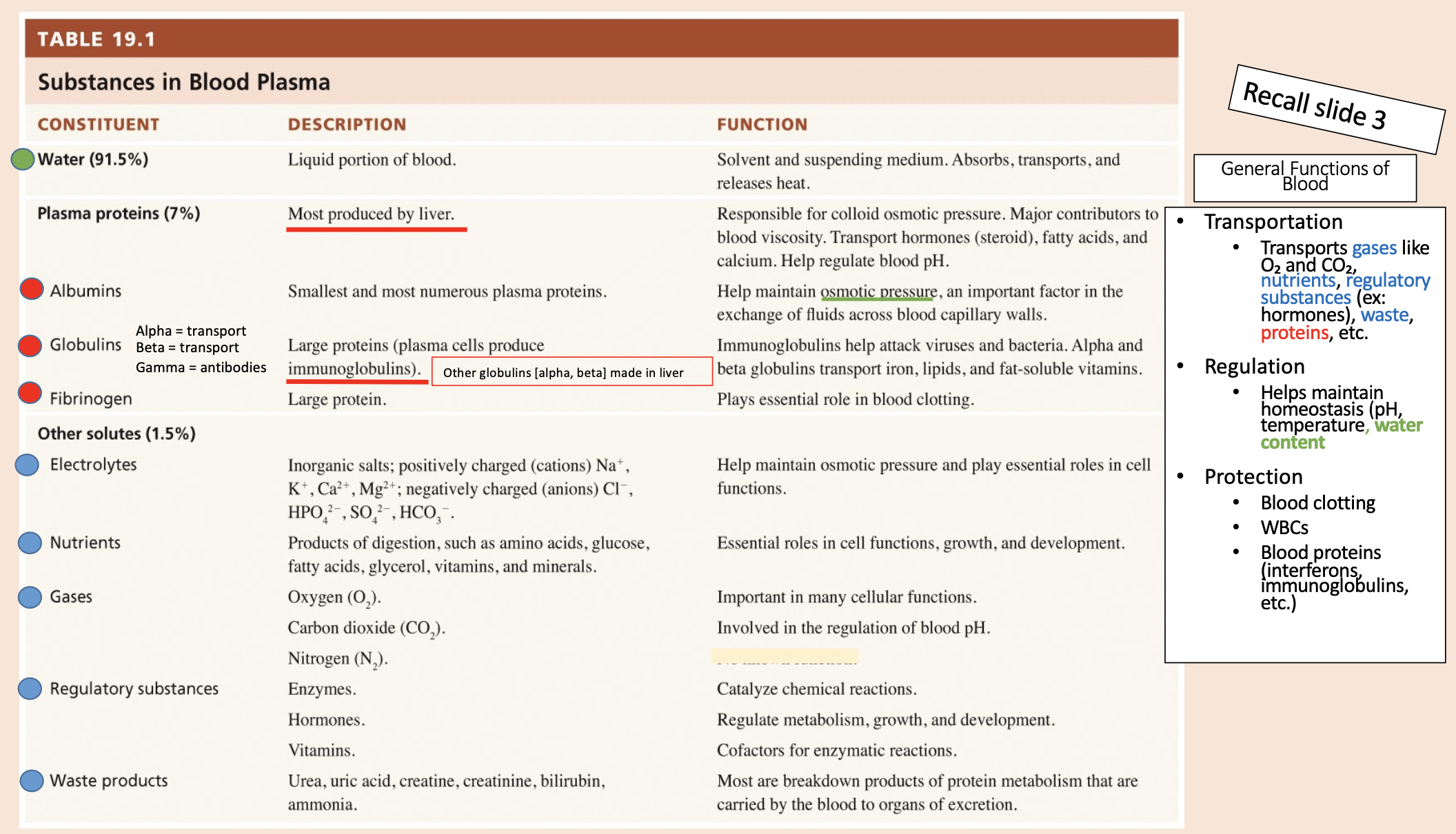
Fibrinogen Description
Large protein.
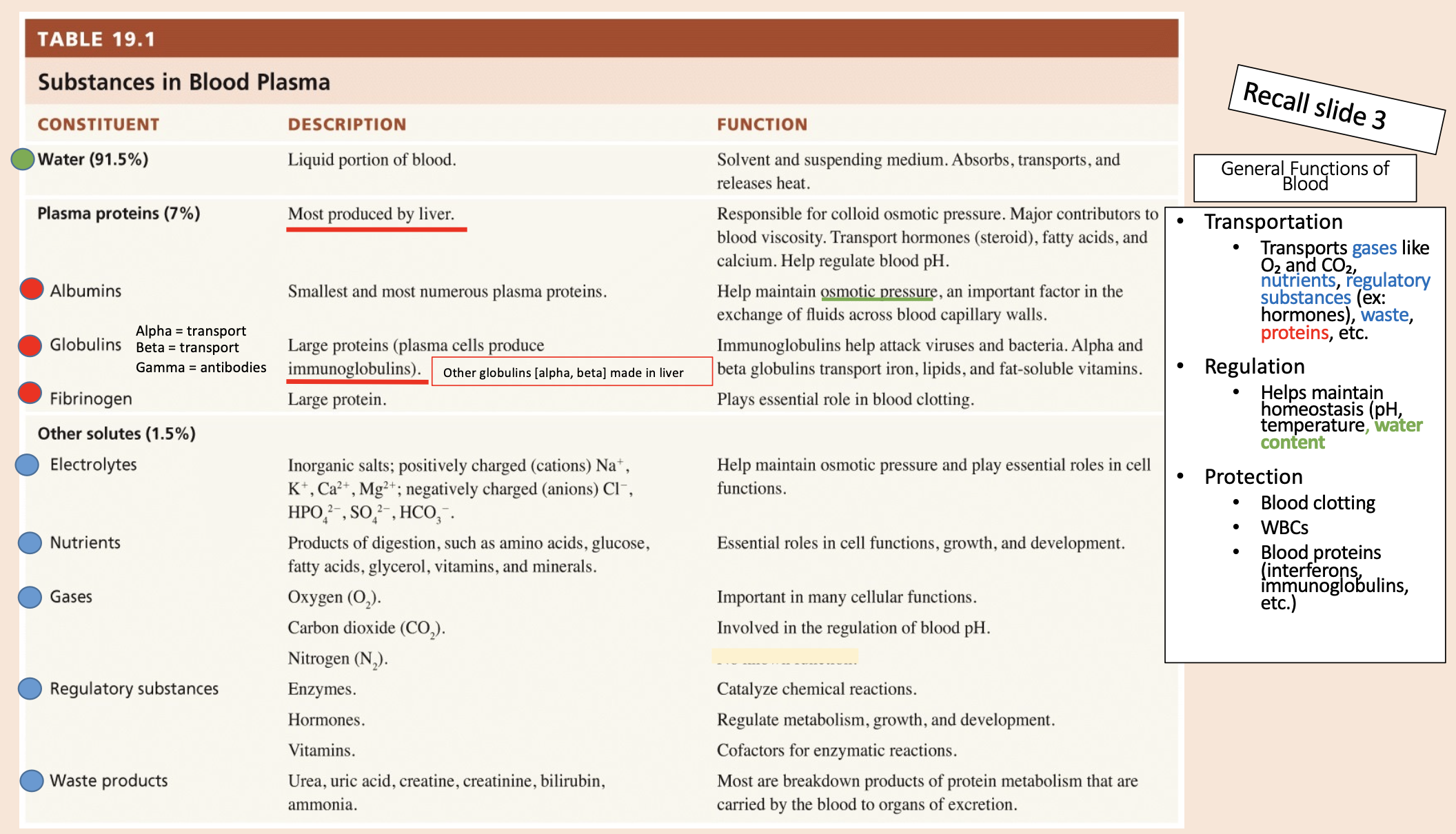
Fibrinogen Function
Plays essential role in blood clotting.
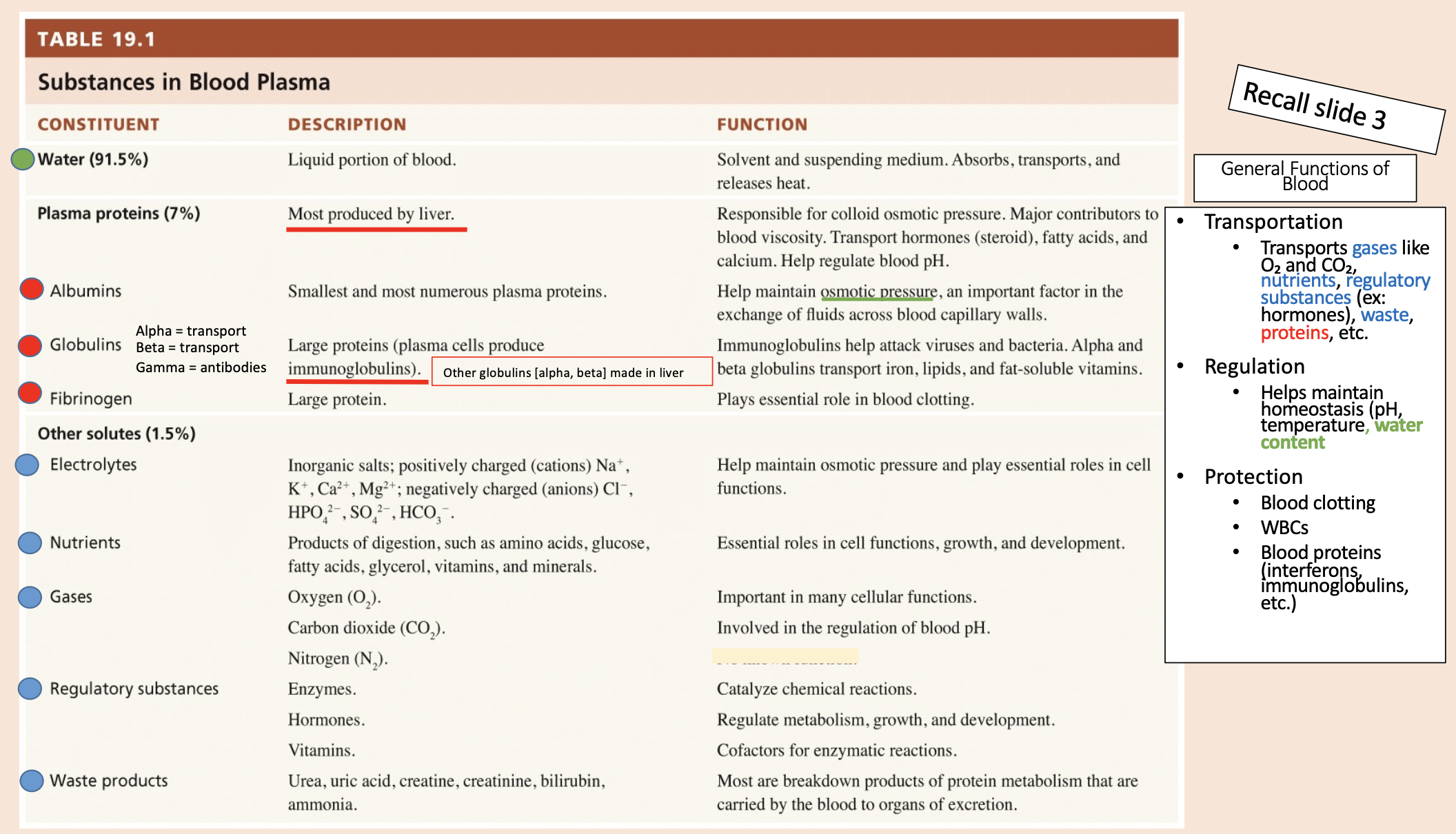
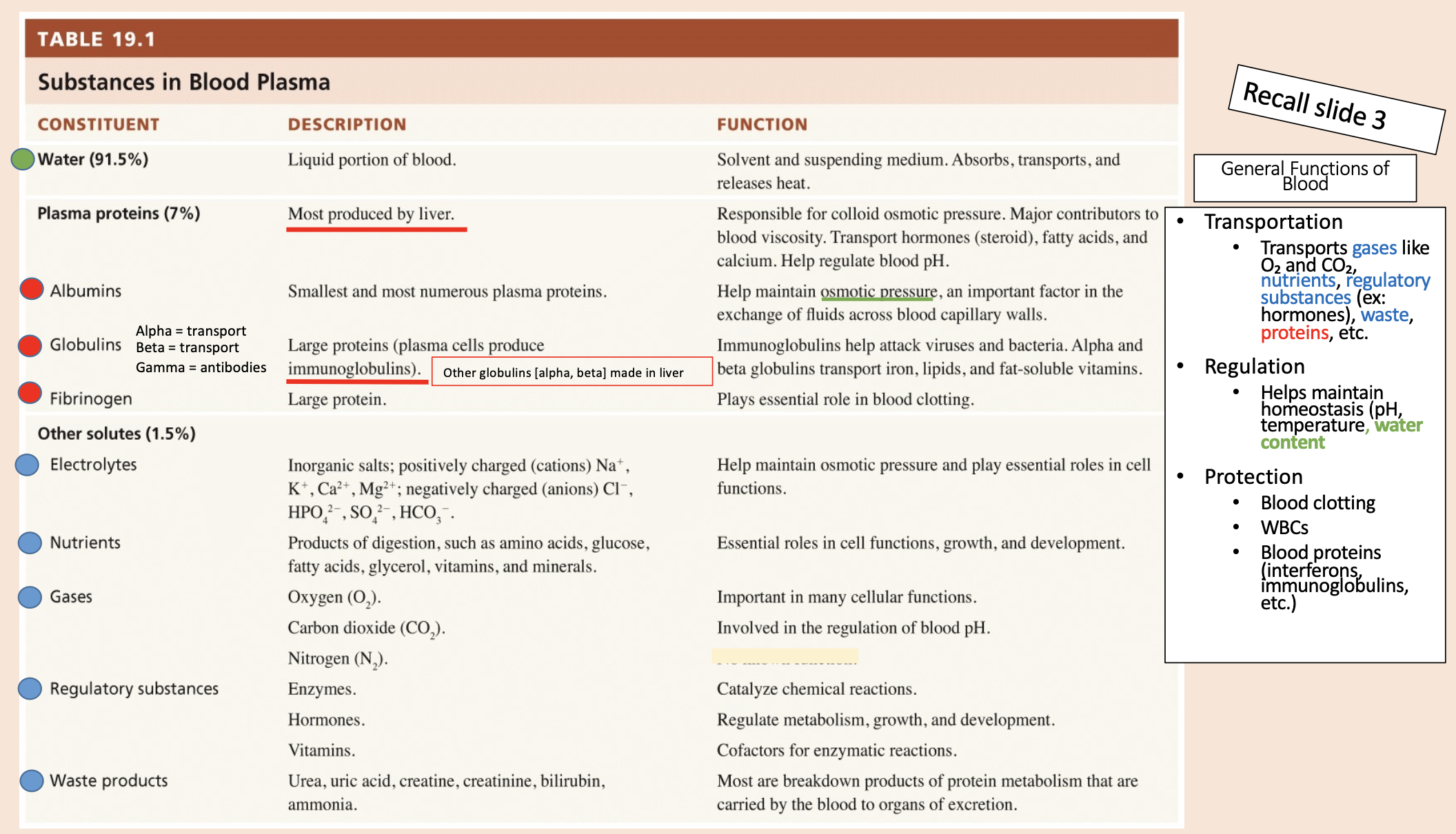
Other solutes (1.5%). Electrolytes Description
Inorganic salts; positively charged (cations) Na+ , K+ , Ca2+ , Mg2+ ; negatively charged (anions) Cl- , HPO42- , SO42- , HCO3- .
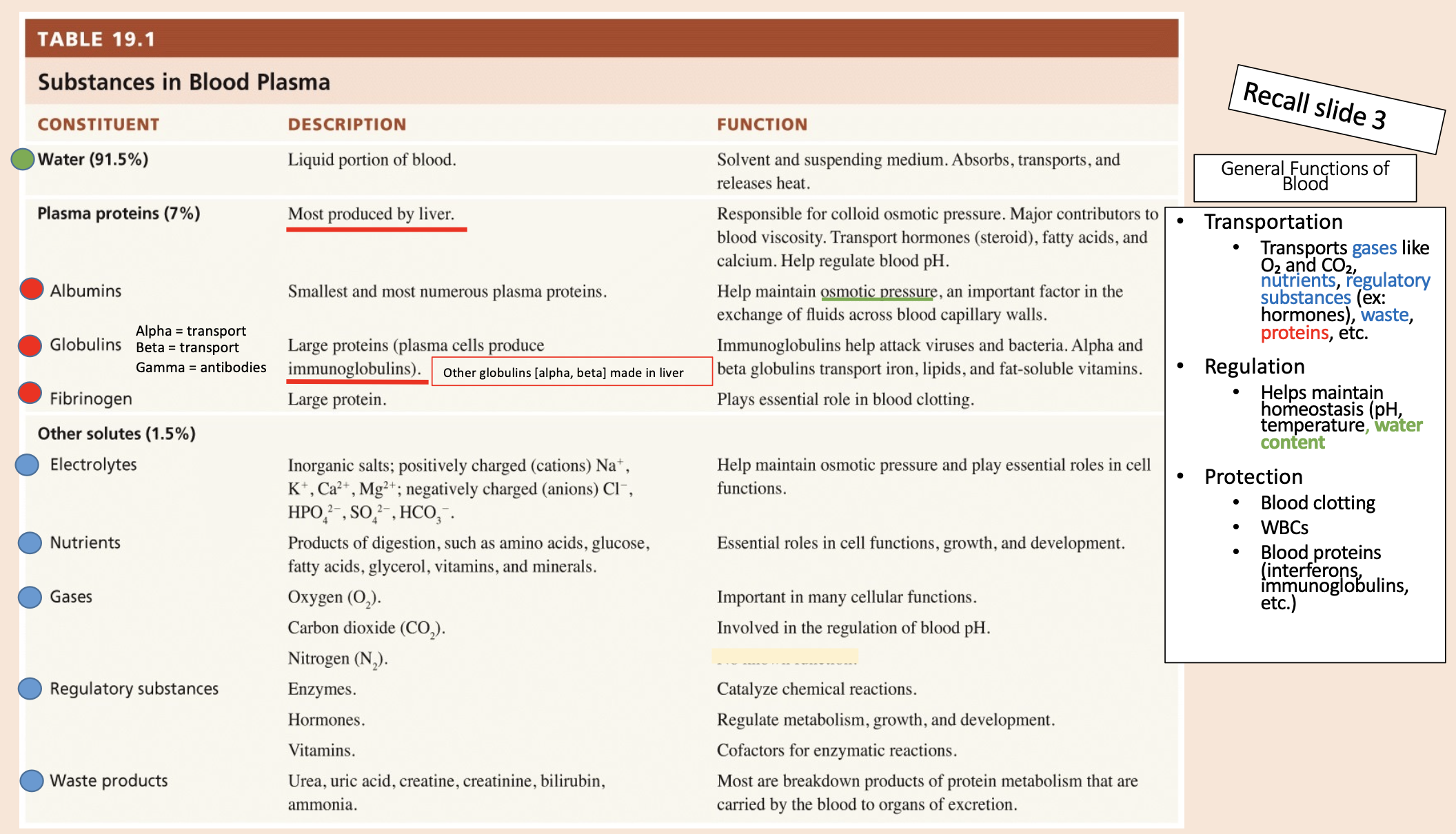
Other solutes (1.5%). Electrolytes Function
Help maintain osmotic pressure and play esstionial roles in cell functions.
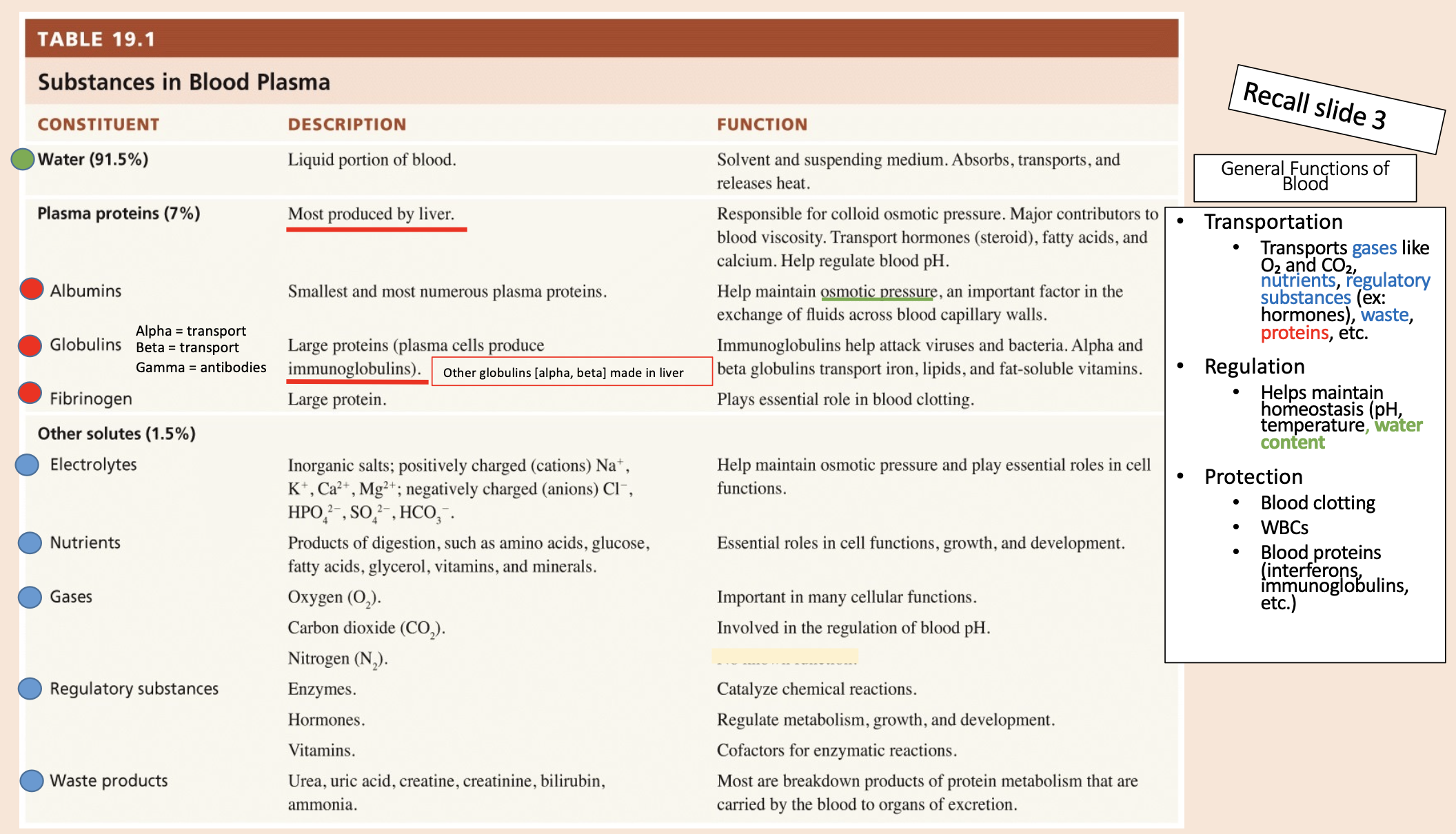
Other solutes (1.5%). Nutrients Description
Products of digestion, such as amino acids, glucose, fatty acids, glycerol, vitamins, and minerals.
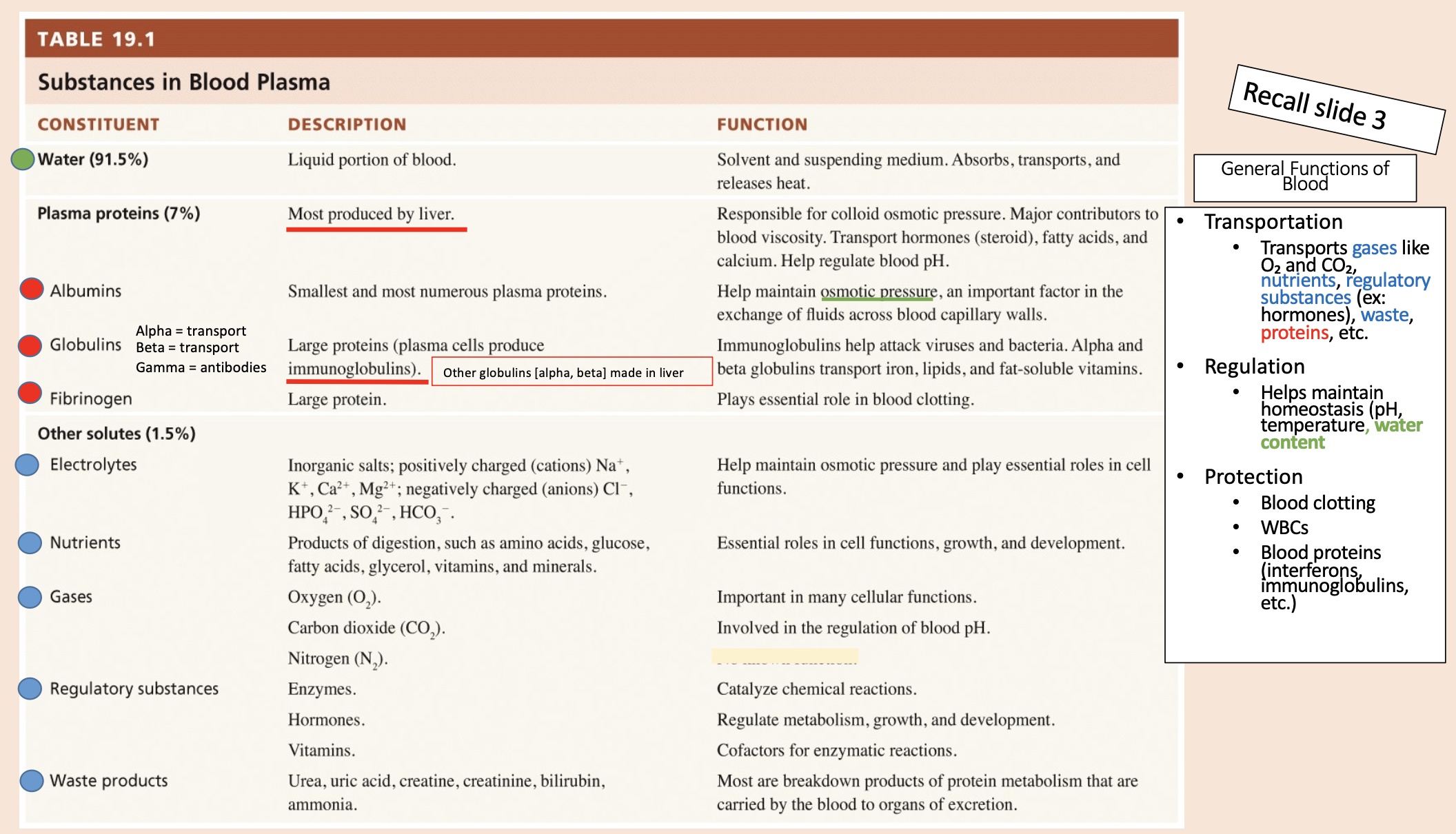
Other solutes (1.5%). Nutrients Function
Essential roles in cell functions, growth, and development.
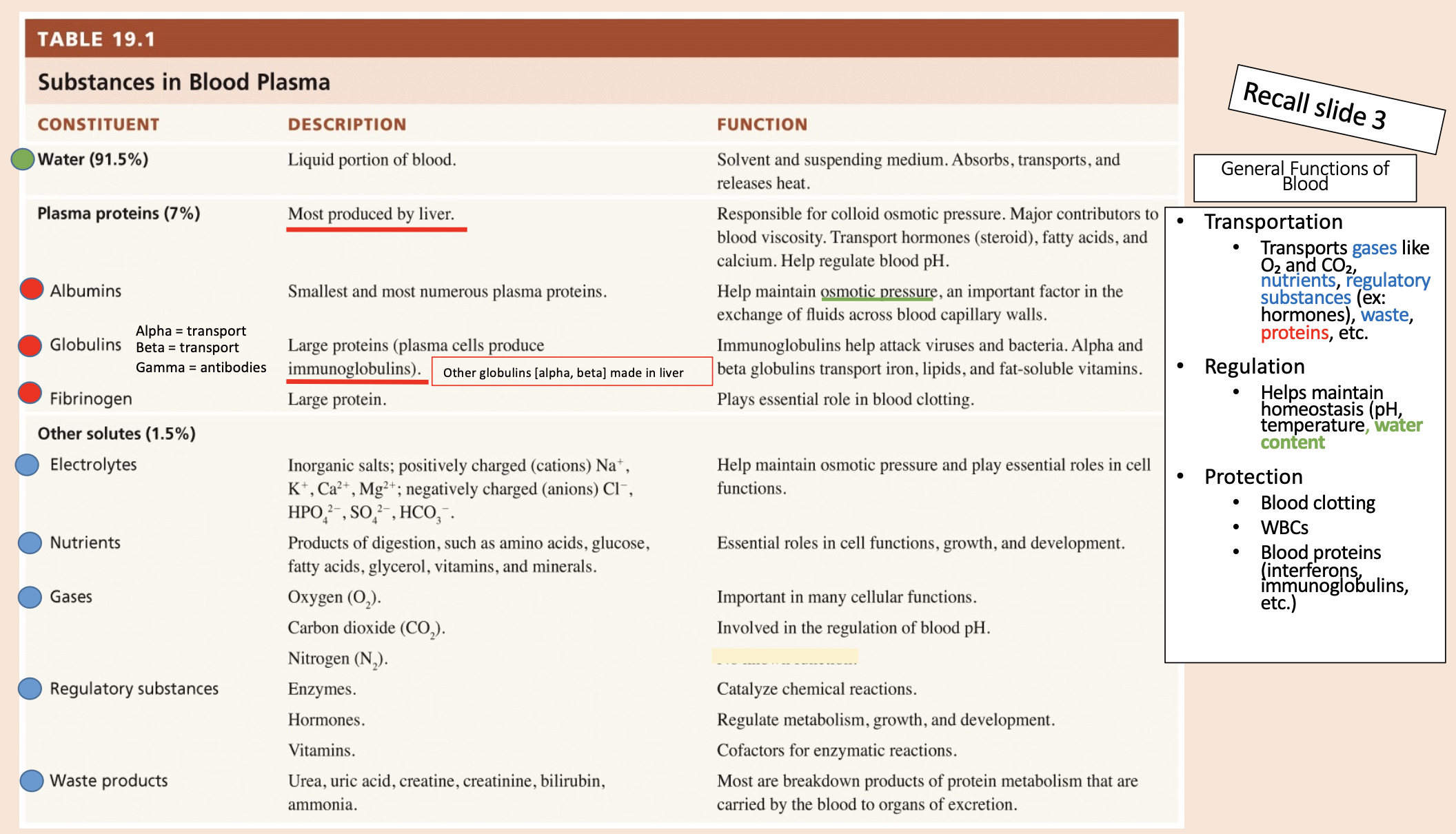
Other solutes (1.5%). Gases Description
Oxygen (O2).
Carbon dioxide (CO2).
Nitrogen (N2).
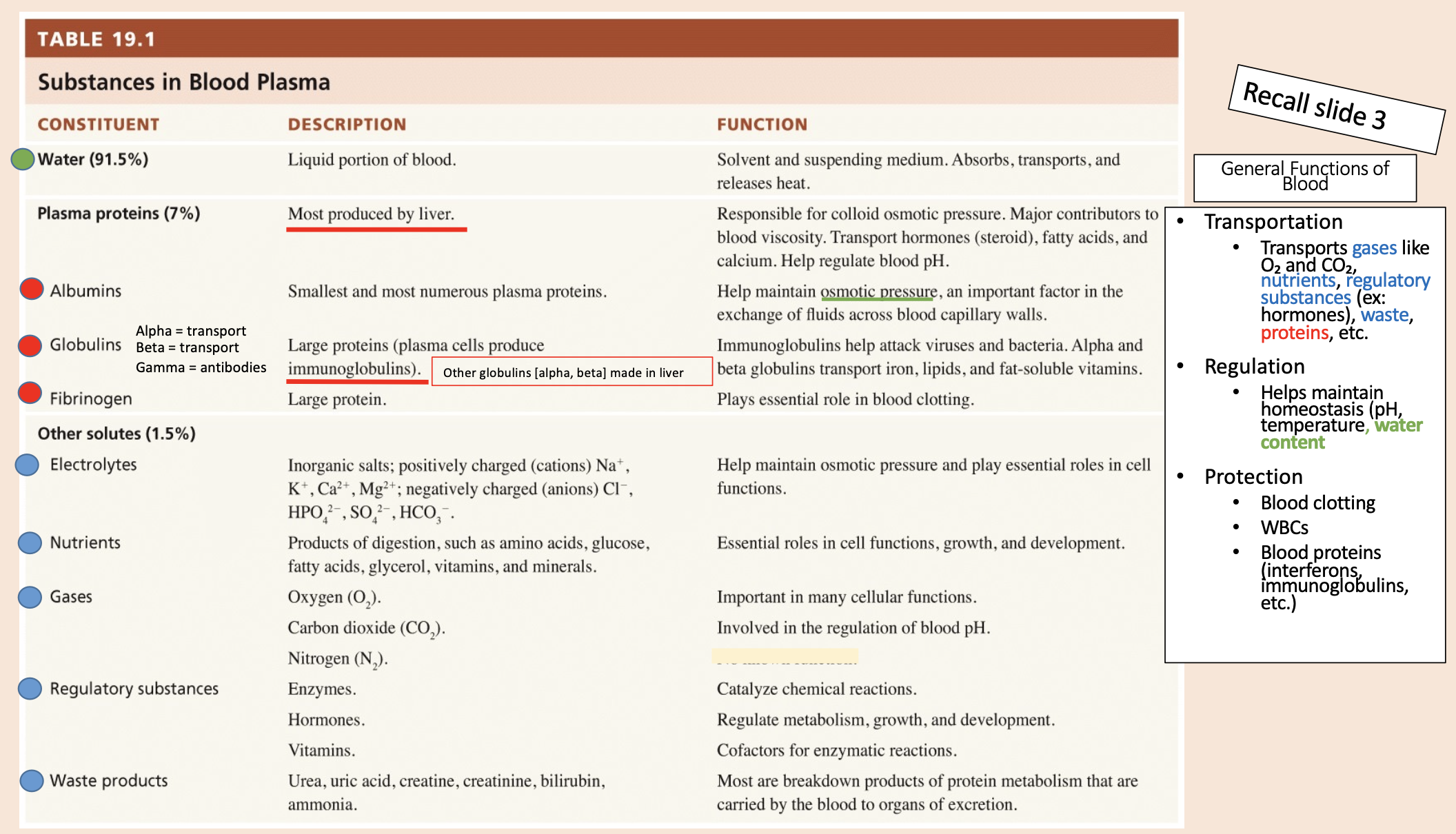
Other solutes (1.5%). Gases Oxygen (O2) Function
Important in many cellular functions.
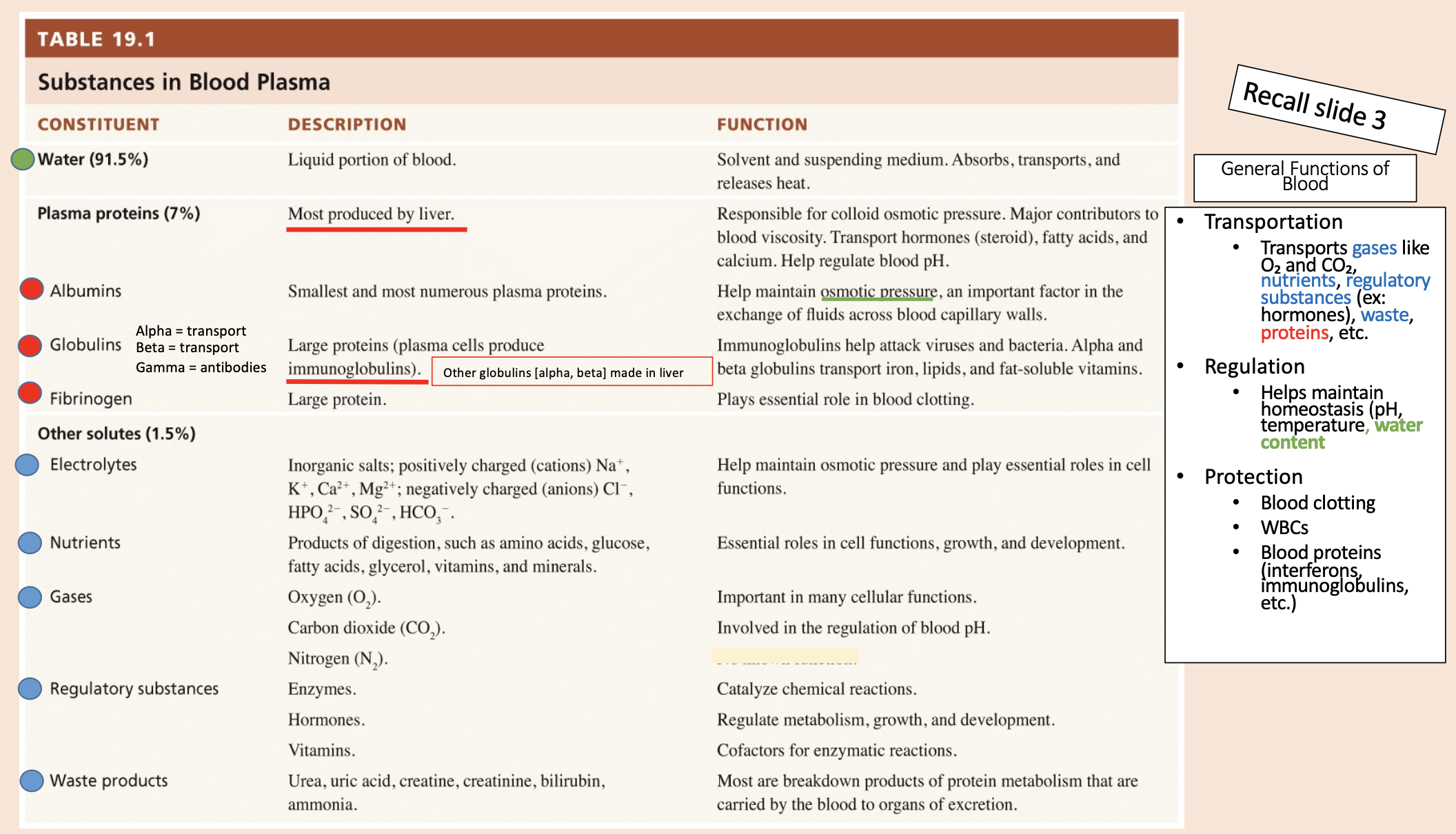
Other solutes (1.5%). Carbon dioxide (CO2) Function
Involved in the regulation of blood pH.
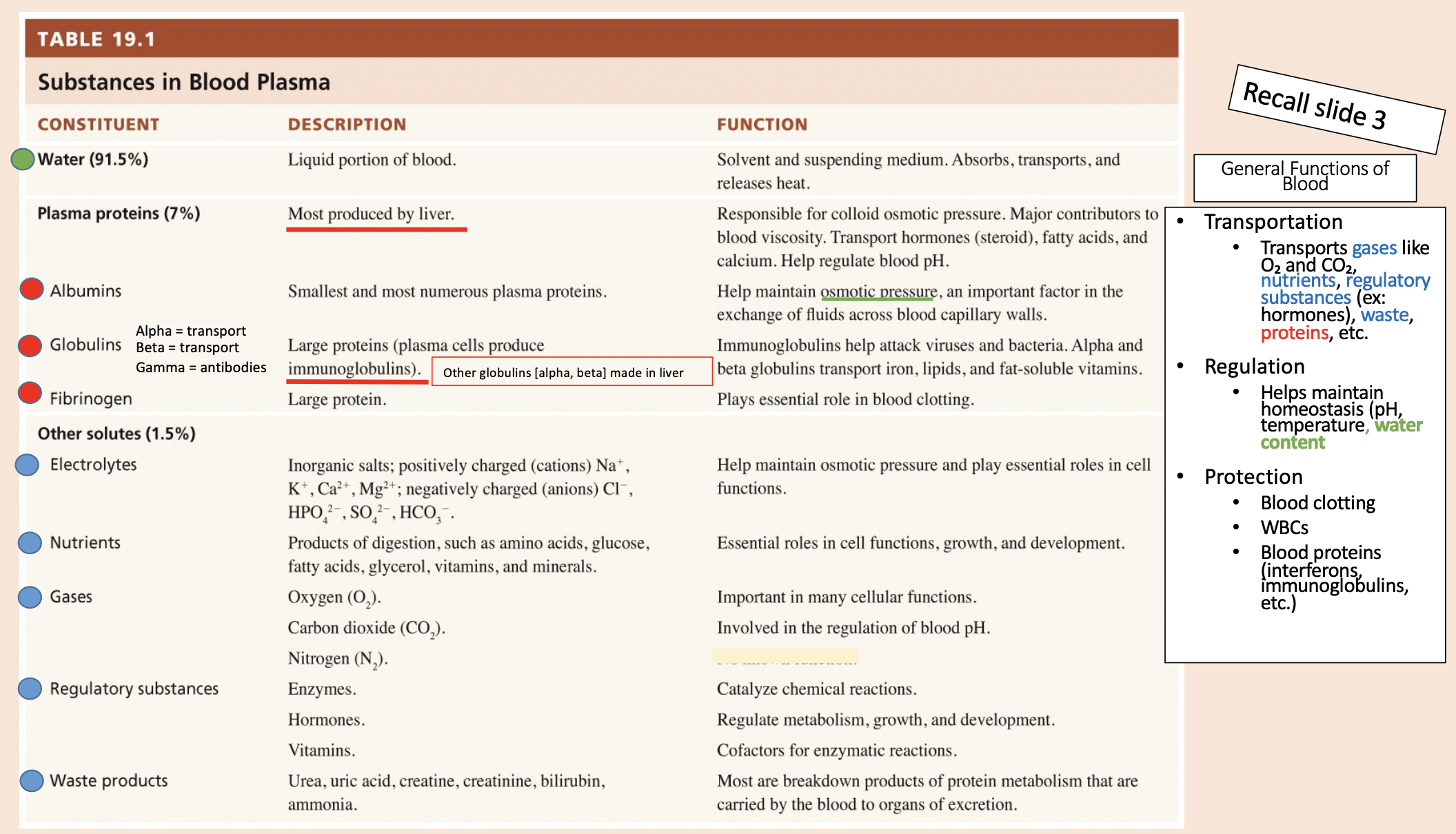
Regulatory substances Description
Enzymes.
Hormones.
Vitamins.
Regulatory substances Enzymes Function
Catalyze chemical reactions.
Regulatory substances Hormones Function
Regulate metabolism, growth, and development.
Regulatory substances Vitamins Function
Cofactors for enzymatic reactions.
Waste products Description
Urea, uric acid, creatine, creatinine, bilirubin, ammonia.
Waste products Function
Most are breakdown products of protein metabolism that are carried by the blood to organs of excretion.
Formed Elements in Blood - RBCs
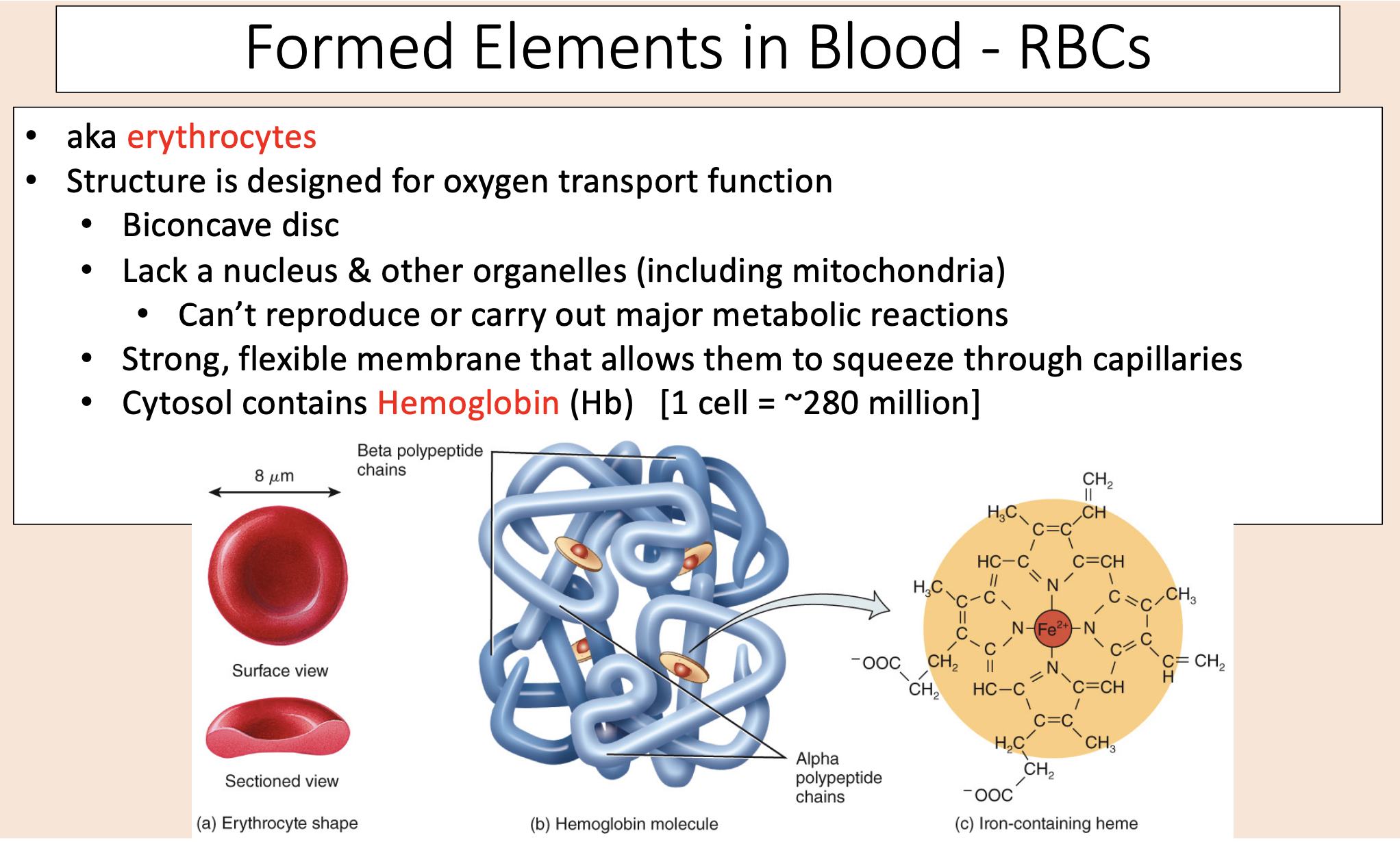
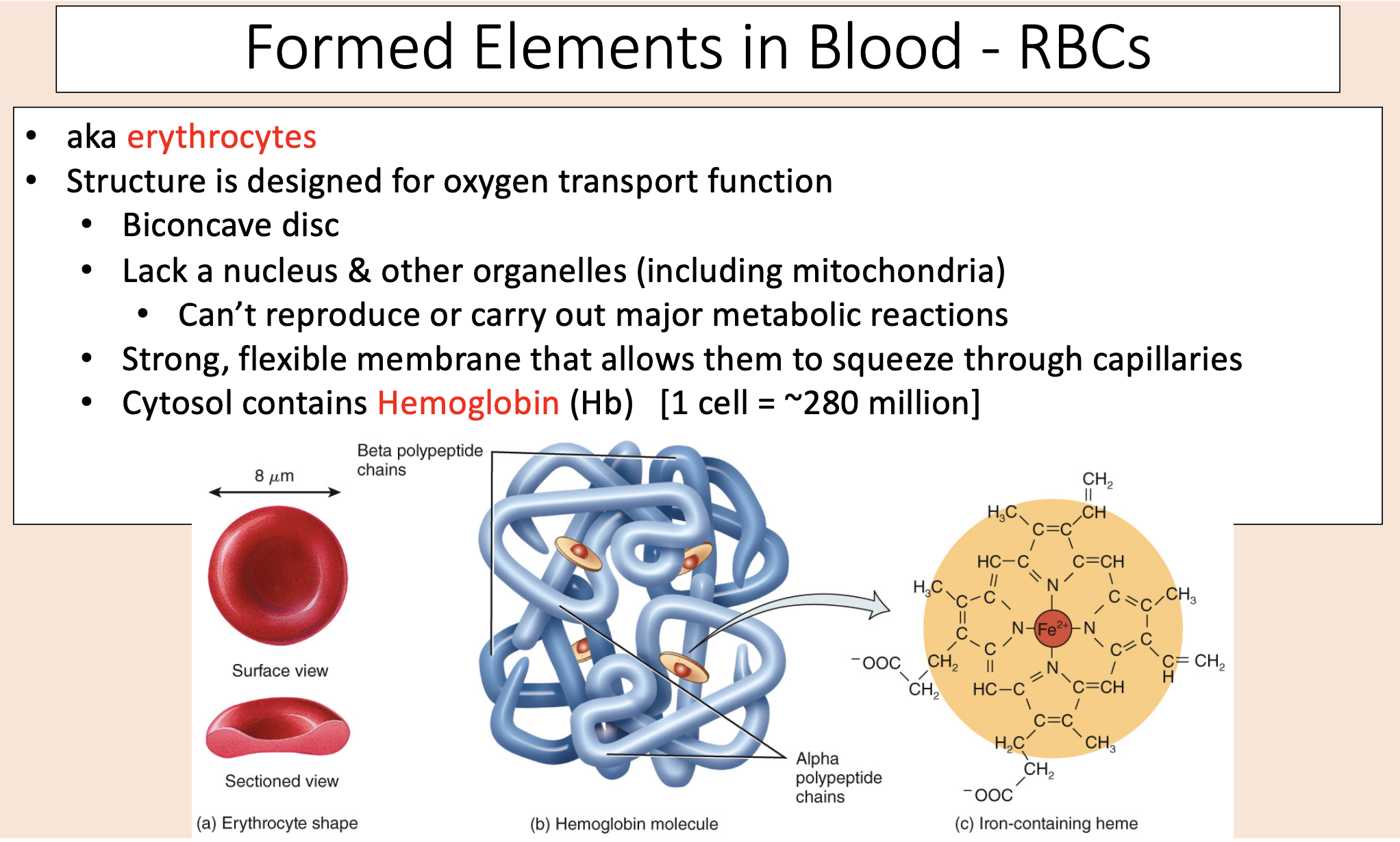
• aka erythrocytes.
• Structure is designed for oxygen transport function.
Structure is designed for oxygen transport function
• Biconcave disc.
• Lack a nucleus & other organelles (including mitochondria).
• Strong, flexible membrane that allows them to squeeze through capillaries.
• Cytosol contains Hemoglobin (Hb) [1 cell = ~280 million].
![<p><span>• Biconcave disc.</span></p><p><span>• Lack a nucleus & other organelles (including mitochondria).</span></p><p><span>• Strong, flexible membrane that allows them to squeeze through capillaries.</span></p><p><span>• Cytosol contains </span><span style="color: rgb(255, 0, 0);"><span>Hemoglobin </span></span><span>(Hb) [1 cell = ~280 million].</span></p>](https://knowt-user-attachments.s3.amazonaws.com/6451e78d-79c4-42c9-b89a-f628d90f6502.png)
Lack a nucleus & other organelles (including mitochondria)
Can’t reproduce or carry out major metabolic reactions.
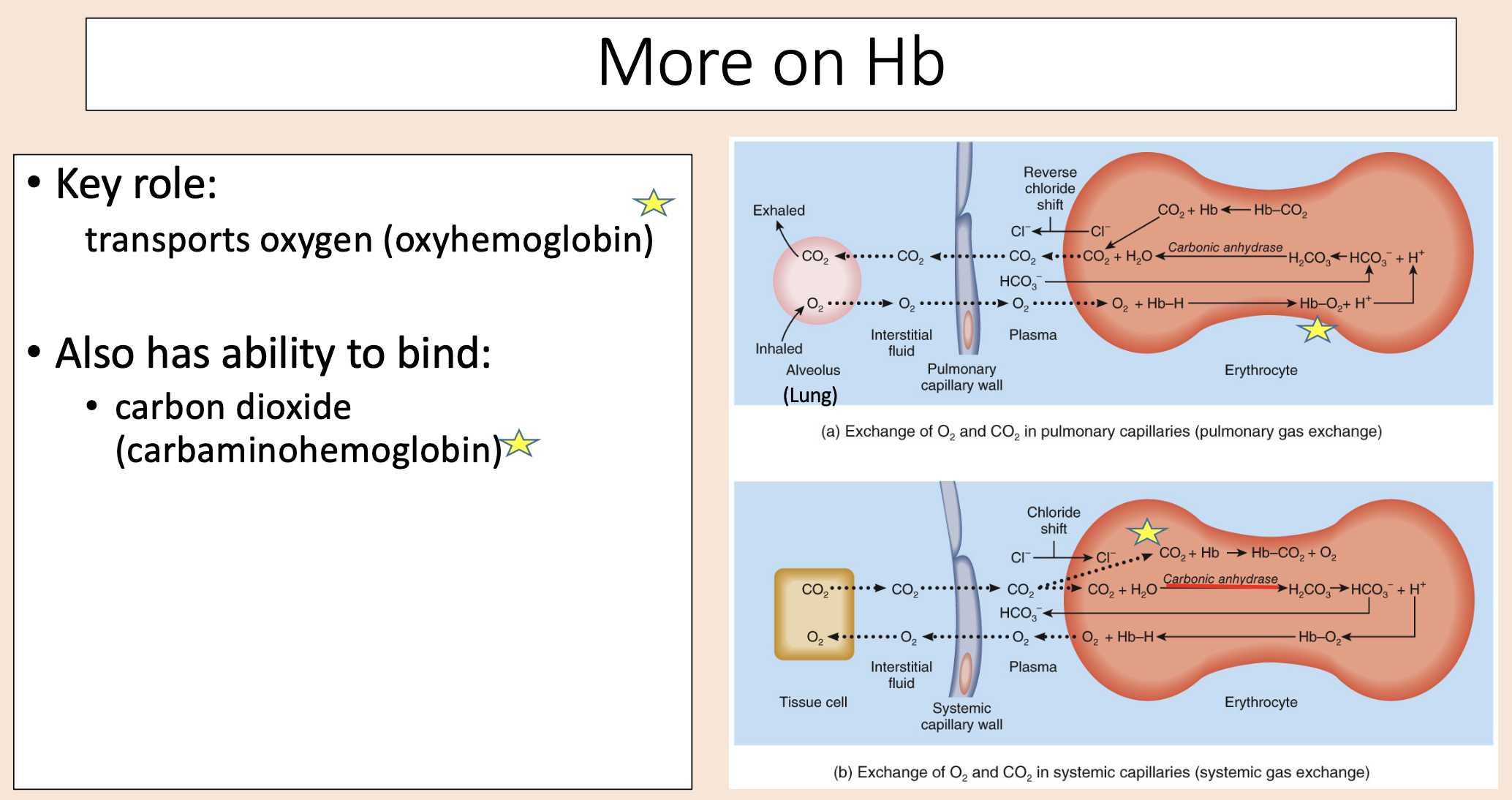
Hb Key role
Transports oxygen (oxyhemoglobin).
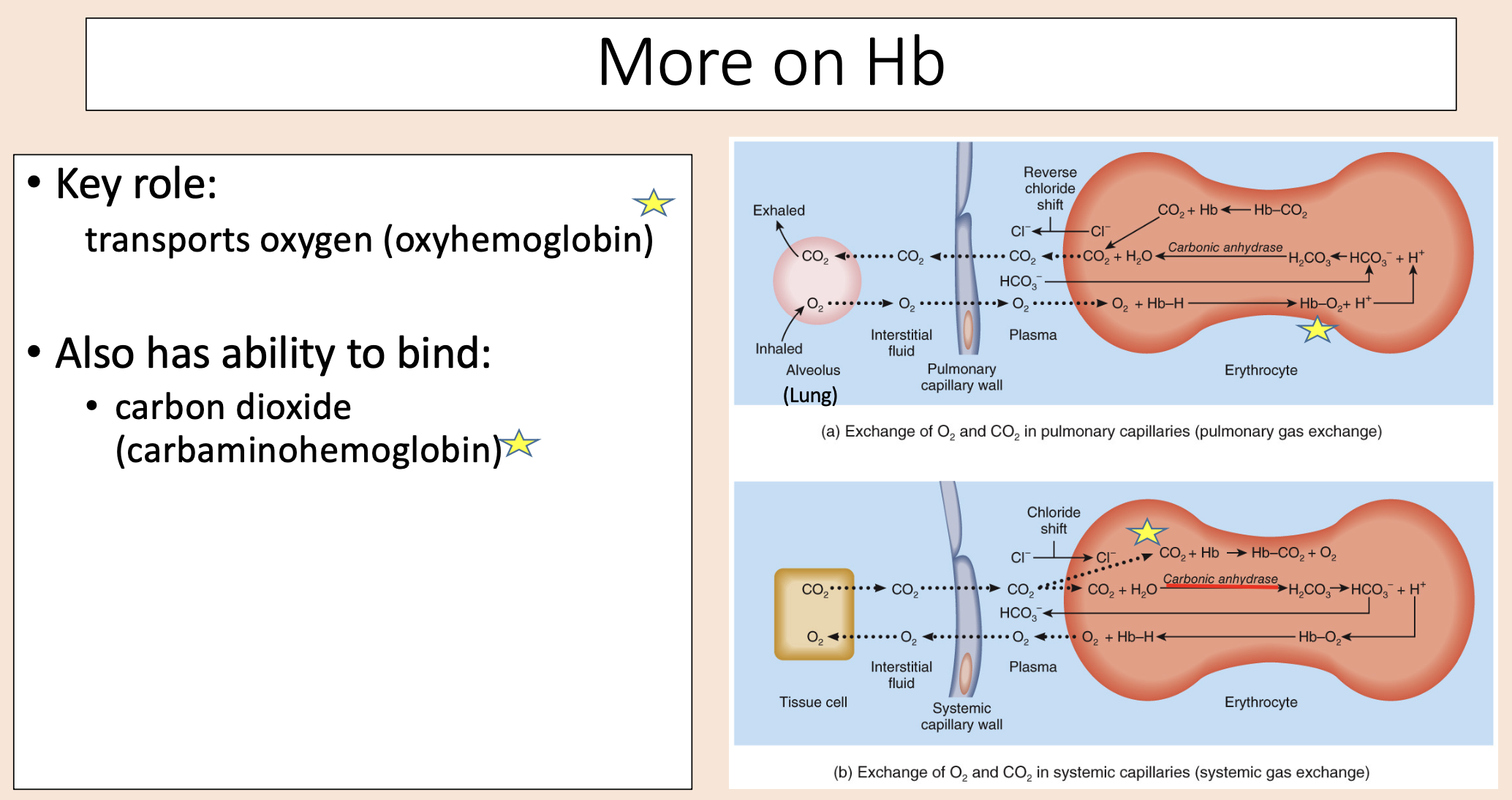
Hb also has ability to bind
Carbon dioxide (carbaminohemoglobin).
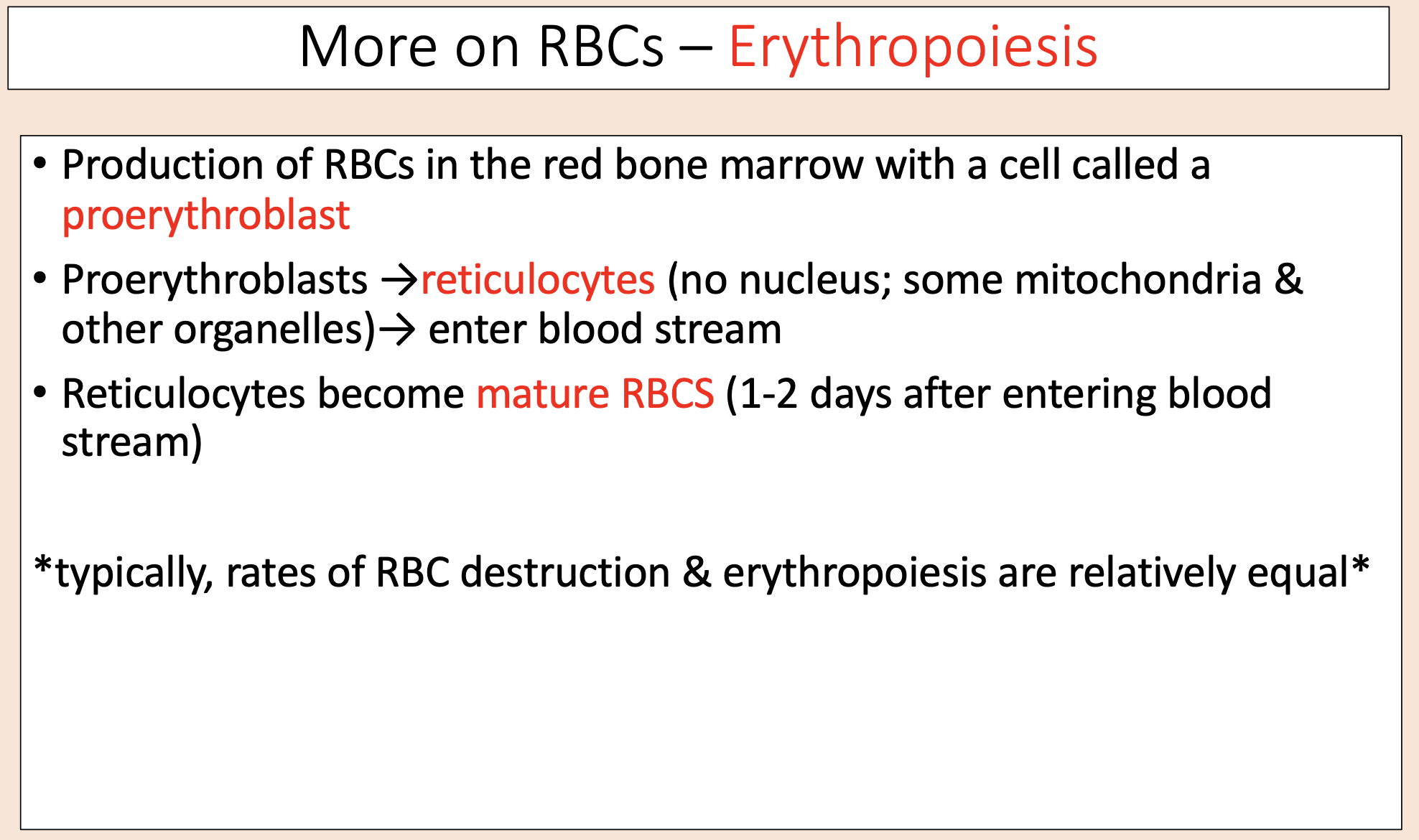
More on RBCs – Erythropoiesis
• Production of RBCs in the red bone marrow with a cell called a proerythroblast.
• Proerythroblasts →reticulocytes (no nucleus; some mitochondria & other organelles)→ enter blood stream.
• Reticulocytes become mature RBCS (1-2 days after entering blood stream).
• Typically, rates of RBC destruction & erythropoiesis are relatively equal.
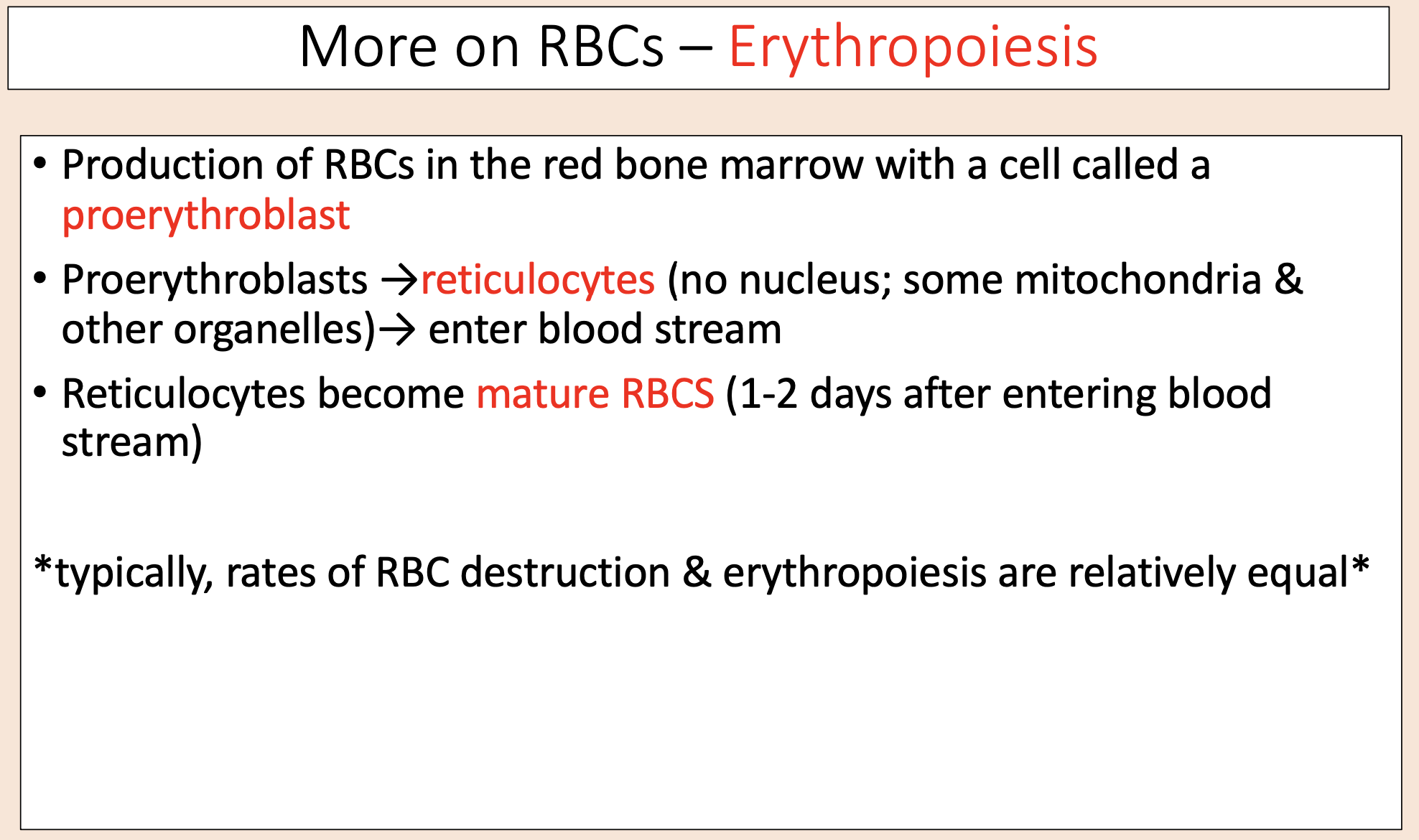
Production of RBCs in the red bone marrow with a cell called a
Proerythroblast.
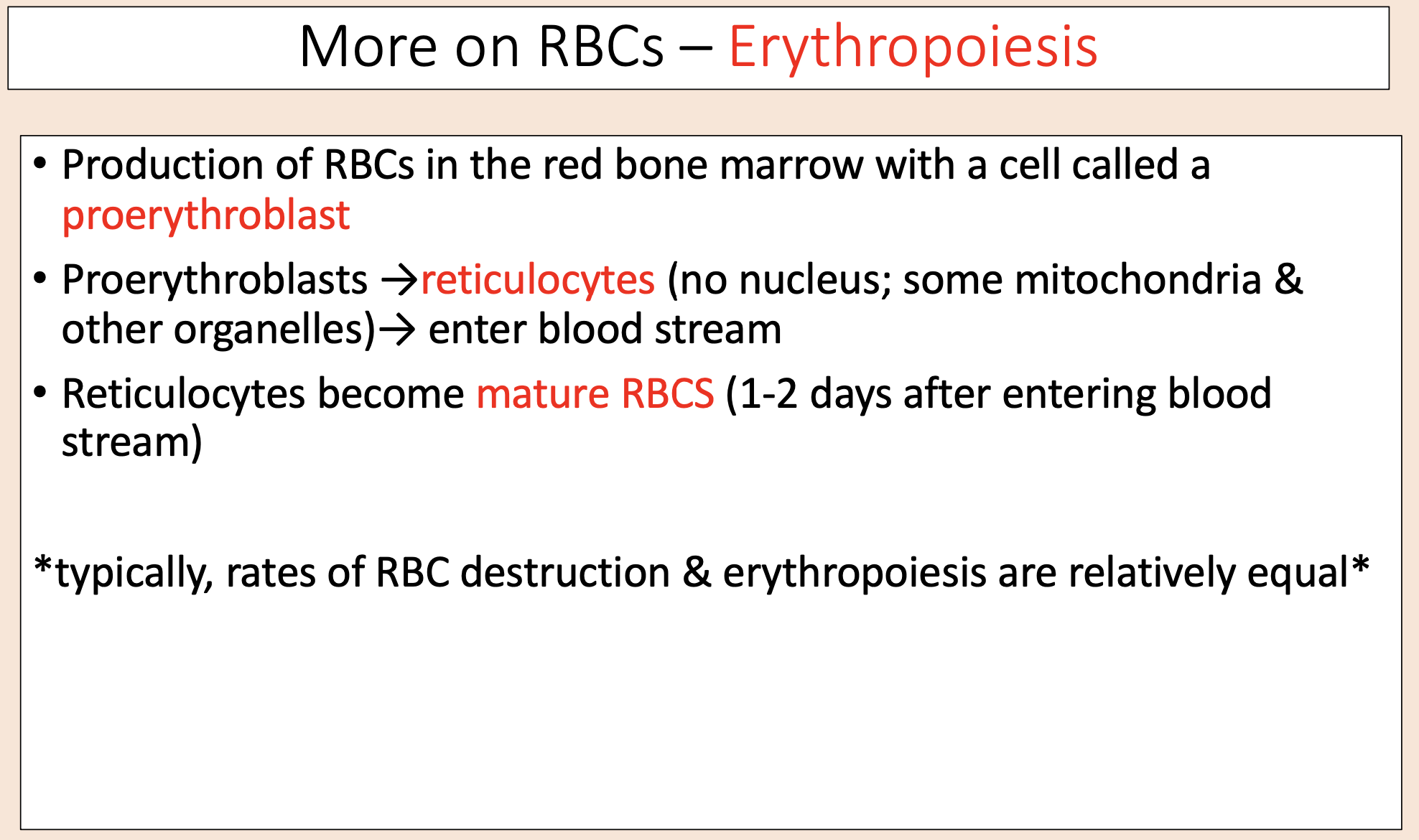
Reticulocytes become
Mature RBCS (1-2 days after entering blood stream).
More on RBCs – the Life Cycle
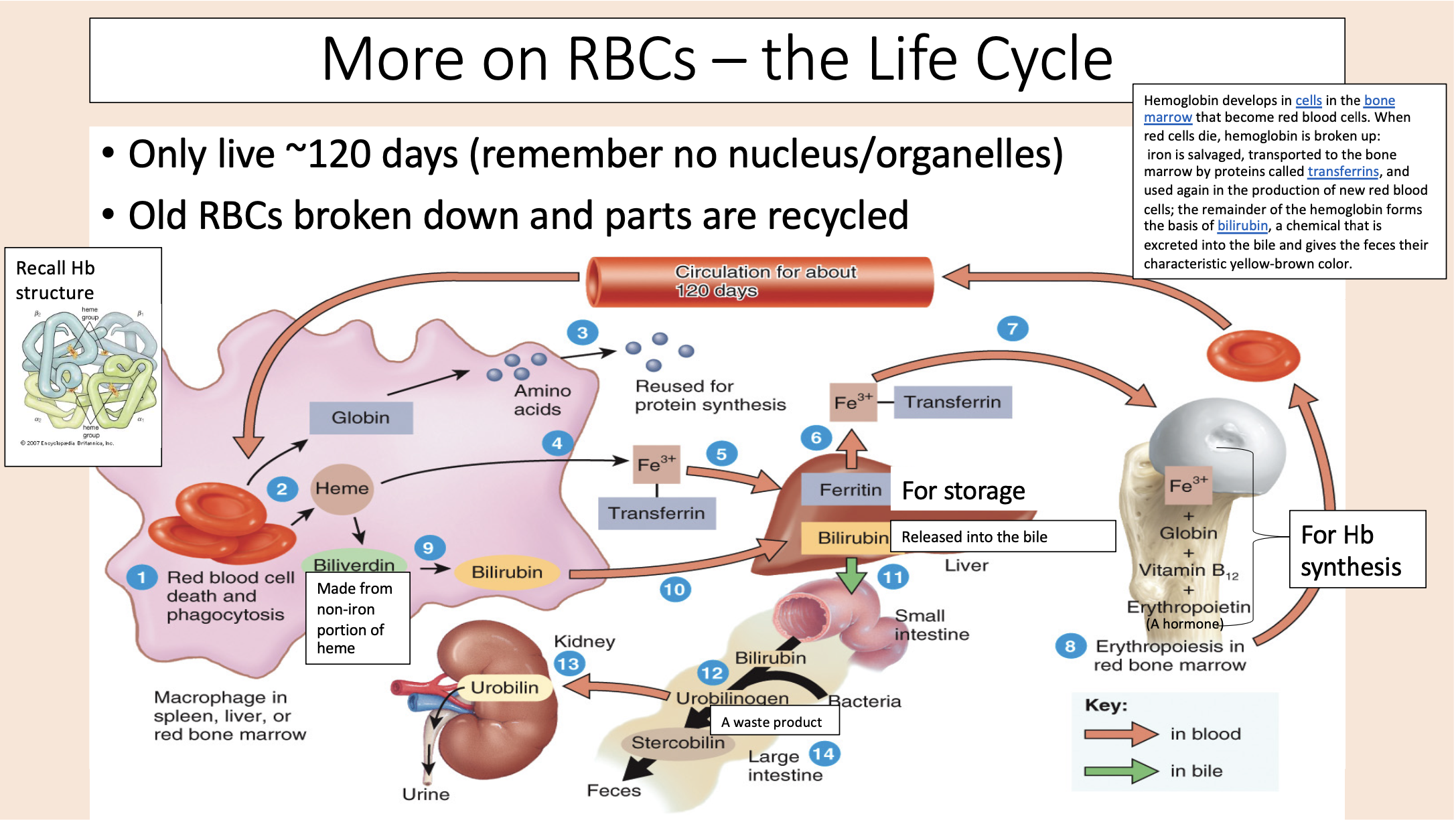
• Only live ~120 days (remember no nucleus/organelles).
• Old RBCs broken down and parts are recycled.
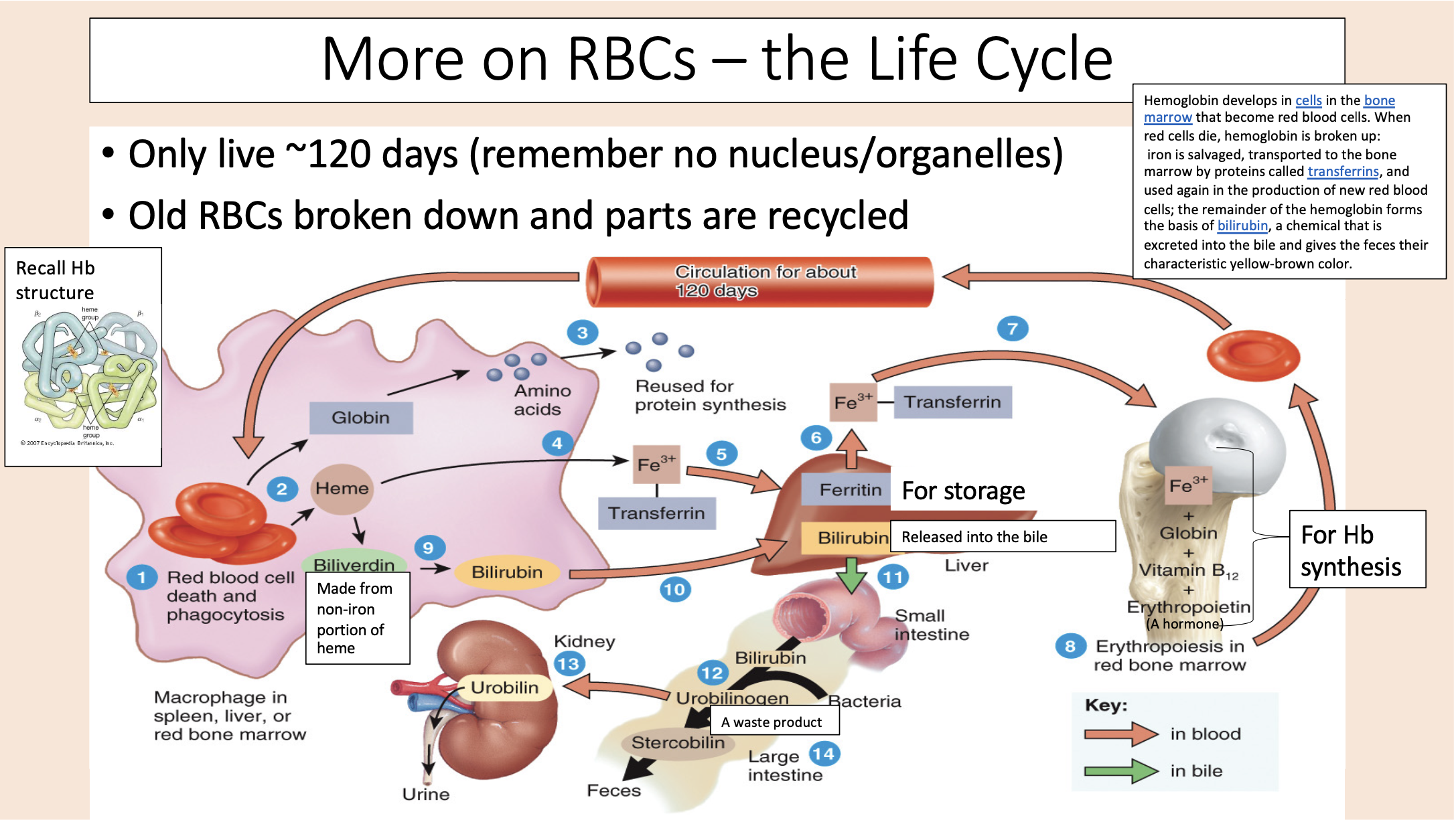
Hemoglobin develops in cells in the bone marrow that become red blood cells. When red cells die, hemoglobin is broken up:
Iron is salvaged, transported to the bone marrow by proteins called transferrins, and used again in the production of new red blood cells; the remainder of the hemoglobin forms the basis of bilirubin, a chemical that is excreted into the bile and gives the feces their characteristic yellow-brown color.
Hematocrit
Percentage of blood volume that is occupied by RBCs.
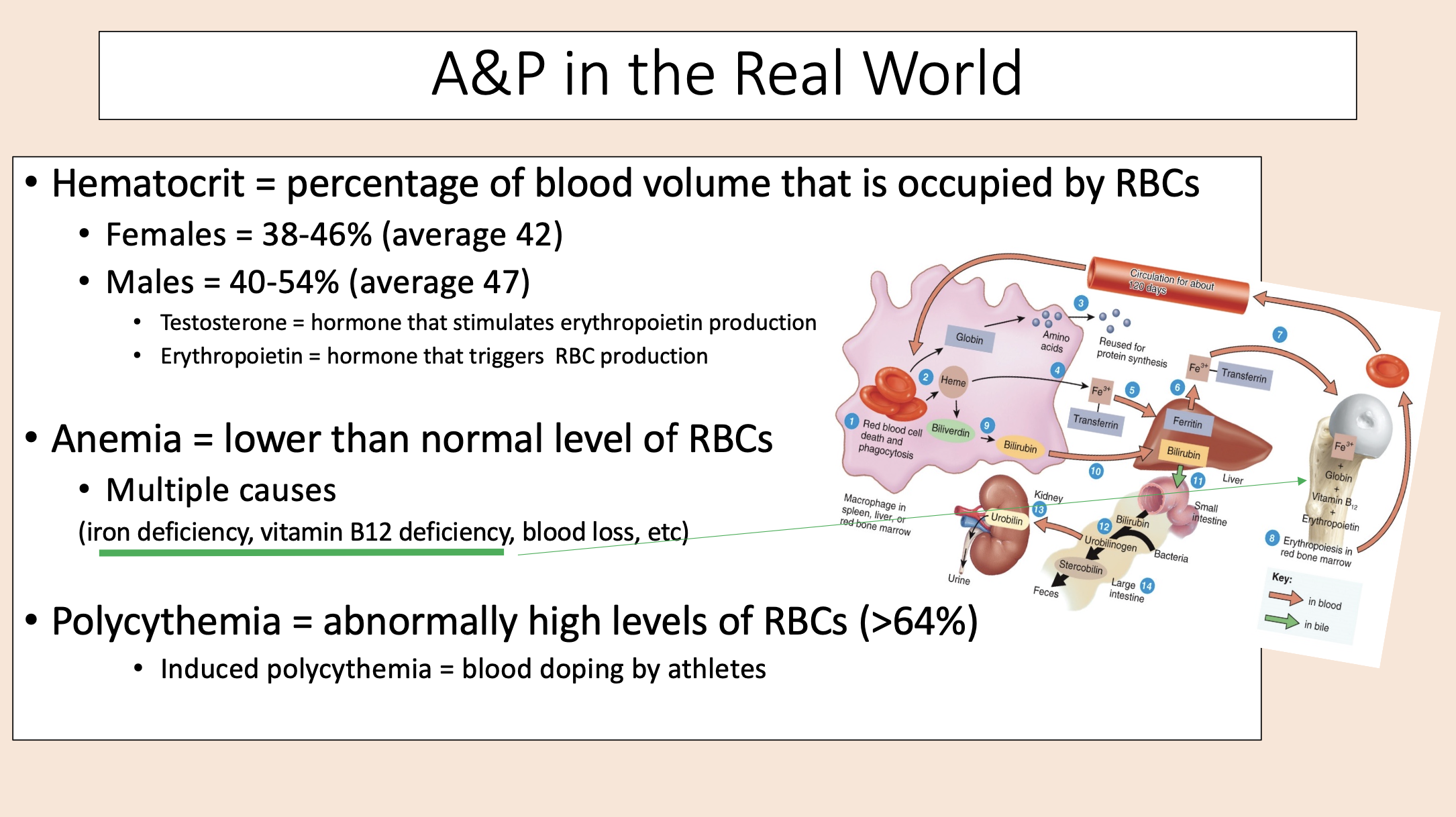
Hematocrit
• Females = 38-46% (average 42).
• Males = 40-54% (average 47).
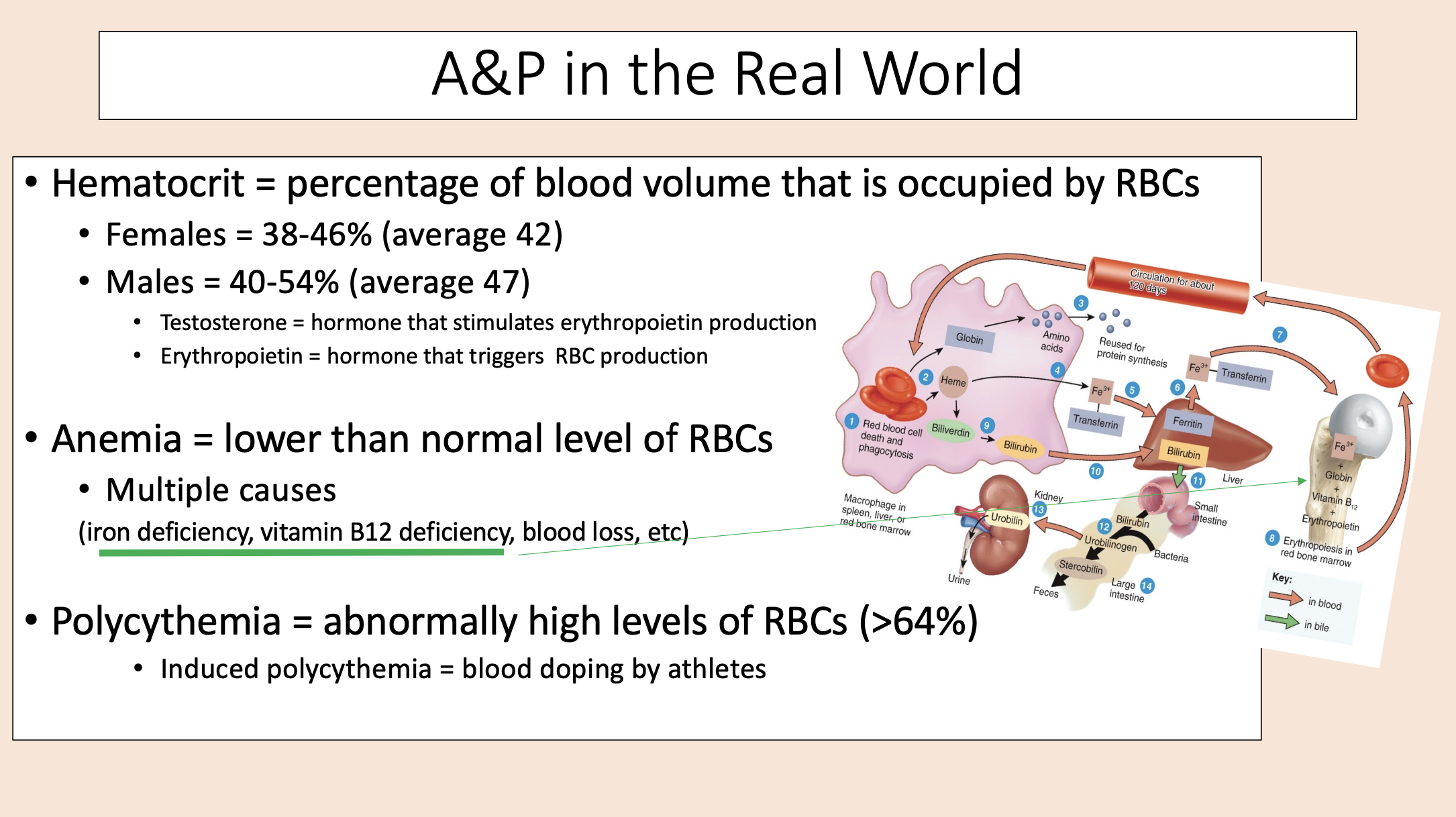
Males = 40-54% (average 47).
• Testosterone = hormone that stimulates erythropoietin production.
• Erythropoietin = hormone that triggers RBC production.
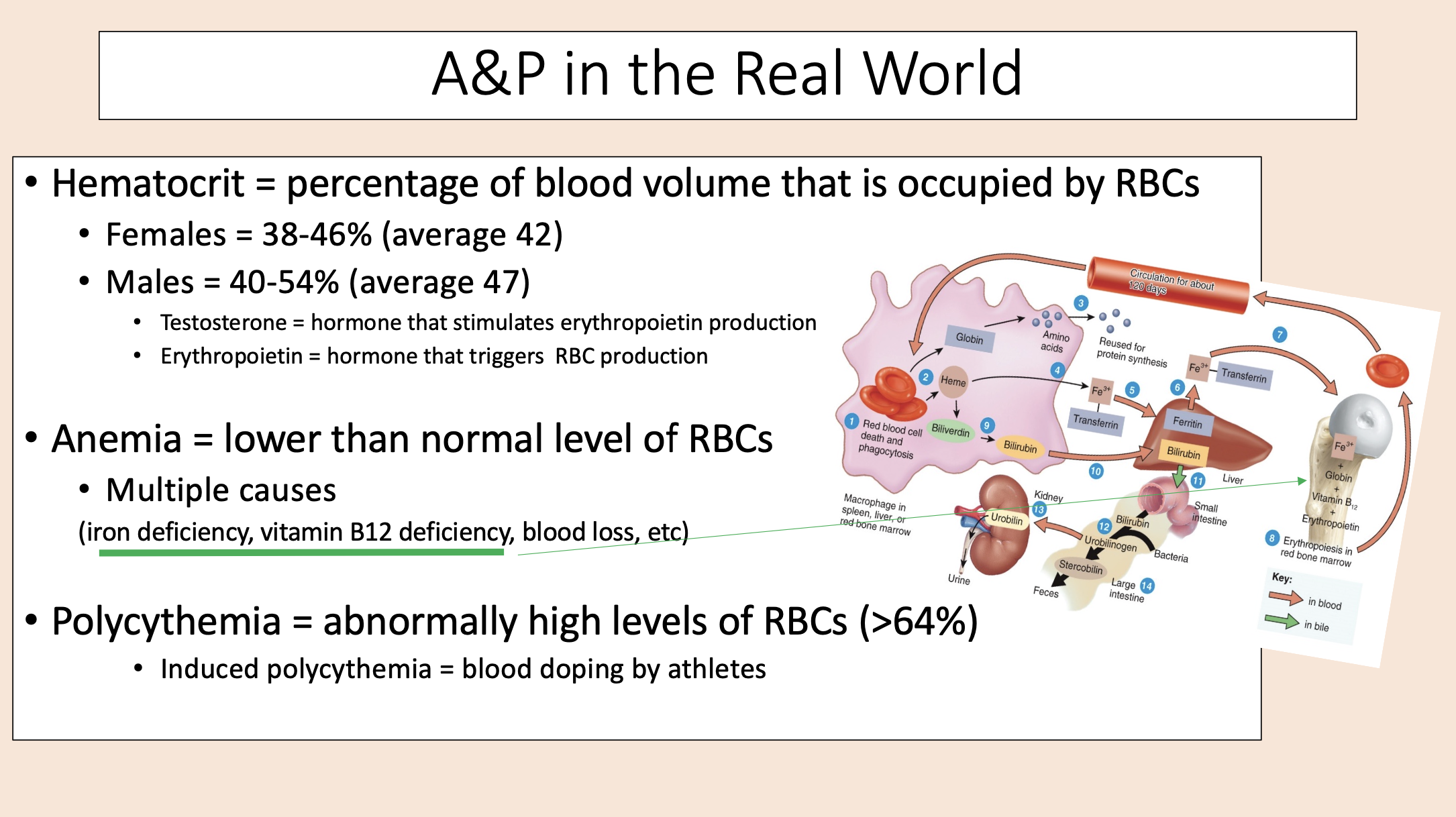
Testosterone
Hormone that stimulates erythropoietin production.
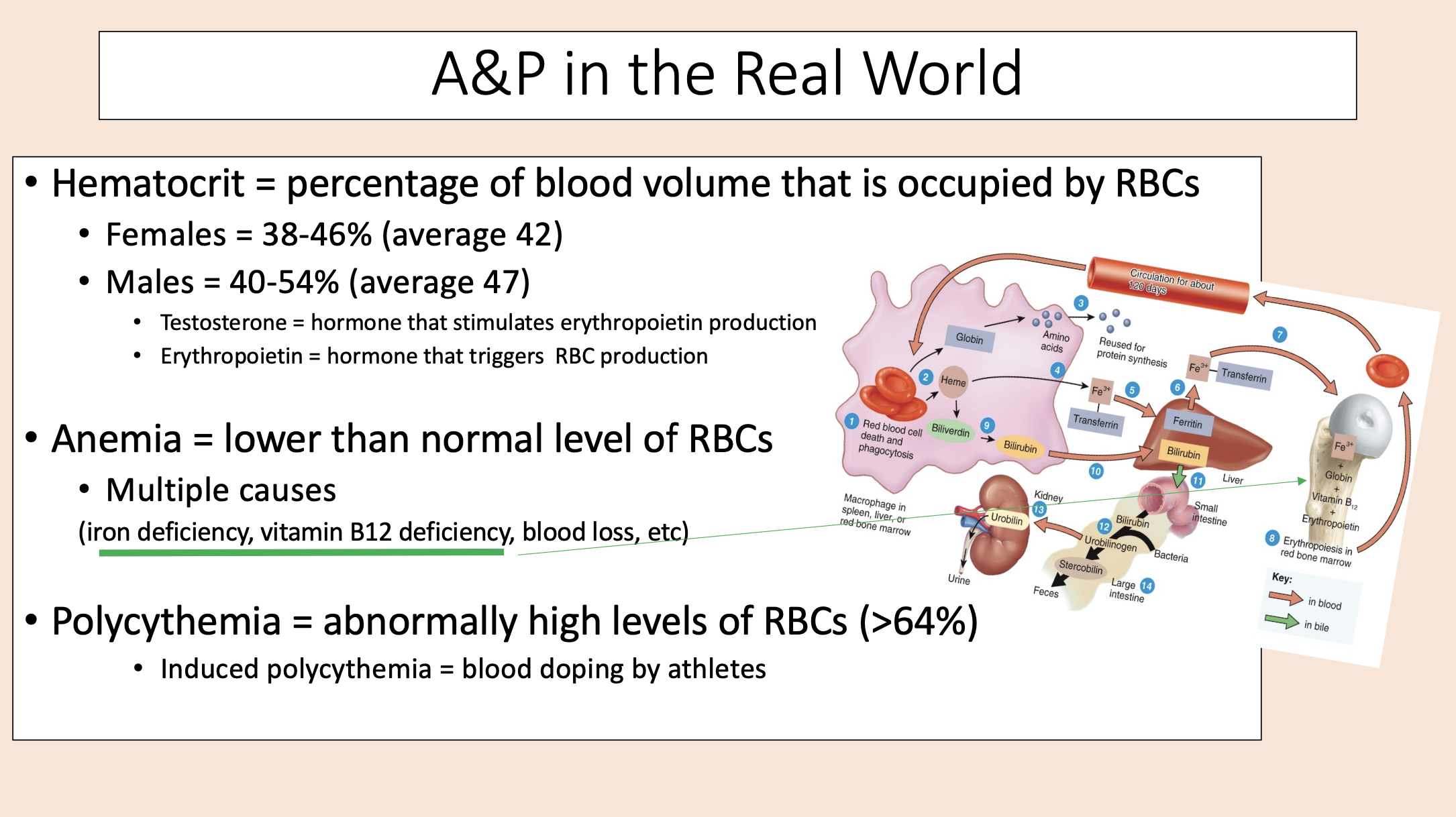
Erythropoietin
Hormone that triggers RBC production.
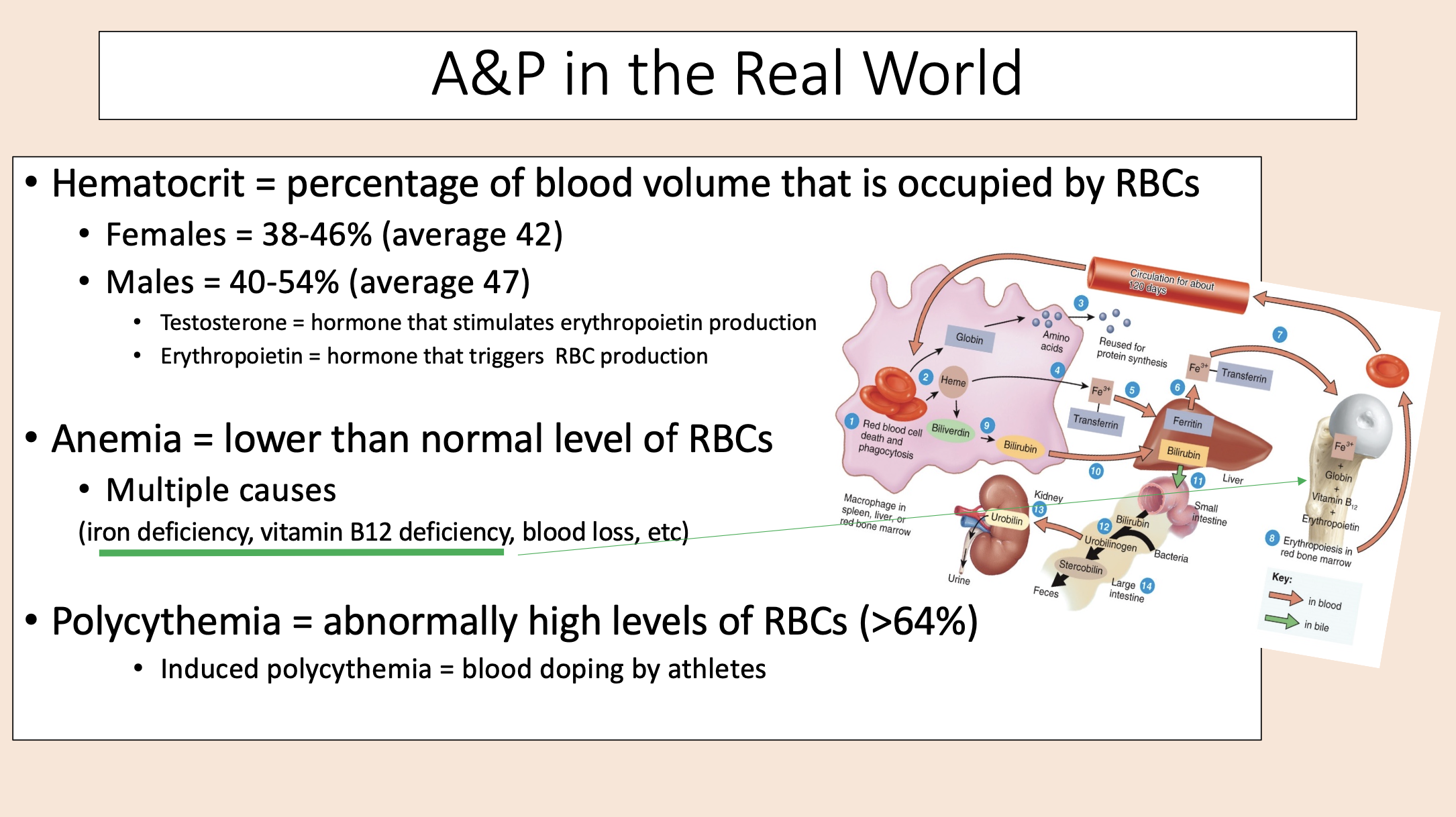
Anemia
Lower than normal level of RBCs.
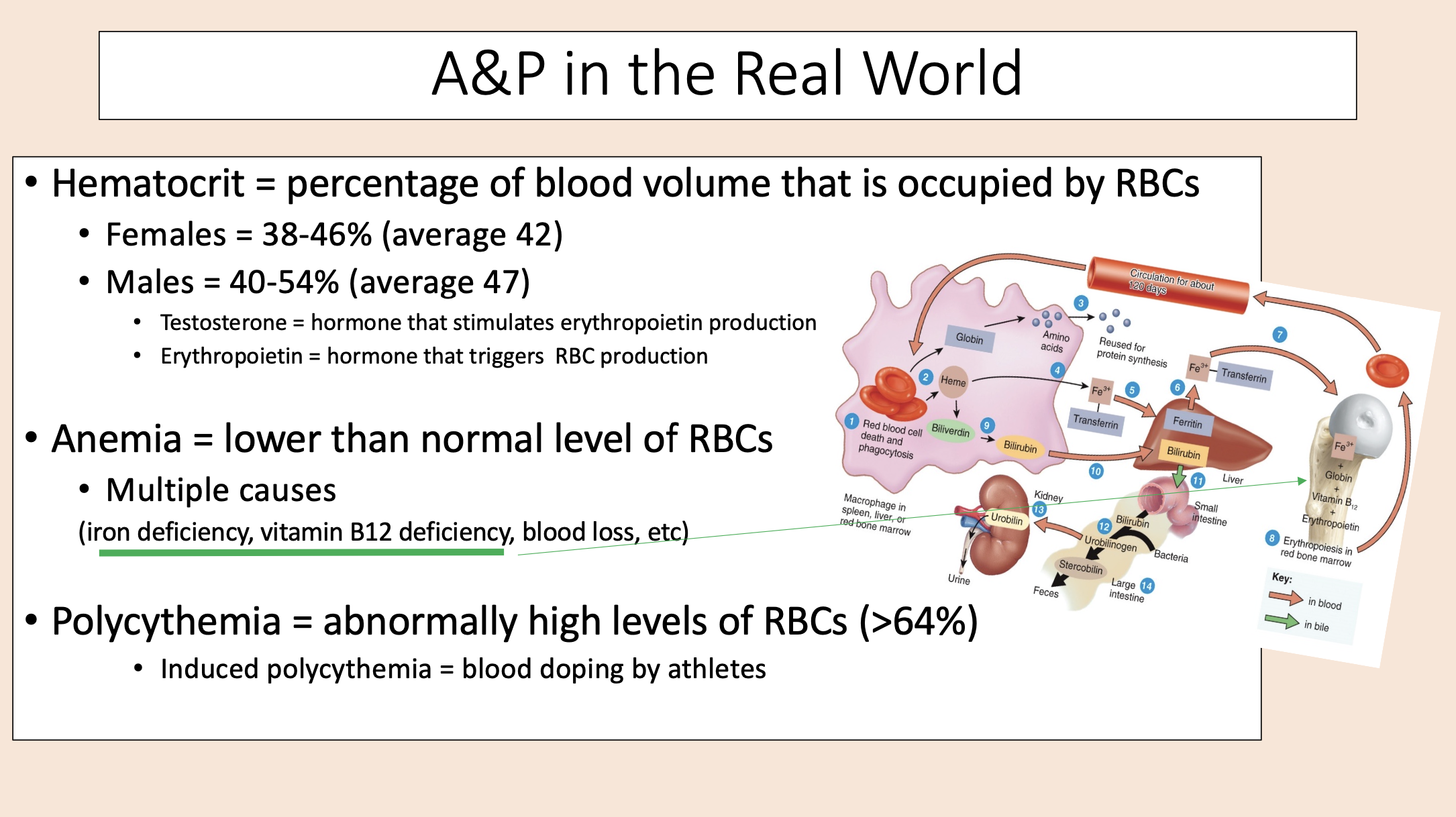
Anemia Multiple causes
• Iron deficiency.
• Vitamin B12 deficiency.
• Blood loss, etc.
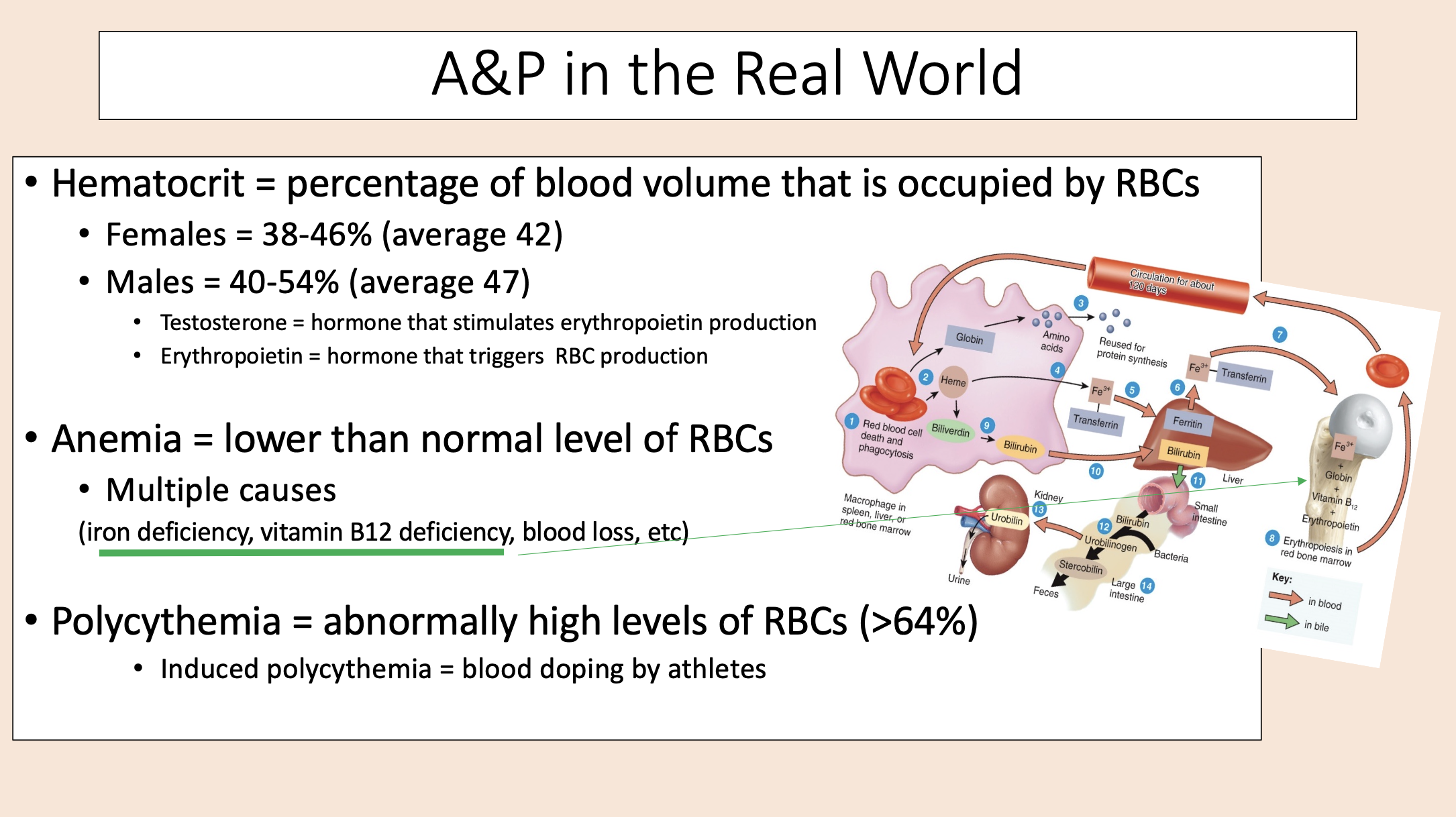
Polycythemia
Abnormally high levels of RBCs (>64%).
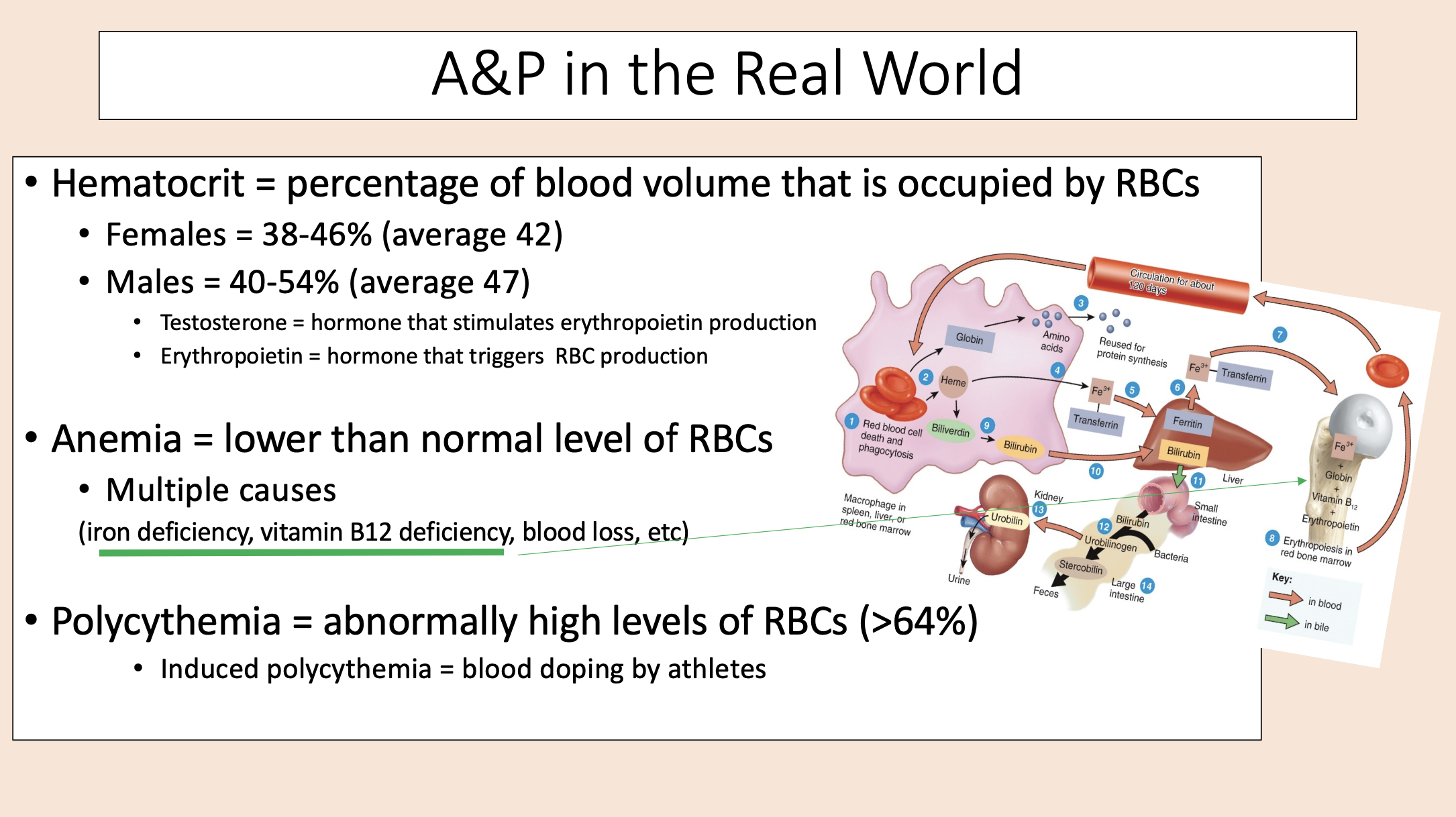
Induced polycythemia
Blood doping by athletes.
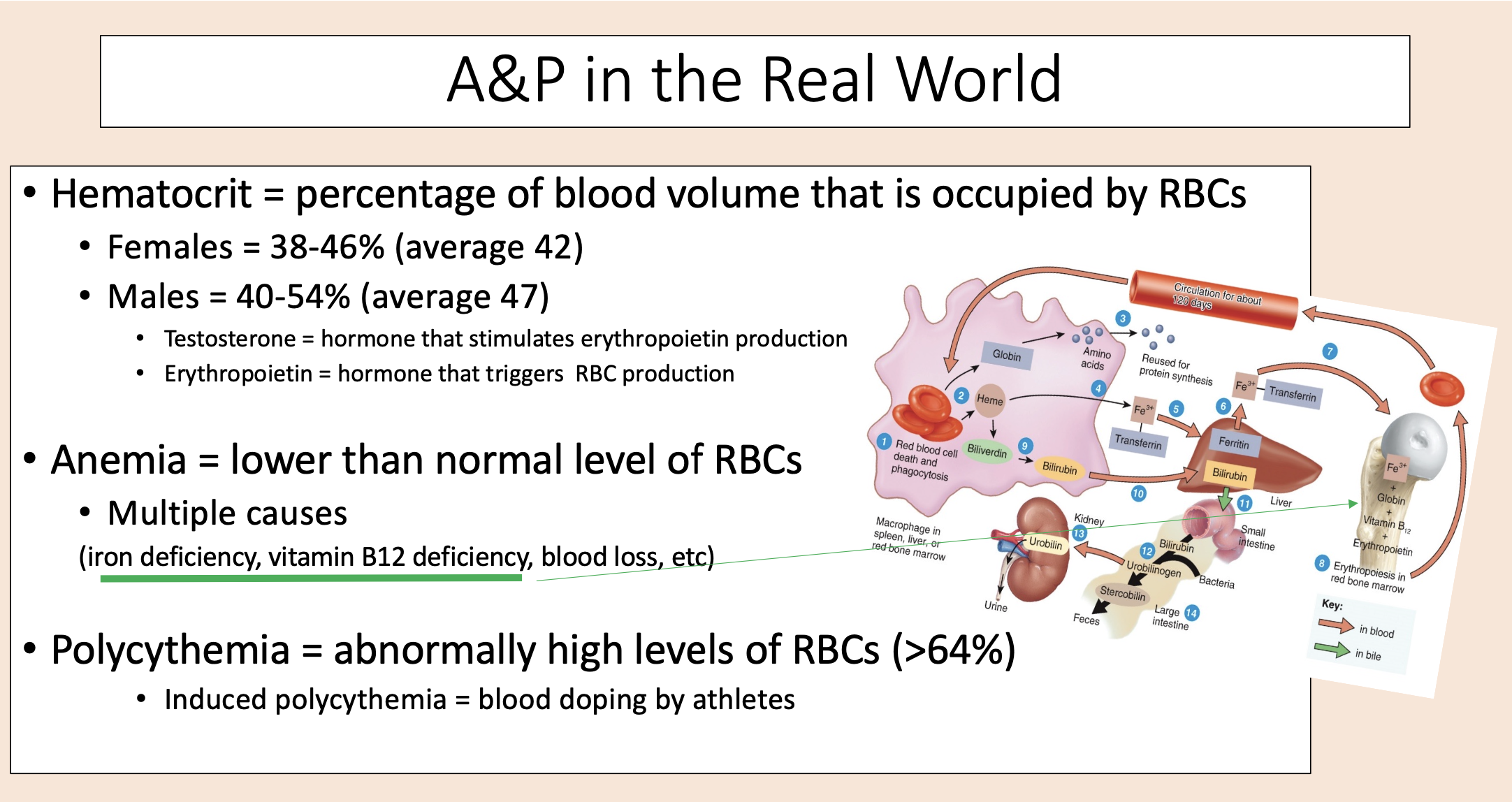
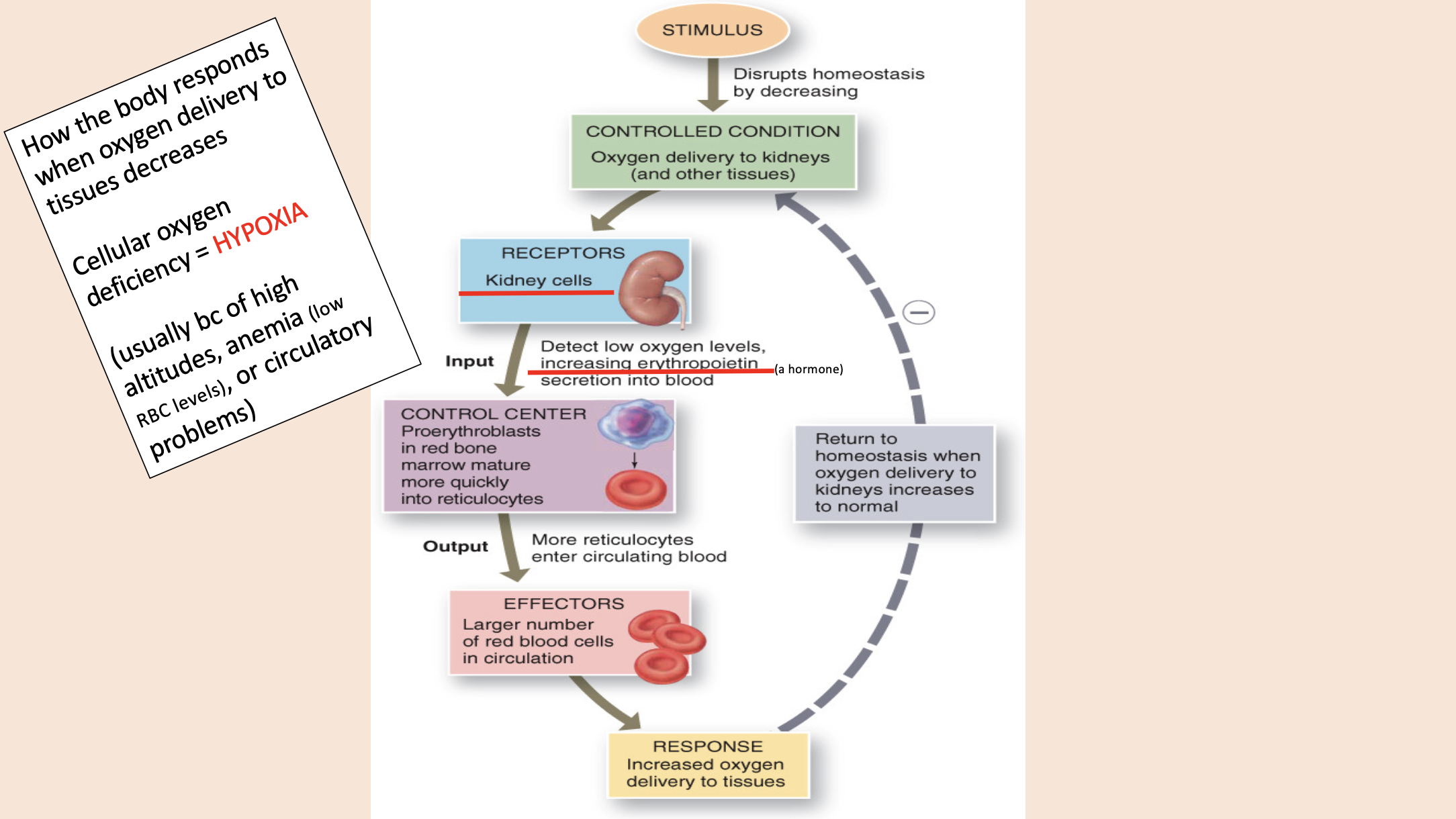
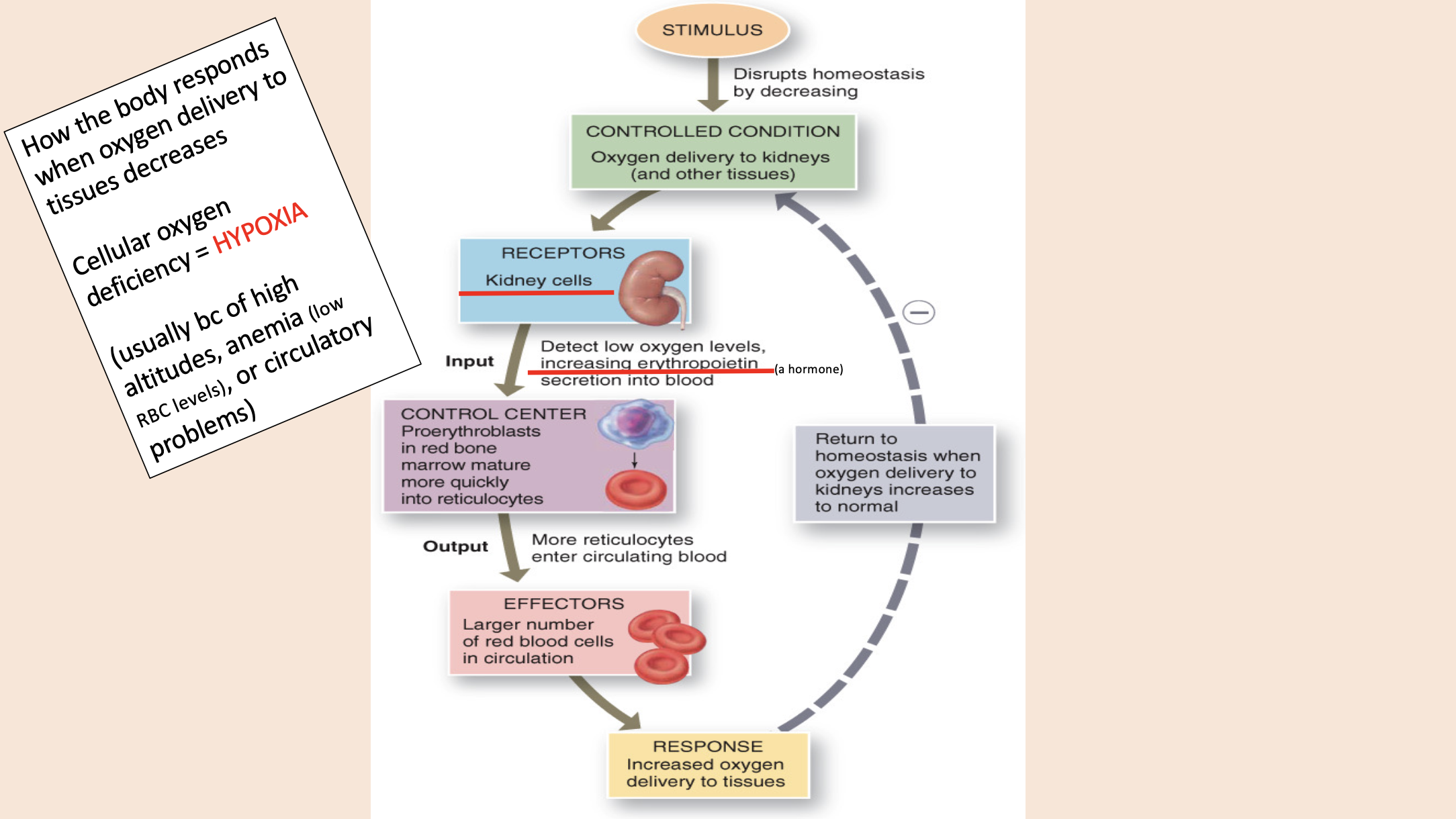
How the body responds when oxygen delivery to tissues decreases
Cellular oxygen deficiency = HYPOXIA (usually because of high altitudes, anemia (low RBC levels), or circulatory problems.
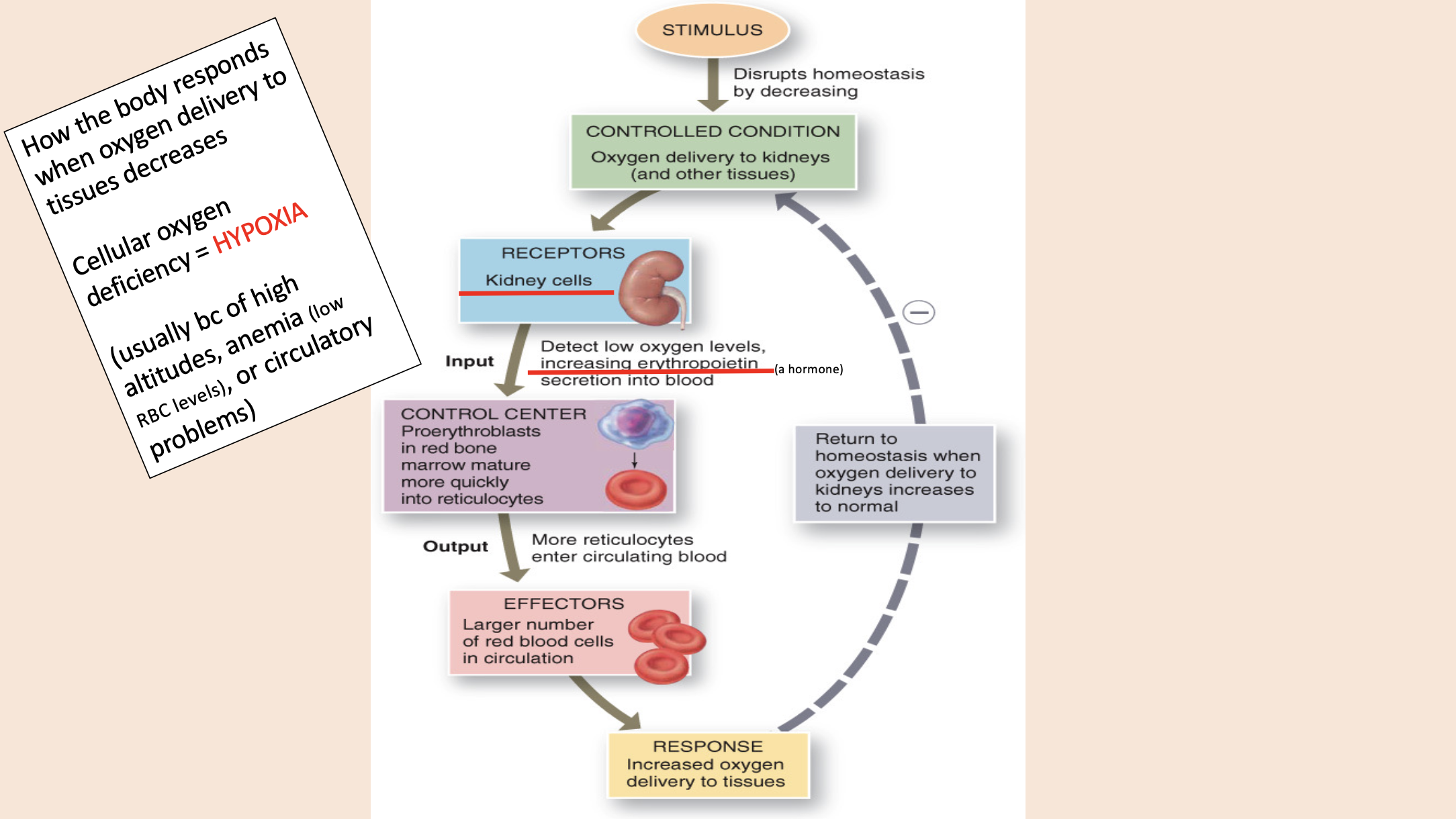
STIMULUS.
CONTROLLED CONIDITON.
RECEPTORS.
Input.
CONTROL CENTER.
Output.
EFFECTORS.
RESPONSE.
Return.
STIMULUS.
CONTROLLED CONIDITON.
RECEPTROS.
Input.
CONTROL CENTER.
Output.
EFFECTORS.
RESPONSE.
Return.
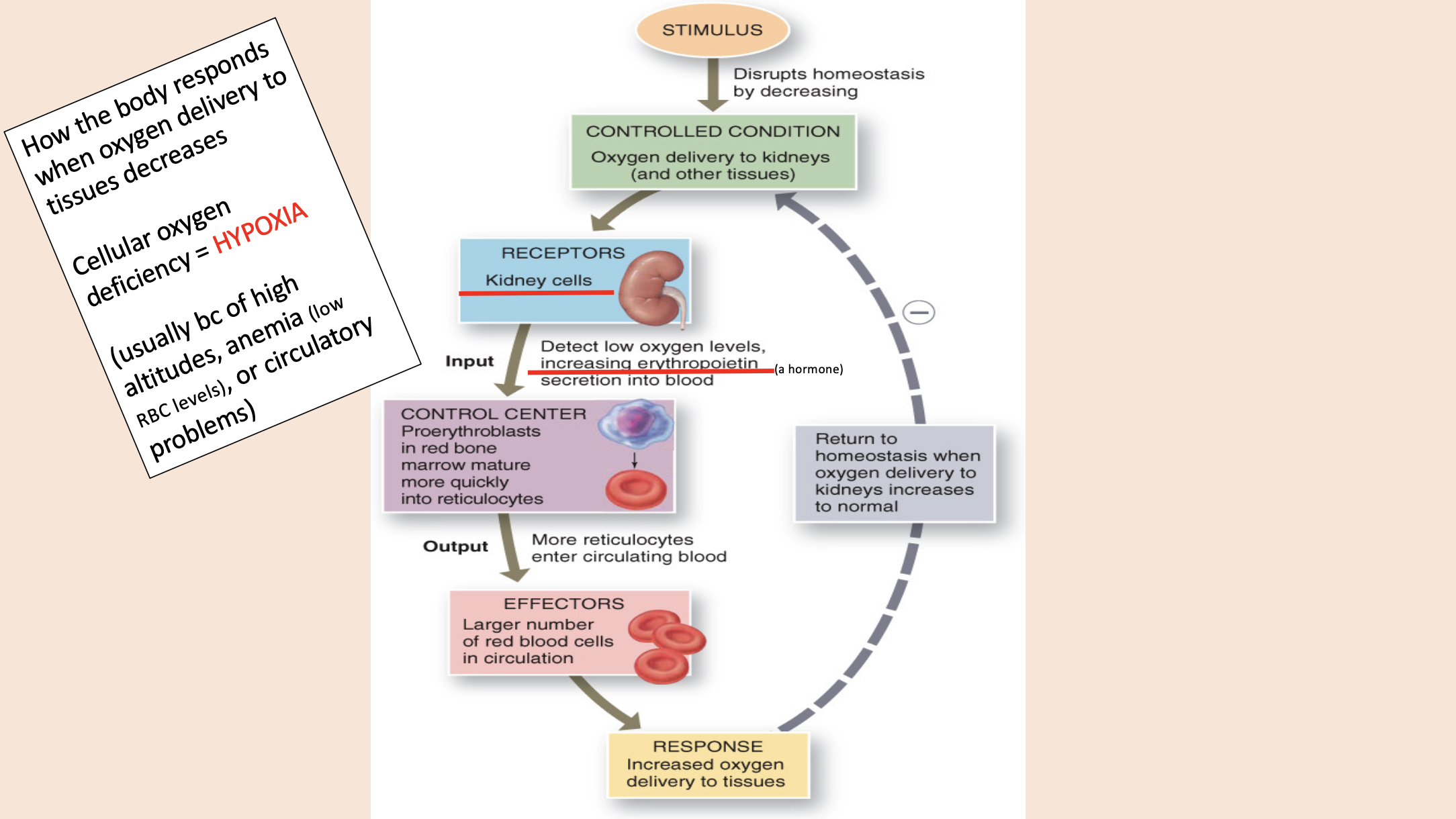
STIMULUS
Disrupts homeostasis by decreasing.
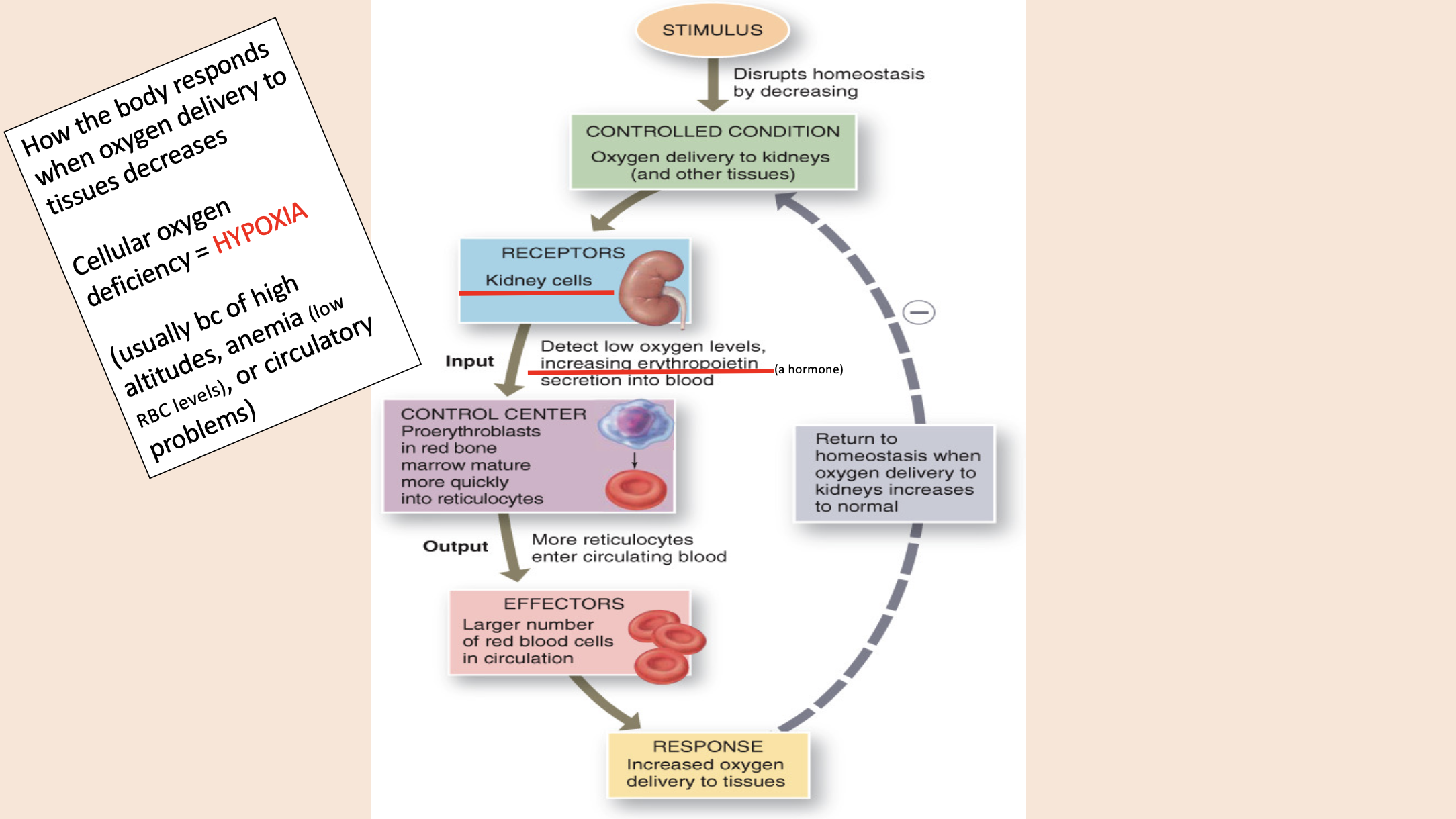
CONTROLLED CONDITION
Oxygen delivery to kidneys (and other tissues).
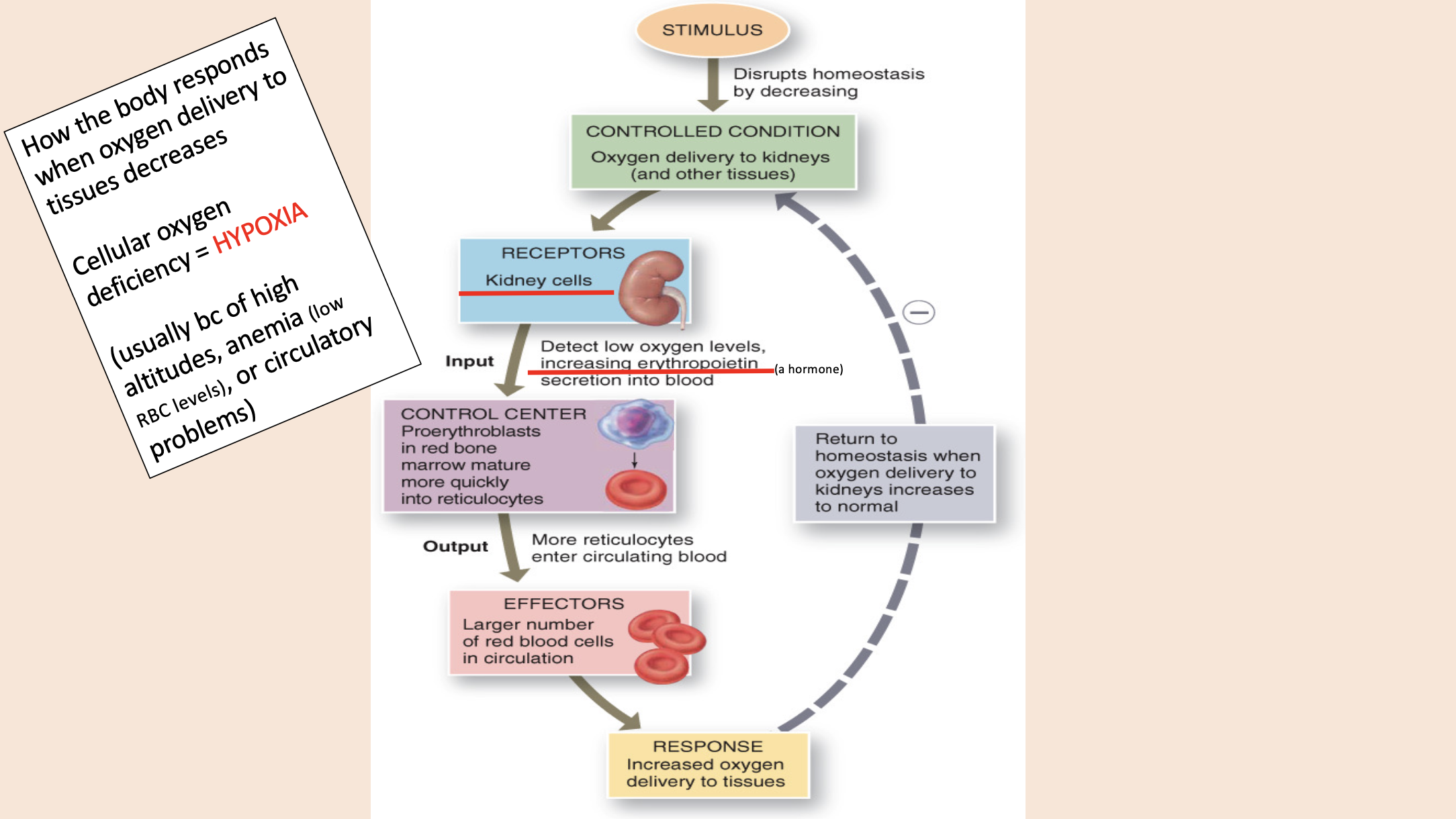
RECEPTORS
Kidney cells.
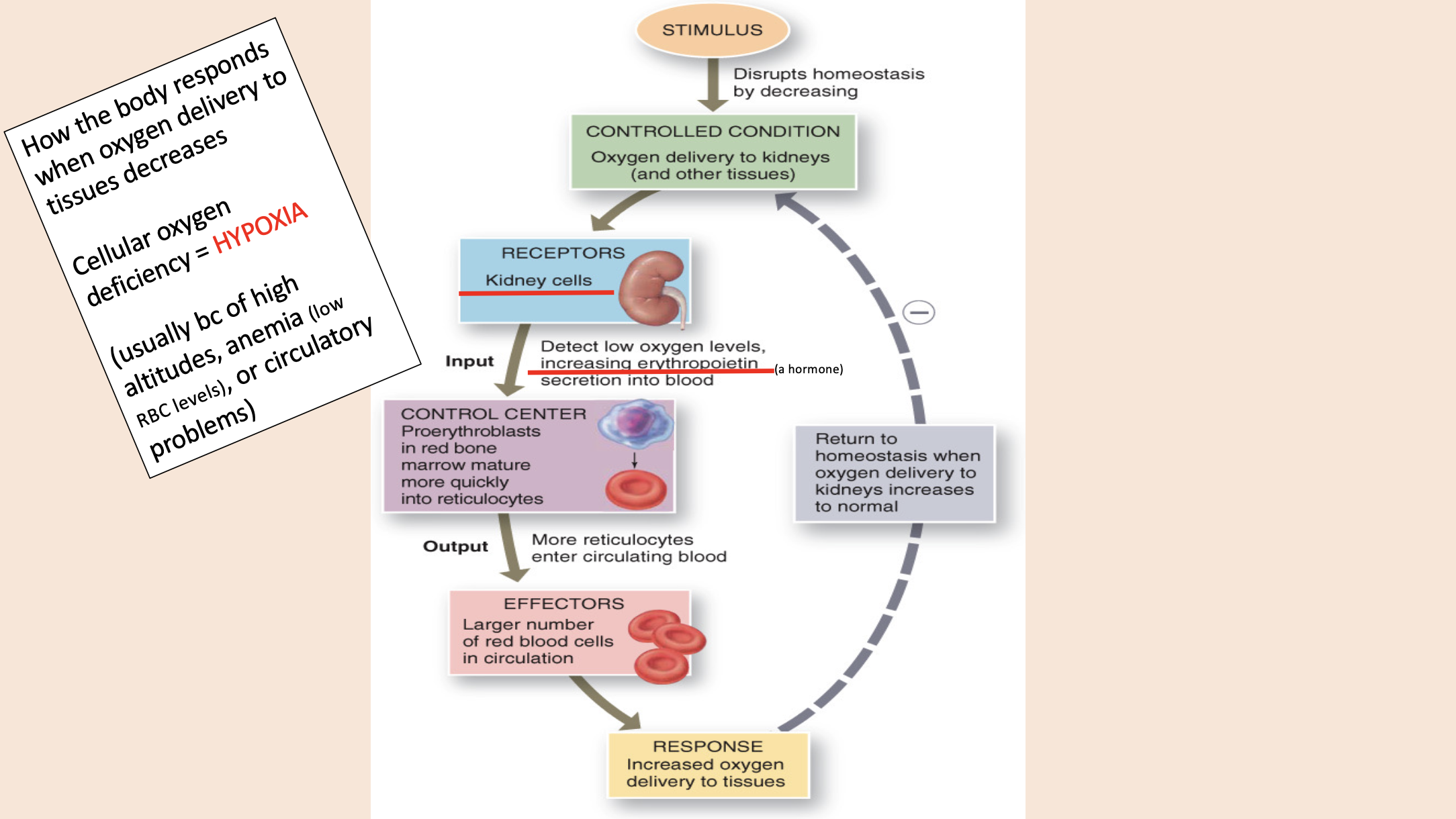
Input
Detect low oxygen levels, increasing erythropoietin secretion into blood (a hormone).
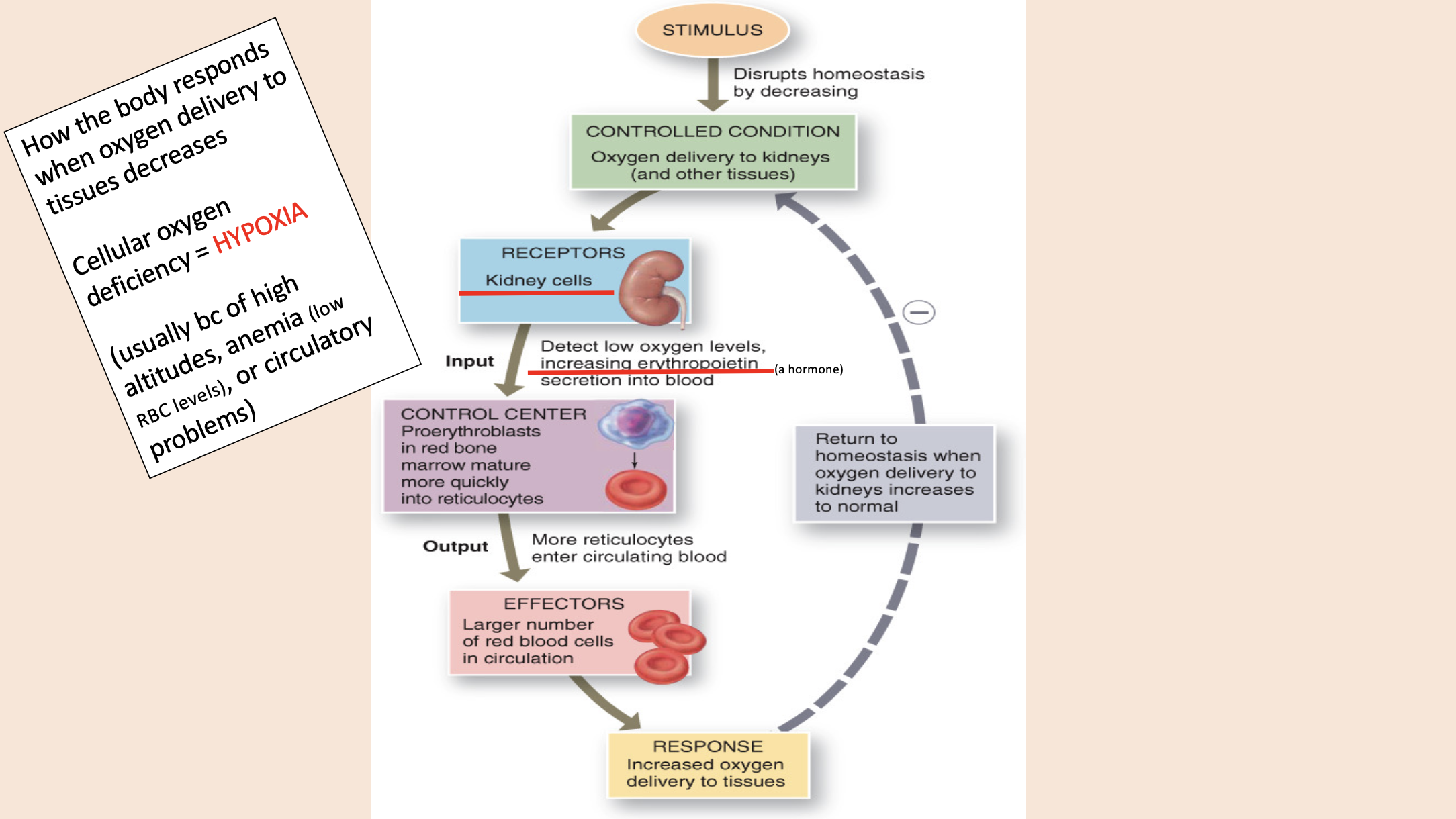
CONTROL CENTER
Proerythroblasts in red bone marrow mature more quickly into reticulocytes.
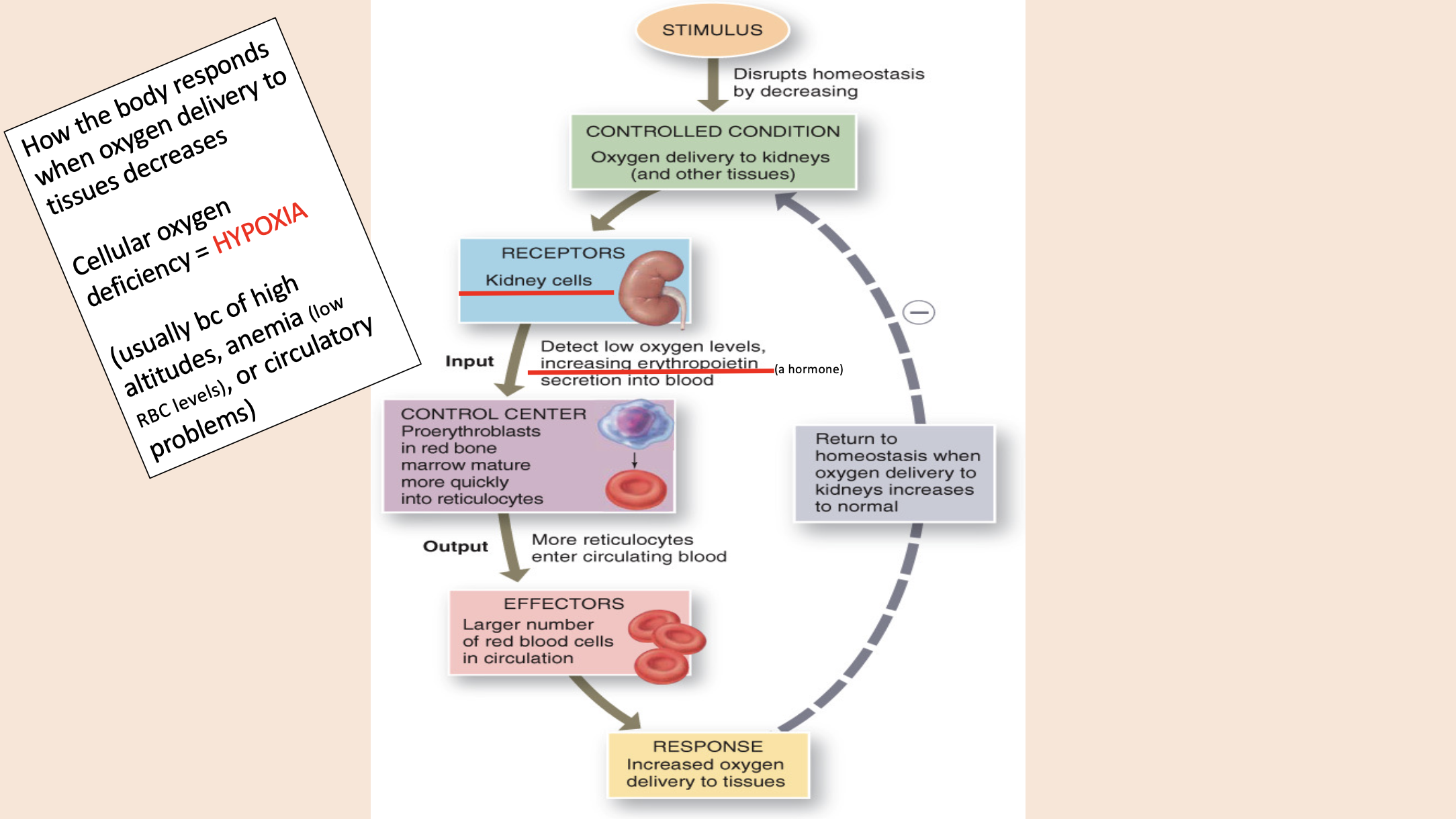
Output
More reticulocytes enter circulating blood.
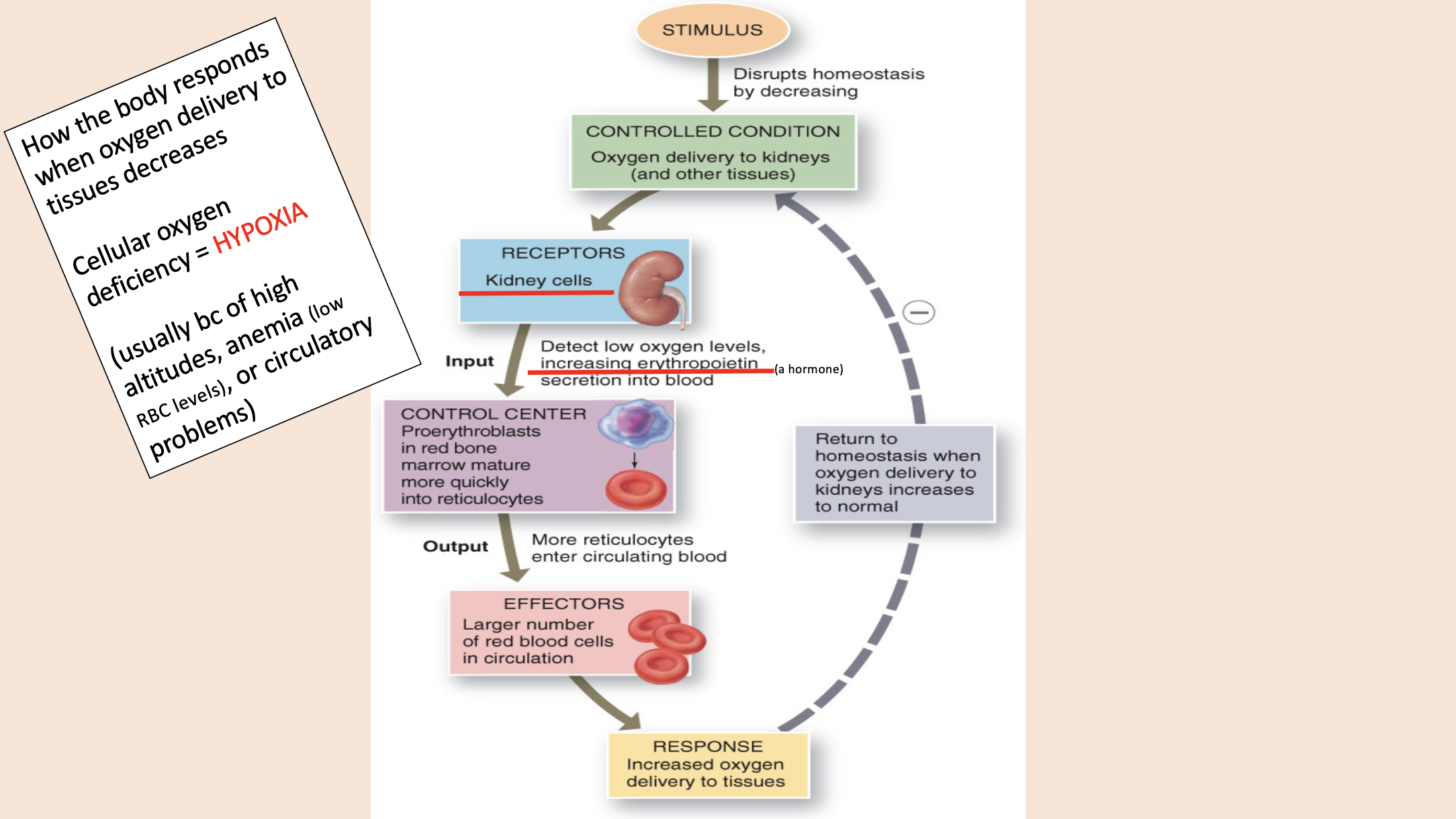
EFFECTORS
Larger number of red blood cells in circulation.
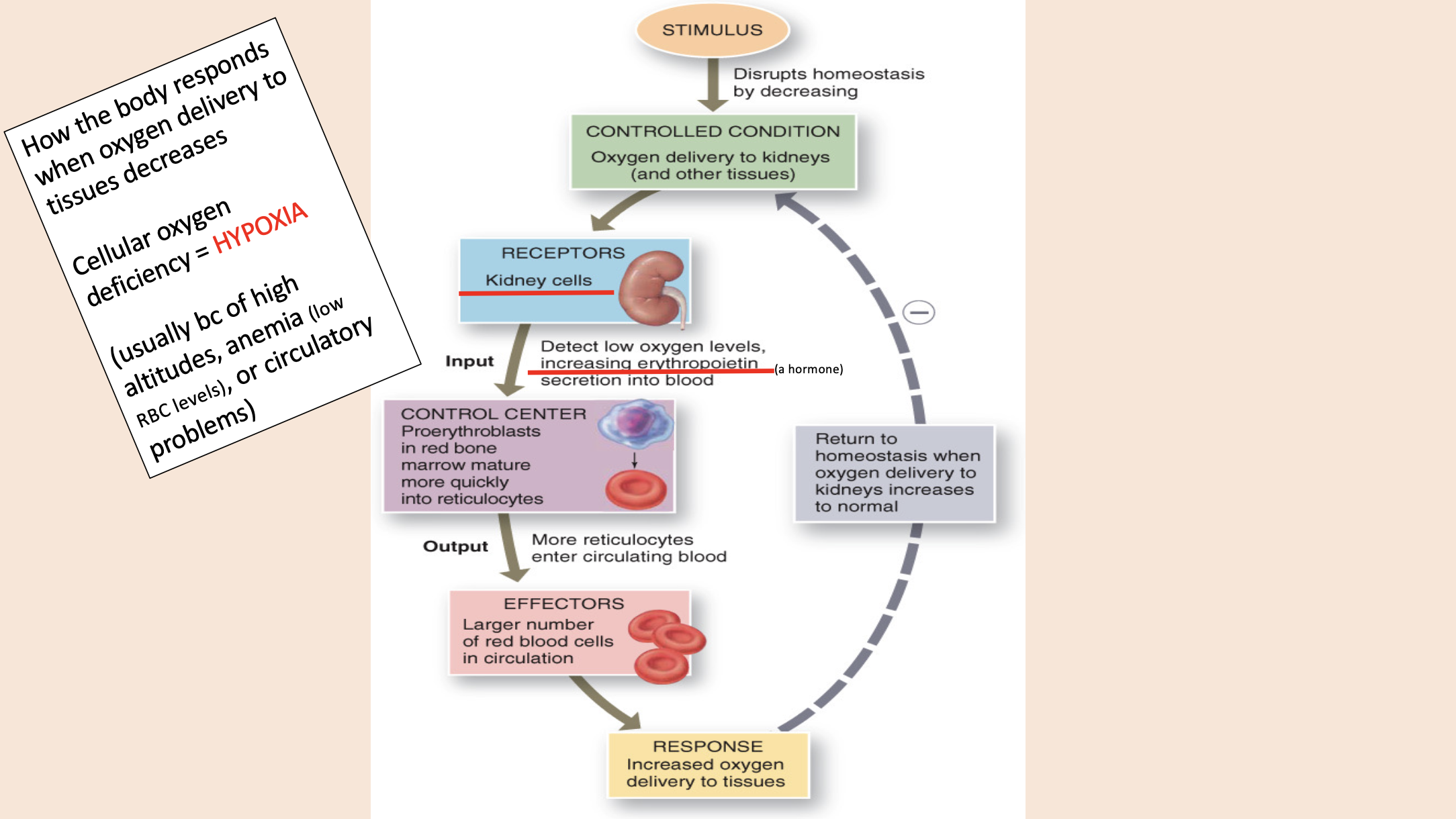
RESPONSE
Increased oxygen delivery to tissues.
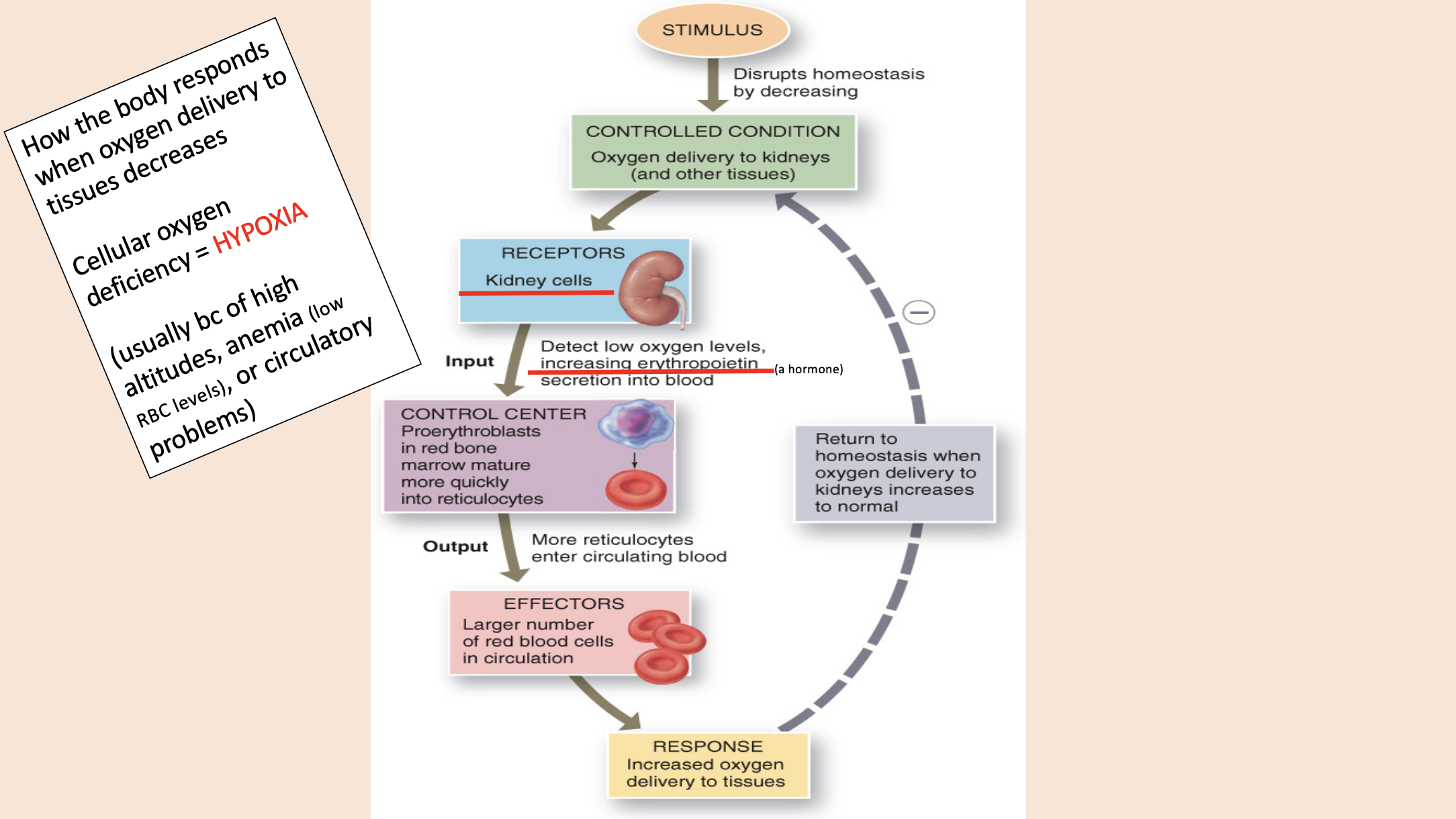
Return
To homeostasis when oxygen delivery to kidneys increases to normal.
Cellular oxygen deficiency
HYPOXIA
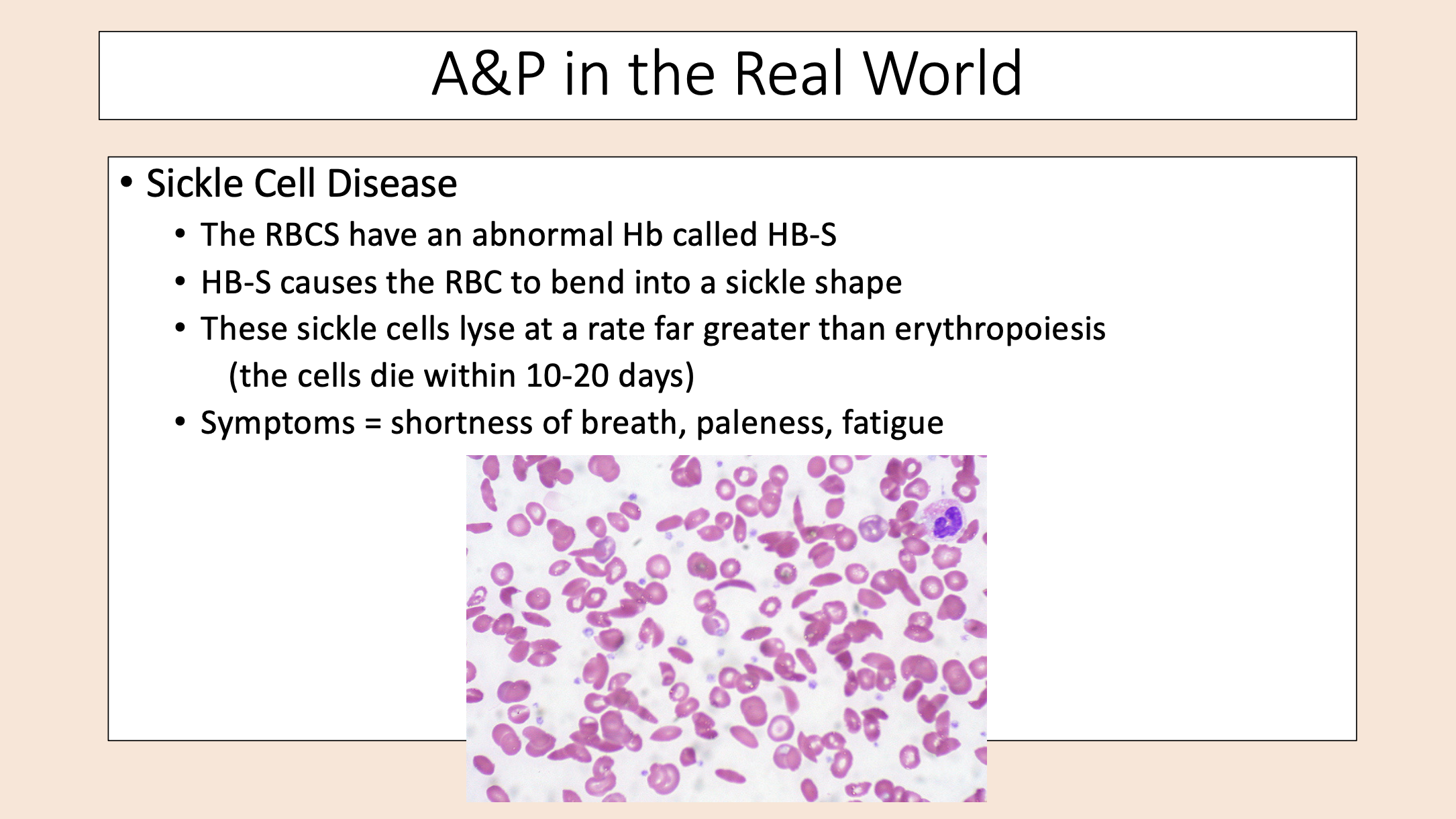
Sickle Cell Disease
• The RBCS have an abnormal Hb called HB-S.
• HB-S causes the RBC to bend into a sickle shape.
• These sickle cells lyse at a rate far greater than erythropoiesis (the cells die within 10-20 days).
• Symptoms = shortness of breath, paleness, fatigue
Sickle Cell Disease Symptoms
Shortness of breath.
Paleness.
Fatigue.
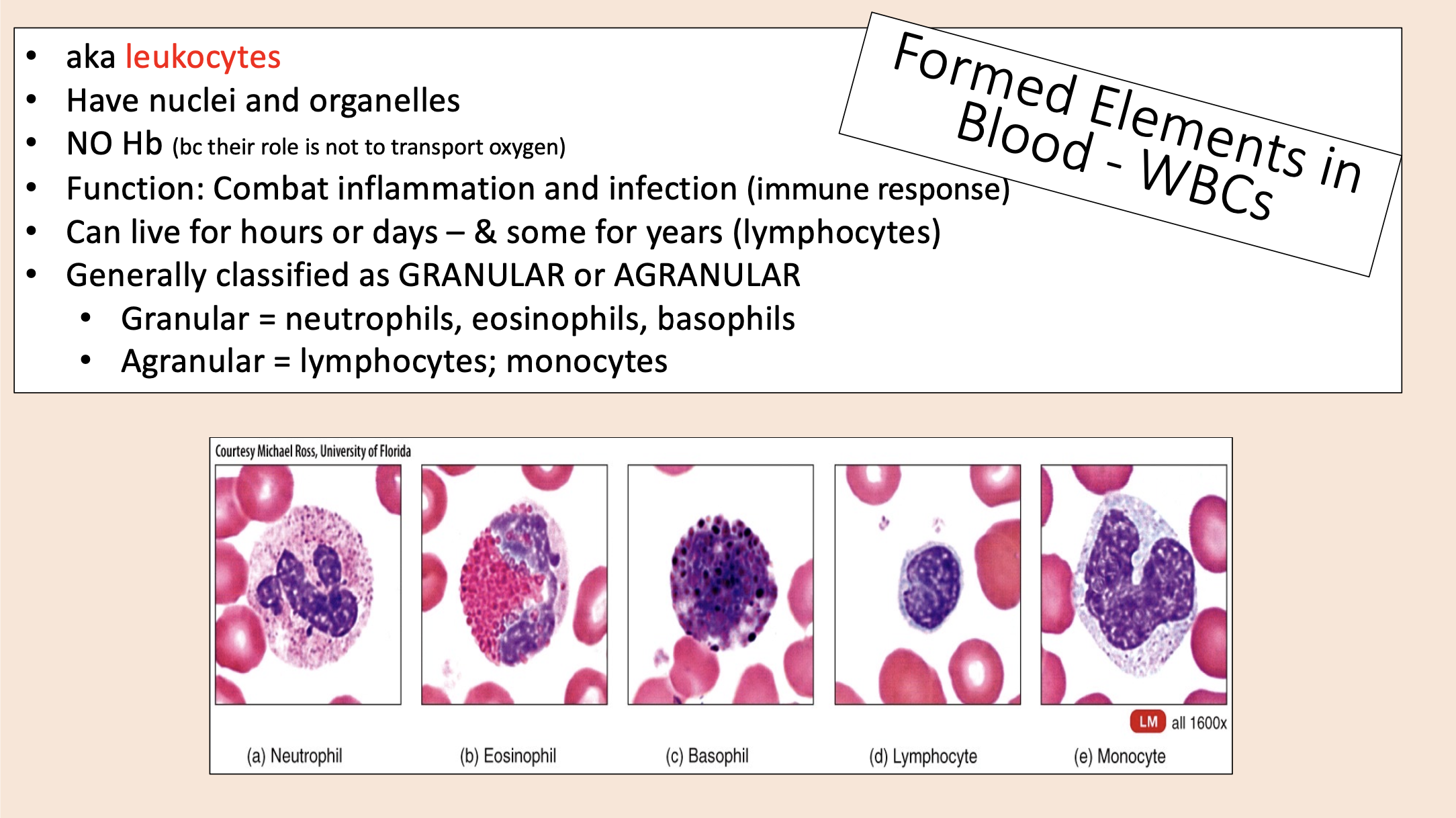
Formed Elements in Blood - WBCs
• aka leukocytes.
• Have nuclei and organelles.
• NO Hb (bc their role is not to transport oxygen).
• Function: Combat inflammation and infection (immune response).
• Can live for hours or days – & some for years (lymphocytes).
• Generally classified as GRANULAR or AGRANULAR.
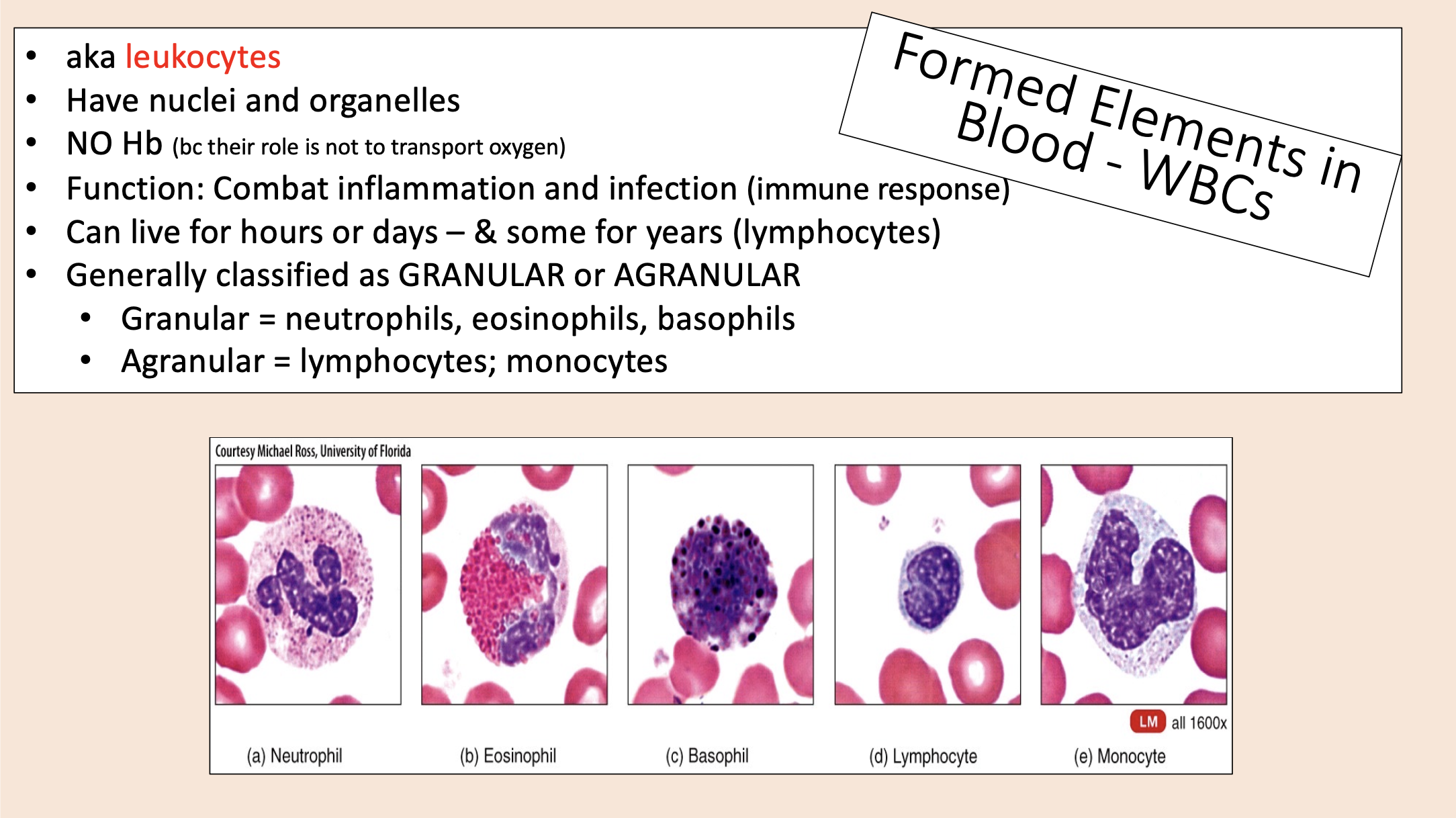
Granular
• Neutrophils.
• Eosinophils.
• Basophils.
Agranular
• Lymphocytes.
• Monocytes.
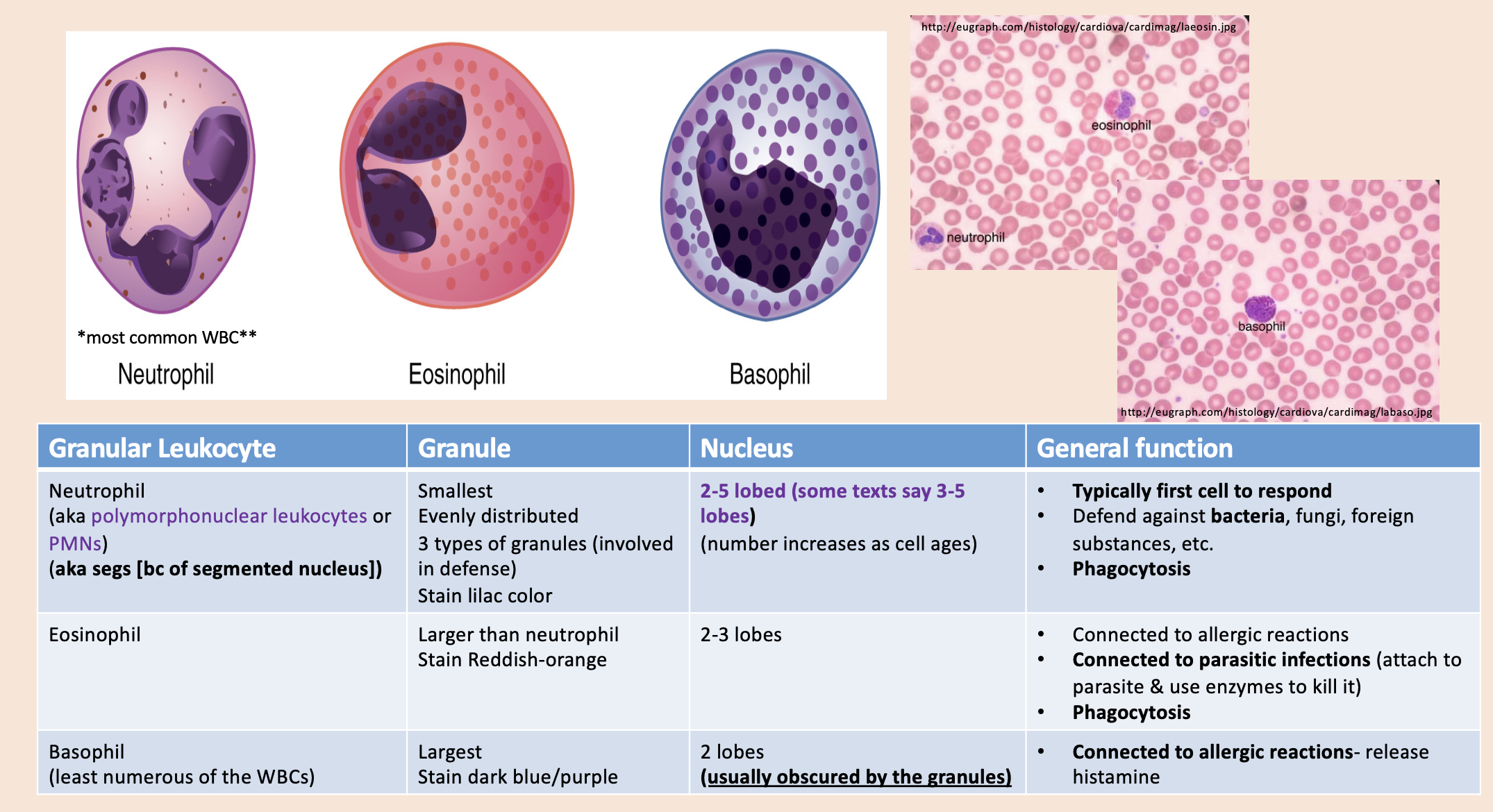
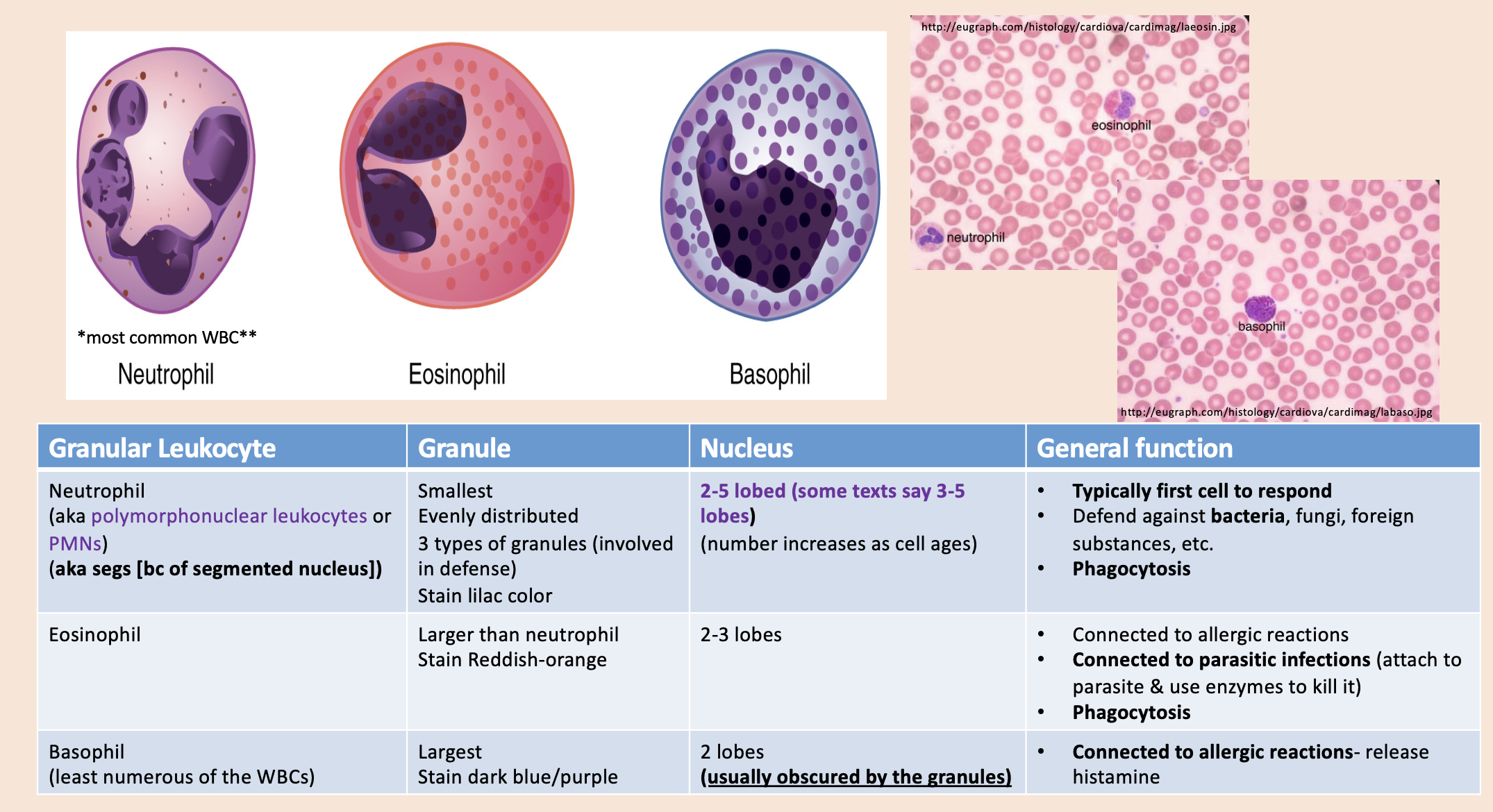
Granular Leukocyte
• Neutrophil (aka polymorphonuclear leukocytes or PMNs) (aka segs [because of segmented nucleus]).
• Eosinophil.
• Basophil (least numerous of the WBCs).
![<p><span>• Neutrophil (aka </span><span style="color: rgb(112, 48, 160);"><span>polymorphonuclear leukocytes </span></span><span>or </span><span style="color: rgb(112, 48, 160);"><span>PMNs</span></span><span>) (</span><strong><span>aka segs [because of segmented nucleus]).</span></strong></p><p><span>• Eosinophil.</span></p><p><span>• Basophil (least numerous of the WBCs).</span></p>](https://knowt-user-attachments.s3.amazonaws.com/69f0333b-29f5-48f6-9ae5-4ee853dc9532.png)
Granule Neutrophil
• Smallest.
• Evenly distributed.
• 3 types of granules (involved in defense).
• Stain lilac color.
Granule Eosinophil
• Larger than neutrophil.
• Stain Reddish-orange.
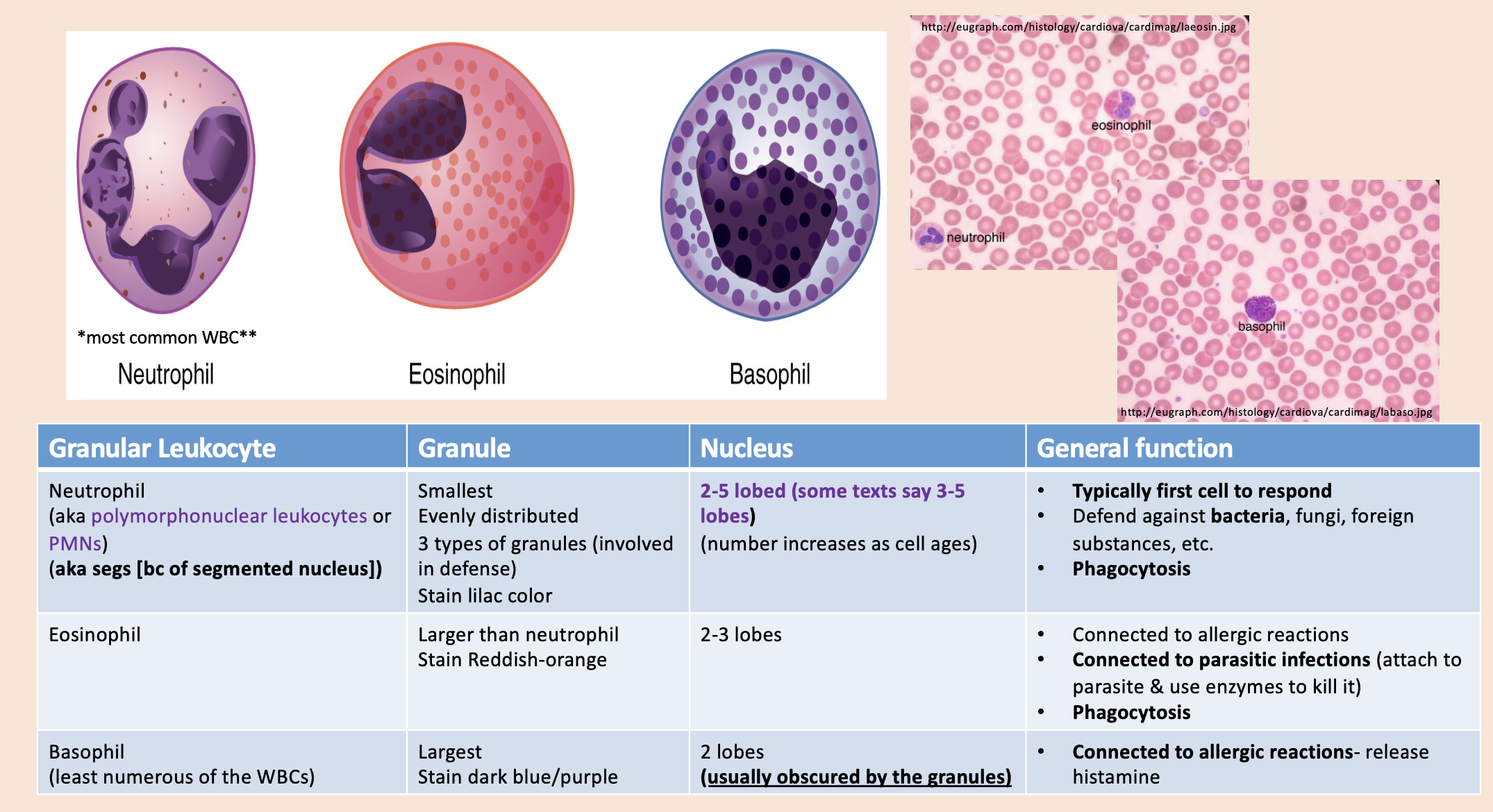
Granule Basophil
• Largest.
• Stain dark blue/purple.
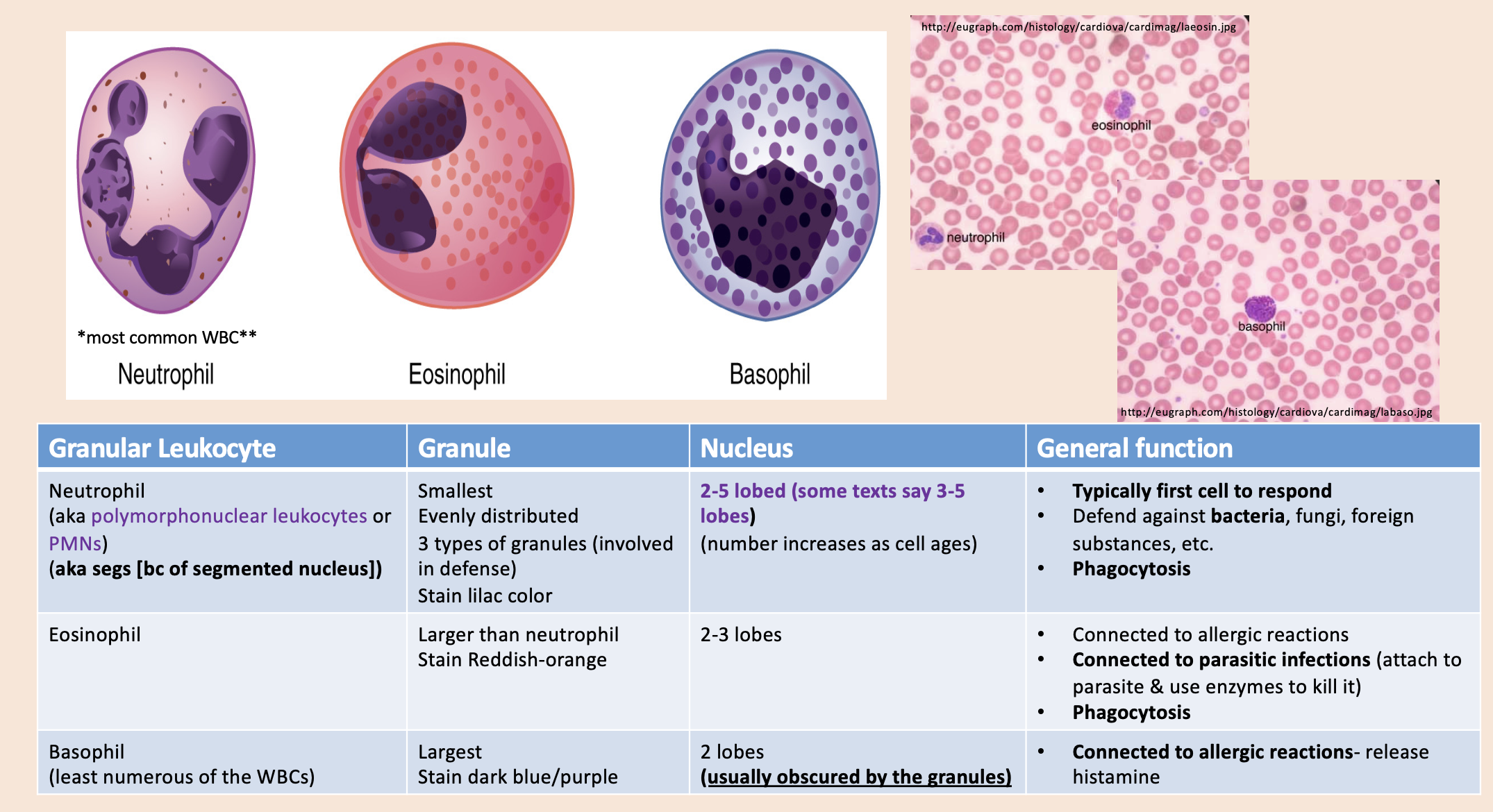
Nucleus Neutrophil
• 2-5 lobed (some texts say 3-5 lobes).
• (number increases as cell ages).
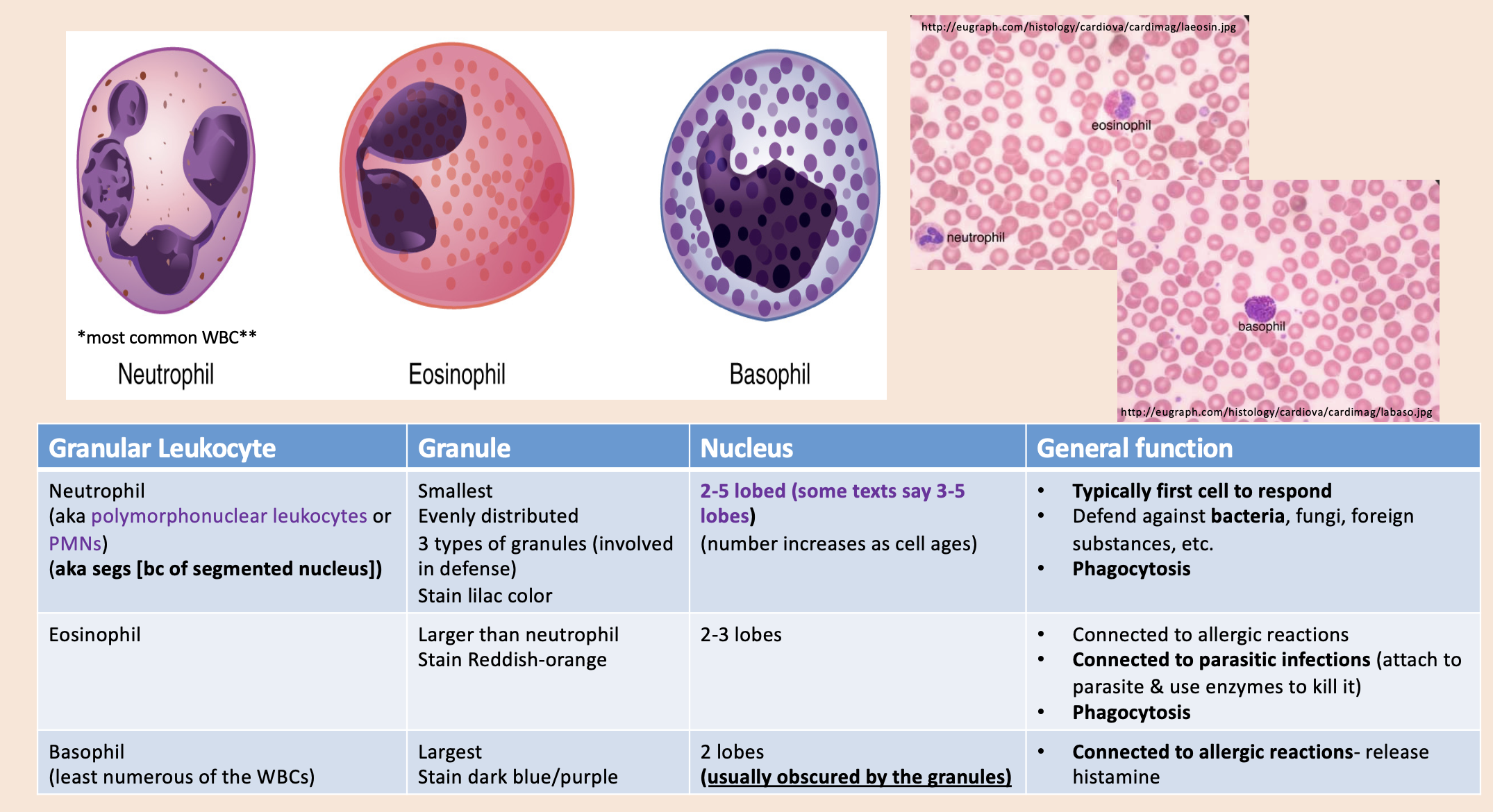
Nucleus Eosinophil
2-3 lobes.
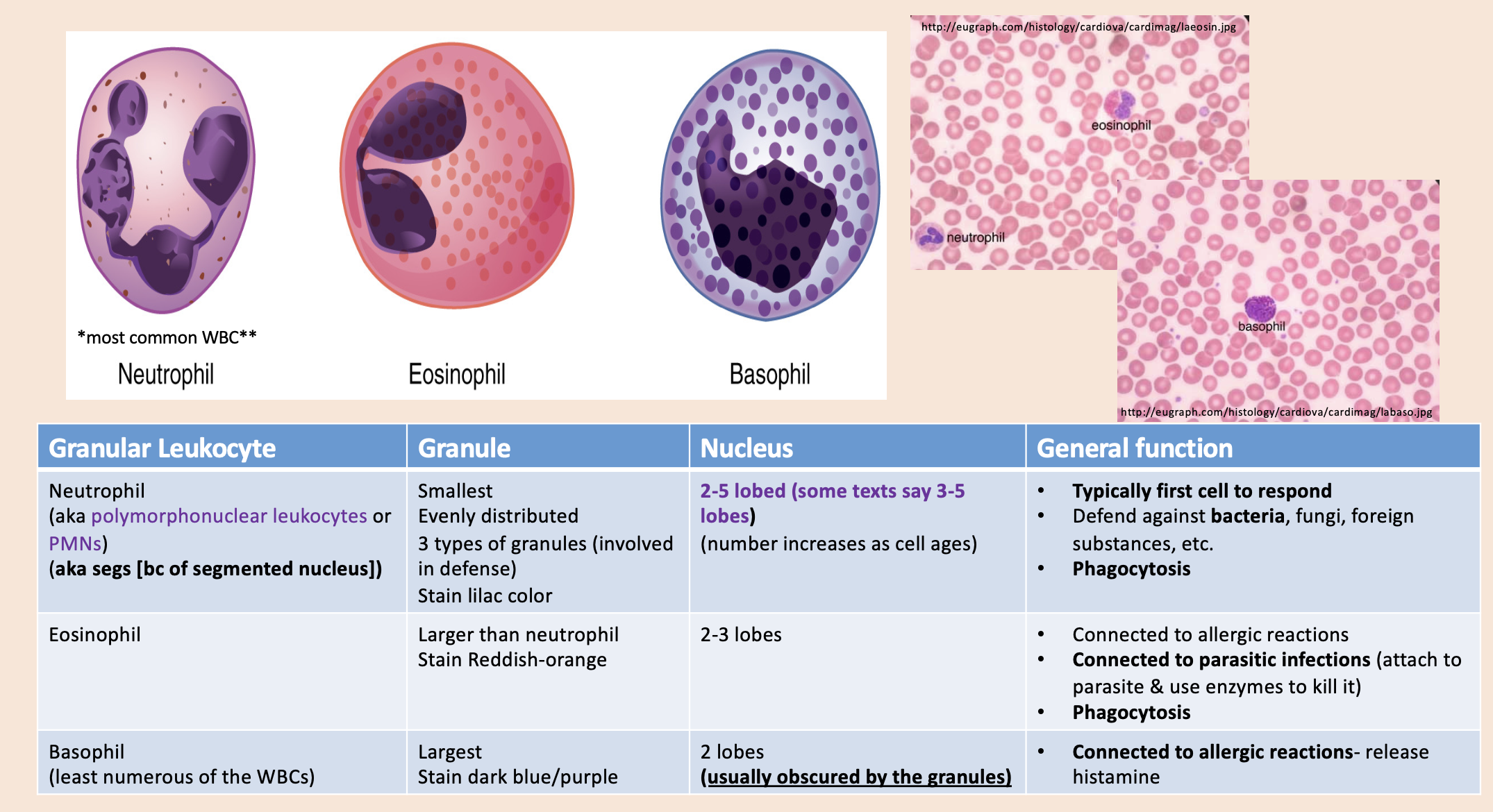
Nucleus Basophil
2 lobes (usually obscured by the granules).
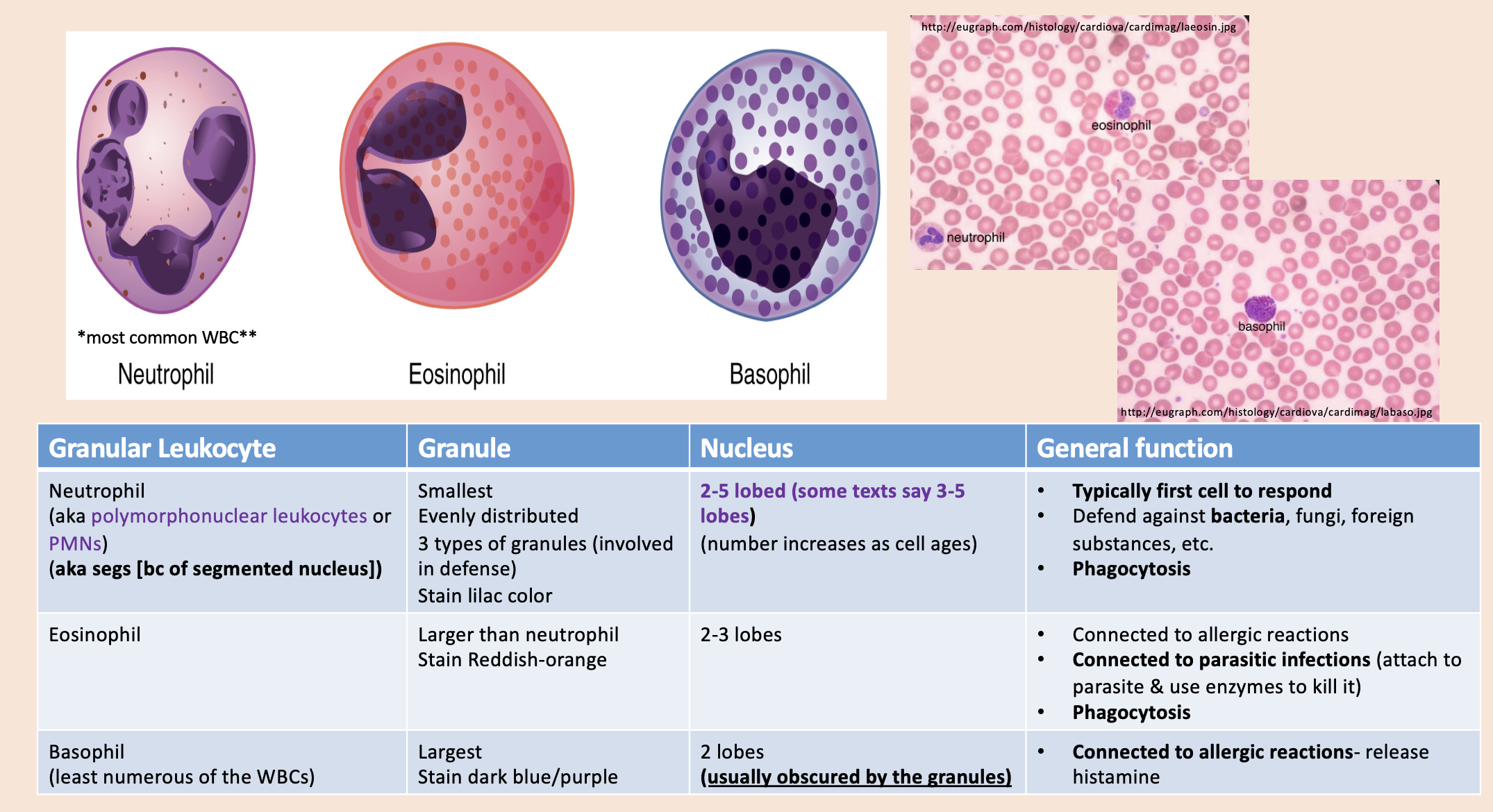
General function Neutrophil
• Typically first cell to respond.
• Defend against bacteria, fungi, foreign substances, etc.
• Phagocytosis.
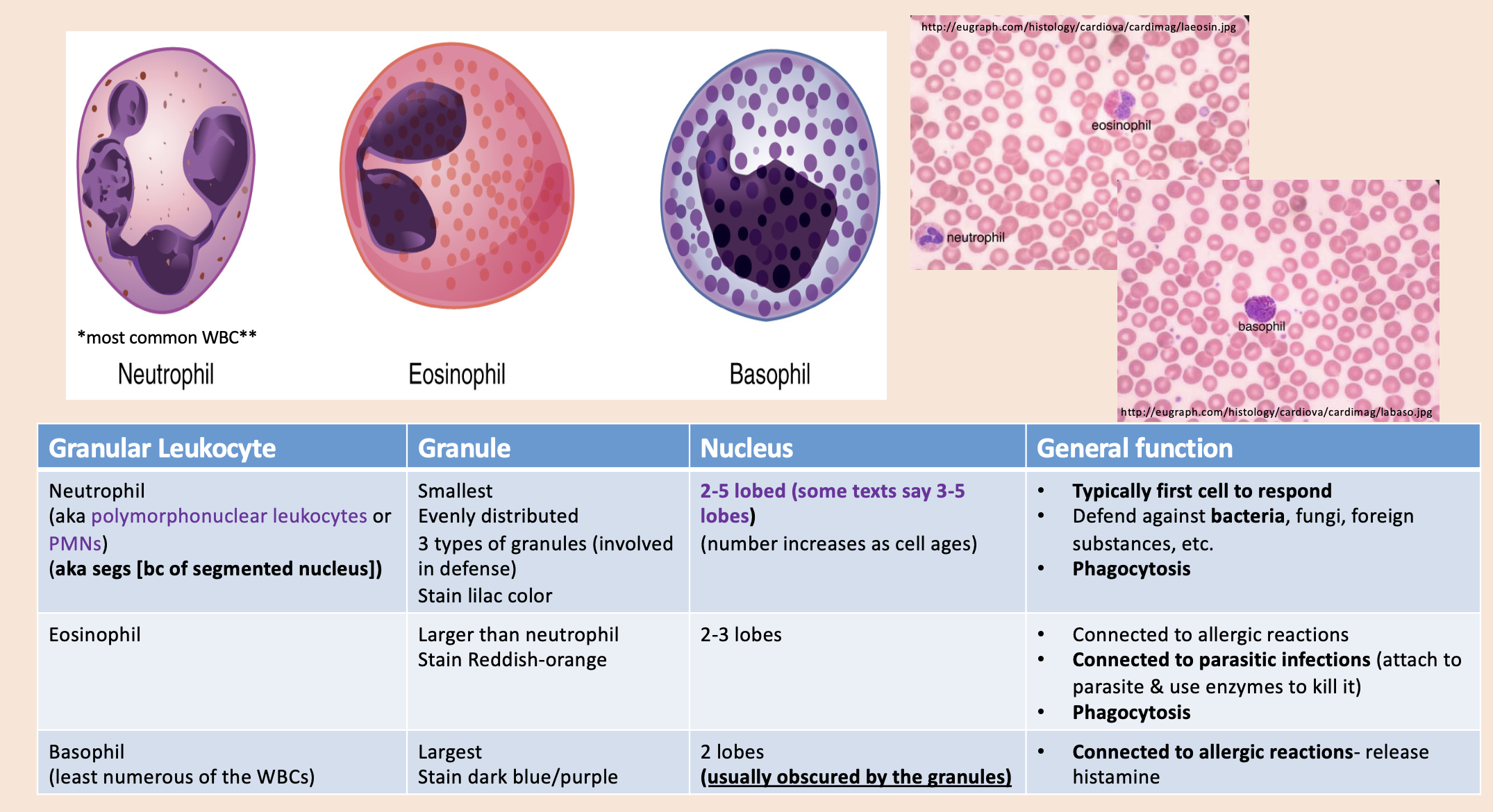
General function Eosinophil
• Connected to allergic reactions.
• Connected to parasitic infections (attach to parasite & use enzymes to kill it).
• Phagocytosis.
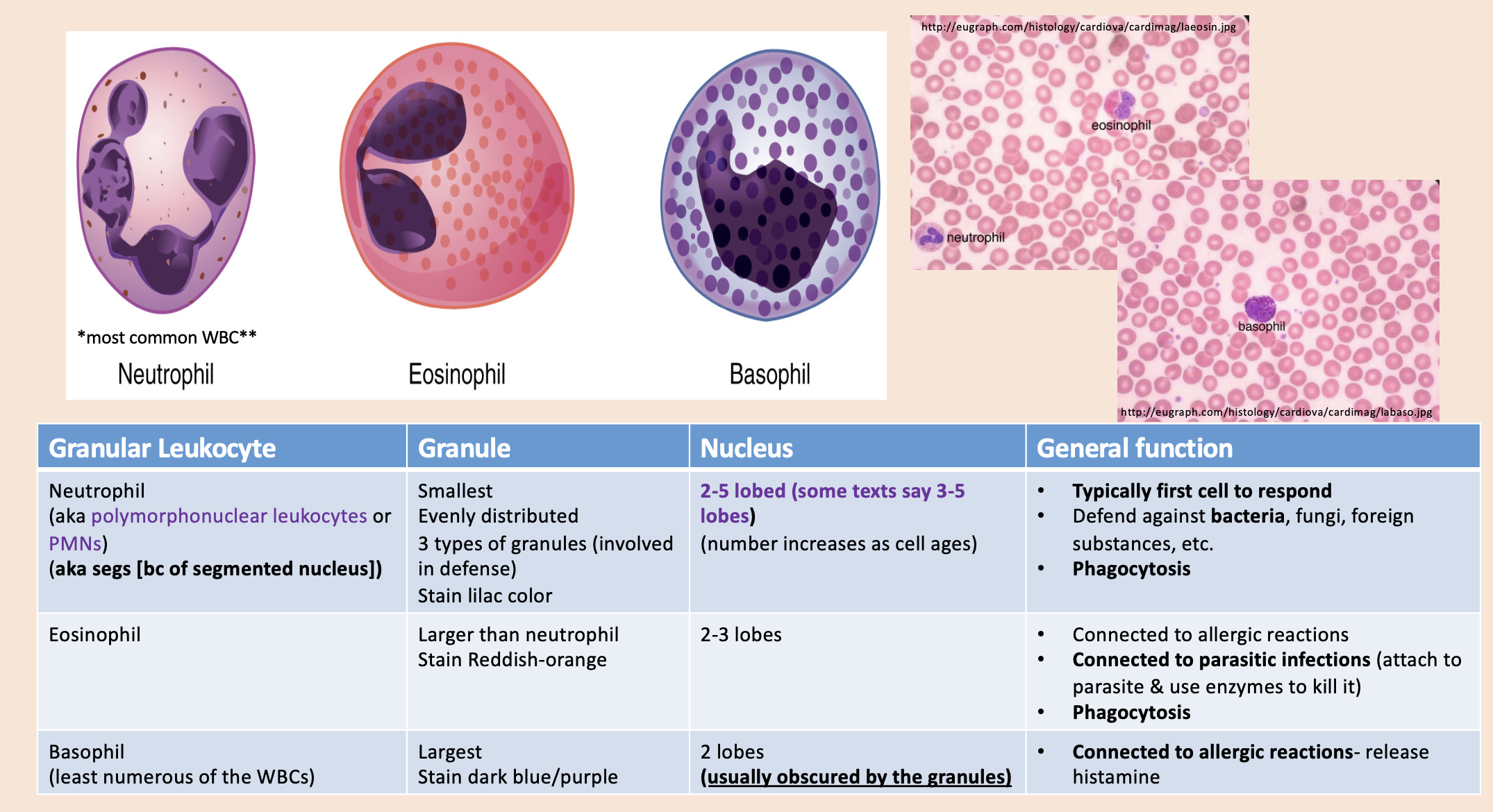
General function Basophil
Connected to allergic reactions- release histamine.
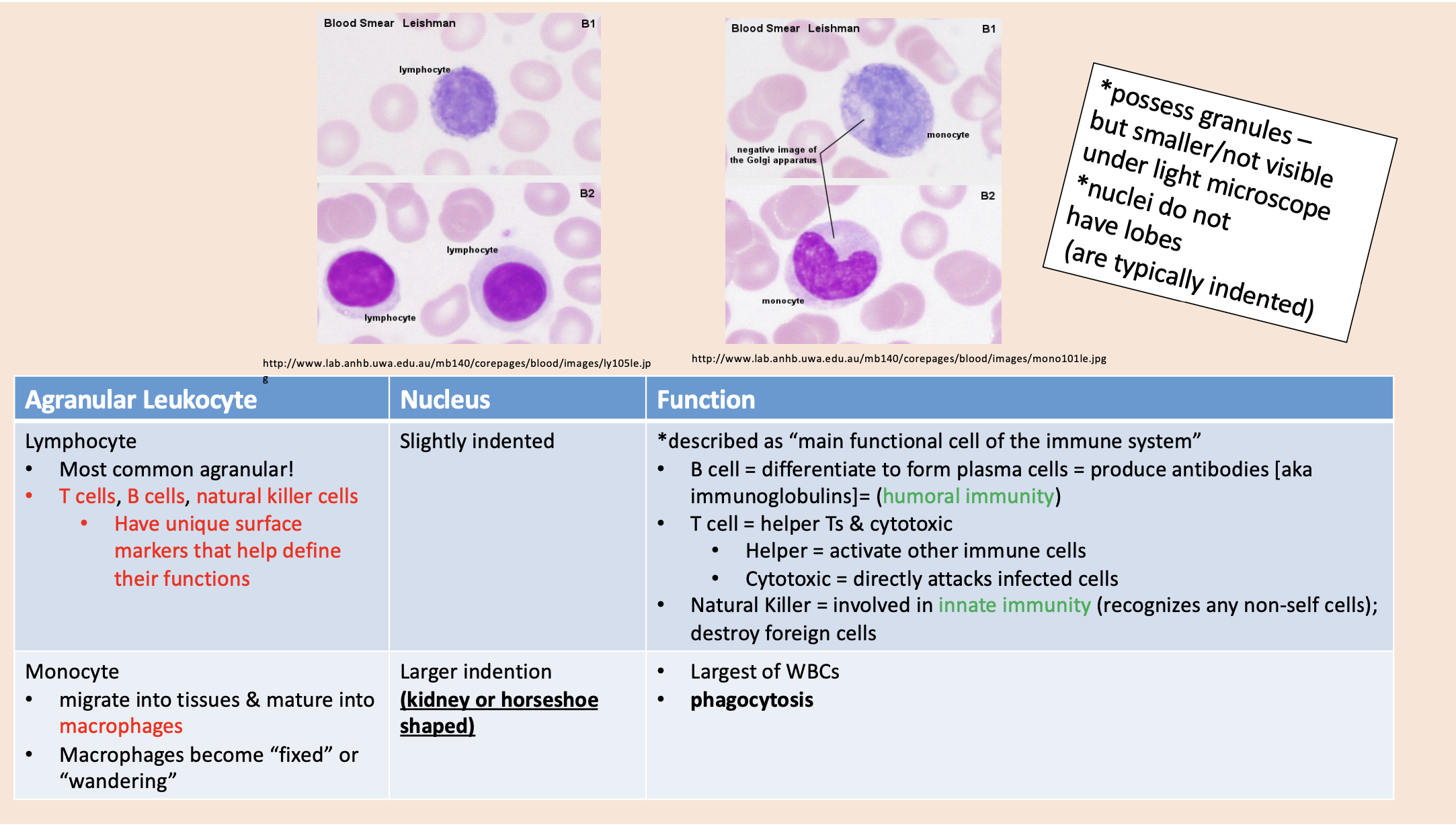
Agranular Leukocyte Lymphocyte
• Most common agranular!
• T cells, B cells, natural killer cells.
• Have unique surface markers that help define their functions
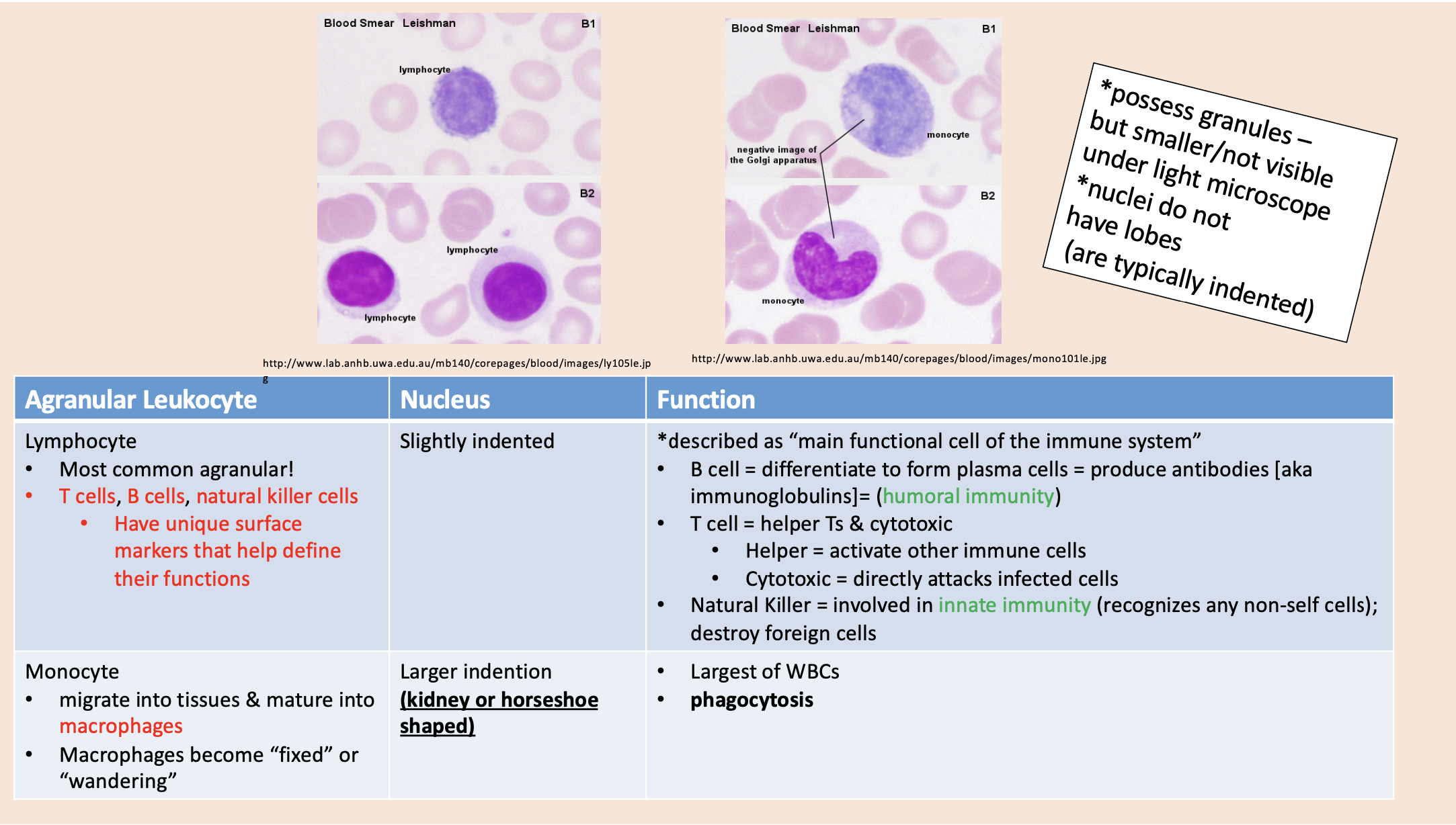
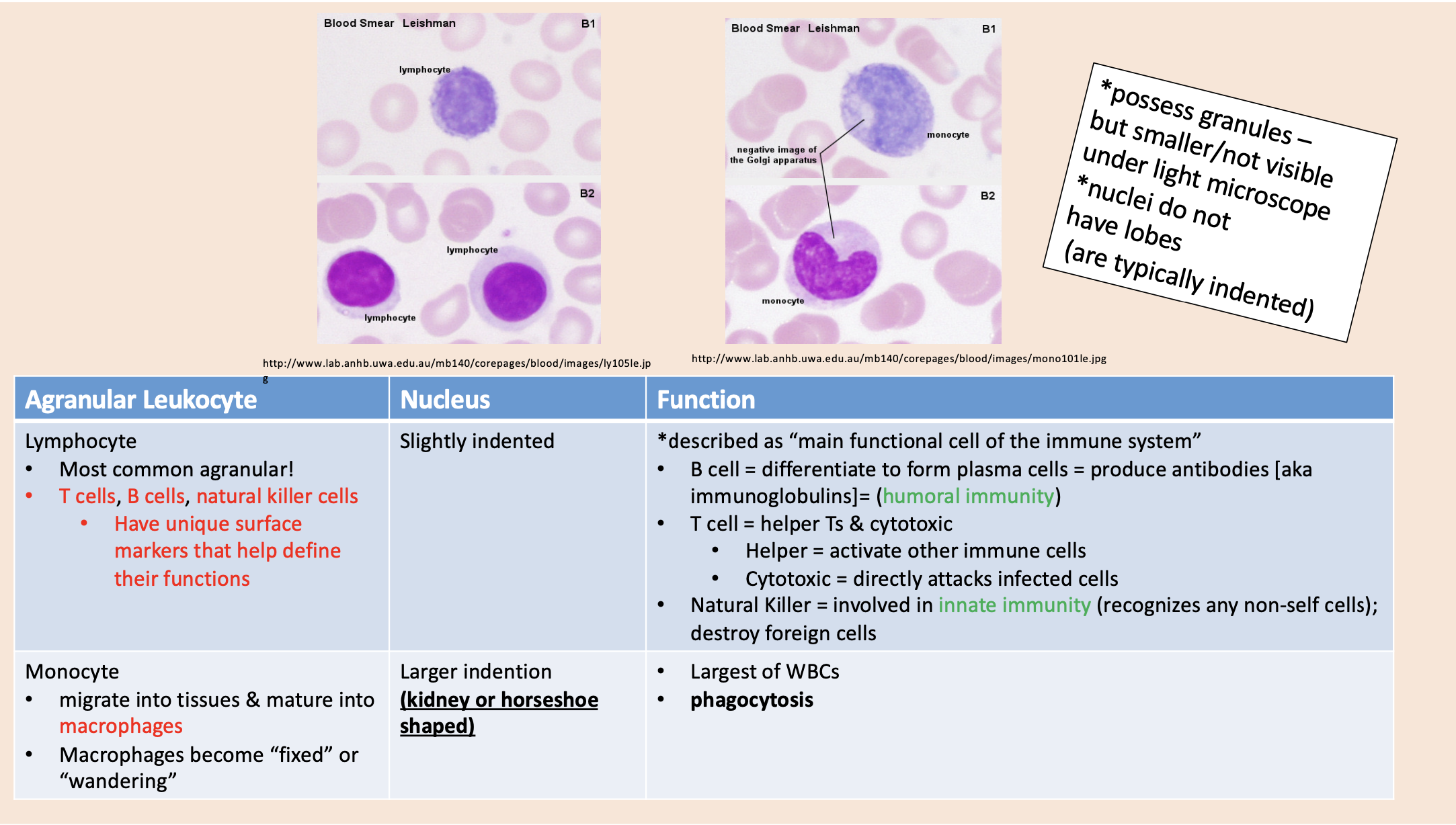
Agranular Leukocyte Monocyte
• Migrate into tissues & mature into macrophages.
• Macrophages become “fixed” or “wandering”.
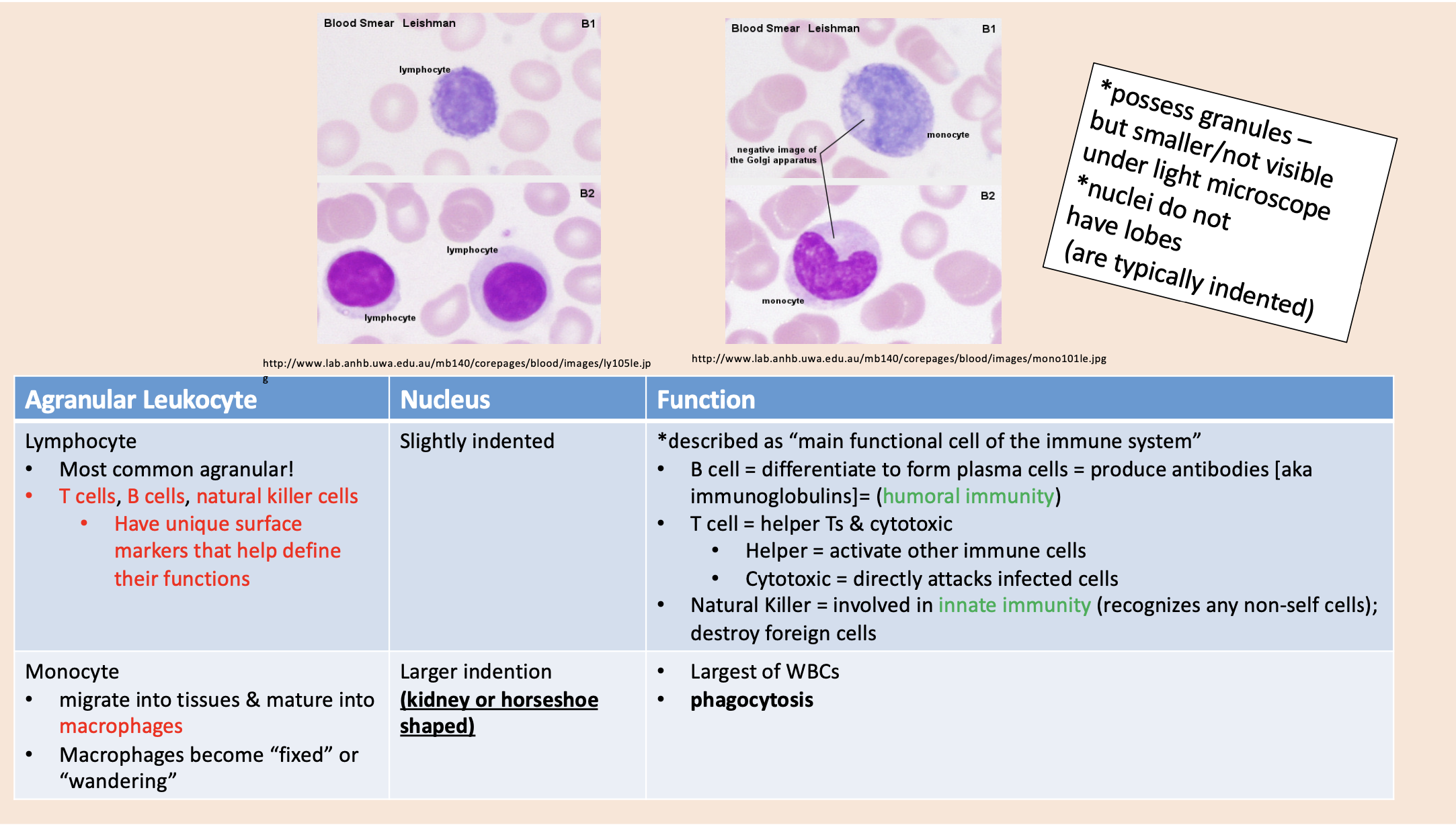
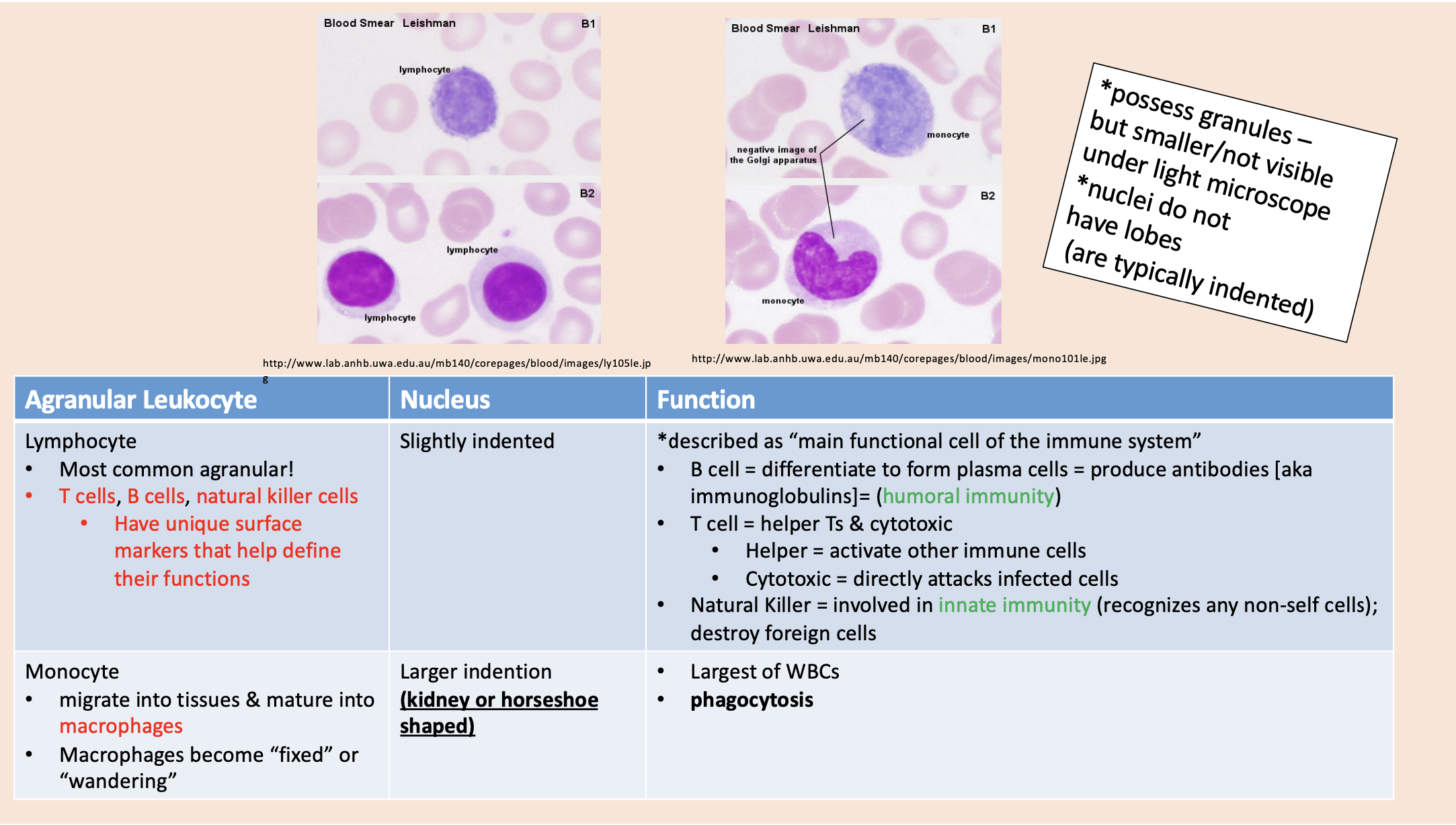
Nucleus Lymphocyte
Slightly indented
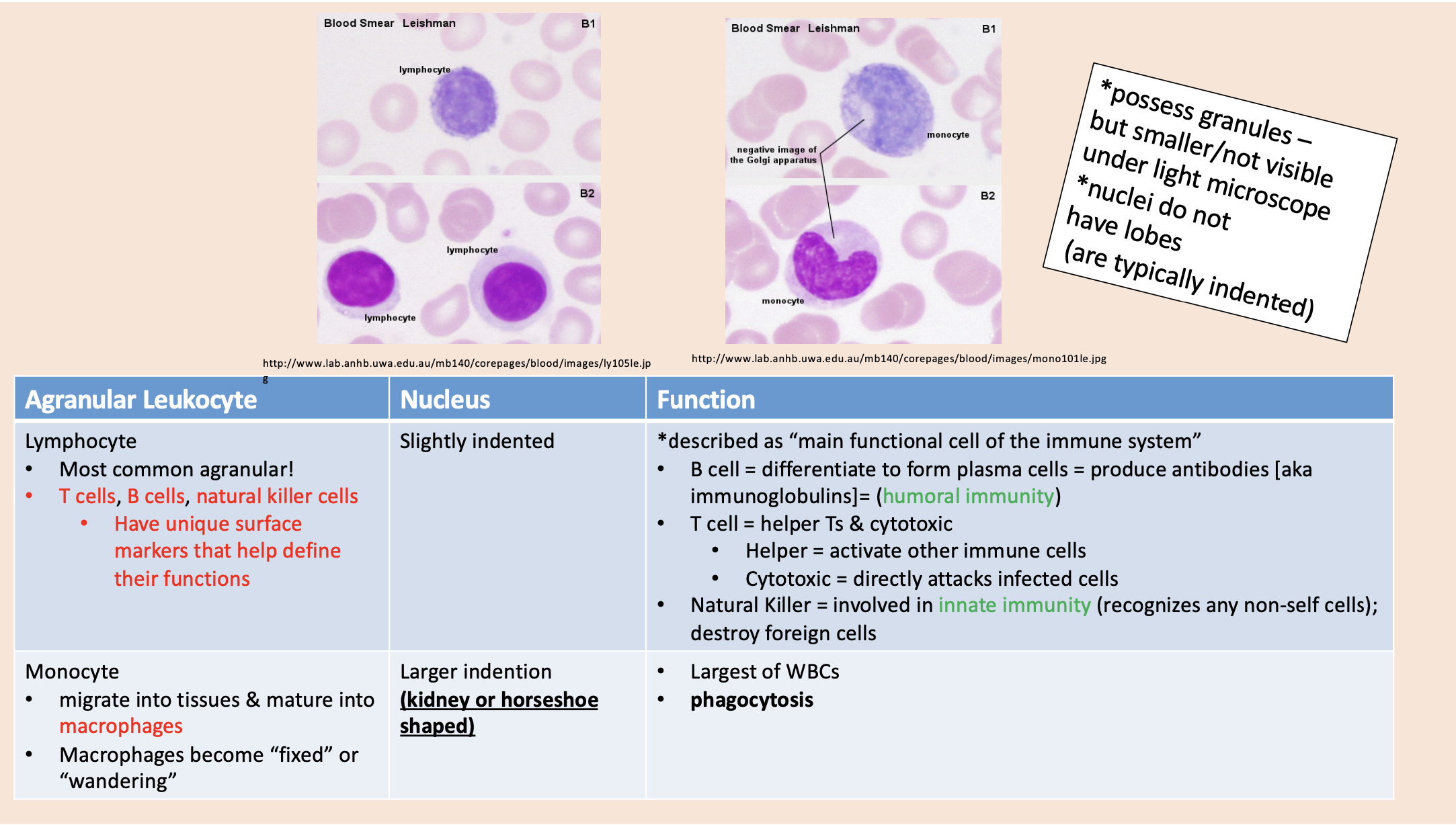
Nucleus Monocyte
Larger indention (kidney or horseshoe shaped).
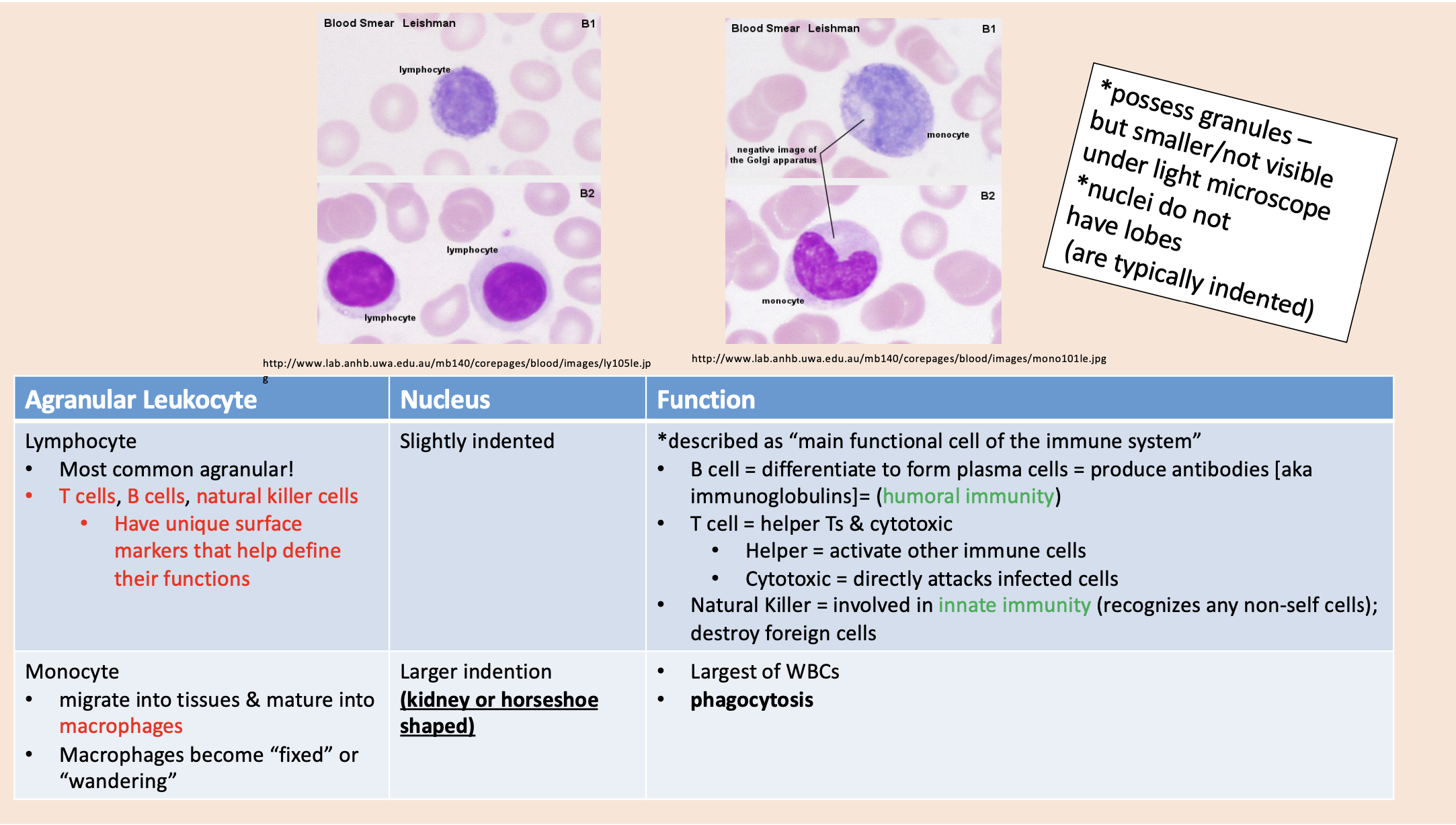
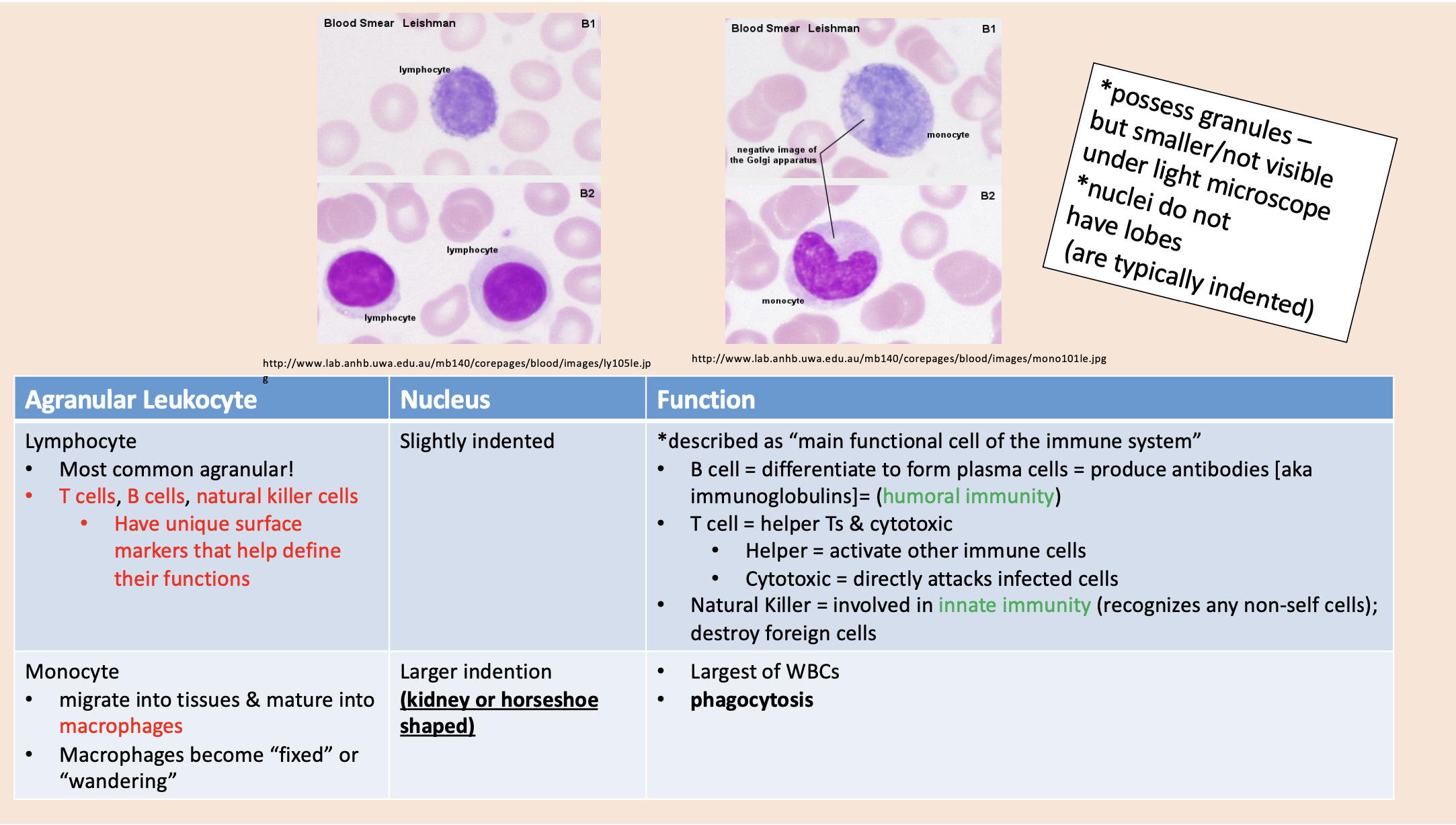
Function Lymphocyte
• Described as “main functional cell of the immune system”.
• B cell = differentiate to form plasma cells = produce antibodies [aka immunoglobulins]= (humoral immunity).
• T cell = helper Ts & cytotoxic.
• Helper = activate other immune cells.
• Cytotoxic = involved in cell-mediated immunity.
• Natural Killer = involved in innate immunity (recognizes any non-self cells); destroy foreign cells.
![<p><span>• Described as “main functional cell of the immune system”.</span></p><p><span>• B cell = differentiate to form plasma cells = produce antibodies [aka immunoglobulins]= (humoral immunity).</span></p><p><span>• T cell = helper Ts & cytotoxic.</span></p><p><span>• Helper = activate other immune cells.</span></p><p><span>• Cytotoxic = involved in cell-mediated immunity.</span></p><p><span>• Natural Killer = involved in innate immunity (recognizes any non-self cells); destroy foreign cells.</span></p>](https://knowt-user-attachments.s3.amazonaws.com/ee5c6b94-7edb-4a9e-b9ba-cd6fe4be83be.png)
B cell
Differentiate to form plasma cells = produce antibodies [aka immunoglobulins]= (humoral immunity).
![<p><span>Differentiate to form plasma cells = produce antibodies [aka immunoglobulins]= (humoral immunity). </span></p>](https://knowt-user-attachments.s3.amazonaws.com/4bfe2589-42fe-4644-9c0d-56d0e0b259ef.png)
T cell
Helper Ts & cytotoxic.
Helper
Activate other immune cells.
Cytotoxic
Directly attacks infected cells.
Natural Killer
Involved in innate immunity (recognizes any non-self cells); destroy foreign cells.
 Note
Note  Flashcards (74)