Introduction to Housing: Traditional Forms, Socio-Cultural Influences, and Urbanization in Asia
 Call Kai
 Learn
Learn Practice Test
 Spaced Repetition
 Match
Match Flashcards
 Knowt Play
1/176

There's no tags or description
Looks like no tags are added yet.
Name | Mastery | Learn | Test | Matching | Spaced | Call with Kai |
|---|
No analytics yet
Send a link to your students to track their progress
177 Terms
What is a general definition of housing?
Housing refers to physical and spiritual aspects related to real geography, including territory, land, location, place, built space, area, and material elements.
What is vernacular architecture?
Vernacular architecture is a building style that serves as living quarters for one or a few families, often developed by residents rather than architects.
What are the four main influences on traditional forms of housing?
1. Availability and utilization of materials and technology; 2. Environmental considerations; 3. Socio-cultural influences; 4. Economic and political considerations.
How does the term 'human settlements' integrate various concepts?
Human settlements comprise physical components of shelter and infrastructure, along with community services such as education, health, culture, welfare, recreation, and nutrition.
What does the study by Amos Rapoport focus on?
Rapoport's study focuses on primitive buildings and pre-industrial vernacular, highlighting the majority of buildings in human settlements as housing.
What is the main difference between primitive and pre-industrial vernacular buildings?
The main difference is the incorporation of special skills and increased specialization in pre-industrial vernacular, allowing for more individuality and differentiation.
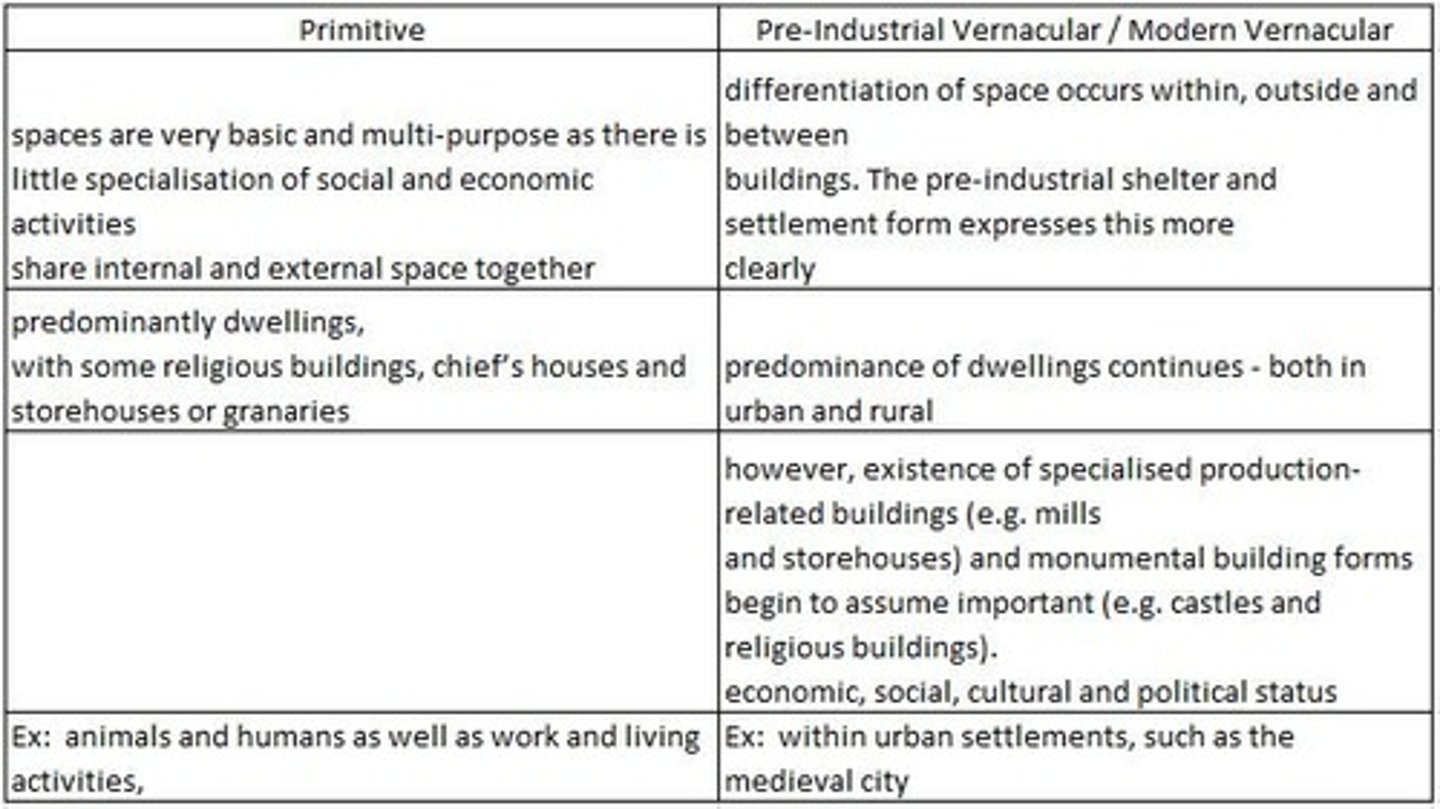
What factors influence the traditional house built form?
Factors include climates and environments, cultural values, social organization, materials and technology, and economic and political aspects.
How does climate affect housing?
Climate is crucial in the creation of built forms, influencing design and construction methods to adapt to environmental conditions.
What role does site play in housing development?
Site is important both physically and culturally, influencing the layout and design of buildings, including considerations for defense and social preferences.
How do materials and technology influence housing?
While materials and technology are important, cultural aspects often dictate their use, with some technologies reserved for ceremonial purposes rather than everyday dwellings.
What is the relationship between religion and housing?
Religion can influence housing design and construction, reflecting the diverse attitudes and ideals of people in response to their physical environments.
What are the characteristics of primitive and vernacular dwellings?
Primitive and vernacular dwellings often exhibit a lack of rapid change and persistence of form, reflecting the cultural values and social practices of their inhabitants.
What does the term 'economic specialization' refer to in housing?
Economic specialization refers to the increasing differentiation of roles and functions within societies, impacting the design and use of housing.
What is the significance of cultural values in housing?
Cultural values shape the design, layout, and decoration of housing, expressing the identity and beliefs of the community.
What are 'pattern books' in the context of housing?
'Pattern books' are collections of designs and plans for buildings that guide construction and reflect cultural and architectural trends.
How do socio-cultural influences affect housing?
Socio-cultural influences shape the nature of housing and settlement forms, impacting aspects such as location, layout, and construction methods.
What is the impact of political considerations on housing?
Political considerations govern how socio-economic interchange occurs, influencing housing policies and community development.
What is the role of community services in human settlements?
Community services support the physical components of shelter and infrastructure, enhancing the quality of life within human settlements.
What is the relationship between housing and the broader social economy?
Housing is influenced by the broader social economy, including employment patterns, forms of savings and investment, and socio-economic governance.
What does the term 'built form' refer to?
Built form refers to the physical structure of housing and other buildings, encompassing design, materials, and construction methods.
How do economic ways of life influence housing?
Economic ways of life impact housing design and function, with different economic conditions leading to varied built forms.
What is the significance of individual and collective living in housing?
Individual and collective living preferences influence housing design and community layout, reflecting cultural and social values.
What are the implications of environmental considerations in housing?
Environmental considerations affect shelter design, ensuring protection from adverse climates and promoting sustainability.
What is the role of decoration in housing?
Decoration in housing expresses cultural identity and values, often reflecting the artistic forms and meanings within a culture.
What does the concept of shelter encompass?
Shelter encompasses both physical structures and the meanings associated with them within a cultural context.
What is the primary purpose of housing?
To serve as a social institution for shelter and various human activities.
How does traditional housing reflect cultural aspects?
Traditional housing expresses the cultural milieu and functions for which it is used.
What is Rapoport's main thesis regarding traditional house form?
Traditional house form is primarily shaped by socio-cultural factors, modified by physical factors.
What does the relationship between house and settlement form indicate?
In some societies, houses may be limited to functions like sleeping and storage.
What is urbanization?
The spatial concentration of people and economic activity, marking a significant social transformation.
Why is urbanization considered a desirable phenomenon?
It is seen as the foundation of modern civilization, driving economic growth and cultural development.
What historical change occurred in urban population from 1900 to 2000?
In 1900, only 15% of the world's population lived in cities; by 2000, it was estimated that half did.
What are the predicted urban population growth rates in developing countries by 2030?
Urban populations in developing countries are expected to grow by more than 65 million people a year.
What skepticism exists regarding urbanization in developing countries?
88% of policymakers in less developed countries find the spatial distribution of their population unsatisfactory.
What triggered the evolution of housing studies and programs?
The integration of various fields such as anthropology, cultural, social, economic, and political disciplines.
What was the initial focus of early housing studies?
They primarily focused on design and construction factors of traditional housing.
How have cultural and social attributes been integrated into housing studies?
By considering the cultural and social aspects of traditional dwellings alongside architectural studies.
What is the significance of housing development in East Asia?
It is viewed as a means to drive urban development and economic growth while fostering self-reliant home-owning households.
What major transformation occurred in urbanization rates around 1950?
The pace of urban population growth accelerated significantly.
What is the relationship between urbanization and economic growth?
Urbanization is often seen as the engine of economic growth and centers of culture and innovation.
What role do socio-cultural factors play in housing?
They shape the design and function of housing, reflecting the values and practices of a society.
What is the impact of rural to urban migration?
It contributes to the rapid growth of urban populations and changes in housing demand.
What are 'push-pull factors' in urbanization?
Factors that drive people away from rural areas (push) and attract them to urban areas (pull).
How has the focus of housing studies shifted over time?
From solely design and construction to a more integrated approach considering various social sciences.
What is the relationship between housing and landscape?
Housing is part of a social and spatial system that relates dwellings to other buildings and the landscape.
What is the significance of the socio-cultural context in housing?
It influences the design, function, and meaning of housing within a community.
What are the implications of urbanization for housing policies?
Housing policies must adapt to the rapid changes in urban demographics and socio-economic conditions.
What challenges do policymakers face regarding urbanization?
Addressing the dissatisfaction with spatial distribution and managing the impacts of rapid urban growth.
What is the role of housing in the context of urbanization?
Housing serves as a critical component of urban infrastructure, impacting social and economic dynamics.
How do cultural ceremonies relate to housing?
Housing often plays a role in religious and cultural ceremonies, reflecting its spiritual significance.
What is the importance of understanding urbanization for students?
It helps students grasp the complexities of living conditions and housing needs in urban settings.
What has been considered a means to offset the development of onerous welfare states?
Supporting access to goods that bolster the economic position of families.
What are the two main points discussed in the socio-economic context section?
1) Evolution of housing programs 2) Correlation of housing to socioeconomic aspects of urban living.
What is the significance of the 2014 data in the discussion of housing policies?
It is relevant to establish context for discussing housing programs and socioeconomic aspects.
What is a distinctive characteristic of urbanization in East Asian countries?
Rapid urbanization, with the exception of Japan.
How does the urbanization growth in East Asia compare to Western developed countries?
East Asia has experienced a switch from agricultural-based to manufacturing-based economies.
What type of welfare framework is applied in East Asian countries?
A hybrid method featuring corporate social policies with strong reliance on the market and family.
What is the overriding policy objective of East Asia's productivist welfare regime?
Economic growth.
How is social policy linked to citizenship and social rights in East Asia?
Social policy is largely de-linked from concepts of citizenship and social rights.
What stigma has been created regarding social protection in East Asia?
Expectations that the family, company, and community play major welfare roles.
What has home ownership become in East Asian models?
A strongly embedded concept.
What has rapid urbanization in East Asia led to regarding housing?
Increased demand for urban housing.
What are the main concerns regarding housing shortages in South Asia?
Housing shortages are a concern among middle- and low-income groups due to rapid population growth and urbanization.
What demographic change is threatening the balance between working and retired populations in East Asia?
Population ageing.
What socioeconomic stresses affect public resources and housing stability?
Greater economic volatility and slower growth rates.
What has been the role of East Asian governments in housing supply?
They have rapidly expanded construction programs and mobilized resources for new housing.
What are the aims of state plans regarding housing in East Asia?
Clear slum housing, increase land values, and promote high-speed growth.
How has housing been primarily discussed in the East Asian context?
In terms of urban growth objectives and economic policy.
What is the relationship between housing and socioeconomic factors in East Asia?
Housing policies are deeply rooted in the early stages of urbanization and economic growth.
What does the focus on growth in early urbanization stages imply for housing provision?
The task of providing housing was primarily left to families, not the government.
What social problems have arisen from the East Asian approach to housing?
Congestion, expanding slum dwellers, and related issues.
What is the impact of increasing numbers of women in paid employment on housing?
It reinforces the ageing trend and affects housing needs.
What does the term 'productivist welfare regime' refer to?
A system where social protection measures are subordinated to economic growth objectives.
What is the expected role of family in East Asian welfare models?
To bear the primary responsibility for the welfare of the family home.
What does the term 'de-commodification' refer to in the context of housing?
The potential extension of autonomy of workers and social rights to public goods.
What has been the effect of government housing policies in East Asia?
They are often growth-oriented but embedded with developmentalism.
What is the relationship between housing and social protection in East Asia?
Housing has not been included in measures addressing social protection.
How does the East Asian approach to housing differ from Western strategies?
East Asia focuses on economic expansion rather than social insurance.
What are the developmental characteristics of Indonesia, Malaysia, and Thailand?
They are developmental late starters with lower GDP per capita, less developed urban frameworks, and a significant agricultural sector accounting for at least 10% of total GDP.
How does China's housing development differ from other East Asian countries?
China has experienced accelerated urban growth due to being led by a communist party and market-oriented growth since 1978, with two decades of intensive housing privatization until 2010.
What significant housing initiative did the Chinese government announce in 2010?
One of the largest social housing construction programs in the world, targeting around 36 million units by 2015.
When did China overtake Japan in terms of economic size?
In 2011, China became the second largest economy in the world.
What are the economic characteristics of Hong Kong and Singapore?
They resemble advanced western countries, are small city-states with minimal agricultural sectors, and have largely resisted democratic transformations.
What has dominated urban housing production in Korea since 2002?
Public rental housing units.
What social policy transformations occurred in Japan, Korea, and Taiwan after the 1997 financial crisis?
These countries underwent social policy transformations that shaped their developmentalism and democratic tensions.
What is the main focus of the housing evolution section dedicated to the Philippines?
To discuss the evolution of housing programs and the correlation of housing to socioeconomic aspects of urban living.
What dictates housing demand in the Philippines?
Housing affordability, which includes a household's ability to pay and the price of housing in the market.
What are the factors affecting housing affordability in the Philippines?
Rising housing costs, limited low-cost alternatives, and limited innovative housing finance.
What government strategies have evolved in the Philippines regarding housing?
Strategies include direct production, pricing policies, land tenure security, tax incentives, financial subsidies, and zoning regulations.
What major reform has the Philippine government undertaken in housing?
A shift from a centralized system to a decentralized and participative approach to housing.
What is a key feature of East Asian housing system approaches?
Housing development is seen as a means to drive urban development and economic growth while stimulating a property-asset-holding class.
What is the top-down nature of planning in East Asian housing provision?
It involves large public corporations facilitating mass housing construction at unprecedented speed and scale.
How do East Asian governments influence housing production?
They orchestrate planning, set measurable goals, and steer economic factors affecting development, while construction is often carried out by private companies.
What effect has state-coordinated housing development had on urbanization rates?
It has increased urbanization rates and expanded the construction industry, providing homes for workers near economic activities.
What has been the GDP growth rate from the construction industry in East Asia?
Rates of GDP growth derived from construction have often exceeded 8 to 10 percent.
What is the impact of sharp increases in land and house prices?
They transform economic growth into household asset wealth, particularly among urban middle classes, stimulating further investment, consumption, and growth.
How do commodified housing schemes support welfare?
They allow government-subsidized housing to be resold into the market, providing families with cash or equity for other commodities.
What role do East Asian governments play in housing?
They drive the proliferation of owner occupation and expand the housing market through public home ownership and mortgage schemes.
What is the projected urban population in Asia by 2050?
The number of urban residents is expected to reach 3.3 billion.
What is the daily urban population increase in Asia?
127,000 people are added to urban centers every day.

