2.4 -motivational theories
 Call Kai
 Learn
Learn Practice Test
 Spaced Repetition
 Match
Match Flashcards
 Knowt Play
1/23

There's no tags or description
Looks like no tags are added yet.
Name | Mastery | Learn | Test | Matching | Spaced | Call with Kai |
|---|
No analytics yet
Send a link to your students to track their progress
24 Terms
motivational theories
Maslow’s hierarchy of needs
Taylor’s
Herzberg’s two factor theory
McClelland’s acquired needs theory
Deci and Ryan’s self determination
equity and expectancy theory
Taylor’s theory
main reason people work is money
higher financial reward = more hard working and productive workers
specialisation = enhanced productivity
uses piece rate
Taylor’s theory limitations
less suitable for modern businesses
people cannot be only motivated by money
qualitative factors are ignored
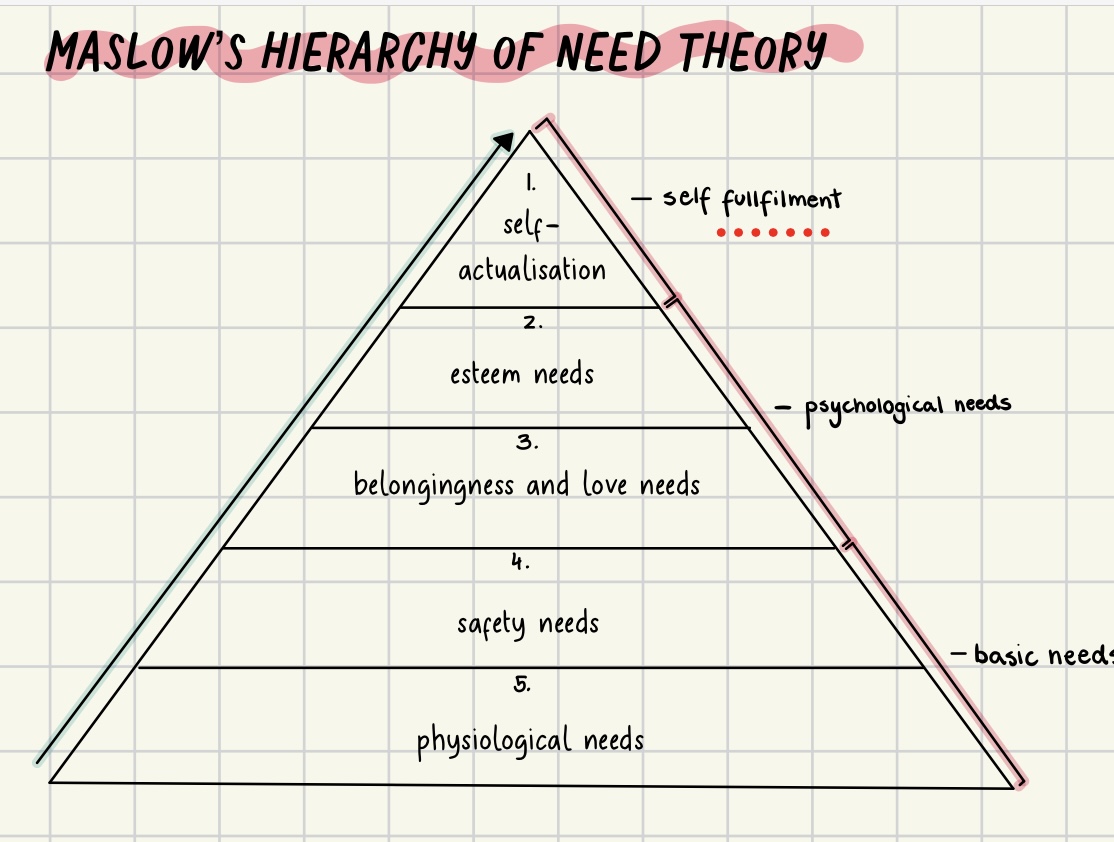
Maslow’s hierarchy of needs
achieving one’s full potential
value and respect and feeling of accomplishment
being accepted by others
security and safety
basic needs
physiological, safety and social needs must be met to prevent dissatisfaction
esteem and self-actualisation needs help to provide a person with sense of content and satisfaction
Maslow’s hierarchy of needs limitations
not all people are motivated in the same way
assumes rigid, linear procession that doesn’t reflect human dynamics
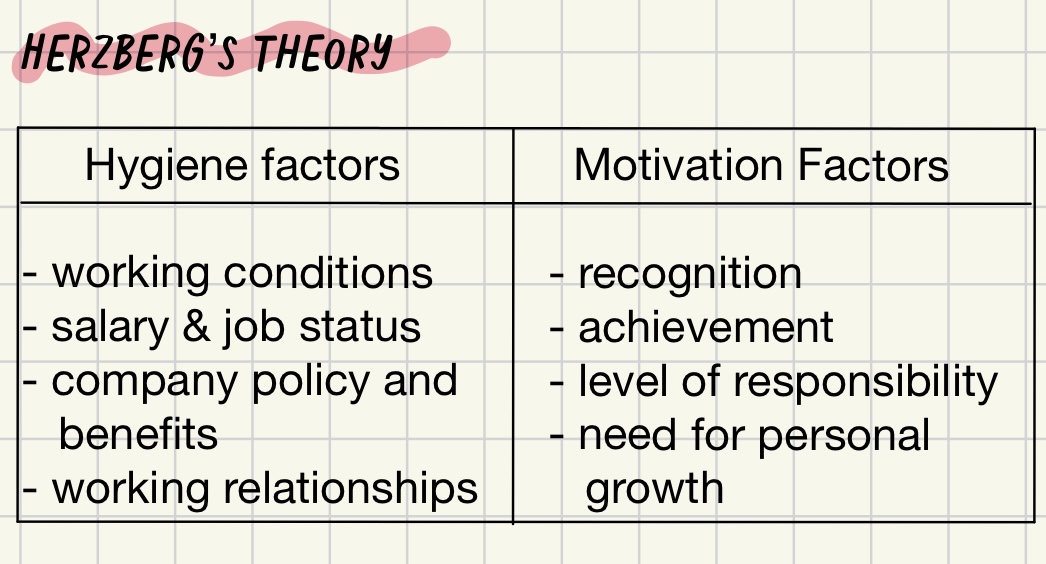
Herzberg’s theory
Hygiene factors
expected by workers
must be met in order to avoid dissatisfaction
Motivation factors
will make employees work harder
lack = demotivated
there = motivation
McClelland’s acquired needs theory
based on 3 extrinsic psychological needs
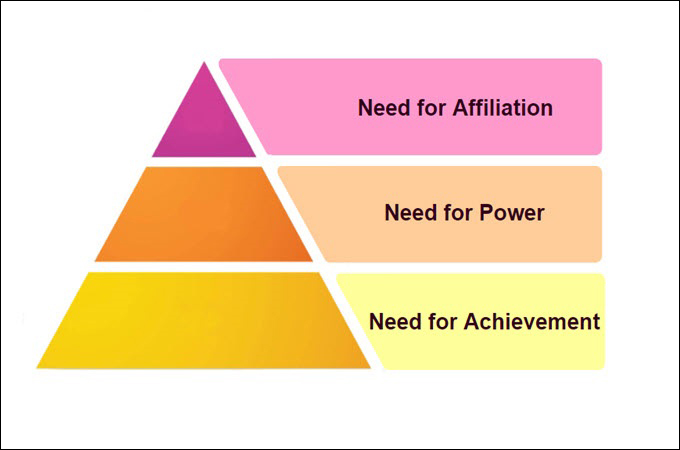
best approaches for each need
N-Aff
should be provided with cooperative and collaboration
sense of belonging/ matrix structure
N-Pow
should be given opportunities to manage and lead
sense of importance/ tall structure
N-Ach
should be given achievable but challenging tasks
sense of achievement/ flat structure
strengths of McClelland’s theory of acquired needs
ability to personalise motivation
optimises task allocation
framework for talent development
cultivates a motivated and engaged workforce
limitations of McClelland’s acquired needs theory
ignores fundamental needs
tendency to stereotype
difficulty and complexity to accurately identify the dominant need
Deci and Ryan’s self determination
based on 3 intrinsic psychological needs
autonomy
competence
relatedness
autonomy definition
to be self-sufficient to direct and control own life
competence definition
combination of
knowledge
skills
abilities
that an individual possesses to perform a task effectively and successfully
relatedness definition
connections with other people in society that provide people with sense of security, love and belonging
strengths of Deci and Ryan’s theory
fosters intrinsic motivation and well-being
applicable in multiple contexts
focus on basic psychological needs
limitations of Deci and Ryan’s theory
doesn’t apply across all professions and cultures
no one has only 1 out of 3 needs
equity theory
employees are demotivated when their inputs are larger than outputs
people are motivated by fairness
key elements of equity theory
inputs (effort)
output (rewards)
comparison → interpretation and evaluation will influence their motivation
limitations of equity theory
perception of equity will vary and is subjective
expectancy theory
employees decide how much effort to put into a task based on expected outcomes
core components of expectancy theory
expectancy (effort → performance)
instrumentality (performance → outcome)
valance (value of outcome)
how expectancy theory motivates
creating and maintaining positive links between the high level of inputs/efforts with appropriate outputs/ rewards
M = E x I x V
intrinsic motivation
from within the person
motivated by internal benefits
long lasting
strong on autonomy
heightened creativity due to sincere interest
extrinsic motivation
result of outside influence; praise, acknowledgment
depends on outside incentives; cash, grades
compliance in short time

