Gene Expression II
 Studied by 0 people
 Call Kai
 Learn
Learn Practice Test
 Spaced Repetition
 Match
Match Flashcards
 Knowt Play
1/66

Earn XP
Description and Tags
Name | Mastery | Learn | Test | Matching | Spaced | Call with Kai |
|---|
No analytics yet
Send a link to your students to track their progress
67 Terms
Eve
gene responsible for defining the body plan for fruit flies
lacZ
encodes beta-galactosidase
beta-galactosidase
breaks down lactose
can break down X-gal into a dark blue compound
repressors; activators
each regulatory element has its own sequence to recruit:
a set of _______
a set of _______
activators
Within stripe 2 of the regulatory DNA segment in eukaryotes, only what is recruited?
Combinational control
can also generate different cell types
transcription regulators
different combinations can generate many distinct cell types during development
new
after cell division, a cell may begin expressing a ______ transcript regulator, creating a new regulatory combination
Eight (A-H)
How many different cell types can be produced using only three transcription regulators?
regulators
Each cell type (A-H) expresses a unique set of genes based on its specific combination of ____________.
Red blood cells, epidermal (skin) cells, and gut epithelial cells.
What are three examples of specialized cells that are terminally differentiated and cannot divide?
by proliferating precursor cells
If a specialized cell like a red blood cell cannot divide, how is it replaced?
precursor cells
arise from a small population of self-reviewing stem cells
Stem cells
undifferentiated and can divide for long periods (often the organism’s lifetime)
specialized cells
most cannot divide and are terminally differentiated
T
T or F?
after division, a stem cell daughter can either remain a stem cell or begin a pathway toward terminal differentiation through precursor-cell
bone marrow
Stem cells change/differentiate where?
Differentiated cells
can be grown in culture and reprogrammed
from adult mouse or human tissues
transcription regulators
Forced expression can reverse the differentiated state of what?
key regulators
Oct4, Sox2, and Klf4 are all considered
ES-like
Key regulators reprogram cells into an embryonic stem-like state called
iPS
can be used to make almost any cell type imaginable
positive
Cell memory is primarily driven by ______ feedback.
cell memory
used for proliferating cells to maintain their identity
must remember what transcription factors they must keep as they divide
cells remember what they have + don’t have then pass it on to the next generation
DNA methylation
addition of methyl groups to DNA
generally associated with transcriptional repression
compact
The addition of methyl groups to DNA promotes a more ______ chromatin structure
gene expression
A more compact chromatin structure limits what?
histone methylation
lead to chromatin compaction and reduced transcription
Covalent histone modifications
regulate gene activity by altering DNA packaging (chromatin structure)
also for inheriting gene expression patterns
histones
During DNA replication, each daughter strand receives half of the parental modified ______, preserving gene expression patterns.
epigenetic inheritance
DNA sequence is NOT changed during positive feedback—methylation or histone modifications
initiation
Translation requires what complex?
ribosome binding site
By folding into additional structures, RNA can either prevent or allow the ribosome to bind to its __________________.
mRNA
The ribosome binding site is a special sequence on the ______ where the ribosome makes contact.
hides
When RNA folds into an additional structure, it _____ the ribosome binding site, preventing the ribosome from binding.
exposed
When RNA does not fold (or folds differently), the ribosome binding site is ______, allowing the ribosome to bind and start translation.
microRNAs (miRNAs)
tiny RNA molecules that:
control gene expression by base-pairing with specific mRNAs and reducing both their stability and their translation into protein
RISC (RNA-induced silencing complex)
involved in miRNA maturation
responsible for mRNA degradation
RNA interference (RNAi)
is triggered by long, double-stranded RNA (dsRNA).
Viruses; Transposable elements
dsRNAs can come from:
Dicer
enzyme in the cytosol that cuts long dsRNA into short fragments
small interfering RNAs (siRNAs)
Dicer enzyme cuts long dsRNA into short fragments called what?
siRNA
RISC uses what as a guide to target complementary RNA?
complementary RNA
RISC targets which RNA?
RISC
siRNAs are loaded into _____ proteins.
silencing
When RISC targets complementary RNA using the siRNA guide, the result is __________ or degradation of the target RNA.
miRNAs
RISC uses the same complex for siRNAs as it does for __________.
silencingl; degradation
RISC uses the siRNA as a guide to find complementary RNA, resulting in the _____ or ______ of the target RNA.
RNA-inducing transcriptional silencing (RITS)
an alternative protein complex, besides RISC, that siRNAs can be loaded into
RITS pathway
Attracts chromatin-modifying enzymes to silence the expression of complementary genes (transcriptional silencing).
viral infections
The RITS pathway is useful for combating transposon elements and _____________.
Telomerase
has lncRNA that is the template for DNA replication, but also binds the enzyme (protein) that performs the activity.
also is a protein-RNA complex
lncRNA
can serve as scaffolds that bring together proteins that function in the same cell processes
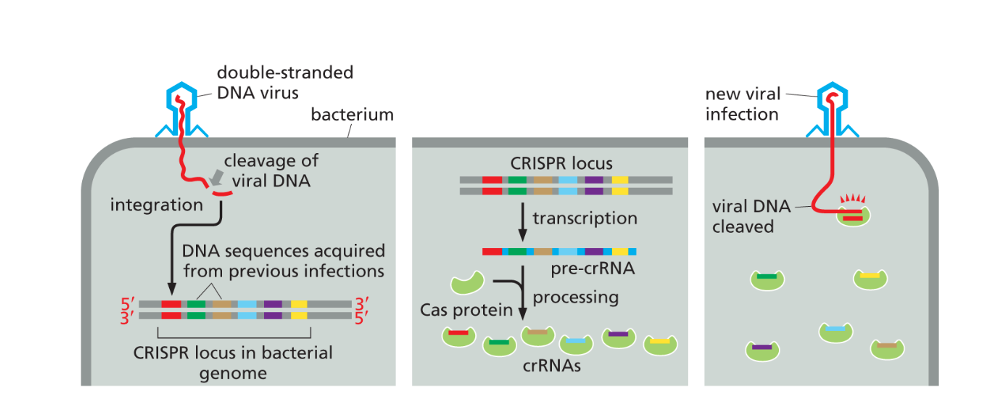
CRISPR
a tool used in gene editing; a defense system bacteria & archaea have against viruses
Spacers
correspond to sequences of viral DNA from a previous infection
used as templates for future infections
Cas (CRISPR-associated) proteins
Proteins associated with the CRISPR system
CRISPR regions
constant DNA sequences separated by variable sequences known as spacers
PAM (protospacer adjacent motifs)
Cas proteins recognize sequences on viral DNA known as ______.
DNA
The CRISPR-Cas9 system recognizes ______ but works as RNA.
PAM
Cas proteins cleave the region next to the _______ (protospacer).
protospacer
gets incorporated in the genome and becomes a spacer
Cas9
If spacer is matching with viral DNA of phage, _____ will activate and destroy the foreign DNA.
CRISPR
Step 1: short viral DNA sequence is integrated into CRISPR locus
Step 2: RNA is transcribed from CRISPR locus, processed, and bound to Cas protein
Step 3: small crRNA in complex with Cas seeks out and destroys viral sequences
 Note
Note  Flashcards (52)