BIOL 145 -Week 7- Simpson college
 Studied by 0 people
 Call with Kai
 Learn
Learn Practice Test
 Spaced Repetition
 Match
Match Flashcards
 Knowt Play
1/102

There's no tags or description
Looks like no tags are added yet.
Name | Mastery | Learn | Test | Matching | Spaced | Call with Kai |
|---|
No study sessions yet.
103 Terms
Angiosperms =
flowering plants
Magnoliopsida =
Dicots
Liliopsida =
Monocots
Formation of male gametophytes takes place in
Anthers
Pollination =
Transfer of pollen grains from anther to stigma
Self-pollination =
Pollen grains germinate on stigma of same flower
Fertilization =
Union of sperm and egg
After pollination, further development of male gametophyte may not take place unless pollen grain is:
From a different plant of the same species. From a variety different from that of the receiving flower
Mature male gametophyte =
Germinated pollen grain with its vegetative nucleus and two sperms within tube cell
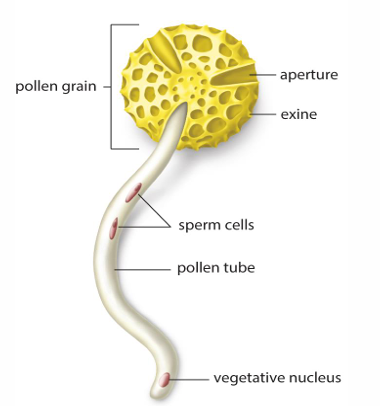
Endosperm tissue =
nutritive tissue for embryo
Double Fertilization
One sperm unites with egg, forming zygote, then embryo. Other sperm unites with central cell nuclei, producing triploid endosperm nucleus that develops into endosperm tissue.
Apomixis
Without fusion of gametes but with the normal structures otherwise being involved. Create new plant genetically identical to parent plant
Parthenocarpy
Fruits develop from ovaries with unfertilized eggs. Results in seedless fruits (grapes, bananas, oranges, etc.)
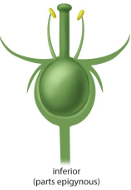
Inferior ovary (epigynous flower)
Receptacle or other flower parts fused to ovary and grown up around it. Calyx and corolla appear to be attached to top of ovary
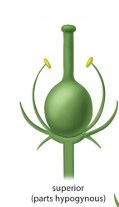
Superior ovary (hypogynous flower)
Ovary produced on top of receptacle. Other flower parts attached around ovary base
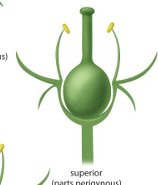
Perigynous flowers (superior ovary)
Flower parts attached to corolla tube of fused petals, creating floral tube that is not attached to ovary
Complete flower
Has calyx, corolla, stamens and pistil
Incomplete flower
Corolla or other flower parts missing.
Perfect flower
Both stamens and pistil present
Imperfect flower
Either stamens or pistil missing.
Monoecious species (imperfect)
Male and female imperfect flowers on same plant
Dioecious species (imperfect)
Plant bears only male flowers and other plants bear only female flowers.
Bee-pollinated flowers:
See UV light (humans do not). Flower generally brightly colored, mostly blue or yellow. Often have lines or other distinctive markings, which may function as honey guides to lead bees to nectar.
Beetle-pollinated flowers:
Strong, yeasty, spicy or fruity odor. White or dull in color. Some do not secrete nectar, but furnish pollen or food on petals in special storage cells.
Fly-pollinated flowers:
Smell like rotten meat. Dull red or brown
Butterfly- and Moth-Pollinated Flowers:
Nectaries at bases of corolla tubes or spurs for long tongues. Often have sweet fragrances. White or yellow for night-flying things. Sometimes red, often blue, yellow or orange
Bird-Pollinated Flowers (Hummingbirds and Sunbirds):
Copious amounts of nectar. Often bright red or yellow. Little if any odor. Large and part of sturdy inflorescence. Long floral tubes
Bat-Pollinated Flowers:
Large enough for them to insert head or consist of ball-like inflorescence containing large numbers of small flowers. Primarily in tropics. Open at night. Dull in color
Members of Ophrys have
modified petal that resembles female bumble bee or wasp
Ophrys
Male bees or wasps try to copulate with flower
Gymnosperm refers to
The exposed nature of the seeds.
Gymnosperm Seeds
Produced on surface of sporophylls or similar structures, instead of enclosed within a fruit as in flowering plants. Often arranged in cones
Female gametophyte
Pollen cones produce pollen grains that are carried by the wind to female cones, where fertilization occurs.
Female gametophyte (Female gametophyte)
Produced inside an ovule that contains nucellus. Does not grow independently, but develops within sporophyte structures.
Phylum Pinophyta – the Conifers: Pines (Pinus)
largest genus. Dominant trees in coniferous forests of Northern Hemisphere
Pines (Pinus) Structure and form:
Leaves needlelike and arranged in clusters of two to five leaves. Cluster = fascicle. Fascicles are short shoots Have restricted growth
Maturation of Seed Cones: First year
Pollen grains catch on sticky pollen drops oozing out of micropyle. Pollen grain produces pollen tube that grows through nucellus. Megaspore develops
Second Year of Seed Cone Development
Female gametophyte and archegonium mature. Pollen tube arrives at archegonium. One sperm unites with egg, forming zygote. Other sperm degenerates. Embryo nourished by female gametophyte. Integument becomes seed coat.
Production of Megaspores
Ovule contains a megasporangium containing a nucellus and a single megasporocyte. Megasporangium surrounded by integument. Megasporocyte undergoes meiosis, producing four megaspores.
Are gymnosperms known for their hardwood true or false?
False
Phylum Equisetophyta
the Horsetails and Scouring Rushes
Phylum Polypodiophyta
The Ferns
Introduction to the Seedless Vascular Plants
Internal conducting tissue developed. True leaves appeared. Roots that function in absorption and anchorage developed. Gametophytes became progressively smaller.
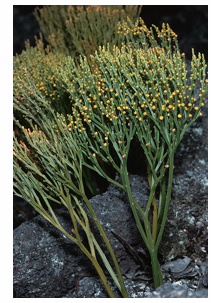
Psilotophyta
Sporophytes have neither true leaves, nor roots. Stems and rhizomes fork evenly
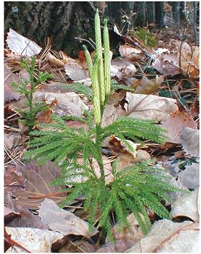
Lycophyta
Plants covered with microphylls.
Microphylls
Leaves with single vein whose trace is not associated with a leaf gap
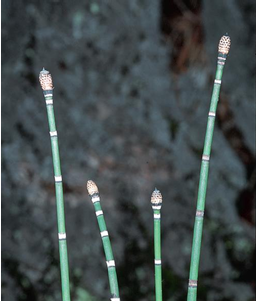
Equisetophyta
Sporophytes have ribbed stems containing silica. Have whorled, scalelike microphylls that lack chlorophyll
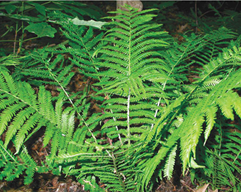
Polypodiophyta
Sporophytes have megaphylls that are often large and much divided.
Megaphylls
Leaves with more than one vein and a leaf trace associated with leaf gap
Phylum Psilotophyta: Structure and form
Dichotomously forking stems. Have neither leaves nor roots. Sporophytes
Phylum Psilotophyta– Reproduction
Self-fertilizers. Sporangia fused in threes and produced at tips of short branches. Gametophytes develop from spores beneath ground.
Phylum Lycophyta– the Ground Pines, Spike Mosses, and Quillworts
Have true roots and stems. Stems are simple or branched (branching rhizomes) Leaves usually less than 1 cm long. Roots develop along rhizomes.
Phylum Lycophyta (Lycopodium) Reproduction
Sporangia in axils of sporophylls. In sporangia, sporocytes undergo meiosis, producing spores.
Sporophyll
Sporangium bearing leaves
Do lycophytes produce seeds?
No sporophytes
Isoetes- Quillworts
Most found in areas partially submerged in water for part of year. Microphylls are arranged in a tight spiral on a stubby stem. Ligules occur towards leaf bases. Corms have vascular cambium
Microphylls
Small leaf-like structures in lycophytes that are usually spiral and arise from a single vascular strand
Isoetes Reproduction
Similar to spike mosses, except no strobili (spore like structures) Sporangia at bases of leaves
Phylum Equisetophyta – Equisetum
The Horsetails and Scouring Rushes
Phylum Equisetophyta: Structure and Form
Stems jointed and ribbed. Branches in whorls. Scalelike leaves in whorls at nodes. Stomata in grooves between ribs
Phylum Equisetophyta Anatomy
Hollow central cavity from break down of pith
Phylum Equisetophyta (Equisetum) Reproduction
Asexual by fragmentation of rhizomes. Strobili at tips of stems with sporangia connected to sporangiophores. Spores green with 4 ribbon-like elaters attached
Phylum Polypodiophyta
The Ferns
Fern leaves are megaphylls
Referred to as fronds
Phylum Polypodiophyta Reproduction
Sporophyte is conspicuous phase of life cycle, producing spores in clusters called sori on the underside of fronds.
Phylum Polypodiophyta – Meiosis and Development
Meiosis forms spores in sporangia.
Fronds first appear
coiled in crozier (fiddlehead), and then unroll and expand
Fronds often divided
into segments called pinnae (singular: pinna).
 Note
Note  Flashcards (100)