Gen Bio II: Exam 4
 Call Kai
 Learn
Learn Practice Test
 Spaced Repetition
 Match
Match Flashcards
 Knowt Play
1/50

Earn XP
Description and Tags
Chemical Signaling-Hormones
Name | Mastery | Learn | Test | Matching | Spaced | Call with Kai |
|---|
No analytics yet
Send a link to your students to track their progress
51 Terms
The Nervous System: What it Does
Allows for sensory input, using sensory organs that travel to central system that integrates it to produce a motor output.
Types of Neurons (3)
Sensory Neurons - get information from sensory organs towards the interneurons
Interneurons - Interconnected neurons that process, integrate, analyze, and interpret
Motor neurons - transmit signals to muscles
CNS and PNS
The Central nervous system is what processes information gained from the peripheral nervous system. (Interneurons)
The Peripheral Nervous System
Nerve Cells (Neurons)
Cell body covered in dendrites (recieve information), with an axon connection that leads to their synaptic terminal.
Glia Cells (vertebrates)
Helping cells that do many functions that assist neurons with firing information, protection, and other things (To be discussed later)
There are WAY more times glial cells than neurons (10:1)
Post and Pre-Synaptic: What they Are
Pre-synaptic cells are the ones sending the response, and post-synaptic cells receive the information from the axon terminal (synaptic terminals)
Fun Fact: Sciatic Nerve
The longest Axon that travels all the way down to the toes from the brain (1.3m)
Illnesses can damage this,
NerveCell: Resting Potential
Ion pumps cause a negative charge inside the nerve cell, across the membrane (it’s revving up)
Resting Potential Charge
-60/-80mV (Mili Voltage)
Ion Pumps: What they Move
Na+/K+ pump: for every 3 Na+ out of the cell, 2K+ in; are pumped in against the concentration gradients (The outside of the cell usually has way more Na+)
Causes the inside of the cell membrane to be negatively charged because the positive ions are mostly outside of the cell(?)
Ion Pumps: Energy Cost
These pumps are 70% of nerve cell energy use
Neurons: Open/Leak Channels
Pores that only let Na+ move into the cell, not using ATP as it goes with the concentration gradient
Pores that let their specific Ions move with the concentration gradient. (Selectively Leaks)
Open/Leak Channels: Quantity
There are more K+ Channels than Na+, which generates the negative charge
Neurons: Gated Ion Channels
Na+ and K+, these close but open upon stimulus. Lets Na+ in to the cell.
K+ Gated Ion Channels used to get rid of K+ excess
([What does it do?] Effects membrane potential)
Situation: Stimulus Opens Na+ Gated Ion Channel
The Na+ flux causes the membrane potential to become more positive, depolarizing the membrane.
Situation: Simulus Opens K+ Gated Ion Channel
Membrane gets higher negativity inside the cell. Called Hyperpolarization.
Hyperpolarization
The membrane potential of a cell is more negative than it’s resting membrane potential. Is the main cause of the rest period before a neuron can reach the threshold again. (creates Undershoot)
Depolarization
The change that causes the Voltage-Gated Channels to open, creating a reactionary positive mV value (electrical signal is created)
Graded Potentials
Potentials that change across multiple different pumps adding up with eachother to reach a specific threshold
Neuron: Action Potentials
The transmission of nerve impulses along axons after activity from the Voltage-Gated Ion Channel
Neurons: Na+ Voltage-Gated Ion Channels
When the voltage of the membrane reaches -50mV, they all activate had Na+ shoots up so high there is a rebound +mV charge gained
Neurons: K+ Voltage-Gated Ion Channels
When the voltage is way positively high, it opens to let K+ out of the cell
Post-Action Potential: Undershoot (Refractory Period)
The membrane potential lowers to a point where it is impossible to generate a new action potential for a couple of milliseconds.
Undershoot (Refractory Period): Importance
Lets the other neighboring cells reach their own Action Potential and move back down before shooting once again
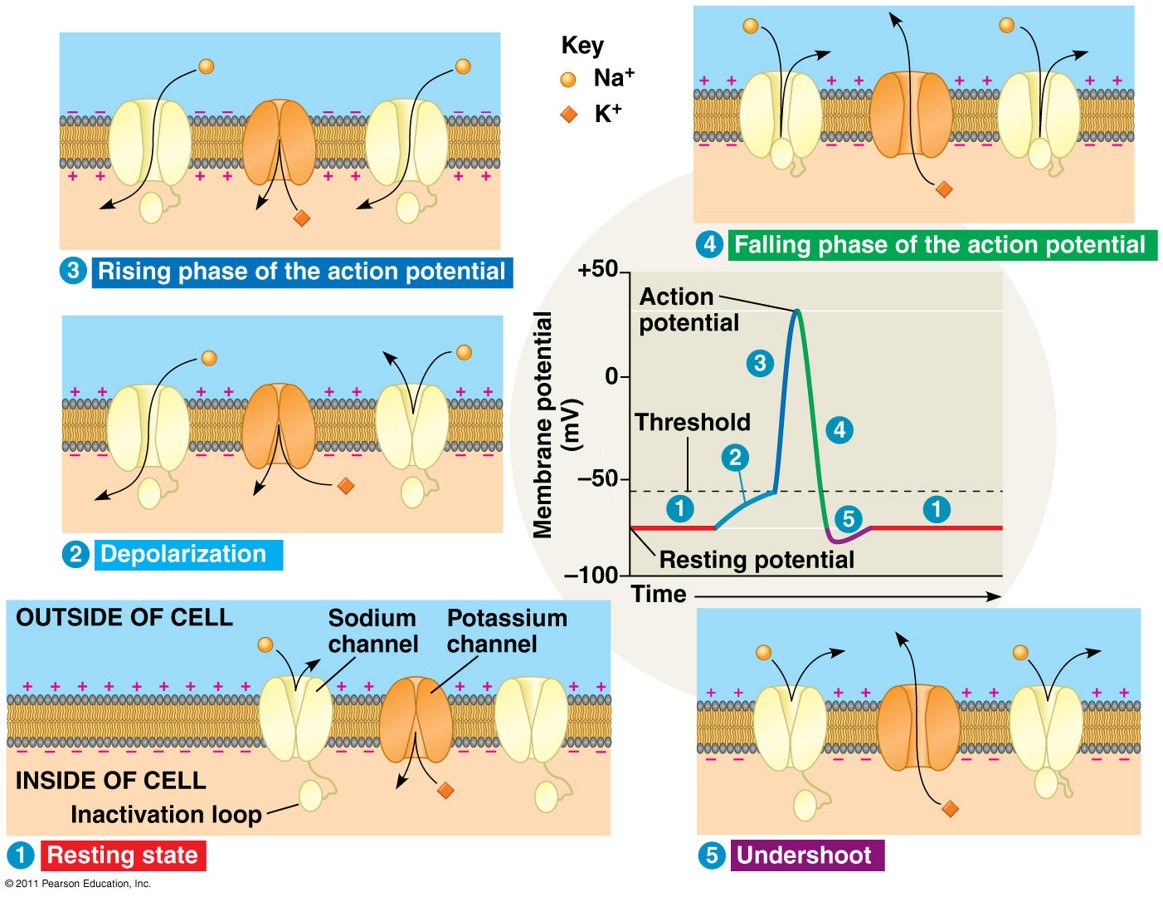
Quiz on the parts of the image
How Long have we Known about Action Potentials?
1963, studied on squids. This was in an invertebrate, so it’s different from vertebrates. The squid axon seen was also thicker than normal
Invertebrate Axons
Have no glial cells and the currents often times get scattered because they have no coverings. Thicker axons transmit information faster (think cables and wires)
Fun Fact: Squid Escape
They prepulse themselves using jet propulsion at a speed of about 24km/hr using the thickest giant axon in their little bodies
Why does the action potential only move down the axon?
The Undershoot - or refractory period
Fun Fact: Water Potentials
The sudden intake does cause a change in osmotic pressure; the water flows in through the membrane to where there are more solutes present. [This is NOT in the Exam]
Fun Fact: Facilitated Diffusion
The Na+ is entering through facilitated diffusion, which occurs due to the charge differences between the two regions. Positive ions move towards negatively charged areas.
Vertebrate Axons
They can be narrow, but can get faster than the skinnier invertebrate axons. This is because of different Glial Cells (Myelin Sheath)
Myelin Sheath
The covering of the axon, made of the Schwann cells in the PNS and the oligodendrocytes in the CNS. It works as insulation for the axon’s electrical charge
Schwann Cells
The cells that specifically wrap around the axon as a part of the myelin sheath.
Nodes of Ranvier
Exposed section of a vertebrate’s neurons. In contact with extracellular fluid for Na+ and K+ diffusion. These cut the amount of action potentials being generated, increasing the speed of conduction
Saltatory Conduction
“The rapid diffusion of action potentials across a myelinated sheath.” It jumps from one Node of Ranvier to the next all the way down the line.
Axon Terminal: Electrical Synapses
Examples when neurons send pure electricity to each other (Not common in Vertebrates)
Axon Terminal: Chemical Synapses
The release of neurotransmitters from synaptic vesicles to the synaptic terminals that send them towards the post-synaptic cell’s dendritic receptors.
Voltage-Gated Ca2+ Channels
Calcium diffuses into the cell, causing the vesicles to merge with the outer membrane of the axon terminal, releasing the neurotransmitters to the synaptic cleft
Synaptic Cleft
The space right between an axon terminal meets with another neurons dendrite.
Ligand-Gated Ion Channels: Na+
It is only when the Ligand(Neurotransmitter) binds to the Channel that Na+ is allowed to enter to the cell, causing a brief depolarization
Ligand-Gated Ion Channel: K+
Causes small hyperpolarization after the Ligand(NeuroTransmitter) binds to the channel. Inhibits potential of the pot-synaptic neuron (IPSP)
EPSP
Na+, excitatory post-synaptic potential
IPSP
K+, inhibitory post-synaptic potential
Neurotransmitter Uptake
It takes energy to create Neurotransmitters, so the presynaptic neurons reabsorb them back into themselves or broken down and absorb them to create new ones.
Subthreshold, No summation
Neuron fires that are too far appart of otherwise do not cause big enough of a depolarization effect to reach the neuron’s firing threshold
Temporal Summation
Presynaptic neuron sends enough concurrent firings to create enough depolarization to reach the threshold
Spatial Summation
When two neurons can send a signal at the same time to create a single, stronger hid of depolarizaton, that reaches the action potential threshold.
Spatial Summation of EPSP and IPSP
The presynaptic cells neurons charge to go up and down by small implements
What kind of channels cause EPSPs and IPSPs?
Ligand-Gated Channels
Human Health: Major Depressive Disorder
(just a theory) Decreased activity of synapses, not enough serotonin is released.
Drugs used to treat it are selective serotonin reuptake inhibitors (SSRIs). This lets serotonin accumulate in the synaptic cleft

