ML2 - M4 Modules
 Call Kai
 Learn
Learn Practice Test
 Spaced Repetition
 Match
Match Flashcards
 Knowt Play
1/43

There's no tags or description
Looks like no tags are added yet.
Name | Mastery | Learn | Test | Matching | Spaced | Call with Kai |
|---|
No analytics yet
Send a link to your students to track their progress
44 Terms
is a type of machine learning model that learns the underlying distribution of a dataset to generate new data that resembles the training data.
generative model
Learn boundaries
Discriminative
Learn how data is structure
Generative
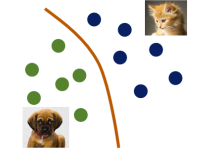
Discriminante Model
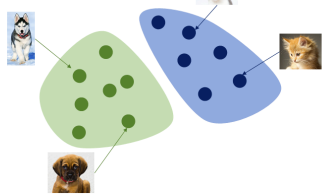
Generative Model
is a type of neural network used to compress and then reconstruct input data.
autoencoder
Compresses input into a latent representation
Encoder
Reconstructs input from this compressed form
Decoder
Goal of autoencoder is to learn efficient _________
representations
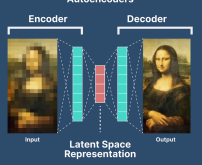
autoencoder
Autoencoder Architecture
_________ → ____________ → ____________ → ___________ → ____________
Input
Encoder
Bottleneck
Decoder
Output
Learns to reconstruct clean input from noisy version
Denoising AE
Introduces sparsity constraints in hidden layers
Sparse AE
Concept only Learns probability distributions in the latent space Enables generation of new data by sampling from that space
Variational Autoencoder (VAE)
Measures how similar output is to input (e.g., MSE)
Loss function
Use Cases of Autoencoders
Image compression
Anomaly detection
Data denoising
Pretraining for deep networks
Autoencoders aren 't just for _________—they help the network understand data better.
compression
consists of two neural networks—the Generator and the Discriminator—that compete in a game-theoretic setup.
GAN
GAN
Generative Adversarial Network
tries to produce realistic data
Generator
tries to detect if the data is real or fake
Discriminator
In GAN, The goal is for the generator to eventually “_______” the discriminator
fool
z→G(z)→xfake
Generator
x→D(x)→[real/fake]
Discriminator
Generator wants Discriminator to be ___________
wrong
Discriminator wants to be _________
correct
Generator outputs similar images
Mode collapse
Generator and discriminator don ’t balance
Unstable training
Discriminator becomes too good too fast
Vanishing gradients
DCGAN
Deep Convolutional GAN
DCGAN
Uses __________ layers instead of fully connected layers
convolutional
Introduced architectural guidelines (ReLU in G, LeakyReLU in D)
DCGAN
____________ was the first GAN architecture to produce high-quality images at scale.
DCGAN
Goal - Reconstruct input
autoencoder
Goal - Generate realistic new data
GAN
Architecture - Encoder-Decoder
autoencoder
Architecture - Generator - Discriminator
GAN
Output - Quality Often blurry
autoencoder
Output - Sharper, More realistic
GAN
Stability - Easier to train Difficult to converge
autoencoder
Stability - Difficult to converge
GAN
Use Case - Denoising, Compression
autoencoder
Use Case - Data synthesis, Image generation
GAN

