Communication & Conflict Resolution - Exam 3
 Studied by 0 people
 Call Kai
 Learn
Learn Practice Test
 Spaced Repetition
 Match
Match Flashcards
 Knowt Play
1/69

There's no tags or description
Looks like no tags are added yet.
Name | Mastery | Learn | Test | Matching | Spaced | Call with Kai |
|---|
No analytics yet
Send a link to your students to track their progress
70 Terms
Transactional Analysis: Rituals
Structured transactions
Safest form of transactions
Ex: “How are you?” → “I’m fine”
Strokes
Responsive social actions that provide recognition & attention to another person
Can be verbal, nonverbal, &/or electronic
Nonverbal
Ex: touch, gesture, eye contact
Electronic
Ex: email, text
Individuals need strokes to survive & thrive both physically & psychologically
Can be
Positive, negative, or non-stroke
Internal or external
Conditional or unconditional
Positive Strokes
“Warm fuzzies”
Refer to any recognition that is direct, appropriate, relevant, & leaves the recipient feeling significant
Ex:
Compliments
Ex: “I like your outfit”
Signs of affection
Ex: “I’m glad we’re friends”
You run into an ex-romantic partner while shopping. You say “Hi!”
Your ex says “Hi” back to you
When people don’t get positive strokes, they seek any kind they can, even if it it negative
Negative Strokes
“Cold pricklies”
Any recognition that is negative
Ex:
Insults, criticism, physical abuse, laughing at someone
You run into an ex-romantic partner while shopping. You say “Hi!”
Your ex says “Whatever", rolls eyes, & turns the other way
Non-Strokes
Perceiving no noticeable recognition (no response) after a transaction stimulus
Any stroke is better than no stroke
Ex:
Ghosting someone (not acknowledging them)
You run into an ex-romantic partner while shopping. You say “Hi!”
Your ex does not acknowledge you
This is worse than a negative stroke b/c you may not know whether your ex saw you, didn’t feel comfortable saying “Hi” back, or intentionally ignored you
Internal/External Strokes
Internal
Ex: self-praise, self-soothing behaviors, fantasies
External
Strokes from others
Recognition Hunger
People desire & seek out strokes
When children are younger, most strokes are physical (ex: breastfeeding, hugs, cuddling), but as they grow older, words & gestures also become important strokes
During childhood, the youth test & learn strategies & behaviors that result in strokes
Stroke Reservoir
Individuals store strokes (they remember strokes)
People need to keep their reservoir filled to feel good about themselves
People have different sized reservoirs (they need different #s of strokes to feel good)
Stroke Value
Each stroke carries value based on the content & the individual who delivers the stroke
Ex:
“I love you”
Generally has more value than “I like you”
Generally has more value from a spouse than from a stranger
A diamond ring given as part of a marriage proposal generally has more stroke value than given as a birthday gift
Unconditional Strokes
Have no strings attached
Ex: “Your photograph is beautiful”
Conditional Strokes
Have strings attached
Designed to change someone’s behavior
Can be
Performance-oriented
Accommodation-oriented
Conformity & Compromise-oriented
Performance-Oriented Strokes
Strokes are only given when a person performs a certain behavior, meets a certain goal, &/or produces a good result
Thus, strokes are withheld based on someone’s judgement (ex: parents)
Rules for performance-oriented conditional strokes are known since the person has well-developed parent scripts to guide behavior
Children raised in these environments will often become very performance oriented
They may feel inadequate when they can’t perform well enough to get the strokes
They may have trouble understanding how someone can feel good just by trying
Ex:
“For each ‘A’ you get on your report card, I will give you $20”
“You make me proud b/c you were the best hockey player on the ice today”
Accommodation-Oriented Strokes
Strokes must be earned, but the rules for getting strokes are unknown
People receiving mostly accommodation-oriented strokes learn to please others to receive strokes
Ex: agreeing with them, being funny, being caring, not being controversial
People may become very anxious since they don’t know how to give unconditional strokes
They may constantly fear rejection since they don’t know how to receive unconditional strokes
Conformity-Oriented Strokes
Strokes are withheld when a person doesn’t conform or follow the rules
The parent has given rules on how to keep strokes, but not necessarily on how to get stokes
Majority views, family values, &/or family traditions should be followed to get the strokes
Conformity & compromise are encouraged
Children raised in these settings often lose original thought
Ex: “Son, I am really proud of you when you dress like that"
Natural (Free) Child
Most emotional & spontaneous
Represents the natural & spontaneous impulses/emotions of a very young child
Ex:
loving, happy, impulsive, fearful, angry, hateful, sad
“I saw a spider & felt so scared!”
“The clown was really funny!”
“I love you sooooo much!”
Little Professor
Most inquisitive & intuitive
Represents a thoughtful, wise, creative, inquisitive, or imaginative child who knows how to manipulate others to get what they want
Ex:
“If you buy me the toy, then you will be the best big brother ever”
“If you take out the trash for me, you will be the best husband”
Critical Parent
Finds fault, criticizes others, passes judgments, &/or blames others
Ex:
“Can’t you do anything right?”
“You are so disrespectful”
“B/c of you, we’re losing our house”
Child says “You’re not allows to smoke here”
Nurturing Parent
Provides support, nurturance, comfort, sympathy, & protection
Ex:
“You are a very special person”
“It will be okay; it could happen to anyone”
“Here, let me help you with that”
“Don’t worry. I will protect you”
Mother smashes finger, & the child nurtures the mother while she is driving to the hospital
Prejudicial Parent
Reflects the attitudes/opinions/standards set by authority figures; often without objective reasoning (they just follow what they have always seen or heard)
The person is often just stating cliches they heard without even thinking
Tells us what we ought or should do
Ex: how to dress, how to speak, gender roles
Ex:
“Don’t talk to strangers”
“Kids should be seen & not heard”
“Always chew with your mouth closed”
“What goes around comes around”
“It is what it is”
Transactional Analysis: Adult
Language of logic/rationality, learned concept
Computer metaphor
Objectively deals with reality & the outside world, accumulates & organizes info, tests ideas, estimates probabilities, makes decisions
Ex: crossing a busy road or running a chainsaw requires processing multiple pieces of data to ensure safety
Often validates messages from the Parent
Ex:
Prejudicial parent: “You should always look both ways before crossing a street"
Adult: “You are so right. I could get hit by a car if I don’t look both ways”
Transactional Analysis: Scripts
Ways of interacting that are learned from decisions made during childhood
Can be
Healthy
Ex: work hard to advance
Destructive
Ex: addiction, depression, madness
Examples of parental strokes that can turn into life scripts for children
“You always want to rule to roost”
“You are always getting into trouble”
“You will be liked by others if you just _____”
Are maintained by the “games” people play
Transactional Analysis: Games
Refer to a classification of repetitive counterproductive transactions (social interactions) designed to get strokes, often in devious & sometimes deadly ways
Learned (often predictable) patterns of behavior with a concealed/ulterior motive
Are considered the building blocks of people’s life scripts (we learn methods to get strokes)
Most people have a few favorite games they play with different people & in varying intensities
Improving Your Communication & Conflict Resolution
Make communication a priority
Enhance your listening skills
Hearing & listening are not synonymous. When a person thinks they are listening, they are often just preparing their next response
People often focus on their own thoughts, feelings, & points instead of acknowledging others’ thoughts, feelings, or messages
Try to keep your biases from interfering with your listening skills
Try to listen non-defensively
Prioritize conversational involvement
Show interest in a conversation through verbal & non-verbal cues
Face your partner & maintain eye contact
Provide appropriate verbal feedback
Ex: polite acknowledgement
Provide appropriate nonverbal feedback
Ex: open & receptive body posture, nod, smile, make eye contact
Prioritize conversational management
Consciously focus on making the conversation equitable & enjoyable for all people engaging in the conversation
Don’t interrupt
Wait for other people to complete their message
Avoid unsolicited advice, comments, & criticism
Use reflective listening
Clarify your understanding of what your partner is saying by restating what you have heard, & then ask your partner to confirm if you are understanding correctly
Use the 1-minute drill
Speaker 1 talks for 30 seconds, while Speaker 2 listens w/out interrupting while using respectful & receptive body language & avoiding negative body language
Respectful & receptive body language
Ex: being quiet, making eye contact, leaning forward, avoiding negative facial gestures
Negative body language
Ex: frowning, shaking head side to side
After the 30 seconds, Speaker 2 summarizes what Speaker 1 said as accurately as possible
The roles are then reversed for 30 seconds
Use the 2-question approach
Ask a question in response to the answer
Following up on what the person is saying shows that you are interested
The goal of questions is to better understand the other person’s pov, not to interrogate the person so blame can be affixed
Ex:
“What happened?”
“Why do you think it happened?”
Ask open-ended questions
Use “I” statements/messages
Stay focused on the issue
Focus on what you want instead of what you don’t want
Ex:
“I don’t want you spending so much time with other women at parties” vs. “I want you to spend more time with me at parties”
The 1st statement is likely to get a more defensive response
Treat the other person with respect, even when you feel frustrated or angry
Make constructive requests that seek to change the way you interact with the other person
Requests should
Begin with “I would like"…” statements
Call for positive actions
Be respectful by using words like “please”
Speak in the language of wants rather than needs
Consistently praise your partner for fulfilling your requests & be sure to respond to your partner’s requests
Offer each other ongoing, positive feedback
Negative feedback is likely to make things worse, but positive info will probably help keep the relationship open to positive change
Research has shown that 1 brutal comment can erase 20 acts of kindness
Don’t assume any issue will disappear over time
Reflective Listening
aka Parallel talk, Parrot talk
Paraphrasing or restating what a person has said while being sensitive & nonjudgmental to what the person is feeling
Enhancing Reflective Listening
Asking questions that encourage a person to share more info
Summarizing the feeling(s) & content of what was heard without a biased interpretation
Inviting the other person to respond to your summary
Reflecting back the other person’s response to your summary
Outcomes of Reflective Listening
Lets other people know you heard what they said
Helps other people identify & label their emotions
Reflective Listening Involvement
Listening Orientation
Being more focused on listening than responding
“Listening looks easy, but it’s not that simple. Every head is a world”
“We have 2 ears & 1 mouth so that we can listen 2x as much as we speak”
Providing
Support conversation
Ex: eye contact, head nodding
Verbal affirmations
Ex: “I see”
Understanding/Empathy
A sincere desire & effort to understand others from their internal frame of reference (trying to understand what the person is feeling & what led up to these feelings)
Acceptance/Validation
Accept the other person’s feelings or views as legitimate, whether you agree or disagree
Ex: if a person is very upset over something you consider to be trivial, don’t invalidate by saying they should not be upset
By accepting/validating the other person’s feelings, a more open dialogue can ensue
Reflecting/Mirroring Technique
Concisely paraphrasing what the other person said while focusing on specific & present feelings
Make the statement sound like a conjecture or question
Ex:
“I think what you are trying to say is…”
“It seems like you feel that…”
“What I hear you saying is…”
“Let me see if I understand you; you…”
“I get the impression that what you are saying is…”
3 Types of Reflective Listening
Repeating/Rephrasing
Listener repeats or substitutes synonyms or phrases so as to retain the original message as close as possible
Ex:
Friend: “I get so mad b/c my husband never listens to me!”
You: “So, you feel upset when you believe he doesn’t listen”
Paraphrasing
Listener figures out the point the speaker is trying to make, & after the person stops talking, the receiver states the deduced message
Ex:
Coworker: “My boss gives more work than I can handle. It is way too much work. I don’t want people thinking I’m trying to get out of doing my job, but she’s really got me totally buried. I don’t know how I can get all of this work done. I won’t be able to finish it all, & then people will think I am slacking”
You: “It seems like you are overwhelmed with too much work & you are worried others may think you are not doing your job”
Reflection of Feeling
Listener infers & highlights the underlying feelings of the speaker
Ex:
Significant other: “I’m sick & tired or you being late all the time. You are so inconsiderate. Don’t you even care about making me have to wait?”
You: “It sounds like you feel hurt & angry b/c I was late, & you feel that my being late means I don’t care about you or that I am being inconsiderate”
Advantages of Reflective Listening
Listener gains info b/c the other person is more likely to self-disclose underlying feelings/issues
More open & trusting relationship occurs when the other person is not worried about being invalidated
Corrects misunderstandings & misinterpretations
Barriers to Reflective Listening
Focusing on responding instead of listening
Rehearsing
Thinking about what you want to say instead of focusing on what the other person is saying
Filtered listening
Being so focused on the facts & not listening to the other person’s feelings
Not giving support conversation or continuing another task while “listening”
Interrupting
Focusing on problem solving/giving advice instead of understanding & supporting
Not believing the other person’s problems are important (invalidating)
Ex: parents & other adults often don’t take children’s & adolescent’s problems seriously
Believing you have “heard it all before”
This is especially a problem with intimate partners
Scripted responses where you just keep reflecting their message back to avoid open communication
Pretending to understand
Overreaching or giving meaning that goes far beyond what the other person has expressed (giving a psychological explanation for the feeling)
I-Messages vs. You-Messages
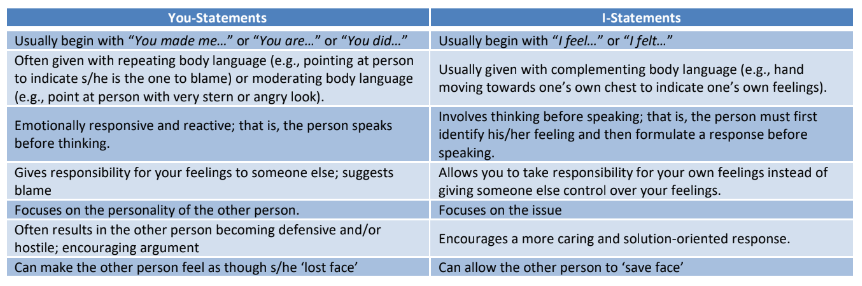
I-Statements
aka I-messages
Statements about yourself & your feelings
More likely to result in a caring response
Ex:
“I am sorry you feel let down”
“Why are you upset?”
You-Statements
Statements about what the other person did & how they made you feel
Will often result in a defensive response
Ex: “No. I didn’t!”
Ex:
“I feel let down” vs. “You broke your promise to me”
“I feel I’m not being listened to” vs. “You never listen to what I have to say”
“I feel neglected when I was alone at the party” vs. “You are so rude when you leave me at the party by myself”
You-Statements vs. I-Statements (Comparison Table)
5 Types of I-Statements
Declarative
I-statements that are used to self-disclose one’s beliefs, ideas, likes/dislikes, feelings, reactions, interests, attitudes, & intentions
Ex:
“I don’t like sports that are violent, such as boxing or rugby”
“I love you”
“I feel happy & alive when I am hiking”
Positive
A clear sincere message that expresses a positive feeling in response to another person’s actions
Communicate something about yourself, not evaluations of the other person (ex: praise, blame)
Ex:
“I feel good when…”
“I enjoyed it so much when…”
You-statement: “You were such a good boy to put your breakfast dishes in the dishwasher this morning”
I-statement: “I felt good not having to put your dishes away b/c it saved me some work”
Responsive
Can be used when a person is asked to do something they don’t want to do
We will often agree to do something we don’t want to do b/c
We feel obligated
We don’t want to feel guilty
We didn’t have time to think it through (got caught off-guard)
We want to please the other person
Should give a clear refusal
Ex: “I have decided not to…”
If a clear refusal isn’t given
“I am too busy right now…”
Then the person may ask again at a later time
Can include the reason for the refusal
Ex: “I can’t take you to prom b/c I am going with someone else”
Could be for responding “yes” to someone’s request
Ex: “I would enjoy meeting you at 3pm since we haven’t seen each other this week, & I miss talking to you”
Confrontive
Non-blameful, non-evaluative message that tells the person what you’re experiencing when you feel their behavior is interfering with your needs
Used to facilitate open, direct, & sincere communication about an issue
Important to identify the problem as well as what is creating the problem, but without placing blame
Important to demonstrate the effect the behavior has on you
Ex:
“You make me so mad when you interrupt me” vs. “When I am interrupted, I don’t get to finish what I am saying. So, I feel my views are not valued”
“You are so inconsiderate & make me mad when you trample on the flowers I planted” vs. “I don’t think I will be able to enjoy the flowers I planted if they are walked on”
“You are so disrespectful when you turn the TV up so loud that I can’t even carry a conversation with your mother” vs. “When the TV is on so loud, I have difficulty carrying on a conversation with your mother”
Preventative
Help communicate to other people your needs &/or what you expect; hence, preventing conflict & miscommunication
Used when you desire cooperation/support from someone in the future &/or when you want to influence someone to take a particular action in the future to avoid your displeasure (you don’t approve of a person’s behavior)
Ex:
“You make me so upset when you don’t come home right after school” vs. “I would like you to tell me when you aren’t coming home right after school, so I won’t get worried when you don’t”
“You’re always getting into trouble & begging to go to the arcade when we go to the mall” vs. “We are going to the mall in a few minutes, so I’d like us to decide what special rules we’ll need to prevent any problems”
Caveats of I-Messages
Can sound like a You-Statement when the tone of voice & demeanor are belittling, sarcastic,or angry
Ex: a high school student states an I-statement using a very sarcastic & snide tone
Will not result in solution-oriented & positive communication when used improperly
Ex: there is an implied threat & blame when a parent yells “I feel so mad, & I feel like washing your mouth with soap or slapping your face when I hear cuss words”
Can be manipulative if they are used to control or change the other person
Can sometimes become circular with so solution-oriented talk
Person gives an I-statement about some negative feeling, which then results in a reciprocal response from the other person about a negative feeling they are having (ritual trouble talk)
A solution is to switch to reflective listening
May not be appropriate in some cultures
Content vs. Context Reframing
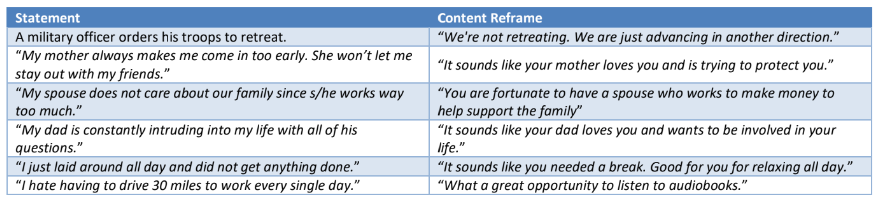
Content
Changing the meaning of a situation/behavior
Identify alternate meanings for the same situation/behavior/action
Identify a positive benefit of the situation/behavior/action
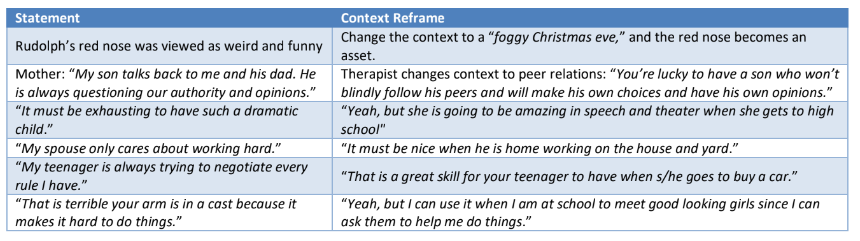
Context
Taking a situation/behavior that appears to be useless, harmful, or distressing, & then demonstrate how the same situation/behavior can be useful in a different context
Most behaviors/actions are useful or appropriate in some context
Often changes its meaning
One way is to change the time &/or space of the event or situation
Ex: a young woman was concerned b/c her parents used their life savings to add an extension to their house for her to live in after she got married
Context Reframing: reframe the situation to the parents & congratulated them for their willingness to share in the rearing of their future grandchildren
Ex: babies crying throughout the night, toddlers crawling everywhere, toys all over the house, babysitting
This reframing (setting the view of the situation in the future) created a positive but very descriptive representation of grandparenthood
Parents decided to rent the rooms in the new addition to “mature” adults & use the rent money to support their grandchildren’s education
Content Reframing (Comparison Table)
Context Reframing (Comparison Table)
Double Bind Overview
Conflicting messages given negate each other
Messages are mutually exclusive & contradicting
Creates a dilemma where following or obeying 1 message or directive means the other message/directive is disobeyed
No matter what the person does, they will be wrong
Especially frustrating when a person can’t confront or comment on the contradiction
Can’t resolve or avoid the dilemma
General Considerations About Conflict
Conflict is a process
All relationships experience conflict
Occurs in both successfully functioning & dysfunctional relationships
Destructive conflict is detrimental
A meta-analysis indicated hostile conflict behaviors in interpersonal relationships were related to decreased relationship quality & satisfaction
Meta-analyses indicated hostile interparental conflict was related to increased youth anxiety & worse youth psychosocial development
Conflict is not necessarily bad
Even thought the media often portrays conflict as bad
Productive &/or positively resolved conflict may keep relationships from collapse & may result in stronger relationships
It isn’t the existence of conflict that is problematic for the family
It is the methods of managing & resolving conflicts that are important
Conflicts can be diffused at any time
People manage conflict in different ways
People do not have just 1 conflict strategy.
Instead, people use various conflict strategies, depending on various factors
Ex: roles of each person in the conflict, reason for the conflict, context
People often fall back on the same conflict strategies
They may feel more comfortable using the same conflict strategies
They may have won or resolved conflicts in the past using the strategies
Couples generally establish their own unique conflict style within the 1st 2 years of marriage
1 style of conflict resolution won’t work in all situations
Children often model their parents’ conflict strategies
Conflict strategies children learn are often carried into adulthood
Some parents don’t allow their children to see them upset or in conflict
This can create an unrealistic view of interpersonal dynamics & relationships
Parents can model for their children how to positively manage &/or resolve conflict
Important to understand & learn different conflict-handling strategies
Increases tools (most appropriate approaches for positively resolving a disagreement
Understanding different styles can help individuals recognize their predominant strategies
Then they can learn how to change if necessary
Competitiveness
High concern for self
Low concern for others
Goal is to win the conflict & make the other person lose (often at their expense)
Person often operates from a position of power
Ex: position, rank, expertise, persuasive ability
Person has a low interest in cooperation, knows what they want, & takes a firm stand
Strategies can include:
Making a request for change
Using persuasion through info, evidence, & emotional appeal
Using aggressiveness to get change
Ex: yelling, threatening, cursing
1 way to determine a win is by getting concessions from the other person(s) in the conflict
Especially helpful when:
There is an emergency & a decision needs to be made fast
The decision is unpopular
Defending against someone who is trying to exploit the situation selfishly
Can result in bruised, unsatisfied, & resentful feelings when used in less urgent situations
Collaboration
High concern for self
High concern for others
Goal is to try & meet the needs of all people involved & facilitate a win/win outcome
Everyone feels they won
No one feels they had to compromise what they want
Collaborators can be highly assertive, but they cooperate effectively & recognize everyone is important
Especially helpful when the person
Needs to bring together a variety of viewpoints to get the best solution
There have been previous conflicts in the group
Situation is too important for a compromise
Avoidance
Low concern for self
Low concern for others
Seeks to evade conflict
Often has low assertiveness & low cooperation
Typified by delegating controversial decisions, accepting default decisions, & not wanting to hurt anyone’s feelings
May involve indirect communication
Ex: hinting, joking, passive-aggressive behaviors
May be more common in families or cultures where harmony is valued over individual needs
Especially helpful when:
“Winning” is impossible
Controversy is trivial
Someone else is in a better position to solve the problem
In many situations, this is a weak & ineffective approach to take
Can lead to unresolved frustration or anger
Can make the conflict worse
Can lead from avoiding the conflict to avoiding the person
Accommodation
Low concern for self
High concern for others
Concern for cooperating with others & meeting their needs at the expense of their own needs
Person can be persuaded to surrender a position even when it’s not necessary
Person isn’t assertive but is highly cooperative
Especially helpful when:
Issues matter more to the other party
Peace is more valuable than winning
Person wants to be in a position to collect on this “favor” later
Others may not return favors later
Unlikely to result in the best outcomes
Compromise
Medium concern for self
Medium concern for others
Solving conflict by partially meeting needs of each person
Everyone can accept the solution
Especially helpful when:
Cost of conflict is higher than the cost of losing ground
Equal strength opponents are at a standstill
Is an immediate deadline
Beltliner
aka “Hitting Below the Belt”
When a person intentionally brings up a sensitive subject to cause the other person pain
Attacking areas of personal sensitivity creates distrust, anger, & vulnerability
Ex: bringing up an abortion your partner had years ago when you know she is extremely sensitive about it
Gunnysacking
aka Stockpiling
Not responding immediately when angry. Instead, the person puts resentments into an imaginary gunnysack with other complaints. When the sack fills up & bursts, the person pours out all pent-up aggression onto partner
Storing up lots of grievances, complaints, & hurt feelings over time is counterproductive
Very difficult to deal with numerous old problems
Many of which will have gained a different meaning or interpretation over time
Try to deal with problems as they arise
Benedict Arnold
Failing to defend partner from other attackers &/or encouraging ridicule from others outside of relationship
Gameplaying
Covering up motives & trying to trick others into doing things
Ex:
Not calling, even thought you want to talk, just to see if your partner will call first
Spending time with the opposite sex friend to make your partner jealous
Disqualification
Cover up an emotion revealed earlier
Ex: “I only said I hate your mother because I was in a bad mood. I didn’t really mean it”
Denial
Saying “I’m okay” when you aren’t okay
Disengagement
Avoid interacting with the other person as a way to cause the person pain
Sabotage
Person tries to ruin or undermine an activity planned by another person to get revenge or to hurt them
Ex: spouse doesn’t want to host a dinner party, so acts rude or bored to ruin the evening
Displacement
Taking out anger on someone or something else
Person can displace their anger on themselves
Ex: self-deprecating thoughts, self-mutilation
Ex: you are having a bad day at work, & then you come home & kick the dog
Guilt-Making
Make others feel responsible for your pain
Ex: “Your rude behavior has made me so upset & depressed”
Mind Reading
Assume you know what the other person is thinking, & hence, you don’t allow the other person to express their own feelings/thoughts
Kitchen Sinking
Bringing up many issues at once
Everything but the kitchen sink is added to the argument
Off-Beaming
Jumping from topic to topic & never letting 1 topic get resolved before moving to another
Person deflects the conflict by moving the topic to something else
Trivial Tyrannizer
Does trivial things to annoy another person
Ex:
Trimming toenails in bed
Playing loud music when you know the other person is trying to sleep or study
Triangulating
Bringing another person into the conflict
Creates loyalty conflicts
Especially when it’s 2 parents involving a child into their conflict
Ex:
Trying to get the 3rd person to take your side
Having the 3rd person deliver messages btwn the 2 people who are arguing
Saying bad things to the 3rd person about the other person
Pseudomutuality
Family/Couple establishes patterns of behavior to appear happy & harmonious b/c they aren’t allowed to have conflict &/or they ignore the conflict
Gottman’s 4 Horsemen of the Apocalypse
4 Horsemen
Criticism
Contempt
Defensiveness
Stonewalling/Resistance
Belligerence (extra horseman)
Criticism
Refers to making disapproving judgments &/or negative evaluations about a partner
Different than a complaint
Attack of the partner’s character
Pervasive criticism will often lead to contempt
Ex: “You always come home late, so I always have to eat by myself. You obviously think other things are more important than spending time with me. You are so uncaring!”
Alternative:
Use a “soft or gentle start-up”
State the issue in a neutral way
Use “I-statements” to bring up an issues w/out attributing blame
Avoid using “You-statements”
Complaint should focus on a specific behavior instead of criticizing the person
Finish by stating a positive need
Focus on what is wanted, not what is wrong
Ex:
“I feel lonely when I eat dinner by myself. I like eating with you. What can we do to have more dinners together?”
Contempt
Refers to feeling & treating a partner as inferior &/or not desirable
Person using contempt assumes a position of moral superiority
Ex:
Being mean or disrespectful, mocking with sarcasm, ridiculing, name calling, eye-rolling, scoffing
“Once again, you FORGOT to take out the trash? Do you have dementia or are you just freaking lazy?!?!”
Alternative:
Build a culture of appreciation & respect in your relationship
Routinely & frequently express respect, gratitude, appreciation, & affection toward a partner. These positive acts can help buffer negative behaviors & feelings
Use Magic Ratio
Ex: “I know you have been distracted lately with all the stress at school, but please take out the trash when you get home? Thank you for helping me around the house. I am so appreciative”
Magic Ratio
Engage in at least 5 positive interactions to every 1 negative interaction
These consistent deposits (positive interactions) into an “emotional bank account” help encourage relationship satisfaction
Defensiveness
Typical response to criticism from a partner & refers to routinely preparing to defend oneself against perceived attacks from a partner
Ex:
Playing the innocent victim, making excuses, not taking partner’s concerns seriously, not taking responsibility for actions, reversing blame on partner
“I didn’t mow the lawn b/c you didn’t tell me to mow the lawn. I am not a mind reader!”
Isn’t usually a successful strategy since it often escalates the conflict
Especially when neither partner backs down nor apologizes
Alternative:
Giving a non-defensive response communicates an understanding of the other person’s perspective & feelings
Can also express an acceptance of responsibility or admission of fault, even if partial responsibility (when appropriate)
Ex: “Oh shoot, I meant to mow the lawn today, & I got sidetracked. I’m sorry. I will get to it tomorrow”
Occurs more frequently in troubled relationships
Stonewalling/Resistance
Often a response to contempt
Refers to resisting or refusing to take a partner’s grievances seriously
Allows a partner to avoid or delay issues that produce tension
Often results from feeling emotionally overwhelmed
Individuals who stonewall all the time (chronic stonewallers) may fear rejection or retaliation from their partners
Individuals are hesitant to acknowledge any angry emotions by themselves or their partner
Ex: “Oh my gosh, how many times do we have to go over this. If you are going to bring this up again, I am going to the bar”
Strategies
Ignoring or tuning out the discussion
Engaging in distracting behaviors
Avoiding or evading the interaction or argument
Trying to shut down the argument
Ex:
“When you yell, I can’t even think”
“We have already discussed this, we don’t need to discuss it again”
Withdrawing or leaving when an argument seems imminent
Shutting down & not responding
Starting to brood & refuse to talk
Using the Hit-&-Run Tactic
Insincerely giving up
Ex: telling a partner insincerely that “you are right”
Alternative:
Engage in physiological self-soothing
When individuals realize they are emotionally overwhelmed & stonewalling in the discussion/argument, they can ask to take a brief break (ex: a time out) from the argument (ex: at least 20 mins)
During the break, engage in something soothing
Ex: mindfulness activity, exercise
Once a partner doesn’t feel so emotionally overwhelmed, the discussion can continue
Hopefully more productively
Ex: “I know this is important to you, & I want to discuss it, but I feel a bit overwhelmed right now. If I take a short break, maybe 20 mins, then I’ll be ready to talk more? Thanks for listening to me”
Hit-&-Run Tactic
Bringing up a grievance or complaint & then leaving no time to discuss an answer or get resolution
Belligerence
Honorary horseman
Added later
Refers to expressing anger & frustration in threatening &/or aggressive manners
Those who are belligerent will engage in little compromise & often threaten to end the relationship instead of trying to fix any issues in the relationship
Ex: “If you can’t come home to eat dinner, then I guess I can move out & find someone who would actually like to eat dinner with me”
Gottman’s Four Horsemen of the Apocalypse: Research Results
In stable couples, the amount of positive affect in the conflict was the only variable that consistently predicted marital happiness & stability
Shared humor, expressions of warmth, interest, & affection help deescalate arguments
Anger wasn’t the most destructive emotion in marriages
Neither conflict nor anger necessarily predicted relationship dissolution (ex: divorce), but the conflict processes did predict divorce
Contempt was the strongest predictor of divorce
The following interaction pattern most strongly predicted divorce btwn a husband & wife:
Wife brought up a complaint → Husband refused to accept any influence → Wife reciprocated her husband’s escalated negativity → Neither spouse deescalates using positive affect
The negativity could be demonstrated with anger, belligerence, contempt, defensiveness, disgust, fear, sadness, tension, whining
Conflict Resolution
Constructive Conflict
Refers to behaviors which serve as a learning experience for future conflicts, or that make the relationship stronger
Info exchange is an effective tool to alleviate conflict
Respectfully asking for more info before automatically reacting to a conflict-triggering event can provide a buffer btwn the conflict-triggering event & both people’s reactions
Before you begin, determine:
Exactly what is bothering you
Whether your feelings are proportional to the issue
What are the possible outcomes that could be acceptable to you
Know yourself
Self-awareness is very important to positive conflict resolution
You need to know your biases, hot spots (triggers), needs
Use good timing
Set a tie for a discussion that is as soon as possible, & agreeable to all parties involved
Discuss issues when:
You are alone with your partner in private rather than in public
You & your partner have sufficient time to talk
You & your partner are rested & generally feel good
Be aware if you negotiate more positively in the morning, afternoon, evening, night
Bringing up something when the other person is unprepared may result in more defensiveness b/c the other person may feel attacked
If there isn’t enough time to fully discuss an important issues, then try to find a later time for the discussion
It’s okay to begin a discussion with the understanding that there will be a later, more in-depth discussion
Ex: “Let’s get started in the time we have available, but let’s talk about this more tonight when we get home”
If there is resistance to setting a time, help the other person see why the issue is important
Manage the physical environment
Find a neutral room for the discussion
If the conversation starts in a more public place, suggest a more private place
Ex: if you are at work, & a coworker confronts you, then suggest moving to a private room to talk
Eliminate distractions
Ex: turn off phone, computer, TV, radio
Phubbing
aka Phone Snubbing
Ignoring another person by focusing on one’s phone or mobile device
Females phubbed their companions more than males
Females were phubbed by their companions more than males
Smartphone addiction, Fear of Missing Out (FOMO), & lack of self-control were all positively related to increased phubbing & being phubbed
Phubbers were perceived as less polite & attentive
Negatively related to perceived quality of conversation
Partner phubbing was related to decreased relationship satisfaction
Let the other person go outside for a few mins to “cool off”
Have children occupy themselves for the next hour w/out interrupting you & your partner
Listening
It is the right of each partner to be heard
Face each other with an open body posture
When individuals are upset or angry, they rarely use words that convey the real issues or feelings
Listen to the reasons the other person gives for being upset
Need to understand where the other person is coming from before defending our own position
Need to listen for what is felt as well as what is said
Strengthens & informs us
Use empathic or Reflective Listening
Listen w/out judging, try to hear the feelings behind the statements
Try to keep an open mind to view differences from our own
Make sure good relationships are the top priority
Do your best to treat the other person calmly & courteously
Try to build mutual respect
Think “if one loses, we both lose”
The idea isn’t to “win”, but to come to a mutually satisfying & peaceful solution to the issue
Keep people & problems separate
Recognize that in many cases the other person isn’t just “being difficult”
Real & valid differences often underlie differences of opinions
By separating the problem from the person, real issues can be debated w/out harming relationships
Set ground rules that outline appropriate & inappropriate behaviors during negotiation
One person speaks at a time
Info shared in the discussion will remain confidential unless otherwise stated
Don’t involve others into the negotiation unless discussed 1st
State the problem & say what you really mean in clear language
Stick to the facts
Be specific about what is bothering you
Vague complaints are difficult to resolve
State your wishes & requests clearly & directly
Avoid accusations & attacks
Avoid “You-Messages”
Accusations will result in defensive posturing by the other person
Own your own feelings 1st
Use “I-Messages”
Clarify the real issue, rather than making assumptions
Always check your perceptions
Try to understand what the other person is telling your from their pov
Repeat the message you think you received (paraphrase) & ask if you understood correctly
Reflect the feelings you thought you heard
Shelve your agenda
Temporarily delay your own needs to meet those of the other person
Encourage the other person to share
Ex: issues, perspectives, feelings
Use encouragers
Comments &/or nonverbal gestures that encourage the other person to continue talking & sharing
Ex:
“I want to understand what is upsetting you”
“I want to know what you need to feel better”
Ask questions that help gain more info so the other person will know you are trying to understand
Ex: “Can you say more about that?”
Ask if anything remains unspoken
Give the person time to think before answering
Validate the other person’s concerns & feelings
Ex:
“I can imagine how upsetting that must have been”
“I really appreciate that we are talking about this issue”
“I hear you; I will watch for that”
Don’t interrupt
Resist the temptation to interject your own perspective until the other person has said everything they want to say
This will demonstrate that you have listened to & understood their messages
Negotiate from the “adult” position
Use appropriate affectionate touch before & during conflict
In real & imagined contexts, affectionate touch (ex: holding hands) before & during conflict was related to:
More constructive conflict behaviors
Less destructive conflict behaviors
Less stress
In imagined contexts, affectionate touch was related to higher/better state intimacy/security & cognitive interdependency (couples see themselves as a collective)
Avoid ultimatums
Resist giving the silent treatment
Is sometimes used as a manipulative strategy to control the situation
When one person stops responding, frustration, anger, & mind-reading can result
None of which help resolve conflict effectively
Positive resolution can only be attained with 2-way communication
Refuse to fight dirty
Do not engage in name-calling, beltliners, blaming, passive-aggressive behaviors, gunnysacking, rapid fire questioning
Call “time-out” & “foul” when someone fights dirty
Praise the other person when they do what you request
Expressing appreciation can be very impactful when conveyed with integrity & respect
Focus on the issue & on the present
Deal with only 1 issue at a time
If you are still upset about old issues, hurts, & resentments, your ability to see the current situation is impaired
Instead of looking to the past & assigning blame, focus on what you can do now to solve the problem
Don’t introduce other topics until each is fully discussed
When people express all their complaints or issues, it’s difficult for anything to be resolved
If a person brings up a past issue, validate the issue
Ex: “I see this is still bothering you. B/c it’s important to you, it’s also important to me. Let’s resolve our current issue, & then talk about that one”
Don’t generalize
Avoid words such as “never” or “always”
Generalizations are often inaccurate & can increase frustration
Avoid fabricating & exaggerating issues/feelings
Exaggerating or inventing an issue &/or exaggerating your feelings will prevent real issues from surfacing
Use humor & comic relief when appropriate
Never use sex to avoid or smooth over a disagreement
Always go for closure
Explore options together
Discuss the advantages & disadvantages of each option
Be ready for compromise
When there is agreement, celebrate
If no solution has been reached on the issue, schedule a time to begin the discussion again
 Note
Note  Flashcards (61)