ORAL PATH. 3 REVIEW EXAM 1
 Call Kai
 Learn
Learn Practice Test
 Spaced Repetition
 Match
Match Flashcards
 Knowt Play
1/83

There's no tags or description
Looks like no tags are added yet.
Name | Mastery | Learn | Test | Matching | Spaced | Call with Kai |
|---|
No analytics yet
Send a link to your students to track their progress
84 Terms
Take history
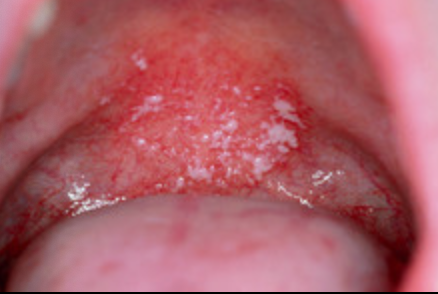
Case 1. A 42-year-old male is asthmatic and presents with diffuse white plaques on the palate. 1a. What is the first thing you would do?
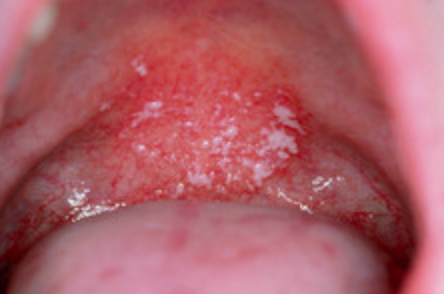
Steroid Inhaler
1b.What would be the most likely cause of the white lesion?
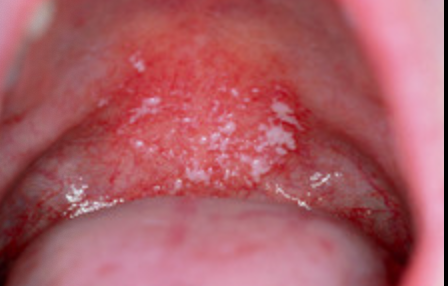
Pseudomembranous candidiasis
1c.What is the MOST appropriate diagnosis?
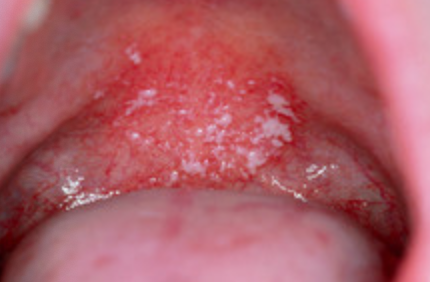
White plaques that wipe off
1d.What is a defining feature of Pseudomembranous candidiasis?
Burning and metallic taste
1e.What would be the symptoms?
Nystatin oral suspension
1f. Which is the best first-line prescription therapy?
Rinse mouth
1h.Which management step is essential after inhaler use?
leukoedema
Case 2. A 33-year-old woman reports burning and irritation on the right buccal mucosa with white reticular striations with erythema. 2a. Which of the following is NOT in the differential?
Drug induced lichenoid mucositis
Oral lichen planus
Cinnamon hypersensitivity
Leukoedema
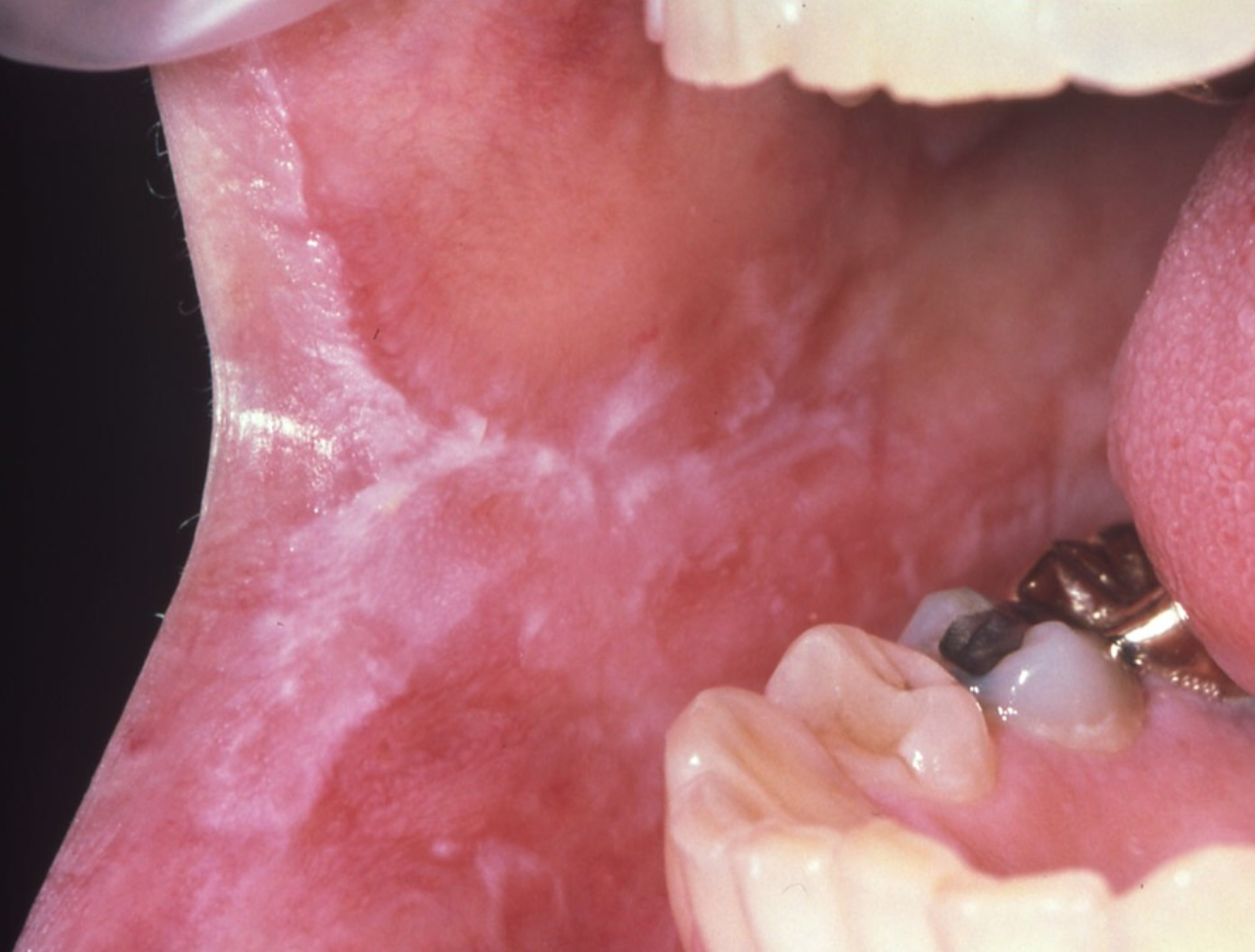
Unilateral lesions adjacent to offending agent
2b. What feature supports a cinnamon-induced lichenoid mucositis?
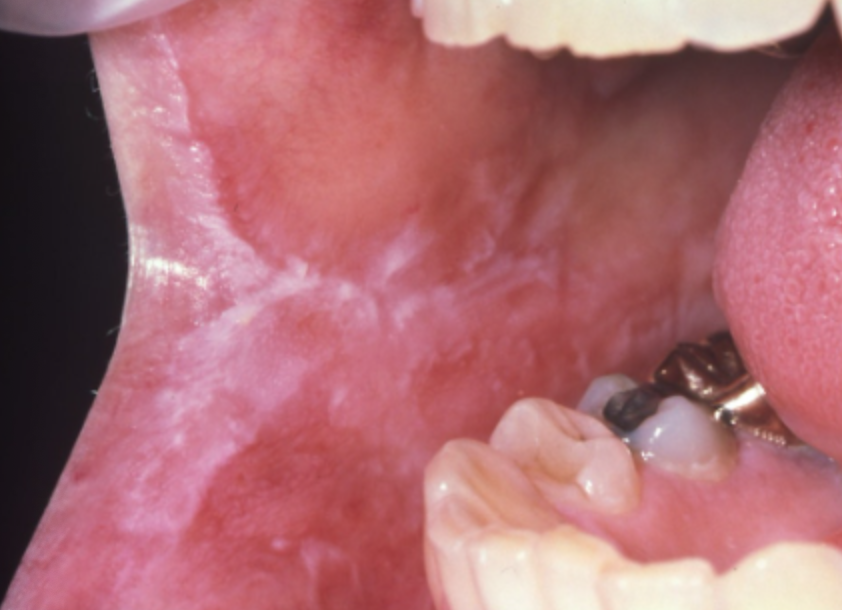
Stopping the cinnamon-containing product
best treatment for cinnamon-induced lichenoid mucositis?
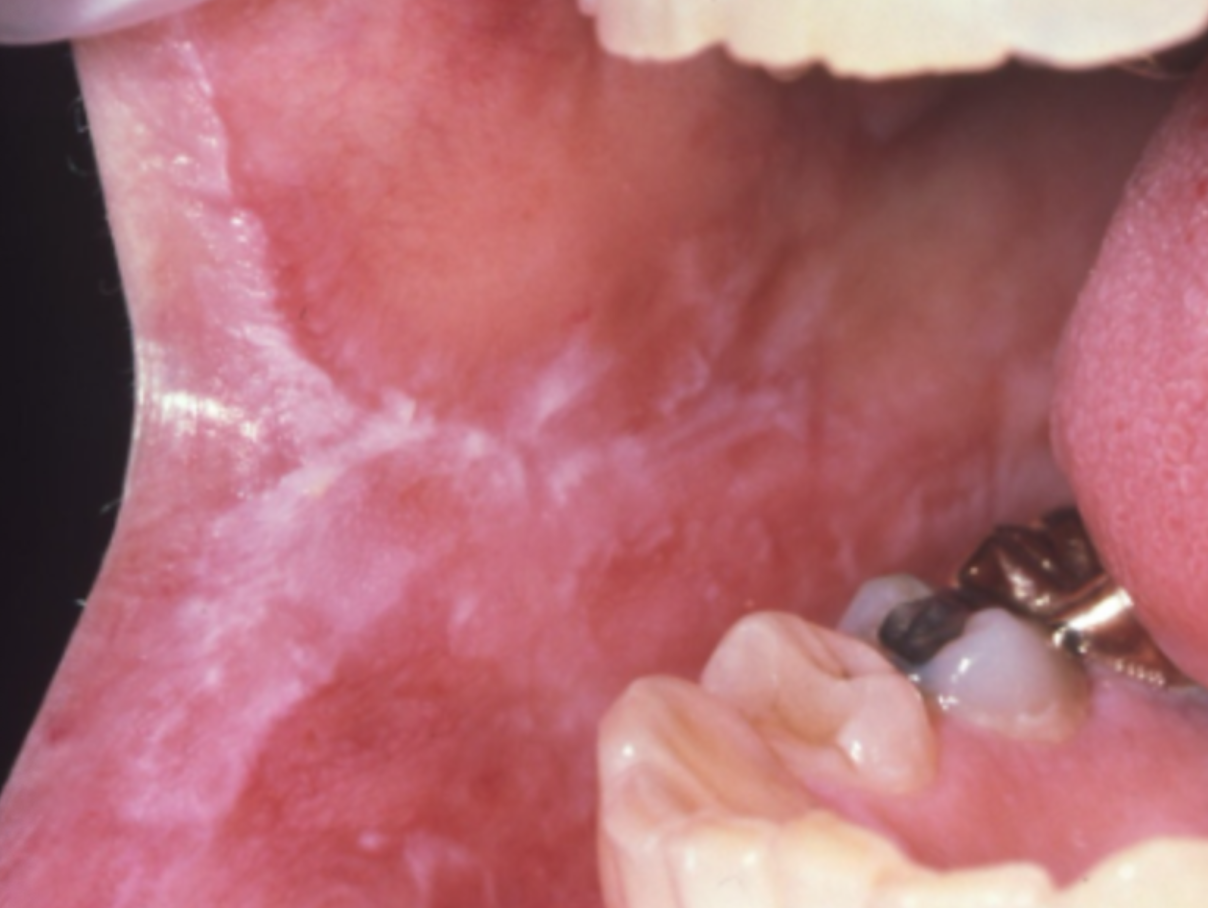
Flucinonide gel
2d. If symptoms persist after removing the allergen, which medication is appropriate?
Acyclovir tablets
Nystatin mouth rinse
Fluocinonide gel
Mycelex troches
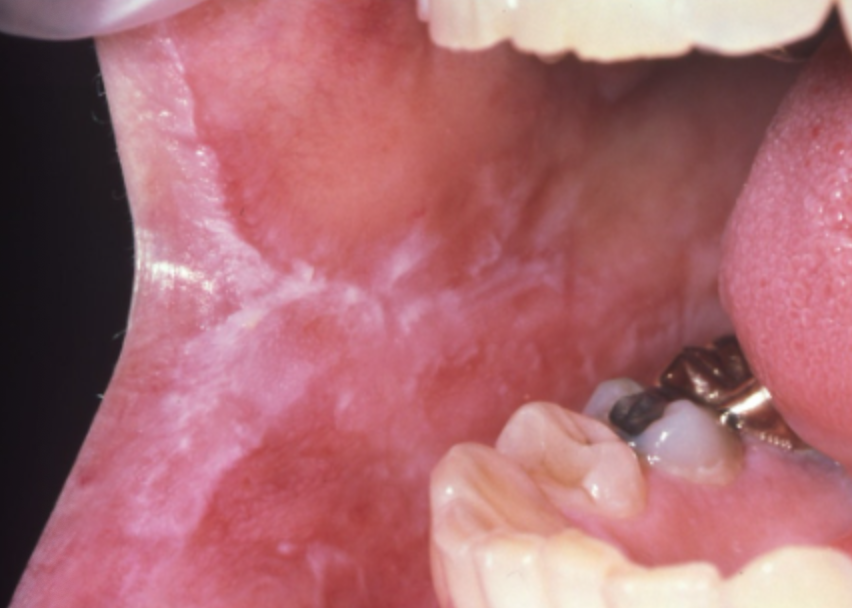
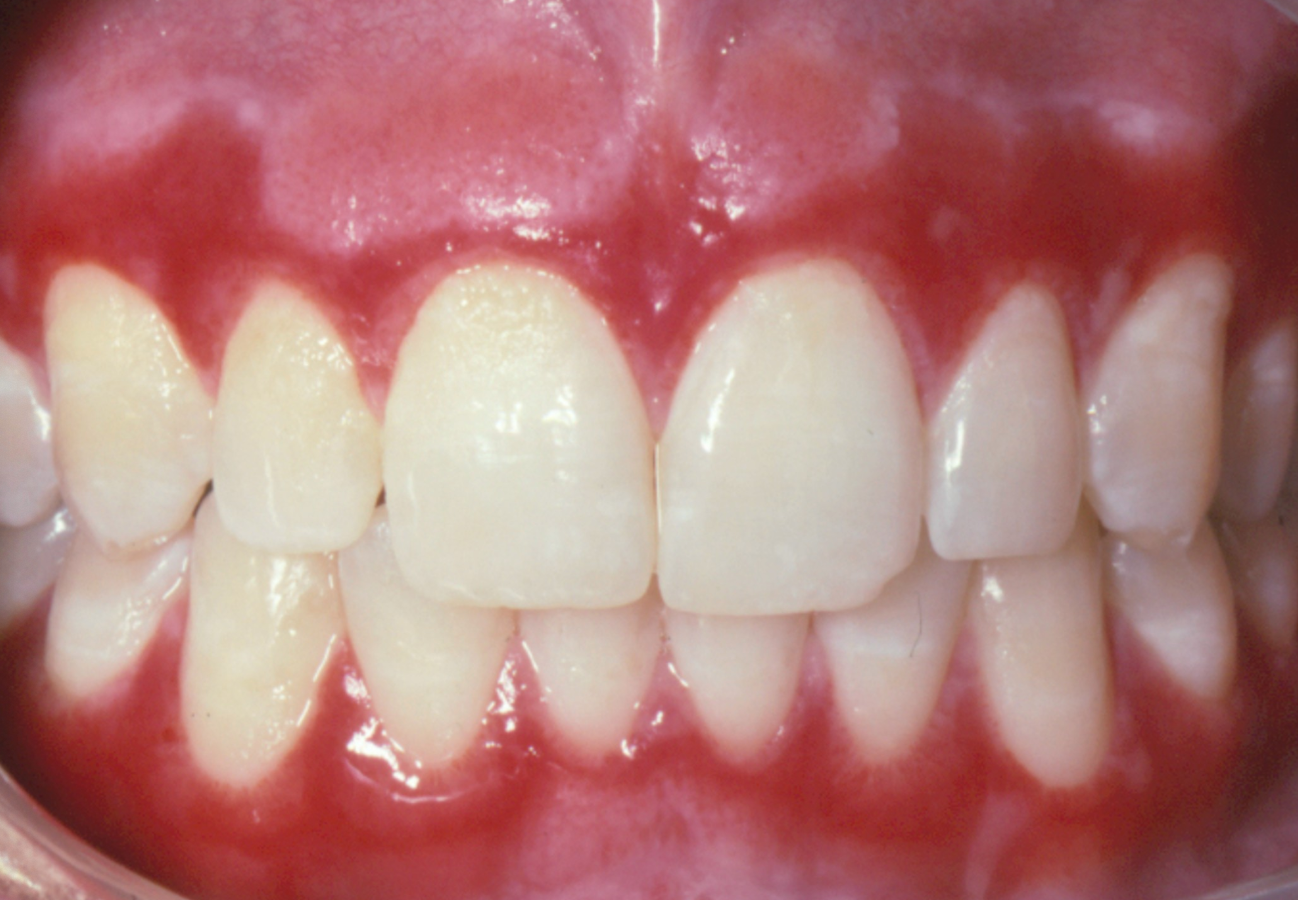
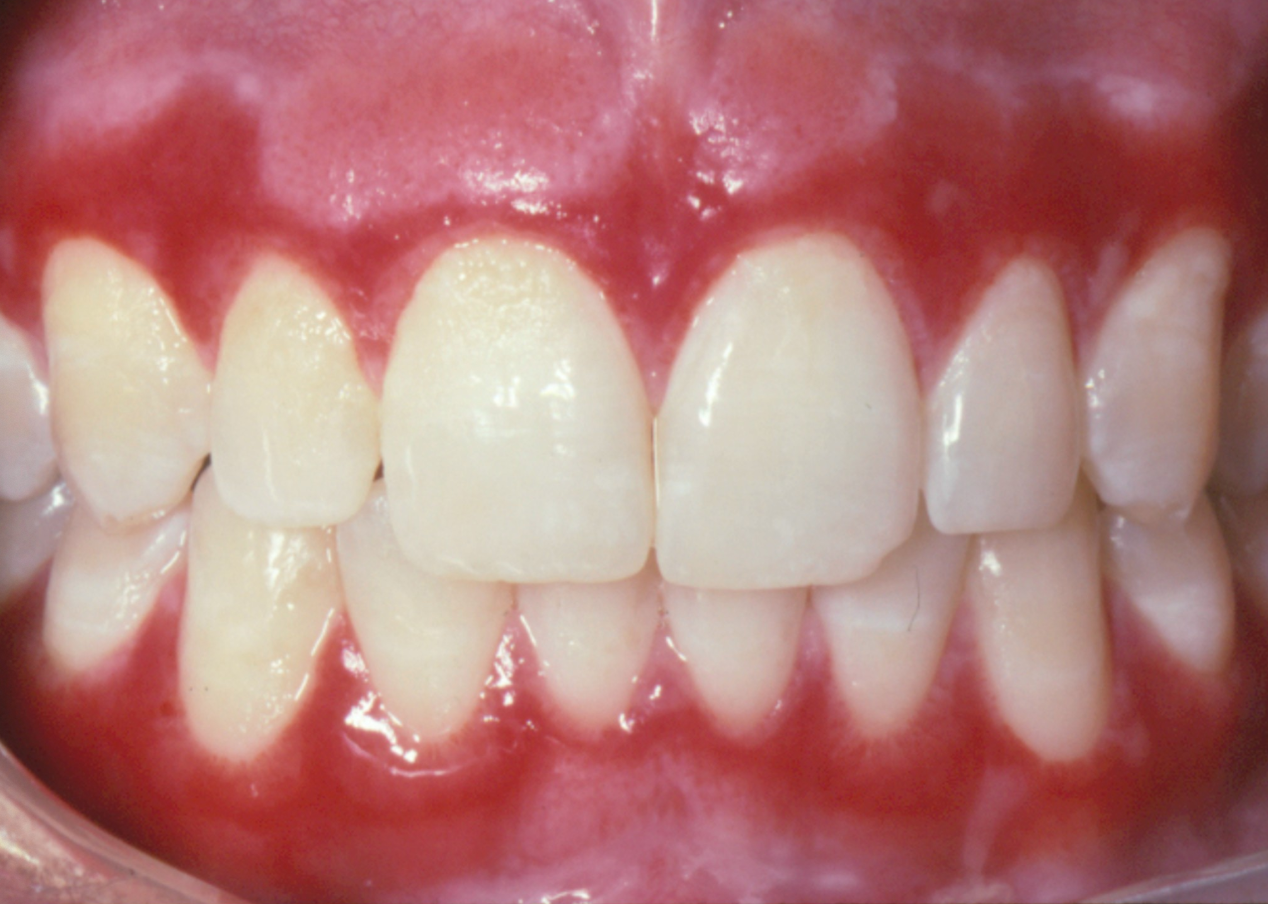
Desquamative gingivitis
Case 3. A 55-year-old woman presents with painful peeling gingiva. Gingiva is erythematous with sloughing epithelium. 3a. What is the term to describe the gingiva?
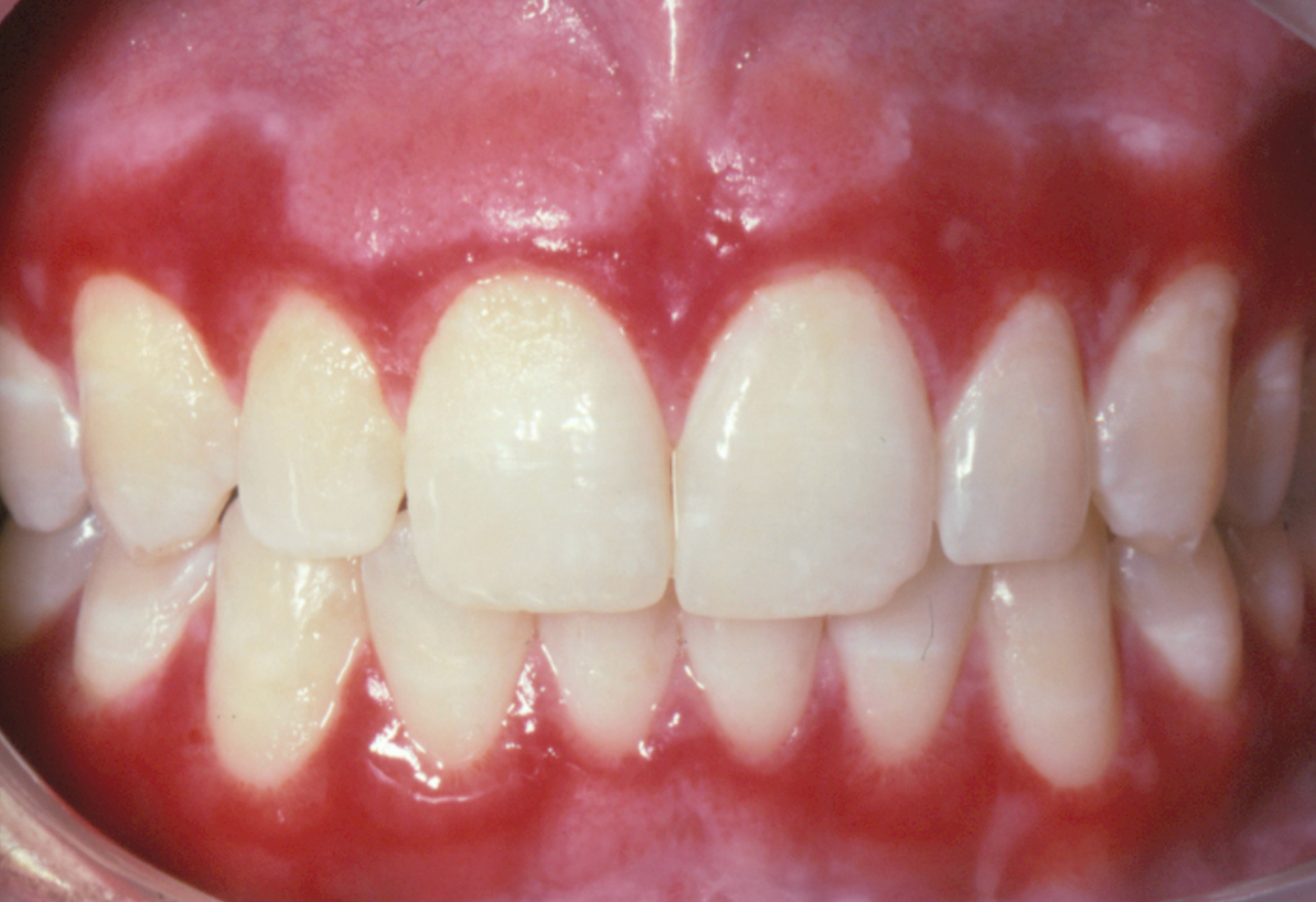
Pemphigus vulgaris, mucous membrane pemphigoid, erosive LP
3b. Which of the following is the correct differential diagnosis?
Primary herpetic gingivostomatitis, erosive LP, lichenoid mucositis
Erosive LP, systemic lupus, erythema multiforme
Pemphigus vulgaris, mucous membrane pemphigoid, erosive LP
Mucous membrane pemphigoid, reticular LP, pemphigus vulgaris
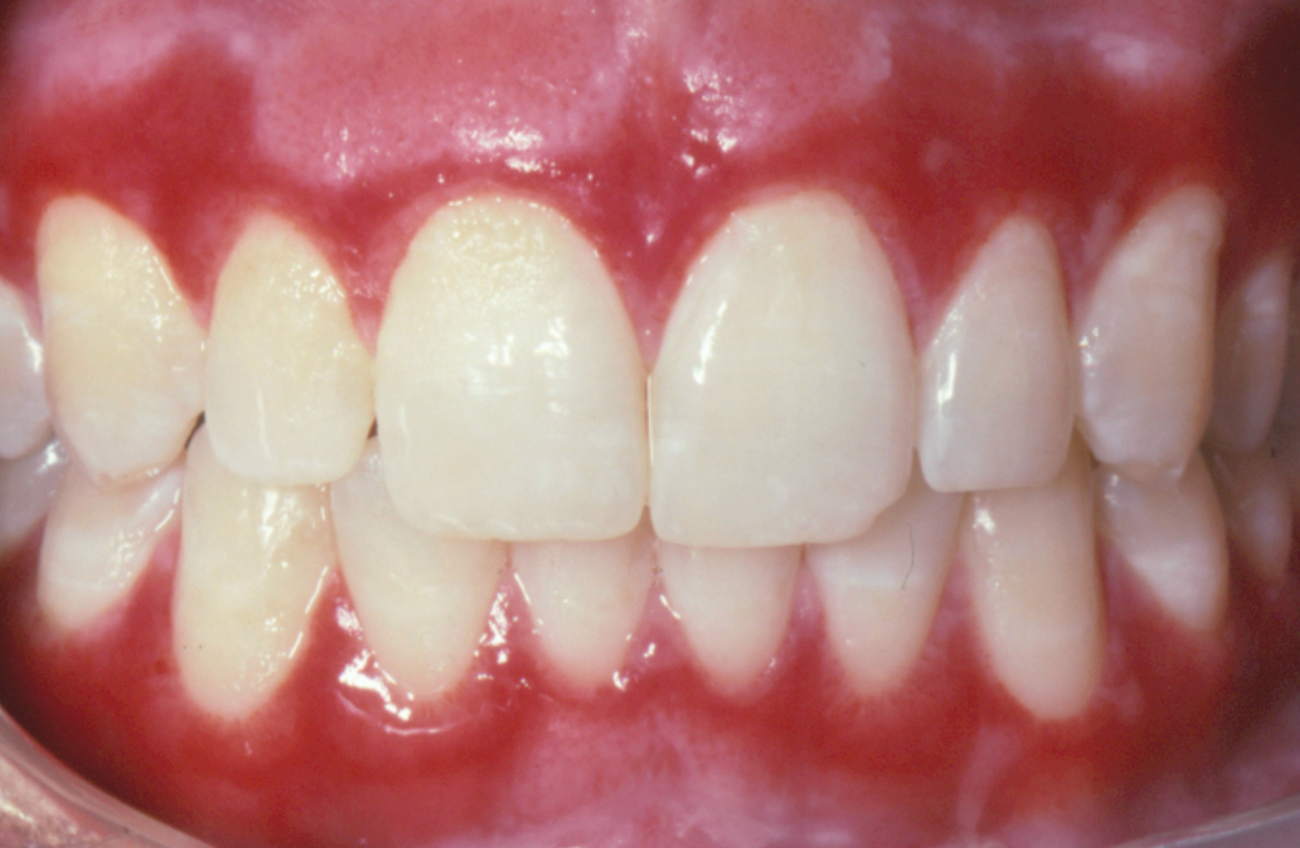
Incisional biopsy with DIF testing
3c. How would you confirm the disease?
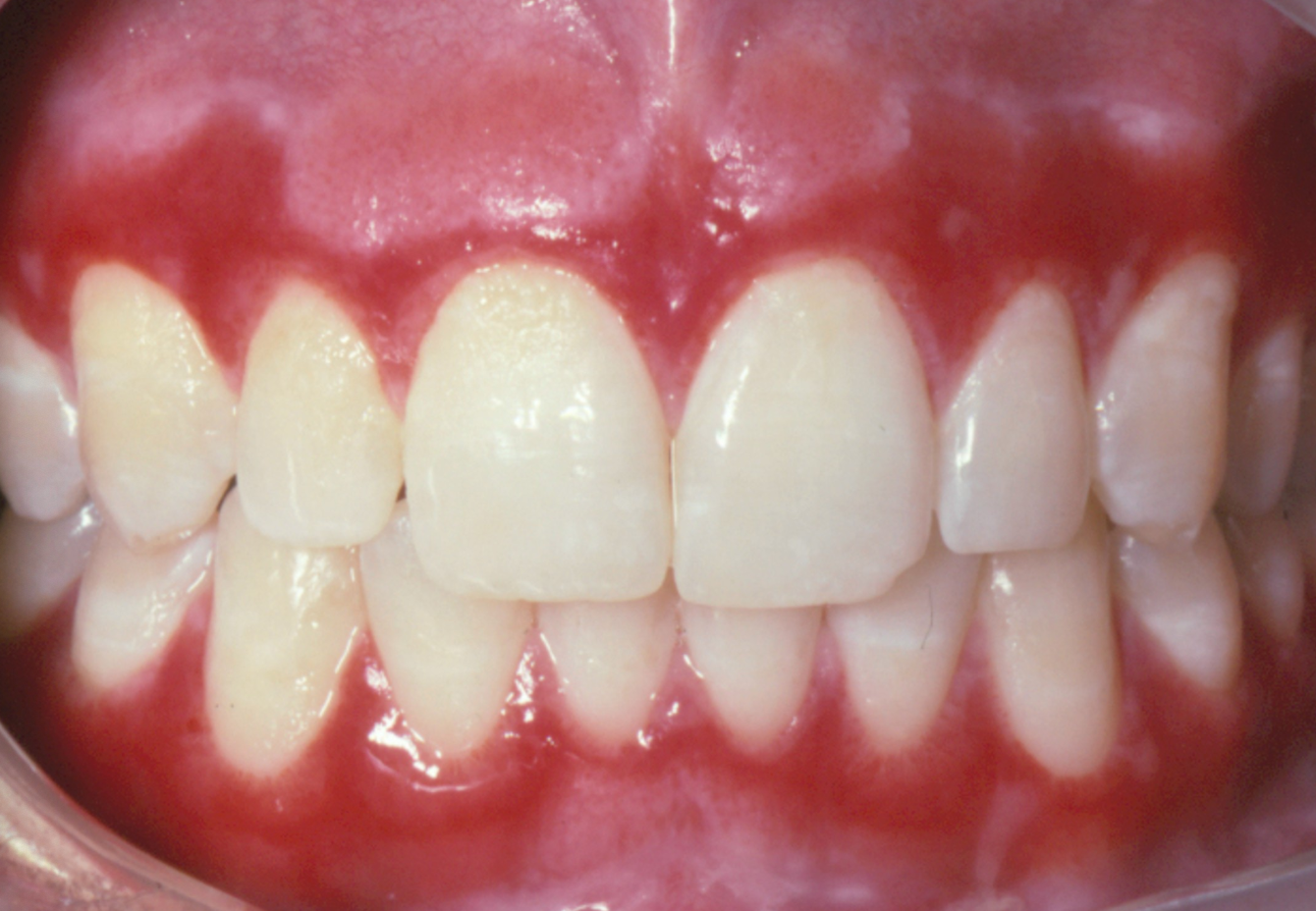
Subepithelial blister formation
3d. Which feature is characteristic of mucous membrane pemphigoid?
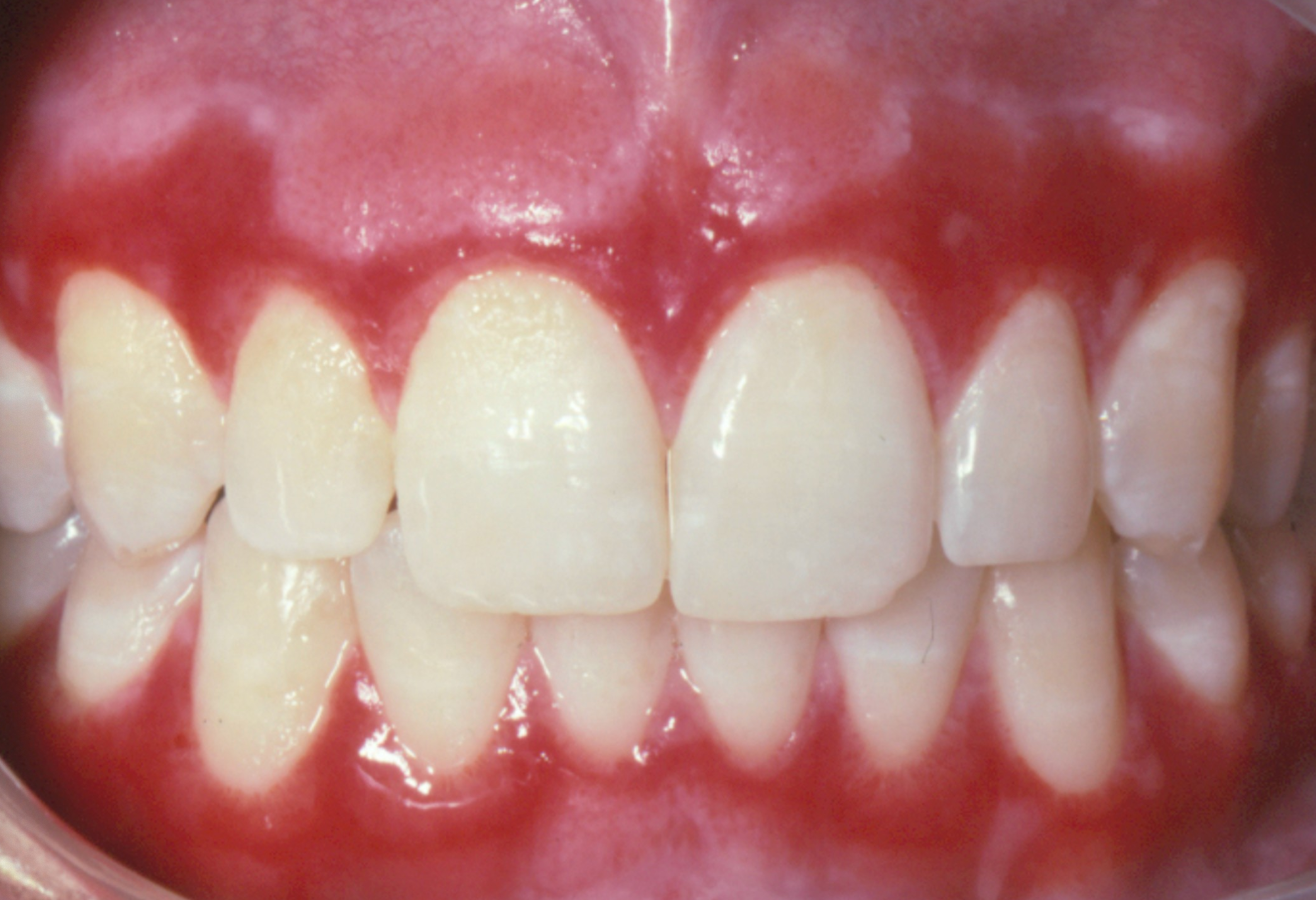
Dexamethasone oral solution
3e. What is the most appropriate initial therapy?
Dexamethasone oral solution
Penicillin tablets
Mycelex troches
Acyclovir tablets
Nystatin mouth rinse
3f. Which medication should also be prescribed with corticosteroids in this case?
Mycelex troches
Prednisone tablets
Nystatin mouth rinse
Acyclovir tablets
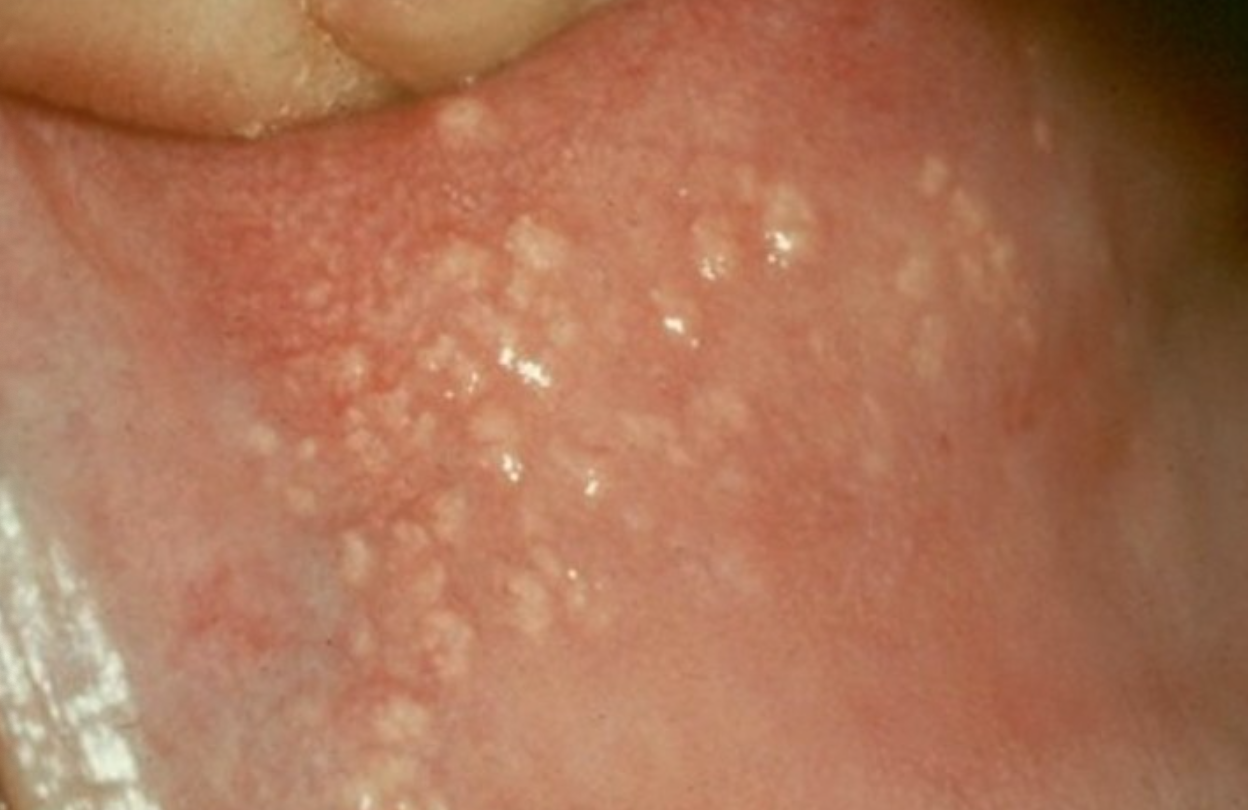
Fordyce granules
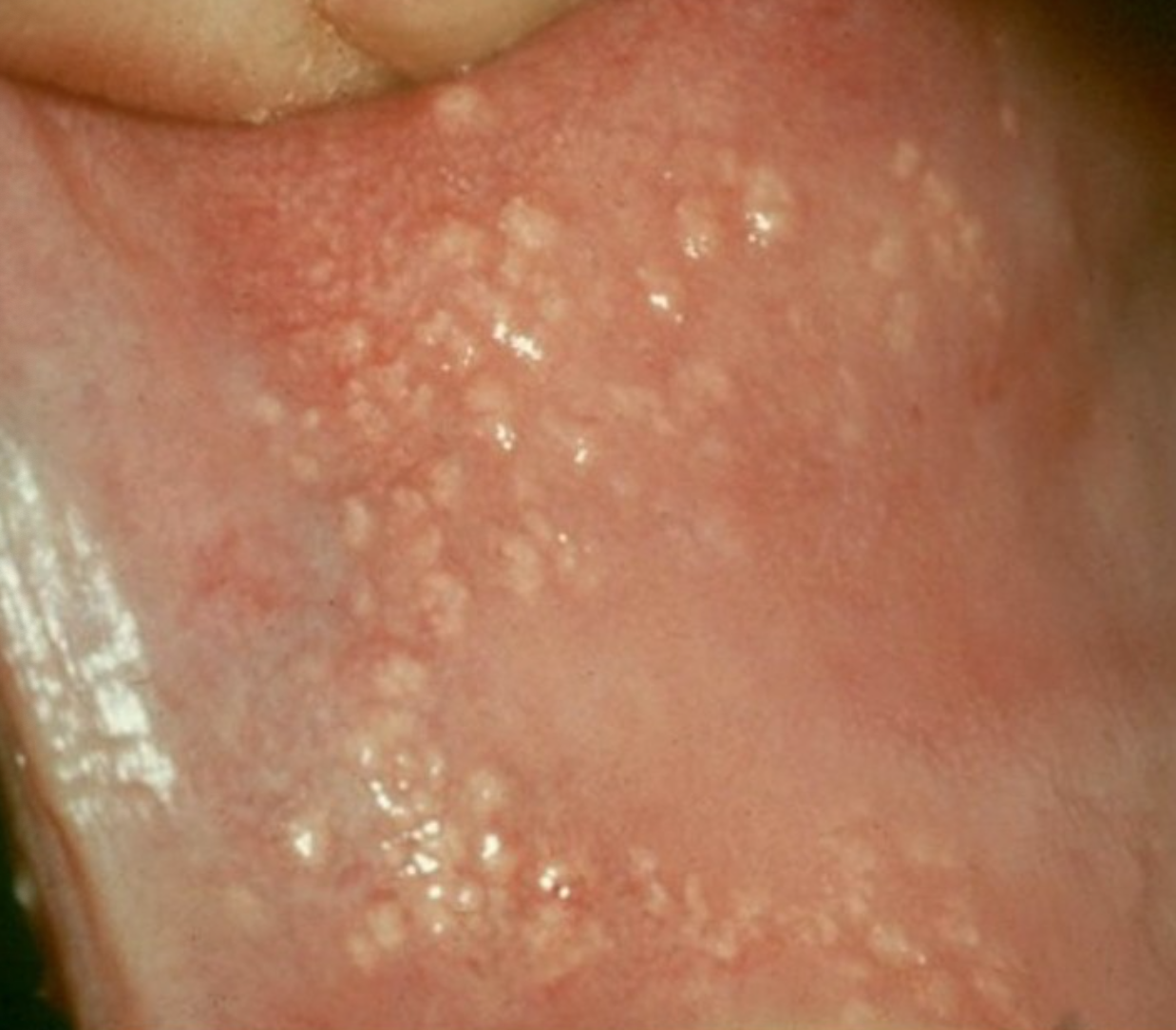
Case 4. Asymptomatic small yellow-white papules on the buccal mucosa of a 60-year-old man. 4a. What is the diagnosis?
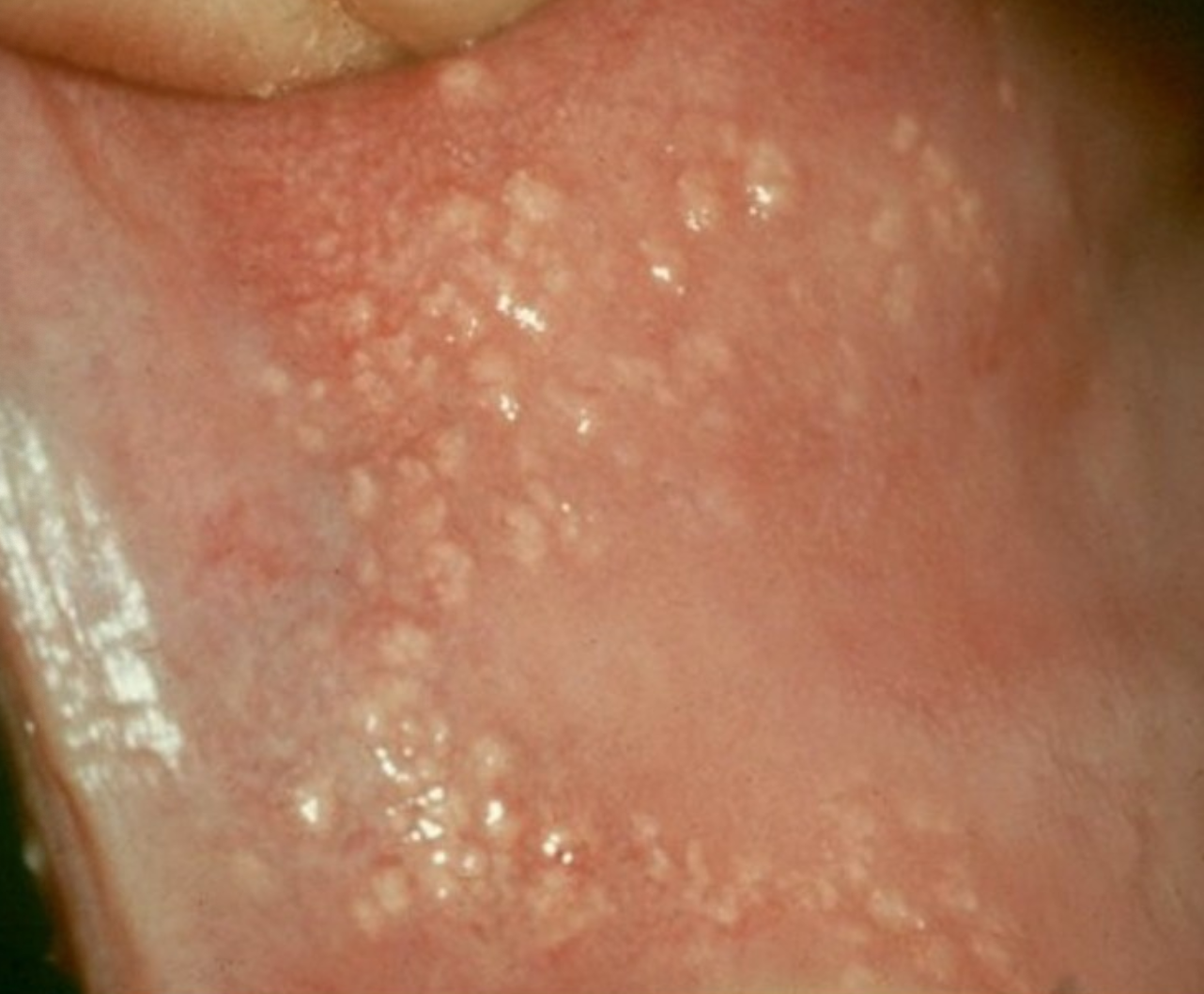
Ectopic sebaceous glands
4b. What is the etiology of this lesion?
No treatment
4c. What is the management:
SCC and high grade dysplasia
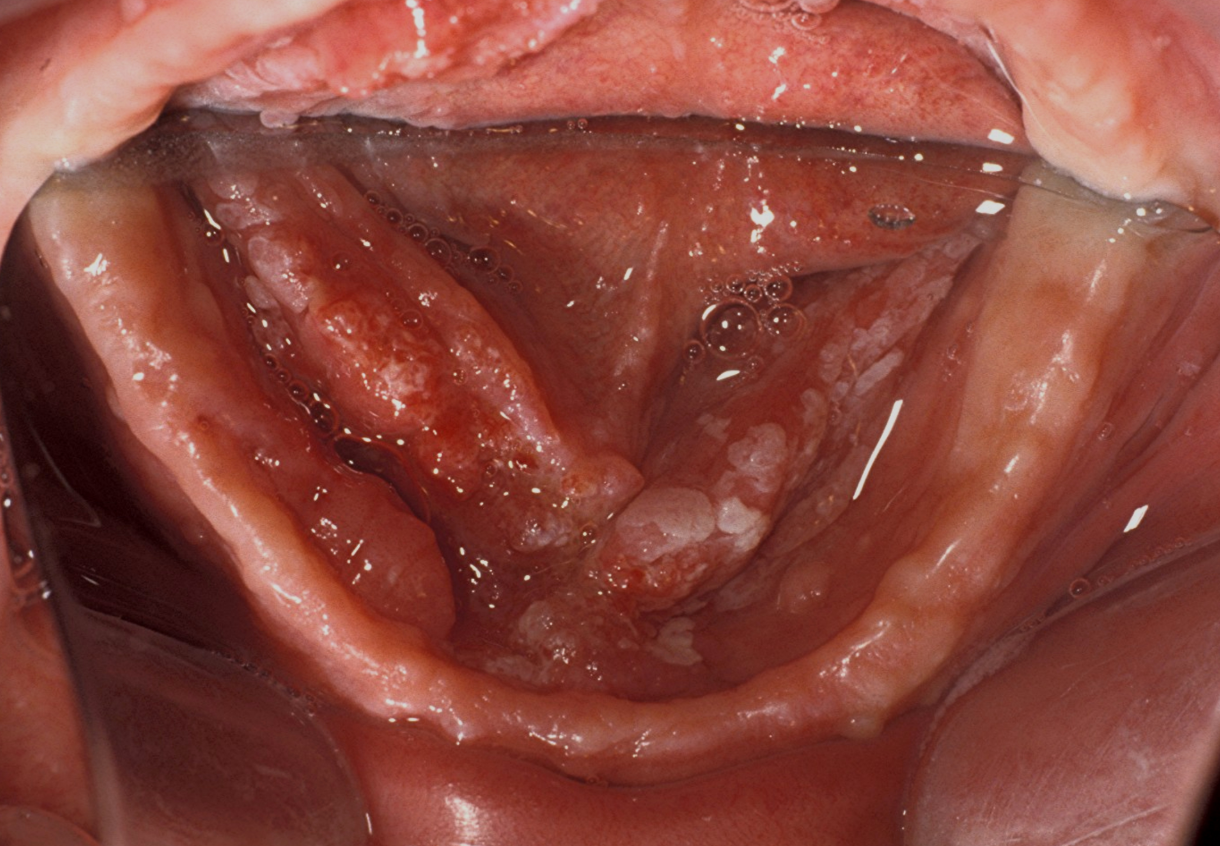
Case 5. A 70-year-old smoker presents with an erythroleukoplaic lesion on the floor of the mouth for 6 months. He complains of pain and is unable to wear his denture. 5a. What is the most likely diagnosis?
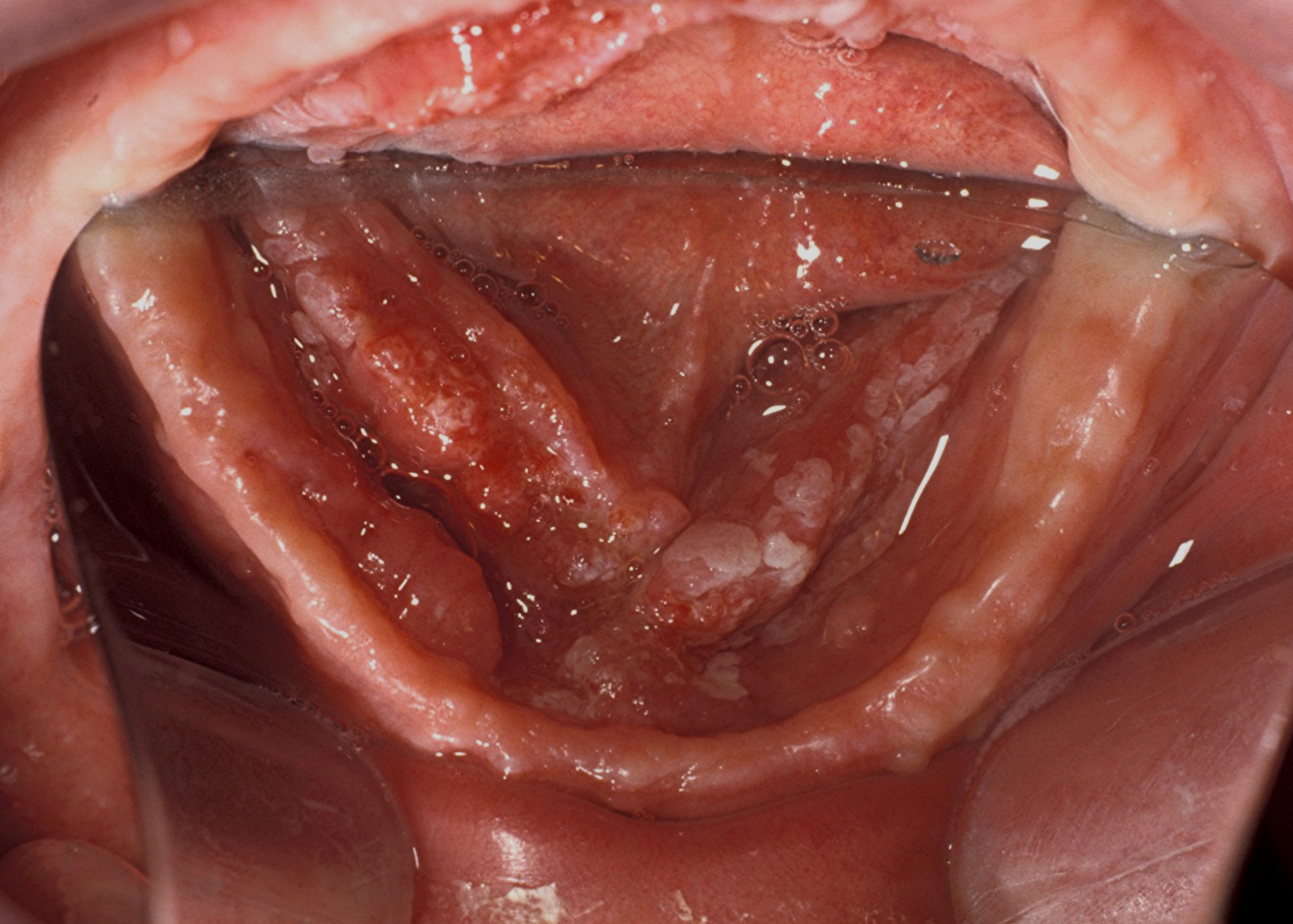
Has a high malignant transformation
5b. Why is erythroleukplakia concerning?
Follow up
5d. What is the management of mild dysplasia?,
Moderate dysplasia
5c. Atypical cells reach 2/3 of the epithelium thickness. What is the diagnosis?
Immediate incisional biopsy
5e. What is the management of this lesion?
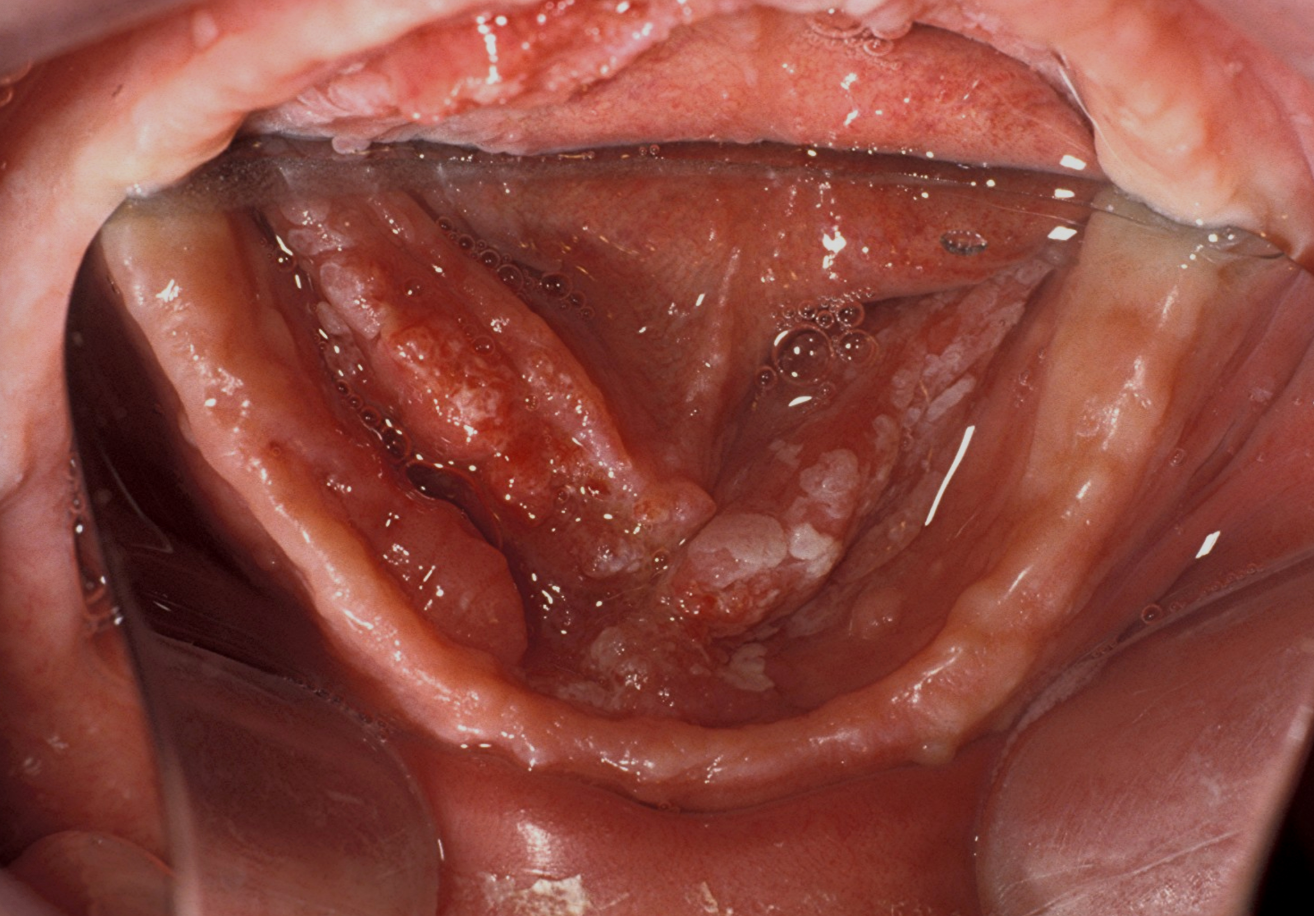
Proliferative verrucous leukoplakia (PVL)
what is the most likely diagnosis?
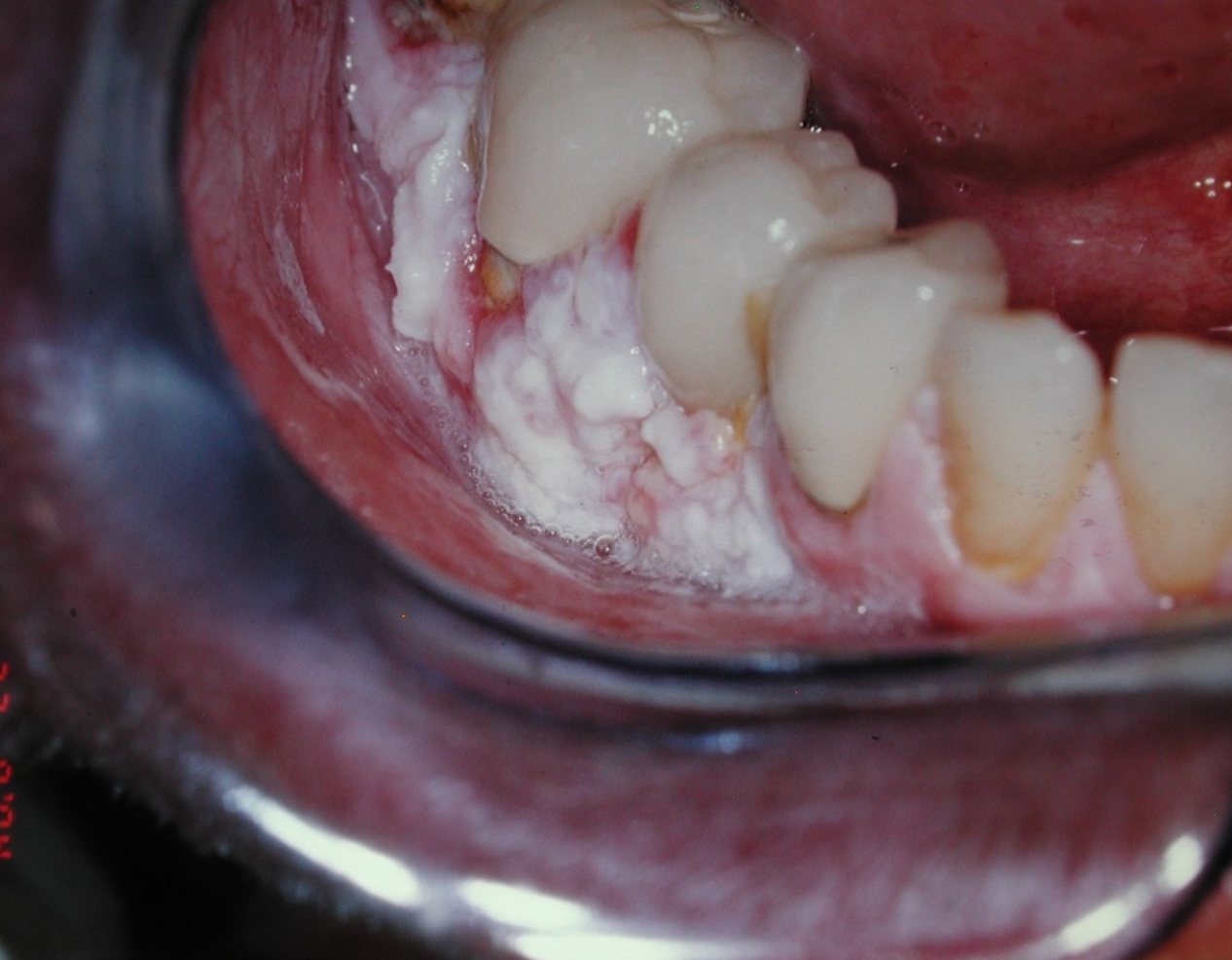
Premalignant
6b. Why is PVL concerning?
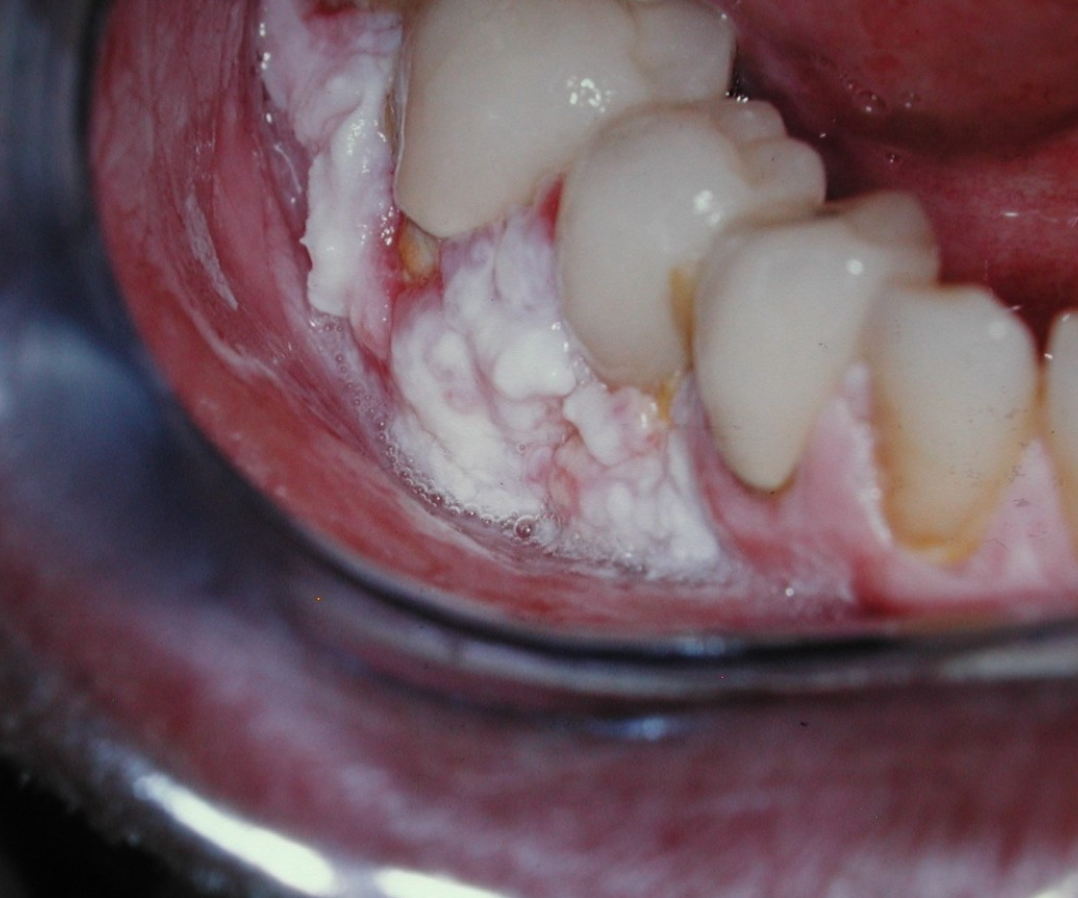
Wipes off
6c. All of the following are unique clinical features of PVL EXCEPT:
Multiple locations and can spread
Gingiva is usually involved
Wipes off
High recurrence rate
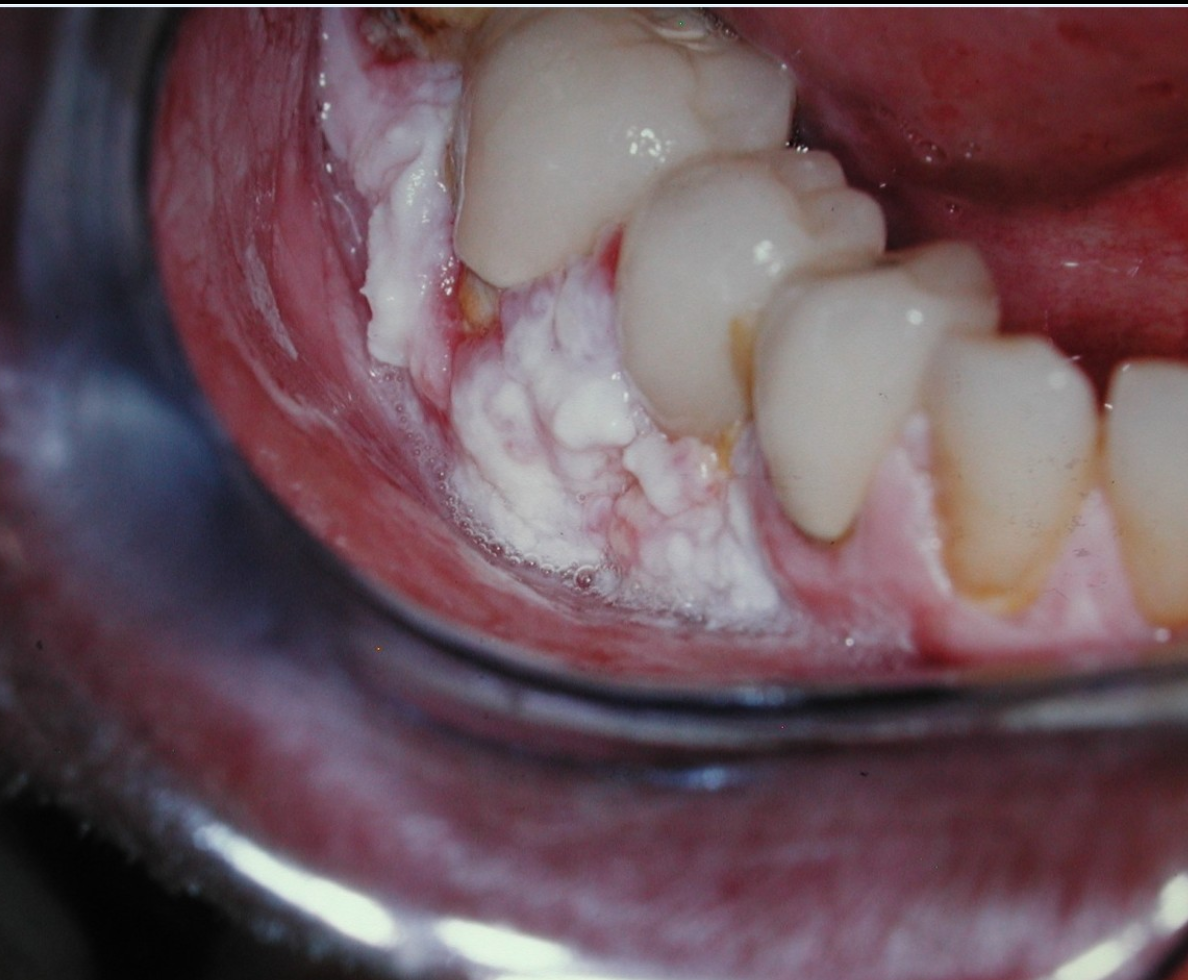
Immediate incisional biopsy
6d. What is the appropriate management?
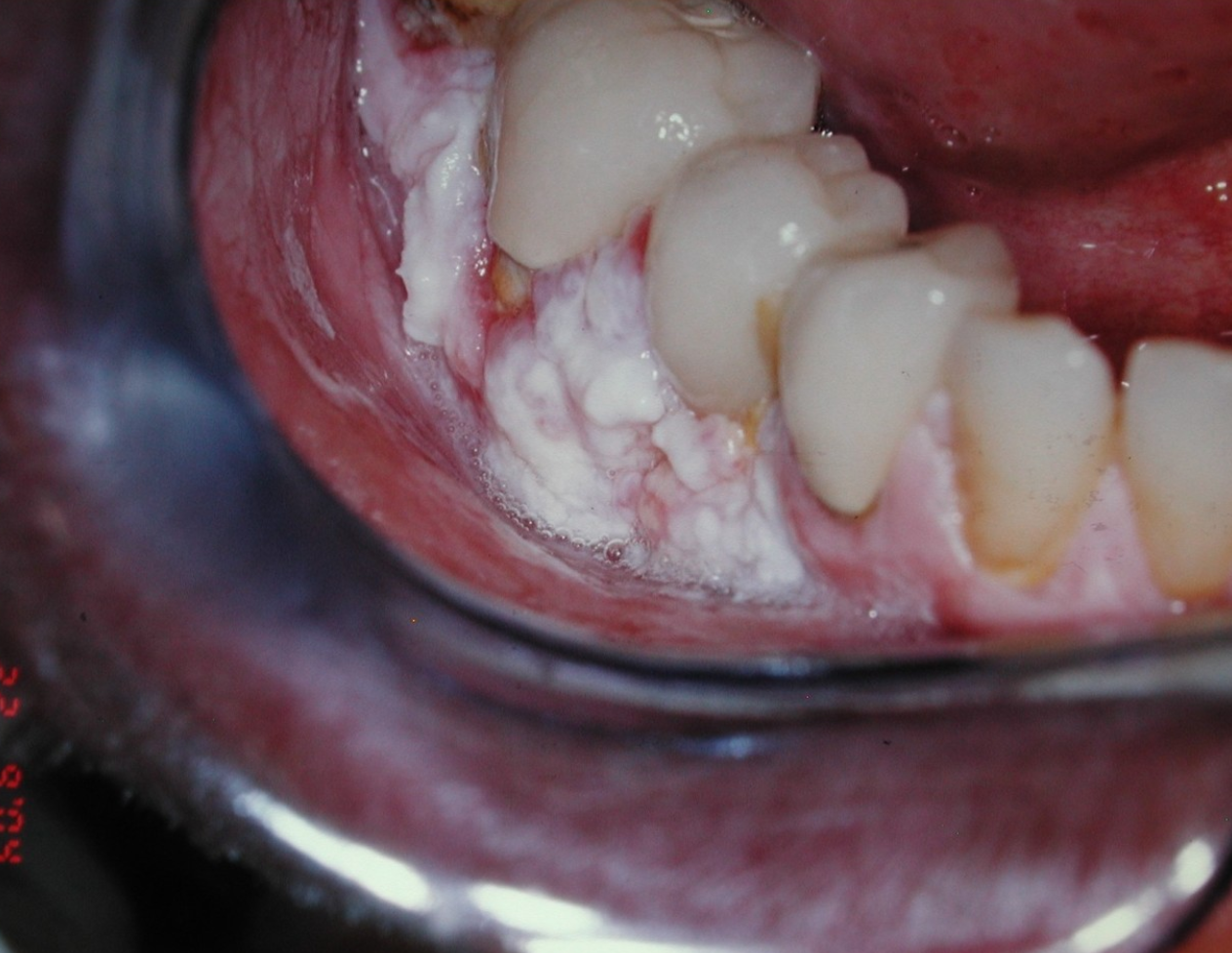
Melanocytic nevus and melanotic macule
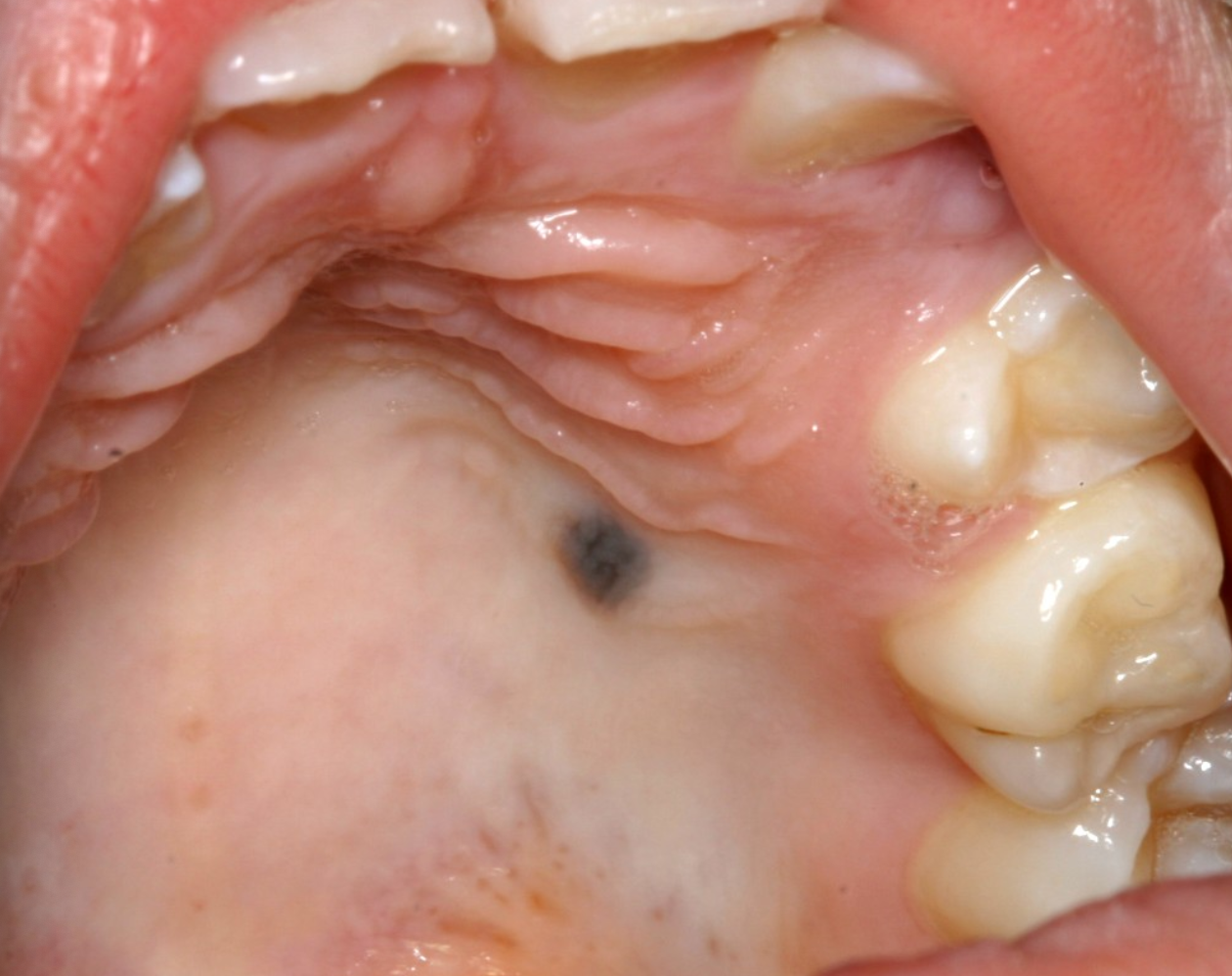
Case 9. A 45-year-old female with a small well-demarcated brown macule on the hard palate was discovered during a dental examination. 9a. What would be the differential diagnosis?
Melanocytic nevus and melanotic macule
Melanoma and amalgam tattoo
Amalgam tattoo and blue nevus
Melanoma and melanotic macule
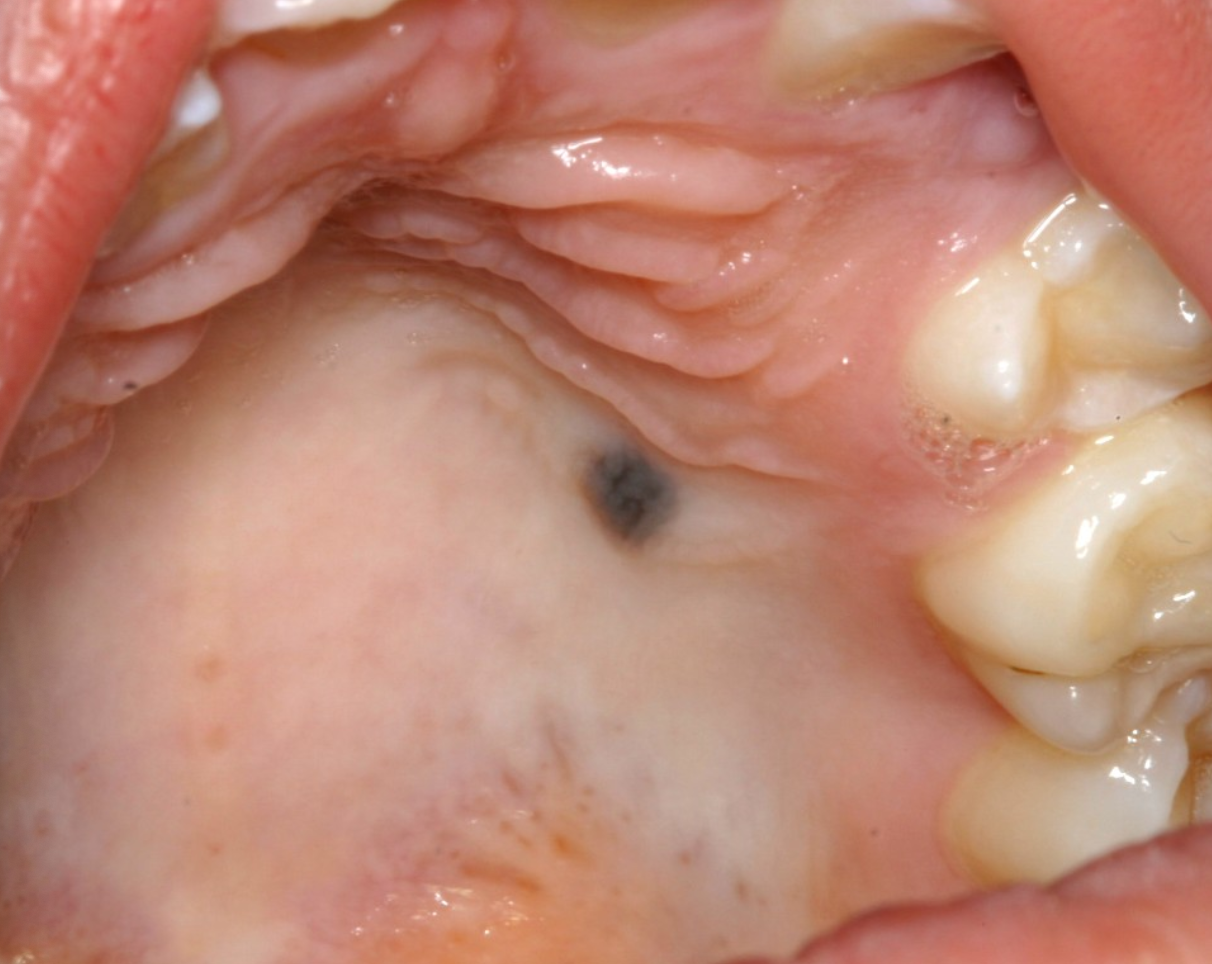
Symmetric, uniform pigmentation
9b. What would be a clinical feature of a benign brown pigmented lesion?
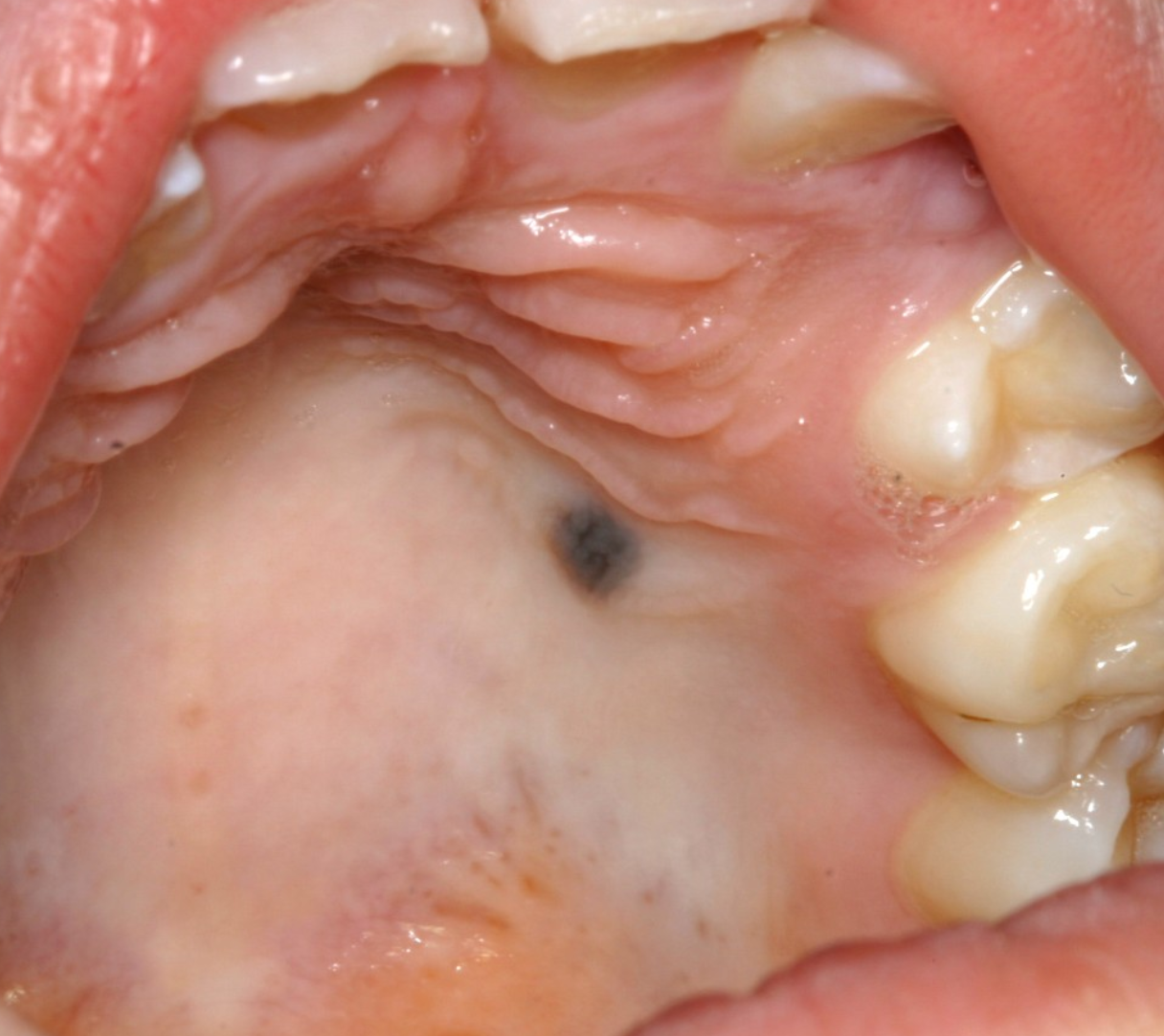
Observation
9c. What would be the management?
Melanoma
Case 10. A 62 year old male with a painful dark lesion on the maxillary gingiva that has increased in size the past few months. 10a. What is the most likely diagnosis?
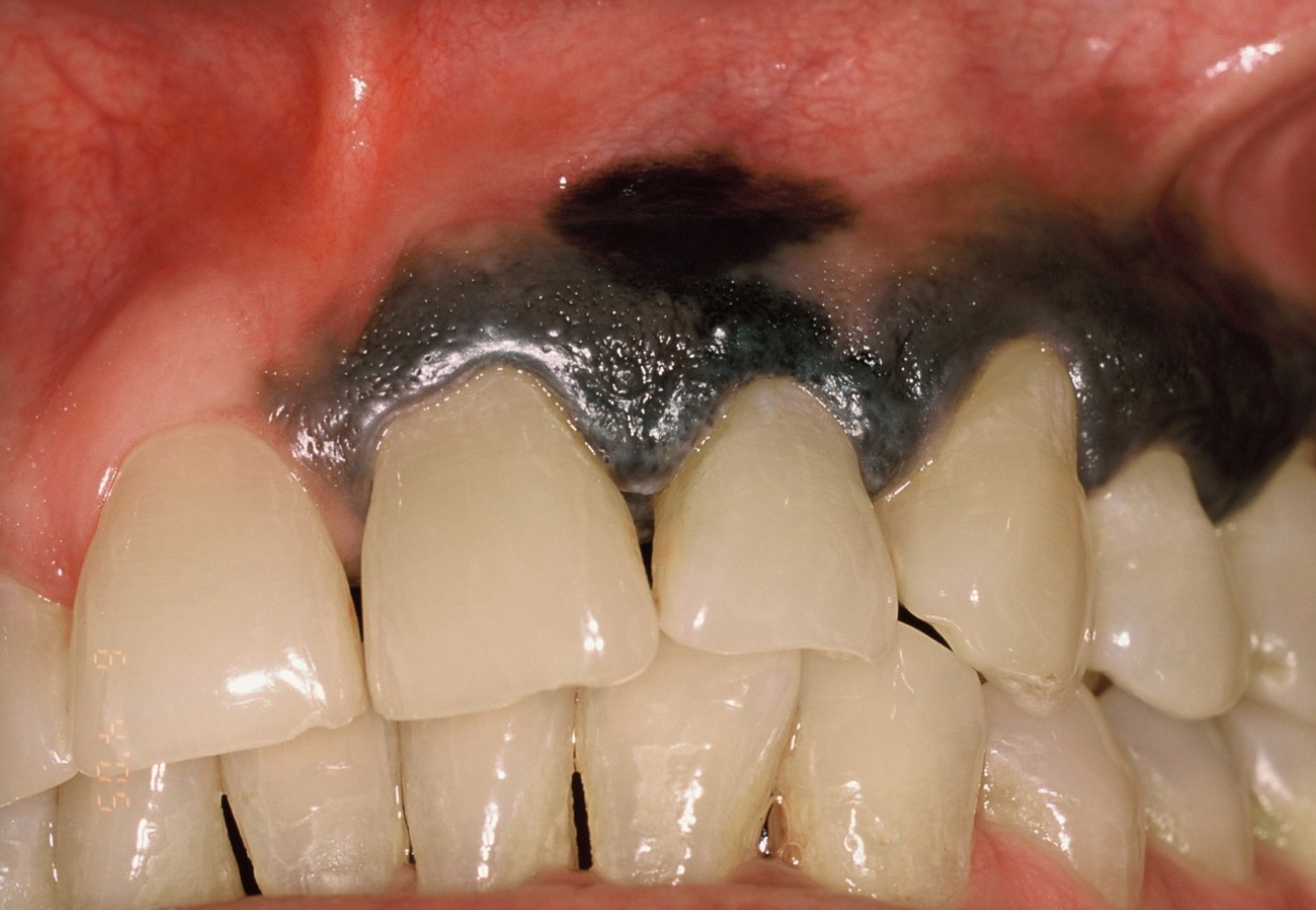
take Xray and perform incisional biopsy
10b. What is the appropriate next step after clinical examination?
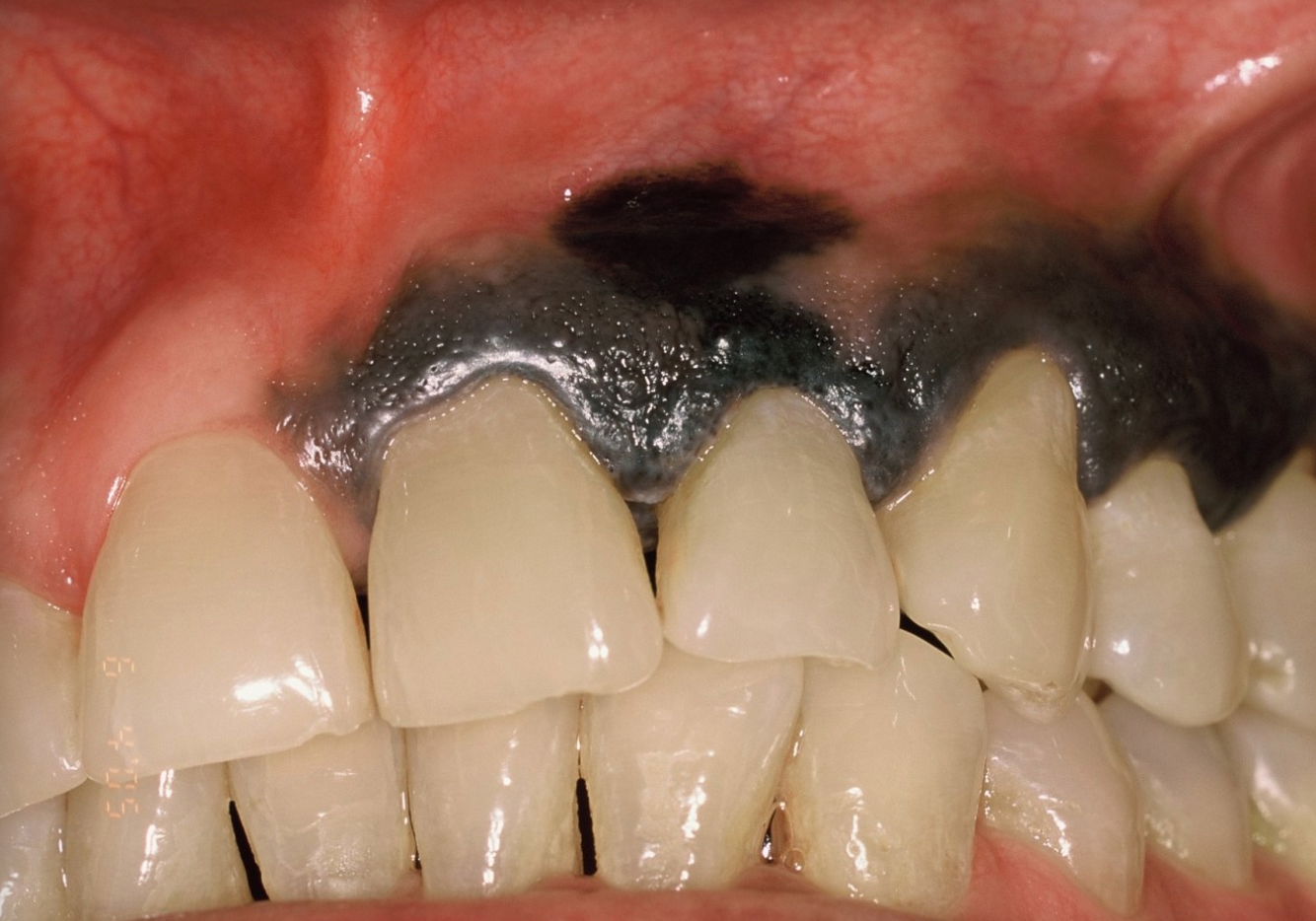
Irregular borders and variegated color
10c. Which of the following descriptions meets the ABCED criteria for this lesion?
Symmetry and well defined
Irregular borders and variegated color
Uniform color and size
Evolution remained stable
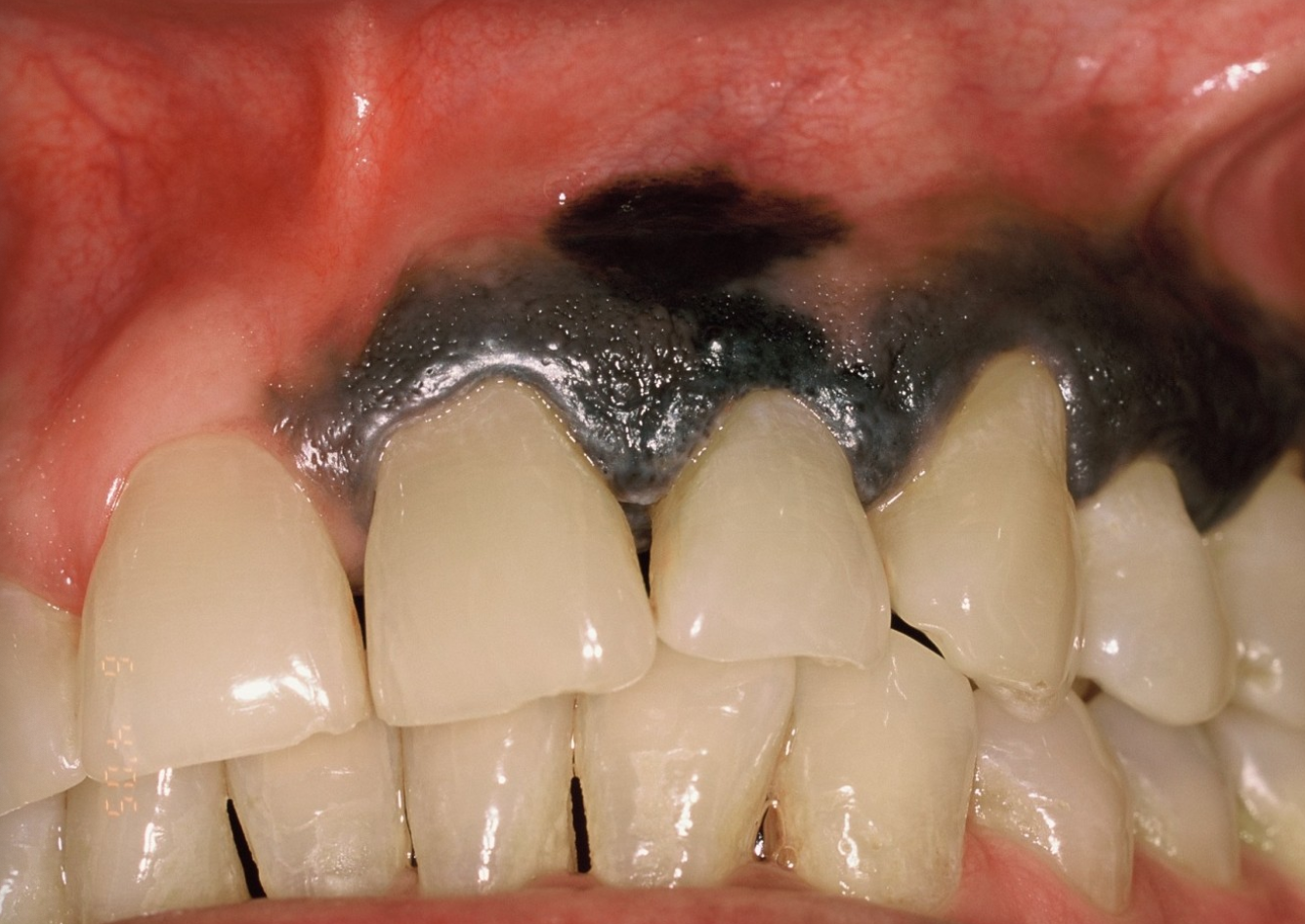
Early melanoma is often curable with excision
10d. Which of the following statements about melanoma is correct?
It only develops from moles
It is the least dangerous skin cancer
It does not occur in darker skin tones
Early melanoma is often curable with excision
Major aphthous ulcer
Case 11. A 21 year old female with a painful ulcer on soft palate that has appeared before and disappeared after 10 days. 11a. What would be the diagnosis?
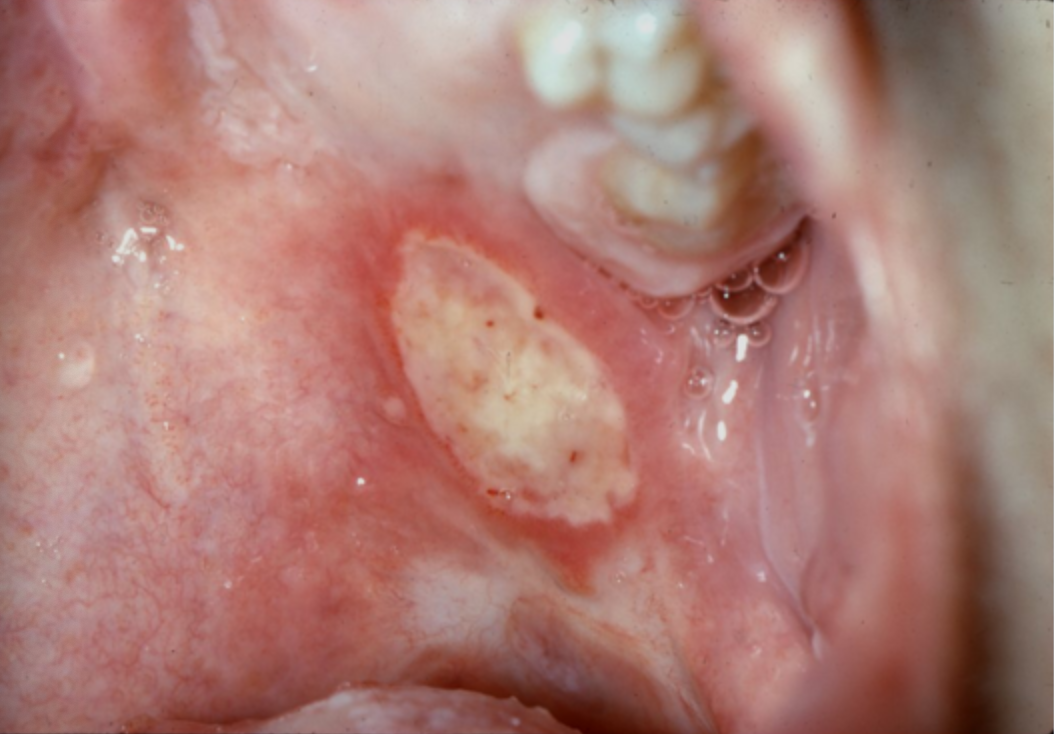
Occur on non-keratinized mucosa
11b. Which of the following is a unique clinical feature of aphthous ulcers?
Occur on keratinized mucosa
Are contagious and highly infectious
Occur on non-keratinized mucosa
Cause burning and metallic taste
Clobetasol gel
11c. What would be the appropriate medication for aphthous ulcer ?
Acyclovir
Clobetasol gel
Nystatin mouth rinse
Mycelex troches
Recurrent herpes and herpes zoster
Case 12. A 66-year-old male developed these lesions following the flu. 12a. What is the most likely differential diagnosis?
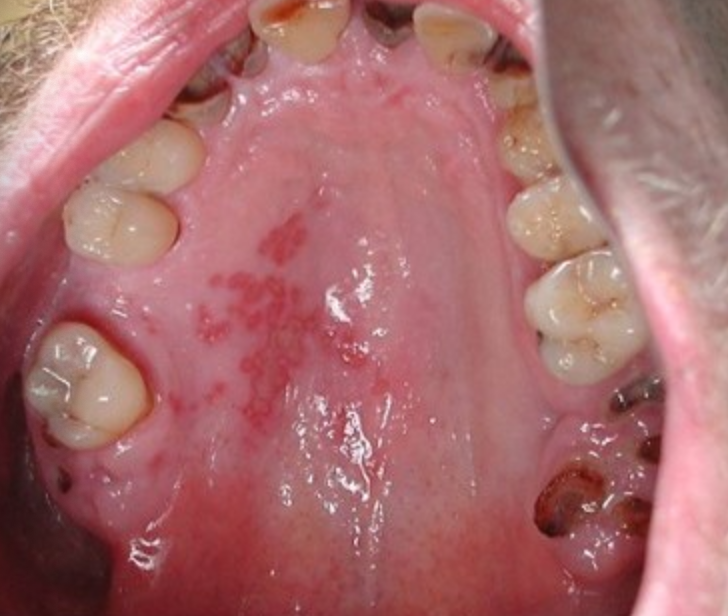
shingles dermatomal distribution with lesions not crossing the midline
12b. Which of the following features best differentiates shingles (herpes zoster) from recurrent herpes simplex infection?
Varicella-zoster virus
12c. What is the cause of shingles?
Epstein–Barr virus (HHV-4)
12d. What type of virus is varicella-zoster virus (VZV)?
Ramsay Hunt syndrome
12e. Which rare type of shingles affects the facial nerve causing facial paralysis?
In the ear canal and on the ear
12f. Where do the vesicles typically appear in Ramsay Hunt syndrome?
Begin steroids and antivirals within 72 hours
12g. What is an important management step for Ramsay Hunt syndrome?
nicotine stomatitis
Case 13. A 57-year-old male presents for a routine dental checkup. Patient smokes a pipe. 13a. What is the MOST likely diagnosis based on the clinical presentation?
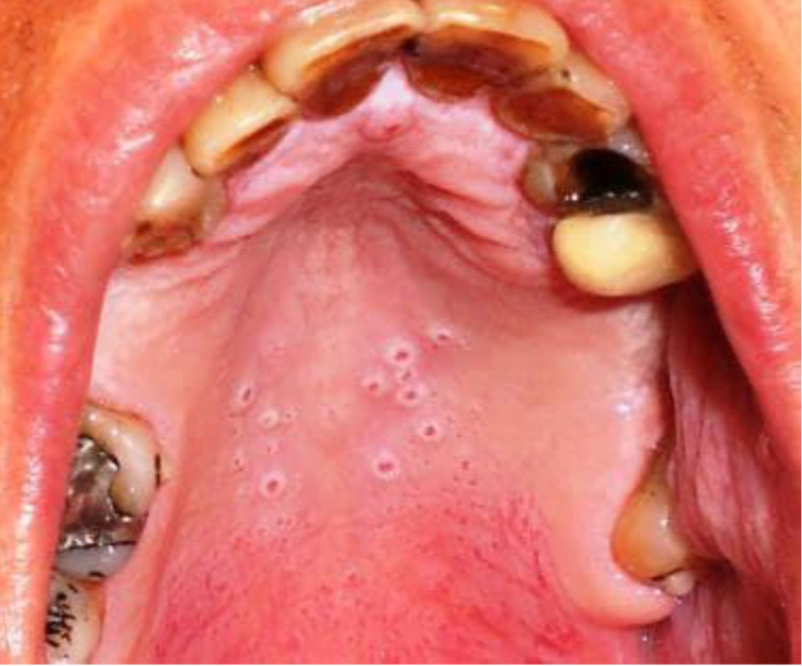
chronic heat irritation from smoking
13b. What is the primary etiologic factor responsible for this condition?
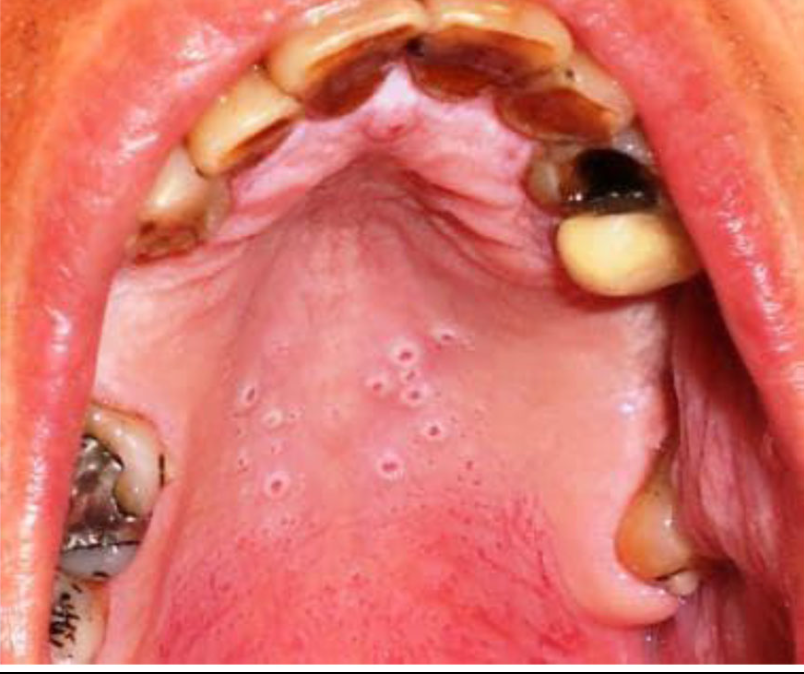
lesion is benign
13c. The patient is concerned about the possibility of cancer because he has been smoking a pipe for the past 20 years. Which of the following is TRUE about the lesion?
lesion is curable cancer
lesion is premalignant
lesion is dyplastic
lesion is benign
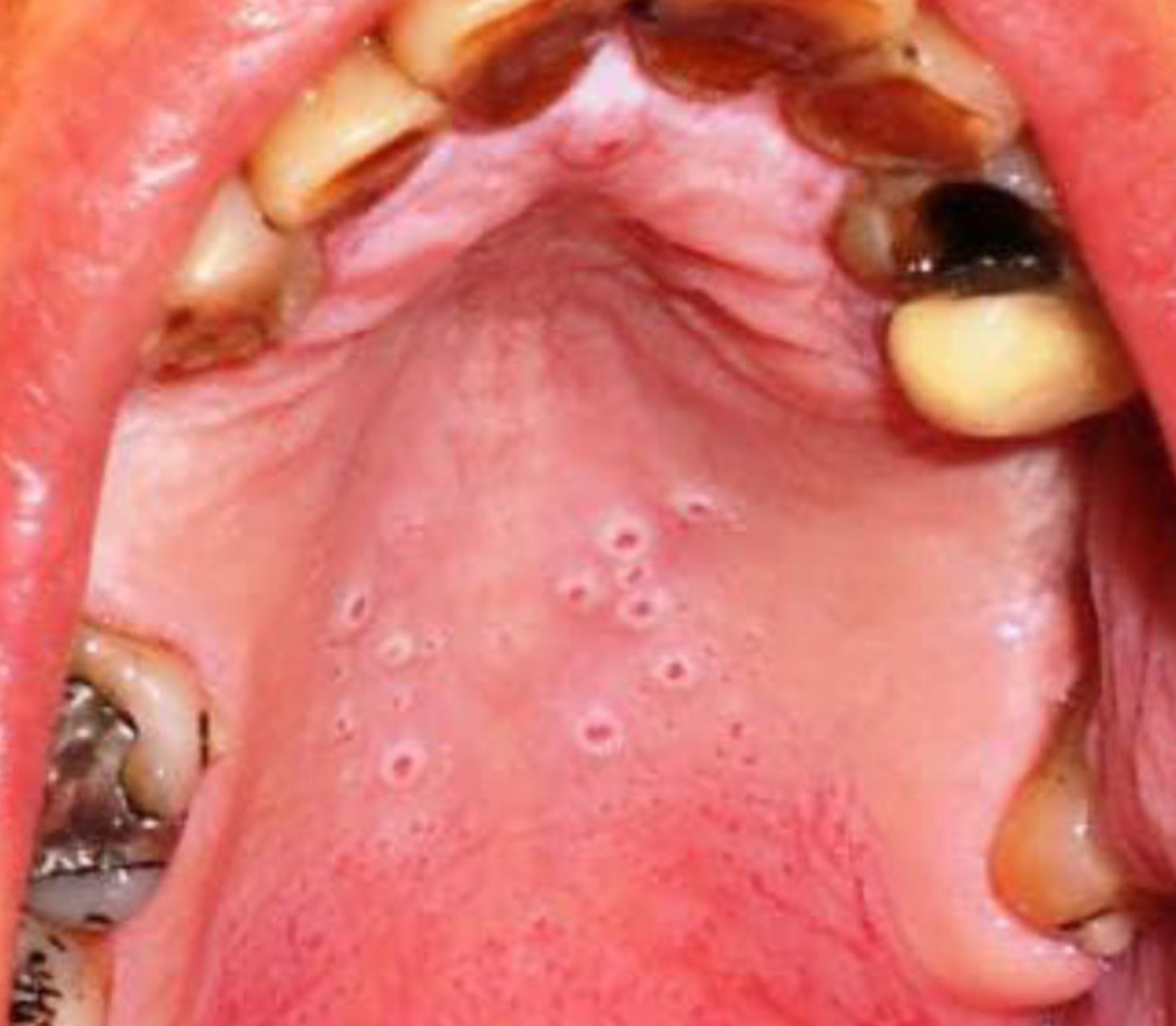
advise smoking cessation and monitor
13d. What is the most appropriate management for this patient?
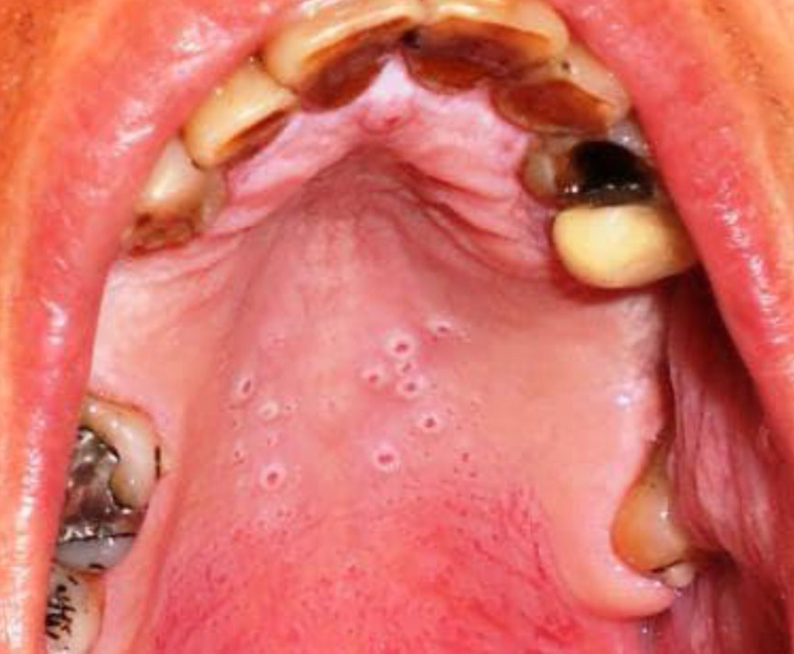
epithelial dysplasia
The biopsy results reveal abnormal epithelial cells. What is the BEST term to describe the findings?
epthelial atypia
squamous cell carcinoma
eputhelial dysplasia
verrrucous carcinoma
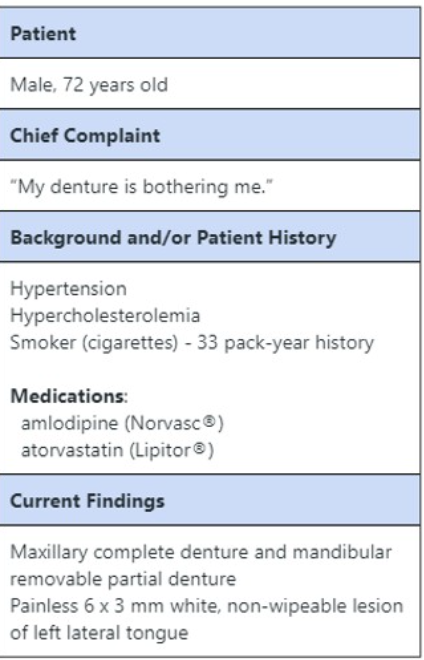
prescribe antifungal therapy
Which is the most appropriate management?
rinse with water after inhaler
stop use of inhaler
change to different inhaler
prescribe antifungal therapy
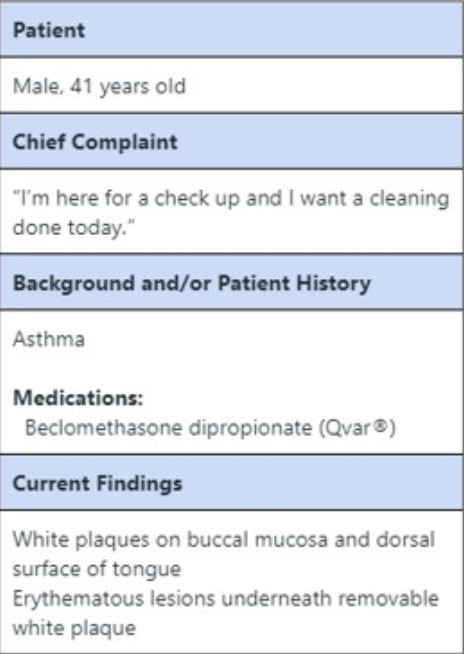
drug induced
What is the most likely the etiology of the discoloration
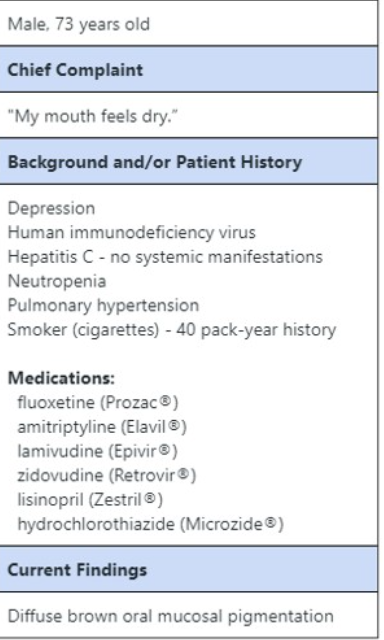
ectodermal dysplasia
Which of the following diagnosis is most likely?
congenital syphilis
regionalodontodysplasia
ectodermal dysplasia
cleidocranial dysplasia
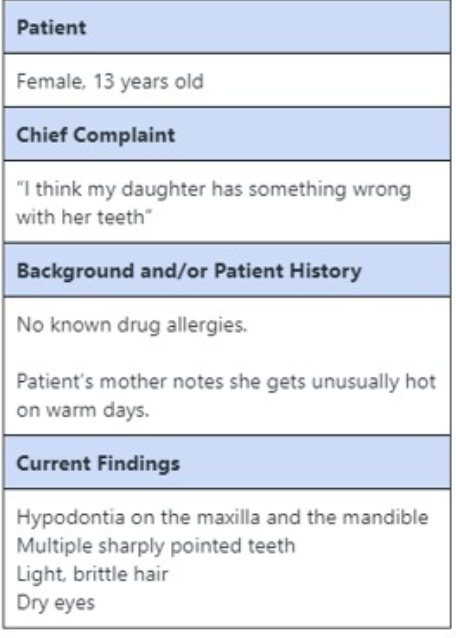
adjacent to ulcer
Which of the following is the BEST area for biopsy?
mucosa on right
adjacent to ulcer
no biopsy
within the biopsy
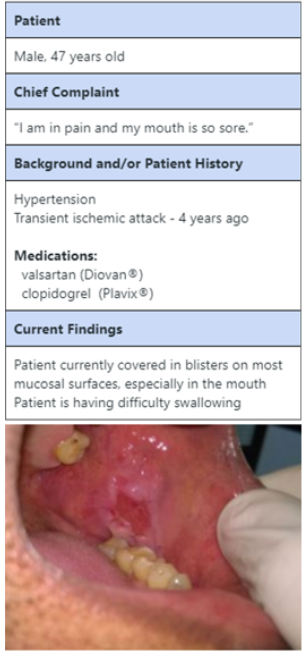
erethema multiforme
what is the most likely diagnosis?
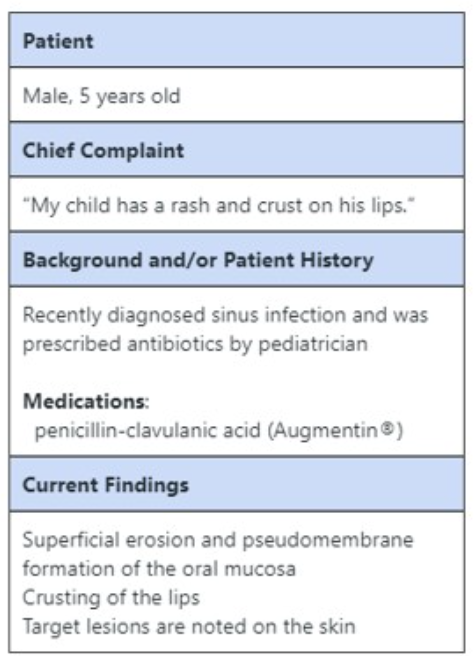
herpes simplex 1 (not varicella due to age?)
What is the most likely causative agent?
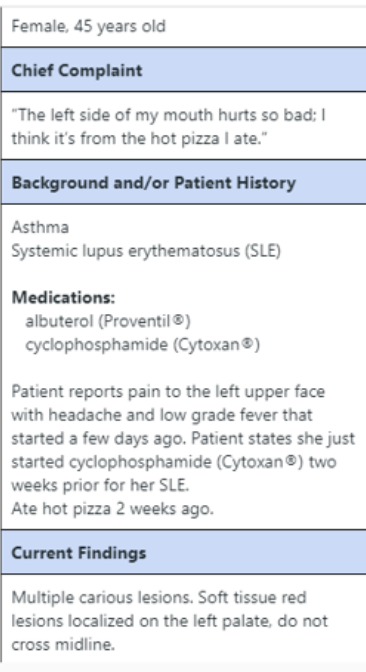
location on lateral tongue
What presentation of the lesion worsens the diagnosis?
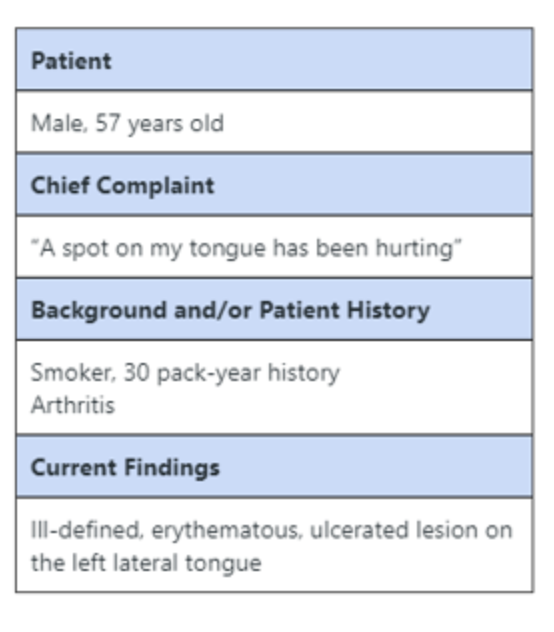
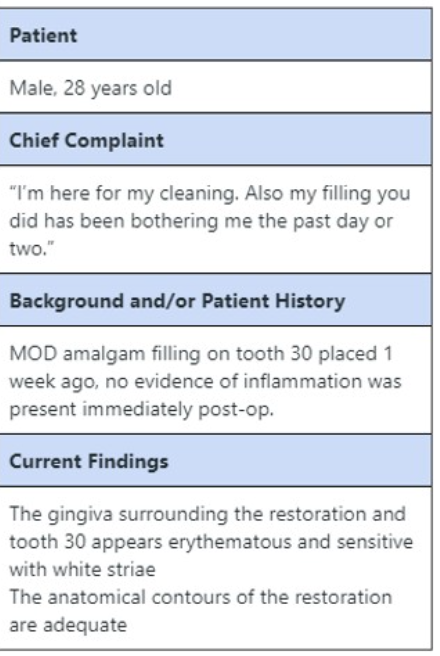
remove amalgam restoration
What is the most appropriate next step?
pseudomembranous candidiasis
All of the following are in the differential diagnosis EXCEPT:
pseudomembranous candidiasis
graft v host
reticular lichen planus
idiopathic leukoplalkia
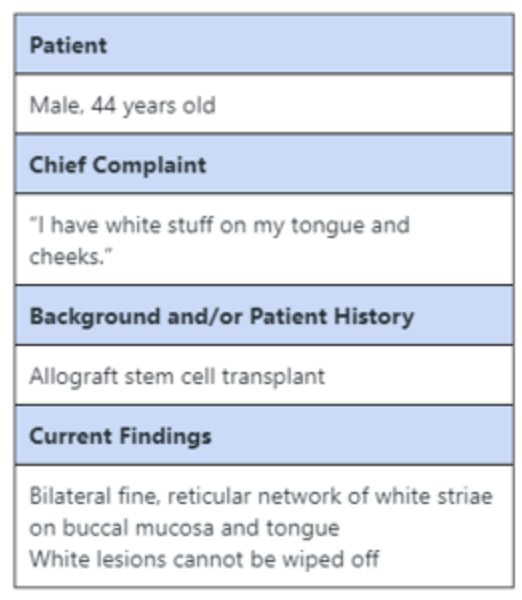
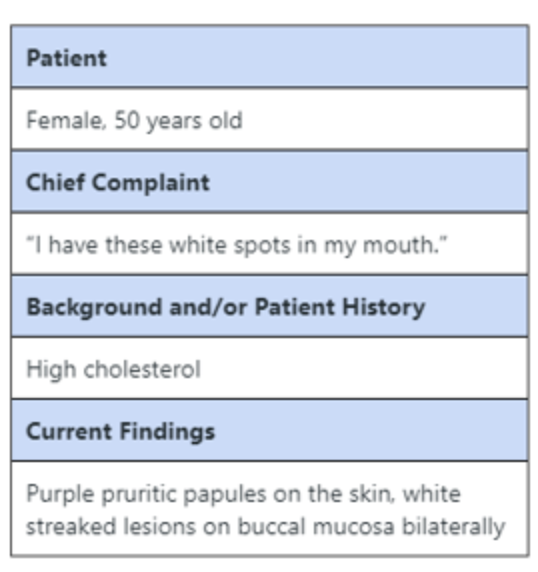
lichen planus
what is the most likely diagnosis?
nikolsky sign
Which of the following signs is demonstrated in this patent's physical exam findings?
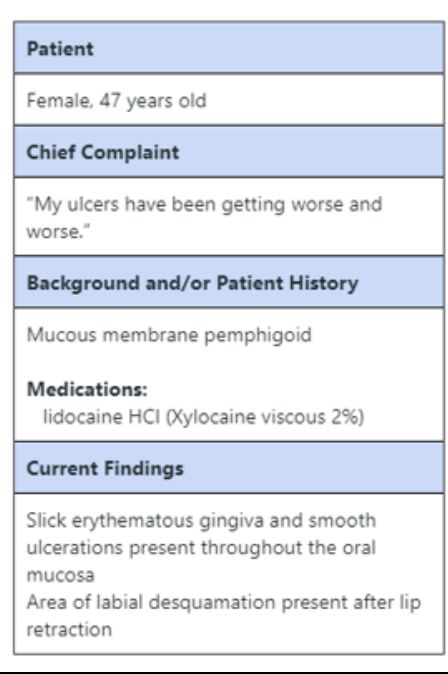
prophy jet with abrasive paste
Which of the following is NOT appropriate management?
prophy jet with abrasive paste
cavitron
manual curretage
alcohol-free rinse
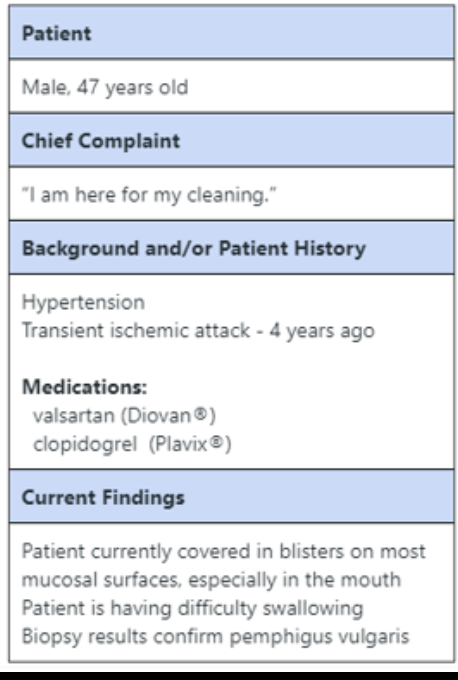
attached gingiva
Where is the most likely location of the lesions?
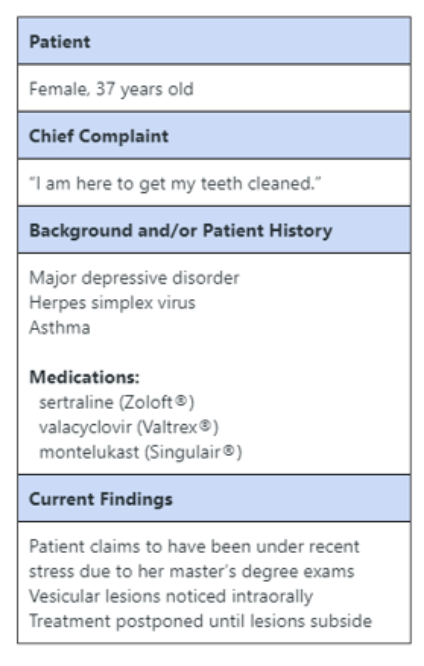
epstein barr virus (oral hairy leukoplakia)
What is the causative agent?
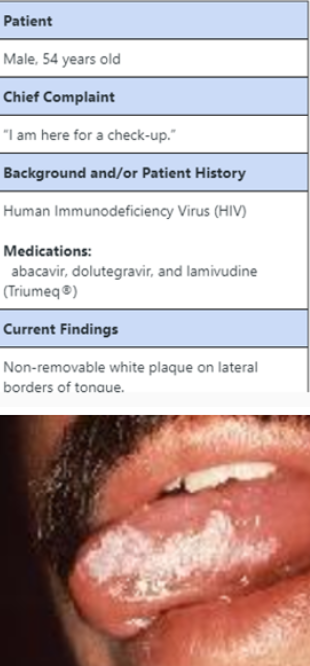
mild dysplasia
atypical cells that are confined to the bottom 1/3 of epithelial thickness
geographic tongue
diagnosis of this lesion that keeps changing location
surgical removal
how would you manage carcinoma in situ
cheewing tobacco
which of the following agents does NOT cause lichenoid mucositis
toothpaste
medication
cinammon
chewing tobacco
lisinopril
all of the following could be prescribed for autoimmune disease EXCEPT
dexamethasone
clobetosol
lisinopril
prednisone
biopsy
what is the management if there is a focal area that looks different
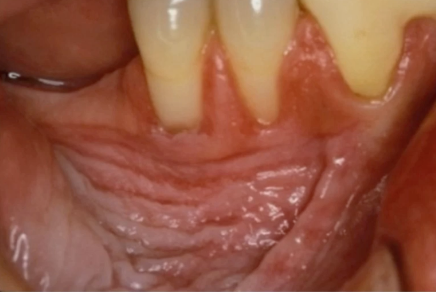
due to ectopic salivary glands
which of the following is FALSE regarding this lesion:
asymptomatic
due to ectopic salivary glands
no management
can occur on the lip
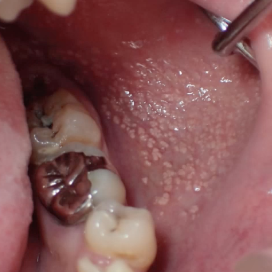
lymphoid hyperplasia
which of the following is NOT in the differential diagnosis of a yellow lesion
lymphoepithelial cyst
lymphoid hyperplasia
lipoma
sialolith
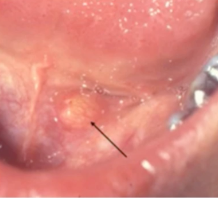
E, O, A, S
arrange the lesions from high to low risk for malignant transformation:
(O) oral submucous fibrosis, (E) erythroplakia, (A) actinic cheilosis, (S) smooth leukoplakia
herpetiform apthous ulcer
what is the diagnosis of this lesion that occurs of MOVABLE mucosa
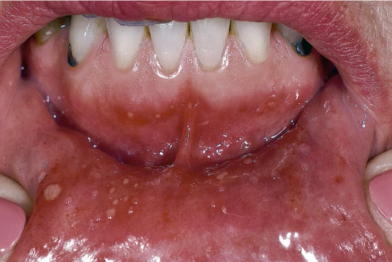
incisional biopsy
what is the management of this lesion
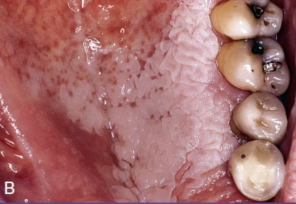
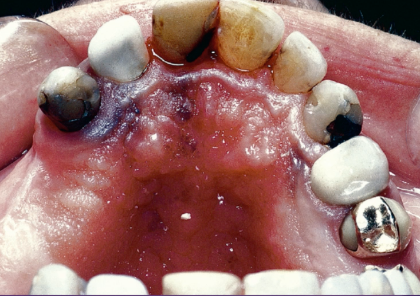
melanoma
what is the most likely diagnosis
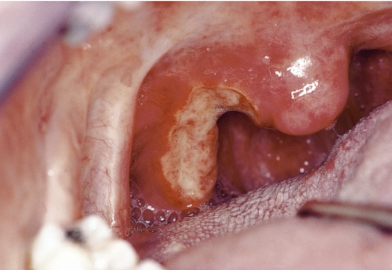
mucous membrane pemphigoid
separation of the epithelium from underlying mucosa is most characteristic of which diagnosis
malignancy
the lesion has been present for 3 weeks, what is the concern with this lesion
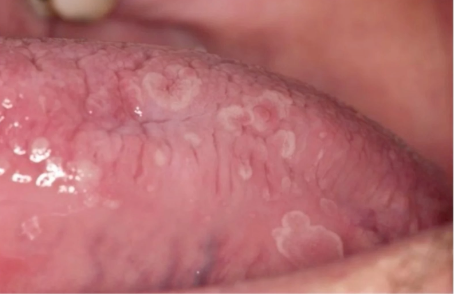
geographic tongue
what is the diagnosis
see if lesion wipes off
what is the first step you would take to reach a diagnosis of this lesion
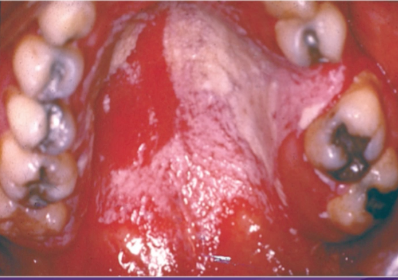
observe/follow up
patient is asymptomatic, what is the management?
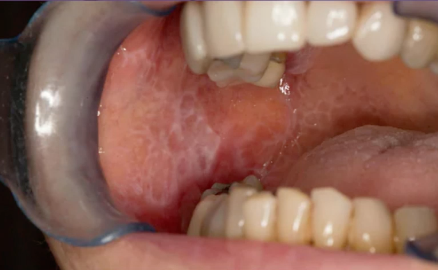
HSV 1
what is the cause of this lesion
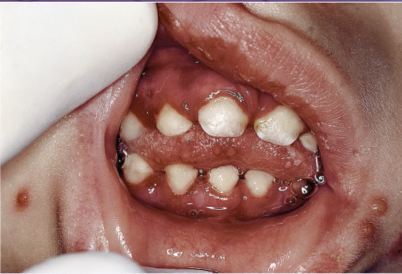
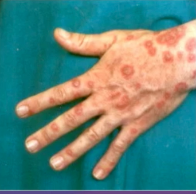
targetoid
what is the description of this skin lesion