PES
 Call Kai
 Learn
Learn Practice Test
 Spaced Repetition
 Match
Match Flashcards
 Knowt Play
1/107

There's no tags or description
Looks like no tags are added yet.
Name | Mastery | Learn | Test | Matching | Spaced | Call with Kai |
|---|
No analytics yet
Send a link to your students to track their progress
108 Terms
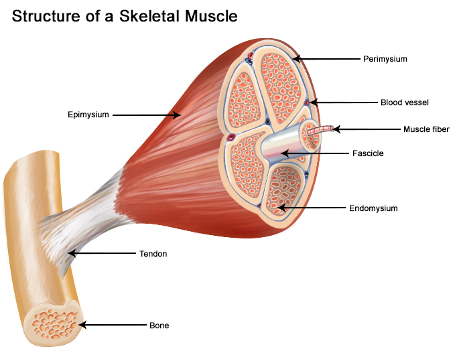
what is the structure of a skeletal muscle
1. epimysium
2. muscle belly
3. perimysium
4. fascicle
5. endomysium
6. muscle fibre
7. myofibril
8. sarcomere
9. myofilaments
epimysium
Connective tissue that surrounds the muscle belly, holding all components together. Made up of connective tissue
Muscle Belly
Fattest part of the muscle. Made up of lots of fasciles.
Perimysium
Connective tissue surrounding individual fascicles. Made up of connective tissue
Fascicle
A bundle of muscle fibres banded together. Made up of lots of muscle fibres
Endomysium
Connective tissue surrounds individual muscle fibre. Made up of connective tissue
Muscle Fibre
The cell of the muscle, determines nerve connection and type of fibre. Made up of lots of myofilaments
Myofibril
Long filaments that run parallel to each other that form muscle fibres that contain the myofilaments. Made up of lots of sarcomeres and myofilaments
Sarcomere
Run along the myofibril, contractile unit of the muscle. Made up of lots of Myofilaments
Myofilaments
Protein filaments. Made up of Myosin and Actin.
diagram of skeletal muscle
Structure of sarcomere
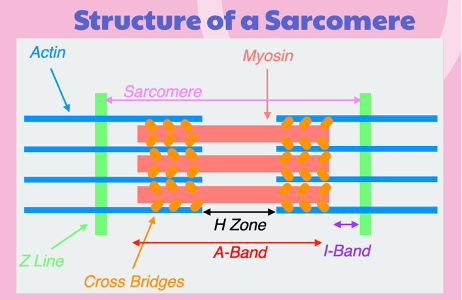
sarcomere
Functional unit of the muscle fibre, space between two z-lines
myosin
Thick protein filament, that HAS cross-bridges
cross bridges
Stick out from Myosin, play large part in contraction
actin
Thin protein filament, attached to z-lines
z line
Membrane found at either end of the sarcomeres
h zone
Space between actin filaments, includes myosin only.
I Band
Gap between the end of a myosin and the z-line, actin only
A Band
Length of myosin filament, sometimes includes both actin and myosin
Concentric
Occurs when the muscle shortens while contracting. Bicep Curl (up)
Eccentric
Occurs when the muscle lengthens while still creating a force (contracting). Bicep Curl (down)
Isometric
Occurs when the muscle length remains unchanged while contracting. Plank
Sliding Filament Theory
1.Motor Neuron
2.Calcium
3.Binding Sites
4.Cross Bridge
5.ATP
6.Power Stroke
7.Slide
8.Detachment
motor neuron
motor neuron receives signal from CNS, stimulates muscle fibre with impulse.
calcium
this impulse causes calcium to be released into the sarcomere.
binding Sites
presence of calcium causes actin to change shape to reveal binding sites for myosin
Cross Bridge
myosin attaches to actin filaments creating a cross-bridge.
ATP
breakdown of ATP releases energy which stimulates the cross-bridge.
Power Stroke
myosin performs a power stroke (oscillates)
slide
actin slides over myosin, causing sarcomere to shorten.
detachment
ATP releases energy causing myosin to detach from actin and cross-bridge is broken. Calcium leaves the sarcomere preventing further cross-bridges forming.
sarcomere in contractions
concentric: shortens
eccentric: lengthens
Myosinin in contractions
concentric: stays the same
eccentric: stays the same
cross bridges in contractions
concentric: oscillate
eccentric: oscilliate
actin in contractions
concentric: Stays the Same
eccentric: Stays the Same
Z-Line in contractions
concentric: Come closer together
eccentric: Move further apart
H Zone
concentric: Gets smaller, may disappear
eccentric: Gets larger
I Band
concentric: Gets smaller, may disappear
eccentric: Gets larger
a band
concentric: same length (more actin)
eccentric: Same Length (less actin)
myosin in SFT
role of myosin is to attach to actin (to create a cross-bridge). Myosin pulls on the actin filaments during muscle contraction.
actin in SFT
changes shape with presence of calcium to reveal BINDING SITES which creates a structure for cross-bridges to attach to. Also ATTACHED to Z-lines which means sarcomere shortens during contraction.
sarcomere in SFT
functional unit of the muscle fibre, runs along the myofibril and contains actin and myosin proteins to allow contraction.
calcium ions
bind to actin which causes them to change shape revealing binding sites. Allows myosin heads to attach to actin.
force velocity relationship
relationship between the velocity of muscle contraction to the amount of force exerted by the contraction
concentric muscle contraction
•Maximum force is achieved at MINIMUM velocity
•The force a muscle can create decreases with the increasing velocity
•We can alter the force we produce by changing the velocity of contraction
•So if we want to lift something very heavy (concentric way) we need to contract muscles slowly to allow maximum number of cross-bridges
Force-Length Relationship
4.relationship between the length of muscle to the potential amount of force it can exert
force-length (shortened, mid-length, lengthened)
The Key Rule for force length relationship
More Crossbridges = More Force Produced
Shortened
•Less cross-bridges due to actin covering each others binding sites
•Large overlap of Actin/Myosin
•Means less force is produced
Mid-Length
•Maximum number of cross-bridges can be produced at mid-length
•This means that force output is maximal
Lengthened
•Less cross-bridges due to cross-bridges being unable to reach actin due to stretching
•Less overlap of Actin/Myosin
Means less force is produced
1.Brain (CNS)
•Initiates voluntary AND involuntary contractions.
•In a contraction:
1.Receives information from sensory neurons
2.Interprets this information and makes decision based on inputs
3.Transmits signal via spinal cord/motor neurons
2.Spinal Cord (CNS)
•Relays information from the body to the brain, and the brain to the body
•Also involved in reflexes
•In a contraction:
1.Receives information from the brain
2.Transmits electrical signals to the motor neuron
Nerves (PNS)
•Motor and Sensory Neurons transmit signals to and from the CNS
Sensory Neurons
•Get signals from all of our sensory receptors
•Sends this information to the brain for processing
•In a contraction:
1.Receives signal from sensor to initiate contraction (ears - hearing starter signal)
2.Sends this information to the brain
Motor Neurons
•"The unit of components responsible for transmitting messages from the CNS to the muscles."
•Receives electrical signal from the spinal cord/brain and transmits this signal to the muscle fibre to innervate
•In a contraction:
1.Receives signal from spinal cord/brain and sends to muscle fibres
2.This occurs at Neuromuscular Junction (NMJ) also known as Motor End Plate
cell body
•Directs activity of the neuron
•Gets information from the dendrite, then sends down the axon
axon
•Transmits information AWAY from cell body to the muscle fibre via NMJ
dendrite
•Receives signal from CNS
•Sends this information to the cell body
myelin sheath
•Surrounds an Axon
•Improves conductivity
NMJ
•Point of "attachment" between motor neuron and muscle fibre
•May initiate multiple muscle fibres so may be lots of these
motor unit
the motor neuron plus all the muscle fibres that it innervates.
•Motor Units may be quite large - so one unit innervates LOTS of muscle fibres
•They may also be small, so one motor neuron only innervates a few or one muscle fibre
•Size depends on function of the muscle
all or none law
"If an electrical stimulus reaches a THRESHOLD level, then ALL of the muscle fibres associated with that unit will contract to their MAXIMUM level at the SAME TIME"
Controlling the Force of a Contraction
•When we decide to lift something, your body will already have made a prediction on the type of fibres needed, number of motor units and size of motor units needed.
•However, if we need to increase force of contraction, we can ONLY do this by:
1.Increasing the number of motor units recruited
2.Increase size of motor units recruited - larger motor units (and therefore more fibres)
3.Increase the strength of nerve signal
4.Increase the frequency of nerve signal
5.Recruiting the correct muscle fibre type (we will talk about this later)
In a muscle contraction
1.Sensory Neuron: transmits information from the senses (eyes) to the brain
2.Brain: Processes information from the senses, makes a decision and sends this information down the spinal cord
3.Spinal Cord: transmits this information from the brain to the relevant motor neuron(s)
4.Motor Neuron: receives this information from the CNS, transmits to the muscle fibres associated with the neuron.
5.Motor Unit: made up of the motor neuron and the muscle fibres it innervates, carries out the muscle contraction based on the signal from CNS.
fibre recruitment
•Preferential recruitment: the body's recruitment of muscle fibres depending on the demands of the muscle contraction
•Your body will first recruit smaller motor units, as these have a lower threshold of activation
•This obviously generates less tension
•If more tension or force is required, then progressively larger motor units are activated
•The TYPE of muscle fibre also comes into play, but we will talk about this later
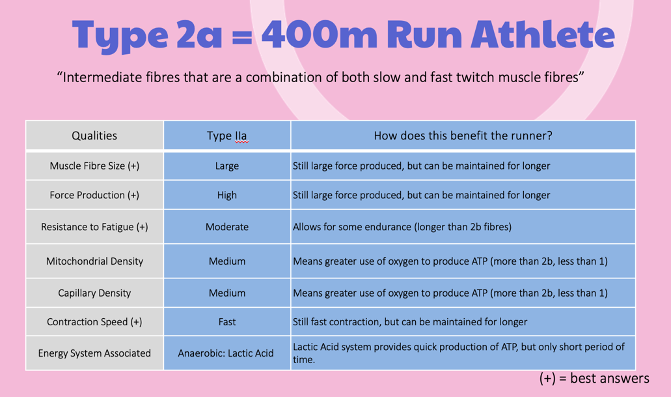
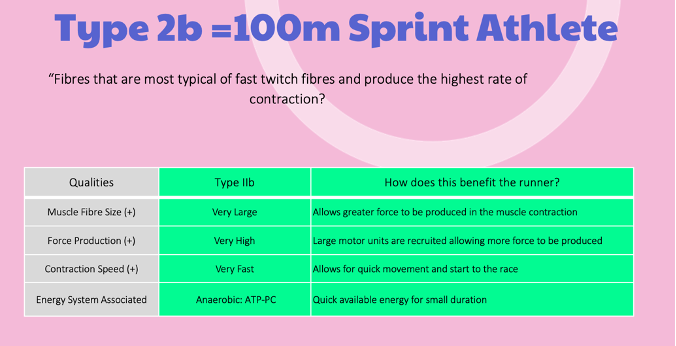
fibre table
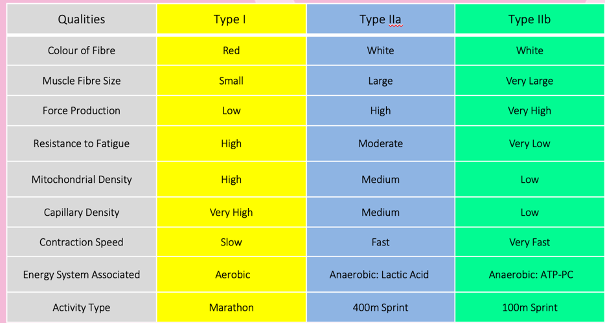
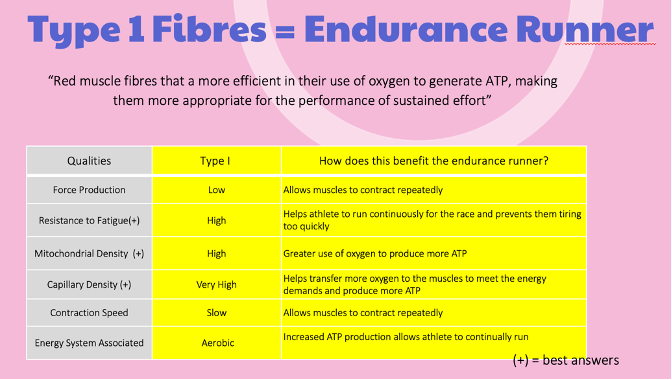
type 1 fibres
type 2a
type 2b
linear momentum
Linear Momentum: defined as the product of an object's mass multiplied by it's velocity. P=m.v
P=linear momentum
m=mass
v= velocity
we can increase our momentum by increasing:
• Mass
• Velocity
• Both
This is the Fly Half; their job is to run with the ball and get it down the field (they need to DODGE and run QUICKLY)
impulse
Impulse is a mechanical variable we use to talk about PRODUCTION of movement and to STOP movement.
the change in momentum
∆𝑝=F.t
∆𝑝=impulse
F = Force
t = time
Both the magnitude (force) and the duration of the force (time) determine the effect of an object's motion.
• The application of force over time will change the momentum of an object.
impulse force production
When we are applying the force, if we apply the force for a longer period of time, we get a larger impulse! Shot Put without the spin, we have reduced time, so we have less impulse (and therefore less change in momentum)
Shot Put with the spin, we have increased time that we apply the force, meaning we have a larger force and impulse. When we are trying to produce maximal force, we often want to increase both the magnitude and duration of the force.
Magnitude:
• We will try to maximise force using other biomechanical
principles
• For example, we might try to increase number of segments used
Duration
• The biggest change we can make is to the time we produce the
force. We could do this by run-up or swing or follow through.
Time Based Example:
• HOWEVER, we can't always
increase the time to apply the
force
• Especially if we are in a time-
based event
• If a swimmer maximised the time
they apply force to the blocks
they will not win the race
impulse force absorption
When we are absorbing a force we CANNOT reduce the amount of
force/impulse experienced, we can only increase the time we absorb the
force with and therefore decreased PEAK FORCE. Catching a ball with no give, decreased time
you experience force so PEAK FORCE
is high.
Catching a ball with give, increased time you experience force so PEAK FORCE is decreased.
Area under the curve is the SAME
Coefficient Of Restitution
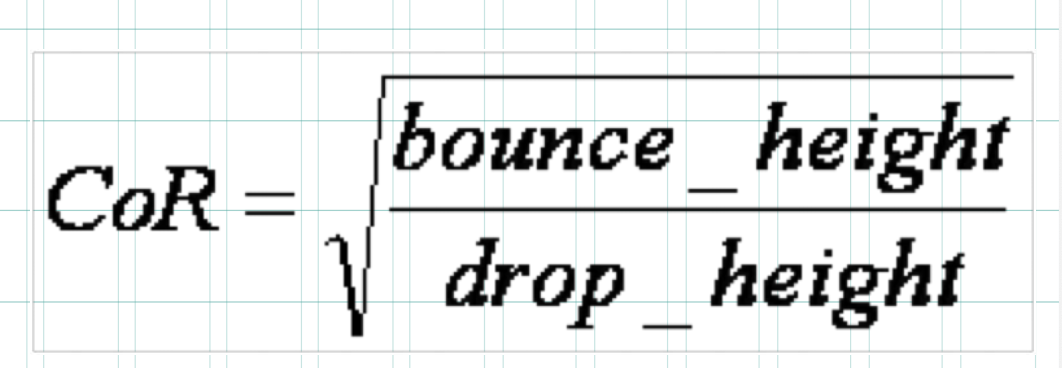
CoR = A value representing the ratio of the velocity after
an impact compared with the velocity before an impact.
CoR is a value representing the bounciness of an object
• When an object bounces against a surface, that object
changes shape – this causes a loss of energy. The more it
changes shape the more energy is lost.
• As it is a square root, it is ALWAYS a value between 0-1
perfectly elastic collision
This is when the CoR = 1
• All energy that existed remains after the bounce
• All linear momentum is conserved
Partially Inelastic Collision
Partially Inelastic Collision
• This is when the CoR is <1 and >0
• Some energy is lost to the bounce
• Most collisions are in this category
• Energy is lost due to change of shape,
heat and sound
Perfectly Inelastic Collision
Perfectly Inelastic Collision
• This is when the CoR is 0
• No energy remains after the
bounce
There are three factors that influence the value
of the CoR:
There are three factors that influence the value
of the CoR:
1. Equipment and Surfaces (materials)
2. Velocity of the Collision
3. Temperature of Materials Involved
CoR- Equipment and Surfaces
• Newer materials will often have higher CoR than older
• More elastic materials will have higher CoR
• Often the CoR at competitions is regulated
CoR-Velocity
Higher velocities will REDUCE the CoR due to greater
compression and therefore greater change of shape
• This is velocity of ball AND the implement that may be
used to hit the ball
CoR-Temperature
• As temperature increases, so does the CoR
• Often as an object heats up it becomes more bouncy
Moment of Inertia
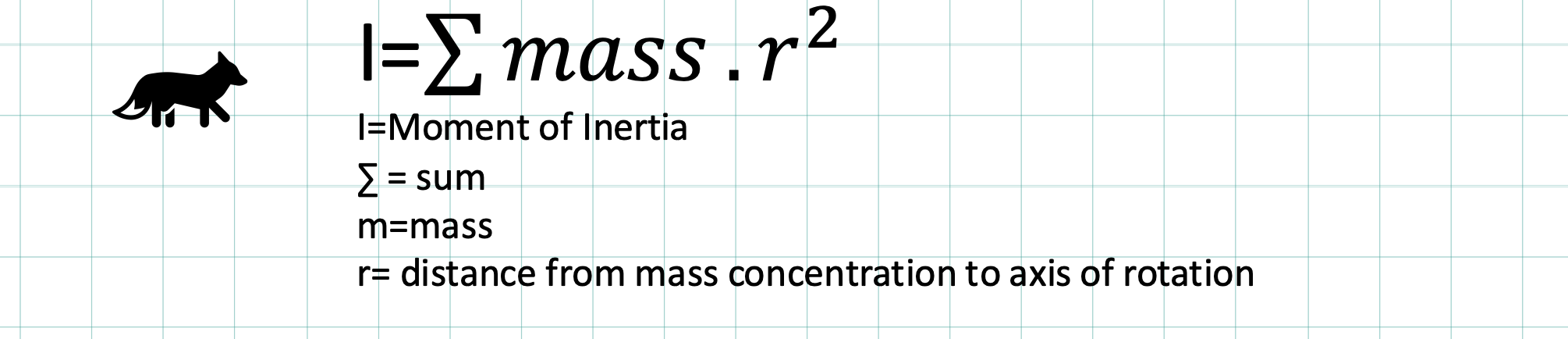
A body’s tendency to resist angular motion. MoI is the angular equivalent of mass
• If an object has lower MoI it will be EASIER to rotate
• If an object has a higher MoI it will be HARDER to rotate
• Most of the time the actual mass is constant, so it is the
r value that we manipulate.
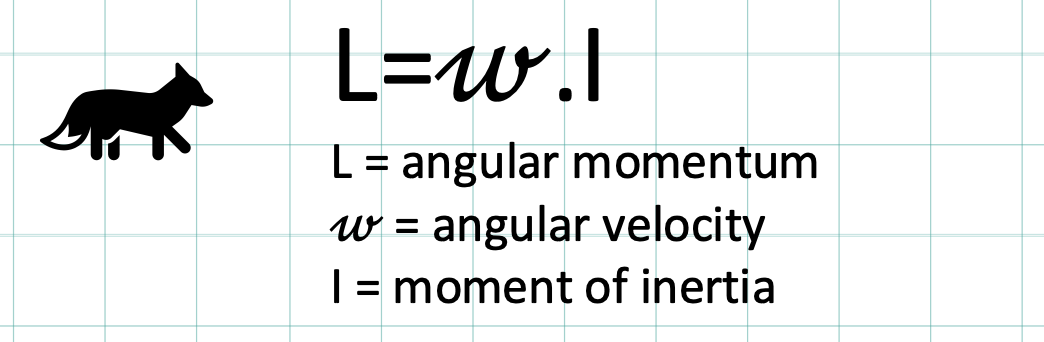
Angular Momentum
the quantity of rotation of a body.
Angular Velocity and Moment of Inertia are INVERSELY
PROPORTIONAL
• When we leave the ground, angular momentum is
constant unless acted upon by an external force
• Angular Velocity = the rate of change of angular position
of a rotating body
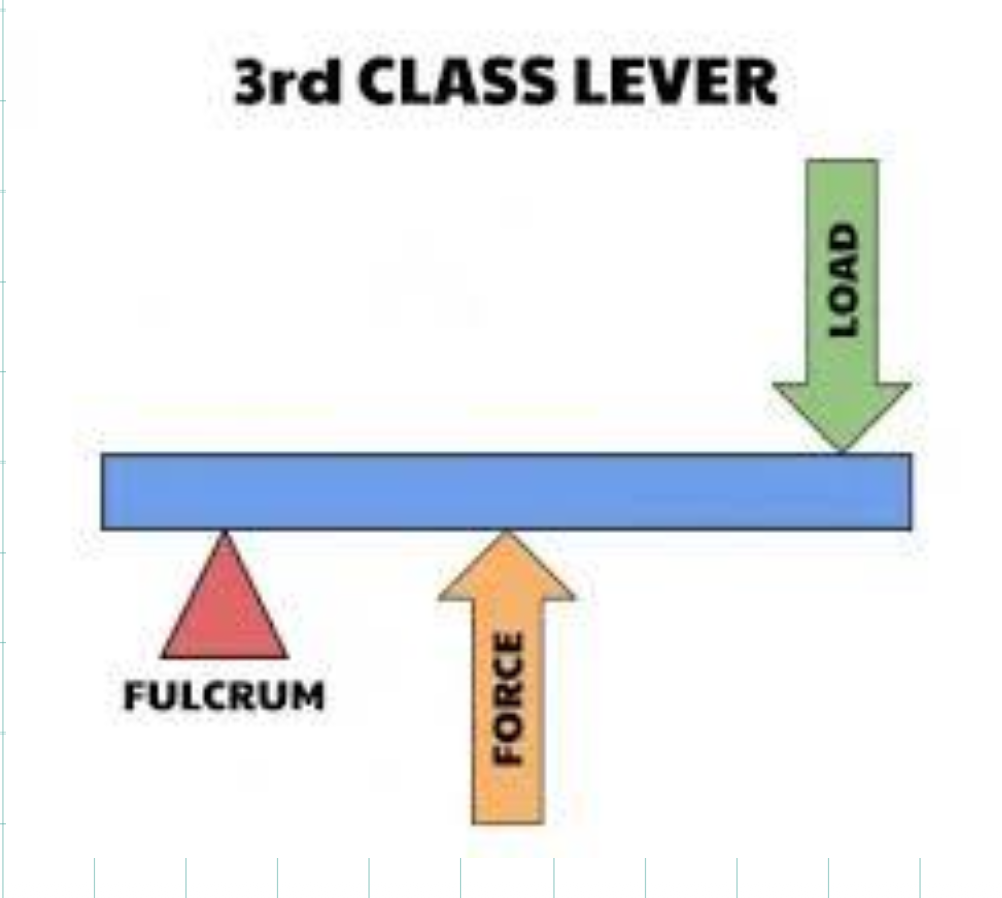
Third Class Levers
A lever system where the FORCE
is between the resistance and
the fulcrum
• SPEED multiplier, promotes
speed at the end point of the
lever
• We often attempt to increase
overall length of lever to
maximize this speed at end
point
balance
Balance= refers to the body’s or an
object’s ability to maintain
equilibrium when stationary (static)
or moving (dynamic)
base of support
area bounded by the outermost regions of contact between a body and support surface. It refers to the area beneath an object or person that includes
every point of contact that the object or person makes with
the supporting surface.
⎯ These points of contact may be body parts e.g. feet or even
the chair a person is sitting in.
• Wider base of support = more stable
• Most stable in the direction of the width of base of support
e.g. feet side to side = stable if pushed from the side
e.g. feet front to back = stable if pushed from the front
centre of gravity
the theoretical point in an object where all of the body’s mass is equally distributed
(located either inside or outside the body)
Standing still – centre of gravity is located in the abdominal
cavity
• As your position changes – so does your centre of gravity
• The position of the centre of gravity will determine
whether the body is in balance
• To be more stable, we want the COG to fall inside our body,
AND as low as possible
line of gravity
Line of Gravity = imaginary vertical line passing downwards through the CoG to the ground or surface the person is on
Movement is easier when the line of gravity falls outside
the object’s base of support
• If your line of gravity is not in the center of your base of support= unstable
• If your line of gravity is in the middle of your base of support= stable
mass
Mass = amount of matter in an object/resistance to a change in position
increase stability
if a person was aiming to increase stability they would need:
• As large a Base of Support as possible
• Lowest Centre of Gravity possible
• Line of Gravity in the middle of the base of support
• Largest Mass Possible
decrease stability
If a person was aiming to decrease stability they would:
• Decrease size of base of support
• Have CoG near edge of BoS, as with LoG
summation of forces
when force is developed through the use of multiple body parts.
We are trying t o get the correct timing and/or sequencing through a range of body of motion
segments and muscles
• When we w e are either complete a coordinated performing: movement,
• Simultaneous
•Sequential MovementMovement
Simultaneous Force Summation
the use of multiple body parts at the same time to produce a force
advantages of Sequential OF
Moving in a sequence often produces more force as each segment will
add to the overall force
• To get maximal force:
1. Activate stronger and larger muscles first moving through to smallest last
2. Use as many different body segments as possible (think impulse)
3. Transfer momentum from one part t o the other when at maximum velocity
4.Ensuring follow through t o ensure no deacceleration
Have a stable base for body parts t o allow for optimal transfer of momentum between body parts
6. All forces are directed at the target
Projectile Motion-Angle
Angle of Release = the angle at which an object is released
Determines the SHAPE of the projectile
• With all other things held constant it also determines:
• The time the object stays i n the air
• The horizontal distance the object moves.
• Theoretical optimal angle o f release for distance = 45° provided height o f release and landing height remain equal and spin and air resistance are not present (this of course
never occurs on earth!)
• Angle of release is between 0 ° and 90 °
Projectile Motion - Velocity
the velocity of the projectile when it is released
The greater the speed or velocity of release, the greater the
distance a projectile will carry.
• The velocity o f release is the most important factor when maximizing the distance travelled.
—Vertical velocity component determines height o f apex
—Horizontal component i s constant throughout flight of projectile i f air resistance = 0 and is determined at point of release
• Often we are always trying to increase velocity of release, especially if distance is what we want. We do this using other biomechanical principles.
Projectile Motion - Height
Height of Release - the height from the ground that the projectile as it is released
The greater the height of a release of a projectile, the greater
the horizontal distance it will cover
• Provided other factors are equal
• Remember that the height o f release will also be determined by the landing height!
Projectile Motion - Optimal
Optimal Projection is the relationship between the angle, velocity, and height of release/landing to attain the goal of the athlete.
Laminar Flow
Laminar Flow = type of flow in which the fluid travels smoothly or in regular paths. Fluid flows in parallel layers with no disruption between layers
• Has an earlier boundary layer separation
• Large pocket of air behind object
• LARGER pressure differential between front and back of an object
• Usually occurs at low velocity
Explore top notes

