The basics: Chapter 1
 Studied by 0 people
 View linked note
 Call Kai
 Learn
Learn Practice Test
 Spaced Repetition
 Match
Match Flashcards
 Knowt Play
1/38

Earn XP
Description and Tags
A set of flashcards covering key concepts related to DMS graphs, relationships between data items, and scientific notation.
Name | Mastery | Learn | Test | Matching | Spaced | Call with Kai |
|---|
No analytics yet
Send a link to your students to track their progress
39 Terms
What is the purpose of graphs in DMS (Data Management System)?
Graphs, such as blood velocity graphs, are used to represent data visually.
What defines unrelated items in a data context?
Unrelated items are two items that are not associated with each other, e.g., hair color vs shoe size.
What does it mean for two items to be related or proportional?
Related items are those that are associated or affiliated, but the nature of their relationship does not need to be specified.
What is a directly related or directly proportional relationship?
When one item increases, the other also increases, e.g., clothing size is directly proportional to one's weight.
What defines an inversely related or inversely proportional relationship?
When one item increases while the other decreases, e.g., basketball score is inversely related to skill.
What is a reciprocal relationship?
A reciprocal relationship occurs when two numbers are multiplied together to result in one; they are inverse of each other.
Why is it necessary to include units in numerical answers?
A comprehensive numerical answer requires a unit to provide context to the number.
What is unit conversion?
Unit conversion is the process of changing from one unit of measurement to another.
What does a positive exponent represent in scientific notation?
A positive exponent represents a value greater than 10.
What is the value of an exponent of zero in scientific notation?
An exponent of zero represents a value between 1 and 10, e.g., 1.0.
What does the notation 1.24 x 10^-3 represent?
It represents a number in scientific notation, specifically 0.00124.
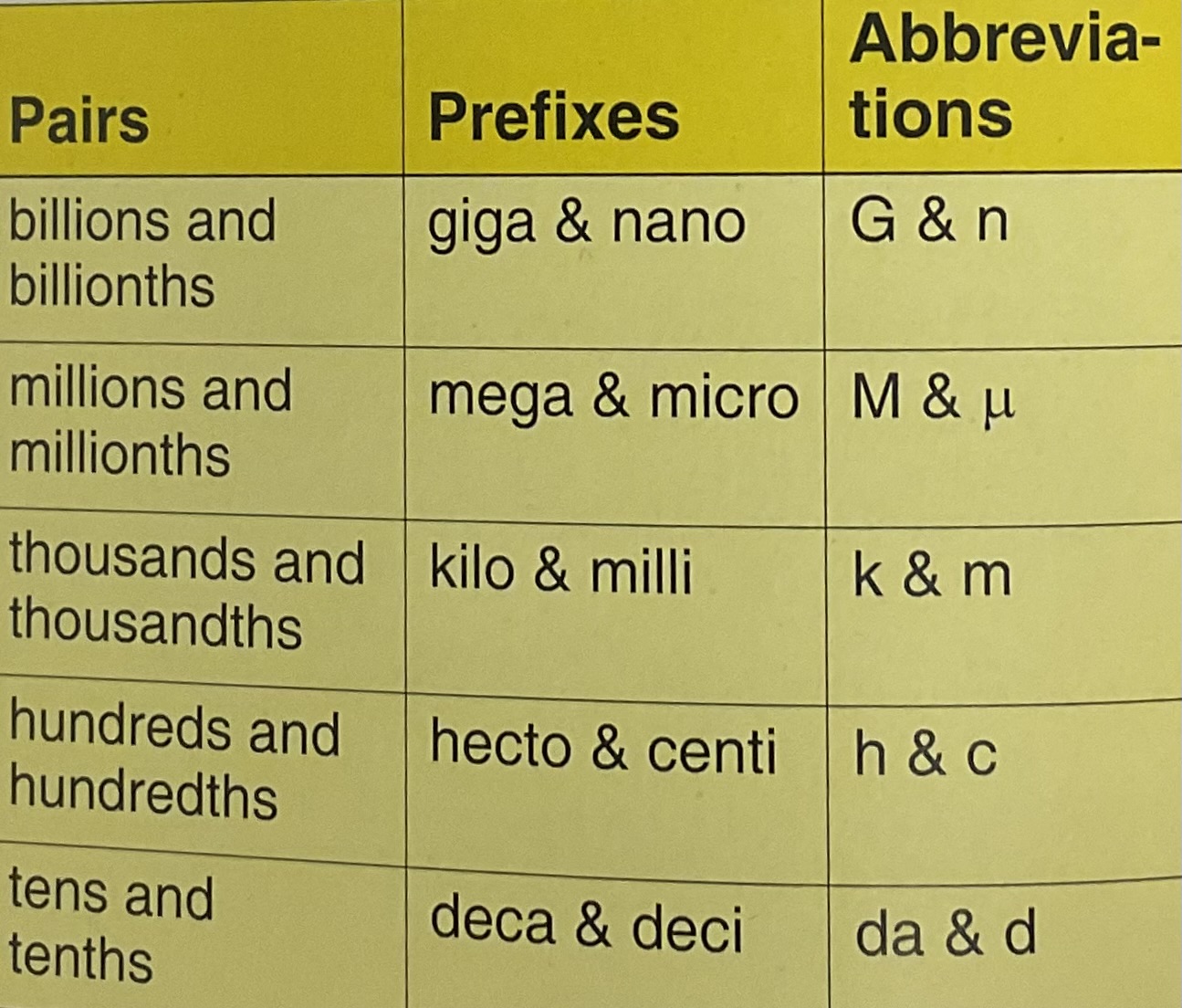
What are complementary metric units?
Complementary metric units refer to units of measurement that are related to each other in terms of magnitude and can be converted from one to another.
Complementary Metric Units: Pairs/Prefixes/ Abbreviations
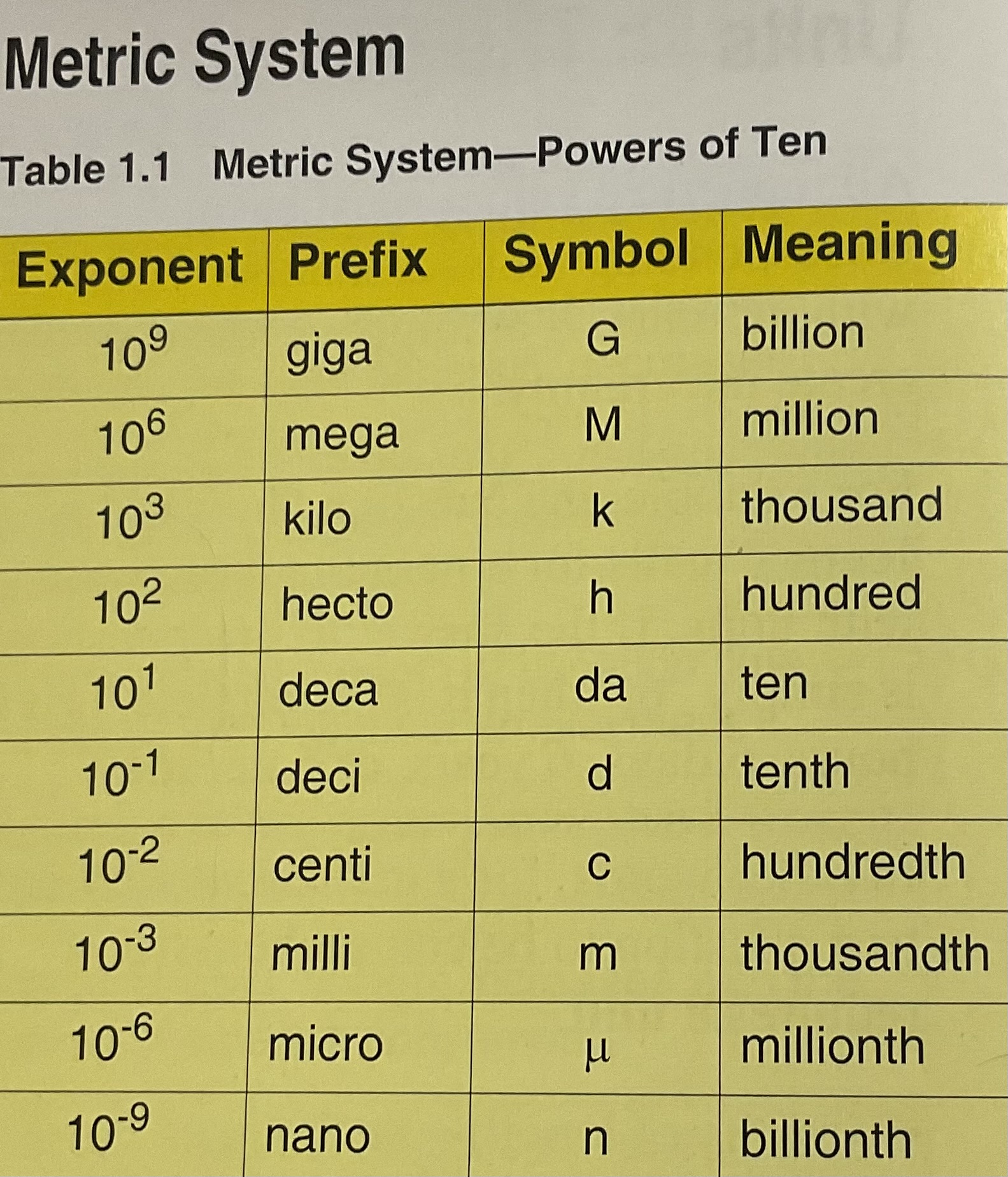
Metric System: Exponent/ Prefix/ Symbol/ Meaning
What is an appropriate unit for area?
Square yards- area is measured in units of length squared.
What is not an appropriate unit for volume?
Cm. Volume is measured in units of length cubed.
List the metric terms in increasing order
A.mega
B.micro
C. Milli
D. Hecto
E. Deca
F. Deci
Micro, milli, deck, deck, hecto, mega
What is an inverse relationship?
Frequency and period
When frequency gets higher, periods get shorter
What is a direct relationship?
Power and intensity
When power gets stronger, intensity gets stronger.
List the metric terms in decreasing order:
A. Nano
B. Centi
C. Giga
D. Kilo
E.hecto
F. Micro
Giga, kilo, hecto, centi, micro, and nano
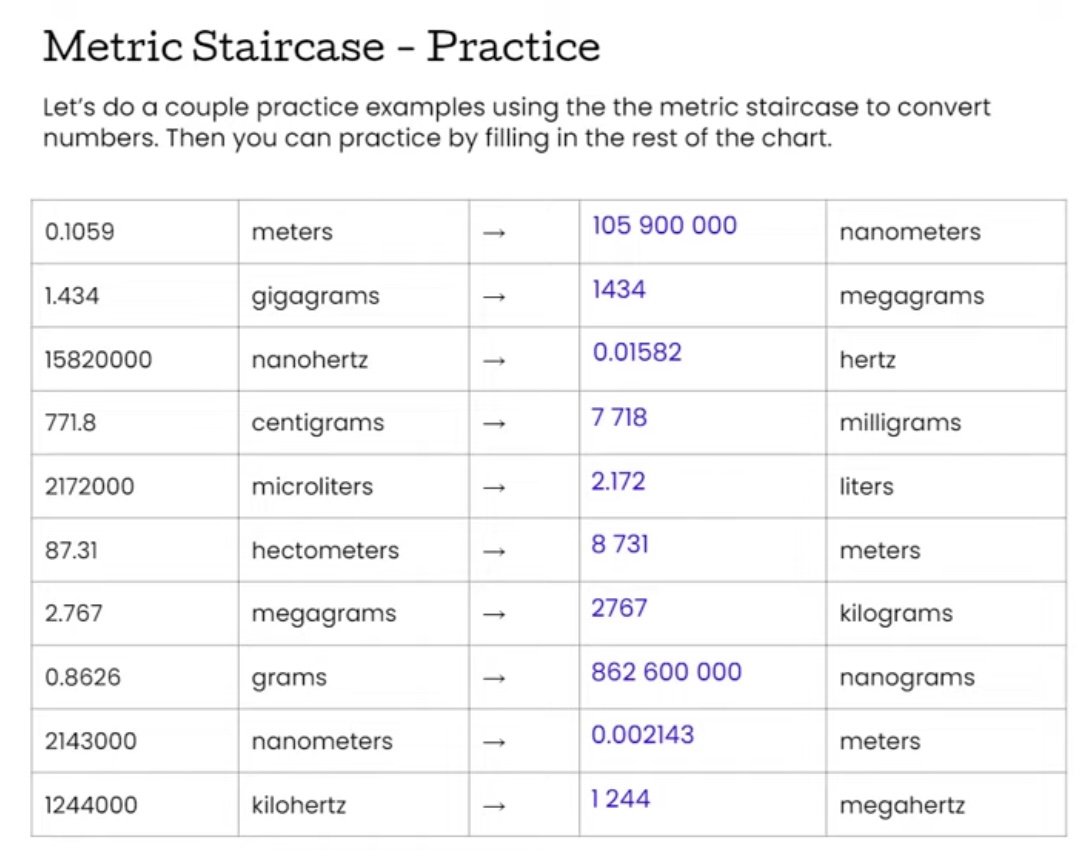
How many milliliters are in 8 liter?
8000
How many kilometers are in 3000 metes?
3
How many hearts is 3MHz?
3,000,000
How many milliliters are contained in a jar filled with 5 liters of fluid?
5000
How many liters are contained in 80 ml of fluid?
0.080
How much bigger is a thousand than ten?
100 times
How much bigger is a billion than a million
1,000 times
How much smaller is a hundred than a thousand?
A hundred is one tenth of a thousand.
List the units for the following terms
Time
Length
Cost
Volume
Area
Test score
Mass
Temperature
Minutes
Centimeters
Cents
m³
Square miles
%
Kilograms
Degrees.
Factors are directly related to the _____
Product
The quotient is ____ related to anything above the numerator and _____ related to anything below the denominator
The quotient is directly related to anything above the numerator and inversely related to anything below the denominator
What happens to the nyquist limit when the PRF increases? And decreases?
If PRF increase, NL increases, if PRF decreases, NL decreases
What happens to the PRF when the Nyquist Limit increases? And decreases?
If NL increases, PRF increases. If NL decreases, PRF decreases.
What happens to intensity if the power increases? And decreases?
Power increases, intensity increases.
Power decreases, intensity decreases.
What happens to intensity if area increases? And decreases?
Area increases, intensity decreases. Area deceases, intensity increases.
What happens to power and area if intensity increases? And decreases?
Intensity increase, power increase or area decrease. Intensity decreases, power decreases or area increased.
List complementary units
Giga& nano
Mega& micro
Kilo& Milli
Hecto &Centi
Deca & Deci
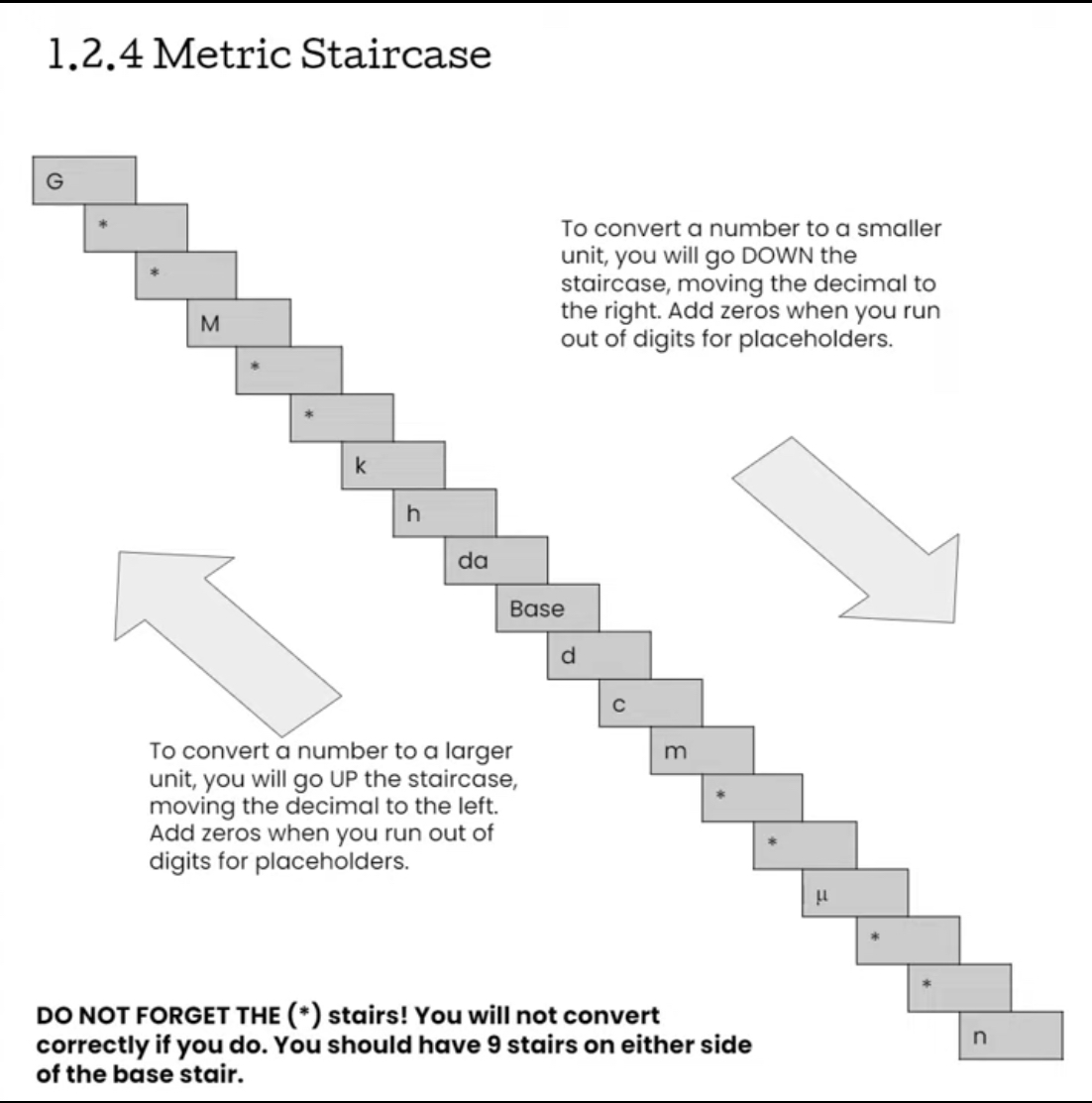
Draw the conversion stairs
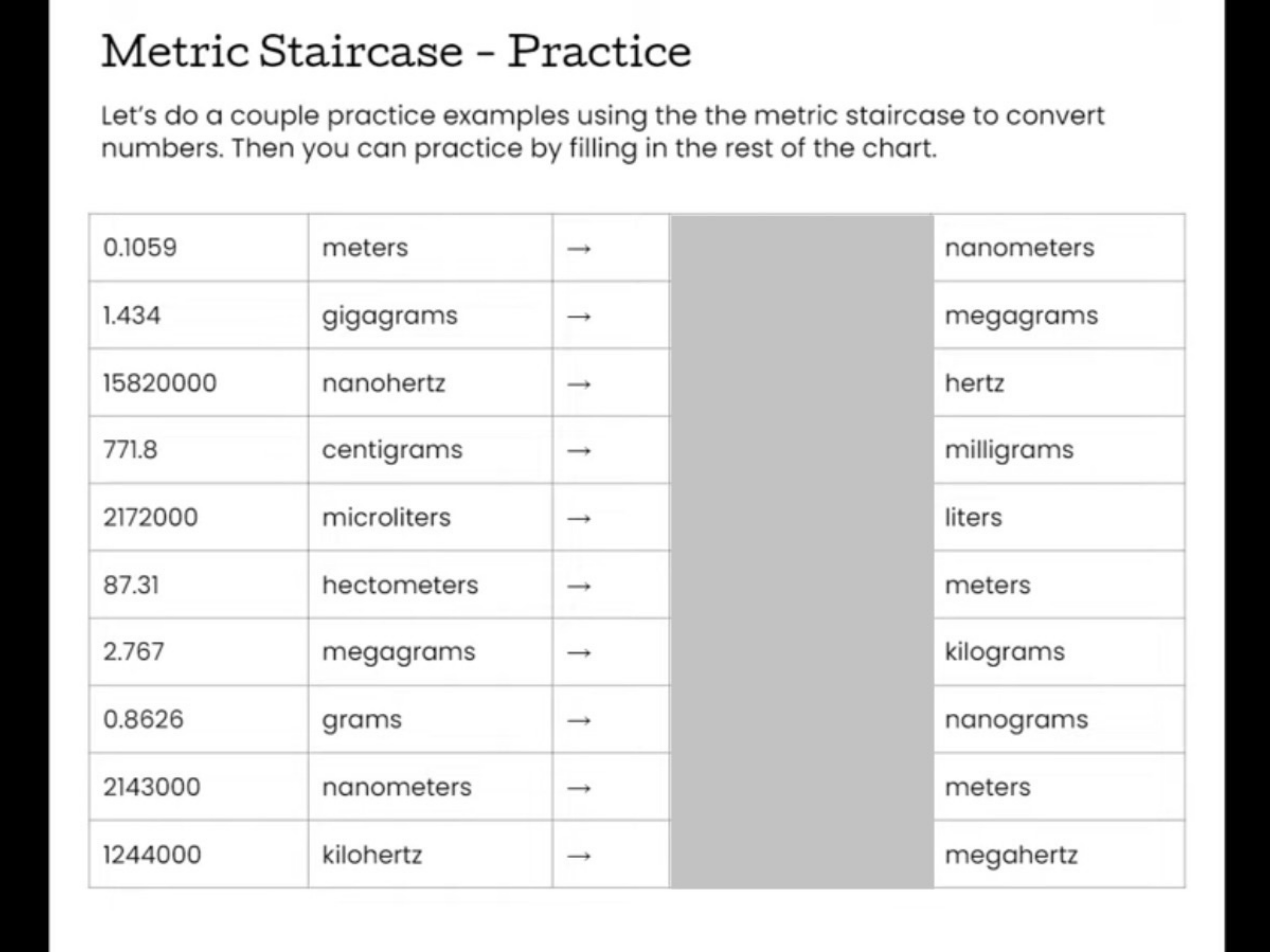
Fill in the blank
 Flashcards (45)