Physics 2 Homework 2 Steps
 Studied by 0 people
 Call Kai
 Learn
Learn Practice Test
 Spaced Repetition
 Match
Match Flashcards
 Knowt Play
1/14

There's no tags or description
Looks like no tags are added yet.
Name | Mastery | Learn | Test | Matching | Spaced | Call with Kai |
|---|
No analytics yet
Send a link to your students to track their progress
15 Terms
A small sphere with a charge of -0.630 μC is placed in a uniform electric field of magnitude 1.170×10⁶ N/C pointing to the west. What is the magnitude and direction of the electric force on the sphere? (Round the final answer to three decimal places.)
__ N to the east
write down given (q, E, direction of field)
convert to C
use F=qE
plug in numbers
The electric field across a cell membrane is 2.720×10⁷ N/C directed into the cell. If a pore opens, which way do sodium ions ( Na+ ) flow?
Into the cell
The electric field across a cell membrane is 2.720×10⁷ N/C directed into the cell.
What is the magnitude of the electric force on the sodium ion? The charge on the sodium ion is +e. (You may enter your calculation using scientific notation.)
Write given (E, q=+e)
use electric force formula F=qE
plug in numbers
What are the magnitude and direction of the acceleration of an electron at a point where the electric field has magnitude 8,854 N/C and is directed due north? (You may enter your calculation using scientific notation.)
__ m/s2 south
write down given (E, electron, direction)
write down electron constants (charge and mass)
Find electric force (F=qE)
use newtons 2nd law (F=ma → a=f/m)
plug in numbers
Two point charges, −15.0 μC and +12.0 μC , are kept 7.70 cm apart.
What is the magnitude of the electric field midway between the two point charges? (You may enter your calculation using scientific notation.)
understand geometry ( 2 point charges- q1q2, distance between them, point of midway is r=d/2)
use electric field formula (E=k q/r²)
determine directions (+points toward positive charge, - points toward negative charge)
calculate electric field for each charge
add the fields together
An electron traveling horizontally from west to east enters a region where a uniform electric field is directed upward. What is the direction of the electric force exerted on the electron once it has entered the field?
downward
Two point charges, −15.0 μC and +12.0 μC , are kept 7.70 cm apart.
What is the direction of the electric field midway between the two point charges?
directed toward the -15-μC charge
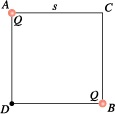
Two equal charges (Q=+3.500 nC) are situated at the diagonal corners A and B of a square of side 1.700 m . What is the magnitude of the electric field at point D?1
where s=1.700 m .
understand the setup (r and q, want the electric field at corner D, corner D has no charge)
distance from rach charge to point D (A to D is r, B to D is the diagonal. r square root 2)
Electric field formula (E=k Q/r²)
Find the electric charge from point A then from B
Break B into x and y
A and x of B add
y B is the vertical
Find the magnitude
A particle with mass 2.10 g and charge +10.0 μC passes upward through a small hole in a horizontal metal plate with a velocity of 7.60 m/s directed at 55.0° above the horizontal. The region above the plate has a uniform electric field directed downward with magnitude 9.30×10³ N/C . The region above the plate is essentially a vacuum, so there is no air resistance.
The electric field E acts in the downward direction on the plate. Delta x is the distance from the hole to the right on the plate.
Compute the ratio of the gravitational force to the electrical force of the particle. (Round the final answer to three decimal places.)
Understand the ratio
Write the expressions of each for (Fg = mg, Fe = qE)
convert units and write what you know
Compute Fg
Compute Fe
Use Fg/Fe ratio
Solve
A particle with mass 2.10 g and charge +10.0 μC passes upward through a small hole in a horizontal metal plate with a velocity of 7.60 m/s directed at 55.0° above the horizontal. The region above the plate has a uniform electric field directed downward with magnitude 9.30×10³ N/C . The region above the plate is essentially a vacuum, so there is no air resistance.
At what horizontal distance from the hole does the particle strike the plate? (Round the final answer to three decimal places.)
unsure (number 12)
A conductor in electrostatic equilibrium has a cavity that contains two point charges: q1=+5.600 μC and q2=−12.20 μC . The conductor itself carries a net charge −4.0 μC .
Find the net charge on the inner surface of the conductor. (Round the final answer to two decimal places.)
Add the charges inside the cavity (q=q1+q1)
Determine the inner surface change (q inner = -(q inside))
A conductor in electrostatic equilibrium has a cavity that contains two point charges: q1=+5.600 μC and q2=−12.20 μC . The conductor itself carries a net charge −4.0 μC .
Find the net charge on the outer surface of the conductor. (Include a minus sign if necessary.)
find the net charge in the cavity
Charge on the inner surface (the inner surface must cancel the cavity charge)
use charge conservation for the conductor (q conductor = q inner + q outer)
A small sphere with charge 0.970 μC is placed at the center of a cube. What is the electric flux through one surface of the cube? (You may enter your calculation using scientific notation.)
this problem focuses on Guass’s law
Find total flux through the cube
Find the flux through one face (one face = total/6)
An electron beam in an oscilloscope is deflected by the electric field produced by oppositely charged metal plates. If the electric field between the plates is 5.200×10⁵ N/C directed downward, what is the force on each electron when it passes between the plates? (You may enter your calculation using scientific notation.)
use the electric force formula (F=qE)
plug in values
find direction
16..? 17..? 19..?
 Note
Note  Flashcards (31)