Courts and Alternative Dispute Resolution (ADR)
 Call Kai
 Learn
Learn Practice Test
 Spaced Repetition
 Match
Match Flashcards
 Knowt Play
1/55

There's no tags or description
Looks like no tags are added yet.
Name | Mastery | Learn | Test | Matching | Spaced | Call with Kai |
|---|
No analytics yet
Send a link to your students to track their progress
56 Terms
What is the Judiciary’s role in American Government?
The body of law is useless without the courts to interpret and apply them. this is the essential role of the judiciary. to interpret and apply the laws.
Judicial Review
the judiciary can decide whether the laws or actions of the other two branches are constitutional. this process is called judicial review and is seen as a check on the other branches of government.
How was the power of judicial review established?
Marbury v. Madison.
it established judicial review when Chief Justice John Marshall declared that the Supreme Court had the power to nullify an act of Congress (the Judiciary Act of 1789) because it violated the Constitution.
the case began when William Marbury sued Secretary of State James Madison for failing to deliver his judicial commission.
What are basic judicial requirements before a court can hear a lawsuit?
jurisdiction, venue, and standing to sue.
Jurisdiction
juris means "law," and diction means "to speak." Thus, "the power to speak the law" is the literal meaning of the term.
before any court can hear a case, it must have jurisdiction over the person or company against whom the suit is brought (the defendant) or over the property involved in the suit. the court must also have jurisdiction over the subject matter of the dispute.
Jurisdiction over Persons (in personam jurisdiction)
a court with jurisdiction over a particular geographic area can exercise personal jurisdiction over any person or business that resides in that area. a state trial court normally has jurisdiction over residents (including businesses) in a particular area of the state, such as a county or district.
a state’s highest court (often called the state supreme court) has jurisdicition over all residents of that state.
Jurisdiction over Property (in rem jurisdiction)
a court can also exercise jurisdiction over property that is located within its boundaries. also known as “jurisdiction over the thing.”
State long arm statutes
under the authority of this statute, a court can exercise personal jurisdiction over certain out-of-state defendants based on activities that took place within the state.
before exercising long arm jurisdiction over a nonresident, however, the court must be convinced that the defendant had sufficient contacts, or minimum contacts, with the state to justify the jurisdiction.
similarly, a state may exercise personal jurisdiction over a nonresident defendant who is sued for breaching a contract that was formed within the state. this is true even when that contract was negotiated over the phone or through online correspondence.
Jurisdiction over corporations
because corporations are considered legal persons, courts use the same principles to determine whether it is fair to exercise jurisdiction over a corporation.
a corporation normally is subject to personal jurisdiction in the state in which it is incorporated, has its principal office, and is doing business.
courts apply the minimum-contacts test to determine if they can exercise jurisdiction over out-of-state corporations.
in the past, corporations were usually subject to jurisdiction in states in which they were doing business, such as advertising or selling products.
The United States Supreme Court decided that this situation made questions of jurisdiction too unpredictable.
after all, many corporations do business in multiple states, and the Court concluded that it was unfair to expose them to costly legal proceedings in numerous different locations.
Jurisdiction over Subject Matter
is a limitation on the types of cases a court can hear.
in both the federal and the state court systems, there are courts of general (unlimited) jurisdiction and courts of limited jurisdiction. an example of a court of general jurisdiction is a state trial court or a federal district court.
Probate court
state courts that handle only matters relating to the transfer of a person's assets and obligations after that person's death, including matters relating to the custody and guardianship of children and incompetent adults.
an example of a state court of limited jurisdiction
Bankruptcy court
handle only bankruptcy proceedings, which are governed by federal bankruptcy law.
an example of a federal court of limited subject-matter jurisdiction
How is a court’s jurisdiction over subject matter defined
in a statute or constitution creating the court.
What can a Court’s subject-matter jurisdiction can be limited by?
The subject of the lawsuit.
The sum in controversy.
Whether the case involves a felony (a more serious type of crime) or a misdemeanor (a less serious type of crime.
Whether the proceeding is a trial or an appeal.
What is the distinction between courts of original jurdisdiction and courts of appellate jurisdiction?
whether the case is heard for the first time. Courts having original jurisdiction are courts of the first instance, or trial courts—that is, courts in which lawsuit begin, trials take place, and evidence is presented. in the federal courts system, the district courts are trial courts.
any court having original jurisdiction is normally known as a trial court. courts having appellate jurisdiction act as reviewing courts, or appellate courts. in general, cases can be brought before appellate courts only on appeal from an order or a judgment of a trial court or other lower court.
Jurisdiction of the federal courts
because the federal government is a government of limited powers, in turn the jurisdiction of the federal courts is limited.
federal courts have subject-matter jurisdiction in two situation: those involving federal questions and diversity of citizenship.
Federal Questions
Article III of the U.S. Constitution establishes the boundaries of federal judicial power.
Section 2 of Article III states that "[t]he judicial Power shall extend to all Cases, in Law and Equity, arising under this Constitution, the Laws of the United States, and Treaties made, or which shall be made, under their Authority."
this clause means that whenever a plaintiff's cause of action is based, at least in part, on the U.S. Constitution, a treaty, or a federal law, then a federal question arises, and the federal courts have jurisdiction.
any lawsuit involving a federal question, such as a person's rights under the U.S. Constitution, can originate in a federal court. note that in a case based on a federal question, a federal court will apply federal law.
Diversity of Citizenship
federal district courts can also exercise original jurisdiction over cases involving diversity of citizenship.
the most common type of diversity jurisdiction requires both of the following:
the plaintiff and defendant must be residents of different states.
the dollar amount in controversy must exceed $75,000.
for purposes of diversity jurisdiction, a corporation is a citizen of both the state in which it is incorporated and the state in which its principal place of business is located.
a case involving diversity of citizenship can be filed in the appropriate federal district court. if the case starts in a state court, it can sometimes be transferred, or "removed," to a federal court. a large percentage of the cases filed in federal courts each year are based on diversity of citizenship.
the party seeking to move a case to federal court bears the burden of demonstrating that the grounds for diversity exist.
a federal court will apply federal law in cases involving federal questions. in a case based on diversity of citizenship, in contrast, a federal court will apply relevant state law (which is often the law of the state in which the court sits).
When does concurrent jurisdiction exist?
when both federal and state courts have the power to hear a case, as is true in lawsuits involving diversity of citizenship, it exists.
when concurrent jurisdiction exists, a party may bring a suit in either a federal court or a state court. a number of factors can affect the decision of whether to litigate in a federal or a state court, such as the availability of different remedies, the distance to the respective courthouses, or the experience or reputation of a particular judge.
a resident of a state other than the one with jurisdiction might also choose a federal court over a state court if there is any concern that a state court might be biased against an out-of-state plaintiff. in contrast, a plaintiff might choose to litigate in a state court if it has a reputation for awarding substantial amounts of damages or if the judge is perceived as being pro-plaintiff.
When does exclusive jurisdiction exist?
when cases can be tried only in federal courts or only in state courts.
federal courts have exclusive jurisdiction in cases involving federal crimes, bankruptcy, most patent and copyright claims, suits against the United States, and some areas of admiralty law.
state courts also have exclusive jurisdiction over certain subject matter—for instance, divorce and adoption.
Jurisdiction in Cyberspace
courts frequently have to decide what constitutes sufficient minimum contacts when a defendant’s only connection to a jurisdiction is through an ad on a website.
courts have developed a standard—called a “sliding-scale” standard—for determining when the exercise of jurisdiction over an out-of-state defendant is proper.
What is the sliding-scale standard?
when the defendant conducts substantial business over the Internet (such as contracts and sales), jurisdiction is proper. this is true whether the business is conducted with traditional computers, smartphones, or other means of Internet access.
when there is some interactivity through a website, jurisdiction may be proper, depending on the circumstances. it is up to the courts to decide how much online interactivity is enough to satisfy the minimum-contacts requirement.
when a defendant merely engages in passive advertising online, jurisdiction is never proper.
International Jurisdictional Issues
because the Internet is global in scope, it raises international jurisdictional issues. the world's courts seem to be developing a standard that echoes the minimum-contacts requirement applied by U.S. courts.
most courts are indicating that minimum contacts- doing business within the jurisdiction, for instance—are enough to compel a defendant to appear. the effect of this standard is that a business firm has to comply with the laws in any jurisdiction in which it targets customers for its products. this situation is complicated by the fact that many countries' laws on particular issues- such as free speech-are very different from U.S. laws.
Venue
concerned with the most appropriate physical location for a trail. two state courts (or two federal courts) may have the authority to exercise jurisdiction over a case, but it may be more appropriate or convenient to hear the case in one court than in the other.
venue in a civil case is typically where the defendant resides, whereas venue in a criminal case normally is where the crime occured. pretrial publicity or other factors, though, may require a change of venue to another community, especially in criminal cases when the defendant’s right to a fair and impartial jury has been impaired.
Standing to Sue
before a person can bring a lawsuit before a court, the party must have a sufficient “stake” in the matter to justify seeking relief through the court system. the party bringing the lawsuit must have suffered a harm, such as physical injury or economic loss, as a result of the action that will be the focus of the lawsuit. at times, a person can have standing on behalf of another person, such as a minor or mentally incompetent.
another requirement to bringing a lawsuit is that the controversy at issue be a justicable controversy. a court will not hear a case if the matter at issue is not justicable.
Justiciable controversy
a controversy that is real and substantial, as opposed to hypothetical or academic.
Are federal courts superior to the state courts?
no, they are simply an independent system of courts, which derives it authority from article III, sections 1 and 2, of the U.S. constitution.
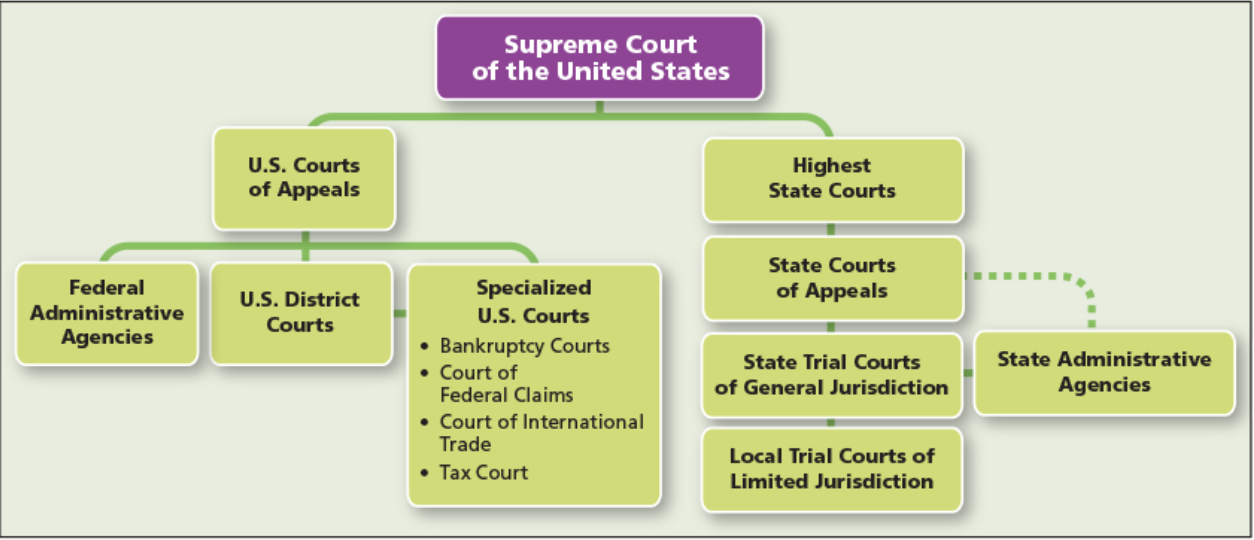
The state court system includes
trial courts of limited jurisdiction,
trial courts of general jurisdiction,
appellate courts, and
the state’s highest court (often called the state supreme court).
any person who is a party to a lawsuit has the opportunity to plead the case before a trial court and then, if that person loses, before at least one level of appellate court. if the case involves a federal statute or a federal constitutional issue, the decision of a state supreme court on that issue may be further appealed to the United States Supreme Court.
Trial courts
courts in which trials are held and testimony taken. state trial courts have either general or limited jurisdiction. trial courts that have general jurisdiction as to subject matter may be called county, district, superior, or circuit courts.
Trial courts of general jurisdiction
trial courts that have general jurisdiction as to subject matter may be called county, district, superior, or circuit courts. these courts have jurisdiction over a wide variety of subjects, including both civil disputes and criminal prosecutions. (in some states, trial courts of general jurisdiction may hear appeals from courts of limited jurisdiction.)
Trial courts of limited jurisdiction
may be called special inferior trial courts or minor judiciary courts. limited jurisdiction courts might include local municipal courts (which could include separate traffic courts and drug courts) and domestic relations courts (which handle divorce and child-custody disputes).
a small claims court is an inferior trial court that hears only civil cases involving claims of less than a certain amount, such as $5,000 (the amount varies from state to state).
suits brought in small claims courts are generally conducted informally, and lawyers are not required (in a few states, lawyers are not even allowed). decisions of small claims courts and municipal courts may sometimes be appealed to a state trial court of general jurisdiction.
Appellate court
every state has at least one court of appeals (appellate court, or reviewing court), which may be an intermediate appellate court or the state's highest court. about three-fourths of the states have intermediate appellate courts.
generally, courts of appeals do not conduct new trials, in which evidence is submitted and witnesses are examined. rather, an appellate court panel of three or more judges reviews the record of the case on appeal, which includes a transcript of the trial proceedings, and determines whether the trial court committed an error.
What is difference between the focus of a trial court and that of an appellate court?
appellate courts generally focus on questions of law, not questions of fact.
Question of fact
deals with what really happened in regard to the dispute being tried—such as whether a party actually burned a flag.
Question of law
concerns the application or interpretation of the law—such as whether flag-burning is a form of speech protected by the First Amendment to the U.S. Constitution. Only a judge, not a jury, can rule on questions of law.
Why do appellate courts normally defer to a trial court’s findings on questions of fact?
because the trial court judge and jury were in a better position to evaluate testimony. The trial court could directly observe witnesses' gestures, demeanor, and nonverbal behavior during the trial. An appellate court cannot. At the appellate level, the judges review the written transcript of the trial.
an appellate court will challenge a trial court's finding of fact only when the finding is clearly erroneous (that is, when it is contrary to the evidence presented at trial or when no evidence was presented to support the finding).
Highest State Courts
the highest appellate court in a state is usually called the supreme court but may be called by some other. for instance, in both New York and Maryland, the highest state court is called the court of appeals. the decisions of each state’s highest court are final on all questions of state law. only when issues of federal are involved can a decision made by a state’s highest court be overruled by the United States Supreme Court.
The federal court system includes
U.S. district courts (trial courts of general jurisdiction) and various courts of limited jurisdiction,
U.S. courts of appeals (intermediate courts of appeals), and
the United States Supreme Court.
unlike state court judges, who are usually elected, federal court judges—including the justices of the Supreme Court—are appointed by the president of the United States and confirmed by the U.S. Senate.
under Article III, federal judges "hold their offices during Good Behavior." in the entire history of the United States, only seven federal judges have been removed from office through impeachment proceedings.
U.S District Courts
at the federal level, the equivalent of a state trial court of general jurisdiction is the district court. there is at least one federal district court in every state. the number of judicial districts can vary over time, primarily owing to population changes and corresponding caseloads. today, there are ninety-four federal judicial districts.
U.S. district courts have original jurisdiction in federal matters. federal cases typically originate in district courts. federal courts with original, but specialized (or limited), jurisdiction include the bankruptcy courts and others.
U.S. Courts of Appeals
In the federal court system, there are thirteen U.S. courts of appeals—also referred to as U.S. circuit courts of appeals. The federal courts of appeals for twelve of the circuits, including the U.S. Court of Appeals for the District of Columbia Circuit, hear appeals from the federal district courts located within their respective judicial circuits.
The Court of Appeals for the Thirteenth Circuit is called the Federal Circuit. It has national appellate jurisdiction over certain types of cases, such as cases involving patent law and cases in which the U.S. government is a defendant.
The decisions of the circuit courts of appeals are final in most cases, but appeal to the United States Supreme Court is possible.
What circuit of both the U.S. Court of Appeals and U.S. District Court is Virginia in?
The Fourth Circuit.
The United States Supreme Court
according to article III of the U.S. Constitution, there is only one national Supreme Court. All other courts in the federal system are considered “inferior.” congress is empowered to create inferior courts as it deems necessary. the inferior courts that Congress has created include the U.S courts of appeals as well as the District Courts and any other courts of limited, or specialized, jurisdiction.
The court consists of nine justices. although the Supreme Court has original, or trial, jurisdiction in rare instances, most of its work is as an appeals court. The Supreme Court can review any case decided by any of the federal courts of appeals, and it also has appellate authority over some cases decided in the state courts.
How to appeal to the Supreme Court
to bring a case before the Supreme Court, a party requests that the Court issue a writ of certiorari. whether the Court will issue a writ of certiorari is entirely within its discretion. the Court is not required to issue one, and most petitions for writs are denied.
a denial is not a decision on the merits of a case, nor does it indicate agreement with the lower court's opinion. Furthermore, a denial of the writ has no value as a precedent.
typically, the Court grants petitions when cases raise important constitutional questions or when the lower courts are issuing conflicting decisions on a significant issue.
the justices, however, never explain their reasons for hearing certain cases and not others, so it is difficult to predict which type of case the Court might select.
Writ of certiorari
is an order issued by the Supreme Court to a lower court requiring that court to send the record of the case for review. under the rule of four, the Court will not issue a writ unless at least four of the nine justices approve.
Following a State Court Case
The pleadings-
a. Complaint- Filed by the plaintiff with the court to initiate the lawsuit. The complaint is served with a summons on the defendant.
b. Answer—A response to the complaint in which the defendant admits or denies the allegations made by the plaintiff. The answer may assert a counterclaim or an affirmative defense.
c. Motion to dismiss—A request to the court to dismiss the case for stated reasons, such as the plaintiff's failure to state a claim for which relief can be granted.
Pretrial motions (in addition to the motion to dismiss)—
a. Motion for judgment on the pleadings—May be made by either party. It will be granted if the parties agree on the facts and the only question is how the law applies to the facts. The judge bases the decision solely on the pleadings.
b. Motion for summary judgment—May be made by either party. It will be granted if the parties agree on the facts and the sole question is a question of law. The judge can consider evidence outside the pleadings when evaluating the motion.
Discovery-
The process of gathering evidence concerning the case and obtaining information from the opposing party. Discovery involves depositions (sworn testimony by a party to the lawsuit or any witness), interrogatories (written questions and answers to these questions made by parties to the action with the aid of their attorneys), and various requests (for admissions, documents, and medical examinations, for instance). Discovery may also involve electronically recorded information, such as e-mail, voice mail, social media posts, and other data compilations. Although electronic discovery has significant advantages over paper discovery, it is also more time consuming and expensive and often requires the parties to hire experts.
Pretrial conference—
Either party or the court can request a pretrial conference to identify the matters in dispute after discovery has taken place and to plan the course of the trial. Also, the conference may explore the possibility of a settlement without a trial.
Trial- Following jury selection (voir dire), the trial begins with opening statements from both parties' attorneys. The following events then occur:
a. The plaintiff's introduction of evidence (including the testimony of witnesses) supporting the plaintiff's position. The defendant's attorney can challenge evidence and cross-examine witnesses.
b. The defendant's introduction of evidence (including the testimony of witnesses) supporting the defendant's position. The plaintiff's attorney can challenge evidence and cross-examine witnesses.
c. Closing arguments by the attorneys in favor of their respective clients, the judge's instructions to the jury, and the jury's verdict.
Posttrial motions—
a. Motion for judgment n.o.v. ("notwithstanding the verdict") —Will be granted if the judge is convinced that the jury's verdict was in error.
b. Motion for a new trial—Will be granted if the judge is convinced that the jury's verdict was in error. The motion can also be granted on the grounds of newly discovered evidence, misconduct by the participants during the trial, or error by the judge.Appeal- Either party can appeal the trial court's judgment to an appropriate court of appeals. After reviewing the record on appeal, the abstracts, and the attorneys' briefs, the appellate court holds a hearing and renders its opinion.
Courts Online
almost every court has a website offering information about the court and its procedures, and increasingly courts are publishing their opinions online.
in the future, we may see cyber courts, in which all trial proceedings are conducted online. a number of state and federal courts allow parties to file litigation-related documents with the courts via the Internet or other electronic means.
nearly all of the federal appellate courts and bankruptcy courts and a majority of the federal district courts have implemented electronic filing systems.
Alternative dispute resolution (ADR)
the resolution of disputes in ways other than those involved in the traditional judicial process, such as negotiation, mediation, and arbitration.
Negotiation
the parties come together, with or without attorneys to represent them, to try to reach a settlement without the involvement of a third party.
Mediation
the parties themselves reach an agreement with the help of a neutral third party, called a mediator. the mediator may propose a solution but does not make a decision resolving the matter.
Arbitration
the parties submit their dispute to a neutral third party, the arbitrator, who render a decision. the decision may or may not be legally binding, depending on the circumstances.
Other types of ADR
includes early neutral case evaluation, mini-trials, and summary jury trials (SJTs)
Early neutral case evaluation
the parties select a neutral third party (generally an expert in the subject matter of the dispute) and then explain their respective positions to that person. the case evaluator assesses the strengths and weaknesses of each party’s claims
Mini-trial
each party’s attorney briefly argues the party’s case before the other party and a panel of representatives from each side who have the authority to settle the dispute. typically, a neutral third party acts as an adviser. if the parties fail to reach an agreement, the adviser renders an opinion as to how a court would likely decide the issue.
Summary jury trial (SJT)
in which the parties present their arguments and evidence and the jury renders a verdict. the jury’s verdict is not binding, but it does act as a guide to both sides in reaching an agreement during the mandatory negotiations that immediately follow the trial.
Providers of ADR services
ADR services are provided by both government agencies and private organizations. A major provider of ADR services is the American Arbitration Association (AAA), which handles more than 200,000 claims a year in its numerous offices worldwide. Most of the largest U.S. law firms are members of this nonprofit association. Cases brought before the AAA are heard by an expert or a panel of experts in the area relating to the dispute and are usually settled quickly. The AAA has a special team devoted to resolving large, complex disputes across a wide range of industries.
Hundreds of for-profit firms around the country also provide various dispute-resolution services. Typically, these firms hire retired judges to conduct arbitration hearings or otherwise assist parties in settling their disputes. The judges follow procedures similar to those of the federal courts and use similar rules. Usually, each party to the dispute pays a filing fee and a designated fee for a hearing session or conference.
Online dispute resolution (ODR)
a number of organizations and firms are now offering negotiation, mediation, and arbitration services through online forums. these forums have been a practical alternative for the resolution of domain name disputes and e-commerce disputes in which the amount in controversy is relatively small.

