Density and pressure
 Call Kai
 Learn
Learn Practice Test
 Spaced Repetition
 Match
Match Flashcards
 Knowt Play
1/19

There's no tags or description
Looks like no tags are added yet.
Name | Mastery | Learn | Test | Matching | Spaced | Call with Kai |
|---|
No analytics yet
Send a link to your students to track their progress
20 Terms
What is density?
The mass per unit volume of a material
What is the equation for density? + units
Density (kg/m³ OR g/cm³) = mass (kg or g)/volume (m³ or cm³)
ρ = m/v
ρ is the greek letter that means density
p is for pressure
Density of water in g/cm³ AND kg/m³
How would you convert from g/cm³ to kg/m³?
1 g/cm³
1000 kg/m³
x1000 or divide by 1000
Why do different materials have different densities?
Spacing of particles (far away like gases = low density)
Mass of individual particles
Practical: investigate the densities of solids
Describe how the density of a balloon full of air (or any irregular object) could be measured. Give experimental details (equipment)
Measure mass of balloon using a balance/weighing scales
REJECT scale
Use the displacement method
Measure original volume of water
Place ballon gently in water
Make sure ballon is fully submerged
Re-measure volume of water OR water is displaced into a measuring cylinder
Subtract one volume from the other
ρ = m/v
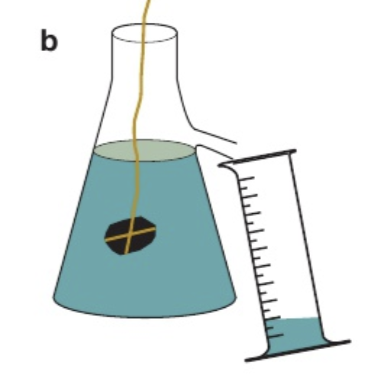
Why should you weigh the ballon (or rock or anything) first?
Water adds weight
Practical: investigate the densities of solids
For a regular object (e.g a box) you would only need to use a ruler to measure width, length and height and multiply to get volume. Then ρ = m/v
How can you get THE ACTUAL volume of the balloon when using the method of displacement of water using a measuring cylinder?
When measuring the v of liquid displaced, make sure the measuring cylinder is on a level (horizontal) surface and that you look at the scale at eye level/straight on to avoid parallax error
What is pressure? Unit?
The force per unit area
Pressure: Pa, N/cm², atm
What creates pressure in fluids?
Pressure in a fluid is created from the movement of particles as they collide with the surface (of a container)
What is the equation for pressure?
pressure (pascals, Pa) = force (N)/area (m²)
p = F/A
1 Pa is equivalent to 1 N/m²
Examples of pressure
Why do tractors not sink into the mud despite being so heavy?
They have large tyres that spread the weight (force) of the tractor over a large area. This reduces the pressure.
How does pressure act in fluids (liquids and gases) that are stationary?
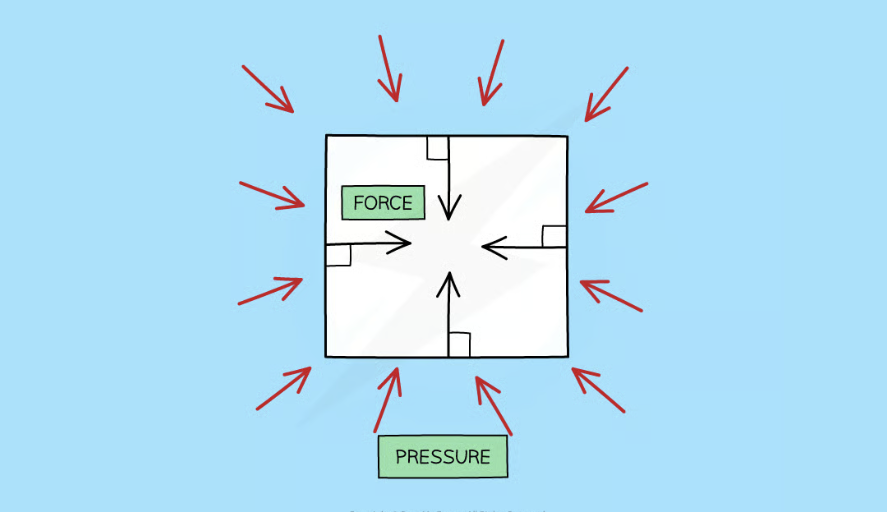
A stationary fluid will exert pressure evenly across the whole surface of the fluid in all directions
The pressure exerted on objects in fluids creates forces against surfaces. These forces act at 90 degrees (at right angles) to the surface
This is why when a can is filled with water and holes are punched out around the base of the can, water is forced out equally in all directions
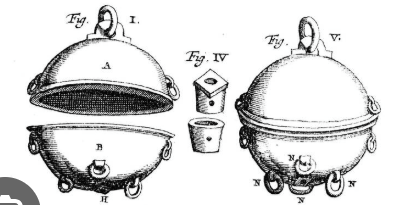
A guy had two large metal bowls made, put them together and then pumped the air out. Explain what the effect of this would be. You can draw a diagram to help your answer
When the hemispheres are full of air, the forces are the same inside and outside (pressure is the same inside and outside)
After the air is taken out, there is only a force on the outside of the hemispheres/pressure is only acting from the outside
The hemispheres cannot be pulled apart until the air is let back into them
What is the pressure exerted by the atmosphere on our bodies? Why can our bodies resist this pressure?
about 100,000 Pa
However, the pressure inside our bodies is similar so we do not notice the pressure of the air
Pressure acting on an object changes with ___ , ___ and ___. How do these two elements affect the pressure experienced by an object in a fluid?
Depth, density and gravitational field strength
The greater the depth/density/gravitational field strength the greater the force experienced by the object
Equation for ‘pressure difference’ + units
pressure difference (Pa) = height (m) x density (kg/m³) x gravitational field strength (N)
p = h x ρ x g
Explain why the pressure (force we experience per unit area) we experience beneath a fluid surface increases with depth, density and g
The deeper the fluid, the more particles above the fluid, hence the greater their weight (the force at the bottom is equal to all the weight of the water above it)
Fluids with higher density have more particles per unit of volume, hence greater weight
Weight depends upon gravitational field strength
Practical errors (no tiene nada que ver con el topic pero si no lo pongo ahora, se me va a olvidar)
What error can we get when we are reading the mass of something and how can we avoid it? What about an error when reading a thermometer?
Press the tare on the balance so it is zeroed to avoid ‘zero error’
Read thermometer at eye level/straight on to avoid parallax error
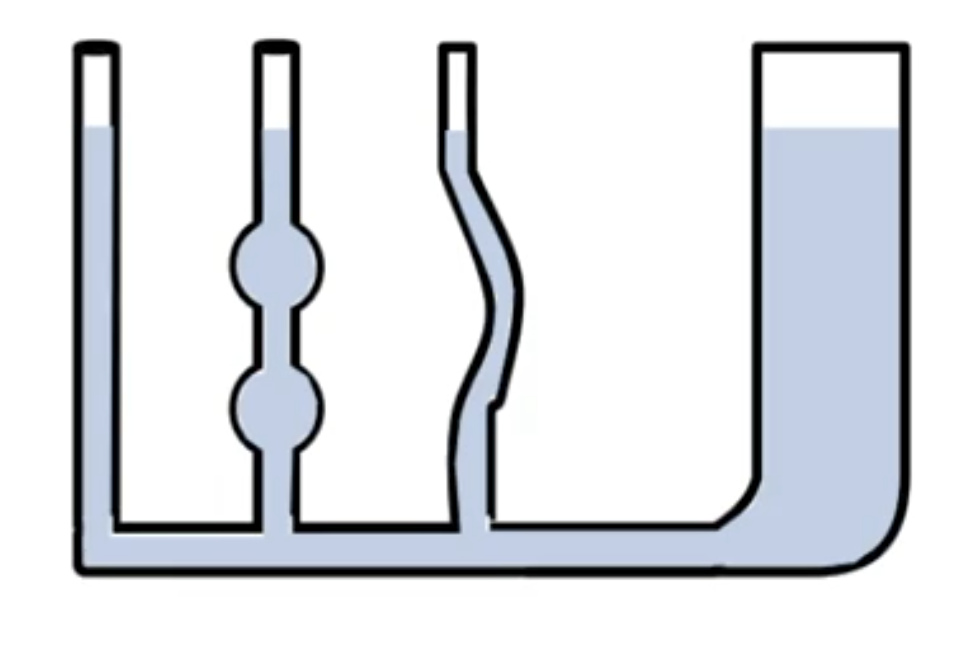
Explain why in connected columns, liquid height is the same
The pressure at the base of each tube is the same. They are in equilibrium.
Pressure difference = depth x density x gravitational field strength
Pressure in a liquid does not depend on the shape of the container
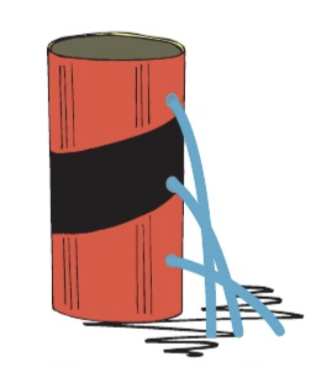
Why is water squirted further from hole 3?
Because pressure increases with depth and the holes have equal diameters. This leads to a greater force on water leaving the lowest hole and a larger horizontal velocity.
Force at the bottom = weight of water above it

