#31 ASTR 1000 Smartwork Homework
 Call Kai
 Learn
Learn Practice Test
 Spaced Repetition
 Match
Match Flashcards
 Knowt Play
1/10

There's no tags or description
Looks like no tags are added yet.
Name | Mastery | Learn | Test | Matching | Spaced | Call with Kai |
|---|
No analytics yet
Send a link to your students to track their progress
11 Terms
What can we infer from the fact that nearly all galaxies are moving away from us?
The universe is expanding.
Cosmological redshifts are calculated from observations of spectral lines from
spectra of entire galaxies.
The scale factor keeps track of:
the changing distance between any two galaxies.
What does a redshift larger than 1 indicate?
The universe has more than doubled in size since the light from that object was emitted.
The following image of the expanding rubber sheet can help us understand the scale factor of the infinitely expanding universe.
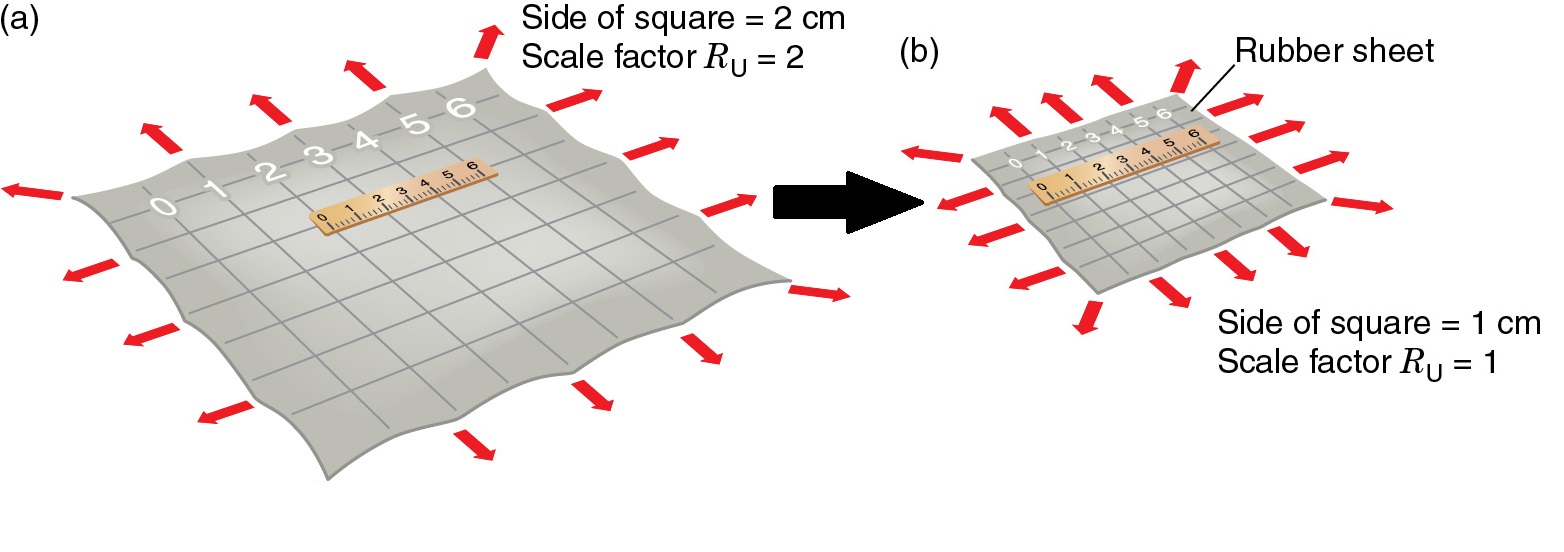
If letter (a) represents the universe as it is now, then what is the scale factor of the earlier universe (b) as observed from (a)?
1/2
The following figure illustrates a simple one-dimensional universe expanding with time.
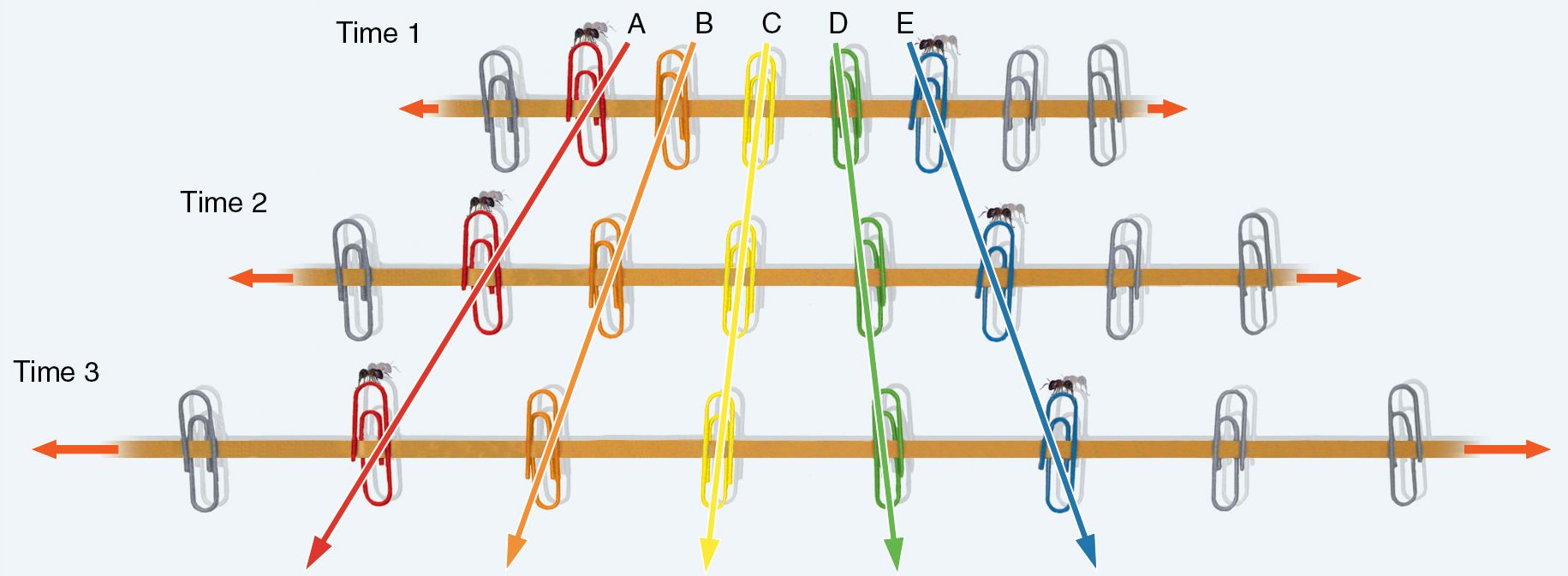
Rank the size of the scale factor of this universe at each of the times shown.
Time 1
Time 2
Time 3
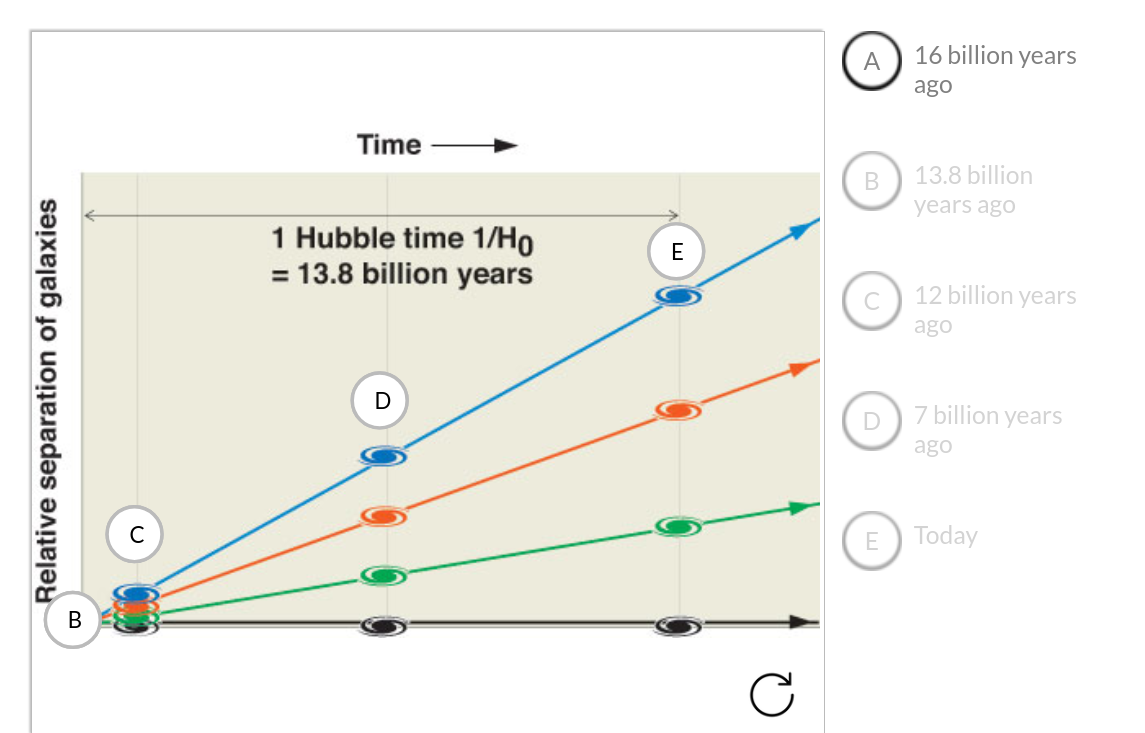
Input an appropriate timeline for the relative separation of galaxies versus time.
Using the relativistic Doppler shift shown in the following graph, calculate the scale factor of a galaxy with an observed velocity of 0.8 c.
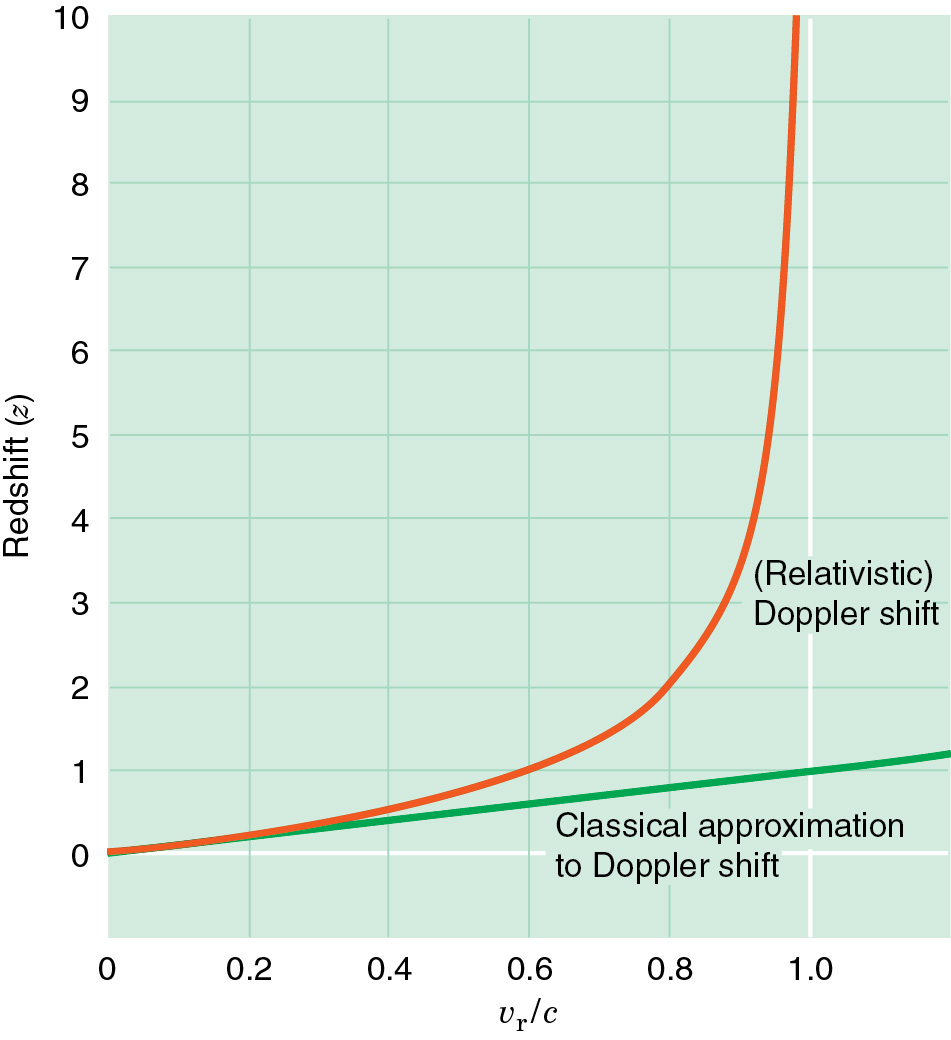
1/3
The scale factor keeps track of the
changing distances between any two galaxies.
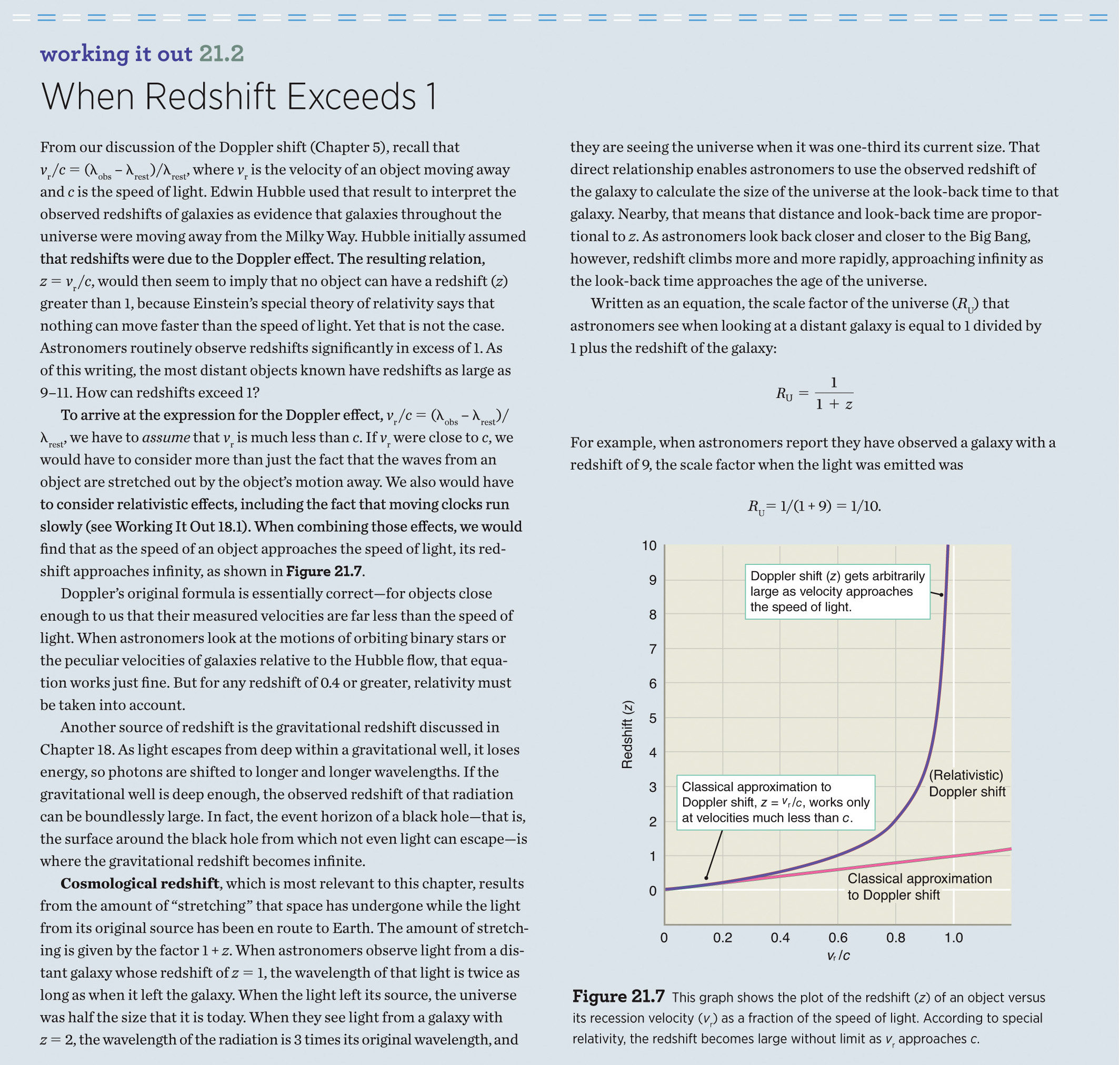
1.) What was the scale factor, Ru, of the universe (compared with the present) when the CMB was emitted, at z = 1000? Make a prediction: Do you expect the scale factor to be large (the universe was much bigger then than now) or small (the universe was smaller then than now)?
2.) Use the equation in the Working It Out example to find Ru at the time the CMB was emitted. Compared to now, how large was the universe when CMB was emitted?
The universe was smaller when CMB was emitted than now.
The universe was 1001 times smaller than now.
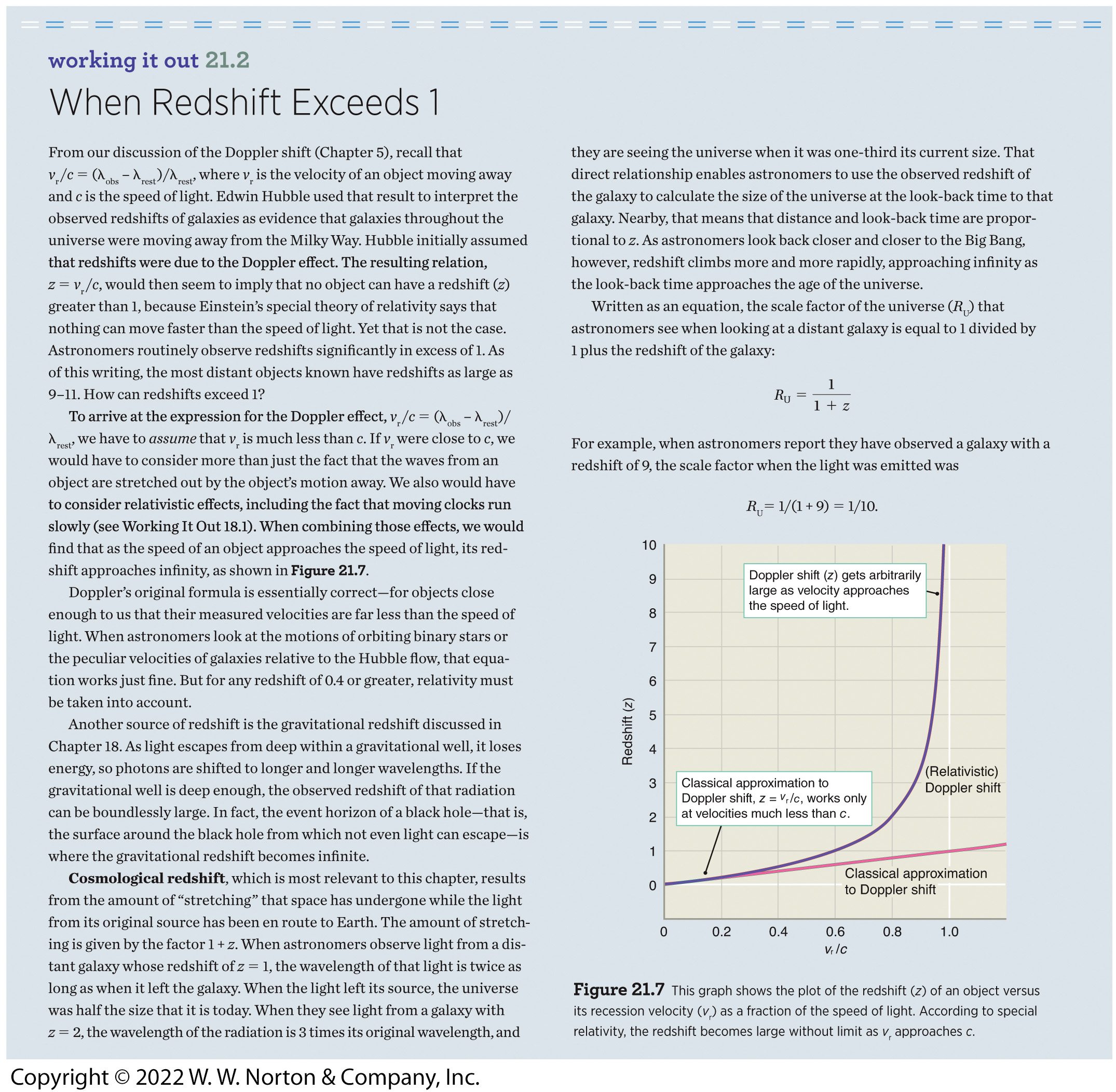
1) What is the redshift of a galaxy observed at a time when Ru was 1/4 of its current value? Make a prediction: Do you expect the redshift to be greater than or less than 1?
2) Use the equation in Working It Out 21.2 to find the redshift of the galaxy. What does this imply about the observed galaxy?
The redshift will be greater than 1.
z = 3, the galaxy is far away from the Milky Way
Explore top notes

Explore top flashcards
