OB exam 2
 Call Kai
 Learn
Learn Practice Test
 Spaced Repetition
 Match
Match Flashcards
 Knowt Play
1/105

There's no tags or description
Looks like no tags are added yet.
Name | Mastery | Learn | Test | Matching | Spaced | Call with Kai |
|---|
No analytics yet
Send a link to your students to track their progress
106 Terms
Motivation
Choice to perform, the choice of effort level, the choice to persist at a given level of effort over time.
Primary determinant of performance.
performance
a function of the interaction between an individual’s motivation, ability and environment
Predict motivation
KSAOs and job characteristics
Self-efficacy
belief in one’s capabilities to mobilize the motivation, cognitive resources, and course of action needed to meet given situational demands.
You believe you can do the task.
Relationship to performance is .38
Intrinsic motivation
doing the activity for the inherent satisfaction of the activity
Extrinsic motivation
performance to obtain an outcome.
Maslow’s Hierarchy of Needs
The most well-known theory of motivation
mixed research support
criticisms:
too simplisitic individuals have multiple needs at a time.
The hierarchy doesn’t hold – people don’t move up only when a need is satisfied.
ERG Theory
Groups Maslow’s needs into three categories
existence
relatedness
growth
Herzberg’s 2-Factor Theory
Motivation is a function of satisfaction/dissatisfaction:
Satisfaction is dependent on motivator factors.
Dissatisfaction is dependent on hygiene factors.
Very little support for this model.
Vroom’s Expectancy Theory
Human behavior is the result of conscious choices made by individuals among alternative courses of action.
Goal = maximize pleasure, minimize pain
Equity Theory
People decide equity by making social comparisons.
Compare my ratio of inputs to outcomes to another person’s ratio of inputs to outcomes.
Motivated by reducing discrepancies between these ratios.
Criticisms:
Too simplistic and rational
Predictions are often wrong
People aren’t that bothered by getting more than they deserve
Neglects individual differences
Ambiguity regarding who we compare ourselves to
Reinforcement Theory
Based on behaviorism.
Three elements: stimulus, response, reward.
Contingent rewards
Continuous rewards
Intermittent rewards
Goal Setting Theory
Most popular of all of the theories.
Goal setting theory has been backed by a ton of research.
Having performance goals increases task performance.
Difficult and specific goals are better than easy, general, or do your-best goals.
S.M.A.R.T Goals are a popular way to address this.
existence
physiological and safety
relatedness
social needs
growth
esteem and self actualization
motivator factors
Arise from conditions of the job itself. Satisfaction.
hygiene factors
Don’t lead to satisfaction, but the absence of them leads to dissatisfaction
3 components of VIE Theory
Valence
Instrumentality
Expectancy
valence
how much outcomes are valued. Do I find the outcomes desirable?
instrumentality
If i perform well, will I get what I want? Will performance lead to outcomes?
Expectancy
Will increased effort lead to good performance
Do I think I can do it? Will my effort lead to high performance?
Stress
A psychological response to demands that possess certain stakes for the person and that tax or exceed the person’s capacity or resources.
A body’s reaction to a change that requires a physical, mental, or emotional adjustment or response.
A response to a threat, depends on our perception of the threat.
Eustress
Optimal performance
Energised, focuses, work feels effortless.
General Adaptation Sydrome
Sequences the typical response to stress for chronic stress
Three Stages:
Alarm reaction stage
Resistance stage
Exhaustion stage
Alarm reaction stage
bodily reactions to stress.
Resistance stage
Cope with the original stressor; resistance to other stressors is lowered.
Exhaustion stage
resistance drops; experience burnout and mental and physical health problems.
Physical stressors
Noise
Extreme temperatures
Lighting conditions
Task stressors
workload
work hours
Role stressors
Psychological stressors
role ambiguity
role conflict
role overload
role ambiguity
the job or role is not clearly defined
role conflict
demands from different roles are incompatible
role overload
expected to fulfill too many roles at the same time
work family conflict
A specific form of role conflict.
Work demands and nonwork demands are incompatible.
This is particularly common in dual-earning families.
Telecommuting and flexible work schedules.
Psychological stressors
interpersonal stressors
Interpersonal conflict or workplace mistreatment
Can take many forms
Subtle, uncivil behaviors
Physical violence and aggression
challenge stressors
offer potential gain. Example: promotion
time pressure
work complexity
work responsibility
time demands from family, personal development, positive life events
weak correlation with job performance
moderate correlation with organizational commitment.
outcomes of stress
Physiological
Psychological
Behavior
burnout
emotional exhaustion
depersonalization
low personal accomplishment
demand control model
High demands and low control maximize stress
Two factors produce job stress:
Job Demands
Workload and intellectual requirements of the job
Job Control
Autonomy and discretion for using different skills
Person environment fit
Stress is determined by the amount of fit between the person (employee) and their environment (organization).
Fit occurs when the person’s KSAOs align with the requirements of the job.
Stress is highest when our KSAOs are not matched to our environment.
conservation of resources theory
We experience stress when our resources are depleted or threatened.
People want to maintain and build resources.
Resources include employment, financial security, self-esteem, energy, and time.
Stress occurs when there is a loss of resources or a threat of loss.
locus of control
Belief that what happens is either under your control or not.
hardiness
Characterized by control, commitment, and challenge.
Stressors as challenge, not hindrance.
self esteem
positive sense of self worth
primary prevention strategies
Reduce or remove the stressor
Job & Work Design
Change the nature of the job or work to reduce stressors
Cognitive Restructuring
Change perceptions and thought processes that lead to stress
secondary prevention strategies
Equip employees to better cope with stressors
Stress Management Training
Cognitive-behavioral skills training
Progressive Muscle Relaxation
Tightening and relaxing sets of muscles
Social Support
Comfort from social relationships
mindfulness
Equip employees to better cope with stressors
Psychological process of focusing on the present.
Bring your attention to your surroundings and the current situation.
Successful in reducing stress, increasing performance, and improving well-being.
recovery
Respite or leisure activities to alleviate consequences of stress
unwinding from the workday
High duty activities
job related activities
household and childcare
Recovery activities
low effort activities
social activiites
physical activities
Hindrance stressors
Interfere with work achievement. Example: organizational politics
role conflict
role ambiguity
role overload
daily hassles
work-family conflict, financial uncertainty, and negative life events.
weak negative correlation with job performance
strong negative correlation with organizational commitment
learning
Permanent changes in an employee’s knowledge or skill that result from experience.
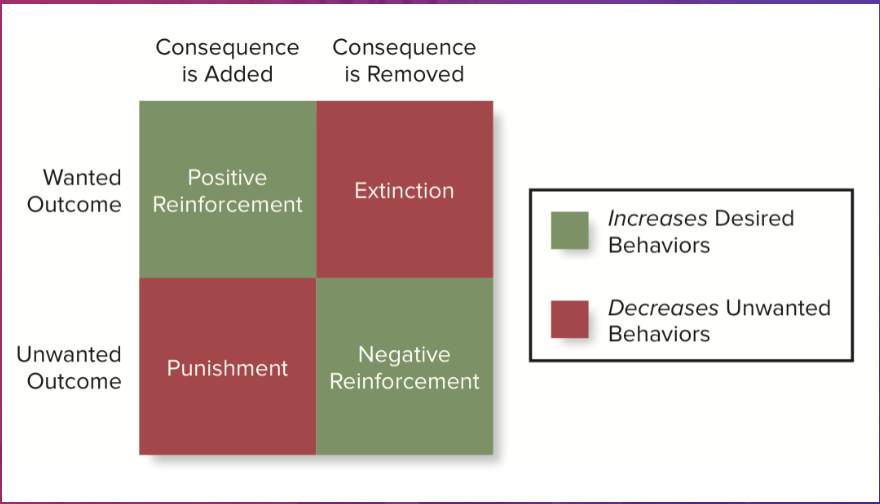
reinforcement theory
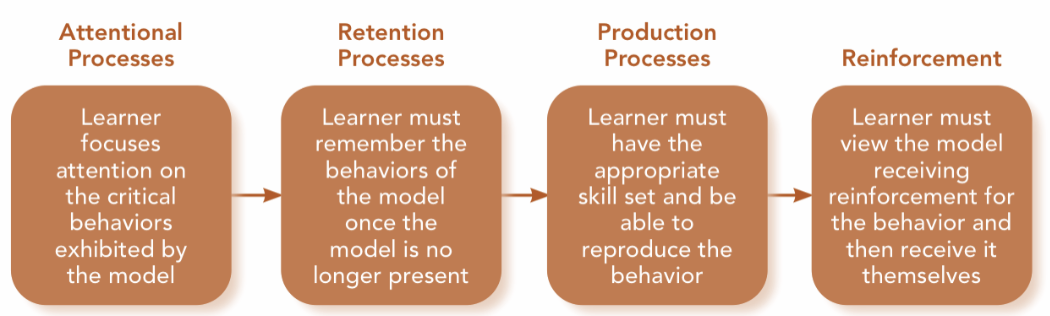
observation
learning goal orientation
goal is development
performance prove goal orientation
goal is to prove competence to others
performance avoid goal orientation
goal is to avoid failure
decision making
Making choices among alternative courses of action.
Half of organizational decisions fail.
There are many biases that lead to faulty decisions.
programmed decisions
routine decisions that have automated responses
nonprogrammed decisions
unique, infrequent decisions that require careful deliberations
strategic decisions
Top management teams, CEOs, and Boards of Directors make these decisions.
tactical decisions
Managers make these decisions
operational decisions
Employees throughout the organization makes these decisions.
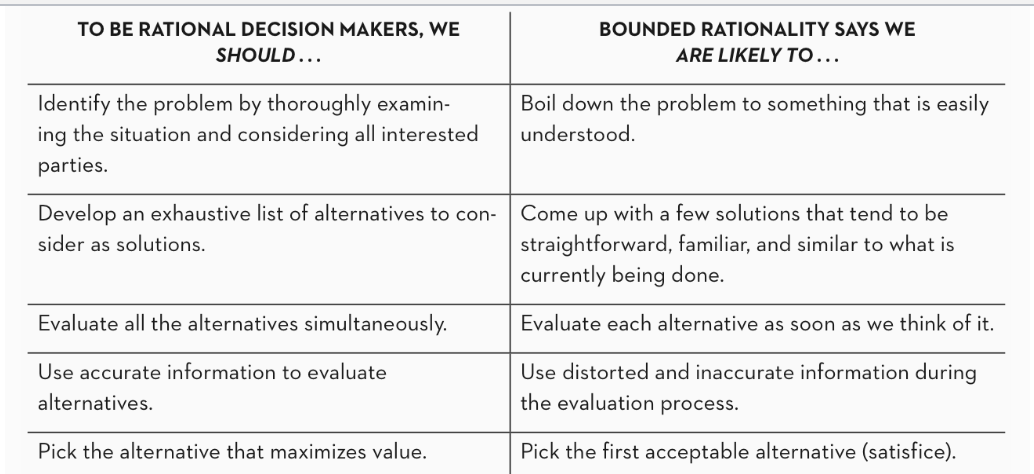
rational decision making model
one should use formal steps to arrive at a decision
bounded rationality model
recognizes the limitations of human decision making
intuitive decisions
Relying on intuition rather than rational decision making.
Very common among managers.
More likely under strained conditions.
creative decisions
generation of new, imaginative ideas
overconfidence bias
People tend to overestimate their skills and abilities
overestimation
overprecision
overplacement
hindsight bias
Mistakes others have made seem obvious after they have occurred.
Makes us poor judges of other people’s decisions.
Different from hindsight, this is the bias that we believe we could have predicted the outcome.
anchoring
Tendency for people to rely too heavily on a single piece of information.
Getting stuck at a starting point.
escalation of commitment
People continue to commit to a course of action even after indicators of failure.
Sunken costs fallacy.
We’ve come too far to go back.
limited information bias
overestimation
estimate one’s performance as better than it is
overprecision
excessive confidence in one’s knowledge
overplacement
overrating oneself compared to others
Availability Bias
Tendency to base judgments on information that is easier to recall.
Recency Bias
Tendency to weight recent events more than earlier events.
Framing bias
Tendency to make different decisions based on how a question or situation is phrased.
Attribution
Regarding something as caused by a person or thing, ascribing results to a particular person or cause.
Fundamental Attribution Error
A tendency to judge others’ behaviors as due to internal factors such as ability or attitude.
Self-Serving Bias
Attribute our failures to external factors and our successes to internal factors.
predictors of motivation
The Big Five and motivation
neuroticism: -.31
conscientiousness: .24
self efficacy
Contingent rewards
reward depends on the response
Continuous rewards
given every time a correct response occurs
Intermittent rewards
only a portion of correct responses are rewarded
positive reinforcement
positive behavior followed by positive consequences
(Manager praises the employee)
Negative reinforcement
Positive behavior followed by removal of negative consequences
(Manager stops nagging the employee)
punishment
negative behavior followed by negative consequences
(Manager demotes the employee)
extinction
negative behavior followed by removal of positive consequences
(Manager ignores the behavior)
strategies for fostering goal commitment
rewards
publicity
support
participation
resources
rewards
tie goal achievement to the receipt of monetary and nonmonetary rewards
publicity
publicize the goal to significant others and coworkers to create some social pressure to attain it
support
provide supportive supervision to aid employees if they struggle to attain the goal
participation
collaborate on setting the specific proficiency level and due date for a goal so that the employee feels a sense of ownership over the goal
resources
provide the resource needed to attain the goal and remove any constraints that could hold back task efforts.
piece rate
a specified rate is paid for each unit produced, each unit sold, or each service provided
merit pay
an increase to base salary is made in accordance with performance evaluation ratings
lump sum bonuses
a bonus is received for meeting individual goals, but no change is made to base salary. The potential bolnus represents “at risk” pay that must be re earned each year. Bas salary may be lower in cases in which potential bonuses may be large.
recognition awards
tangible awards (gift cards, merchandise, trips, special events, time off, plaques) or intangible awards (praise) are given on an impromptu basis to recognize achievement.
profit sharing
A bonus is received when a company's publicly reported earnings exceed a minimum level, with the magnitude of the bonus contingent upon the magnitude of the profits. No change is made in base salary. The potential bonus represents “at-risk” pay that must be re-earned each year. The base salary may be lower in cases where potential bonuses are substantial.
gainsharing
A bonus is received for meeting unit goals (department goals, plant goals, business unit goals) for criteria controllable by employees (labor costs, use of materials, quality). No change is made to base salary. The potential bonus represents “at-risk” pay that must be re-earned each year. The base salary may be lower in cases where potential bonuses are substantial.
Explore top notes

