Activity 5: Voltage Variation in a Capacitor
 Studied by 0 people
 Call Kai
 Learn
Learn Practice Test
 Spaced Repetition
 Match
Match Flashcards
 Knowt Play
1/16

There's no tags or description
Looks like no tags are added yet.
Name | Mastery | Learn | Test | Matching | Spaced | Call with Kai |
|---|
No analytics yet
Send a link to your students to track their progress
17 Terms
Circuits use ______ to temporarily store energy that can be released as needed.
capacitors
It exists inside a capacitor when energy is stored there
electric field
This increase happens in a curve that follows a mathematical "______" law to its maximum value, after which, the voltage will remain at this "_________" value until there is some other external change to cause a change in voltage
exponential, steady state
From the instant the voltage is applied, the rate of change of the voltage is _____
high
If voltage is applied continuously in a linear manner, the voltage would reach to its maximum value in a time equal to:
5 time constants or 5t

Equation for time constant
r is:
time constant (s)

Equation for time constant
C is:
the Capacitance (F)

Equation for time constant
R is:
the resistance (ohm)
The voltage across the capacitor, Vc at any instant time during the charging period is given as:

What is the voltage across the capacitor in trial 1 after 47 seconds?
1.926 V

From the graph, approximate VC after 47 seconds in trial 1 and compare it to the computed value using the equation
The voltage is less
Compare the voltage across the capacitor in b to its capacitance when it is fully charged. By how much has it increased?
19.3%
What is the voltage across the capacitor with 100 kΩ in trial 2 after 10 seconds? By how much has it increased?
Use Vc formula. Answer is 6.32V
Vc at any instant time during the discharging period:
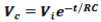
What is the voltage across the capacitor in trial 1 after 47 seconds?
8.07 V
Compare the voltage across the capacitor in a to its initial value when it is fully discharged. By how much has it decreased?
decreased in voltage after t is decreased
In activity 5, how does resistance affect the time to fully discharge in trial 2?
Resistance controls the speed of discharge because it appears in time constant
 Note
Note  Flashcards (25)