The Gilded Age (1870s-1890s) - AMSCO 6.5-6.12
 Studied by 2 people
 Call with Kai
 Learn
Learn Practice Test
 Spaced Repetition
 Match
Match Flashcards
 Knowt Play
1/30

There's no tags or description
Looks like no tags are added yet.
Name | Mastery | Learn | Test | Matching | Spaced | Call with Kai |
|---|
No study sessions yet.
31 Terms
general government policies during the gilded age
They supported laissez-faire economics, protestant work ethic and Social Darwinism. These popular ideals meant that business leaders opposed most government actions to regulate business, levy taxes, or take steps to counter serious downturns or depression. Goverments pursued policies that favored big business/wealthy WHITE elite at the expense of farmers and consumers (e.g federal land grants).
laissez faire economics
'hands off' - a theory that advocates for minimal government intervention in the economy. The theory holds that free markets and competition are the best mechanisms for regulating the economy and promoting economic growth.
Supreme Court's policy towards corporations during Gilded Age?
The Supreme Court during the Gilded Age adopted a pro-business stance and issued several landmark decisions that favored corporations over workers and consumers. The Court's rulings often struck down laws that regulated business practices, and they upheld the rights of corporations as legal persons under the law.
What did railroads contribute to society?
Railroads contributed significantly to American society by facilitating the transportation of goods and people across long distances. They also helped to stimulate economic growth by opening up new markets and reducing transportation costs.
How did the government contribute to the expansion of railroads in America?
The government contributed to the expansion of railroads in America through the passage of laws that provided land grants and subsidies to railroad companies. The government also allowed railroad companies to issue bonds and raise capital through the sale of stocks.
What did the government to regulate railroad companies during the Gilded Age
The government attempted to regulate railroad companies during the Gilded Age through the passage of several laws, such as the Interstate Commerce Act (1887) and the Sherman Antitrust Act (1890) However, these laws were often ineffective, and the railroad companies were able to maintain their dominant position in the economy.
What does it mean to say that many railroad companies formed 'pools'?
The term "pools" refers to agreements among railroad companies to fix prices and divide up the business among themselves. Pools were used to eliminate competition and maintain high profits for the participating companies.
What impacts did the railroad have on the economy and businesses?
The railroad had a significant impact on the economy and businesses by facilitating the growth of industries, such as agriculture, mining, and manufacturing. It also led to the development of new markets and the expansion of existing ones. However, it also created economic inequalities and social divisions between different regions and classes.
How were labor unions viewed by the public and the government?
Labor unions were often viewed with suspicion and hostility by both the public and the government during the Gilded Age. They were seen as a threat to the established order and were often portrayed as violent and radical.
What effect did strikes such as Railroad (1877) Pullman (1894) and Haymarket Bombing (1886) have on the perception of labor unions?
The Great Railroad Strike (1877): A strike on the Baltimore/Ohio railroads that shut down 2/3 of the countries railines caused by wage cuts during economic depression
Haymarket Bombing (1886): In response to the May Day movement calling for strike to achieve an 8 hour work day, labor violence struck. Bomb was thrown
Pullman Strike (1894): A cut in wages as announced at Pullman's Car Company for railroad cars and people appealed to the ARU. A strike ensued
The strikes and bombings had a significant impact on the perception of labor unions, as they were portrayed in the media as violent and subversive. The events also led to a crackdown on labor unions by the government and employers, which further marginalized their influence.
What were some effective ways to break strikes?
Employers often used a variety of tactics to break strikes, including hiring replacement workers, using violence and intimidation, and seeking injunctions from the courts to limit the activities of the unions.
Success/Failures of Labor Unions
Labor unions had mixed success during the Gilded Age, as they were able to secure some gains for workers, such as higher wages and better working conditions. However, they also faced significant opposition from employers and the government, which limited their ability to organize and bargain collectively
American Federation of Labor (1886)
The American Federation of Labor (AFL) was a labor union formed in 1886, representing skilled workers in various industries. Led by Samuel Gompers, the AFL focused on collective bargaining and advocated for better working conditions, higher wages, and the eight-hour workday.
robber baron
Historians use this term to describe some of the industrialists of the Gilded Age who were accused of using unethical and ruthless business practices, such as exploiting workers and manipulating markets, to amass their fortunes (e.g Vanderbilt: railroad monopoly and poor labor polices)
captains of industry
This term is used to describe industrialists who were viewed as leaders in the development of American industry, creating jobs, and contributing to economic growth (e.g Pillsbury - unique innovations that boosted flour industry, philanthropist and decent labor practices)
Social Darwinism
The belief is that Darwin's ideas of natural selection and survival of the fittest should be applied to the marketplace. Society should do as little as possible to interfere with people's pursuit of success. Society would benefit from success of the fit and weeding out wealth.
Bessemer process
The Bessemer process was a method of producing steel in large quantities by blowing air through molten iron to remove impurities and increase carbon content.
monopoly and oligopoly
A monopoly is a company that dominates a market so much that it faces little or no competition from other companies (e.g Standard Oil Trust Rockefeller). An oligopoly is a market dominated by a few large profitable firms (e.g airlines). The issues with monopolies was that they were bad for the conomy for they subverted mopolies, slowed down innovations, overchaged consumers and developed political influence.
Andrew Canegie and "Gospel of Wealth" (1889)
Andrew Carnegie was a Scottish-American industrialist who became one of the wealthiest men in America through his leadership in the steel industry. His "gospel of wealth" argued that the wealthy had a responsibility to use their wealth for the betterment of society, promoting philanthropy and charitable giving.
Cornelius and William Vandebilt
Cornelius Vanderbilt was an American entrepreneur who built a shipping and railroad empire in the 19th century, becoming one of the wealthiest men in the country. William Vanderbilt was his son and successor, who expanded the family's wealth through investment in railroads and other industries.
J.P Morgan
J.P Morgan was one of the most powerful bankers/financers. He founded J.P Morgan and Co (a bankhouse), a firm involved in funding and reconstructing various industries (steel and railroads). When a financial panic in 1893 forced 1/4 of all railroads into bankruptcy, bankers led by J.P Morgan worked quickly to consolidate them. This eliminated competition and formed an oligarchy who dominated boards by interolecking direcoarates.
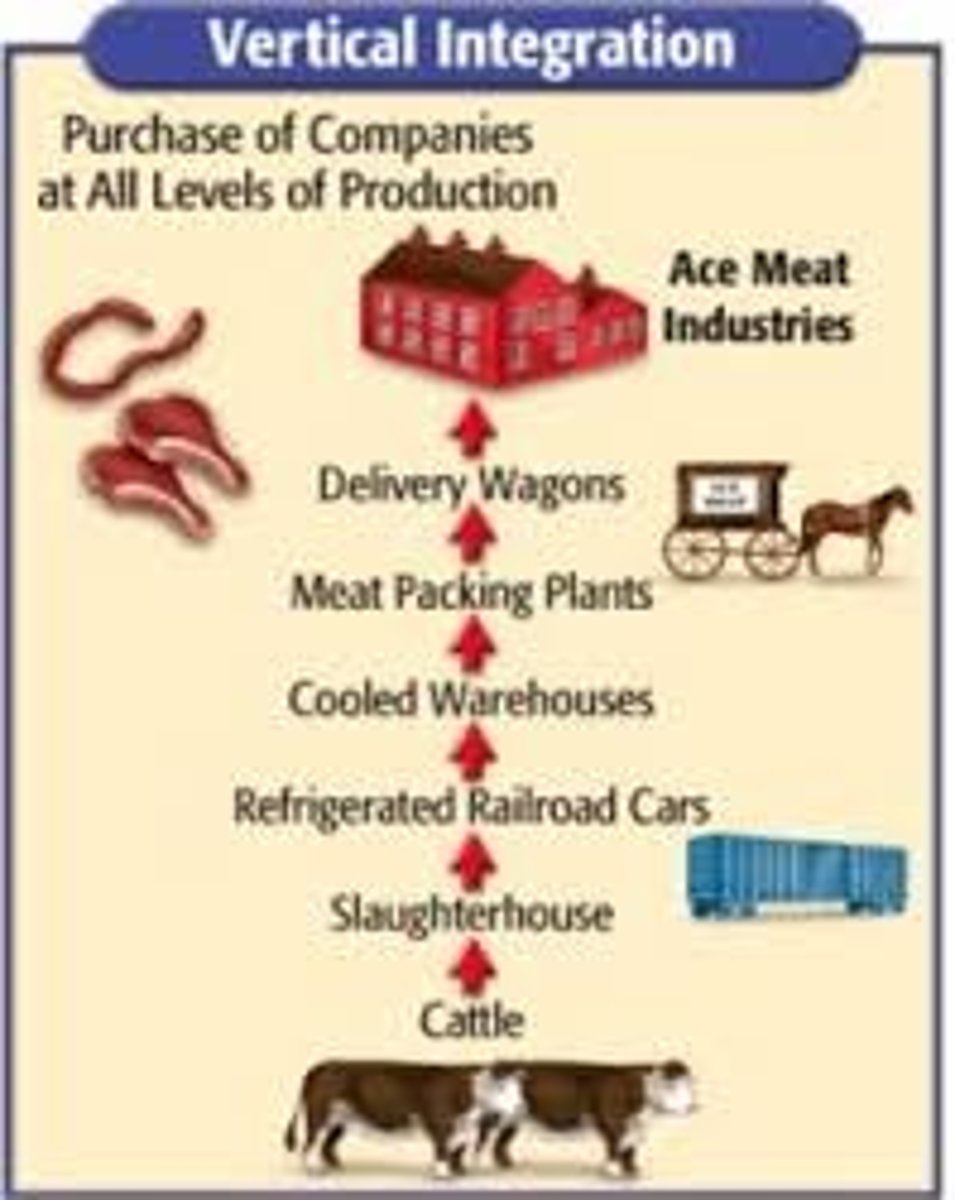
vertical intergration
involves a company owning and controlling all aspects of production, from raw materials to distribution
(e.g Carnegie Steel)
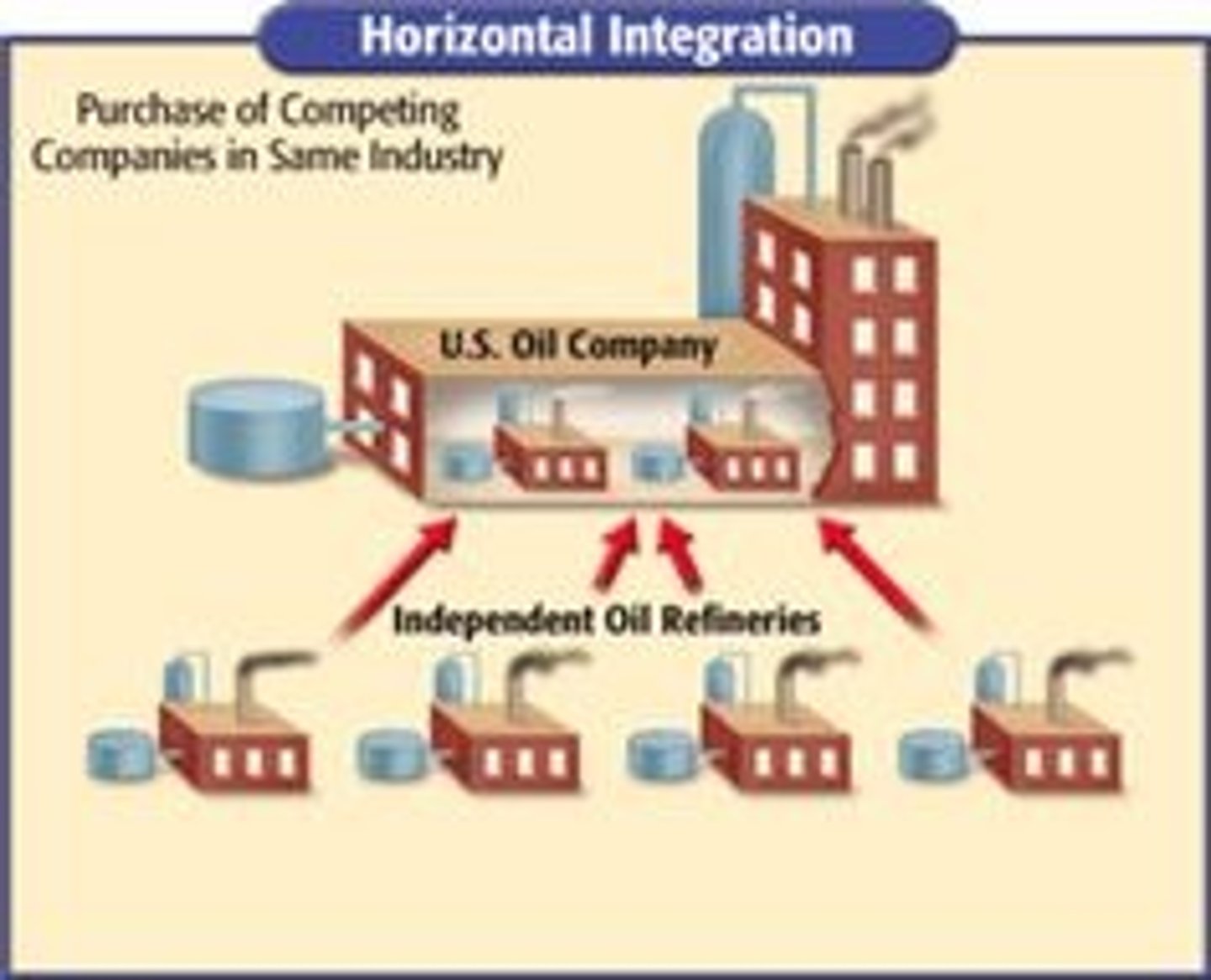
horizontal integration
involves a company acquiring other companies that produce the same or similar products (e.g Rockefeller Oil consolidating many firms into the same business)
Sherman Antitrust Act (1890)
The Sherman Anti-Trust Act was a federal law passed in 1890 that aimed to prevent the formation of monopolies and promote competition in the marketplace by prohibiting anti-competitive business practices.
push and pull factors that drove immigrants to America
Pushes
- poverty of displaced farmworkers driven from land by political turmoil and mechanism of farmworker
- overcrowded and joblessness in European cities as a result of growing population
- religious persecution
Pulls
- US = political/religious freedom, economic opportunities because of West ward settelement and industrial jobs in the city
( note: economic opportunities fluctuated based on US economy)
- introduction of large steamships and oneway passage made it possible for people to immigrat
"old" immigrants (pre 1880s)
- North and West Europe (e.g British Isles, Germany, Scandinvia)
- Mostly protestant
- english speaking, high literacy levels, and occupation skills made it easy for them to blend into rural society
- Irish and German Roman Catholics faced discrimination
"new" immigrants (1890s-WWI)
- South and East Europe (Italian, Greek, Croat, Pole, Slovak, Russian)
- poor and illeterate peasants fleeing autocracy
- largely Roman Catholic, Greek/Russian Orthodox, Jewish
- settled in poor ethnic neigbohoods in major cities
- 25%: birds of passage - young men contracted for unskilled labor who would go home to give $ to family
- faced more challenges in assimilating to American society
settlement houses
Settlement houses were community centers that provided social services and education to immigrants and the poor. They were staffed by middle-class volunteers, often women, who sought to improve the lives of the less fortunate. Also helped the next generation move up in social ranks
(e.g Hull House and Jane Addams 1889)
realism and "first great realist"
Realism emerged as a defining characteristic of the Gilded Age, representing a shift from the romanticized and idealized narratives of earlier periods. Authors sought to depict life authenticity (depicted political and social critiques. The first realist author was Mark Twin ("The Adventures of Huckleberry Finn" 1884 - depicted greed, violence, and racism in American Society).
What contributed to the growth of sports & entertainment in the Gilded Age?
The growth of leisure time (amuesement parks, music, spectator sports etc) was caused by high incomes, a gradual reduction in working hours, improved transportation, promotional billboards and advirtsement and decline of restrictive Puritian and Victorian values that discouraged 'wasting' time on play.
political machines and role in the Gilded Age
Political machines were a tightly organized group of politicians who welcomes newly arrived immigrants to gain loyality in future elections. Each machine had a 'boss', a top politican who gave orders to rank and doled out government jobs to loyal supporters (e.g Tammany Hall in NYC started as social clubs, then developed into power centers to coordinate needs of immigrants, businnsees and underpriviledged). In turn, machines asked for people's votes. In terms of the Gilded Age, they controlled many city politics, instrumental in modernizing American cities by pushing infastructure projects, and heavily involved in helping immigrants arriving in large numbers.
(e.g Boss Tweed and Tammany Hall)
 Note
Note  Flashcards (53)