Lecture 5 - Methods & Perception, Knowledge and Action in Infancy
 Studied by 0 people
 Call with Kai
 Learn
Learn Practice Test
 Spaced Repetition
 Match
Match Flashcards
 Knowt Play
1/95

There's no tags or description
Looks like no tags are added yet.
Name | Mastery | Learn | Test | Matching | Spaced | Call with Kai |
|---|
No study sessions yet.
96 Terms
preterm birth
• <37 weeks (considering pregnancy of 40 weeks)
• immature (<28 weeks) to slightly premature (<37 weeks)
• 10% of cases = preterm birth
• from ~24 weeks active help → at 24 weeks infant able to live outside womb
maturation
• aspects of development that are largely under genetic control, and hence largely uninfluenced by environmental factors.
‘folk’ theories of development
• ideas held about development that are not based upon scientific investigation.
paradigm
• literally, a pattern or sample, the term is now frequently applied to a theoretical or philosophical framework in any scientific discipline → e.g. organismic world view is a paradigm
organismic world view
• the idea that people are inherently active and continually interacting with the environment, and therefore helping to shape their own development. Piaget’s theory is an example of this world view.
mechanistic world view
• the idea that a person can be represented as being like a machine (such as a computer), which is inherently passive until stimulated by the environment.
behaviourism
• the theoretical view, associated with J.B. Watson and B.F. Skinner, that sees directly observable behaviour as the proper focus of study, and that sees the developing child as a passive respondent to conditioning, reinforcement, and punishment.
cross-sectional design
• a study where children of different ages are observed at a single point in time.
longitudinal design
• a study where more than one observation of the same group of children is made at different points in their development.
cohort
• a group of people who were raised in the same environment or who share certain demographic characteristics.
microgenetic method
• a method that examines change as it occurs and involves individual children being tested repeatedly, typically over a short period of time so that the density of observations is high compared with the typical longitudinal study.
cohort effects
• design problem → particularly relevant for studies covering large age range
• when changes across generations occur in characteristic one is interested in
intelligence test
• Any test that aims to measure an individual’s intellectual ability.
sequential design
• a combination of longitudinal and cross-sectional designs that examines the development of individuals from different age cohorts.
What are strengths of longitudinal designs? (3)
• effects can’t be attributed to cohort differences
• association between measurements at different ages (measurement equivalence, stability)
• individual curves of development (continuous vs. discontinuous)
What are weaknesses of longitudinal designs? (5)
• expensive (in cost and time)
• dropout of subjects
• different measurement instruments (e.g. intelligence is measured differently at different ages)
• possible practice effect
• not always possible to generalize to other cohorts
observational studies
• studies in which behaviour is observed and recorded, and the researcher does not attempt to influence the individual’s natural behaviour in any way.
Why do you use observational studies?
• often used in context where people can’t reliably complete questionnaires or probably don’t understand questions in interviews
What are possible weaknesses observational studies? (4)
• selectivity, subjectivity, absence of base rate/standardization, (in)stability of perception → interrater reliability crucial for observational studies
observation units
• molecular
• molar
molecular observation units
• more objective and higher reliability of assessor
molar observation unit
• more interpretation
Where can you conduct observational studies?
• laboratory
• simulated setting
• natural environment
experimental methods
• experimental methods control an individual’s environment in systematic ways in an attempt to identify which variables influence the behaviour of interest.
psychological tests
• instruments for the quantitative assessment of some psychological attribute or attributes of a person.
correlational studies
• studies that examine whether two variables vary systematically in relation to each other, e.g. as height increases, will weight reliably increase also?
baby biographies
• diaries detailing an infant’s development, usually kept by the infant’s parents or caregiver. Charles Darwin’s biography of his eldest son’s development is a well-known example.
Time sampling
• an observational study that records an individual’s behaviour at frequent fixed intervals of time.
affect
• emotional state or feelings. Contrast with behaviour (what one does in a situation) and cognition (how one thinks about a situation).
event sampling
• an observational study which records what happens during particular events. Events studied include playing, bath-time, feeding, and reading.
clinical method
• research method first used by Piaget whereby natural behaviour is observed and then the individual’s environment is changed in order to understand better the behaviour of interest.
What are strengths/weaknesses of correlational studies?
• strengths: association between variables, ecologically valid
• weaknesses: no causal relationships can be established
What are strengths/weaknesses of experimental studies?
• strengths: manipulation of variable → causal relation can be established
• weaknesses: often not ecologically valid, sometimes unethical
How can we find evidence for causality without experimentation?
• exclude alternative explanations → control for background variables
• do that through: matching of groups (e.g. on SES, educational attainment of parents, …), calculating partial correlations
independent variable
• a factor or variable in a study or experiment which can be systematically controlled and varied by the experimenter to see if there are changes in the child’s response. The behaviour that changes is called the dependent variable.
dependent variable
• the behaviour that is measured or observed in a study. Changes in the behaviour are dependent on, that is, caused by, changes to the independent variable.
structured observation
• an observational study in which the independent variable is systematically controlled and varied, and the investigator then observes the child’s behaviour. Similar to an experiment but the degree of control is less precise than in a laboratory setting.
personality trait
• facet of a person’s character that is relatively stable. Examples of personality traits include shyness, extraversion, and confidence.
extraversion
• a personality variable. Someone who scores highly on an extraversion scale will typically be an outgoing and confident person.
introversion
• a personality variable. Someone who scores highly on an introversion scale will typically be very quiet and reserved.
experimental group
• the group of individuals who receive a particular treatment or manipulation. In order to measure the effectiveness of the treatment, their results are compared with those from a control group that does not receive the treatment.
control group
• In order to evaluate the effectiveness of a particular treatment or manipulation, the control group is that group of individuals in an experiment who do not receive the treatment. Their behaviour is then compared with that of the experimental group, which does receive the treatment.
concurrent study
• concurrent correlational study: where we are interested in relationship between variables that are measured at the same time
predictive study
• predictive correlational study: where we are interested in finding whether individuals retain relative standing/rank order relative to others over time
marker task
• a method designed to elicit a behaviour with a known neural basis.
smooth pursuit
• eye movements in which the point of gaze stays more or less locked on target as an object moves back and fort
measurement equivalence
• measurements at different ages allow for same interpretation
reliability
• how many measurement errors? → test-retest, internal, interrate
validity
• do I measure what I want to measure → construct, ecological, predictive
medial temporal (MT) area
• a specific area of the visual system. The development of this area and its connections with other parts of the visual system is responsible for the onset of smooth pursuit in humans.
imaging methods
• methods of recording brain activity.
electroencephalogram (EEG)
• a scalp recording done with electrodes that measure electrical activity produced by neurons.
event-related potential (ERP)
• scalp recordings in which brain activity is monitored during the presentation of specific perceptual events.
positron emission tomography (PET)
• an imaging method measuring cortical activity. PET works by measuring blood flow to tissues in the body, including tissues in the brain; blood flow is localised to regions of high activity.
functional magnetic resonance imaging (fMRI)
• an imaging method measuring cortical activity, which works by measuring blood flow, and involves no invasive procedures.
ecological validity
• the results obtained from a study are ecologically valid if they are meaningful in the real world.
catharsis hypothesis
• the argument that watching aggressive tendencies in others will reduce your own feelings of aggression → wrong
social policies
• actions, rules, and laws aimed at solving social problems or attaining social goals, in particular intended to improve existing conditions.
Head Start and Sure Start
• A federally supported programme in the United States with five components:
(1) preschool enrichment education
(2) health screening and referral services
(3) nutrition education and hot meals
(4) social services
(5) parent education and involvement.
• Research has indicated that children’s cognitive and language development is enhanced during the period that they are participating in a Head Start programme → British equivalent is called Sure Start.
developmental functions
• typical trends in development; for example, we typically get more intelligent as we age.
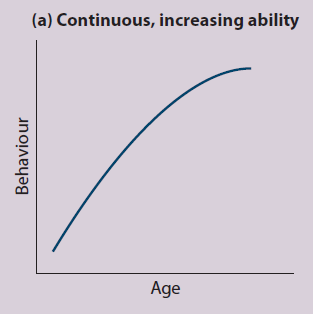
continuous function – increasing ability
• behaviour that improves with age. For example, during the first year of life the precision with which infants reach for objects increases.
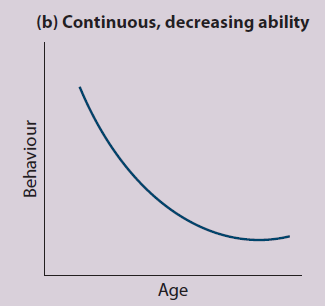
continuous function – decreasing ability
• behaviour that gets worse as we age. For example, young infants can initially distinguish non-native speech sounds very easily; however, for many sounds they lose this ability after their first year of life.
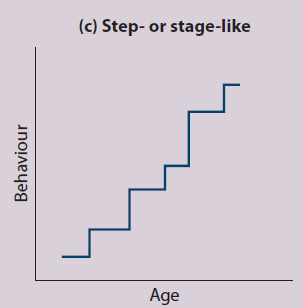
discontinuous (step) function
• where development takes place in a series of stages, where each new stage appears to be qualitatively different from the preceding (and following) stages.
theory of mind
• the understanding that different people may have different emotions, feelings, thoughts, and beliefs from one’s own.
moral judgement stages
• Piaget described two stages in the development of moral reasoning: heteronomous and autonomous.
• Kohlberg described five stages: punishment and obedience orientation, instrumental morality, interpersonal normative morality, social system morality, and human rights and social welfare morality.
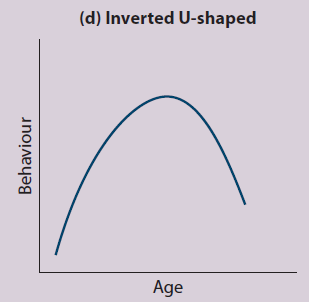
U-shaped functions
• behaviour where ability is initially very good, then decreases, and then increases again follows an (upright) U-shaped function of development.
• inverted U-shaped function follows the opposite trend, initially poor, then getting better, and then becoming poor again.
fear of depth
• develops 6 weeks after start of crawling → test through visual cliff
visual preference method
• assumption: longer looking time → preference/interest, being able to distinguish stimuli
• 2 visual stimuli available → for visual preference method with head turn: infant needs to turn head in one of two directions
• dependent measure: fixation time to one versus other stimulus → scoring by researcher/eye tracker
→ no difference in looking time tells us nothing
habituation
• repetition of stimulus reduces attention (infant gets bored)
dishabituation
• attention recovers when new stimulus is presented → conclusion: infant can distinguish between two stimuli
cognitive development
• the development of behaviours that relate to perception, attention, thinking, remembering and problem-solving.
mental representation
• an internal description of aspects of reality that persists in the absence of these aspects of reality.
visual acuity
• the ability to make fine discriminations between the elements in the visual array.
visual accommodation
• the ability to focus on objects irrespective of their distance from the eye. Therefore, as an object moves closer toward us, it does not appear to go in and out of focus.
visual preference method
• method to determine whether infants have preferences for certain stimuli, they are shown two objects (usually 2-D pictures) side by side, and the amount of time they spend looking at each one is then compared.
habituation/recovery
• the process by which attention to a stimulus gradually declines over time and recovers when a new stimulus is presented. Sometimes named habituation/ dishabituation.
size constancy
• understanding that an object remains the same size despite its retinal image size changing as it moves closer to or away from us.
shape constancy
• understanding that an object remains the same shape even though its retinal image shape changes when it is viewed from different angles.
retinal image size
• the size of a visually perceived object on the retina of the eyes. This image will vary depending on the real size of the object and its distance from the observer.
Object unity
• understanding that an object is whole or complete even though part of it may be hidden.
common motion
• one principle infants use to perceive object unity
• means fact that e.g. upper and lower portions of rod move at same time and in same direction
trajectory continuity
• understanding that an object moves behind an occluder, when the object is totally invisible for a period of time before and after it moves
subjective contour
• when only parts of an object are presented, the remaining contours are ‘filled in’ in order that the complete shape can be perceived.

prototypical face
• the most typical example of a face. Produced when many different faces are averaged.
innate mechanism
• a mechanism or ability that does not need to be learned, something we are born knowing.
intonation
• the rhythmic pattern of speech. For example, the meaning of a sentence is changed when the ending has a raised pitch, e.g. ‘He didn’t come’ versus ‘He didn’t come?’
infant-directed speech (motherese)
• the speech that adults and children over 4 years old use when addressing an infant.
cognition
• psychological processes that involve mental representations and thus that go beyond perception.
object permanence
• the ability to understand that even if an object is no longer visible, it continues to exist.
A not B error
• an object-searching error that is often made by 8–12-month-olds. Infants making this error will look for an object where they have most often found it (location A) rather than where they last saw it hidden (location B).
violation of expectation technique
• infants are shown an event and are then shown two new events, one of which is consistent with everyday reality (possible), and the other inconsistent (impossible). Infants will typically look longer at the impossible event because it violates their expectancies.
core knowledge
• basic information about the world, particularly knowledge about the physical properties of objects, available to the very young infant and probably innate
subitising
• the ability to perceive directly the number of items without consciously counting them or using another form of calculation. This ability only applies to very small numbers.
response perseveration
• repeating a previously learned response usually when it is no longer appropriate.
frontal cortex
• one of the four main lobes of the cerebral cortex. It is involved in emotional experiences and many cognitive abilities, such as problem-solving, planning and judgment.
executive functions
• the process whereby behaviour is directed and controlled in order that the desired goal will be achieved.
 Note
Note  Flashcards (97)