Marketing Flashcards
 Call Kai
 Learn
Learn Practice Test
 Spaced Repetition
 Match
Match Flashcards
 Knowt Play
1/113

There's no tags or description
Looks like no tags are added yet.
Name | Mastery | Learn | Test | Matching | Spaced | Call with Kai |
|---|
No analytics yet
Send a link to your students to track their progress
114 Terms
Four Conditions that Guarantee Business Cycle: boom to bust
The belief that growth is assured by an expanding and more affluent population
The belief that there is no competitive substitution for industry’s major product
too much faith in mass production and in production and in the advantages of rapidly declining unit costs as output rises
preoccupation with a product that lends itself to carefully controlled scientific experimentation, improvement, and manufacturing cost reduction
shadow of obsolescence
When an industry is within a growth phase, there seems to be no substitute for it, but when an industry is growing, it is growing at the expense of another - zero-sum game, but with products
the belief there is no competitive substitution for the industry’s major product
there is always competition, a false illusion of indispensability - oil companies thought they had no competition until gasoline emerged as a consumer forward product, no guarantee against a product’s obsolescence, even if it is as generic as oil
the belief that growth is assured by an expanding and more affluent population (population myth)
harmful to believe that as the population rises, demand for your product will rise, if there is no innovation within industry it is not safe to assume demand will increase
too much faith in mass production and in the advantages of rapidly declining unit costs as output rises
dangerous for a growth company to focus more on mass production than marketing, firms should be “marketing-minded” and create value-satisfying goods and services that consumers actually want to buy, sellers should take cues from buyers so that the product becomes a consequence of marketing effort not vice versa
creative destruction
don’t focus on the product, focus on the experience
product provincialism
the dangers of narrow minded focus on producing specific goods, rather than satisfying customer needs
dangers of R&D
marketing should not be treated as a residual activity, market becomes a step-child in this scenario and is neglected, focus on experimentation and study leads to forgetting realities of the market
Elements of Value
functional
emotional
life changing
social impact
When combined optimally, they increase customer loyalty and revenue growth
functional element of value
help consumers interact with the outer world, saves time, avoids hassle, reduces effort, simplifies/reduces risk, organizes, integrates, connects, reduces costs, quality, variety, sensory appeal, informs, makes money
emotional element of value
reduces anxiety, rewards person, nostalgia, design/aesthetic, badge of value, wellness, therapeutic value, fun/entertainment, attractiveness, provides access
life changing element of value
inward - provides hope, self-actualization, motivation, heirloom, affiliation/belonging
social impact element of value
self-transcendence
companies should improve value in 3 areas
new product design
pricing
customer segmentation
patterns of value
Some elements matter more than others - perceived quality is most important
Consumers perceive digital firms as offering more value
brick and mortar businesses can still win on certain elements - omnichannel retailers (emotional and life-changing elements)
value in use
the extent to which we achieve our goals through using a product or service
experience quality
customer’s perception from the holistic brand encounter of the brand’s contribution to the value-in-use they seek
myths about customer experience
Experience is only about entertainment (it has 3 layers: product, service, environment)
Differentiation occurs by creating great experiences, which may be quite unrelated to the product or service sold
We need to optimize satisfaction scores with every aspect of the experience
case study of the advantages of designing customer experiences with value-in-use in mind
London Symphony Orchestra - the scope for differentiation within the London orchestra was in the outer layer of the environment
case study for how to change your experience to increase value-in-use
lucozade - changed from recovery drink to energy drink
case study how to segment by value-in-use
iphone - some people want iphone to take pictures, some for computer chip nerd reasons lol - marketed differently to different consumers
the outdated funnel metaphor
consumers start at the wide end of the tunnel, many brands and narrow them up as they make a final choice
the new consumer journey
Consumers add and subtract brands from a group under consideration during an extended evaluation phase
todays decision journey
consider
evaluate
buy
enjoy, advocate, bond
C.E.B.E.A.B. - considering everything Bob eats, apples bewilder
three new roles
the orchestrator
publisher and content supply chain manager
marketplace intelligence leader
two important aspects of competitive positioning
understanding the frame of reference within which their brand’s work
addressing the features that brands have in common with competitors - points of parity
frame of reference
defines a specific market segment, category, or competitive space in which a brand competes
brand performance association
relate the ways in which a product or service attempts to meet consumers’ functional needs
does the product benefit from consumption?
is the brand reliable, durable and how good is the serviceability?
service effectiveness, efficiency, and empathy; speed and courtesy of the service
style and design
value and price
brand imagery associations
When you are making a choice based on experience, such as where to get a haircut or eat dinner, established by depicting who uses the brand and under what circumstances
consumer insight associations
shows consumers insights into problems, used when a brand’s performance and imagery don’t differ much from the competition, ex. ad for jeans recognizes the struggle of getting jeans to fit right
desirability
a point of difference must be perceived by the brand’s audience as both relevant and believable
deliverability
point of difference need to meet three deliverability criteria:
Creating a point of difference must be feasible. you can’t have impossible promises
Positioning on a particular benefit must be profitable. you can’t bleed money
positioning must be preemptive, definable and difficult to attack
sequencing
the timing at which information is introduced to consumers: establish it tastes good before you say its healthy
leveraging an unconnected attribute
ex. getting an influencer to promote products
brand extension
launching a new product or service under an existing brand name
fit-as-similarity (traditional)
similarity between the parent brand extension category and the dominant product brand extension literature
High similarity: Colgate → mouthwash
Low similarity: Harley Davidson → wine coolers
fit-as-relevance (association relevance)
whether parent brand associations provide relevant benefits in the extension category - even dissimilar categories can ‘fit’ if association transfer
Caterpillar → boots
Coca-Cola → lip balm
service brand associations
carry transcending service attributes, outcome quality, interaction quality, and service environment quality, dimensions: reliability, responsiveness, assurance, empathy, tangibles
why are services different
evaluated on global service quality, which is abstract and transferable
not tied to specific product attributes - Vodafone extension into banking, travel, insurance, streaming
Associations are geared more towards experience than product
steps to launching a brand
decide if brand is extension or a new brand
almost always preferable to have extension rather than new
leverage existing brand - halo effect
ex. apple ipod - halo effect because people like apple already
when company lacks existing brand extensions that fit - create new company - ex. pantene under procter and gamble or lexus under toyota
brand positioning: frame of reference, points of parity and difference
the way the company intends on being perceived in market
brand image is how consumers see the brand
must have:
clear frame of refernce
points of parity
points of difference
build brand awareness: perceptual prominence and perceptual difference
perceptual prominence is staying at top of consumers mind - easily noticed and recalled by consumers
perceptually different from pioneer, instead of merely imitating it
two aspects of packaging
out-intermediate-inner
outer - box it comes in
intermediate - bottle, the holder, etc.
inner - shape, color, form of product
purchase-consumption layer
store etc.
sensory marketing
marketing that engages consumers’ senses, perception, judgement, and behavior
types of sensory marketing
color engagement
olfactory cues
haptic engagement
auditory engagement
perception
what drives consumer behavior
grounded cognition theory
thought is rooted in bodily/sensory experience, not purely abstract
types of touch
instrumental (touch for function/purchase reasons)
autotelic (touch for pleasure/emotional reasons)
law of contagion
proximity not just contact changes perception of items
smell findings
flat forgetting curve (-60-75% after 1 year, picture recognition drops to 58% after 4 months)
autobiographical memory (evoke more detailed memories than other scences)
ambient scent (increases brand recall)
product scent (scented v unscented pencil sales)
scent & pictures (superadditive effect on verbal recalls)
congruent scent theory
enhance consumer behavior, memory, and satisfaction when they align with brand image, product, or environmental context - boosts information processing fluency and more positive product evaluations and higher purchase intent
sound features
sound symbolism (word sounds shape perception)
language (english in ads = modernity, native=closeness/in-group)
music in ads (affects mood and involvement)
ambient music (slower music, slower shopping, more purchases)
voice (low-pitched, authoritative, faster - more competent)
highly susceptible to external influences
color
brand name
ingredient disclosure
ad copy
‘healthy’ framing
cognitive load
grounded cognition
Cognition is not purely abstract. It is grounded in bodily states, situated actions, and mental simulation
grounded emotion
Emotion is physically embodied - blocking smile muscles reduces the ability to recognize joy/sadness
sensory metaphors
Physical and social warmth share a neural substrate (insula): fishy smells trigger suspicion
areas that need further study (Krishna)
interaction of senses (cross-modal effects)
sensory dominance and conflict
sensory overload
sensory imagery and sensory load
grounded emotion
a-modal information affecting perception
individual differences in need for sensory input
7 myths about maximizing brand community value for a firm
a brand community is marketing community is a myth. In reality, a brand community is a business community
a brand community exists to serve the business. in reality, brand community exists to serve the people in it
build the brand and the community will follow. in reality, engineer the community and the brand will be strong
brand communities should be love-fests for faithful brand advocates. In reality, smart companies embrace conflicts that make communities thrive
opinion leaders build strong communities. In reality, communities are strongest when everyone plays a role
online social networks are the key to community strategy. In reality, online networks are just one tool, not a community strategy
successful brand communities are tightly managed and controlled. In reality, they are controlled of and by the people, communities defy managerial control.
script
a set of expected behaviors in a particular social setting - management reinforce
traditional view of how brand community practices create value
firms create value and consumer consumes
revised view of how brand community practices create value
value in co-created within brand communities via practices (not just individuals)
shares, repeated activities (‘practices’) within brand
Service-Dominant (S-D) Logic:
consumers act as:
operant resources - active contributors
operand resources - inputs into value creation
anatomy of a practice
procedures - rules, instructions
understandings - tacit skills, know-how
engagements - emotional commitments and purpose
12 value-creating practices
social-networking (homogeneity, emotional ties)
welcoming - integrating newcomers
empathizing - emotional/functional support
governing - enforcing norms
impression management (external focus)
evangelizing - promoting the brand to outsiders
justifying - rationalizing brand devotion
community engagement (heterogeneity, status)
staking - defining roles/identity
milestoning - celebrating key events
badging - symbolic markers of status
documenting - narrating brand journey
brand use (product-focused)
grooming - maintaining optimal use
customizing - modifying the product
commoditizing - regulating marketplace behavior
how practices create value for consumers
social value - belonging, identity
functional value - improved product use (tips, modifications)
cultural capital - status & expertise from participation
how practices create value for firms
increased brand equity
stronger customer engagement
expanded community
higher switching costs
intrathematic
within same category - welcoming, empathizing, governing
interthematic
across categories - evangelzing, welcoming, engagement
key outcomes of practices
cultural capital
shared repertoire
consumption opportunities
indicator of community strength
brand community
group organized around a brand with shared rituals & responsibility
practice
routinized behavior combining procedures, understanding, egagements
relative advantage
The degree to which an innovation is perceived as better than the idea it supersedes by a particular group of users
compatibility with existing values and practices
The degree to which an innovation is perceived as being consistent with the values, past experiences, and needs of potential adopters
simplicity and ease of use
How easily the product can be used before purchase, or tested on a limited basis, less uncertainty - faster adoption,
observable results
visible outcomes help with uncertainty and stimulate peer discussion
how much for the five attributes determine variation in adoption rates
49-87%
use of reinvention
innovations must continuously evolve to meet the needs of increasingly demanding/risk-averse adopters - make users into partners of a continuous process of redevelopment
adoption
managing risk and uncertainty, only trusted pers who have successfully adopted can provide credible reassurance
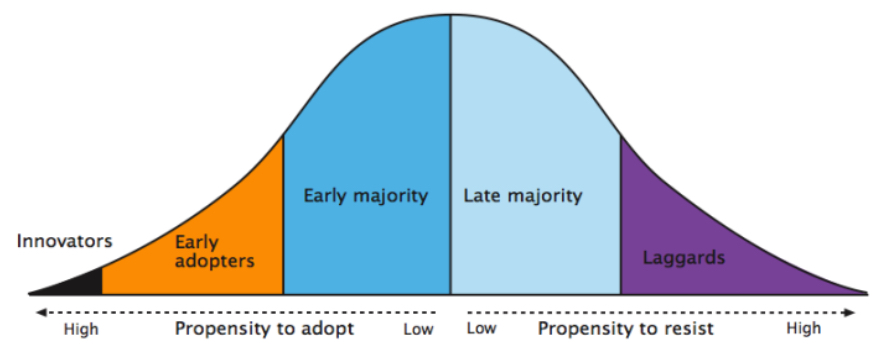
innovators (2.5%)
Visionary, creative, obsessive about new ideas. Seem idealistic to the majority but essential for kick-starting change. Work with them: become their first followers; invite them as project partners.
early adopters (13.5%)
seek strategic advantage, trend-conscious, socially respected. Their buzz determines an innovation’s success; they also act as a test bed for reinvention. Work with them: support trials, reward egos with media coverage, recruit as peer educators.
early majority (34%)
pragmatists. Won’t act without solid proof. Want simplicity, low-cost, minimum disruption, and mainstream endorsement (“plug-and-play”, value for money). Work with them: mainstream advertising, credible endorsements, reduce cost/complexity
late majority (34%)
Conservative, risk-averse. Primary driver is fear of not fitting in. Influenced by laggards’ fear. Work with them: promote social norms, emphasize risk of being left behind, address laggard criticisms.
Laggards (16%)
Resist to the end; perceive high risk. May actually raise valid concerns worth addressing. Work with them: maximize personal control and familiarity; show other laggards who’ve successfully adopted
user segments chart
Subcultures
incubate new ideologies and practices
amplified substructures
social media has expanded and democratized subcultures that used to only exist physically
art worlds
break new ground in entertainment
turbocharged art worlds
artists gather in inspired collaborative competition
mindshare branding
treats the brand as a set of psychological associations. Benefits emotions and personality
purpose branding
brand espouses values or ideas that customers share
Cultural branding
a strategic approach that aligns a brand's identity and messaging with the deeply held values, traditions, and ideologies of a target culture to build intense loyalty and relevance
12 social media brand behaviors
Look for coupons/discounts
Actively search brand info
Get brand info from others
Directly communicate with brand
Engage with brand interactive content
Make positive comments
Make negative comments
Display own brand experiences
Joint brand discussions/threads
Visit brand fan pages
Follow brand news/updates
Share brand info
four underlying motivators for brand engagement
Brand tacit engagement - private non-visible behavior (functional, experiential, symbolic)
Brand exhibiting - public, identity-signaling behavior (symbolic, self-presentation, image-related utility)
Brand patronizing - critical or corrective behavior (functional, symbolic)
Brand deal seeking - searching for discounts/coupons (functional, symbolic)
6 consumer segments
Content seekers (13.6%) - secret affair - private - information driven
Observers (20.9%) - buddies - weak sporadic relationship
Deal hunters (16.5%) - transactional, price-driven
Hardcore fans (13%) - best friends - deep emotional bond
Posers (22%) - attention seekers - public self-presenting
Patronizers (13.9%) - master-slave - expect responsiveness, complain often
management strategy for fans & posers
encourage UGC, advocacy
management strategy for content seekers
provide rich info & updates
management strategy for observers
maintain engaging, low-effort content
management strategy for deal hunters
tactical promotions
management strategy for patronizers
Monitor complaints, prevent crises (word-of-mouth issues)
pricing unique feature
To double profits, price only needs to increase 9.1%, is the highest-leverage tool available
what matters when it comes to price
relative price, not absolute price - comparing price to that of competitors
Cost-plus pricing
Adding additional costs to the consumer for additional perceived goods or services

