Lecture 2 - Why has econ not always included behavioural
 Call Kai
 Learn
Learn Practice Test
 Spaced Repetition
 Match
Match Flashcards
 Knowt Play
1/14

There's no tags or description
Looks like no tags are added yet.
Name | Mastery | Learn | Test | Matching | Spaced | Call with Kai |
|---|
No analytics yet
Send a link to your students to track their progress
15 Terms
Econ periods over time

20th century (modern / orthodox) econ focus
Attempt to rid econ theory of “unobservable” concepts, that were seen as “unscientific”
economic theory on formal model of rational choice by individuals
View that choices are observable, but psychological experiences not
psychological realism or realistic underlying assumptions not necessary
Quotes of orthodox econ on psychology
Pure political economy has therefore a great interest in relying as little as possible on the domain of psychology.” (Vilfredo Pareto, 1897.)
“ if we wish to place economic science upon a solid basis, we must make it completely independent of psychological assumptions.” (Evgeny Slutsky, 1915)
Utility & econ
Enters during 19th/20th century neoclassical marginal revolution
In psychology utility was a psychological experience BUT in econ it became more mathematical (differentiable - Marginal Utility & optimisation)
Idea of diminishing marginal utility also included
Late 19th/20th century economists began to doubt possibility of measuring pleasure or being able to compare it between people - unobservable
econ moved away from psychology in early/mid 20th
Utility became a representation of complete and consistent preferences
Quotes of econ on utility
Edgeworth (1881): “Let it be granted to the science of pleasure what is granted to the science of energy: to imagine a perfect instrument (utility) continually registering the height of pleasure experienced by an individual”
Jevons (1871): “Pleasure and pain are undoubtedly the ultimate objects of the Calculus of Economics. To satisfy our wants to the utmost with the least effort ….. in other words, to maximise pleasure is the problem of Economics.”
Complete preferences
For any outcomes a and b, either a > b or b > a (or both – i.e. indifference)
Transitive preferences
If a > b and b > c, then a > c
Ordinal Representation Theorem:
If the preference relation > is complete and transitive, then there exists a (real-valued) utility function u(),
defined on outcomes such that, for any two outcomes a and b
u(a) ≥ u(b) if, and only if, a > b
Maximisation of u() represents satisfaction of preferences given by relation >
whatever they are, provided complete + transitive
agent maximises utility theory
They choose from among the available actions the one that best satisfies her preferences over outcomes
preferences satisfy conditions required for the theorem
complete + transitive preferences
The Pareto Improvement criterion
Outcome x is a Pareto-improvement on outcome y if at least one person strictly prefers x to y and no-one strictly prefers y to x
Compares outcomes using preferences, without needing to measure of intensity of preference or pleasure
Friedman & psychology
instrumentalist methodology (1953)
argued that economics does not need realistic assumptions at all, if its models predict successfully the variables they are intended to predict
Theory judged only by how well it achieves its purpose of prediction
Modern econ & psychology
Late 20th/21st econ put psychology back into econ
Stimulated by:
need for explanation not just prediction
empirical failings of orthodox theory (experimental methods)
Realisation that greater psychological realism still allows tractable, formal models that can be more general ( keep orthodox theory as special case).
Characteristics of (most) BE
Methodological individualism
Still tries to ground economic theory in theories of individual behaviour;
Theoretical generalisation
Often tries to keep standard “rational” theory as special case
Allows departure from ‘rationality’ when suggested by psychology & evidence
PEEMs - Rabin (2013)
Portable Extensions of Existing Models
Used to extend existing model of utility maximisation
Retaining standard theory as special case (when a parameter = 0)
Allowing cases with more realistic psychology too, via a measureable departure from orthodox model
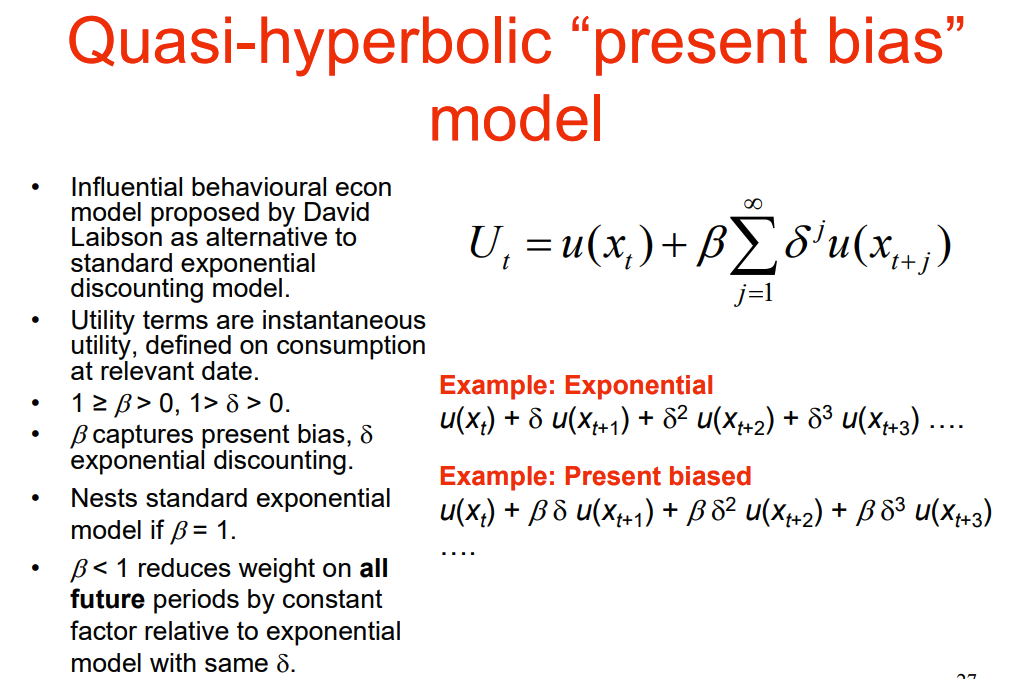
PEEM example - present bias