Topic 5 - Development of Attachment
 Call Kai
 Learn
Learn Practice Test
 Spaced Repetition
 Match
Match Flashcards
 Knowt Play
1/23

There's no tags or description
Looks like no tags are added yet.
Name | Mastery | Learn | Test | Matching | Spaced | Call with Kai |
|---|
No analytics yet
Send a link to your students to track their progress
24 Terms
What does attachment mean and why is it important?
Attachment refers to the enduring emotional bond that exists between 2 people
The quality of our early attachments affect how we areable to form and maintain attachments in the future
What are the essential qualities of attachment and what do they mean?
Proximity seeking – wanting to be physically close to the other person
Separation anxiety or protest – distress experienced when leaving the other person
Happiness at reunion – pleasure experienced when being reunited
What is Harlow’s explanation of attachment?
Harlow’s explanation was that attachment develops as a result of the mother providing “tactile comfort,”
suggests that infants have an innate (biological) need to touch and cling to something for emotional comfort
Outline Harlow’s research into infant monkeys reared in isolation
He took babies and isolated them from birth. They had no contact with each other or anybody else.
He kept some this way for three months, some for six, some for nine and some for the first year of their lives. He then put them back with other monkeys to see what effect their failure to form attachment had on behaviour.
Results: The monkeys engaged in bizarre behaviour such as clutching their own bodies and rocking compulsively. They were then placed back in the company of other monkeys.
To start with the babies were scared of the other monkeys, and then became very aggressive towards them. They were also unable to communicate or socialize with other monkeys. The other monkeys bullied them. They indulged in self-mutilation, tearing hair out, scratching, and biting their own arms and legs.
Harlow concluded that privation (i.e., never forming an attachment bond) is permanently damaging (to monkeys). The extent of the abnormal behaviour reflected the length of the isolation. Those kept in isolation for three months were the least affected, but those in isolation for a year never recovered the effects of privation.
Outline Harlow’s research into infant monkeys reared with surrogate mothers
8 monkeys- 4 got milk from wire monkey and 4 from the cloth monkey
The monkeys were studied for 165 days
After this time was up, the monkeys would be placed in a cage with both surrogate mothers, but the cloth mother could not provide milk
Results: both spent more time on cloth monkey, if a frightening object was placed in there both clung to the cloth monkey (safe base)
Later in life had major behavioural differences – timid, easily bullied and wouldn’t stand up for themselves, made bad mothers
Supports the evolutionary theory of attachment
What is Bowlby’s theory of attachment?
Bowlby (1958) proposed that attachment can be understood within an evolutionary context in that the caregiver provides safety and security for the infant
Attachment enhances the infant’s chance of survival
Outline Bowlby’s background study
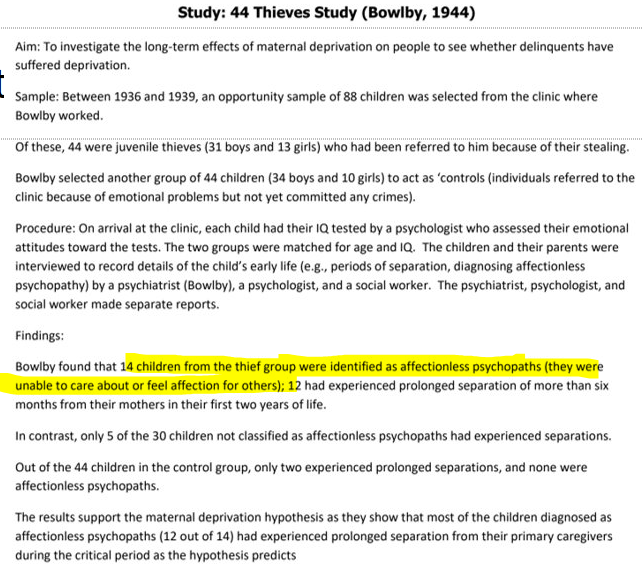
What is Bowlby's theory of attachment?
1. A child has an innate (i.e. inborn) need to attach to one main attachment figure
2. A child should receive the continuous care of this single most important attachment figure for approximately the first two years of life
The long term consequences of maternal deprivation (failure to form an attachment with a primary caregiver within the first 18 months to 2 years) might include the following:
Delinquency
Reduced Intelligence
Increased Aggression
Depression
Affectionless Psychopathy
Evaluate Harlow’s studies
Lacking in population validity- we can’t apply findings about monkeys to humans
Unethical- isolation of babies from birth, no protection from harm
Manipulation of IV- length of time monkeys were reared in isolation and wire vs cloth mother
Qualitative data- bizarre behaviours observed (self-mutilation) and bullying by other monkeys
Cause and effect- monkeys reared in isolation for one year never recover
Low ecological validity in using wire and cloth mother
Nature- innate need for comfort from the cloth mother
Evaluate Bowlby’s research
Methodological issues -Low internal validity –Bowlby relied on interviews to collect data on children’s early experience (SBD) = do not gain full insight?
Low internal reliability– subjective nature of interviews may mean that the pps do not get asked the same questions = lack of consistency
Nurture/situation –maternal deprivation= affectionless psychopathy
Useful – shows importance of attachment – could influence policies –longer mat leave?
SSR – stigma towards those who have experienced maternal deprivation – likely to possess affectionless psychopathy
Reductionist – focuses only on maternal deprivation as the cause of affectionless psychopathy
What is the strange situation?
Ainsworth developed a method for assessing the nature and quality of attachment between infants aged 12-24 months and their caregivers
She developed the ‘strange situation
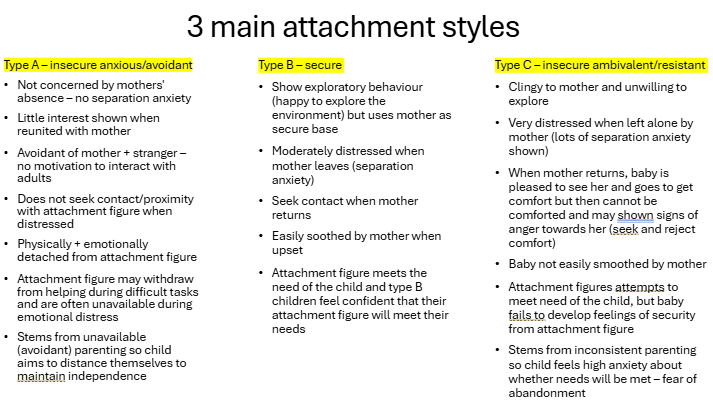
Infants with mothers who showed high levels of responsiveness and who were sensitive and accessible to their infants in their first year of life were likely to develop Type B secure attachments
Those who respond to the child’s needs incorrectly or who are impatient or who ignore the child are likely to have insecurely attached children such as Type A or Type C
What are the three attachment styles?
What is the aim of Ainsworth and Bell’s research?
To investigate the interaction between infant attachment behaviour and other behaviours such as exploration, separation anxiety and fear of stranger
What is the sample of Ainsworth and Bell’s study?
56 participants who were family-reared infants of white, middle-class parents, who were originally contacted through paediatricians in private practice
23 of the infants, who had been observed longitudinally from birth onward, were observed in the strange situation when 51 weeks old
33 of the infants were studied for the first time in this study when they were 49 weeks old
The mothers of the 56 children also participated by enacting the standardised procedure pertaining to the ‘strange situation’
How was data collected in Ainsworth and Bell’s research?
Observations from an adjoining room through one way mirror
Observers dictated continuous narrative accounts into a tape recorder. Tape recordings were transcribed and consolidated then coded (high inter-rater reliability found for coding 0.99)
Description of the experimental room in Ainsworth and Bell’s study
The experimental room was furnished
There was a 9 x 9-foot square of clear floor space
At one end of the room was a child's chair heaped with and surrounded by toys
Near the other end of the room on one side was a chair for the mother, and on the opposite side, near the door, a chair for the stranger
The baby was put down in the middle of the base of the triangle formed by the three chairs and left free to move where he/she wished
Both the mother and the female stranger were instructed in advance as to the roles they were to play
How was the collection of data standardised within Ainsworth and Bell’s study#’
1) a frequency measure was used for three forms of exploratory behaviour (exploratory locomotion, exploratory manipulation, visual exploration) and for crying.
A score of 1 was given for each 15 second interval in which the behaviour occurred.
2) Five classes of behaviour scored on a 7 point rating scale -
Proximity and contact seeking behaviours,
contact maintaining behaviours,
proximity and interaction avoiding behaviours,
contact and interaction resisting behaviours
search behaviour.
The score was influenced by the following features:
the strength of the behaviour, its frequency, duration, and latency (length), and by the type of behaviour itself—with active behaviour being considered stronger than signalling.
What are the steps of the procedure of the strange situation in Ainsworth and Bell’s study?
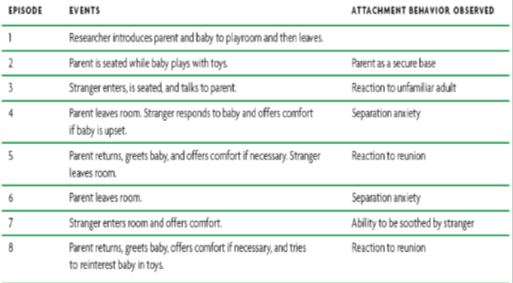
What are some findings from Ainsworth and Bell’s study? (S= stranger, M=Mother and B=Baby)
Overall, the amount of exploratory behaviour decreased when the stranger entered the room in episode 3 (S,M,B)and remained low during episode 4 (S,B) after the mother left.
During episode 5 (M,B) visual and manipulative play increased as the mother attempted to interest the baby in play. When this was attempted by the stranger in episodes 4(S,B) and 7 (S,B) there was no such increase.
Contact maintaining behaviour increased during episodes 5 (M, B)and 8 (M,B) . Proximity seeking and contact maintaining behaviours were less frequent and less strong towards the stranger
During episode 4 (S,B) the mother left and crying increased and then declined again on her return at episode 5 (M,B)
There was an increase in episode 6 when the baby was left alone. The stranger returned at episode 7 (S,B) and there was no significant decrease, which suggested that crying was caused by the mother leaving rather than the baby being alone.
What conclusions can we draw from Ainsworth and Bell’s research?
In threatening situations, attachment behaviour increases.
The attachment figure is used as a secure base for exploration by the infant.
Absence of the mother tends to heighten attachment behaviour and lessons exploration of a novel or unfamiliar situation.
There are individual differences in attachments, but this doesn’t mean there are differences in the strength of the attachment.
What two applications do we have for developing an attachment-friendly environment and when are they to be used?
Family-centred care - Use in hospitals
High quality day care - Use in nursery
How can we use the application of family-centred care in order to develop an attachment friendly environment?
FCC is effective in meeting the social and emotional needs of the child
despite being in hospital, the child still has needs that can only be met by the Primary caregiver (PCG), especially if the infant is under 2 since that is our critical period
Hospitals are likely to provoke feelings of fear and extreme vulnerability in children, especially if they are having to stay for weeks or months at a time
open visitation and overnight stays for parents means that emotional needs of the child are met and attachment is maintained
FCC values: working in partnership with families regarding care decisions, respect, treat each case as individual, maintain family routine
How can we use the application of high quality day care in order to develop an attachment friendly environment?
Having low child to caregiver ratio so that the child being cared for receives an adequate amount of care and attention:
1:3 for under 2s
1:4 for 2-3 year olds
1:8 for 3-5 year olds
Key workers – allows children to feel safe and cared for, familiar figure to build trusting relationship with child and parents/carers, children more likely to explore and feel confident in their environment once they feel settled with an attachment figure
Separate strategy:
50% of staff in a nursery must have a childcare qualification
Staff should be well treated to limit the amount of staff who leave (as this impacts upon a child’s ability to form attachments)
If staff members are constantly leaving, the children can never for a true attachment to anyone
What evidence can we use to support our applications to provide an attachment friendly environment?
Ainsworth

