Biol 204 exam 3 lecture 1

0.0(0)
Studied by 0 people
call kaiCall Kai
learnLearn
examPractice Test
spaced repetitionSpaced Repetition
heart puzzleMatch
flashcardsFlashcards
GameKnowt Play
Card Sorting

1/81

encourage image

There's no tags or description

Looks like no tags are added yet.

Last updated 3:46 AM on 3/29/26
Name
Mastery
Learn
Test
Matching
Spaced
Call with Kai

No analytics yet

Send a link to your students to track their progress

82 Terms

1
New cards

kidneys

filter the blood to remove metabolic wastes, toxins etc

This process produces urine
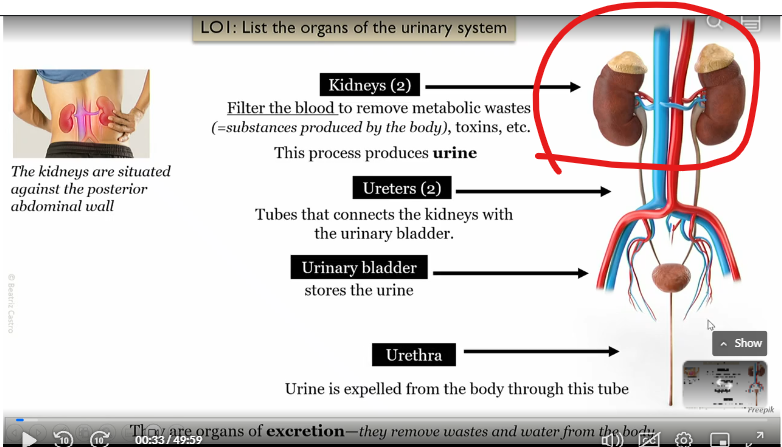
<p>filter the blood to <strong>remove metabolic wastes, toxins</strong> etc</p><p></p><p>This process produces <strong>urine</strong></p>
2
New cards

Uterer

Tubes that connect kidneys to bladder
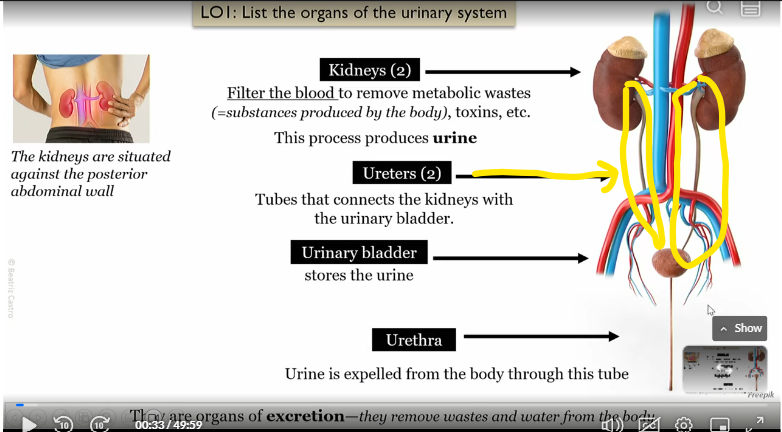
<p>Tubes that connect kidneys to bladder</p>
3
New cards

urinary bladder

connected to the kidneys via the uterer, stores the urine
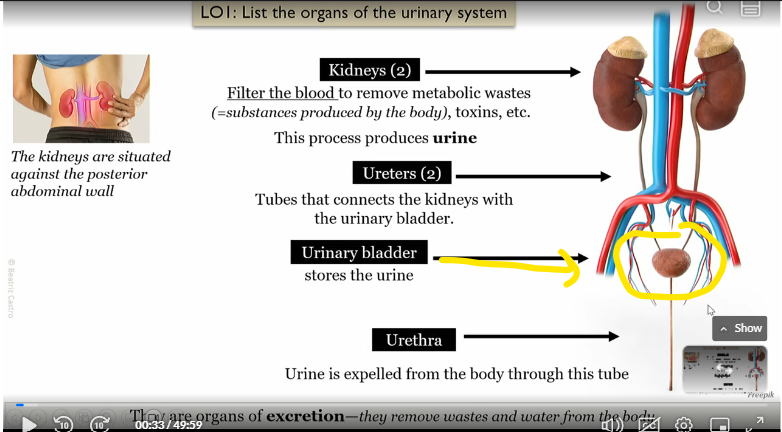
<p>connected to the kidneys via the uterer, stores the urine </p>
4
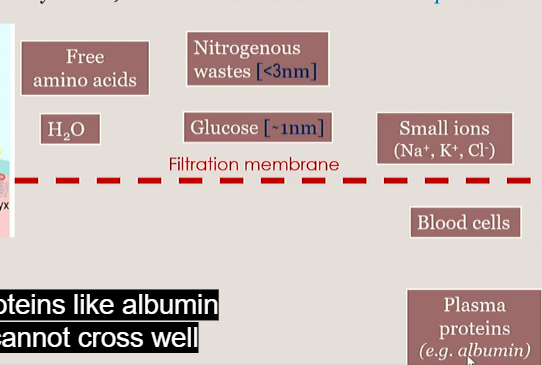
New cards

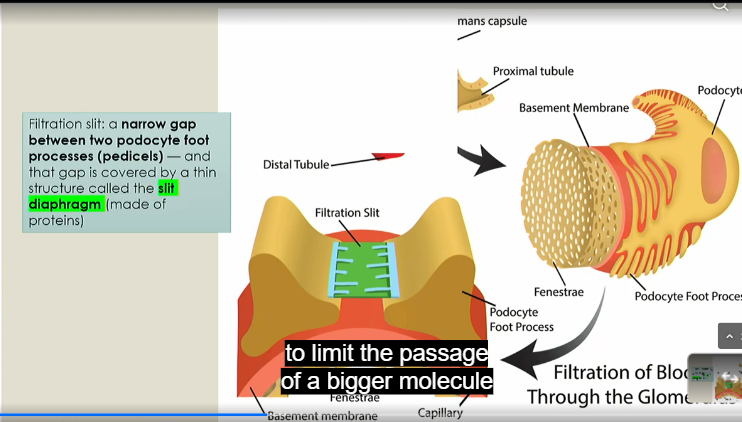
urethera

connected to urinary bladder, urine is expelled from the body to the tube
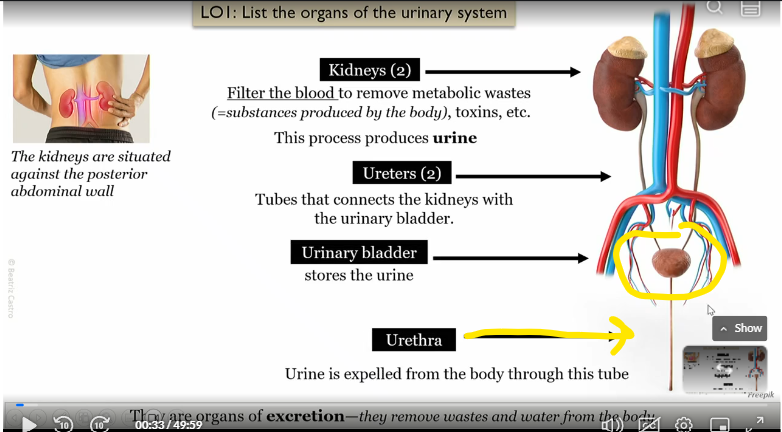
<p>connected to urinary bladder, urine is expelled from the body to the tube</p>
5
New cards

what type of organs are the kidney, uterer, bladder, and urethera?

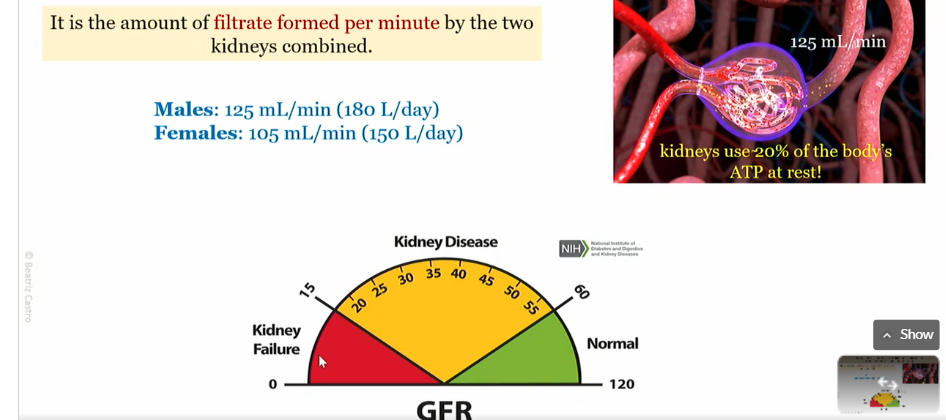
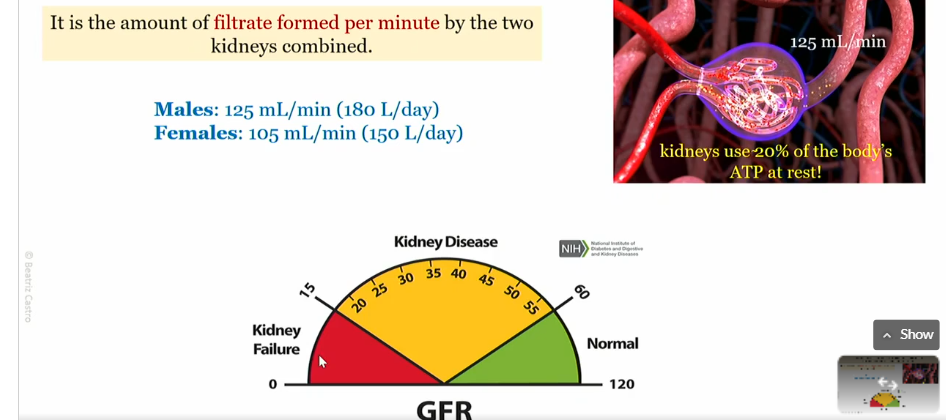
organs of excretion, which remove wastes and water from the body
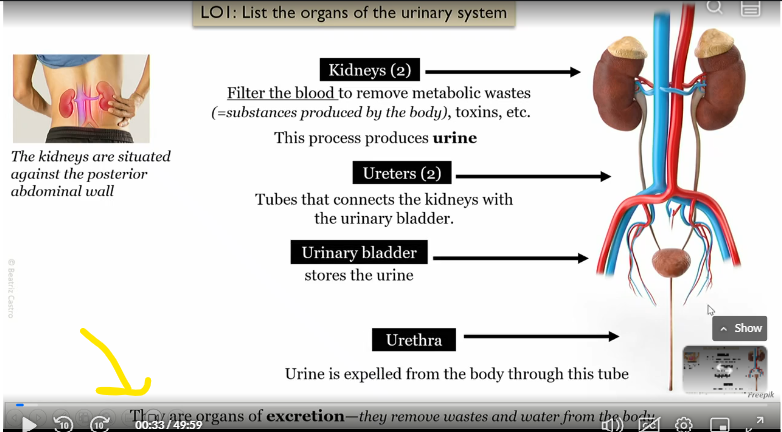
<p>organs of excretion, which remove wastes and water from the body</p>
6
New cards

Where are the kidneys situated?

Against the posterior abdominal wall
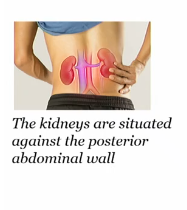
<p>Against the posterior abdominal wall</p>
7
New cards

What does the kidney excrete

urea, creatine, and uric acid

c urea c uri (nitrogenous waste)

and ingested toxins
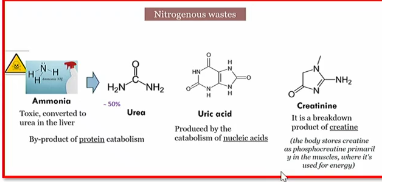
<p>urea, creatine, and uric acid</p><p>c urea c uri  (<strong>nitrogenous waste</strong>)</p><p></p><p>and<strong> ingested toxins</strong></p>
8
New cards

Nitrogenous waste

urea, creatine, and uric acid

c urea c uri (Korea Curry)

excreted by kidney
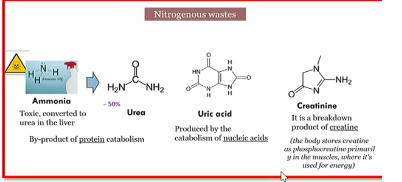
<p>urea, creatine, and uric acid</p><p>c urea c uri  (Korea Curry)</p><p>excreted by kidney</p>
9
New cards

what does the kidney Regulate

Water and electrolytes

Acid base

arterial BP

WAR (waghhh)
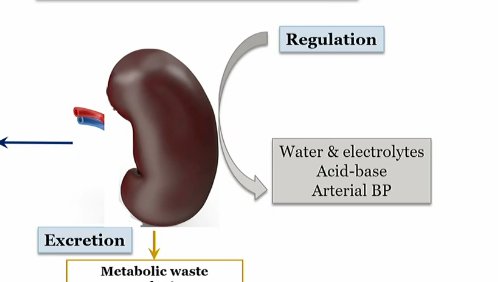
<p>Water and electrolytes</p><p></p><p>Acid base</p><p></p><p>arterial BP</p><p></p><p>WAR (waghhh)</p>
10
New cards

What does the kidney produce in its syntheic function

erythopoietin

1-25 dihydroxy vitamin D3 (calcitriol)

renin

4-evr
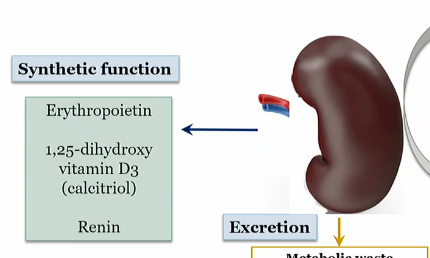
<p>erythopoietin</p><p></p><p>1-25 dihydroxy vitamin D3 (calcitriol)</p><p></p><p>renin</p><p></p><p>4-evr</p>
11
New cards

Functions of the kidneys

Regulation, excretion, synthetic function
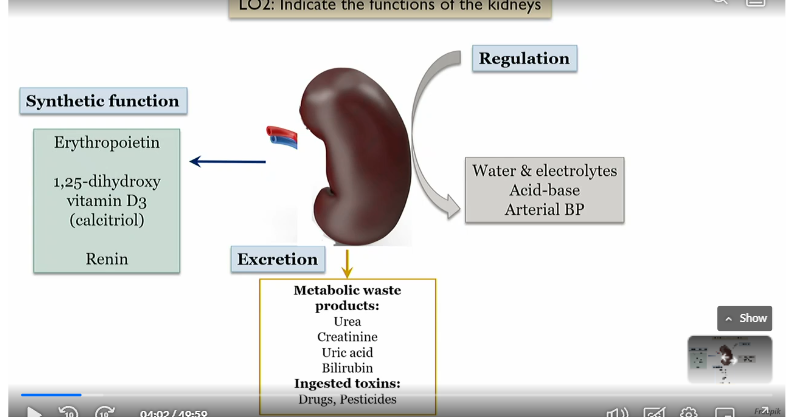
<p>Regulation, excretion, synthetic function</p>
12
New cards

Where are nephrons

within the renal pyramids in the medulla and in the cortex depending on type

13
New cards

renal cortex

houses blood vessels and most parts of the nephrons
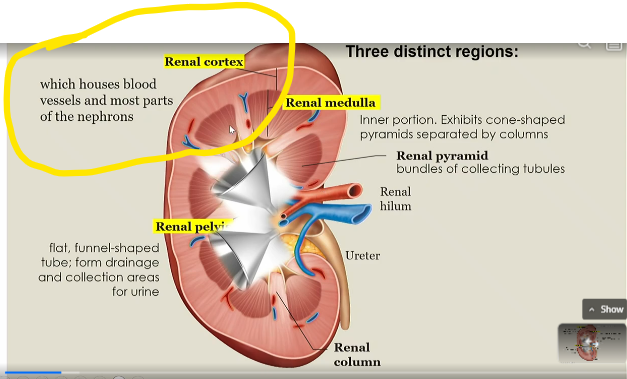
<p>houses blood vessels and most parts of the nephrons</p>
14
New cards

renal medulla

inner portion of kidney that exhibits cone shaped pyramids seperated by columns
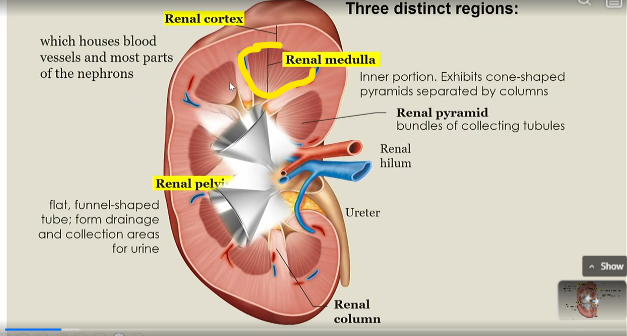
<p>inner portion of kidney that exhibits cone shaped pyramids seperated by columns</p>
15
New cards

renal pyramid

bundles of collecting tubules
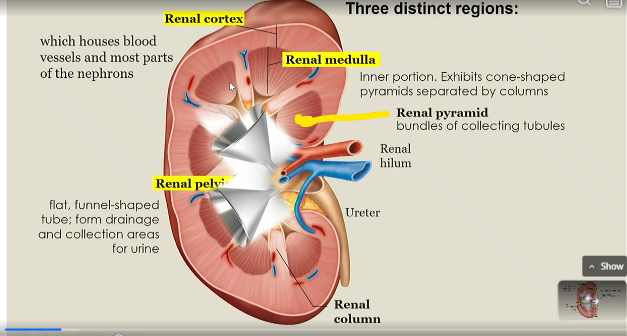
<p>bundles of collecting tubules</p>
16
New cards

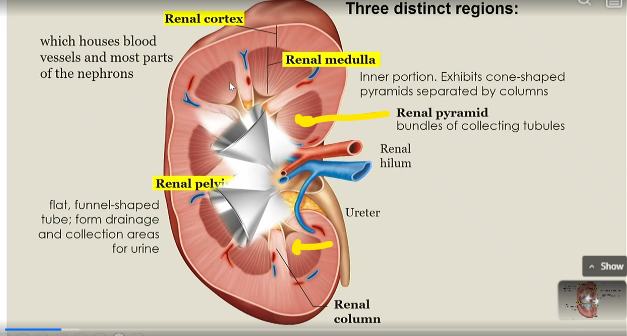
Renal column

seperates renal medullas
<p>seperates renal medullas</p>
17
New cards

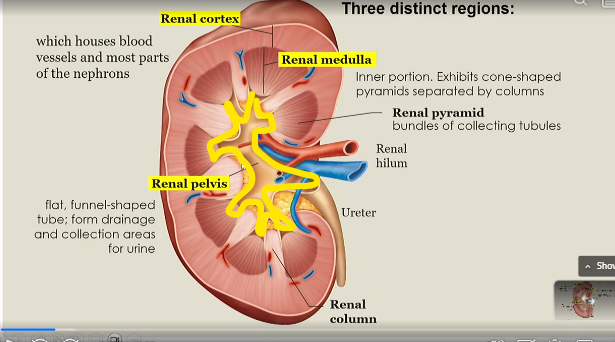
Renal pelvis

flat, funnel shaped tube that forms drainage and collection areas for urine
<p>flat, funnel shaped tube that forms drainage and collection areas for urine</p>
18
New cards

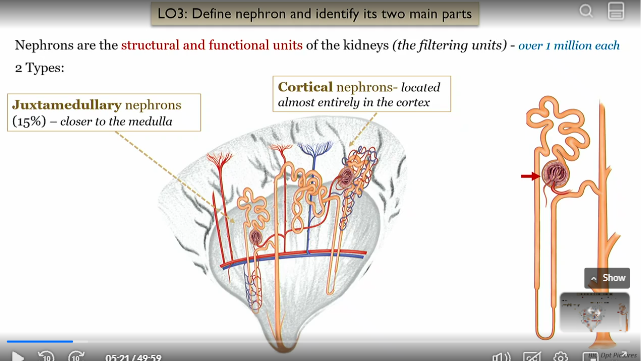
What are nephrons

the structural and functional units of the kidneys (filtering units)

can be juxtamedullary or cortical
<p>the structural and functional units of the kidneys (filtering units)</p><p></p><p>can be juxtamedullary or cortical</p>
19
New cards

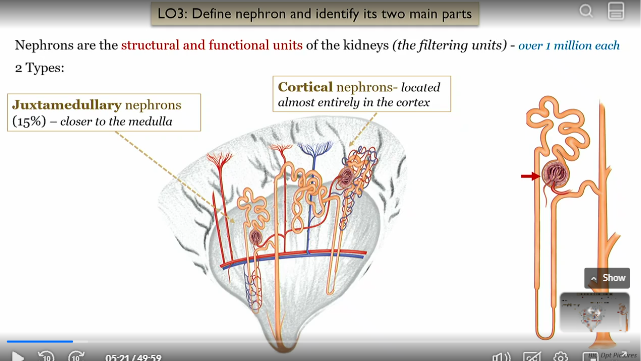
How much nephrons are there

1 million per kidney
<p>1 million per kidney</p>
20
New cards

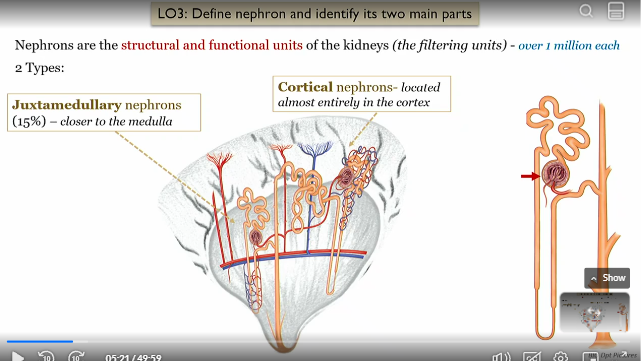
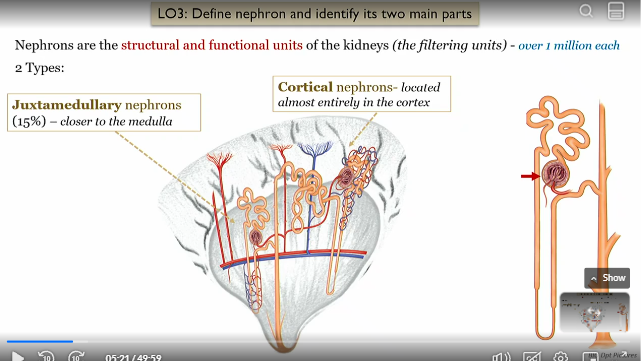
Cortical nephrons location

located almost entirely in the renal cortex
<p>located almost entirely in the renal cortex</p>
21
New cards

Juxtamedullary nephrons location

15% located closer to the renal medulla
<p>15% located closer to the renal medulla</p>
22
New cards

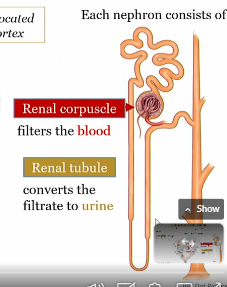
Nephron anatomy

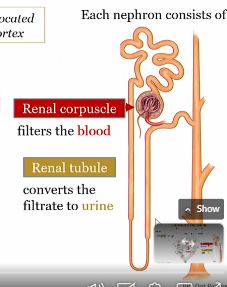
Renal corpuscle (filters the blood)

renal tubule (converts the filtrate to urine)
<p>Renal corpuscle (filters the blood)</p><p>renal tubule (converts the filtrate to urine)</p>
23
New cards

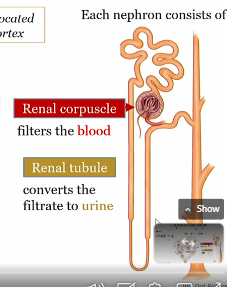
renal corpuscle purpose

part of nephron that filters the blood
<p>part of nephron that filters the blood</p>
24
New cards

renal tubule purpose

part of nephron that converts filtrate from the renal corpuscle into urine
<p>part of nephron that converts filtrate from the renal corpuscle into urine</p>
25
New cards

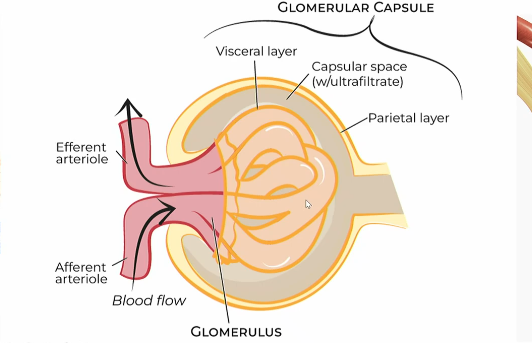
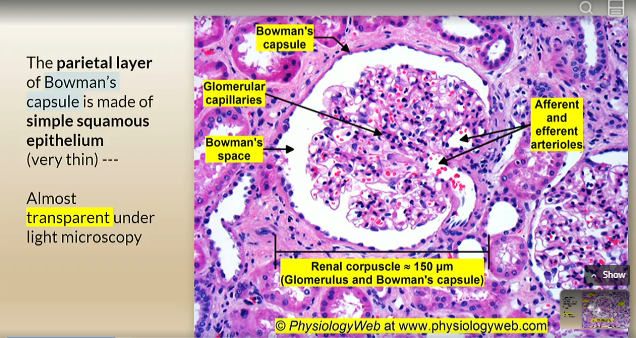
Bowman’s capsule

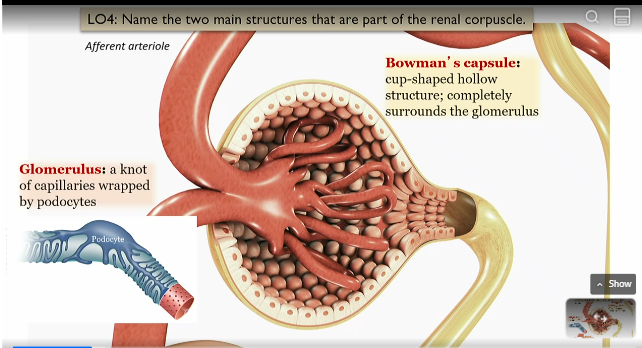
cup shaped hollow structure that surrounds the glommerulus

outer part of the renal corpuscle
<p>cup shaped hollow structure that surrounds the glommerulus</p><p></p><p>outer part of the renal corpuscle</p>
26
New cards

Glommerulus

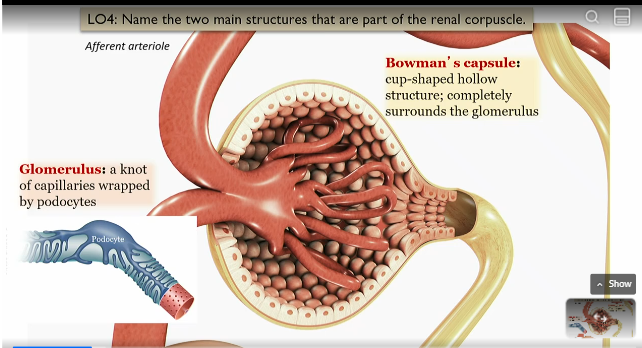
part of renal corpuscle surrounded by bowmans capsule

knot of capillaries wrapped by podocytes
<p>part of renal corpuscle surrounded by bowmans capsule </p><p></p><p>knot of capillaries wrapped by podocytes </p>
27
New cards

Layers of bowman’s capsule

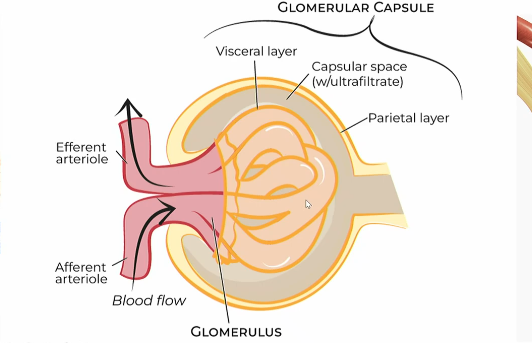
parietal layer

capsular space with ultrafiltrate

visceral layer
<p>parietal layer </p><p>capsular space with ultrafiltrate</p><p>visceral layer</p>
28
New cards

visceral layer of bowmans capsule

the podocytes that wrap around the glomerulus capillaries
<p>the podocytes that wrap around the glomerulus capillaries</p>
29
New cards

Flow of blood filtration in bowman’s capsule
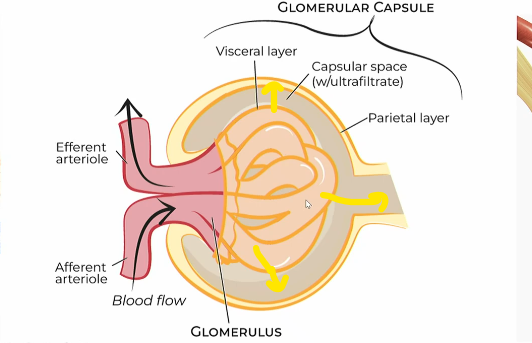
knowt flashcard image
30
New cards

what is the parietal layer of bown’s capsule made of

simple squamous epithelium
<p>simple squamous epithelium</p>
31
New cards

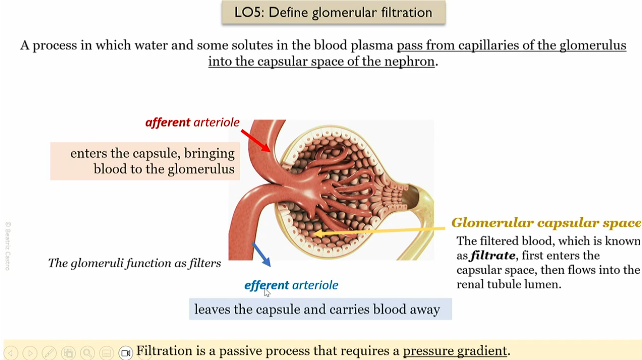
Glomerrular filtration

process of which water and some solutes in the blood plasma pass from the capillaries of the glomerulus into the capsular space of the nephron

32
New cards

Afferent atriole

Brings blood to the glommerulus capillaries in the renal corpuscle
33
New cards

efferent atriole

carries away blood from the glommerulus capillaries in the renal corpuscle

<p>carries away blood from the glommerulus capillaries in the renal corpuscle </p>
34
New cards

Glommerular filtration process

  1. afferent atriole brings in blood to the glommerulus in the renal capsule

  2. Filtered blood enters the capsular space, which then enters the renal lumen of the nephron

  3. The efferent atriole takes the blood away from the glomeerulus


Passive process that requires a pressure gradient to work
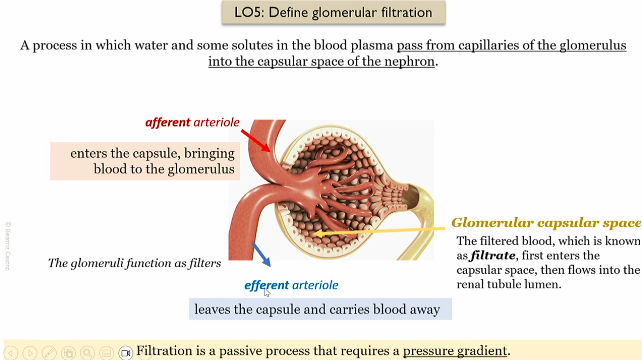
<ol><li><p>afferent atriole brings in blood to the glommerulus in the renal capsule </p></li><li><p>Filtered blood enters the capsular space, which then enters the renal lumen of the nephron</p></li><li><p>The efferent atriole takes the blood away from the glomeerulus</p></li></ol><p><br>Passive process that requires a pressure gradient to work</p><p></p>
35
New cards
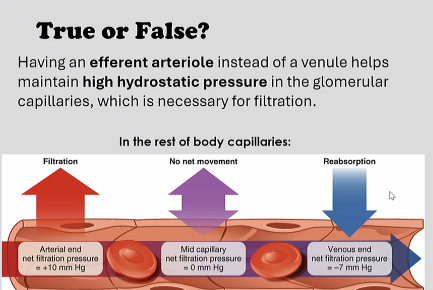
term image

false, glomerulus blood flow gees

36
New cards

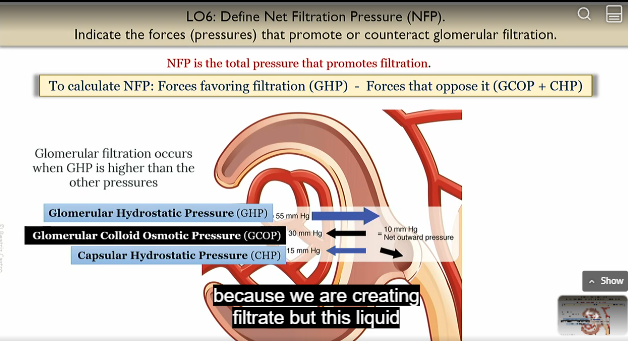
Net filtration pressure

total pressure that promotes filtration

NFP = favors that favor filtration (GHP) - forces that oppose it (GCOP + CHP)
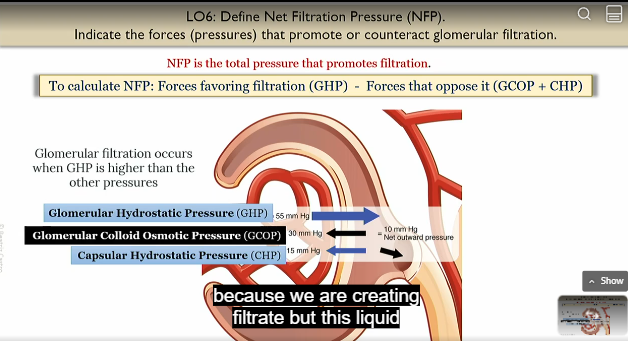
<p>total pressure that promotes filtration</p><p></p><p>NFP = favors that favor filtration (GHP) - forces that oppose it (GCOP + CHP)</p>
37
New cards

GHP

Glomerullar hydrostatic pressure

pressure in glomerulus wanting to come out

favors filtration
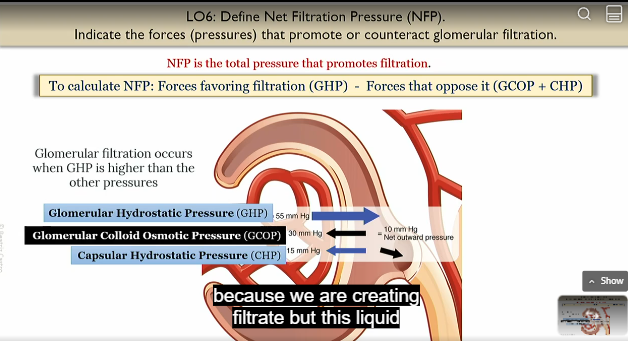
<p>Glomerullar hydrostatic pressure</p><p></p><p>pressure in glomerulus wanting to come out </p><p></p><p>favors filtration</p>
38
New cards

GCOP

glommerular collloid osmotic pressure

due to proteins like albumins bringing in water

unfavorable to filtration
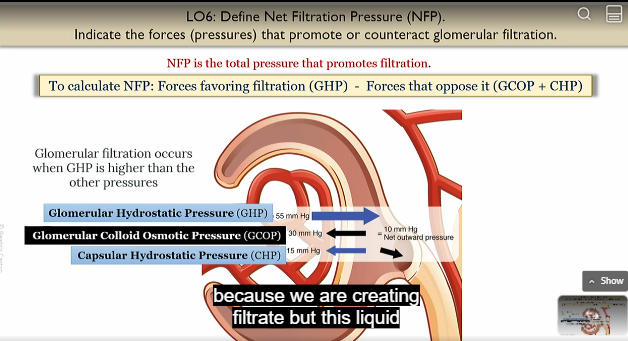
<p>glommerular collloid osmotic pressure</p><p></p><p>due to proteins like albumins bringing in water </p><p></p><p>unfavorable to filtration</p>
39
New cards

CHP

capsular hysrostatic pressure

due to capsular space of bowman’s capsule accumulating with liquid and opposing flow

unfavorable to filtration
<p>capsular hysrostatic pressure</p><p></p><p>due to capsular space of bowman’s capsule accumulating with liquid and opposing flow </p><p></p><p>unfavorable to filtration</p>
40
New cards

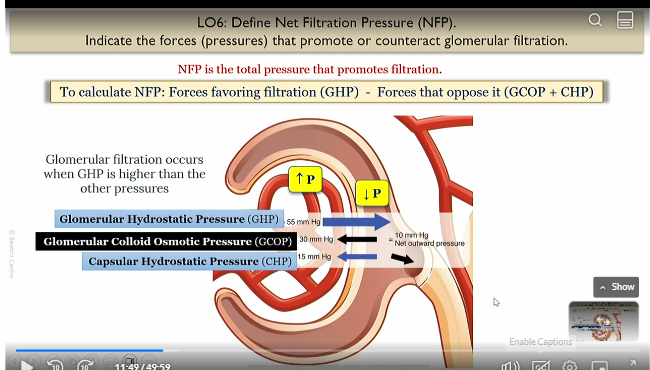
In order for filtration to happen, what do the pressures in the renal corpuscle need to be?

Glomerulus needs to be higher

Bowmans capsule capuslar space needs to be lower
<p>Glomerulus needs to be higher</p><p>Bowmans capsule capuslar space needs to be lower</p>
41
New cards
term image

true, venules have lower pressure

42
New cards

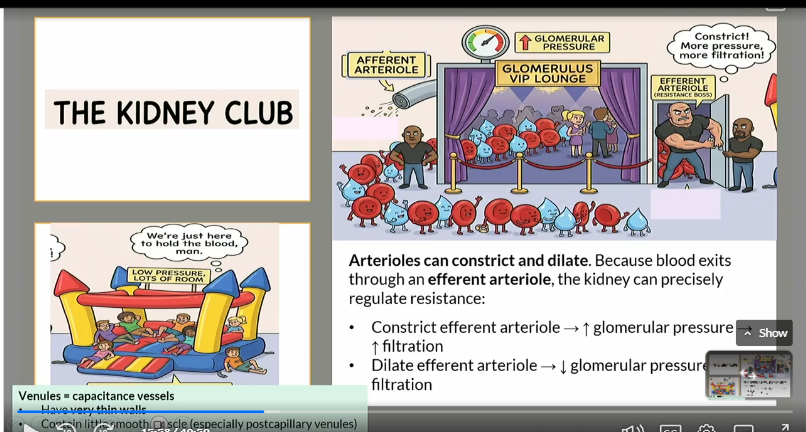
Why is it that the glommerulus uses two atrioles betwen as opposed to the ususal flow of one atriole to capilaries to venule?

Arterioles can constrict and dialate

For example, if you constrict the efferent atriole (moves blood away)

Pressure in the glomerulus goes up, and filtration goes up

For example, if you dialate the efferent atriole (moves blood away)

Pressure in the glomerulus goes down, and filtration goes down

The venules just hold the blood, lots of pressure, lots of room
<p>Arterioles can constrict and dialate</p><p></p><p>For example, if you constrict the efferent atriole (moves blood away) </p><p>Pressure in the glomerulus goes up, and filtration goes up </p><p></p><p>For example, if you dialate the efferent atriole (moves blood away) </p><p>Pressure in the glomerulus goes down, and filtration goes down</p><p></p><p>The venules just hold the blood, lots of pressure, lots of room</p>
43
New cards

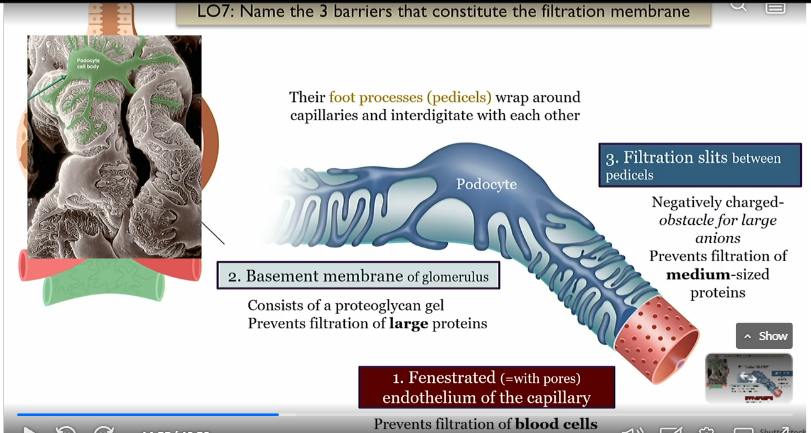
Basement membrane of the glomerulus

middle layer

consists of proteoglycan gel, prevents filtration of large proteins
<p>middle layer</p><p></p><p>consists of proteoglycan gel, prevents filtration of large proteins </p>
44
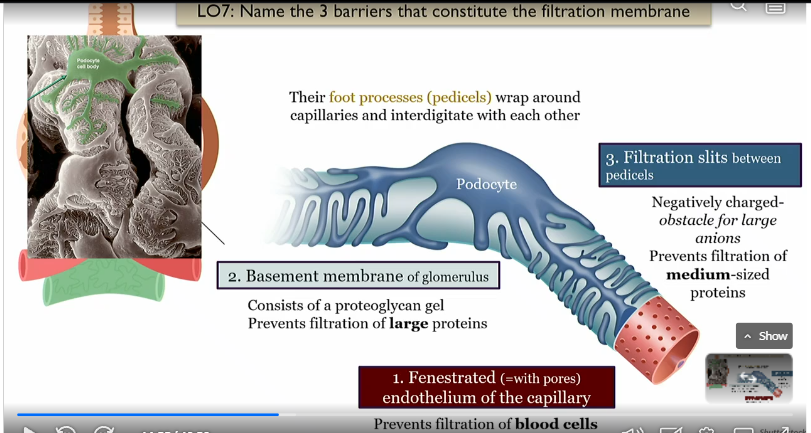
New cards

Fenestrated endothelium of the capillary

prevents filtration of blood cells, innrmost layer of glommerulus
<p>prevents filtration of blood cells, innrmost layer of glommerulus</p>
45
New cards

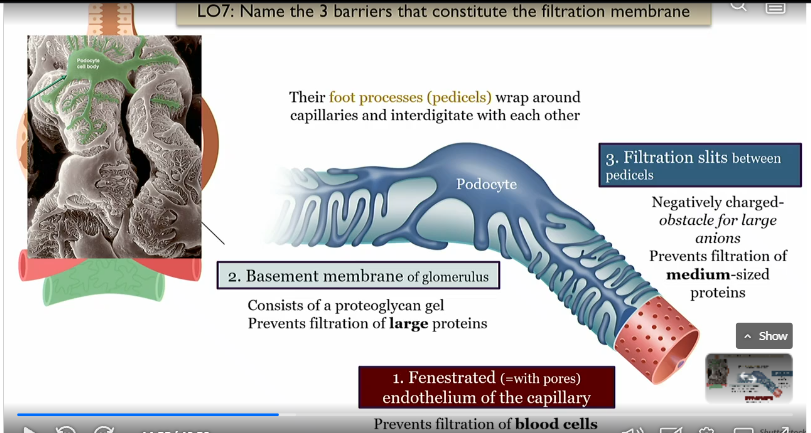
Filtration slits between pedicels

outermost barrier to filtration which is a negativley charged obstacle for large Anions, and prevents filtration of medium sized proteins
<p>outermost barrier to filtration which is a negativley charged obstacle for<strong> large Anions</strong>, and prevents filtration of <strong>medium sized proteins</strong></p>
46
New cards

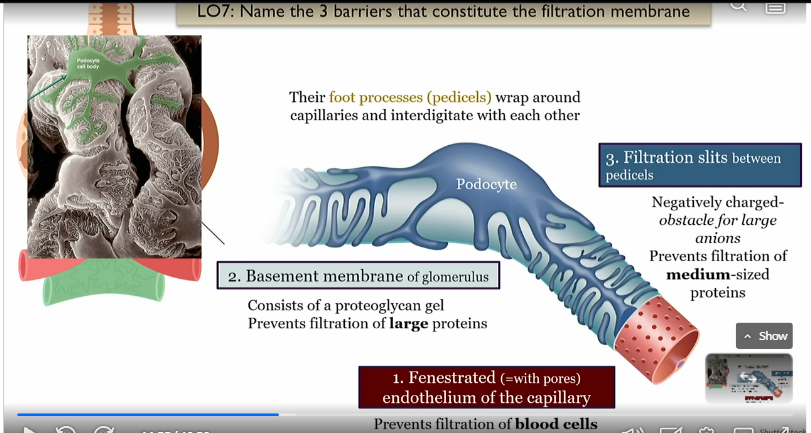
Barriers to filtration in glommerulus

  1. fenestrated endothelium in the capillary

  2. basement membrane

  3. filtration slits between pedicels

  1. prevents blood cells 2. prevents large proteins 3. prevents anions and proteins due to negative charge
<ol><li><p>fenestrated endothelium in the capillary</p></li><li><p>basement membrane </p></li><li><p>filtration slits between pedicels</p></li></ol><p></p><ol><li><p>prevents blood cells 2. prevents large proteins 3. prevents anions and proteins due to negative charge</p></li></ol><p></p>
47
New cards

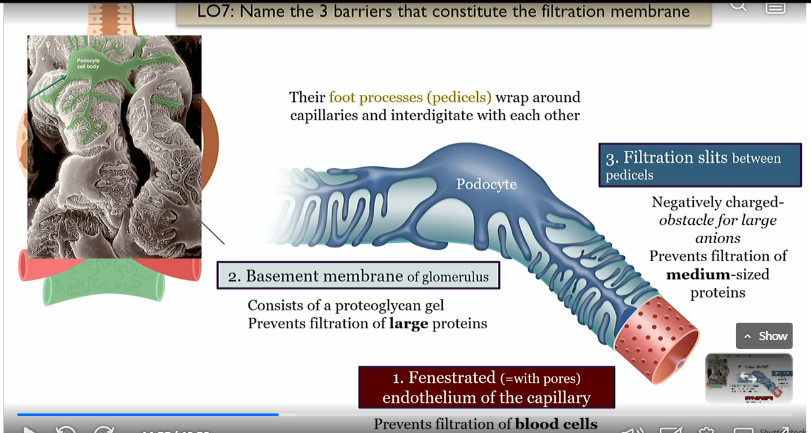
Pedicels

foot processes of podocytes that wrap around capillaries and interdigitate with each other
<p>foot processes of podocytes that wrap around capillaries and interdigitate with each other </p>
48
New cards

Filtration slit

narrow gap between two pediciels that is covered by a thin structure called the slit diaphragm, made of proteins
<p>narrow gap between two pediciels that is covered by a thin structure called the slit diaphragm, made of proteins</p>
49
New cards

What can pass the filtration membrane in the glommerulus?

less than 3 nm, smaller than protiens
<p>less than 3 nm, smaller than protiens</p><p></p>
50
New cards

Glommerular filtration rate

ampunt of filtrate created by renal corpuscle per minute
<p>ampunt of filtrate created by renal corpuscle per minute</p>
51
New cards

Male glommerullar filtration rate

125 mL/min (180 L/day)

52
New cards

Female glommerullar filtration rate

105 mL/min (150 L/day)

53
New cards

What is a Glomerullar filtration rate of less than 60 indicative of

kindey disease or failure
<p>kindey disease or failure</p>
54
New cards

Too low Glomerullar filtration rate

Fluid flows sluggishly through the renal tubules, and they reabsorb wastes that should be eliminated in the urine
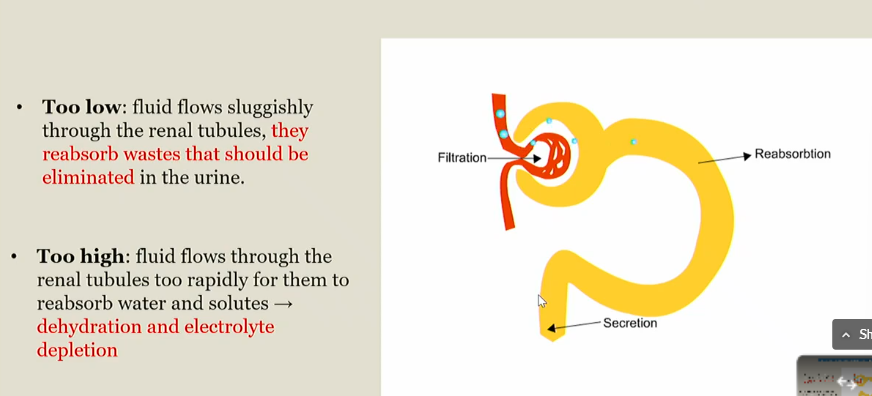
<p>Fluid flows sluggishly through the renal tubules, and they reabsorb wastes that should be eliminated in the urine</p>
55
New cards

too high Glomerullar filtration rate

Fluid flow fast through the renal tubules, and they cant reabsorb water and solutes

Leads to dehydration and electrolyte depletion
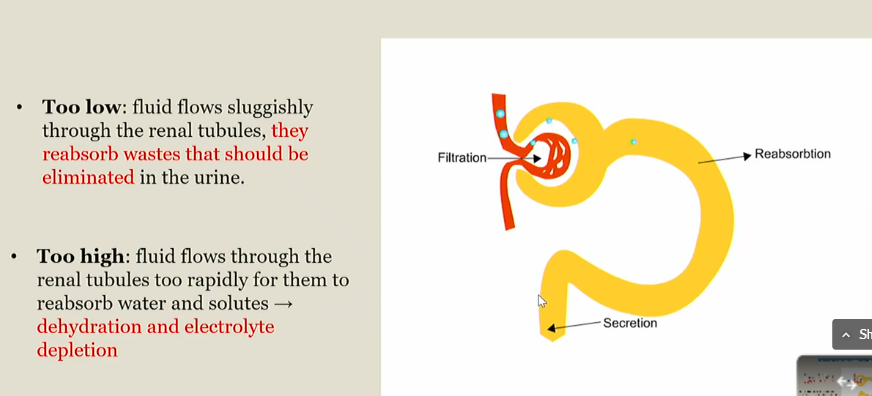
<p>Fluid flow fast through the renal tubules, and they cant reabsorb water and solutes</p><p></p><p>Leads to dehydration and electrolyte depletion</p>
56
New cards

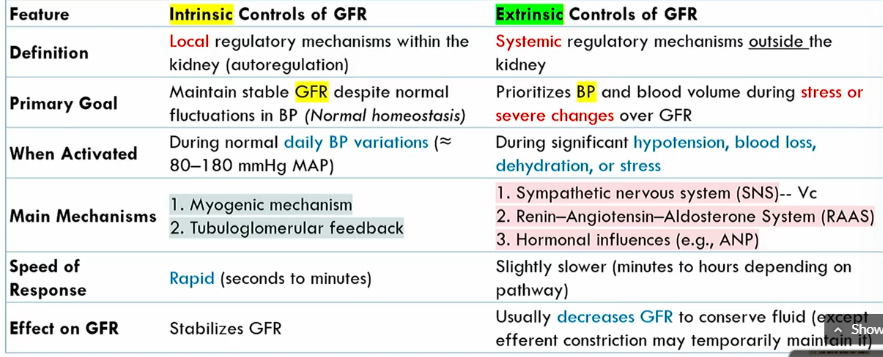
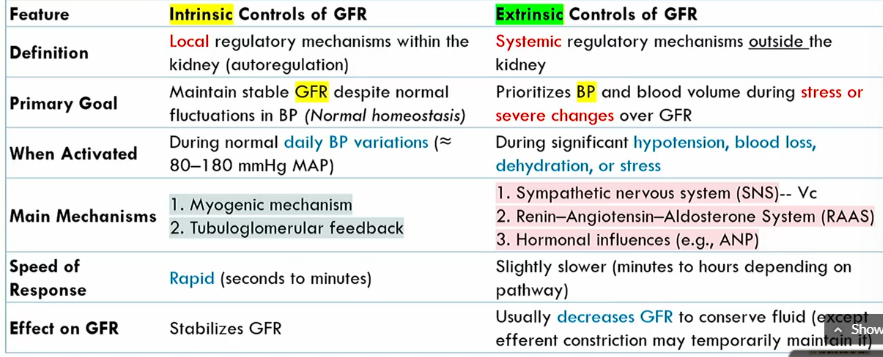
Intrinsic controls of GFR meaning

local regulatory mechanisms within the kidney (autoregulation)
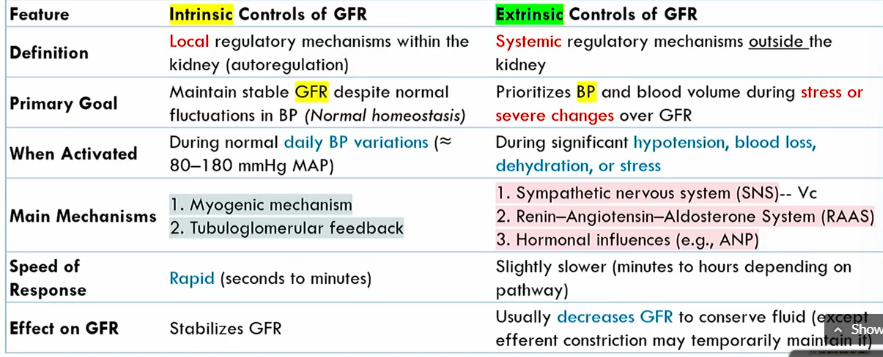
<p>local regulatory mechanisms within the kidney (autoregulation)</p>
57
New cards

Intrinsic controls of GFR primary goals

maintains stable GFR despite noromal fluctuations in BP (normal homeostasis)
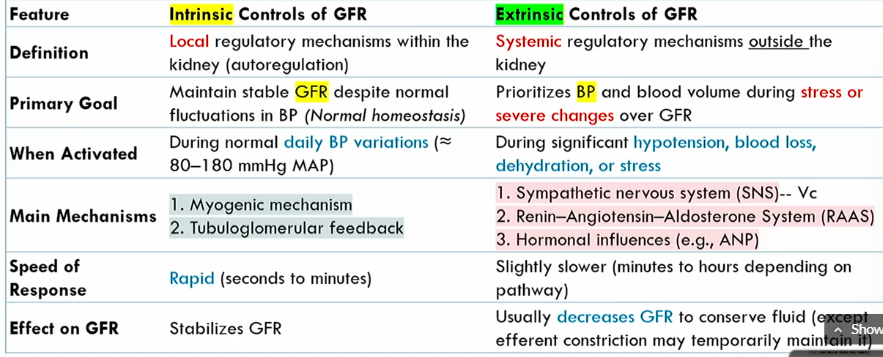
<p>maintains stable GFR despite noromal fluctuations in BP (normal homeostasis)</p>
58
New cards

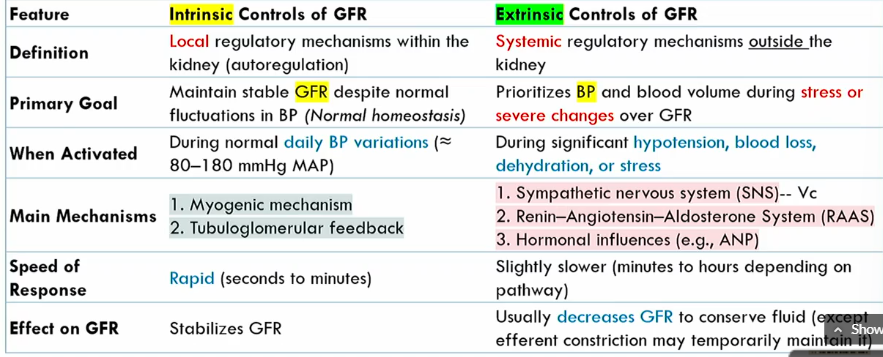
when are the Intrinsic controls of GFR activated

During normal blood pressure fluctuations, around 80-1280 mmHg MAP
<p>During normal blood pressure fluctuations, around 80-1280 mmHg MAP</p>
59
New cards

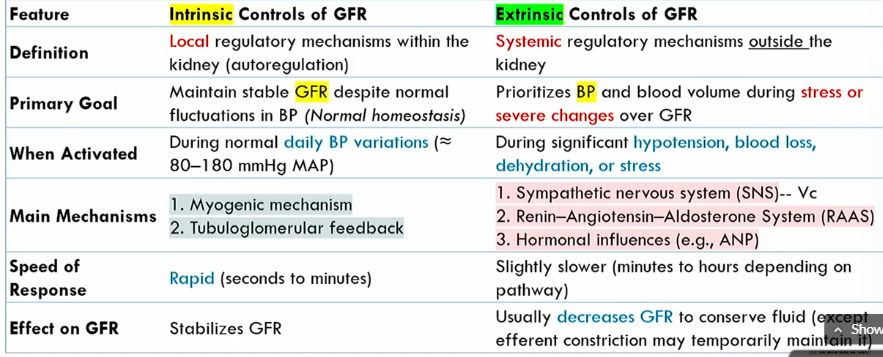
mechanisms of Intrinsic controls of GFR

Myogenic mechanism

tubuloglomerular feedback
<p>Myogenic mechanism</p><p></p><p>tubuloglomerular feedback</p>
60
New cards

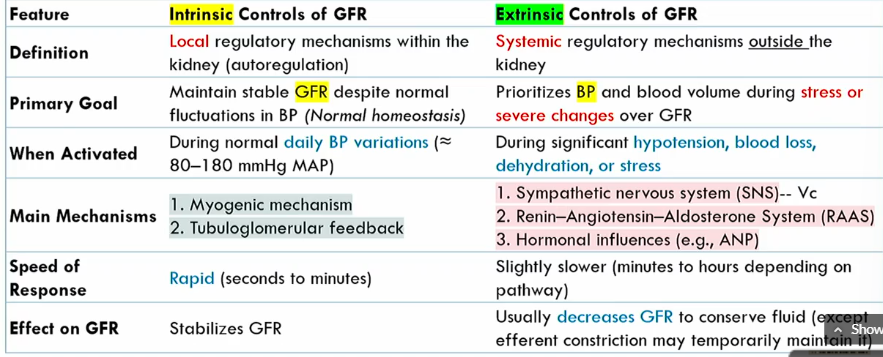
speed of Intrinsic controls of GFR

rapid
<p>rapid</p>
61
New cards

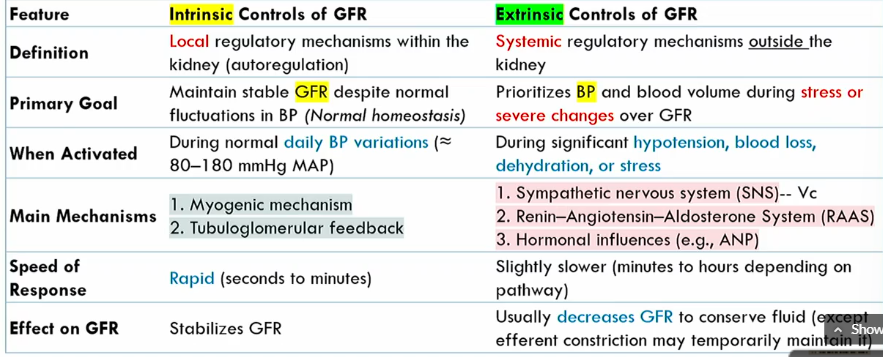
intrinsic conrols of GFR effect on GFR

stabilizes it
<p>stabilizes it </p>
62
New cards

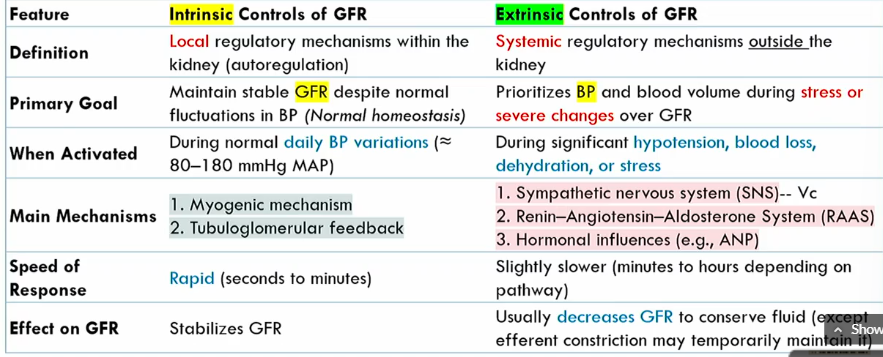
Extrinsic controls of GFR definition

systemic regulatory mechanisms outside the kidney
<p>systemic regulatory mechanisms outside the kidney</p>
63
New cards

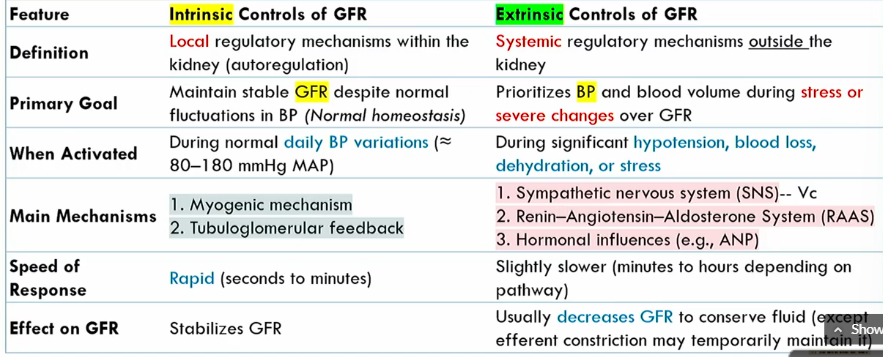
Extrinsic controls of GFR goal

prioritizes blood volume volume during stress or severe changes over GFR
<p>prioritizes blood volume volume during stress or severe changes over GFR</p>
64
New cards

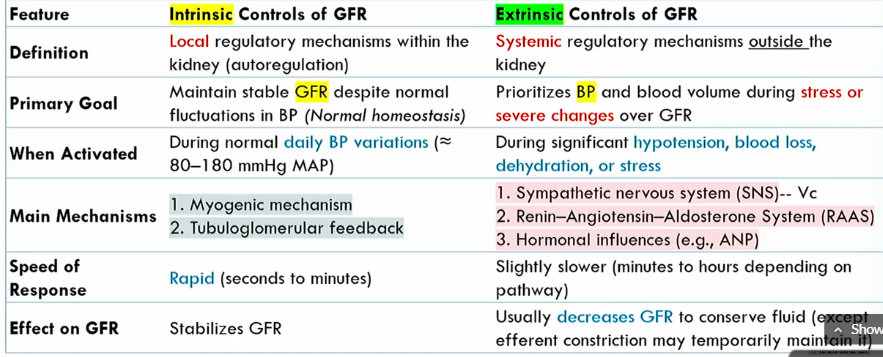
when are the Extrinsic controls of GFR activated

during significant hypotension, blood loss, dehydration, or stress
<p>during significant hypotension, blood loss, dehydration, or stress</p>
65
New cards

what are the main mechanisms of Extrinsic controls of GFR

  1. SNS

  2. renin-agiotensin-aldoseterone system

  3. hormonal influences

<ol><li><p>SNS</p></li><li><p>renin-agiotensin-aldoseterone system</p></li><li><p>hormonal influences</p></li></ol><p></p>
66
New cards

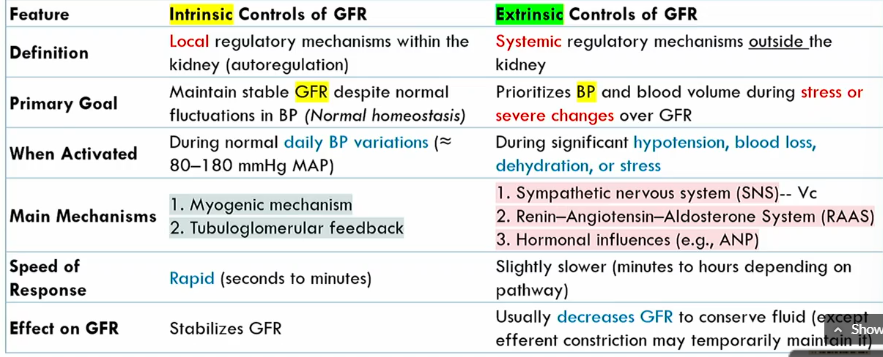
speed of Extrinsic controls of GFR

slightly slower than intrinsic controls of GFR (minutes to hours)
<p>slightly slower than intrinsic controls of GFR  (minutes to hours)</p>
67
New cards

effect of Extrinsic controls of GFR

Decreases GFR to conserve fluid (expect for efferent atriole constriction)
<p>Decreases GFR to conserve fluid (expect for efferent atriole constriction)</p>
68
New cards

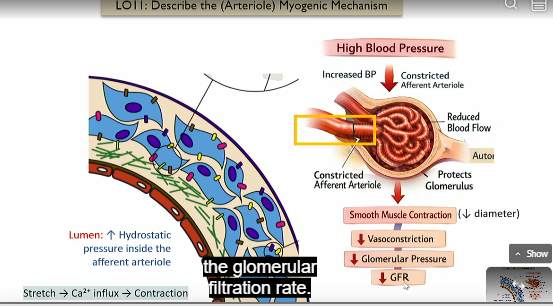
High blood pressure arteriole myogenic mechanism

Intrinsic control of GFR

  1. High blood pressure leads to increased hydrostatic pressure inside the afferent atriole leads to a stretch

  2. stretch leads to an influx in ca2+

  3. ca2+ leads to contraction

  4. diameter then decreases in afferent atriole

  5. this leads to vasoconstriction

  6. Leads to lower glomerular pressure

  7. less net flow from glomerulus to capsule space of bowman’s capsule

  8. lower GFR

<p>Intrinsic control of GFR</p><p></p><ol><li><p>High blood pressure leads to increased hydrostatic pressure inside the afferent atriole leads to a stretch</p></li><li><p>stretch leads to an influx in ca2+</p></li><li><p>ca2+ leads to contraction </p></li><li><p>diameter then decreases in afferent atriole</p></li><li><p>this leads to vasoconstriction</p></li><li><p>Leads to lower glomerular pressure</p></li><li><p>less net flow from glomerulus to capsule space of bowman’s capsule</p></li><li><p>lower GFR</p></li></ol><p></p>
69
New cards

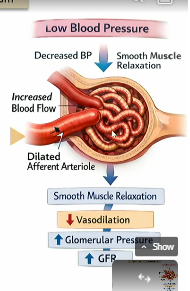
low blood pressure arteriole myogenic mechanism

  1. low blood pressure leads to decreased hydrostatic pressure inside the afferent atriole

  2. smooth muscle relaxes

  3. leads to decreased vasodilation in the afferent atriole

  4. leads to higher flow

  5. Leads to higher glomerular pressure

  6. more net flow from glomerulus to capsule space of bowman’s capsule

  7. higherGFR

<ol><li><p>low blood pressure leads to decreased hydrostatic pressure inside the afferent atriole</p></li><li><p>smooth muscle relaxes</p></li><li><p>leads to decreased vasodilation in the afferent atriole</p></li><li><p>leads to higher flow</p></li><li><p>Leads to higher glomerular pressure</p></li><li><p>more net flow from glomerulus to capsule space of bowman’s capsule</p></li><li><p>higherGFR</p></li></ol><p></p>
70
New cards

Location of juxtaglomerular apparatus
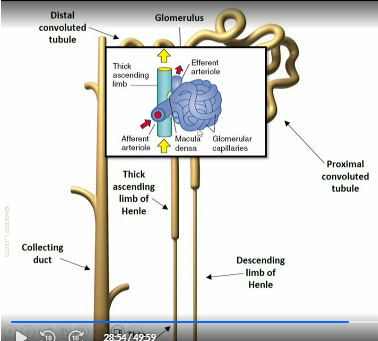
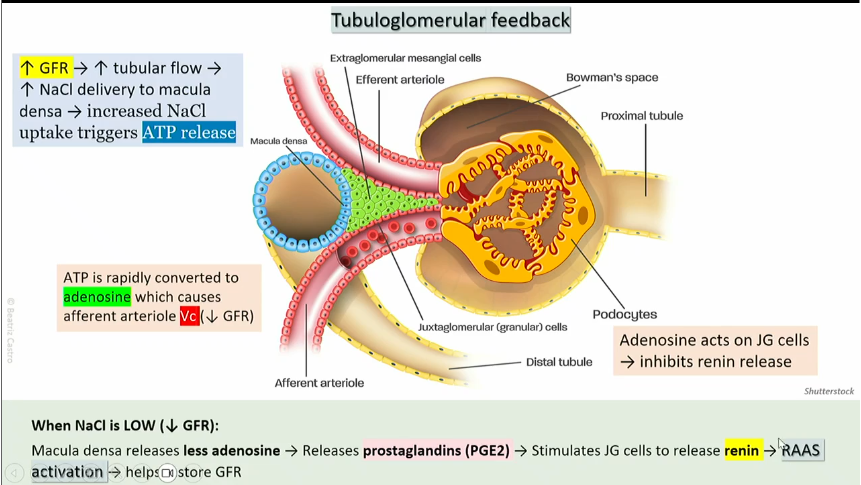
knowt flashcard image
71
New cards

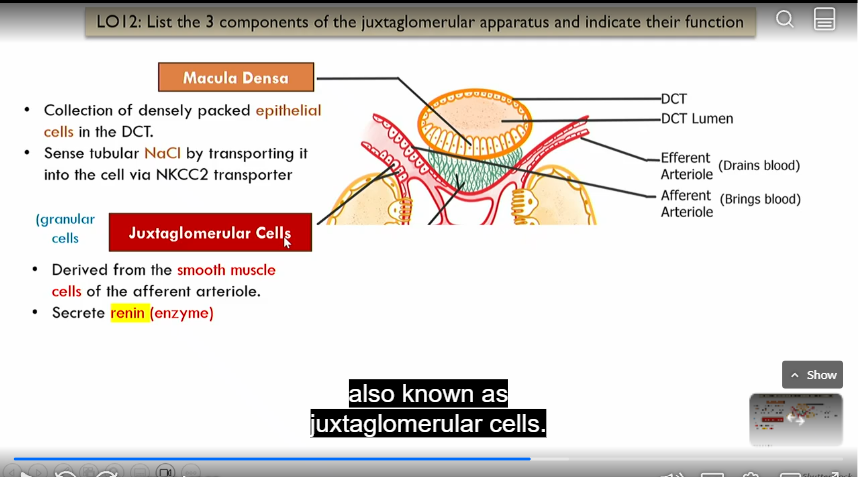
Macula densa

Intrinsic control of GFR, part of juxtaglomerular apparatus

collection of densely packed epithelial cells in distal convoluted tube that sense nacl by absorbing it via NKCC2 transporter
<p>Intrinsic control of GFR, part of juxtaglomerular apparatus </p><p></p><p>collection of densely packed epithelial cells in distal convoluted tube that sense nacl by absorbing it via NKCC2 transporter</p>
72
New cards

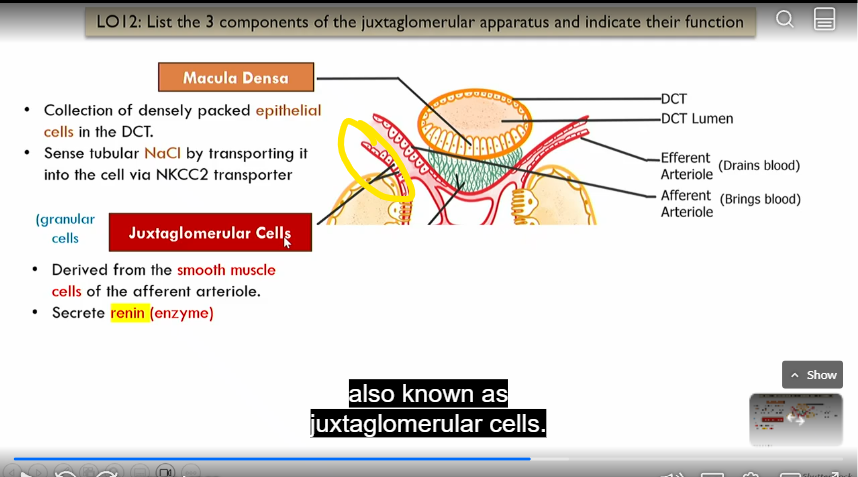
juxtaglomerrular cells

Intrinsic control of GFR, part of juxtaglomerular apparatus

in afferent atriole

derived form smooth muscle cells of efferent atriole, secrete renin (enzyme)
<p>Intrinsic control of GFR, part of juxtaglomerular apparatus </p><p>in afferent atriole</p><p></p><p>derived form smooth muscle cells of efferent atriole, secrete renin (enzyme)</p>
73
New cards

extraglomerular mesangial cells

act as a mechanical anchor between afferent atriole, efferent atriole and macula densa
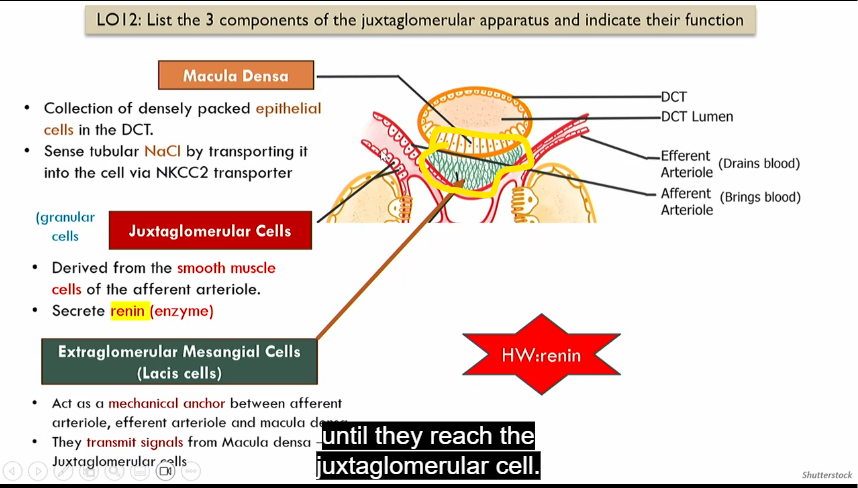
<p>act as a mechanical anchor between afferent atriole, efferent atriole and macula densa</p>
74
New cards

Tuberomerular feedback - high nacl

  1. High GFR leads to high tubular flow

  2. high amounts of Nacl delivered to the macula densa

  3. increased NaCl uptake triggers ATP release

  4. ATP is rapidly converted into adenosine which causes the efferent atriole to vasoconstrict

  5. GFR decreases

  6. Adenosine acts on JG cells, which inhibit renin release
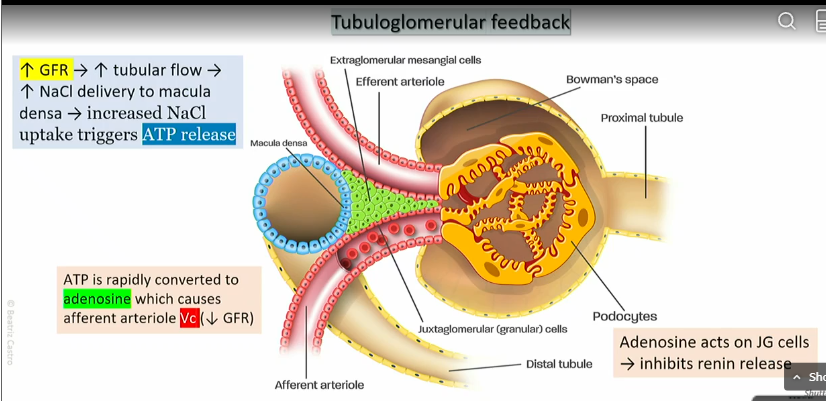
<ol><li><p>High GFR leads to high tubular flow</p></li><li><p>high amounts of Nacl delivered to the macula densa</p></li><li><p>increased NaCl uptake triggers ATP release </p></li><li><p>ATP is rapidly converted into adenosine which causes the efferent atriole to vasoconstrict</p></li><li><p>GFR decreases</p></li><li><p>Adenosine acts on JG cells, which inhibit renin release</p></li></ol><p></p>
75
New cards

Tuberomerular feedback - LOW

NaCl

  1. low GFR leads to low tubular flow

  2. low amounts of Nacl delivered to the macula densa

  3. decreased NaCl uptake triggers less ATP release, which is then turned into adenosine

  4. less adenosine release leads to prostoglandin release

  5. prostoglandin acts on JG cells, which activates RAAS

  6. RAAS helps restore GFR

<ol><li><p>low GFR leads to low tubular flow</p></li><li><p>low amounts of Nacl delivered to the macula densa</p></li><li><p>decreased NaCl uptake triggers less ATP release, which is then turned into adenosine</p></li><li><p>less adenosine release leads to <strong>prostoglandin </strong>release</p></li><li><p><strong>prostoglandin </strong>acts on JG cells, which activates <strong>RAAS</strong></p></li><li><p><strong>RAAS </strong>helps restore GFR</p></li></ol><p></p>
76
New cards

Granular cells

part of afferent atriole in juxtaglomerrular apparatus
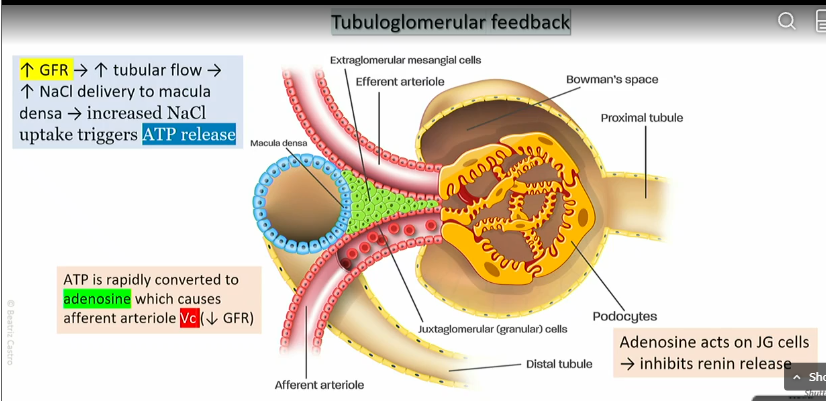
<p>part of afferent atriole in juxtaglomerrular apparatus</p>
77
New cards

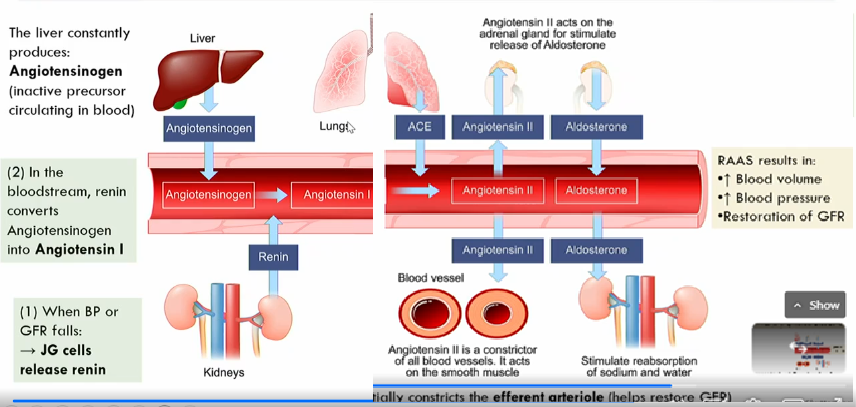
Renin aldosterone system

  1. The liver constantly produces angiotensinogen, an innactive precursor circulating in blood

  2. Blood pressure falls, Juxtoglomerular cells release renin

  3. in the bloodstream, renin converts angiotensinogen into angiotensinogen I

  4. in the lungs and vascular endothelium ACE (angiotensin convertin enzyme) converts angiotensin I into angiotensin II (active form of angiotensin I)

  5. angiotensin II makes adrenal gland release aldosterone , which stimulates the reabsorbtion of sodium and water

  6. angiotensin II also acts on the smooth muscle to constrict blood vessels (the kidney prefers the efferent atriole)
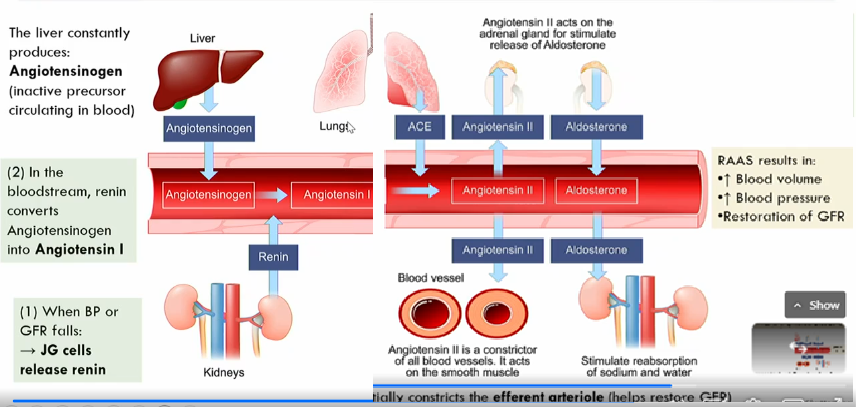
<ol><li><p>The liver constantly produces <strong>angiotensinogen,</strong> an innactive precursor circulating in blood</p></li><li><p>Blood pressure falls, Juxtoglomerular cells release renin</p></li><li><p>in the bloodstream,  renin converts <strong>angiotensinogen </strong>into <strong>angiotensinogen I</strong></p></li><li><p>in the lungs and vascular endothelium <strong>ACE (angiotensin convertin enzyme) </strong>converts angiotensin I into <strong>angiotensin II </strong>(active form of angiotensin I)</p></li><li><p>angiotensin II makes adrenal gland release <strong>aldosterone </strong>, which stimulates the reabsorbtion of sodium and water</p></li><li><p>angiotensin II also acts on the smooth muscle to constrict blood vessels (the kidney prefers the efferent atriole)</p></li></ol><p></p>
78
New cards

What does angiotensin II do?

active form of angiotensin I

  1. angiotensin II makes adrenal gland release aldosterone , which stimulates the reabsorbtion of sodium and water

  2. angiotensin II also acts on the smooth muscle to constrict blood vessels

<p>active form of angiotensin I</p><p></p><ol><li><p>angiotensin II makes adrenal gland release <strong>aldosterone </strong>, which stimulates the reabsorbtion of sodium and water</p></li><li><p>angiotensin II also acts on the smooth muscle to constrict blood vessels</p></li></ol><p></p><p></p>
79
New cards

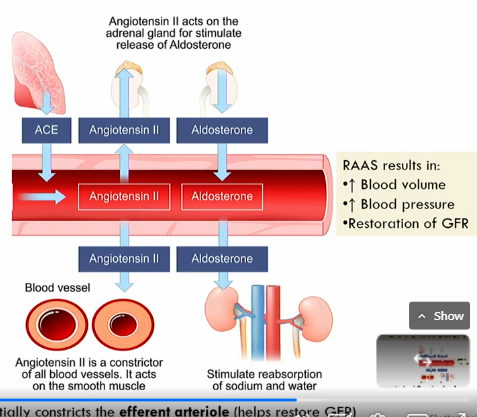
What does RAAS result in?

Increased blood volume

increased blood pressure

restoration of GFR
<p>Increased blood volume </p><p>increased blood pressure</p><p>restoration of GFR</p>
80
New cards

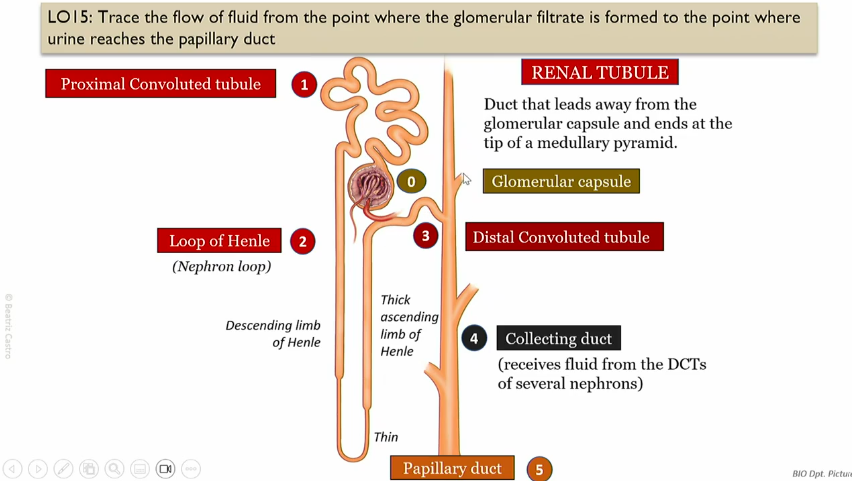
Flow of glomerular filtrate

knowt flashcard image
81
New cards

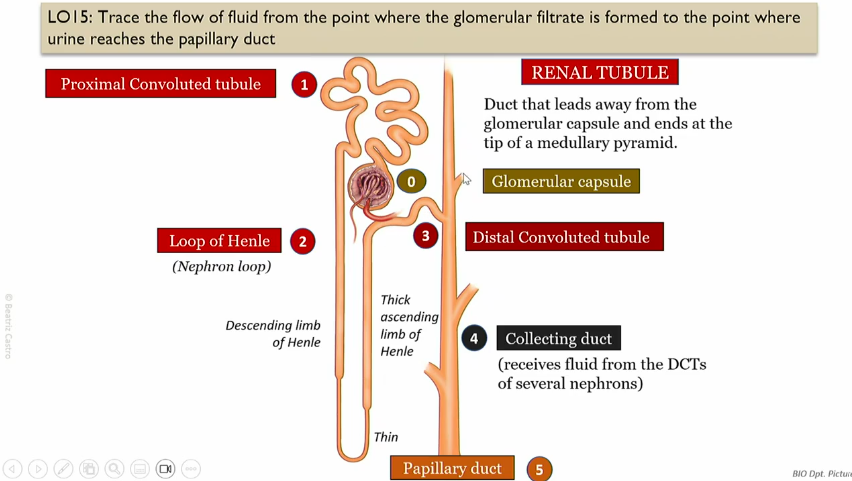
What does the collecting duct do?

recieves fluid form DCTs of several nephrons
<p>recieves fluid form DCTs of several nephrons</p>
82
New cards

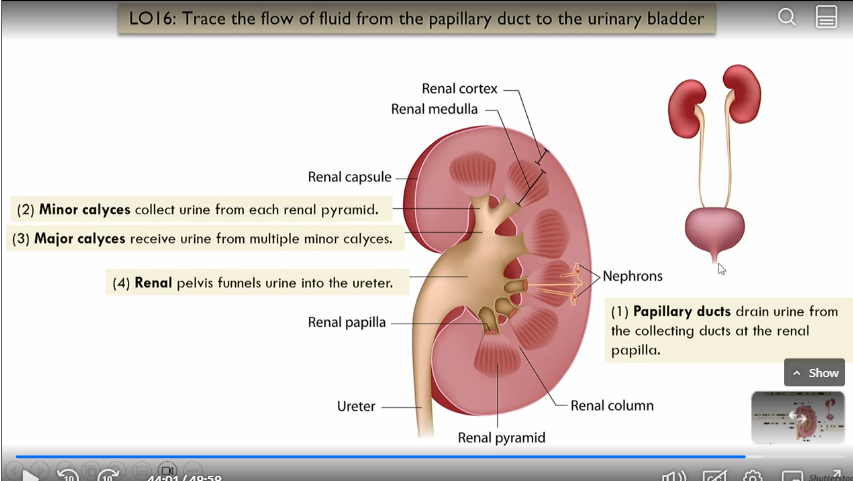
Flow of fluid from papillary duct to the urinary bladder
knowt flashcard image

Explore top notes

note
Cells
Updated 1253d ago
0.0(0)
note
AMSCO AP World History 7.6, 7.7
Updated 1101d ago
0.0(0)
note
Key Moments in the Outsiders
Updated 1223d ago
0.0(0)
note
Color Combinations or Schemes
Updated 1276d ago
0.0(0)
note
Cells
Updated 1253d ago
0.0(0)
note
AMSCO AP World History 7.6, 7.7
Updated 1101d ago
0.0(0)
note
Key Moments in the Outsiders
Updated 1223d ago
0.0(0)
note
Color Combinations or Schemes
Updated 1276d ago
0.0(0)

Explore top flashcards

flashcards
Science 6th grade finale
83
Updated 1044d ago
0.0(0)
flashcards
Hindi
64
Updated 311d ago
0.0(0)
flashcards
FR 1 - Basic Convo
25
Updated 212d ago
0.0(0)
flashcards
Economics chapter 4
25
Updated 900d ago
0.0(0)
flashcards
Forces and Friction Test
27
Updated 881d ago
0.0(0)
flashcards
DITD #1
47
Updated 1148d ago
0.0(0)
flashcards
Science 6th grade finale
83
Updated 1044d ago
0.0(0)
flashcards
Hindi
64
Updated 311d ago
0.0(0)
flashcards
FR 1 - Basic Convo
25
Updated 212d ago
0.0(0)
flashcards
Economics chapter 4
25
Updated 900d ago
0.0(0)
flashcards
Forces and Friction Test
27
Updated 881d ago
0.0(0)
flashcards
DITD #1
47
Updated 1148d ago
0.0(0)