Bio1110 Human female reproductive system
 Call Kai
 Learn
Learn Practice Test
 Spaced Repetition
 Match
Match Flashcards
 Knowt Play
1/86

There's no tags or description
Looks like no tags are added yet.
Name | Mastery | Learn | Test | Matching | Spaced | Call with Kai |
|---|
No analytics yet
Send a link to your students to track their progress
87 Terms
Parts of the female reproductive system
ovaries, uterus, cervix, oviduct/fallopian tube, uterine wall, endometrium, and vagina
What do the ovaries do?
produce and release eggs, produce key hormones
What does the uterus do?
receive a nourished egg and house and protect the growing fetus
What does the cervix do?
sperm must pass through the cervix for fertilization to occur
What does the oviduct do?
passageway that captures ovulated eggs and transports the early embryo to the uterus, is the site of fertilization
What does the vagina do?
entryway to the female reproductive system and the birth canal, and its acidic
What does the endometrium do?
the inner lining of the uterus, sheds during menstruation when pregnancy doesn’t occur, maintains early pregnancy
What does the uterine wall do?
three layered structure that supports pregnancy, endometrium is part of it (the most inner wall where eggs are implanted
Why does the oviduct have cilia?
to move oocytes through the duct since eggs cannot move
What is oogenesis?
the production of oocytes in the ovary
Females are born with all the immature …
oocytes they will produce in their lifetime
When does the development of oocytes begin?
puberty
Oocytes are found within …
follicles
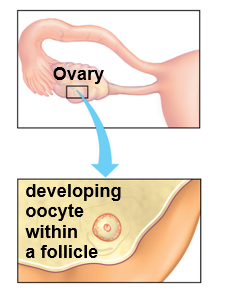
What are follicles?
a pouch-like cavity formed by a group of cells that nourish and protects the oocyte
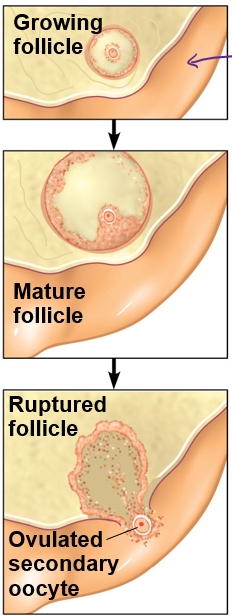
What is ovulation?
at maturity, a follicle will rupture and release the oocyte it carried
What is estradiol?
the most potent form of estrogen, prepares the body for ovulation and possible pregnancy, is released by the follicle
Roughly every 28 days after puberty, 15-20 …
follicles start maturing but usually only one completes maturation and eventually ruptures
The oocyte will only fully develop if its …
fertilized, otherwise it will pass out of the body through the vagina during menstruation
What is the route of a secondary oocyte as it moves through the reproductive system?
first release from the ovary, is carried through the oviduct until it reaches
What does the follicle do once it bursts?
it reorganizes itself into the corpus luteum
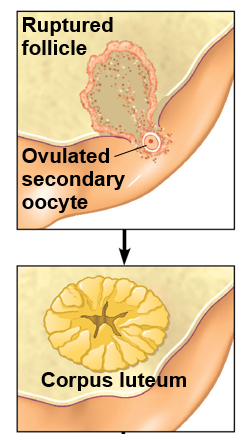
What does the corpus luteum do?
produces estradiol and progesterone, is a temporary gland
If fertilization occurs then the corpus luteum …
takes longer to degenerate
If fertilization doesn’t occur then the corpus luteum …
degenerates sooner
After entering through the vagina, how do sperm reach the egg?
they have to pass through the cervix first
What acts as the birth canal?
the vagina
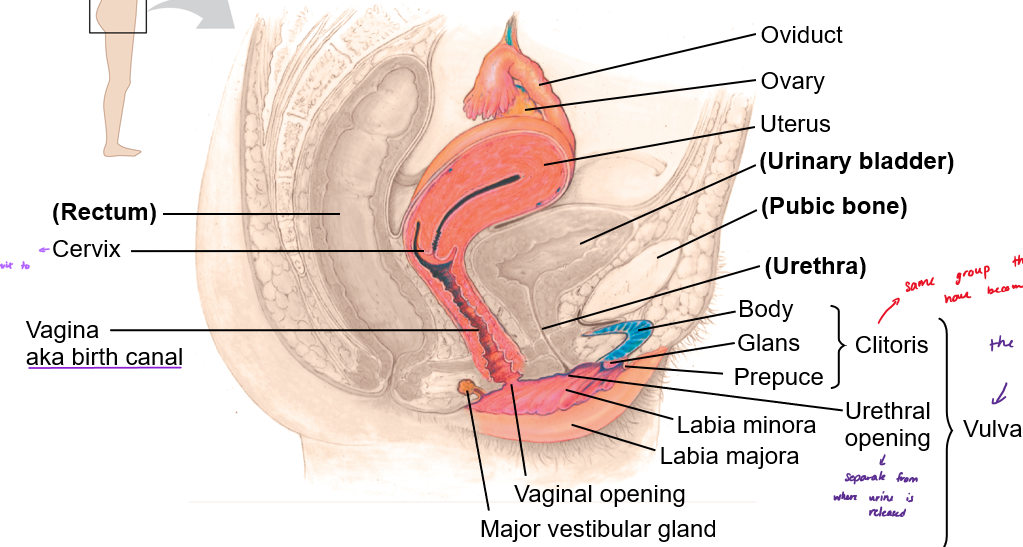
Reproductive organs lie between what?
the digestive system and the rectum
The vulva includes what two things
the clitoris and the urethral opening (which is the exit for urine only
The clitoris includes what three things?
the body, the glans, and the prepuce, and the clitoris is the female homolog of the penis
What two cycles have to crosstalk?
the ovulation and menstrual cycle
Menstruation is the uterus doing what?
preparing for implantation, this happens because we are eutherian mammals (embryo develops inside the body
What hormones synchronize the two cycles
GnRH, FSH, LH, Estradiol and Progesterone
What does GnRH do and what secretes it?
secreted by the hypothalamus, regulates secretion of FSH and LH
What does FSH do and what secretes it?
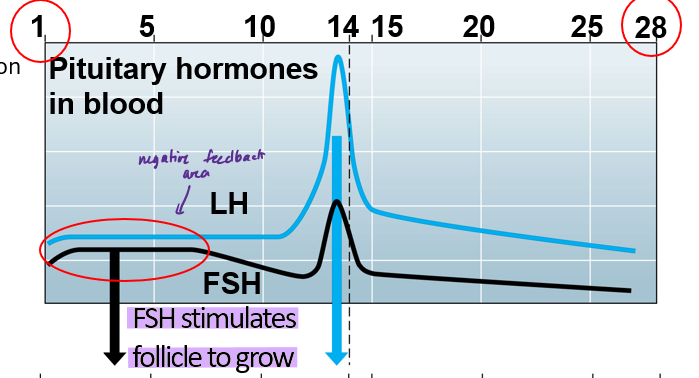
secreted by the anterior pituitary gland, and it stimulates the growth of the ovarian follicles (follicle stimulating hormone)
What does LH do and what secretes it?
secreted by the anterior pituitary gland, stimulates the growth of ovarian follicles and development of the oocyte, promotes ovulation and the development of the corpus luteum
What does just Estradiol do and what secretes it?
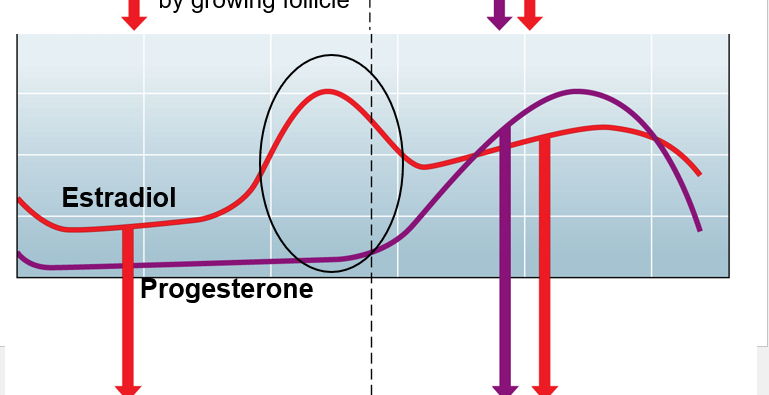
secreted by the ovarian follicle, low levels inhibit the pituitary gland, high levels stimulate the hypothalamus, and it promotes growth of the endometrium
What does Progesterone and Estradiol do and what secretes it?
secreted by the corpus luteum, maintains the endometrium, high levels of these inhibit the hypothalamus and the pituitary gland
What does Just progesterone do and what secretes it?
secreted by the placenta, high levels inhibit the hypothalamus and pituitary gland
What is the length of the ovarian cycle?
28 days on average, its start is marked with menstruation
The ovarian cycle is separated into what two phases?
follicular and luteal
high levels of just estradiol stimulate the hypothalamus to do what?
produce more FSH and LH
What day does the follicular phase end?
on average, day 14
What happens during the follicular phase?
GnRH causes release of FSH and LH and FSH is recognized by follicle cells, follicles begin developing and they secrete low levels of estradiol
Low levels of estradiol go to the anterior pituitary gland and produce more FSH which …
matures the follicle which results in greater production of estradiol until a spike in estradiol is reached right before the egg is released from the follicle
15-20 follicles grow, but how many end up maturing
usually 1
Progesterone only starts building …
once the egg has been released
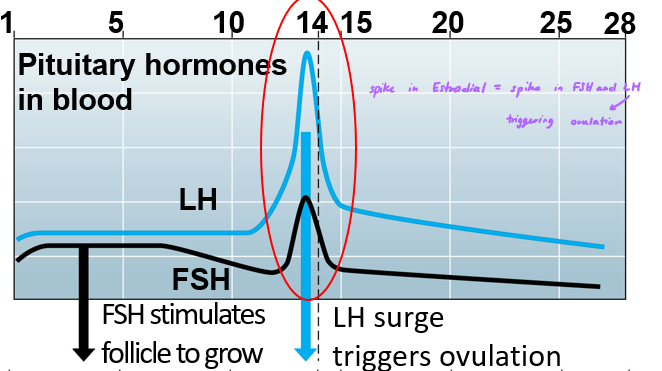
High estradiol stimulates high GnRH which leads to …
high LH and FSH, then LH triggers enzymes that rupture the follicle releasing the egg
How long is the oocyte viable after being released?
24 hours, why sperm must fuse with it in the oviduct, if they meet in the vagina for example then the egg is no longer viable by the time it gets there
If fertilization is going to happen then it HAS to follow …
ovulation
What are the three stages of Menstruation?
flow phase, proliferative phase, and secretory phase
Increasing levels of _______ cause the thickening of the endometrium
estradiol, only happens when a zygote has implanted
What hormones maintain the endometrium?
progesterone and estradiol
If fertilization doesn’t occur, then estradiol drops which results in …
the uterine lining shedding, takes the unfertilized oocyte with it through the vagina
The flow phase and the proliferative phase line up with what?
The follicular phase of the ovulation cycle
What happens during the flow phase and how long does it last?
the uterine lining of the previous cycle is shedding, it lasts approximately days 1-5
What happens at the end of the flow phase?
estradiol levels increase marking the start of the buildup of the endometrium
What happens during the proliferative phase?
the endometrium is building up, the proliferative phase ends with the combination of progesterone and estradiol produced during the ovarian cycle
What happens during the luteal phase of the ovarian cycle?
the corpus luteum develops which releases estradiol and progesterone, no FSH and LH are released because progesterone and estradiol are present, and low LH levels cause the corpus luteum to degrade
What days mark the secretory phase?
approximately days 15-28, hormones will start to drop during this phase if fertilization doesn’t occur
Contraception targets …
weak points in the system to prevent fertilization
Contraception uses barriers that can be …
permanent or temporary
A vasectomy is …
permanent, prevents sperm transport to the male duct system
Abstinence =
avoiding sexual intercourse, sure fire way of no pregnancy
Coitus interruptus =
not ejaculating in vagina
Condoms are a …
physical contraception method, puts up a literal barrier that prevents sperm from entering the vagina
Tubal ligation =
cutting or tying the fallopian tubes, prevents eggs from coming in contact with the sperm, permanent
Which contraception method acts at the latest stage?
Spermicides (kills or stops sperm from moving, often a gel), diaphragm (covers the cervix), copper IUDs (inserted in the uterus) these are temporary
Most birth control pills use …
low levels of estradiol and progesterone to prevent the release of FSH and LH which means to ovulation
What are the two strategies for contraception?
barriers or hormones
Copper IUDs prevent …
the meeting of sperm and egg cells in the oviduct and the fusion
How to tell is a woman has ovulated
cervical fluid is NOT fertile(low sperm penetrability) or an increase in basal body temperature
The embryo implants in the uterine wall after how many days after fertilization
7 days
The placenta starts forming from what?
cells of the embryo and mom (nutrients and O2)
What does the implanted embryo secrete?
Human chorionic gonadotropin (hCG), it is recognized by the corpus luteum and this is what pregnancy tests are searching for
hCG overrides the lack of LH and the corpus luteum continues to …
secrete estradiol and progesterone instead of degenerating, this tells the uterus to maintain the pregnancy
Why is it important that LH and FSH get blocked once a pregnancy is established?
because the body can only sustain so many embryos plus the size of the uterus
Human development lasts …
38-40 weeks or 9 months inside the mother
When does the placenta form?
2-4 weeks in, the placenta is the transfer organ, made from tissues from the mom and the fetus
What does the placenta do in accordance with the corpus luteum?
it takes over the role of secreting estradiol and progesterone, takes over during the second trimester
What happens during the first trimester?
placenta fully forms, mucus plug forms that seals the uterus (makes the uterus a safe environment), differentiation of organogenesis, fetus = 8 weeks old, first trimester lasts 1-13 weeks
What happens during the second trimester?
external sex organs (can do 20 week full anatomy scan - can see there sex here), outer ears develop, placenta takes over progesterone production, lasts 14-27 weeks
What happens during the third trimester?
final development and growth, lasts 28-40 weeks, and at 32 ish weeks the babies respiratory system is ready to take over and not rely on the mom’s
Estradiol from ovaries activates …
oxytocin receptors on uterus, oxytocin comes from the mother’s posterior pituitary gland and from the fetus
What does oxytocin do?
stimulates uterus to contract and stimulates placenta to make Prostaglandins which stimulates more production of oxytocin/more contractions of the uterus (positive feedback)
What are the three stages of active labor?
Dilation and thinning of cervix, delivery, and afterbirth
What is dilation and thinning of cervix?
when the cervix thins and stretches, is the longest stage of childbirth, and contractions become stronger and more frequent, lasts 6-12 hours sometimes longer, the transition is 7 to 10 cm (the most painful part)
What happens during delivery?
strongest uterine contractions, lasts 20 minutes to an hour (maybe longer)
What happens during afterbirth?
expulsion of the placenta which comes about 15 minutes after the baby

