Astrophysics 13.1.1 - 13.1.5 (telescopes)
 Call Kai
 Learn
Learn Practice Test
 Spaced Repetition
 Match
Match Flashcards
 Knowt Play
1/45

There's no tags or description
Looks like no tags are added yet.
Name | Mastery | Learn | Test | Matching | Spaced | Call with Kai | Chat |
|---|
No analytics yet
Send a link to your students to track their progress
46 Terms
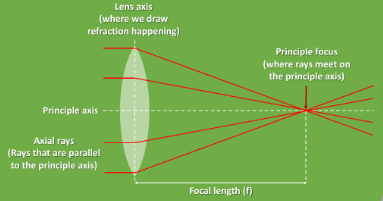
How to label a lens diagram
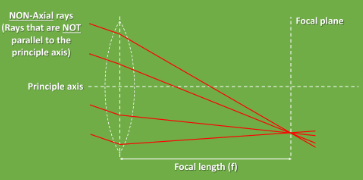
Non-axial rays
The focal length doesn’t change even if parallel rays enter the lens at different angles
They all converge on what is known as the focal plane
How to draw an accurate ray diagram
Draw a axial ray from the top of the object which then is refracted and passes through the focus point
Draw one ray from the top of the object through the centre of the lens
Draw a third ray which passes through the focus on the left side and leaves the lens as axial ray
Draw in the image formed
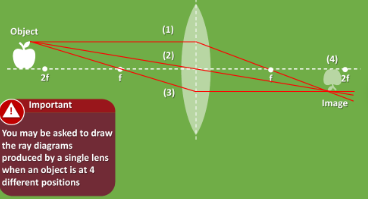
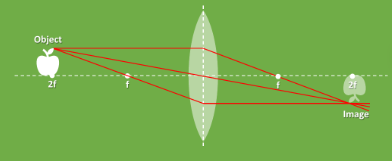
Ray diagram for an object beyond 2f
Object position - More than 2f away
Image position - Between f and 2f
Image orientation - Inverted
Magnified or dimished - Diminished
Application - Camera
Real image
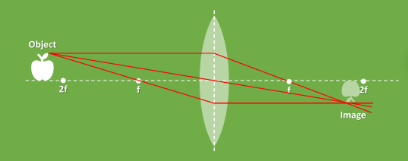
Ray diagram for an object at 2f
Object position - At 2f
Image position - At 2f
Image orientation - Inverted
Magnified or dimished - Same size
Application - Inverter
Real image
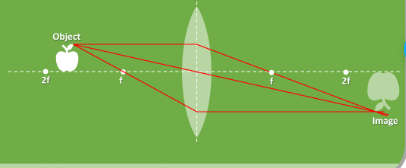
Ray diagram for an object between 2f and f
Object position - Between f and 2f
Image position - Beyond 2f
Image orientation - Inverted
Magnified or dimished - Magnified
Application - Projector
Real image
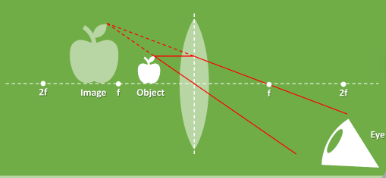
Ray diagram for an object closer than f
Object position - Closer than f
Image position - Same side as object
Image orientation - Upright
Magnified or dimished - Magnified
Application - Magnifying glass
Virtual image
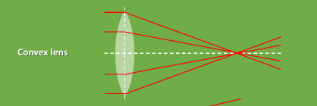
Convex Lenses
Converging lenses
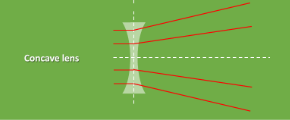
Concave Lenses
Diverging lenses
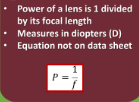
Power of a lens
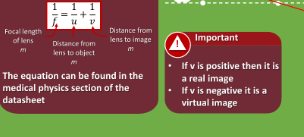
Lens equation
How refracting telescopes work
Refracting telescopes use two convex lenses to form a magnified image
The one closes to the eye is the eyepiece lens
M = f0/fe (f0 = focal length of objective lens and fe = focal length of eye lens)
Total length of the telescope is the sum of the two focal lengths
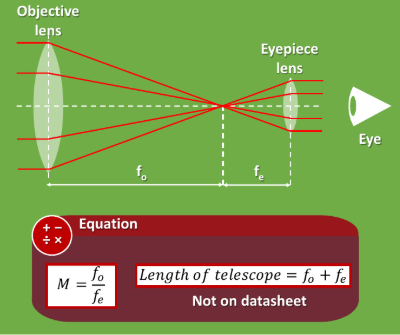
How to draw a ray diagram for three non-axial rays passing through a refracting telescope
Draw a non-axial ray through the centre of the objective lens axis to the eyepiece lens axis
Draw two parallel rays either side
These should meet at the focus and then stop on the eye lens axis
Draw a construction line (which must be drawn) that starts from where the rays cross over and passes through the centre of the eyepiece lens
The three rays emerge parallel to this line
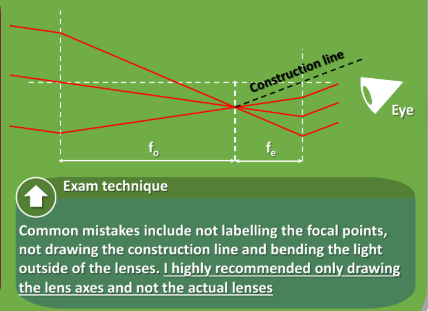
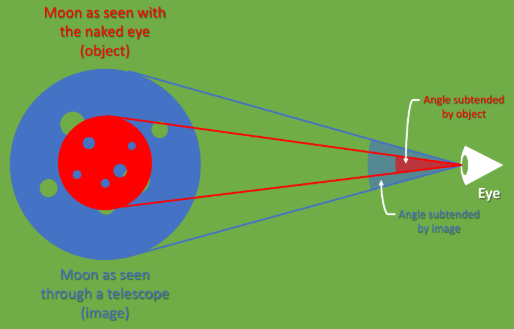
Two ways to calculate Magnification
M = f0/fe (f0 = focal length of the objective lens (Objective lens to focal point | fe = focal length of eye lens (Focal point to eye) )
M = Angle subtended by image/Angle subtended by object
How reflecting telescopes work
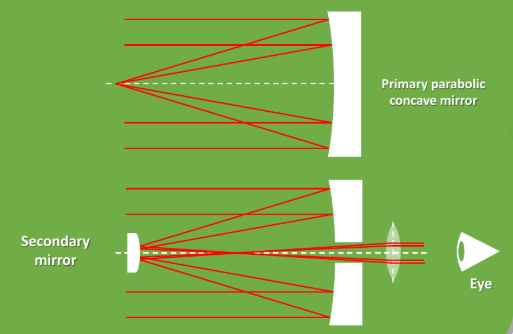
Reflecting telescopes use a parabolic mirror to focus incoming light into a point (rather than a lens using refraction)
A secondary mirror is placed before the focal point to reflect the rays back through a gap in the mirror
Rays cross over then pass into the lens
The rays emerge parallel
This arrangement is known as a Cassegrain telescope
What’s a CCD
Stands for charge coupled device
They’re used to take digital images
They are found in most cameras
CCD’s physical characteristics
CCD’s consist of a series of silicon picture elements (pixels)
These pixels are very small
Not to be confused with the pixels on a screen that change colour
Beneath each one is a potential well which can trap electrons
Above each one is a filter to only allow certain colour photons through
How CCD’s work
Step 1:
The filter allows only certain wavelengths (Colours) of photons to hit the pixels
Step 2:
The photons will cause electrons in the pixels to be released into the potential wells
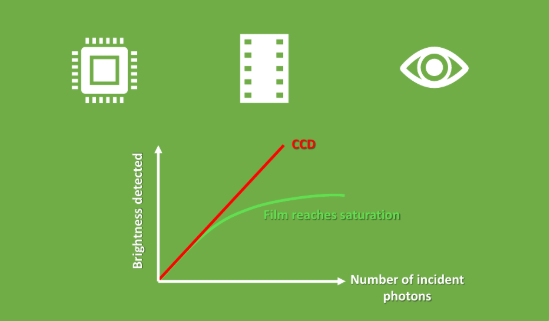
The amount of electrons released is proportional to the intensity of the light incident (number of photons)
Step 3:
The charge is then collected from each potential well
The amount of charge in the potential well and the colour of filter above tells the computer what colour and what brightness needs to be displayed
CCD’s advantages over eye and photographic film
Adv:
Quantum efficiency: -(num of photons detected/num of photons incident x 100) -Tells us how many of the photons that hit a detector are actually detected. -A CCD detects about 80%, Photographic film is 4% and eye is 1%
Saturation: -CCD’s don’t get saturated like how photographic film does
CCD’s can detect a wider spectrum of light vs the eye (Infrared, visible and UV)
CCD’s capture more fine detail: -The minimum resolvable distance (spatial resolution) of the eye is around 100μm vs CCD at 10μm
CCD’s can have long exposures to capture very faint images
Advantages and disadvantages of refracting telescopes
Adv:
No secondary mirror blocking light (optical advantage)
Disadv:
Chromatic aberration
Impurities in glass
Lens distortion
Length of telescope
Advantages and disadvantages of reflecting telescopes
Adv:
Cheaper to make large
Better support structure
Less chromatic aberration (optical advantage)
Better collecting and resolving power (optical advantage)
Disadv:
Spherical aberration
Sceondary mirror blocks light
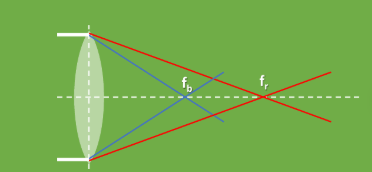
Chromatic aberration (Disadvantages of refracting telescopes)
When light refracts through glass by different amounts depending on the wavelength of the light - so colour focuses in different places after passing through a lens
Shorter wavelengths like blue focus to close to the lens whilst long wavelengths like red focus too far way
In an image this causes a colour ‘bleeding’ effect at the edges
Both types of telescope use a lens but it has a bigger effect on the larger lens in the refracting telescope
Impurities (Disadvantages of refracting telescopes)
Any bubbles or impurities in the glass absorb and scatter light so very faint objects can’t be seen
Lens distortion (Disadvantages of refracting telescopes)
Large lens are heavy and can only be supported at the edge so the shape can become distorted
Length of telescope (Disadvantages of refracting telescopes)
For large magnification long focal lengths are needed so telescopes are very long requiring big expensive buildings
Cost (Advantages of reflecting telescopes)
Large mirrors of good quality are much cheaper than large lenses
Support structure (Advantages of reflecting telescopes)
Lens can only be supported around the edge to prevent blocking light, but as light doesn’t pass through the mirror they can be supported from the back, making them less likely to distorts
Collecting power (Advantages of reflecting telescopes)
The larger the telescope the more light you collect and the dimmer the objects you can see, reflecting telescopes are easier to make larger
Better resolving power (Advantages of reflecting telescopes)
Their design allows for much larger primary mirrors than the lenses used in refractors → as they have greater diameter
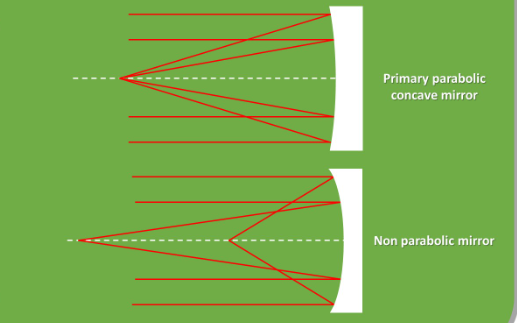
Spherical aberration (Disadvantages of reflecting telescopes)
Occurs when the shape of the mirror isn’t a perfect parabola
Outer rays focus too close
Inner rays focus too far away
The Hubble space telescope suffered from this
It causes images to be blurry
Second mirror (Disadvantages of reflecting telescopes)
The secondary mirror can also block and diffract some of the incoming light - leading to a decrease in image clarity
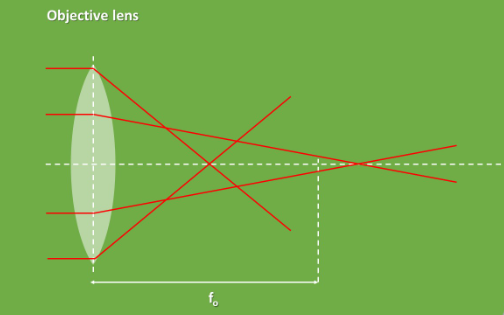
Can lenses suffer from spherical aberration?
Yes as the same effect happens
Outer rays focus too close
Inner rays focus too far away
This leads to a blurry image
Diffraction of light through a circular opening
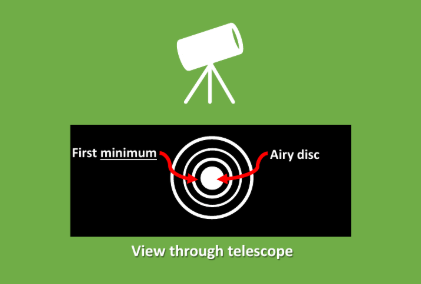
When light passes through a circular opening (Like the opening of a refracting/reflecting telescope) then the light diffracts
This creates a circular diffraction pattern which consists of bright rings (maxima) and dark rings (minima)
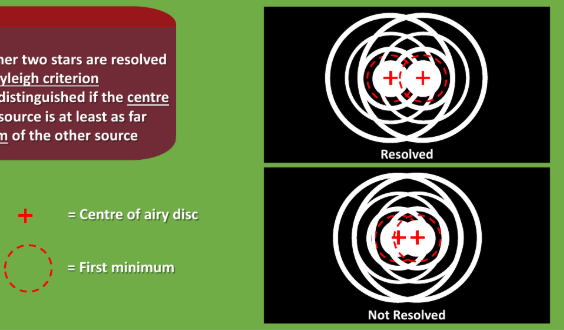
Central maxima is known as an airy disc
Rayleigh Criterion
When two light sources can be distinguished if the centre of the airy disc from one source is at least as far away as the first minimum of the other source
This allows us to decide whether two stars are resolved or not
Resolving power
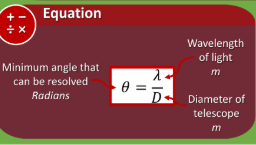
The smallest angle between two stars where they can be seen as 2 distinct stars (resolved)
Smaller angle = More powerful telescope
Smaller the wavelength the better
The larger the diameter the better
Arc seconds
Structure of telescopes
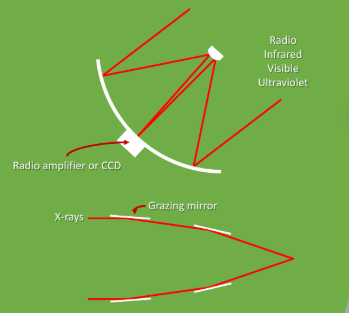
Nearly all types of telescopes use a parabolic dish to focus EM radiation onto a point
Visible, UV and infrared telescopes place a CCD at this point
Radio telescopes use a combination of amplifiers to boost weak signals and a tuner to focus on specific frequencies
X-rays are absorbed by a dish so a different structure is needed -They use a series of ‘grazing’ mirrors to focus the X-rays -This makes X-ray telescopes very long
A Geiger counter, CCD or charged metal mesh is used as a detector
Perfection of telescopes
How perfect the dish of a telescope needs to be depends on the wavelength being collected
An imperfections cannot be greater than 1/20th of the wavelength
Imperfections count as bumps/holes in the dish
UV telescopes have to be the most perfect making them very expensive
Radio can be the least perfect which makes them cheaper and also much larger -Their dishes are often not solid but made of a mesh
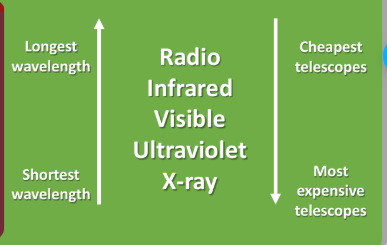
Resolving power of a telescope
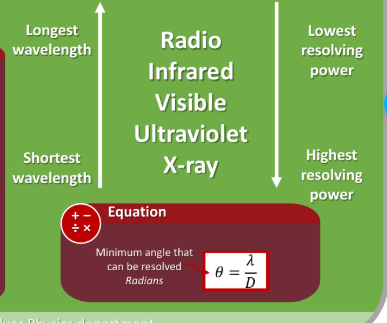
Higher resolving power means a small minimum angle when two stars can be resolved
Resolving power is directly proportional to wavelength. Also directly proportional to diameter.
UV and x-rays have much higher resolving power whilst Radio’s the worst
Collecting power of a telescope
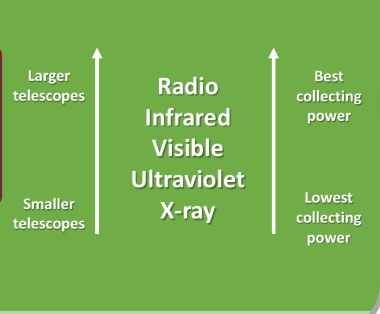
Collecting power is linked to the area of the telescope (Collecting power is directly proportional to the diameter²)
Larger telescope area can collect more photon
This allows you to see the dimmest stars (as few of their photons reach us)
Radio telescopes therefore have the best collecting power
UV and X-ray telescopes tend to be small as they are expensive to make, so they have the worst collecting power
Location of a telescope
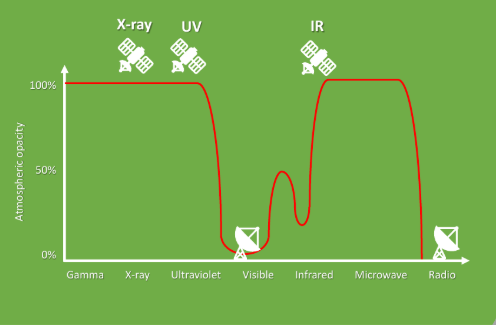
The atmosphere blocks some wavelengths more than others -Most infrared,UV and X-ray’s are blocked so their telescopes are put into space
However infrared telescopes can be put on top of high mountains or in airplanes to get above the atmosphere
Visible and radio passes through the atmosphere so these can be on the ground
However some visible light is blocked so these are more effective in space
Additional points for non-optical telescopes
As infrared radiation is heat, the infrared telescopes have to cool themselves
Supply of coolant will only last a few years
Images produced by a telescope are only as good as the detector (How many pixels are on the CCD)
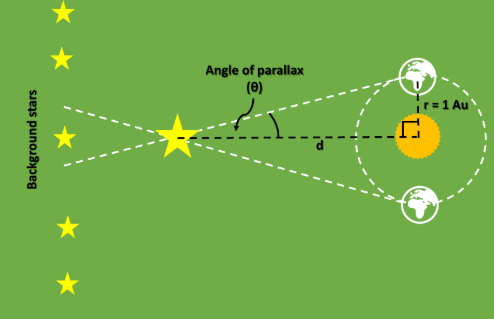
Parallax method
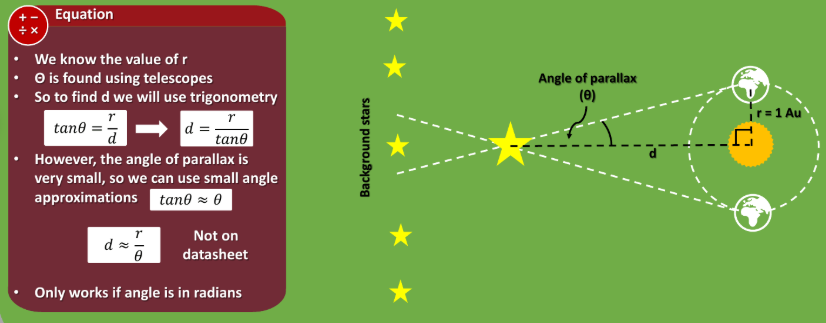
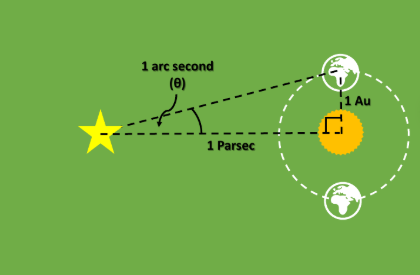
Parsec
1 Parsec is the distance when 1Au subtends an angle of 1 arc second
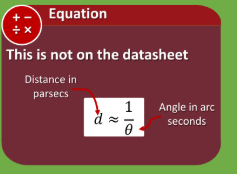
What’s the shortcut to find the distance when an angle is subtended?
Only use it to verify answer
Lightyear
The distance that light travels in a year