ecology unit test 3
 Call Kai
 Learn
Learn Practice Test
 Spaced Repetition
 Match
Match Flashcards
 Knowt Play
1/27

There's no tags or description
Looks like no tags are added yet.
Name | Mastery | Learn | Test | Matching | Spaced | Call with Kai |
|---|
No analytics yet
Send a link to your students to track their progress
28 Terms
Assumptions of the Lotka-Volterra Predator/Prey Model
2-species model: predator & prey, prey death means eaten by a predator so it is proportional to predator growth, infinite prey food
these #s can vary continuously
(atto fox problem: @ a low enough density is extinct)
any predation event has the same population effect: eating old, young, diseased, weak, or parent is all the same
General inputs of the Lotka-Volterra Predator/Prey Model
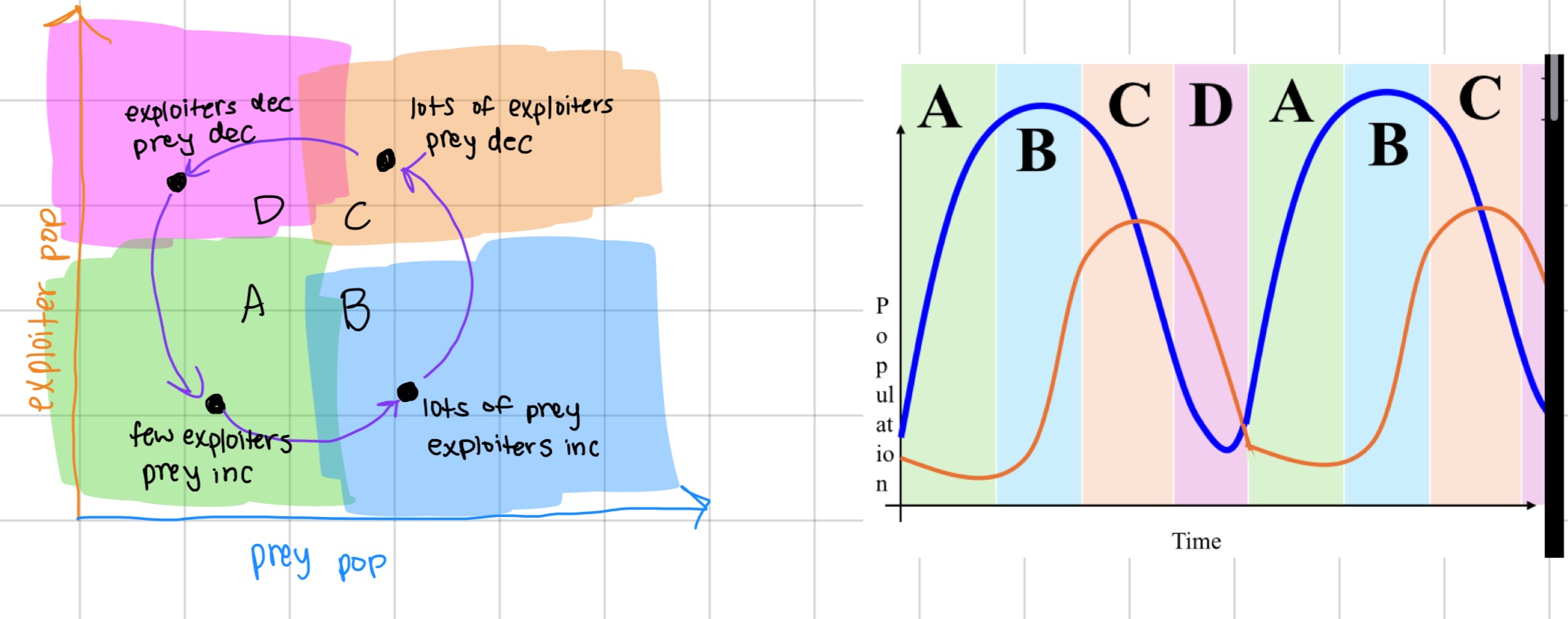
prey: change in prey pop = exponential prey growth - attack rate(prey pop)(exp pop)
a.k.a. change = prey growth rate - prey death rate
if attack rate is low, there needs to be a lot of exploiters to have an effect
if exploiter pop is low, they need to eat a lot to have an effect
a large prey death rate could balance the exp growth
exploiter: change in exp pop = (conversion efficiency)(exp birth rate) - exp mortality*pop
a.k.a change = f(prey death rate) - exp mortality * pop
exploiter birth rate includes prey pop, exp pop, attack rate, & efficiency of turning prey into babies
just assuming, a standard death rate based on pop
Connection between Cycle graph and Linear graph of Predator/Prey Model
mutualism
both species acting in a way that benefits both (+,+)
fruit as seed dispersal (typically interspecific)
difference between obligate & facultative mutualism
obligate is necessary for survival
facultative is not necessary for survival
altruism
individual decreasing own fitness to boost another (-,+)
kin selection, parental protection (typically intraspecific)
Strategies of the Prisoner's Dilemma
naive
strategy: always cooperate
gets taken advantage of by selfish
selfish
strategy: always deflect
great against naive, low payout against selfish
tit-for-tat
strategy: starts cooperating, then copies partner
success w/ naive, not taken advantage of by selfish
succeeds w/ other TFT
stable strategy!
Conditions for cooperation
benefits for cooperation are greater than benefits for selfishness
interactions are repeated, single interactions encourage selfishness
cheaters are punished: “do no harm but take no crap” , defectors don’t get the benefit of cooperation
richness
count of species in an area
3 types of richness
alpha diversity: local richness
# of species in sample site (a part of a region)
gamma diversity: regional richness
total # species across multiple sample sites (region)
beta diversity: richness variation
differences of species between sites
beta = gamma/alpha
eveness
how close in abundance each species is (proportion of individuals that are that species)
functional diversity
variety of ecological “roles” present in an ecosystem
“roles” are most often described by an organism’s space in the food web
phylogenetic diversity
variety of clades present in an ecosystem
concern if extinction of phylogenetically distinct organisms
Shannon-Weiner Diversity Index implications
diversity index = - sum of relative abundance*ln(RA)
increases with both richness & evenness
migration
back-and-forth movement between specific areas
often between feeding sites & breeding sites
driven by cyclical differences in food availability or different survival requirements of young & adults
dispersion
one way movement to a new area, typically of few individuals
difference between natal & breeding dispersion
natal: movement from birthplace
breeding: spread as new adults & find suitable locations
Island biogeography equilibrium
we expect an island to have a # of species based on rate of colonization & extinction
as species richness inc, successful colonization dec (fewer free niches) & extinction inc (more things to go extinct)
crossover point is stable richness
the smaller the island, the higher extinction rate
the closer the island the higher colonization rate
succession
change in species composition of a community over time
(recover from a disturbance)
primary succession
a community starting from nothing
life pioneering into a new space
volcanoes - lava, ash beds, new islands
secondary succession
a community starting from something
dirt, small plants, bugs, typically still there
fires, floods, cutting
“resetting to earlier stage”
pioneer species
in primary succession comes from elsewhere to change environment to be suitable for other organisms
climax community
“old growth” where a community reaches stable state
ex: big tree
non-native
moved (intentionally or not) by humans (alien, exotic, etc.)
invasive
successful in human disturbed areas
often a species in an area where it causes ecological harm (reducing diversity)
why species are invasive
brought as a non-native by humans to an area
thrive in new areas that lack native predators
climate predictors (4)
Latitude: hotter year round the closer to the equator
Atmospheric cells: hot/wet air rises in the equator, cools & drops rain, gets pushed 30 deg N&S, drops & heats, gets pushed back to equator, repeats
Coriolis effect / Ocean currents: earth’s spin sets up a wind direction w/ help from atm cells, wind direction determines ocean current direction which moves large amounts of hot/cold water to a landmass & affects its climate
Rain shadows: warm/wet air pushed up a mountain, air cools & drops as rain, no moisture in air on far side of mountain, causes deserts
climate change (3)
Greenhouse effect / greenhouse gas: molecules in the earth’s atm (h20, co2, methane, nitrogen oxides) reflect infrared radiation to the surface which inc surface temp
Hothouse (no ice caps or glaciers) / Ice Age (fluctuate between glacial (ice sheets/glaciers inc) & interglacial (ice sheets/glaciers dec))
Effects of Anthropogenic Climate Change: burning fossil fuels for energy (easiest/highest density energy source), industry increasing CO2 levels
causes issues: oceanic acidification (dissolve shells), sea level rise (flood), weather changes (droughts, severe storms, change air/water currents)

