Fruit Fly Life Cycle: Eggs, Larvae, Pupa & Adults - Biology Flashcards
 Studied by 0 people
 Call Kai
 Learn
Learn Practice Test
 Spaced Repetition
 Match
Match Flashcards
 Knowt Play
1/37

There's no tags or description
Looks like no tags are added yet.
Name | Mastery | Learn | Test | Matching | Spaced | Call with Kai |
|---|
No analytics yet
Send a link to your students to track their progress
38 Terms
What type of life cycle does Drosophila melanogaster have?
A complete metamorphic life cycle, meaning it has four distinct stages with major structural changes between them.
What are the four stages of the fruit fly life cycle, in order?
Egg → Larva → Pupa → Adult.
How long does the entire life cycle take at room temperature?
Approximately 10-14 days, depending on temperature and food availability.
Where do female fruit flies lay their eggs?
On the surface of fermenting fruit or nutrient-rich food media.
Why is fermenting fruit an ideal location for egg-laying?
It provides immediate food for larvae once they hatch.
What is the approximate size of a fruit fly egg?
About 0.5 mm long, elongated and oval-shaped.
What structure allows the egg to exchange oxygen?
Respiratory filaments extending from the egg.
What is the primary function of the larval stage?
Feeding and growth.
How many larval instars does a fruit fly have?
Three instars (1st, 2nd, and 3rd).
What is an instar?
A developmental phase between molts where the larva increases in size.
How long does the larval stage last?
Approximately 4-5 days.
What do larvae primarily feed on?
Yeast and microorganisms in decaying fruit or food media.
How do larvae breathe without lungs?
Through spiracles, openings along the body connected to a tracheal system.
Why do larvae molt between instars?
Their exoskeleton does not grow, so molting allows continued growth.
What key structures become more developed during the larval stage?
Digestive system, musculature, and imaginal discs.
What are imaginal discs?
Groups of undifferentiated cells that later develop into adult structures (wings, legs, eyes).
What signals the transition from larva to pupa?
The larva stops feeding and forms a puparium.
What is the puparium?
A hardened outer case formed from the larva's last shed skin.
How long does the pupal stage last?
Approximately 4-5 days.
What is the main biological process occurring during pupation?
Metamorphosis.
What happens to larval tissues during metamorphosis?
Many larval tissues break down (histolysis), while adult tissues form (histogenesis).
What structures develop from imaginal discs during pupation?
Wings, legs, eyes, antennae, and reproductive organs.
Is the pupa capable of movement or feeding?
No. The pupa is non-feeding and mostly immobile.
What happens when the adult fruit fly emerges from the pupa?
It ecloses, exiting the puparium.
What does the adult look like immediately after eclosion?
Pale-colored with crumpled wings.
What happens shortly after eclosion?
Wings expand and harden; pigmentation develops.
How soon can adult fruit flies reproduce?
Within 8-12 hours after emergence.
What is the primary role of the adult stage?
Reproduction and dispersal.
How long do adult fruit flies live?
Typically 30-50 days under laboratory conditions.
How does temperature affect the fruit fly life cycle?
Warmer temperatures speed development; cooler temperatures slow it.
Why is a short life cycle useful in genetics experiments?
Researchers can observe many generations quickly, allowing inheritance patterns to be studied efficiently.
Which stage is most affected by nutrient availability?
Larval stage.
Which stage contains imaginal discs?
Pupal stage.
Which stage contains imaginal discs
Larval stage
Which stage involves body reorganization
Pupal stage
Which stage is responsible for population growth?
Adult stage
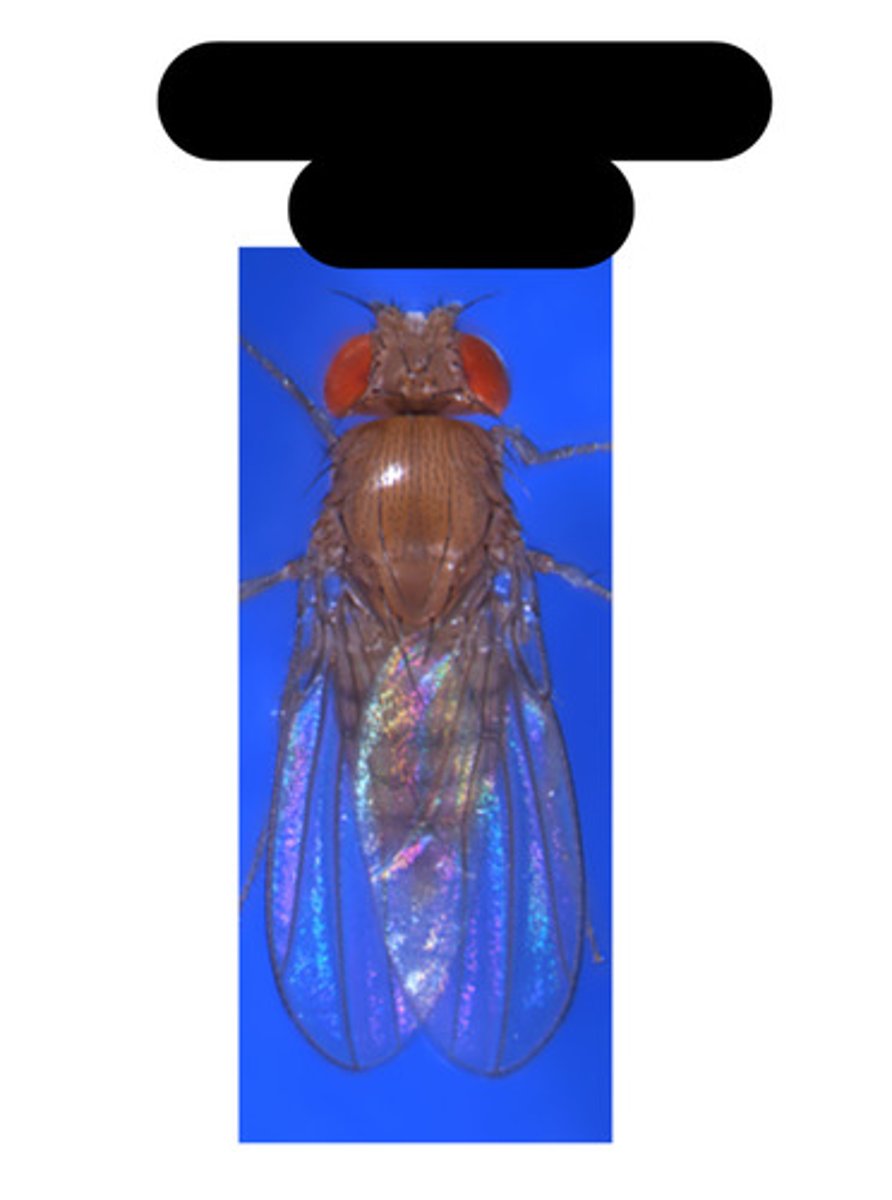
What type of alleles and what gender?
Wild type alleles (+/+) female
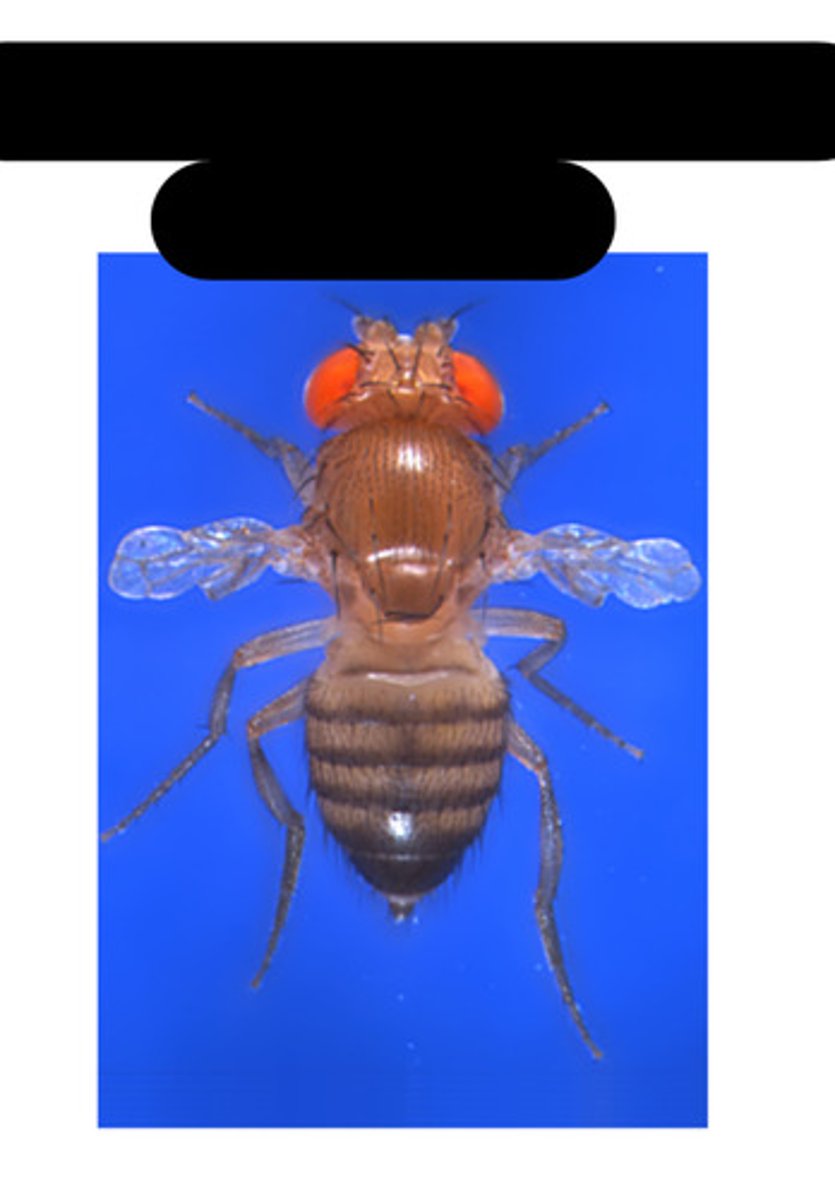
What alleles and what gender?
Vestigial-winged (vg/vg), male
 Note
Note  Flashcards (223)