Indigenous American artwork
 Studied by 0 people
 Call with Kai
 Learn
Learn Practice Test
 Spaced Repetition
 Match
Match Flashcards
 Knowt Play
1/35

There's no tags or description
Looks like no tags are added yet.
Name | Mastery | Learn | Test | Matching | Spaced | Call with Kai |
|---|
No analytics yet
Send a link to your students to track their progress
36 Terms
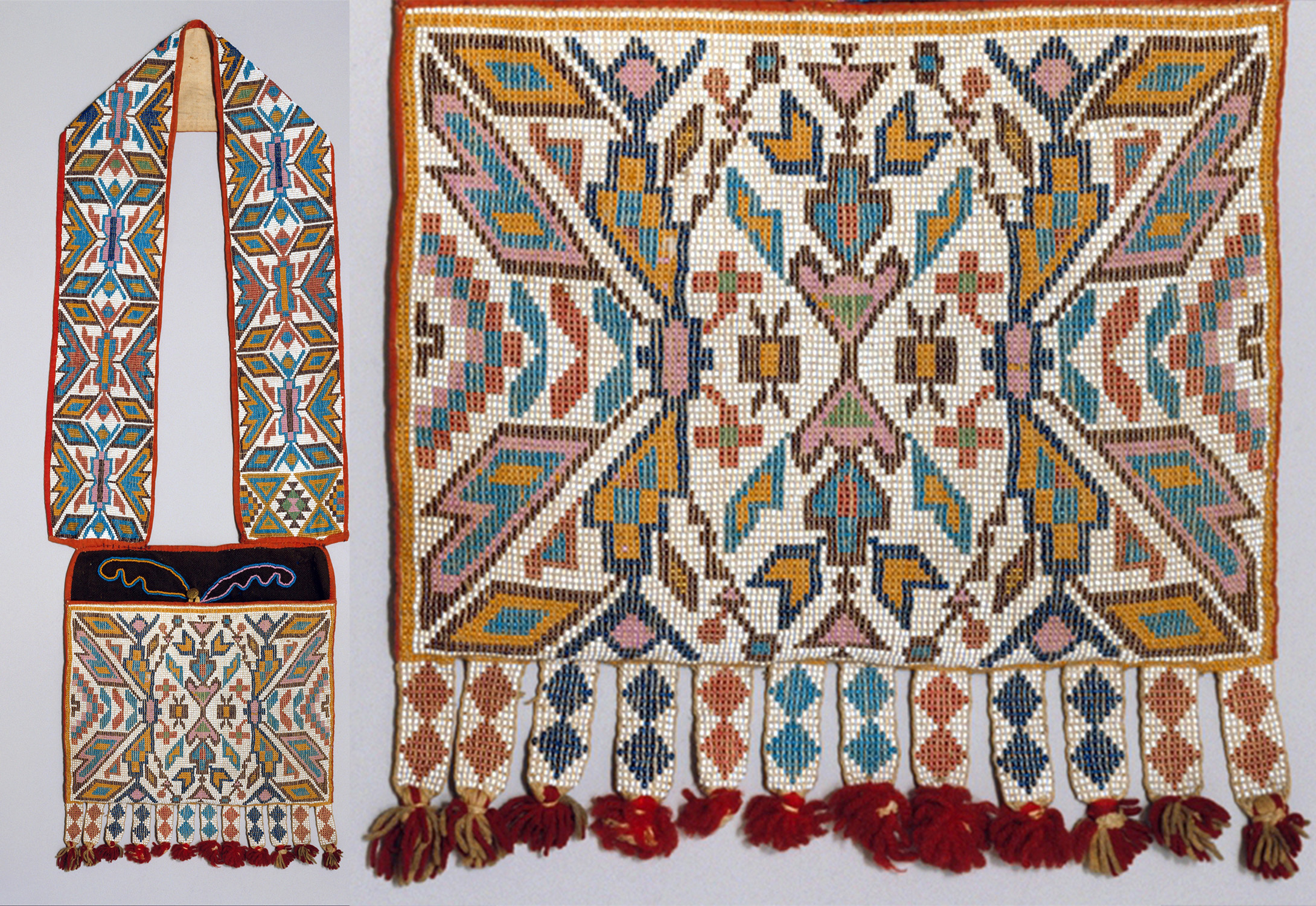
Bandolier bags identification
Time: 1860s
Medium: trade cloth, animal hide, glass beads, fringe
Location: Native North America
Artist: Women in the Ojibwe, Lenape, and Anishinaabe tribes
Museums housed: One is housed in the National Museum of the American Indian (NMAI) in NYC
Bandolier bags historical context
Based on European soldiers who used bags to store ammunition cartridges
Meant to be worn around the shoulder
Stylistic differences in the bags are due to trade with European and Euro Americans
Were very popular in the Eastern or Woodlands region
Bandolier bags formal qualities
They have lots of color (especially red)
Flowers
Geometric shapes
Symmetrical
Both beautiful and functional
Bandolier bags content
Symbolize cultural identity
Tribes used beads, ribbons, and materials specific to their region
Prairie tribes have more geometric patterns white the tribes from the Great Lakes have more floral patterns
Intended to complement men’s ceremonial outfits
Help to express group identities and social status
Serpent mound identification
Time: Created around 1100 CE (Middle Ages)
Location: In rural, southwestern Ohio
Measured about 1,300 feet in length
Artists: The Fort Ancient Culture (1000-1650 CE) was primarily responsible for the mound
Another theory is that the Fort Ancient Culture refurbished a preexisting mound by the Adena Culture (c. 1100 BCE - 200 CE) or the Hopewell Culture (c. 100 BCE - 550 CE)
Serpent mound formal qualities
In the shape of a serpent with an oval head and spiral body
The color green
Both architectural and sculptural
Earth work
Serpent mound historical context
Erected by settled people who cultivated maize, beans, and squash
Cultures in North and Central America have connected supernatural powers to snakes or reptiles
Bedrock folded beneath the mound which suggests a meteor hit it 250-300 million years ago
The rattlesnake was a common theme in Mississippian culture
Serpent Mound content
Has seven winding coils between the head which is at the east and the tail which is at the west
Head is an oval shaped and has been interpreted to be an enlarged eye, a hollow egg, or a frog about to be swallowed by a large jaw
The head aligns with the summer solstice sunset and the tail points to the winter solstice sunrise
Hide paintings identification
Painted elk hide
Time: Created in the 1800s
Artists: Made by the Shosonne tribe; Many hides were painted by Codsiogo
Hide painting by Cotsiogo is in the Brooklyn Museum
Medium: Used natural pigments like red ochre and chalk
Hide paintings content
Includes buffalo, horses, people and teepees
Changed to affirm Native American identities
Scenes celebrated battles and other biographical details
Cotsiogo's Brooklyn Museum hide displays elements of different dances including the Sun Dance
Shows activities of daily life (women resting near a fire and men hunting)
Hide paintings formal qualities
Were aesthetic and functional but switched to merely aesthetic
Were decorated with geometric of figural motifs
Hide paintings historical context
Tradition of the Great Basin and Great Plains people
Represent Cotsiogo’s experiences during a major period of change for the Shoshone people
Cotsiogo was placed on the Wind River Reservation
The Sun Dance was intended to honor the Creator Deity but the government outlawed the dance until 1935
Totem poles identification
Artists: Created by Kwakwaka’wakw, Haida, and Tlingit cultures in the coasts of pacific northwest
Location: Created in British Columbia and Alaska
Time: During the 18th and 19th centuries
Now preserved in museums and traditional territories (ex American Museum of Natural History, Brooklyn Museum, Metropolitan Museum of Art, etc)
Totem poles historical context
Ceremonial - worn by dancers during ceremonies
Worn during potlatch, a ceremony where the host displayed his status, partly by giving away gifts to those who attended
Masks conveyed social position
Family lineages (displayed family crest symbols)
Clan crests
Visual record of important historical events
Function as powerful expressions of identity and storytelling for the communities
Kwakwaka’wakw bands are arranged into 4 clans: Killer Whale, Eagle, Raven, and Wolf clans
Clans are divided into numayn (groups that shared a common ancestor)
Myths relate moments of transformation involving trickster supernaturals
The Thunderbird was a mythical ancestor of the Kwakwaka’wakw
Due to the introduction enforcement of Christianity masking practices started using metal tools
Masks were passed between family members of a specific clan
Potlatches were banned in 1885 until the 1950s since Christian missionaries considered them immoral
Many masks were confiscated due to the prohibition of potlatches
Totem poles formal qualities
Geometric shapes
Symmetry
Use rich colors like red, black, blue-green, and white to emphasize features (eyes, beaks, and wings)
Complementary colors
Stylized
Totem poles are tall cedar carvings that stack bold figure
Have patterns from repeated shapes like ovoids (the pupils of the eyes), U-forms, and S-forms
Take months or years to create
Totem poles content
Transformation masks show a powerful animal on the outside that can be opened to reveal a human face on the inside
Symbolize the shifting between spiritual and human worlds during potlatch ceremonies
Use formline style (terms that describes the characteristics of Northwest Coast visual culture)
Mesa Verde Identification
Time: Between 450 and 1300 CE
Artist: Built by the Ancestral Puebloan people
Medium: Made of stone, mortar, and plaster
Region - Mesa Verde National Park in southwestern Colorado
Built more than 600 structures into the cliff faces of the United States’ Four Corners region
Murals used paint produced from clay, organic materials, and minerals
Mesa Verde formal qualities
Symmetrical
Mostly residential but some were used for storage and ritual
Mesa Verde Content
Show the ingenuity and craftsmanship of the Puebloans
There are traces of the Puebloan constructors in handprints and fingerprints in the mortar and plaster walls
Cliff Palace is the largest of the cliff dwellings with about 150 rooms and more than 20 circular rooms
Originally ranged from 1 to 4 stories
Kivas had wood-beamed roofs held up by 6 support columns
Kivas had fire pits/hearths, ventilation shafts, a deflector, and a sipapu (small hole in the floor used for ceremonial purposes)
Have murals displaying geometric designs or animals and plants
Mesa Verde Historical Context
Wildfires have been a threat to Mesa Verde
Looting has been a threat
Someone took artifacts and human remains in the 19th century
The park is a UNESCO World Heritage Site
“Verde” means green in Spanish and “Mesa” means table but refers to the flat-topped mountains in this context
The Puebloan accessed the dwelling with retractable ladders
Ancestral Puebloans occupied this region between 450 CE and 1300 CE
Only about 125 people lived in Cliff Palace
Families lived in architectural units organized around kivas (circular and subterranean rooms)
Kivas continue to be used today by Puebloan peoples for ceremonial purposes
Were abandoned in 1300 likely due to drought, lack of resources, or violence
Black on Black Ceramic Vessel Identification
Time period: Early 1900s
Artist: Created by Native potter Maria Martinez
Worked with her husband Julian and her family
Medium: Made from locally found clay and was mixed with a temper made from sherds of broken pots that were pounded into a powder or volcanic ash
Used a matte-black design over polished-black
One is in the National Museum of Women in the Arts in New York
Black on lack Ceramic Vessel content
Could be formed into different shapes such as a rounded pot or a flat plate
Covered with designs painted with guaco (iron rich solution)
Had designs including rain clouds, bird feathers, rows of planted corn, and the flow of rivers
Black on Black Ceramic Vessel Formal Qualities
Maria sold them as beautiful objects rather than utilitarian objects
Polished rubbing by a smooth stone to create a shiny finish
Symmetrical
Exaggerated designs due to low rounded shapes of the pot
Black on Black Ceramic Vessel Historical Context
Pots were used in the pueblos for storage, cooking, and ceremonies but these practices began to decline
Watched potters from San Ildefonso especially her aunt Nicholasa and potters from other nearby Pueblos
Martinez signed her name on the bottom of the pots to help the community
The Martinezes worked on an Ancestral Pueblo dig site where they found the pottery sherds
Julian Martinez drew and painted the designs in his notebooks that he found on the walls and and on the sherds of pottery
San Lorenzo and La Venta
Identification:
1600-350 BCE
The Olmec civilization
Gulf Coast of Mexico
The masks were made from polished, green stone
Content:
Jadeite symbolized life, fertility, and elite status
Masks were worn by rulers to gain spiritual authority
Showed Aztecs respected Olmecs and their history
Formal qualities:
Historical Context:
Olmecs were fishers and hunters
Yaxchilan
Identification:
Located on the south bank of Usumacinta River in Chiapas, Mexico
Significant Maya center between 250-900 CE
The carved stone lintels were commissioned by the rulers of the city
Bird Jaguar IV commissioned Structure 21
Lintels 24 and 25 are on permanent display in the British Museum’s Mexican Gallery
Lintel 26 is in the Museo Nacional de Antropologia in Mexico City
Content:
Powerful Maya city-state that had the purpose of serving as a political, military, and trade hub (by controlling the Usumacinta River)
The lintels provide a long dynastic record in text and image
Lintels depicted rituals, warfare, and divine connection
Legitimized its ruling dynasty through grand temples, palaces, and lintels
Structure 23 highlights the wife of Shield Jaguar II - displays the importance of women in Mayan culture
Structure 23 contains lintels 24, 25, and 16
Structure 21 contains lintels 15, 16, and 17
Limestone lintel’s scene represents a bloodletting ritual performed by the king of Yaxchilan, Shield Jaguar the Great (681-742) and his wife, Kady K’ab’al Xook (Itzamnaaj Bahlen III)
First two glyphs in the text at the top of the lintel indicate the event and the date it took place (October 24th, 709 CE) and the last glyph represents the Emblem Glyph of Yaxchilan
Structure 33 has a roof-comb which allows the structure to appear taller
Structure 33 includes lintels depicted Bird Jaguar IV and a top which depicts him against his enemies in a game
Structure 40 depicts part of Bird Jaguar IV’s political campaign
Formal qualities:
Historical Context:
Bird Jaguar was Yaxchilan’s most prolific builder and many major structures were built during his reign
Scenes that depicted the public display or captives are often depicted in Maya Art and this was an essential aspect of Mayan warfare
Bloodletting was a common practice in Maya life from the Late Preclassic period (400 BCE - 250 CE) and beyond
Templo Mayor
Identification:
Principal temple of the Aztec civilization located in the heart of Tenochtitlan
Adobe bricks and volcanic stone
Built by Aztec civilization
Constructed around 1325 CE on island in the middle of Lake Texcoco
Stone monolith of a dismembered and decapitated woman in Mexico City - goddess Coyolxauhqui
Content:
Served as a religious and ceremonial center dedicated to deities Huitzilopochtli (god of war) and Tlaloc (rain god)
Symbolized Aztec’s power and architectural prowess
Covered with intricate carving and sculptures - reflected the civilization's rich mythology and cultural practices including human sacrifices
Formal qualities:
Structure was divided in 4 main quadrants with Templo Mayor at the center centered around the navel of the universe (the axis mundi)
About 90 ft high and covered in stucco
Two grand staircases accessed twin temples dedicated to Tlaloc and Huitzilopochtli
Historical Context:
The Templo Mayor was expanded, enlarged and reconstructed during seven main building phases which corresponded with different rulers (tlatoani) taking office
The two deities symbolized atl-tlachinolli (burnt water)
Coy Stone
Made by Aztec (Mexica) people
Made in 1500 in the Valley of Mexico
Content:
Depicts Coyolxauhqui after she is defeated by her brother, Huitzilopochtli when she tries to kill her mother Coatlicue
Imagery of skulls/monster faces, bells, snakes, and her nakedness
Formal qualities:
Had colors red, green, black, white, and tan
Sun Calendar Stone
Made by Aztec (Mexica) people around 1500 in the Valley of Mexico
Content:
Depicts their sun god, Tonatiuh and the five eras (Jaguar, Wind, Tlaloc, Chalchiuhtlicue)
Depicts the ideas of the Aztec people and the ideas they has about nature being in a cycle
Man in the middle with rich looking clothing/ a headdress (shows he is important)
Formal qualities:
Originally painted with red, yellow, white, and blue
Rulers Feathered Headdress
Identification:
Between 1519-1521 CE
Aztec capital Tenochtitlan (modern day Mexico City)
Made of luxury materials like pure gold ornaments and feathers from the Quetzal, Roseate Spoonbill, and Cotinga
Crafted by skilled Aztec artisans called Amanteca (feather workers) that lived in a special quarter of the Capitol
Use green iridescent feathers from male Quetzal birds found in Central America
Historical Context:
Symbolizes divine power, high status, wealth, and connection to the gods
Were often worn by royalty, priests, or elite warriors
Many different quetzals were needed because each only has about 2-3 long feathers
After Spanish conquest, artifacts like the Moctezuma’s headdress were taken to Europe and became war booty and “exotic treasures”
Spanish conquest shifted artistic tradition towards Christian iconography
They are often misinterpreted as decoration, causing them to lose their original spiritual and political meaning when placed into European collections
Chavin de Huantar site
900-200 BCE
Archaeological and cultural site in the Andean highlands of Peru.
cultural expressions found at Chavín most likely did not originate there.
drew many worshipers to its temple which helped in spreading the artistic style of Chavín
comprised of two building phases: the U-shaped Old Temple and the New Temple
expanded the Old Temple and added a rectangular sunken court
Many of the maze-like galleries are connected with each other but some are separate.
galleries all existed in darkness
there are many smaller tunnels that allow for air to pass throughout the structure.
The god for whom the temple was constructed was represented in the Lanzón
a notched wedge-shaped stone over 15 feet tall, carved with the image of a supernatural being, and located deep within the Old Temple,
Two key elements characterize the Lanzón deity: it is a mixture of human and animal features, and the representation favors a complex and visually confusing style
The fangs and talons most likely indicate associations with the jaguar and the caiman
The eyebrows and hair of the figure have been rendered as snakes, making them read as both bodily features and animals.
The serpent motif seen in the Lanzón is also visible in a nose ornament
would have been worn by an elite person to show not only their wealth and power but their allegiance to the Chavín religion
City of Cusco and Architecture
Capital of Tawantinsuyu (“Land of the Four Quarters”) and is located on a 11,200 ft elevation.
Was the historic capital of the Inca empire from the 13th to the 16th century, but Cusco has been inhabited continuously for 3,000 years
City was divided into two sections: Hanen (upper or high) and hurin (lower)
Some believe that the city is deliberately in the shape of a Puma, a symbol of Inka might
Qorikancha (“Golden House”) was the center point within the Inca empire, a place to worship the sun. (the most sacred shrine of the Inca)
It has radiated imaginary lines (ceques) which connected to shrines all over Cusco valley which were also a mark of time
It is one of the few shrines that was turned into a Christian Holy space after the conquest by the spaniards.
With the Spanish conquest in 1532, monasteries and manor houses were built over the Inca city
Mostly of baroque style with local adaptations
Maize Cobs
gold-silver alloy structures located in the courtyard of the Incan temple of Qorikancha (which is in the capital city of Cusco).
mimic the appearance of a ripe ear of corn that is ready to be harvested
were constructed by Inka metalsmiths between 1440 and 1533 CE.
created in South America, specifically in Peru.
crafted from metal alloys including gold, silver, and copper
the silver and copper were used to imitate the internal and external components of corn.
maize cobs were typically used as offerings in religious and political ritual practices
symbolized the Incas’ control over the natural world.
Inka Art
Miniature llama figurines and Capacocha figures
created by Incan metalsmiths between 1400 and 1532 CE in Peru.
both created from gold, silver, and copper alloys using the techniques of soldering (joining pieces together using heat) and hammerin
The capacocha figures also were sacrifices made to the deities and symbolize the Incas’ divine representation
Llamas were sources of meat and wool for the Incas and they emphasized the community’s health and prosperity. T
he miniature llama figures were offerings to the mountain deities to ensure replenished altiplano grasses and fertility of the herds.
Machu Picchu
The stones that made the buildings were thoughtfully carved so that they fit together and resisted earthquakes.
It was built in the middle of the 15th century as a royal estate for the first Inca emperor, Pachacuti Inca Yupanqui.
Terraces were used for agriculture. Because of the steep mountain sides, steps would be used to plants crops.
It was first intended to be a place where the emperor and his family could host feasts, perform religious ceremonies, and administer the affairs of empire. The emperor also intended this are to be passed down for his family after his death. It contains housing for elites, retainers, religious shrines, as well as carved rock outcrops.
All-T'oqapu tunic and the division of labor
The All-T'oqapu Tunic is a piece of Andean textile art, which shows the Inca empire's way of weaving and dyeing. They were
created by acllas (the chosen women) who were skilled weavers and textile artists.
The tunics were made from finely spun camelid wool and cotton and were made to symbolize the power and dominion of the Sapa Inca
showcasing the empire's wealth, military might, and expertise in textile production.
The tunic depicts certain designs that were made with 100 threads per centimeter, which were reserved for only the royal household that collected the acllas.
The All-T'oqapu Tunic likely represented various peoples, places, and social roles within the empire, making the tunic a symbol of the Sapa Inka's power and dominion.
 Note
Note  Flashcards (25)