Week 2 Sound Propagation
 Studied by 0 people
 Call Kai
 Learn
Learn Practice Test
 Spaced Repetition
 Match
Match Flashcards
 Knowt Play
1/38

There's no tags or description
Looks like no tags are added yet.
Name | Mastery | Learn | Test | Matching | Spaced | Call with Kai |
|---|
No analytics yet
Send a link to your students to track their progress
39 Terms
Sound Propagation
To transmit through a medium/movement through a medium
To travel through space or a material
What does the moving?
Air molecules and exchange of energy
How are waves of energy classified?
based on how the molecules displace compared to the direction of the movement of energy (transverse, longitudinal)
Wavelength
The distance it takes for one cycle to complete
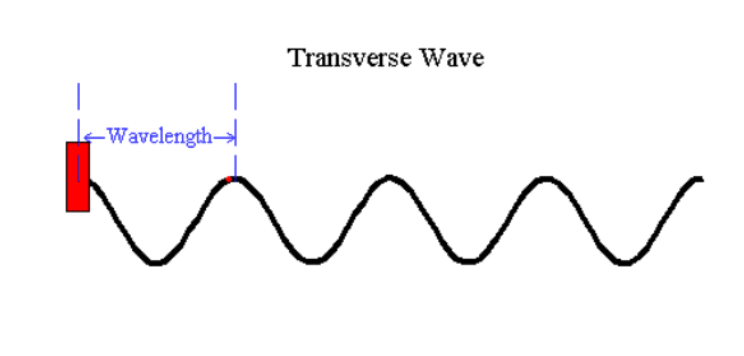
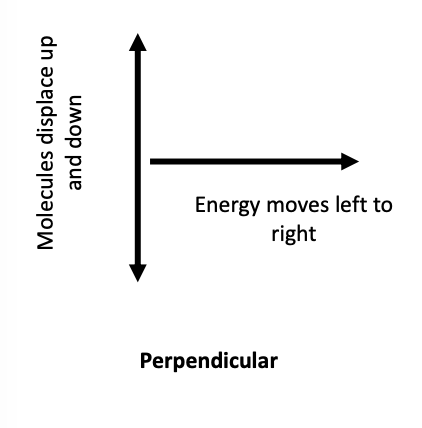
Transverse Waves
Molecules displace up and down, Energy moves left to right, Perpendicular
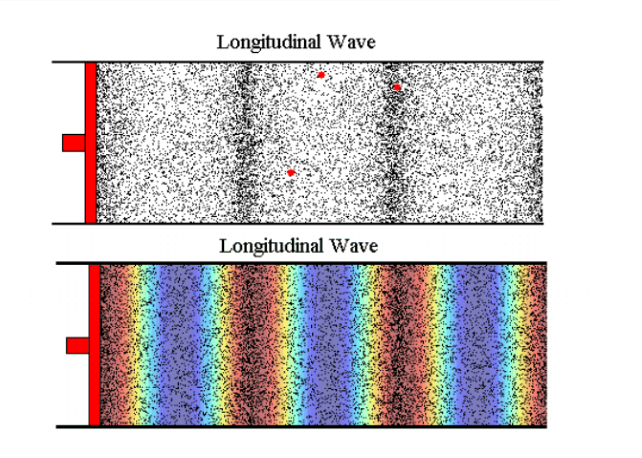
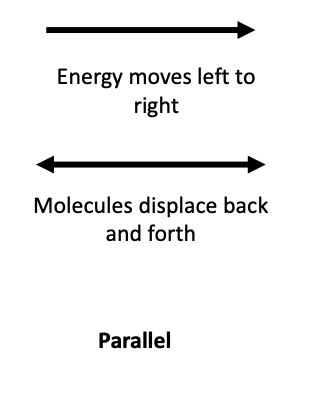
Longitudinal Waves
Energy moves left to right, Molecules displace back and forth, parallel
How does Sound propagation occur?
Forces (F of inertia and F of elasticity) and energy (Kinetic Energy and Potential Energy)
F of inertia (Fi)
Magnitude of applied force
direction of applied force
F of elasticity (Fe)
Dependent of stiffness
Force of the object to return its origin
Kinetic Energy (KE)
Work exerted as an object moves from rest to a certain velocity
Dependent on acceleration
Joule: Work = Fx d
Potential Energy (PE)
Energy held by an object that is not in motion
Dependent on the work put into the object
Compression/condensation
increased pressure
increased density
decreased volume
Rarefaction
decreased pressure
decreased density
increased volume
Wavelength Vs period
Length of one cycle in meters while the period is the length of time in seconds
Wavelength equation
Speed of sound/sec
Speed of sound in meters
343/sec
Speed of sound in cm
34,300/sec
Speed of sound in mm
343,000/sec
Frequency and wavelength relationship
Inverse relationship, when one goes up the other goes down
Impedance (Z)
the opposition to flow of energy
Why does impedance matter?
Sound dies down over time. When sounds encounter other objects/mediums they can 1) continue 2) be absorbed or 3) be reflected
Absorption
conversion of thermal energy
Reverberations
Multiple continuous reflections
Echoes
single distinct reflection
Inverse Square Law
S/4πr² = Intensity
Reverberation Time
Time it takes for a sound to fade to 60 dB after it is turned off. can be affected by room size, room additions like rugs, curtains, and furniture, people
Critical Distance
Distance at which the level of a direct (incident) sound meets the level of reverberant sounds
What makes up Impedance?
Resistance, Reactance, Resonant/Natural Frequency
Resistance and Damping
reducing vibrations
Determining the damping factor?
In(A1/A2)
Resonant Frequency
Natural Frequency an object will vibrate at based on mass and stiffness properties
Impedance spring velocity and force
Spring velocity (stiffness) leads force by 90 degrees,
Impedance mass velocity and force
lags force by 90 degrees
Impedance spring velocity (stiffness) and mass
are 180 degrees out of phase
Impedance Xm - Xs
Doesn’t contribute to impedance
R < 1
Small, Minimal damping, Takes longer for oscillations to stop
Large >1
High Damping, Quicker for oscillations
R = 0
No damping, Continuous sine wave
Critical Damping
No oscillations
 Note
Note  Flashcards (62)