2 - Lumbar Spine Review and Current Concept
 Studied by 0 people
 Call Kai
 Learn
Learn Practice Test
 Spaced Repetition
 Match
Match Flashcards
 Knowt Play
1/72

There's no tags or description
Looks like no tags are added yet.
Name | Mastery | Learn | Test | Matching | Spaced | Call with Kai |
|---|
No analytics yet
Send a link to your students to track their progress
73 Terms
intervertebral disc (IVD) shape
BEAN
IVD in youth
more fluid
IVD with increased age
more fibrous
what part of IVD is most vulnerable to degeneration?
posterior lateral area bc it is the furthest away from axis
nerve roots
differentiate and travel caudally across superior structures before exiting
What must you use to differentiate what nerve roots are affected?
neuroscreen and segmental/translatory motion assessment
- cannot diff. level of problem just by neuro signs bc nerve roots cross multiple segments
- do segmental shearing test and correlate w MRI imiging
Facet joints attenuate
significant anterior shear forces - born on anteromedial region of superior facet, near foraminal space
what ligament makes up the anterior facet joint capsule?
ligamentum flavum
What can happen to the ligamentum flavum with aging and degenerative changes?
can hypertrophy (less elastic, thickens)
- encroaches on intervertebral foramina --> nerve impingement
- bunches up as facet joints close
what ligament makes up the posterior facet joint capsule?
multifidus
intra-articular meniscoids
present in capsule
meniscoids
- fatty deposits
Intraarticular synovial fold inclusions which can become entrapped between the superior and inferior articular processes, producing the acute "locked back syndrome"
Posterior Longitudinal Ligament (PLL)
may play a role in preventing (central) disc protrusion
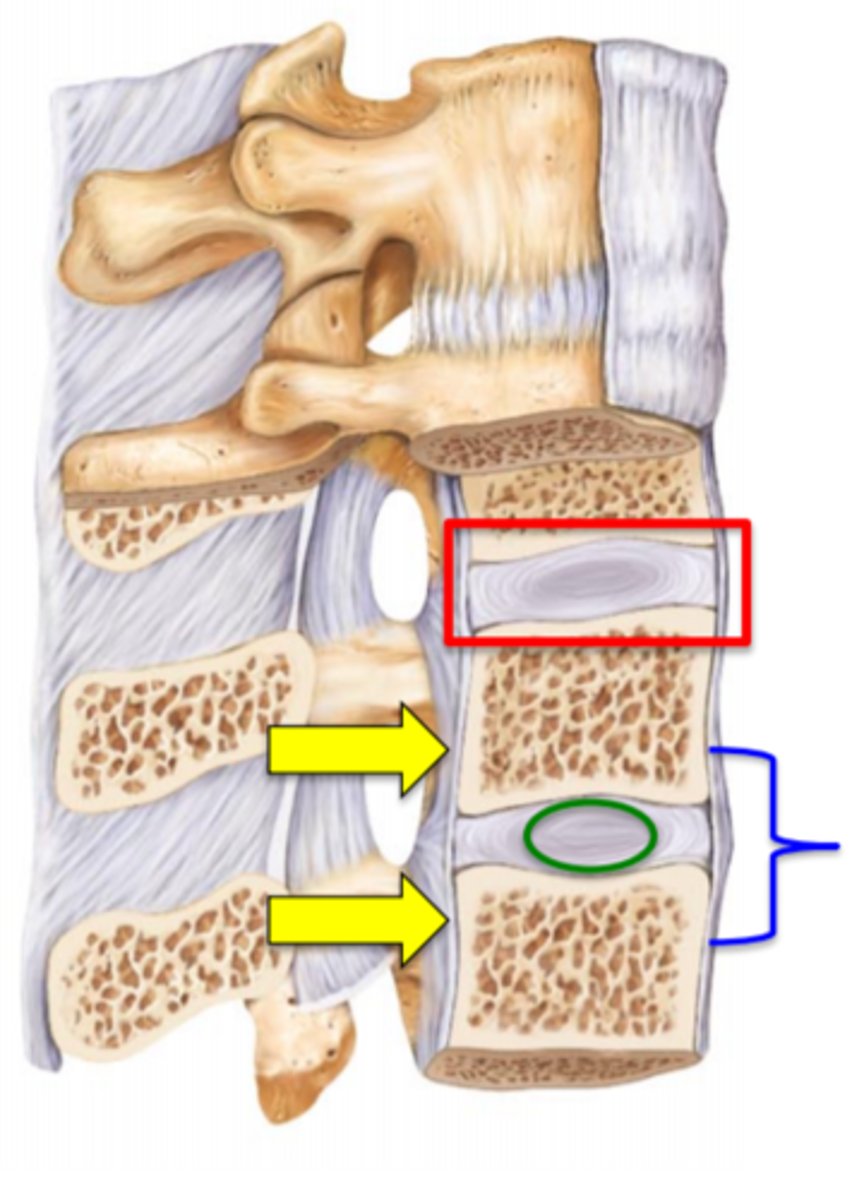
Ligamentum flavum prevents
facet joint capsular entrapment
Hypertrophy of Ligamentum Flavum can contribute to what pathology?
degenerative stenosis
Iliolumbar ligament restrains
all motionsc at L5-S1
Thoracolumbar Fascia envelopes
lumbar musculature
what tensions the TLF?
hypertrophy of muscles
TL fascia attachments
- spine, other ligaments
- latissumus dorsi
- transverse abdominus
what is the major arthrokinematic controller? what is it responsible for?
multifidus
- responsible for 2/3 of lumbar spine stiffness
when are the multifidi active?
ALL antigravity activities
what commonly occurs with the multifidi in patients wit LBP
reduced in size = ATROPHY
- reduction persists after pain has resolved
- may be restored with specific strengthening
- ALWAYS ADDRESS multifidus in LBP
Innervation of lumbar spine muscles
segmentally
the lumbar muscles being segmentally innervated means that they can be segmentally
impaired
- some may spasm, some may not
Lumbar spine muscles always work during what movement?
rotation
transverse abdominus plays a vital role in stability by
creating a rigid cylinder and enhancing lumbar stiffness via attachments to thoracolumbar fascia
~ reciprocally facilitates w intrinsic and extrinsic to maintain columnar integrity of spine and cylinder (PF and diaphragm)
iliopsoas attachments
- bodies
- disks
- TVPs of lumbar spine
iliopsoas can create
compression
- can increase lordosis and anterior shear
- acts as stabilizer
Predominant motion available at lumbar spine
flexion
- most commonly used in everyday activities
full flexion usually results in what?
flattening of lordosis w slight reversal lordosis in some cases
Kinematics of vertebral body during flexion
rocks anteriorly (slight anterior glide)
Kinematics of inferior facets of superior vertebrae during flexion
glide predominantly superiorly and slightly anteriorly
facet joint contact in full flexion is
minimal
- prone to injury
Flexion - kinematics of the disc
anterior disc compressed, posterior disc is tensioned
What prevents excessive anterior translation?
facets and capsule, multifidus and erector spinae, ligaments and disc
Flexion kinematics: intervertebral foraminal space and spinal canal space
intervertebral foraminal space and spinal canal space is increased
what is the primary limiter during flexion? (anterior shear)
DISC!! and facets
Kinematics - extension
reverse of flexion
- body rocks posteriorly
- facets glide inferiorly
- posterior disc compressed
- anterior disc tensioned
Extension Kinematics: space
intervertebral foraminal space is reduced
- space in spinal canal is reduced
Extension kinematics: ligamentum flavum
bunched if degenerated
Extension kinematics: facet joints
closed packed
Extension kinematics: limited by
bony contact and ability of disk to allow tension anteriorly and compression posteriorly
Extension Kinematics - facet joints
glide inferiorly -> posterior disc compressed
- mostly as a return from flexion to neutral
Sidebending Kinematics - with flexion kinematics
SB occurs w flexion kinematics on contralateral side
Sidebending Kinematics - with extension kinematics
SB occurs w extension kinematics on ipsilateral side
Coupled motions of rotation to the ____ side may occur
opposite side
Rotation kinematics
- compresses contralateral facet
- decompresses ipsilateral facet
Rotation kinematics: foraminal space
intervertebral foraminal space is unchanged
Right rotation opens
RIGHT
- R rotation moves spinous process left
What % of fibers in disk are tensioned with rotation?
50%
what range of rotation at each segment in neutral flex/ext does not allow sufficient motion to injure the disc?
3° to 5° of rotation
what motion coupled with rotation allows increased rotation and may injure a disk?
flexion
~ Allows increased rotational torsion on disc = more vulnerable to injur
what structure limits rotation? (in the case of trauma may injure facet joint as well)
facet joint and exressive rotation
Compression/axial loading of lumbar spine is associated with
associated with disc height
with compression/axial loading, water is squeezed out of disc RAPIDLY in what time?
rapidly in the first 2-10 minutes
- THEN slowly after
what percent of disc height is lost throughout the day?
10%
how is disc height restored?
with unloading
Excessive compression may result in loss of...
disc height and degenerative changes
- degeneration = negative effects amplified
Compression - forces are transferred to the facet joints...
abnormal loading causes facet joint hypertrophy. loss of intervertebral foraminal space
distraction rarely occurs in everyday life in a ____ fashion
symmetrical
what primarily limits distraction?
annulus fibrosis
what does distraction allow?
imbibtion of fluids by the disc
how is distraction most often done?
most often employed therapeutically
- Can perform some SB before they get up bc you can imbibe too much and squish into foraminal space
Neutral Zone
region of laxity around neutral resting position of the spine.
Neutral Zone: stability depends on...
- active system
- passive system
- CNS system
Role of active system is...
essential throughout ROM for Stability to occur
Active system
trunk muscles - mobilizers and stabilizers
active system: mobilizers
move trunk thorugh space
active system: stabilizers
maintain general trunk stiffness
active system: stabilizers are classified as
- global stabilizers
- local stabilizers
global stabilizers (4)
- Rectus abdominis
- Internal/external oblique's
- Lateral fibers of QL
- Thoracic part of lumbar illiocostalis
do lumbar global stabilizers have segmental influence?
NO
- but increase general trunk stiffness
- eccentrically decelerate momentum and control gross rotation of trunk
local stabilizers (5)
- Lumbar multifidus
- Transverse abdominus (attaches to TFL)
- Posterior fibers of Internal oblique
- Medial fibers of QL
- Lumbar portions of illiocostalis and longissimus thoracis
 Note
Note  Flashcards (62)