Ch. 4 - The Constitution and the Executive in Environmental Law
 Studied by 0 people
 Call Kai
 Learn
Learn Practice Test
 Spaced Repetition
 Match
Match Flashcards
 Knowt Play
1/30

There's no tags or description
Looks like no tags are added yet.
Name | Mastery | Learn | Test | Matching | Spaced | Call with Kai |
|---|
No analytics yet
Send a link to your students to track their progress
31 Terms
The Commerce Clause
The basis for most federal regulation of the environment.
Allows Congress to “regulate commerce…among…states”
Broadly interpreted
The Dormant Commerce Clause
Restricts state regulatory/enforcement power that might hurt out-of-state interests, including interstate or international commerce.
The Dormant Commerce clause enables federal government to ______.
prevent states from violating the doctrine of extraterritoriality
Extraterritoriality
State of being exempted from jurisdiction of local laws, usually pertains to diplomatic negotiations (e.g., foreign ambassadors) - Diplomatic immunity
Prevents states from regulating actions wholly occurring outside of that state’s boundaries
Commerce in a Legal Sense
The Constitution does not define this term! Some argue it’s the modern English definition (economical, buying and selling)
Others claim that the Framers of the Constitution meant it was the commercial and social interactions between citizens of different states (money and social value aspect)
How do you define interstate commercial activity?
Again, this is debated because there is not a clear definition.
Sources of Federal Authority for Federal Environmental Law: Interstate Commerce Authority
Activity regulated clearly has substantial effect on interstate commerce (e.g., air pollution)
Statute specifies that it reaches only activities in, or affecting, interstate commerce
Congress makes specific findings that the regulated activity affects interstate commerce
Case 1: Municipal wastes generated in New York City is shipped to other states, which generated $550 mil and created about 5000 jobs in VA. Despite these market benefits, the governor stated that VA would no longer be NYC’s dumping ground. NYC sued VA for violation of the dormant commerce clause. The Court found VA’s new regulation as unconstitutional. Today, NYC ships its trash to PA, OH, and VA.
Dormant commerce clause is ______.
not inherently “anti-environment”
Important to prevent states from exerting control over other states
CA and OR enacted low carbon fuel standards
Combats greenhouse gas emissions from vehicles
A series of lawsuits erupted challenging this regulation
Plaintiffs 🡪 CA & OR creating preference for in-state energy sources
In the OR case, 12 Midwest “ethanols” were emitted less GHGs than OR sources
A series of lawsuits erupted challenging this regulation
Both cases were found NOT in violation of DCC
Neither state was favoring in-state interests, both seeking to mitigate climate-change induced damages to natural resources (e.g., wildfires)
Thus, DCC cannot be used to restrict innovative and environmentally progressive laws on the basis that it hurts out-of-state interests
Preemption
Federal law overrides state law; state law overrides local law
Implied and Explicit
Exceptions to Preemption
Clean Water and Clean Air Acts
Provision in these acts that allow States to make regulations stricter than Federal standards, but not less stringent
Allows states freedom to seek stronger environmental regulation
Implied Preemption
Under the Supremacy Clause of the Constitution federal law supersedes state and local law that conflicts with or interferes with federal law.
Explicit Preemption
Congress can explicitly preempt state and local laws when it enacts new laws.
Eminent Domain aka Condemnation
Allows governments to seize property for the public purpose
In order to occur, it requires “just compensation” by the federal government
What amendment talks just compensation in Eminent Domain?
5th Amendment to Constitution
Takings Clause
Guarantees “just compensation” when “private property” is “taken for public use”
Examples of Eminent Domain
Take land to construct a road or public hospital.
Take private land to include in a park.
Take property owner’s freedom to use land
Historic preservation
Endangered Species Act
Inverse Condemnation
Government “takes” property private property, but does not:
Institute eminent domain; nor
Pay just compensation
Private citizen can sue the government over ______.
Inverse Condemnation
Judge decides whether a taking has occurred based on:
Nature of the government regulation,
Economic impact of regulation on property,
The extent to which regulation interferes with the owner's reasonable, investment-backed expectations.
Rowlett, Ltd. v City of Rowlett, Court of Appeals, Decided August 20, 2007
In 2000, a developer paid $1.8 mil for 172 acres for agriculture lands
Since 1967, the land was zoned for single family development on one acre lots
City denied three requests by the developer to rezone for a higher density of lots, so the developer sued
The developer filed suit against the city claiming inverse condemnation.
Does the city’s action constitute a taking?
Trial court held that the denials did not constitute inverse condemnation and appeals court confirmed.
Court stated that a regulatory taking can be either a land-use extraction or a total taking that deprives the owner of all economically beneficial use.
The owner may lose profit because of the smaller density development. However, the city is not required to make the land profitable for the owner.
Land was zoned that way for decades – developer oversight? Hubris?
Ultimately, the land can still be developed, thus it has use to the property owner and its value was not eliminated.
Enforcement of environmental laws requires ______.
investigation
think food inspectors going to restaurants
When an investigation involves a search or seizure, it implicates the _______.
4th amendment
aka no search without a warrant
Procedural Due Process
The entitlement to notice and hearing before deprivation of constitutional right
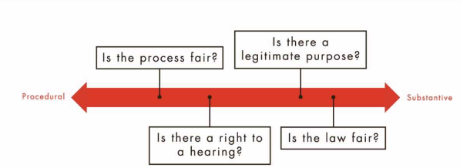
Jones vs Flowers - ex: of procedural due process
State seized and sold property for unpaid property taxes.
Certified letter meant to notify the owner of the impending sale was returned to the state as "unclaimed." (homeowner never received letter). The state made no additional attempt to contact the owner.
Court rejected the state's notice: insufficient.
Executive Order
Order by president or governor, often implementing a statute or governing operation of executive agencies
Executive powers not clearly defined.
Executive orders (EO) framed in an environmental context
EO 12580 – Superfund Implementation (President – 1996)
Executive Order (E.O.) 12580 delegates presidential authorities under CERCLA to the heads of various Executive Branch agencies under certain circumstances.
EO 13514 – Federal Leadership in Environmental, Energy and Economic Performance (President – 2009)
EO 13514 requires federal agencies to reduce energy and water use and achieve other environmental management and sustainability goals.
Equal protection
The requirement that government justify unequal treatment of similarly situated parties.
Its more than just racial or gender equality
Environmental Justice
Fair treatment of people regardless of race, gender, income, nationality with regards to environmental decision-making
Examples of injustice:
Pollution from factories disproportionately located in “poor” areas of town.
Swine Farms in NC being located in areas with higher % of communities of color and poverty
Holistic Management
Consider socioeconomic demographics when creating, enforcing, and interpreting environmental law
Summary
Dormant commerce clause allows federal government to regulate state actions that may violate extraterritoriality or directly harm interstate commerce
Preemption protects the authority of the federal government by overruling any state or local laws that attempt to “overpower” federal reach, unless authorized by law (e.g., CWA, CAA)
Eminent domain allows governments to seize private properties for public use after paying just compensation
Inverse condemnation occurs when governments seize private property without just compensation. Private citizens can sue the government citing inverse condemnation if compensation is inadequate or absent
Summary (cont.)
Private and public entities are protected by the 4th amendment during environmental investigations. This amendment requires warrants before access to documents or property is required.
Procedural due process requires the government to inform citizens of hearings before deprivation of constitutional right
Presidents and governors can implement statutes or governing operation of executive agencies in enforcement of environmental laws; however, their powers are not clearly defined.
Equal protection requires the government to justify unequal treatment of similarly situated parties (e.g., discrimination protections, environmental injustice, etc.)
 Note
Note  Flashcards (129)