eemb 2 evolution
 Call Kai
 Learn
Learn Practice Test
 Spaced Repetition
 Match
Match Flashcards
 Knowt Play
1/110

There's no tags or description
Looks like no tags are added yet.
Name | Mastery | Learn | Test | Matching | Spaced | Call with Kai |
|---|
No analytics yet
Send a link to your students to track their progress
111 Terms
evolution
change within species through time
descent with modification
benoit de maillot
thought earth was billions of years old
life evolved from sea creatures
georges buffon
earth at least 75,000 years old
life is changeable w/modification influenced by the enviornment
erasmus darwin
charles darwins grandpa
competition leads to speciation
all life descended from one filament
speciation
change in respose to the enviornment
georges cuvier
studied comparative anatomy and vertebrate paleontology
catastophism theory
catastrophism theory
extinctions caused by catastrophes
extant species are survivors not new
lamarck
inheritance of acquired characteristics:
physiological changes develop over the life of an organism are trasnmitted to offspring
charles lyell
wrote priciples of geology
geologic processes occur at the same gradual and uniform rates: slowly
malthus
wrote essay of the principle of population
populations can grow exponentially and produce more individuals than the enviornment can support
beagle voyage observations
species compositions change with the enviornment
fossils are related to current species but can also look different
galapagos island species are related to mainland species but have different forms and functions
alfred wallace
independantly works out the pricipals of natural selection: survival of the fittest
presented paper along with darwin to the linnaean society in 1858
gregor mendel
father of genetics
inheritance via discreet units (genes/alleles) with 2 units per individual
devries
theory of mutation
mutation as a source of variation and new speciaiton
neodarwinism
combines genetics with natural selection
gould and eldredge
punctuated equilibrium
long periods of no change w/ short bursts of rapid change
modern theory of evolution
incorporates neodarwinism, population biology and puctuated equillibrium
modifications in descent can occur, rapidly, gradually, or in combination
microevolution
small scale change
involves changes in allele frequency and/or genotype frequency
major mechanims = natural selection
macroeovolution
large scale change
involves speciation or higher level changes
genotype
an individuals genetic (allelic makeup)
phenotype
an individuals physical appearance or observed characteristics
determined by genotype and enviornment
gene pool
collection of all genes and alleles in a populatio
genome
all the genes and alleles in a species
allele (gene) frequency)
relative proportion of an allele w/in the population
how common is A vs a
freq of A = #A/total alleles
hardy weinberg equillibrium
a state of non evolution for the population
no changes in allele frequency are occuring
criteria for hardy weinberg equilibrium to be established
population is large with no migration or mutation
mating between individuals is random
there is no natural selection occuring
sexual reproduction generates a hardy-weinberg equilibrium meaning:
gene frequencies wont change between generations
we can preduct what genotype frequencies should be
hardy weinberg eq. equation
p2 + 2pq + q2
p = freq A
q= freq a
p + q = 1
p2 = AA
2pq = aa
q2 = aa
no evolution
expected HW eq values are observed and equilibrium is stable
evolution is occuring
expected HW eq values are NOT observed equibibrium is unstable
gene flow
genetic drift
natural selection
possible mechanims that HW equilibrium is undergoing evoolution (unstable)
gene flow
changes due to migration
genetic drift
random changes due to sampling error
natural selection
changes due to differing fitness/adaptiveness
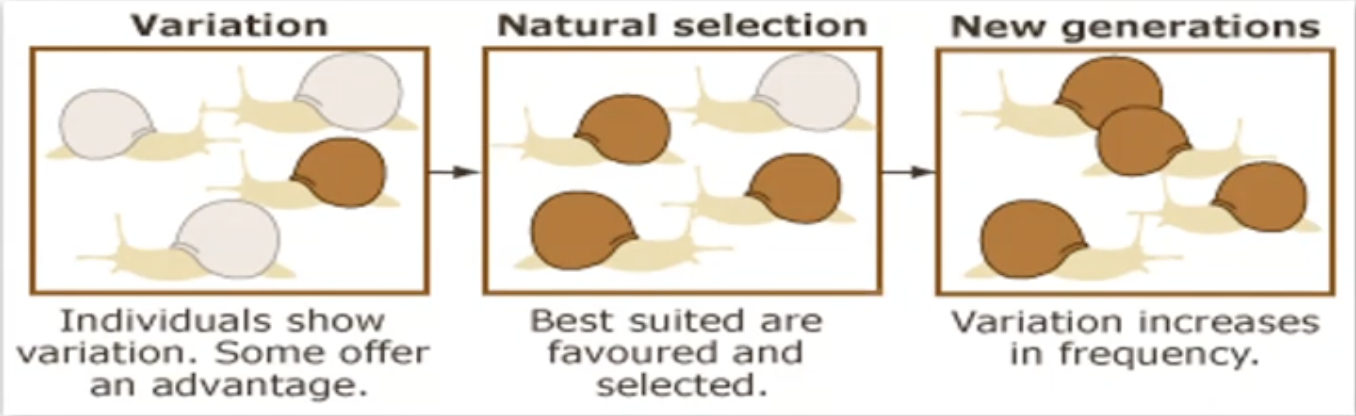
the process by which certain inherited characteristics leading to more offspring increase in a population over time
original synthesis of natural selection by darwin
populations can grow geometrically, but are actually limited by resources
high level of intraspecific competition
variation within a species may be inheritable and affect survival and reproduction
certain types survive better reproduce more and increase in the population
new variations appear
evolution continues
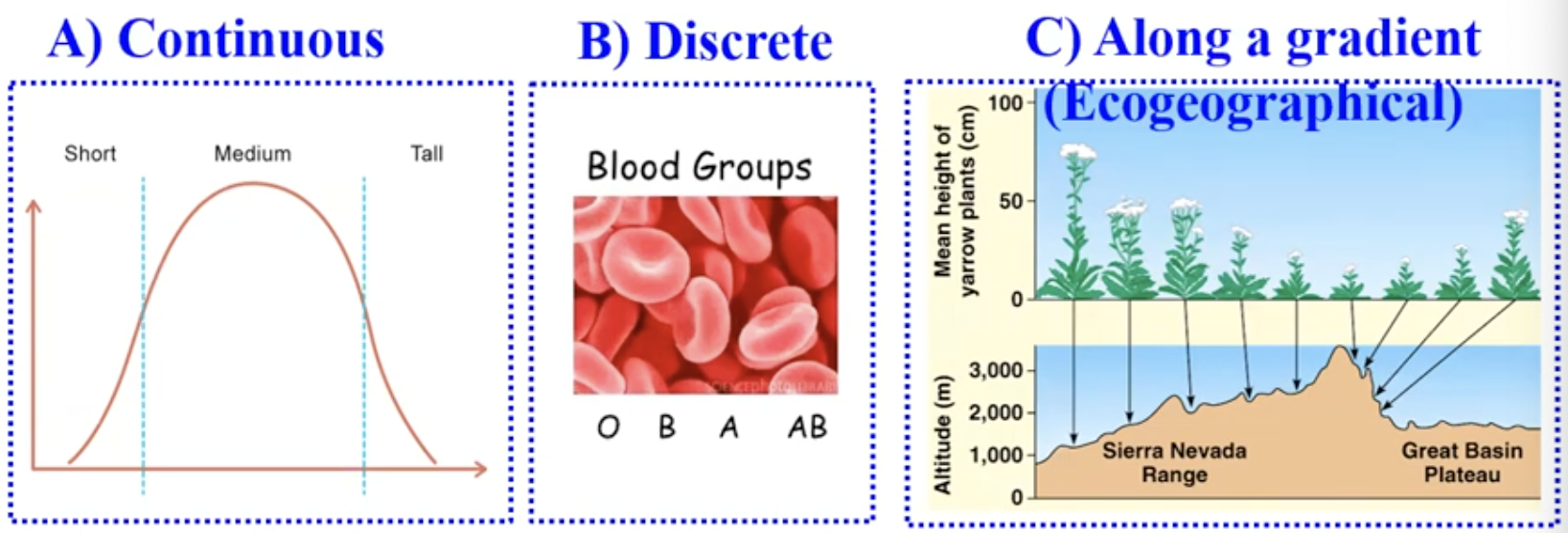
3 types of variation
continuous
discrete
along a gradient ecogeographical
mutatuon
sexual reproduction
sources of variation
mutation
inheritable change in DNA sequece
ultimate source of all NEW alleles (variation)
Rare and random often egative or neutral sometimes beneficial.
can change with environment
sexual reoproduction
during meiosis
crossing over
independent assortment
during fertilization
gametes from differen parents combine to form new genotype combos
spatially varying enviornment
frequency dependent selection
heterozygote advantage
maintaining variation
spatially varying enviornment
different alleles favored in different places/habitats
frequency dependent selection
positive: most abundant form increases
tends to decrease variation
negative: slection favors the rarer form/allele
tends to maintain variation
a form of balancing selection (balaned poymorphism)
ex. predator concentrates on common form
heterozygote advantage
heterozygotes are the most fit (favored by selection)
leads to balanced polymorphism (both alleles maintained)
another form of balancing selection
ex. sickle cell trait
natural selection
gene flow
genetic drift
non random mating
agents of evolution
non random mating
changes due to preferential mating patterns
agents of evolution: natural selection
differences in phenotype leading to differential survival and reproduction
fitness
a relative measure of reproductive success
related to the # of genome copies contributed to the next generation
depends on the match between the individuals phenotype and the present enviornment
higher fitess implies possessing more or better adaptations than others in the population
forms of fitness
evolutionary (individual fitness (W*)
W* = sirvival x fecundity
can use # offspring as estimate
relative fitness (W)
individual fitness/highest individual fitness
W = W*/W*max
normalizes genotype comparison range: 0-1
3 forms of natural selection (based on polygenic/continuous variation)
stabilizing selection
directional selectio
disruptive selection
stabilizing selectio
favors the intermediate
remvoes extreme (reduces variation)
occurs in stable enviornments
ex. clutch size in birds
human birth weight
directional selection
favors 1 extreme
average shifts over time
occurs in changing enviornmets
ex. peppered moth
antibiotic resistance
pesticide resistance
disruptive selection
favors both extreme
intermediates selected against
results in bimodal distribution
occurs in habitats patchy or shifting in time or space
ex. mice in the desert
seed cracker finches
agents of evolution: gene flow
changes due to migration between populations
may counter and slow local adaptation
immigration may introduce new alleles
agents of evolution: genetic drift
changes due to random events
important in small groups → sampling error
may result in loss of alleles → remaining allele becomes fized (freq=1)
when many harmful alleles all become fixed → mutational meltdown
founder effect (genetic drift)
small number of individuals start a population in a new location
ex. colonization of islands
bottleneck effect (genetic drift)
population declines to small size
ex. cheetahs
agents of evolution: non random mating
preferential mating patterns
changes genotype frequencies but not allele frequencies
positive assortative
negative assortative
inbreeding
types of nonrandom mating
positive assortative
between like types
decreases variation; increases homozygotes
negative assortative
between unlike types = disassortative mating
increases variation; increases heterozygotes
inbreeding
between relatives
similar to + assortative mating
sexual selection
differeing fitness within one sex due to competition for mates
arises because the 2 sexes maximize their fitness differently
male fitness by having a large quantity of mates → small mobile gametes
female fitness by choosing a quality male → large well provisioned gametes
leads to sexual dimophism
extremely ornamented males have higher fitness so extreme male traits increase
sexual dimorphism
male and females look different; males often w/ extreme traits
intrasexual selection
intersexual selection
types of sexual selection
intrasexual selection
within 1 sex (usually males)
involves male vs male competition
may include:
fighting and aggression
intimidation displats
sperm competition
intersexual selection
between sexes
involves female choice of the male based on trait
models
fishers runaway (sexy sons)
good genes hypothesis
sensory exploitation hypothesis
fisher runaway (sexy sons)
females choosing attratcive male will also hae attractive sons → attractive sons will have high mating success
good genes hypothesis
male trait is an indicator of superior quality (longevity/good health)
sensory exploitation hypothesis
female is reacting to pre existing sensory preference for the trait
coevolution
when 2 species or genes interact and evolve in response to each other
interspecific coevolution
when 2 SPECIES interact and evolve in response to each other
intraspecific (intergenic) coevolution
when 2 GENES interact and evolve in response to each other
Antagonistic coevolution
mutualistic coevolution
major forms of coevolution
antagonistic
a perpetual cycle of defense and counter defense
aka RED QUEEN
interspecific examples:
predator prey
Parasite Host
Between competitors
intraspecific example
sperm vs egg matrix thickness
mutualistic
system where both parties benefit
interspecific examples
plants and their pollinators
itraspecific examples
hormones and receptors
species (ernst mayers biological species definition)
groups that have gene pools and therefore do not freely exchange genes-they are reproductively isolated
morphology
if extinct (via fossils)
genetic aalysis
microbes
reproductive isolating mechanisms (RIMS)
act as barriers to successful interbreeding and free gene exchange between species
two types of RIMS
pre-zygotic RIMS
post-zygotic RIMS
pre-zygotic rims
preventing interbreeding: no hybrids are formed
ex.
incompatible anatomy or physiology
differing habitats locations or breeding seasons
differing mating courtship behaviours
lions and tigers
never mate in nature due to different habitats
post-zygotic rims
interbreeding occurs but hybrids show lower fitness relative to pure parental types
ex.
decreased hybrid fertility
decreased hybrid survival
hybrid breakdown (F2 offspring w/ low fitness)
horses and donkeys are 2 spp
hybrid offspring (mule) is sterile
reinforcement (decreased interbreeding) can evolve if hybrid fitness is very low
speciation
development of rims between groups/populations
3 main modes of speciation
allopatric
sympatric
parapatric
allopatric speciation
genetic divergence occurs while 2 poplations are geographically seperated (too far apart for gene flow, dispersal or migration)
due to mutation, genetic drift or natural selection
can lead to the pops becoming genetically and or behaviorally incompatible
special case: peripatric speciation → occurs in small isolated peripheral populations
colonization of nearby islands = founder events
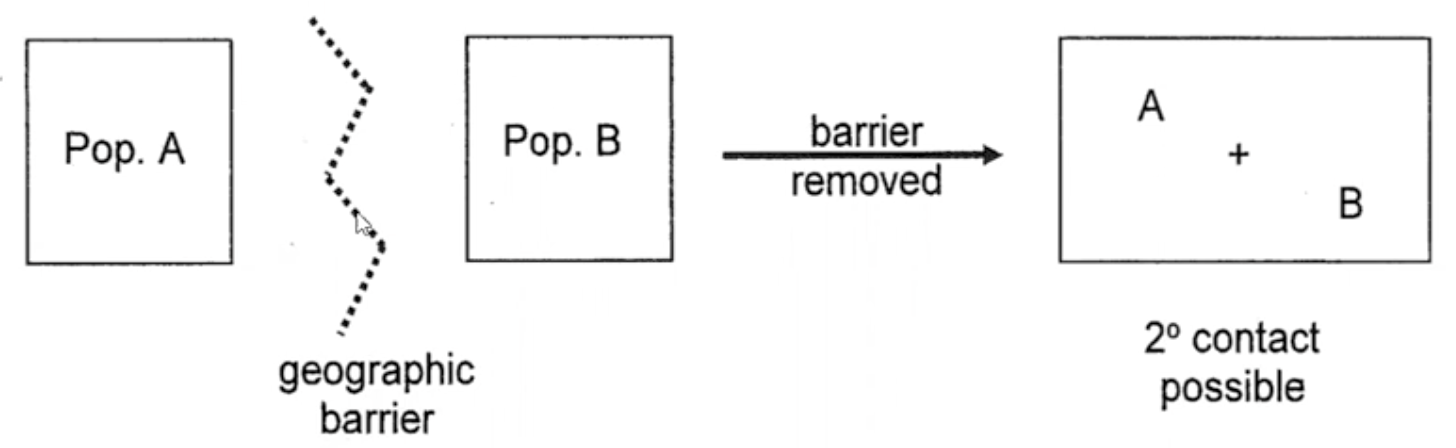
allopatric model secondary contact 3 possible outcomes
the 2 populations do not interbreed (+ assortative mating only)
pre zygotic RIM → 2 spp.
the 2 populations interbreed, but the hybrid offspring are inferior (have lower fitness)
post-zygotic RIM → 2 spp. (reinforcement may occur)
the 2 populations freely interbreed and produce viable and fertile offspring
random matting is occuring
no RIM developed → still 1 sp. (fusion will likely occur)
sympatric speciation
speciation occurs when the populations overlap
can occurs via
resource partitioning and specialization
ex. 2 extremes of an insect population eating, living, and mating on different species of tree may eventually become 2 species
hawthorn flies utilizing different fruits - hawthorn berries vs apple etc.
polyploidy (chromosome duplication)
common in plants (rare in animals)
due to cell division mistakes in meiosis or mitosis
notation A=1 complete set of chromosomes from species A
autopolyploid: involves 1 parental sp.

allopolyploid: duplication after hybridization of 2 spp.

parapatric speciation
speciation occurs while maitaining a common border
neighboring populations adapting to local enviornments
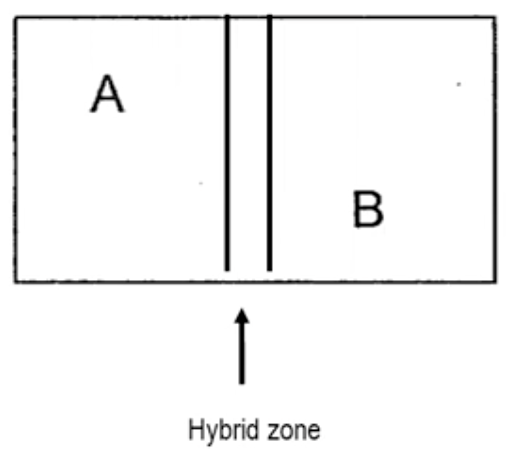
reuslts in a hybrid zone (narrow border where hybrids are produced
macroevolution: large scale change (species level and higher)
can be difficult to track due to incomplete and biased fossil record
patterns change with dispersal and vicariance
rates depend on speciation (alpha) and extinction (omega)
standing diversity
= (total diversity) = diversityt0 + alpha - omega
turnover
= # speciations + # extinctions = alpha + omega
possible mechanisms for macroevolution
gradualism
punctuated equilibrium
gradualism
slow steady rate of change w/ gradual accumulation of small changes over long time periods
punctuated equilibrium
short periods of rapid change followed by long periods of little or no change (stasis)
adaptive radiation
high level and rapid speciation to fill new or open niches (alpha» omega)
processes that increase speciation rates
vacant niches
new mutations
evolution of key innovations/novel traits
wings
bilateral symmetry
animal pollination
ex.
hawaiian honeycreeper birds
cambrian explosion
mass extinction
omega is much greater than baseline/background levels
at least 75% marine spp disappear
causes
climate change
volcanis action
change in sea level
asteroids
phylogeny
the evolutionary hisotyr of organisms
involves cladistics
clade
taxa that descend/diverge from 1 common ancestor
monophyletic
paraphyletic
polyphyletic
phylogenetic tree
summary of relatedness on a branching diagram
monophyletic
includes ALL descendants of a common ancestor
paraphyletic
excludes some descendants of a common ancestor

