Pelvic girdle & Hip positioning/projections
 Call Kai
 Learn
Learn Practice Test
 Spaced Repetition
 Match
Match Flashcards
 Knowt Play
1/31

There's no tags or description
Looks like no tags are added yet.
Name | Mastery | Learn | Test | Matching | Spaced | Call with Kai |
|---|
No analytics yet
Send a link to your students to track their progress
32 Terms
What are the routine projections for the AP Pelvis Exam?
AP Pelvis
AP Pelvis Bilateral Frog Leg (modified cleaves method), recommended for pediatrics
1 projection
What is the CR location for the AP Pelvis?
Midway level of ASIS and symphysis pubis; 2 inches inferior to level of ASIS
What is the CR location for the AP Pelvis Bilateral Frog Leg?
3 inches below level of ASIS
What is the patient position for the AP Pelvis?
Legs and feet separated
Internally rotate lower limb 15 - 20 degrees
What anatomy is included in the AP pelvis projection?
Pelvic girdle, L5, sacrum, coccyx, femoral heads & neck, and greater trochanters.
What is the routine projections for the Hip?
AP Hip
Frogleg (Modified Cleaves) - this will show the lateral
if you can’t do a frog leg modified cleaves due to trauma, you would do a…
XTABLE Lateral (Danelius Miller)
What is the CR location for the hip projections?
a. ASIS
b. Greater trochanter
c. Femoral neck
d. Iliac crest
Femoral neck (1-2 inches medial & 3-4 inches distal to ASIS)
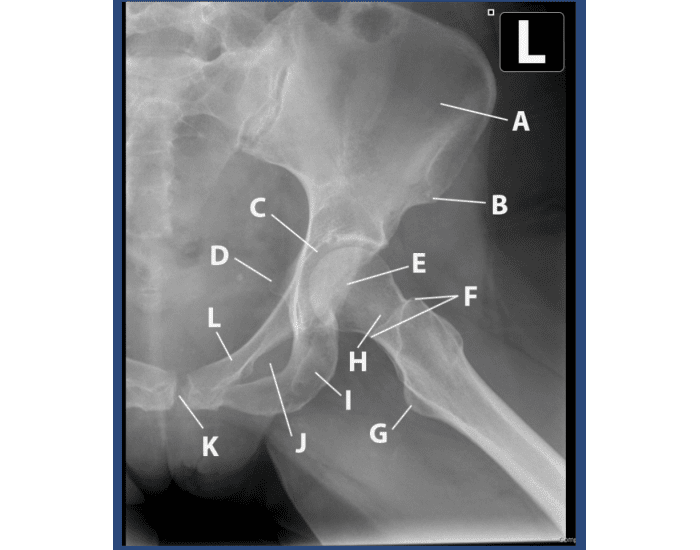
Why do we abduct the femur 45 degrees from vertical for the Frogleg projection (modified cleaves)?
To best demonstrate the femoral head and acetabulum
Why is the CR for all hip projections centered at the femoral neck
because the femoral neck is the most common site for hip fractures
Which 2 bony landmarks need to be palpated for hip localization?
ASIS
Symphysis Pubis
From the midpoint of the imaginary line created by the two landmarks (ASIS & Symphysis pubis), where would the femoral neck be located?
a. 1 in below midpoint of line
b. 2 in below midpoint of line
c. 2.5 in midpoint of line
d. 3 in midpoint of the line
2.5 in midpoint of line
Another method for locating the femoral head is to palpate the ____ and go ____inches medial at the level of the ____, which is ____inches distal to the original palpation point
ASIS; 1-2in;
Symphysis pubis; 3-4in
Which structures on an AP pelvis or hip radiograph indicate whether the proximal head and neck are in position for a true AP projection?
Lesser trochanter should not be visible
Which physical sign MAY indicate that a patient has a hip fracture?
Patients foot rotated externally on affected side
Which projection should be taken first and reviewed by a radiologist before attempting to rotate the hip into a lateral position (if trauma is suspected)?
AP Pelvis
Should a gonadal shield be used for a hip study on a young female? If yes, describe how it should be placed on the patient.
Yes; at ASIS, bottom of the shield placed at inferior margin of symphysis pubis
Should a gonadal shield be used for a hip study on a young male? If yes, describe how it should be placed on the patient.
Yes; top of shield placed inferior margin of symphysis pubis
Geriatric patients are often more prone to hip fractures because of their increased incidence of osteoporosis. (True/False)
True
Which specific positioning error is present when the left iliac wing is elongated on an AP pelvis radiograph?
rotated toward the left side
Which specific positioning error is present when the left obturator foramen is more open than the right side on an AP pelvis radiograph?
right rotation
When gonadal shielding is not used, ___(males/females) receive a greater gonadal dose with an AP pelvis projection.
Females
How many degrees are the femurs abducted (from the vertical plane) for the bilateral frog-leg projection?
40-45*
True/False
Any orthopedic device or appliance of the hip should be seen in its entirety on an AP hip radiograph.
True
How is the unaffected leg positioned for the axiolateral hip projection?
flexed and elevated to prevent from being superimposed over affected hip
How much is the IR tilted for the modified axiolateral projection of the hip?
15* from vertical
A radiograph of an AP pelvis projection reveals that the lesser trochanters are readily demonstrated on the medial side of the proximal femurs. The patient is ambulatory but has a history of early osteoarthritis in both hips. Which positioning modification needs to be made to prevent this positioning?
rotate lower limbs 15-20* internally to place proximal femurs in true AP
A radiograph of a unilateral frog-leg (modified Cleaves) projection distortion of the femoral neck. Based on the AP hip projection, the radiologist suspects a non displaced fracture of the femoral neck. What can the technologist do to better define this region?
repeat the exposure and only abduct the femur 20-30* from vertical.
A portable AP and lateral hip study is ordered for a patient who is in recovery following hip replacement surgery. The radiograph of the AP hip reveals that the upper portion of the acetabular prosthesis is slightly cut off but is included on the lateral projection. Should the technologist repeat the AP projection?
Yes! Any orthopedic appliance or prosthetic must be seen in its entirety in both projections
A patient with hip pain from a fall enters the ER. The physician orders a left hip study. When moved to the radiographic table, the patient complains loudly about the pain in the left hip. Which positioning routine should be used for this patient?
AP pelvic and axiolateral (inferiosuperior) left hip.
How is the cassette aligned for an axiolateral (Danelius-Miller method) projection?
Parallel to femoral neck
Which position/s will best demonstrates signs of developmental dysplasia?
Bilateral frog

