Intro to Cancer Genomics

0.0(0)
Studied by 0 people
call kaiCall Kai
learnLearn
examPractice Test
spaced repetitionSpaced Repetition
heart puzzleMatch
flashcardsFlashcards
GameKnowt Play
Card Sorting

1/20

encourage image

There's no tags or description

Looks like no tags are added yet.

Last updated 4:14 AM on 3/29/26
Name
Mastery
Learn
Test
Matching
Spaced
Call with Kai

No analytics yet

Send a link to your students to track their progress

21 Terms

1
New cards

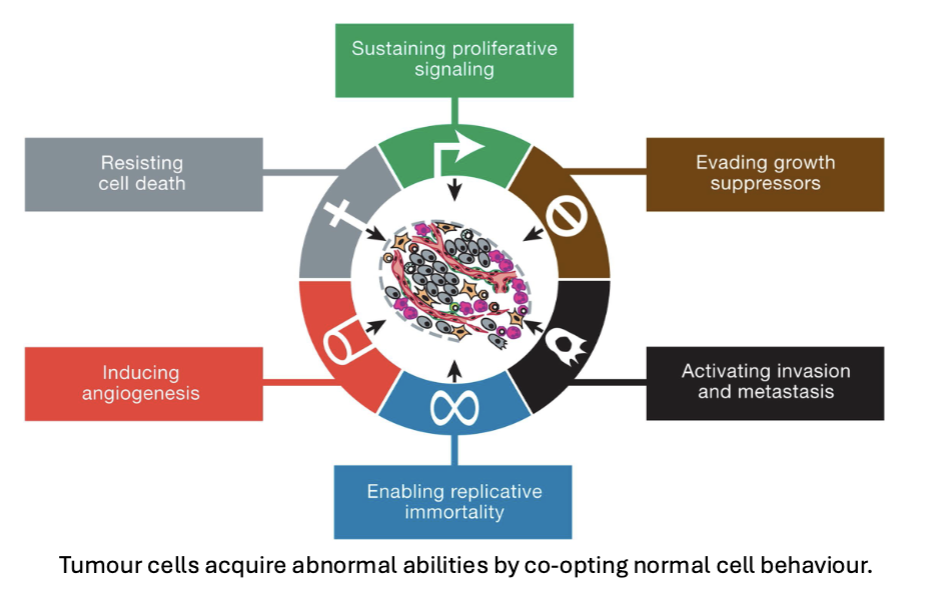
Hallmarks of Cancer

  • tumor cells acquire abnormal abilities by co-opting normal cell behavior
<ul><li><p>tumor cells acquire abnormal abilities by co-opting normal cell behavior</p></li></ul><p></p>
2
New cards

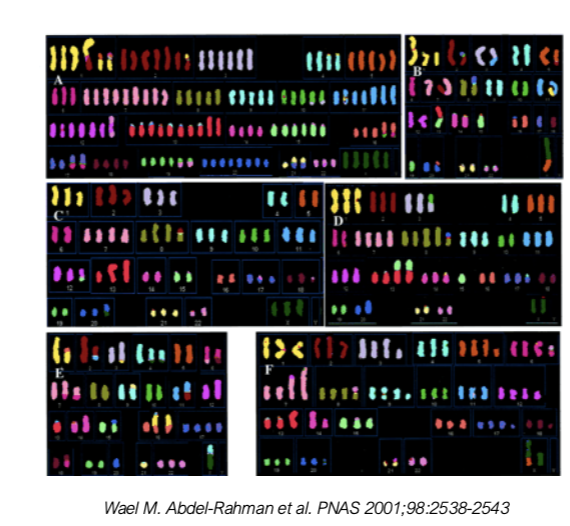
Karyotyping of Colorectal Cancer Cell Lines

  • numerical and structural chromosomal instability

  • translocation b/w chromosomes

  • extra chromosomes (genome may be doubled)
<ul><li><p>numerical and structural chromosomal instability</p></li><li><p>translocation b/w chromosomes</p></li><li><p>extra chromosomes (genome may be doubled)</p></li></ul><p></p>
3
New cards

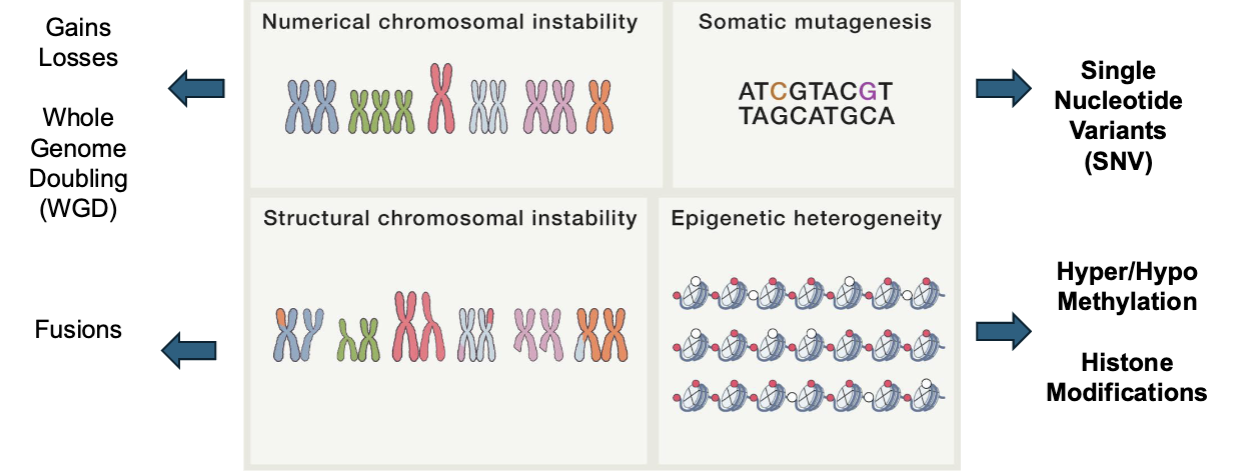
Cancer is a Genetic Disease

  • genomic and epigenomic alterations

  • somatic copy number alternations (SCNA)
<ul><li><p>genomic and epigenomic alterations </p></li><li><p>somatic copy number alternations (SCNA)</p></li></ul><p></p>
4
New cards

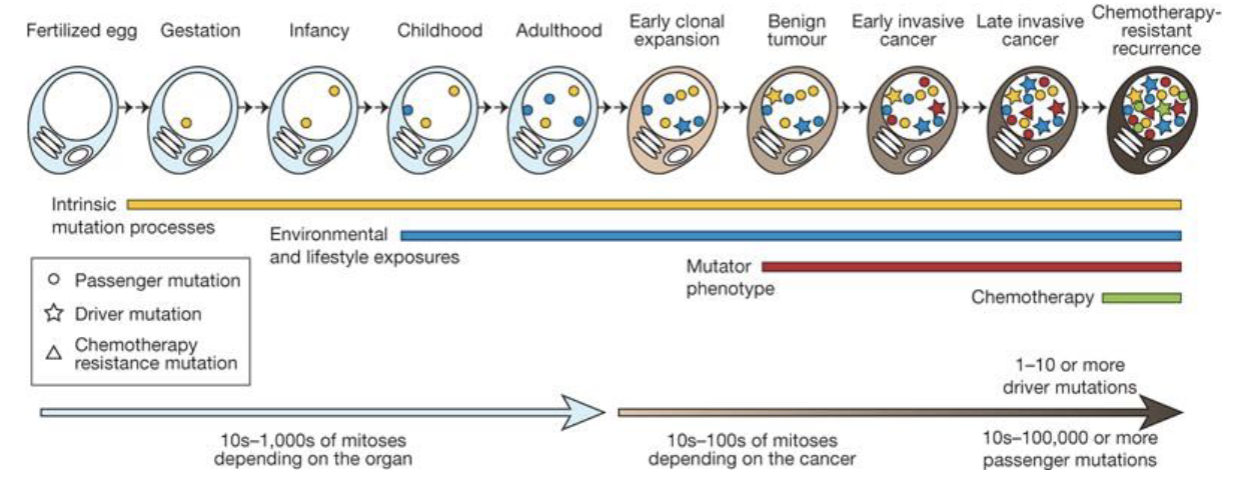
Cancer Cells accumulate somatic alterations over time

  • chemotherapy might induce mutations over time

  • mutations might break down cell functions

  • mutations in specific places might cause cancer
<p></p><ul><li><p>chemotherapy might induce mutations over time</p></li><li><p>mutations might break down cell functions</p></li><li><p>mutations in specific places might cause cancer</p></li></ul><p></p>
5
New cards

Mutation Burden

  • mutation burden varies by cancer type, exposure, age of onset, DNA repair ability, etc.

  • some cancer types have more mutations (e.g. exposure to UV/smoking)

    • pediatric cancer have less mutations, but alterations end up being more disruptive
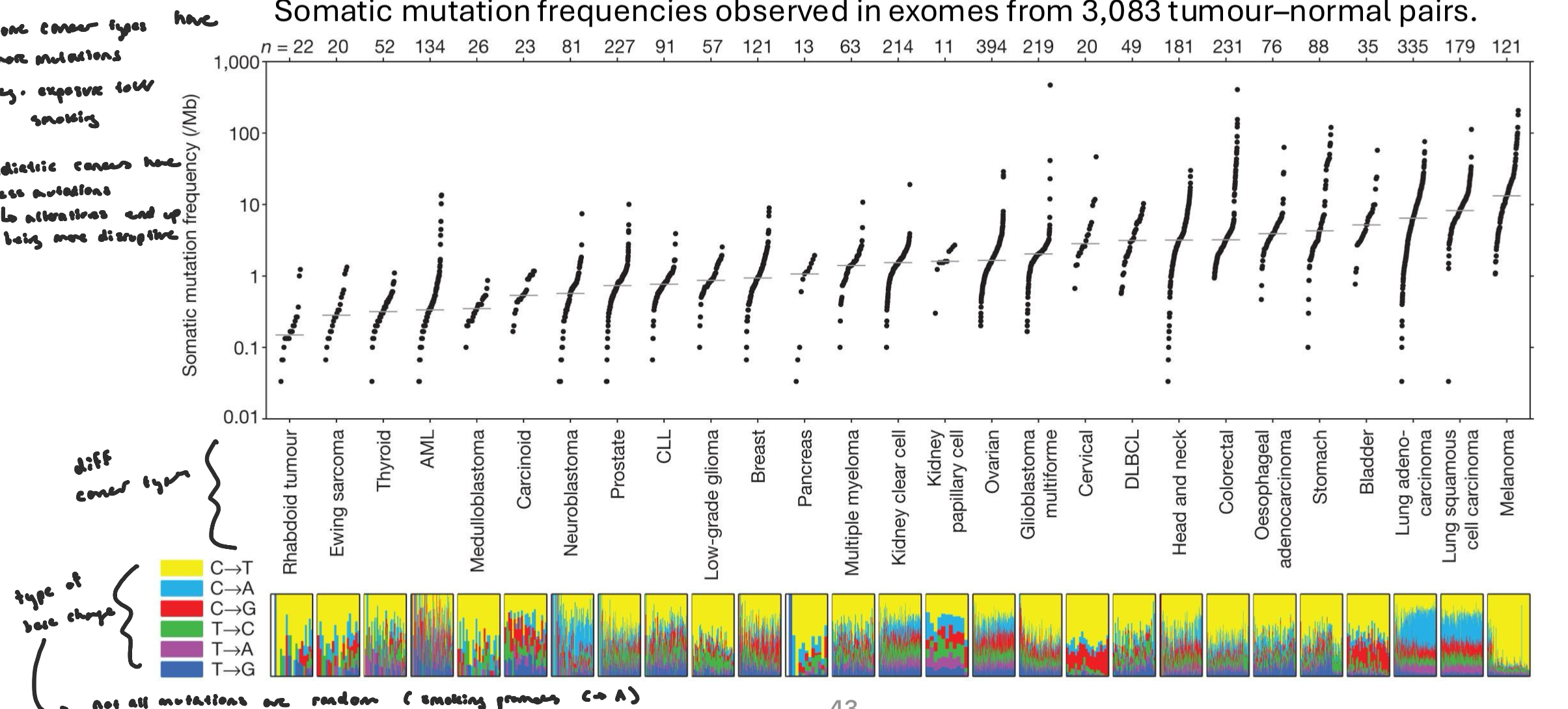
<ul><li><p>mutation burden varies by cancer type, exposure, age of onset, DNA repair ability, etc.</p></li><li><p>some cancer types have more mutations (e.g. exposure to UV/smoking)</p><ul><li><p>pediatric cancer have less mutations, but alterations end up being more disruptive </p></li></ul></li></ul><p></p>
6
New cards

Cancer Genomics Pipeline

  • comparing to person’s own blood instead of reference blood (for detecting somatic mutations)
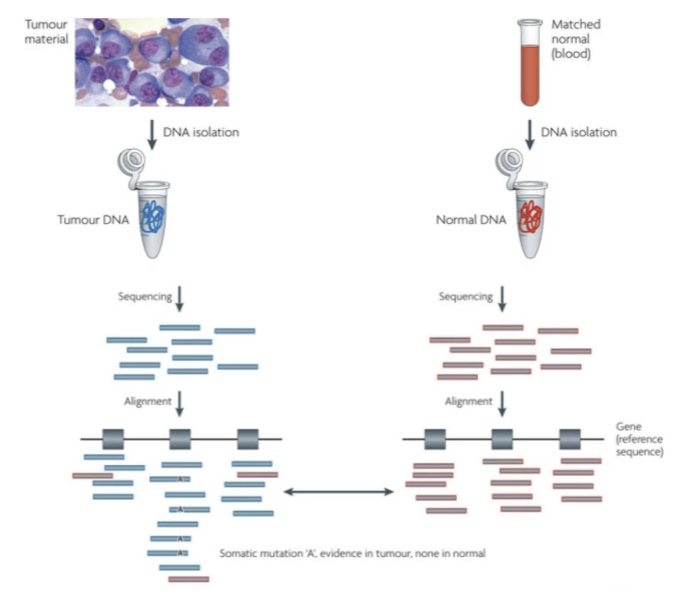
<ul><li><p>comparing to person’s own blood instead of reference blood (for detecting somatic mutations)</p></li></ul><p></p>
7
New cards

Cancer Genomics Pipeline: nf-core/sarek

  • nf-core/sarek is a workflow designed to detect variants on genome sequence data

  • can work on any species w/ a reference genome

  • can handle tumour/normal pairs

  • built using nextflow (a workflow tool)

    • uses Docker/Singularity containers making installation trivial and results highly reproducible
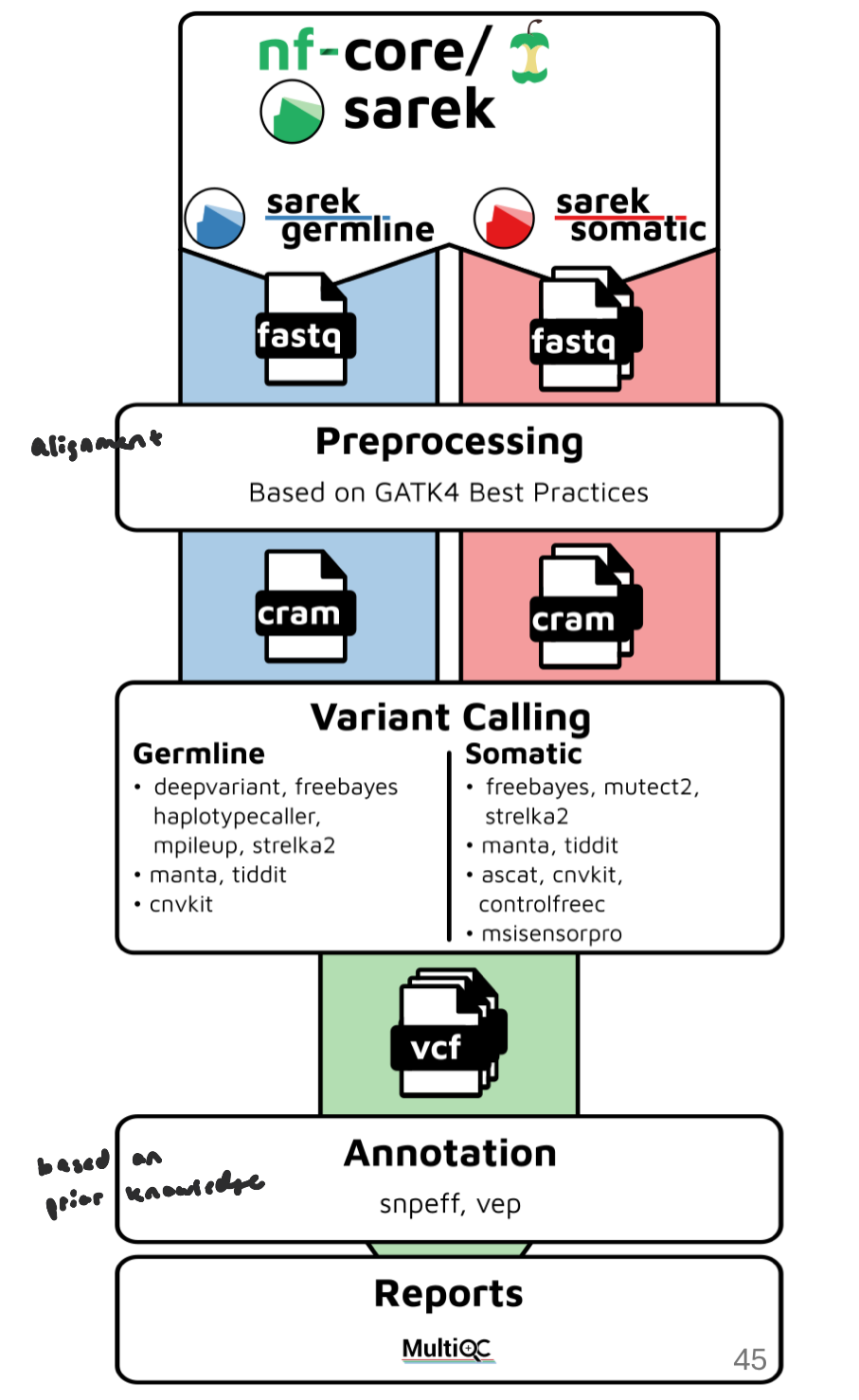
<ul><li><p>nf-core/sarek is a workflow designed to detect variants on genome sequence data</p></li><li><p>can work on any species w/ a reference genome</p></li><li><p>can handle tumour/normal pairs</p></li><li><p>built using nextflow (a workflow tool)</p><ul><li><p>uses Docker/Singularity containers making installation trivial and results highly reproducible</p></li></ul></li></ul><p></p>
8
New cards

nf-core/sarek Overall Workflow

  • input raw sequencing files (FASTQ) or pre-aligned BAM files and reference genome

  • Align reads to the reference genome

  • Sort BAM files and mark duplicates

  • Call variants: identifying positions in a genome where a sample’s DNA sequence differs from the reference genome

  • Variant Filtering: Remove low-confidence variants

  • Annotation: translates raw genetic differences into biologically and clinically interpretable information.
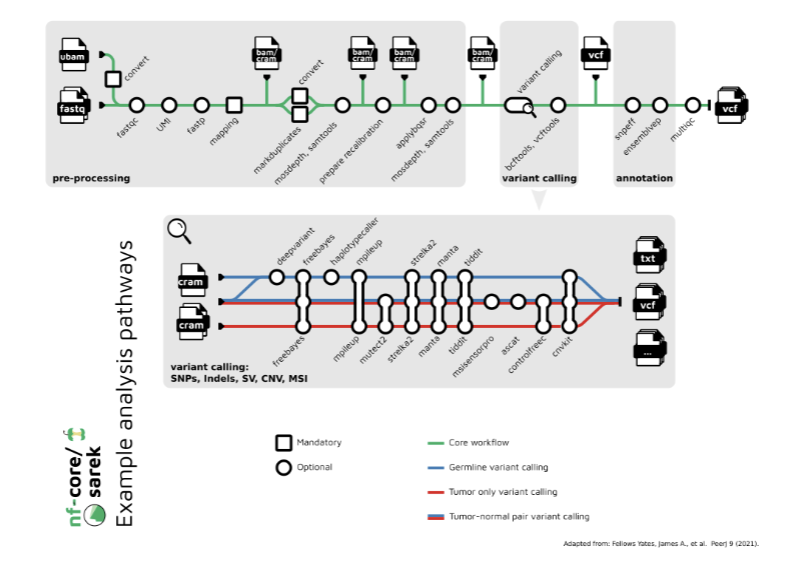
<ul><li><p>input raw sequencing files (FASTQ) or pre-aligned BAM files and reference genome</p></li><li><p>Align reads to the reference genome</p></li><li><p>Sort BAM files and mark duplicates</p></li><li><p>Call variants: identifying positions in a genome where a sample’s DNA sequence differs from the reference genome</p></li><li><p>Variant Filtering: Remove low-confidence variants</p></li><li><p>Annotation: translates raw genetic differences into biologically and clinically interpretable information.</p></li></ul><p></p>
9
New cards

Calling of Single Nucleotide Variants

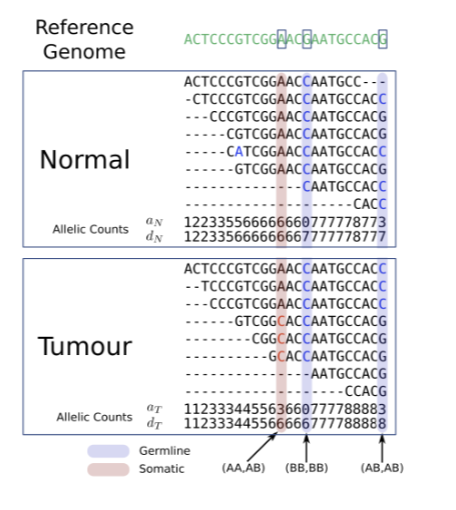
  • germline mutations are also detected (we ignore); only looking at somatic mutations

  • sequence both samples (tumor +normal DNA)

  • align reads to reference genome (generate BAM files for tumor and normal)

  • compare at each genomic position

    • tumor = variant, normal = no variant → somatic mutation

    • tumor = variant, normal = variant → germline variant

  • statistical modeling: evaluating read depth, variant allele fraction, base quality, tumor purity

    • estimating the probability that the variant exists only in tumor and not sequencing noise
<ul><li><p>germline mutations are also detected (we ignore); only looking at somatic mutations</p></li><li><p>sequence both samples (tumor +normal DNA)</p></li><li><p>align reads to reference genome (generate BAM files for tumor and normal)</p></li><li><p>compare at each genomic position</p><ul><li><p>tumor = variant, normal = no variant → somatic mutation</p></li><li><p>tumor = variant, normal = variant → germline variant</p></li></ul></li><li><p>statistical modeling: evaluating read depth, variant allele fraction, base quality, tumor purity</p><ul><li><p>estimating the probability that the variant exists only in tumor and not sequencing noise</p></li></ul></li></ul><p></p>
10
New cards

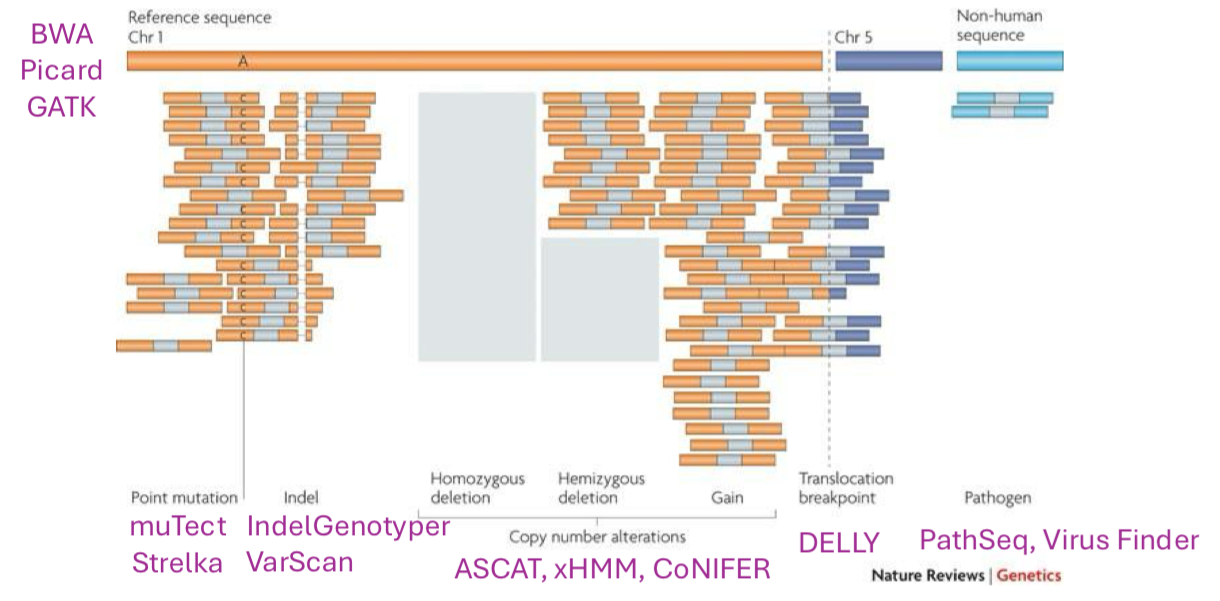
Cancer Genome Variation: Sequencing Read Alignments

  • multiple types of cancer genome variation may be inferred from sequencing read alignments
<ul><li><p>multiple types of cancer genome variation may be inferred from sequencing read alignments </p></li></ul><p></p>
11
New cards

Sample Purity on Coverage

  • if a sample was completely pure, variants are detectable at low coverage (don’t have to cover genome very deeply)

    • every read at a variant site comes from a cell that actually has the mutation

    • even a low number of sequencing reads can reliably detect the variant

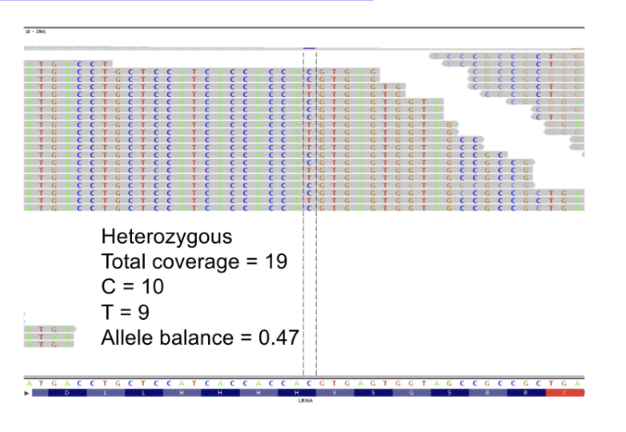
  • variant allele fraction is higher in pure samples: heterozygous mutation → 50% of reads show the variant; homozygous mutation →100% of reads show the variant

    • in mixed samples (tumor+normal), normal cells dilute the signal and the variant allele fraction drops → requires higher coverage to confidently detect variants
<ul><li><p>if a sample was completely pure, variants are detectable at low coverage (don’t have to cover genome very deeply)</p><ul><li><p>every read at a variant site comes from a cell that actually has the mutation</p></li><li><p>even a low number of sequencing reads can reliably detect the variant</p></li></ul></li><li><p>variant allele fraction is higher in pure samples: heterozygous mutation → 50% of reads show the variant; homozygous mutation →100% of reads show the variant</p><ul><li><p>in mixed samples (tumor+normal), normal cells dilute the signal and the variant allele fraction drops → requires higher coverage to confidently detect variants</p></li></ul></li></ul><p></p>
12
New cards

Are tumor samples pure?

No! In reality, tumors are a mix of cancer and normal cells

  • in cancer genomics, we need to consider “tumour content” or “sample purity”

  • tumour purity (or lack of) makes calling cancer mutations difficult

  • as such, sequencing a cancer genome requires sufficiently deep coverage, especially for samples w/ low tumour content

    • increases the chances that alternate alleles (mutations) are detected

13
New cards

Somatic Copy Number Alteration (SCNAs)

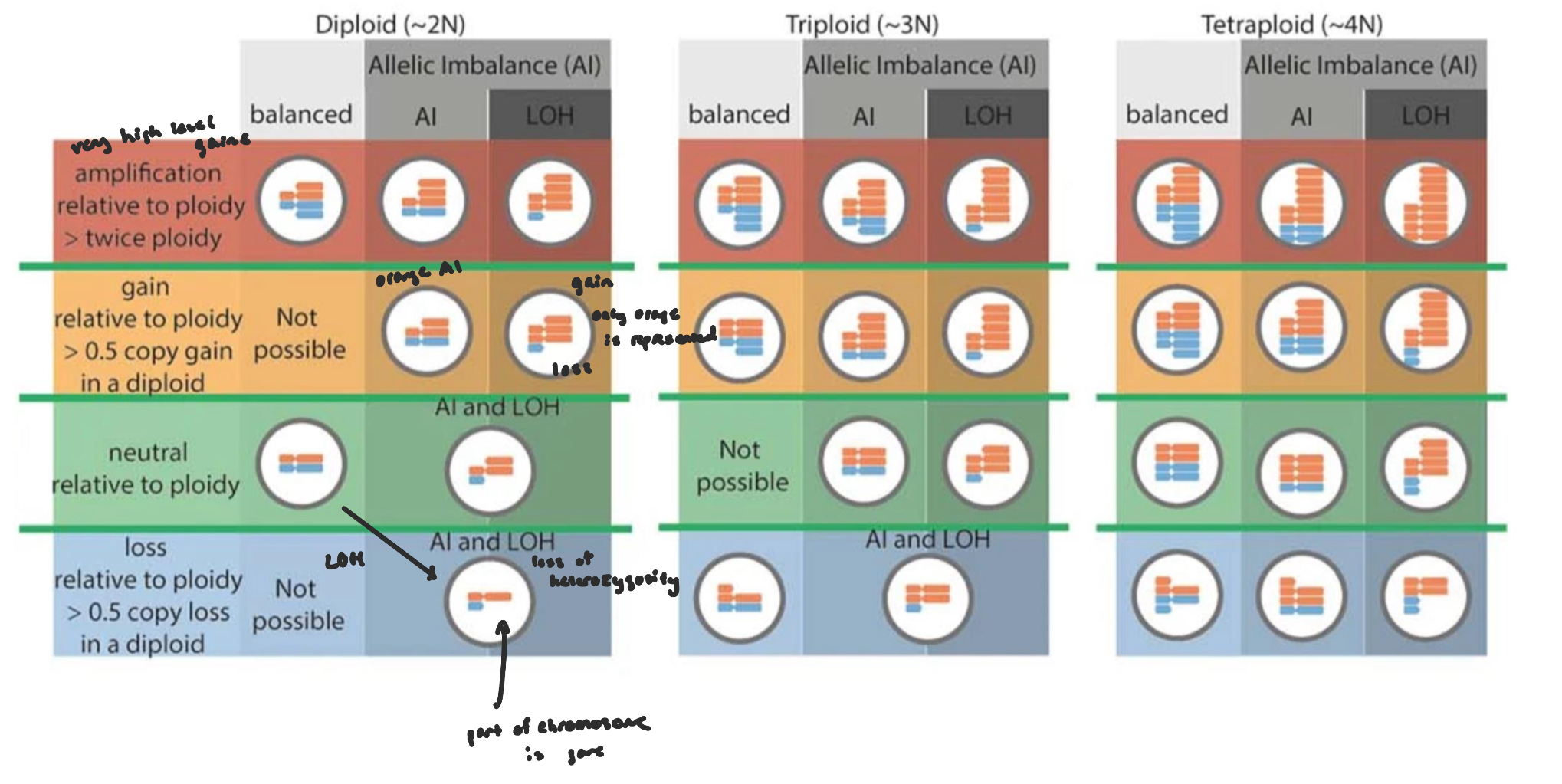
  • prevalent, acquired genomic changes in tumor cells (not inherited) involving the gain (amplification) or loss (deletion) of DNA, ranging from small segments to entire chromosome arms

    • changes relative to one’s ploidy (need to determine current ploidy state before determining SCNAs)

  • major drivers of cancer development, progression, and heterogeneity, affecting oncogene and tumor suppressor gene dosage

  • Compare tumor vs. normal at the same locus. Gain (amplification) → tumor has more copies than normal. Loss (deletion) → tumor has fewer copies than normal.

  • Detection: higher coverage than expected → gain, lower coverage than expected → loss
<ul><li><p>prevalent, acquired genomic changes in tumor cells (not inherited) involving the gain (amplification) or loss (deletion) of DNA, ranging from small segments to entire chromosome arms</p><ul><li><p>changes relative to one’s ploidy (need to determine current ploidy state before determining SCNAs)</p></li></ul></li><li><p>major drivers of cancer development, progression, and heterogeneity, affecting oncogene and tumor suppressor gene dosage</p></li><li><p>Compare tumor vs. normal at the same locus. Gain (amplification) → tumor has more copies than normal. Loss (deletion) → tumor has fewer copies than normal.</p></li><li><p>Detection: higher coverage than expected → gain, lower coverage than expected → loss</p></li></ul><p></p>
14
New cards

Calling Somatic Copy Number Alterations

  • most SCNA callers use a read-depth based approach (focus on SNPs)

  • two main input channels:

    • Log2 ratio (logR): relative depth between tumor and normal

    • B-allele fraction (BAF): allelic imbalance, gives the ability to call allele-specific copy number

    • Combining BAF with logR allows you to see:

      • Which allele is lost or amplified

      • If there is copy-neutral LOH (no change in logR, but BAF shows imbalance)

  • data are segmented into regions of constant copy number (i.e blue lines)

  • segments are classified into copy number events

15
New cards

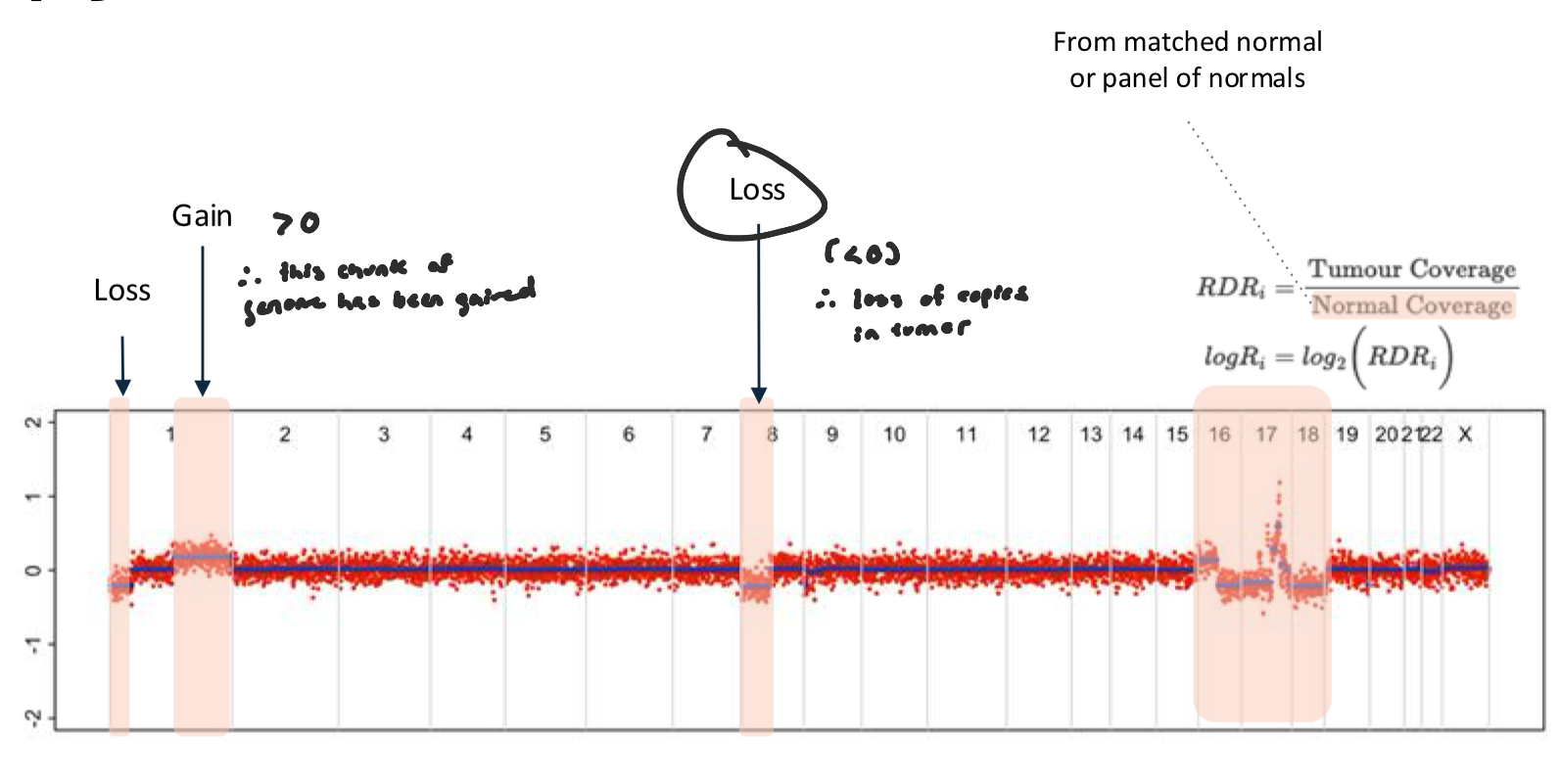
Log2 Ratio Figure

  • data from this plot is sufficient to say whether there is a change in ploidy (gain or loss)

  • compares sequencing coverage in the tumor to the normal at each locus

  • logR > 0 → tumor has more DNA than normal → gain/amplification

  • logR < 0 → tumor has less DNA than normal → loss/deletion

  • logR ≈ 0 → no change (copy number = normal)
<ul><li><p>data from this plot is sufficient to say whether there is a change in ploidy (gain or loss)</p></li><li><p>compares sequencing coverage in the tumor to the normal at each locus</p></li><li><p>logR &gt; 0 → tumor has more DNA than normal → gain/amplification</p></li><li><p>logR &lt; 0 → tumor has less DNA than normal → loss/deletion</p></li><li><p>logR ≈ 0 → no change (copy number = normal)</p></li></ul><p></p>
16
New cards

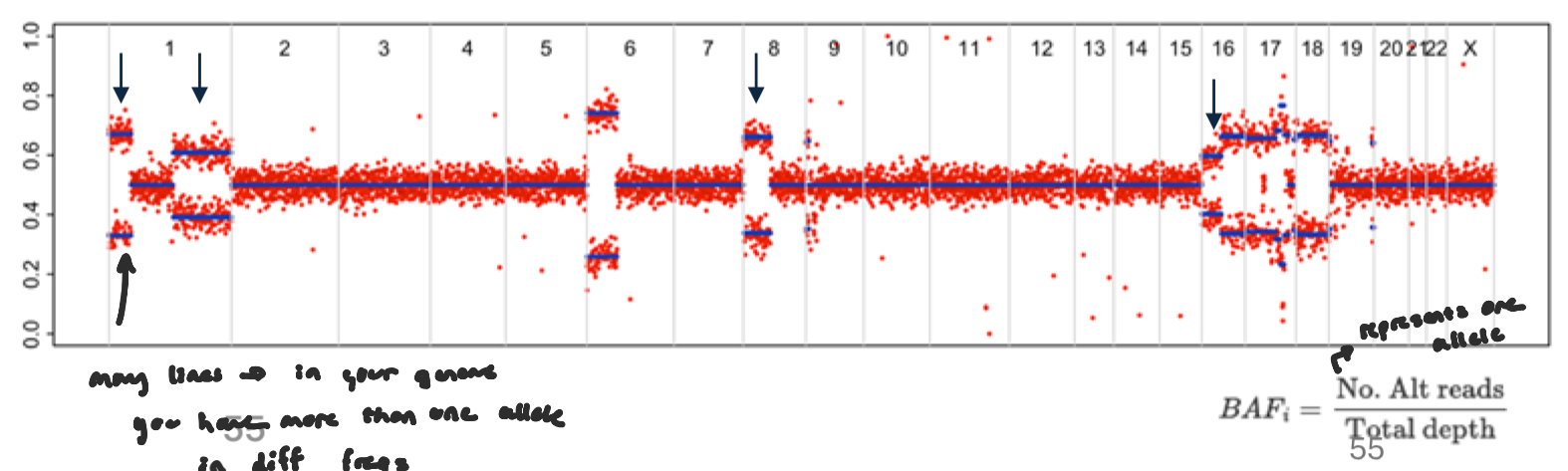
B-allele fraction Figure

  • fraction of reads supporting the alternate allele at heterozygous SNPs.

    • see if representation is equall b/w alleles

  • Normally, for a germline heterozygous SNP: BAF ≈ 0.5 (50% reference, 50% alternate)

  • allelic imbalance: Copy number changes can shift the balance between alleles.

    • Loss of one allele (LOH) → BAF → 0 or 1

    • Gain of one allele → BAF shifts toward 0.33 or 0.66
<ul><li><p>fraction of reads supporting the <strong>alternate allele</strong> at heterozygous SNPs.</p><ul><li><p>see if representation is equall b/w alleles </p></li></ul></li><li><p>Normally, for a germline heterozygous SNP: BAF ≈ 0.5 (50% reference, 50% alternate)</p></li><li><p>allelic imbalance: Copy number changes can shift the balance between alleles.</p><ul><li><p>Loss of one allele (LOH) → BAF → 0 or 1</p></li><li><p>Gain of one allele → BAF shifts toward 0.33 or 0.66</p></li></ul></li></ul><p></p>
17
New cards

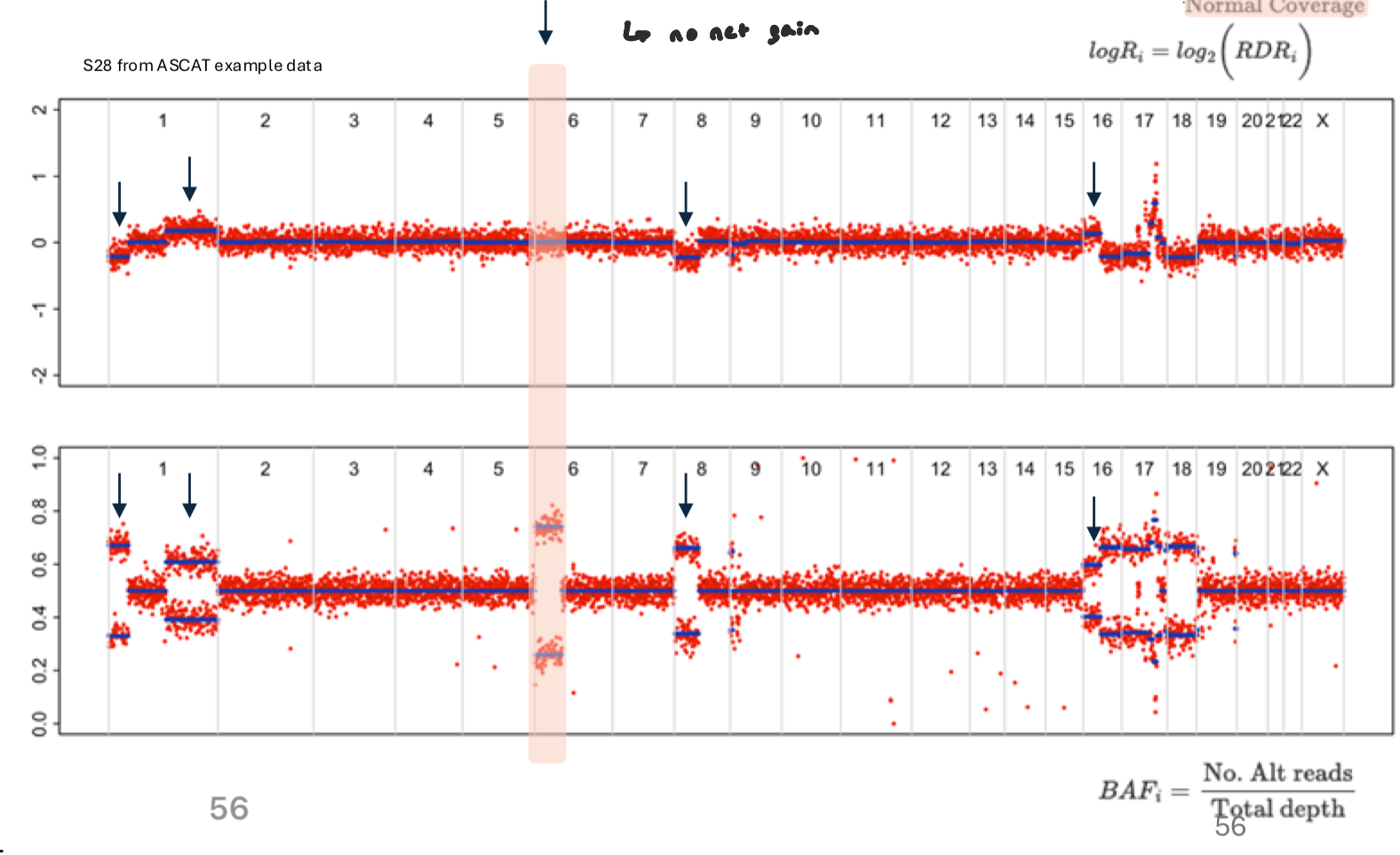
Neutral Loss of Heterozygosity

  • shift in allele representation, but no visible gain or loss

  • occurs when one allele is lost in replaced by other allele (still the same amount of copies, but there’s a loss in heterozygosity)

    • no net gain

  • wouldn’t show as a change in logR, but in BAF, deviates from 0.5 (allelic imbalance)

    • Instead of a single band at 0.5, heterozygous SNPs split toward 0 and 1, forming two “allele-specific” clusters
<ul><li><p>shift in allele representation, but no visible gain or loss</p></li><li><p>occurs when one allele is lost in replaced by other allele (still the same amount of copies, but there’s a loss in heterozygosity) </p><ul><li><p>no net gain</p></li></ul></li><li><p>wouldn’t show as a change in logR, but in BAF, deviates from 0.5 (allelic imbalance)</p><ul><li><p>Instead of a single band at 0.5, heterozygous SNPs split toward 0 and 1, forming two “allele-specific” clusters</p></li></ul></li></ul><p></p>
18
New cards

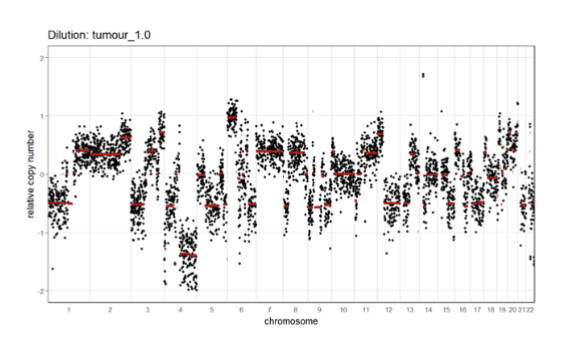
Tumor Purity on SCNA Signal

  • tumor purity affects SCNA signal

  • lower purity means fewer cells harbor the SCNA events (harder to see SCNAs)

  • weaker signal (signal to noise ratio is decreased)
<ul><li><p>tumor purity affects SCNA signal</p></li><li><p>lower purity means fewer cells harbor the SCNA events (harder to see SCNAs)</p></li><li><p>weaker signal (signal to noise ratio is decreased)</p></li></ul><p></p>
19
New cards

Translocations: Soft-Clipped Bases

  • A translocation occurs when a segment of DNA from one chromosome is moved and attached to another chromosome.

  • When reads are aligned to the reference genome:

    • Sometimes only part of a read aligns and the remaining portion does not match the reference at that location.

    • That unmatched portion is called soft-clipped.

  • translocations can be detected from soft-clipped bases

    • Soft-clipped bases can represent sequence that belongs to a different genomic location — potentially another chromosome.

20
New cards

Translocations: Soft-Clipped Bases FIGURE
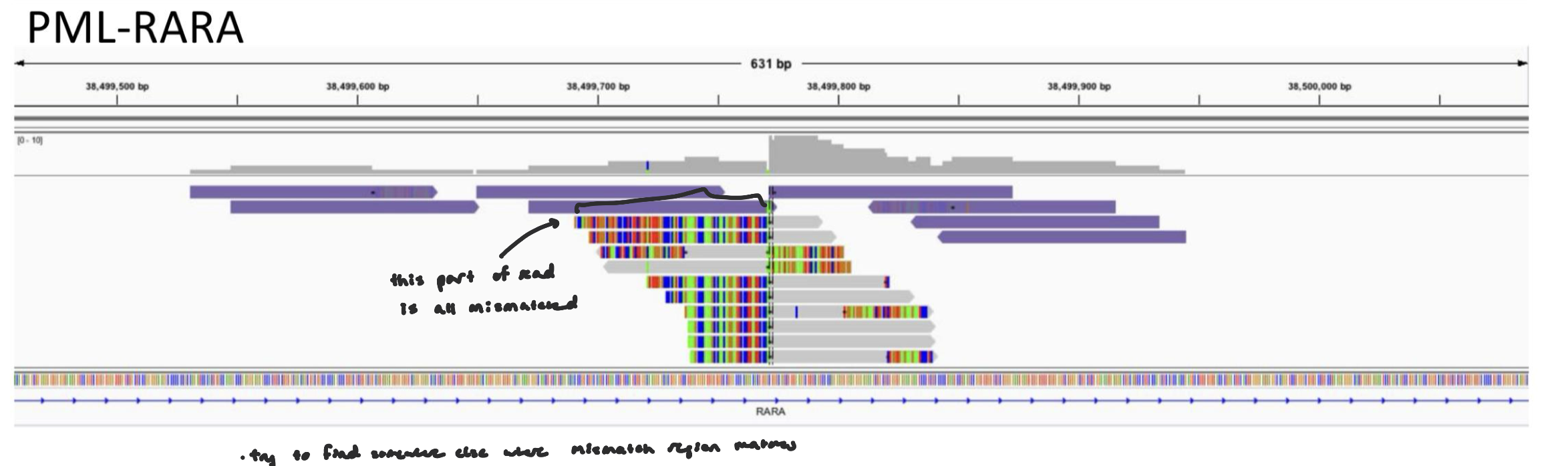
knowt flashcard image
21
New cards

Rearrangement Complex

  • rearrangements can be highly complex and detectable at a base pair resolution

  • genomic rearrangements include: translocation, inversions, deletions, etc.

  • in cancer, rearrangements can involve multiple chromosomes, fragmented DNA segments, etc.

  • tumors can show multiple breakpoints close together, chains of rearrangements, regions shattered and stitched back tgt, copy number changes intertwined w/ structural variants

  • With high-throughput sequencing: Split reads can pinpoint the exact nucleotide where DNA breaks and rejoins.

    • We can identify the precise breakpoint sequence.

Explore top notes

note
Cells
Updated 1253d ago
0.0(0)
note
AMSCO AP World History 7.6, 7.7
Updated 1101d ago
0.0(0)
note
Key Moments in the Outsiders
Updated 1223d ago
0.0(0)
note
Color Combinations or Schemes
Updated 1276d ago
0.0(0)
note
Cells
Updated 1253d ago
0.0(0)
note
AMSCO AP World History 7.6, 7.7
Updated 1101d ago
0.0(0)
note
Key Moments in the Outsiders
Updated 1223d ago
0.0(0)
note
Color Combinations or Schemes
Updated 1276d ago
0.0(0)

Explore top flashcards

flashcards
Science 6th grade finale
83
Updated 1044d ago
0.0(0)
flashcards
Hindi
64
Updated 311d ago
0.0(0)
flashcards
FR 1 - Basic Convo
25
Updated 212d ago
0.0(0)
flashcards
Economics chapter 4
25
Updated 900d ago
0.0(0)
flashcards
Forces and Friction Test
27
Updated 881d ago
0.0(0)
flashcards
DITD #1
47
Updated 1148d ago
0.0(0)
flashcards
Science 6th grade finale
83
Updated 1044d ago
0.0(0)
flashcards
Hindi
64
Updated 311d ago
0.0(0)
flashcards
FR 1 - Basic Convo
25
Updated 212d ago
0.0(0)
flashcards
Economics chapter 4
25
Updated 900d ago
0.0(0)
flashcards
Forces and Friction Test
27
Updated 881d ago
0.0(0)
flashcards
DITD #1
47
Updated 1148d ago
0.0(0)



