Molec Cell Ch 2 chemical components of cells
 Call Kai
 Learn
Learn Practice Test
 Spaced Repetition
 Match
Match Flashcards
 Knowt Play
1/54

There's no tags or description
Looks like no tags are added yet.
Name | Mastery | Learn | Test | Matching | Spaced | Call with Kai | Chat |
|---|
No analytics yet
Send a link to your students to track their progress
55 Terms
Covalent bond
Formed by unequal sharing of electrons.
strong enough to survive conditions inside cell
v. strong, creates polar bonds
Covalent bonds in the cell are rapidly broken by enzyme catalysis that is specific between protein and substrate
Ionic bonds
Formed by the gain and loss of electrons. (Transfer)
One atom becomes positively charged, the other negative (ions)
Hydrogen bonds
noncovalent attraction between a positively charged hydrogen and an electronegative (or negative) atom. Important for many biological molecules.
4 weak interactions that help bring molecules together in cells:
van der waals attraction
electrostatic attractions
hydrogen bonds
hydrophobic (nonpolar) interactions.
all of these r noncovalent
There are four major families of small organic (carbon compound) molecules:
1.sugars -> energy sources/subunits of polysacc.
2.fatty acids -> components of cell membranes
3.amino acids -> subunit of proteins
4.nucleotides -> nucleic acids/subunit of RNA/DNA
What are the large organic molecules created from the small organic building blocks of the cell?
sugars -> polysaccharides and oligosaccharides
fatty acids -> fats and membrane lipids (phospholipids)
amino acids -> proteins
nucleotides -> nucleic acids
Monosaccharides
Formula of (CH2O)n where n can be 3 (trioses), 4, 5 (pentoses), or 6 (hexoses). Contain either an aldehyde (aldose) or ketone (ketoses) group.
monosacc. are subunits used to build carbohydrates
Monosaccharides
trioses -> pentoses -> hexoses:
Aldoses: glyceraledhyde -> ribose ->glucose
Ketoses : dihydroxyacetone -> ribulose -> fructose
Disaccharides
The condensation of two monosaccharides produces one disaccharide. -[The carbon that carries the aldehyde/ketone can react with the hydroxyl group on a second sugar molecule to form a disaccharide] -glycosidic bond
Most common:
maltose (glucose + glucose)
lactose (galactose + glucose)
sucrose (glucose + fructose)
Are glucose, galactose and fructose isomers?
Yes - All have the same formula: C6H12O6
T or F? Condensation (dehydration) reactions are energetically unfavorable. Hydrolysis reactions are energetically favorable.
True
T or F? Biological polymers are broken down through hydrolysis reactions.
True
Fatty acids
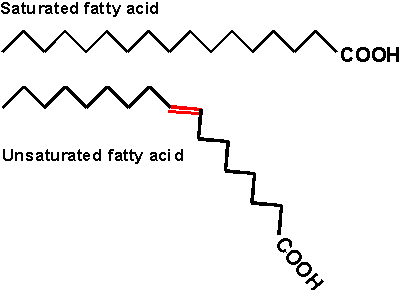
All fatty acids have a hydrophilic carboxyl group at one end and a long hydrophobic hydrocarbon tail at the other. The length and extent of saturation vary. Fatty acids with no double bonds in their tail are saturated.
essential building blocks for the phospholipids that form the lipid bilayer of cell membranes.
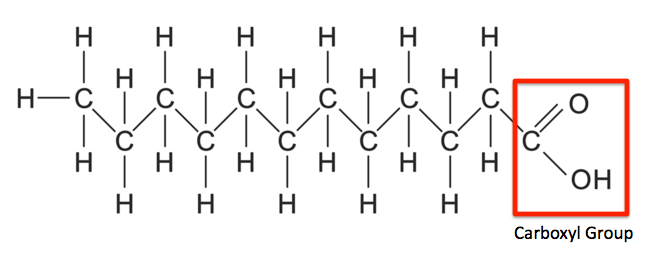
Triacylglycerols: [three fatty acids]
Fatty acids are stored in cells as an energy reserve (fats and oils) through an ester linkage to glycerol to form triacylglycerols.
Connected to glycerol via ester linkages
Degrees of saturation of fatty acids
-This determines the physical properties of the fat molecules.
Saturated fats
No double bonds
Solid at room temperature
Usually made by animals
Unsaturated fats
Have double bonds
Liquid at room temperature
Usually made by plants
Phospholipids (amphipathic) in biological membranes typically contain one saturated and one unsaturated fatty acid. [two fatty acids]
True.
-saturated fatty acids make the membrane less fluid and tend to aggregate.
-cis unsaturated fatty acids reduce membrane rigidity because they do not form solid aggregates.
Prevents tight packing
Keeps membranes fluid but stable
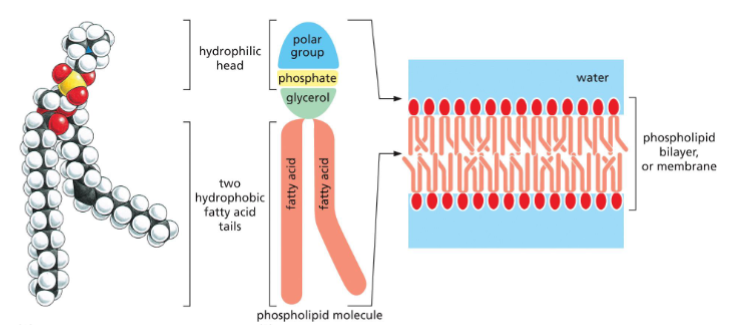
Phospholipid Molecule
hydrophilic head (polar group/phosphate/glycerol) and two hydrophobic fatty acid tails
Phospholipids in cell membranes
Typically have:
1 saturated fatty acid
1 cis-unsaturated fatty acid
Steroids
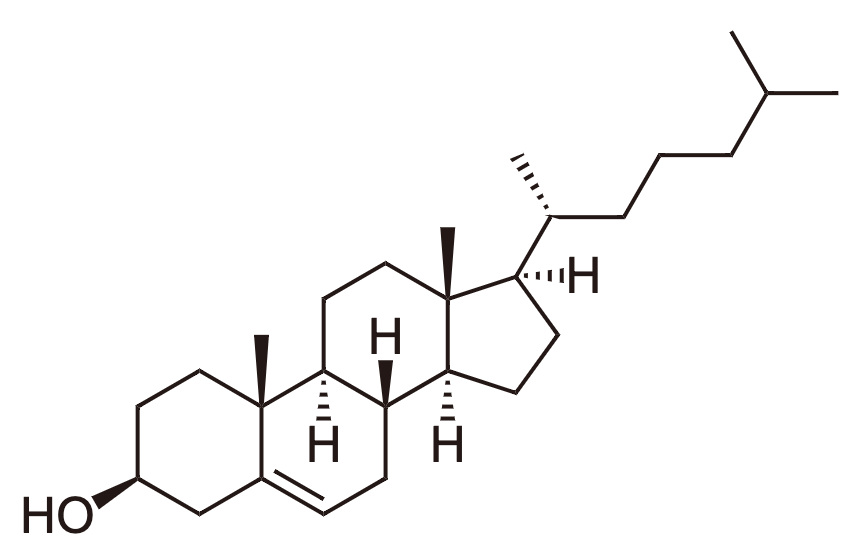
are another class of lipids and all share a common multiple-ring structure
Lipids with a shared core structure
Different functions, same backbone
ex: testosterone + cholestrol
What bonds connect amino acids?
peptide bonds
R groups/side chains in a.a
the variable chemical groups attached to the alpha-carbon of amino acids that define their unique properties (size, charge, polarity, and hydrophobicity).
There are 20: categorized primarily into nonpolar, polar uncharged, positively charged (basic), and negatively charged (acidic) groups.
What are the basic (positively charged) side chains?
lysine, arginine, histidine
What are the acidic (negatively charged) side chains?
aspartic acid, glutamic acid
What are the uncharged polar side chains?
asparagine, glutamine, serine, threonine, tyrosine
What are the non polar side chains?
Glycine, Alanine, Valine, Leucine, Isoleucine, Methionine, Cysteine, Phenylalanine, Tryptophan, Proline
What bond can form between two cysteine side chains?
covalent disulfide bond
What bond links nucleotides? and how are they produced?
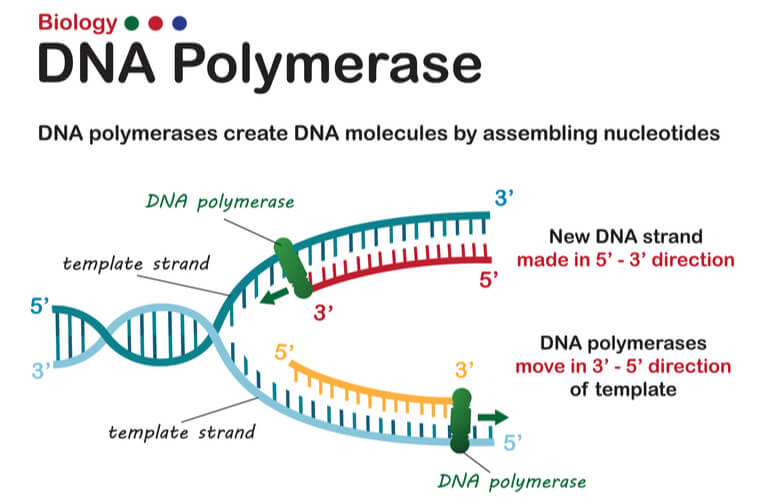
phosphodiester bonds produced by RNA or DNA Polymerase
What is the structural difference between DNA and RNA?
DNA is double stranded and RNA is single stranded.
diff btwn DNA and RNA
DNA uses deoxyribose sugar and thymine (T), whereas RNA uses ribose sugar and uracil (U)
DNA polymerase and RNA polymerase read the template strand in ______ direction.
read the template strand in the 3’ to 5’ direction.
they synthesize the new, complementary polynucleotide chain—whether it is DNA or RNA—in the 5’ to 3’ direction.
This ensures the new strand is antiparallel to the template
What percent of the bacterial cell is chemical?
30%
other 70% is water
The 30% chemical of the bacterial cell is made up of what?
inorganic ions (1%)
small molecules (3%)
phospholipids (2%)
DNA (1%)
RNA (6%)
protein (15%)
polysaccharide (2%)
What are the 4 classes of macromolecules and what are their roles in the cell?
1) polysaccharides (sugars) - energy source/subunit
2) fats/oils (fatty acids) - form cell membranes, steroids,
3) proteins (amino acids) - enzymes
4) nucleic acid (nucleotides)- DNA/RNA, ATP, cyclic AMP, coenzyme A (CoA)
What are the building blocks of these molecules ?
1) sugars
2) fatty acids
3) amino acids
4) nucleic acid
How do these macromolecules form?
1) Condensation/ dehydration reaction of two monosaccharides produces one disaccharide with a glycosidic bond.
disaccharides - maltose, lactose, sucrose.
2) Fatty acids are stored as energy reserves (fats/oils) through an ester linkage to glycerol to form triacylglycerols.
3) Peptide bonds connect amino acids to form proteins.
4) Nucleotides are linked by phosphodiester bonds which are produced by DNA or RNA polymerases.
What are the roles of covalent vs non covalent interactions in the formation of molecules and structures in the cell?
Covalent bonds are strong enough to survive conditions within the cells.
Noncolvalent bonds are how molecules interact with one another.
glycosidic bonds
Join sugars together
Formed by condensation (dehydration) reactions
Water is released
Two monosaccharides → one disaccharide
energetically UNFAVORABLE
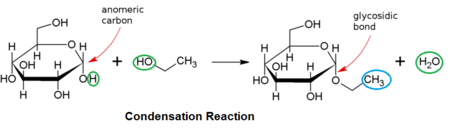
condensation/dehydration rxn
They require an input of energy, so energetically UNFAVORABLE
In cells, enzymes and activated intermediates are used to make this happen
Requires energy → ATP (directly or indirectly)
produce water as a byproduct when two molecules combine to form a larger one
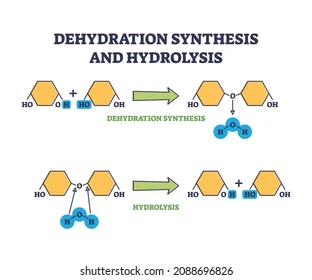
hydrolysis rxn
Hydrolysis (breaking the bond using water)
Energetically favorable
Happens easily during digestion and metabolism
Does NOT use ATP
Releases energy
polymers broken down
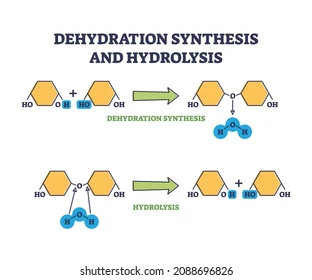
polymer formation + breakdown
Condensation reactions
Build polymers
Require energy (energetically unfavorable)
Hydrolysis reactions
Break polymers apart
Release energy (energetically favorable)
sat. fatty acids
No double bonds
Solid at room temperature
Usually made by animals
STRAIGHT
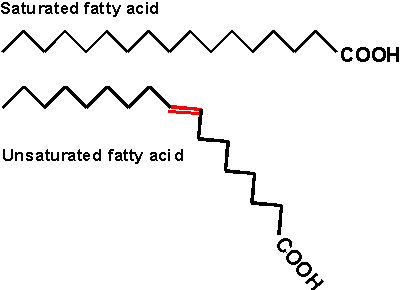
unsat. fatty acids
Have double bonds
Liquid at room temperature
Usually made by plants
KINKED
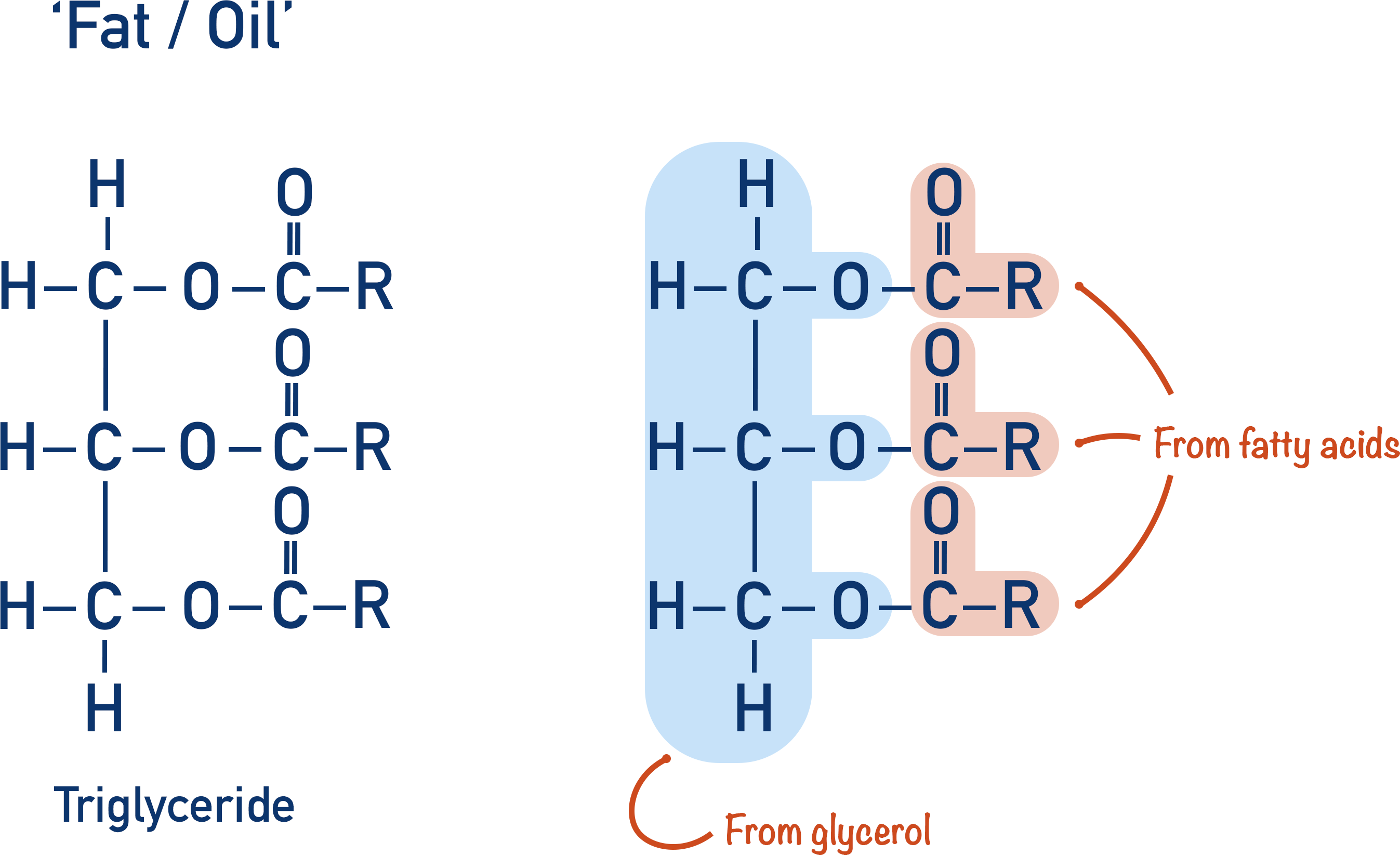
ester linkage
a condensation reaction between the carboxyl group of a fatty acid and a hydroxyl group of an alcohol, usually glycerol.
- This linkage is crucial for forming triacylglycerols (fats/oils), phospholipids, and waxes
fatty acids r stored as energy reserves through ester linkage to glycerol to form triaglycerols
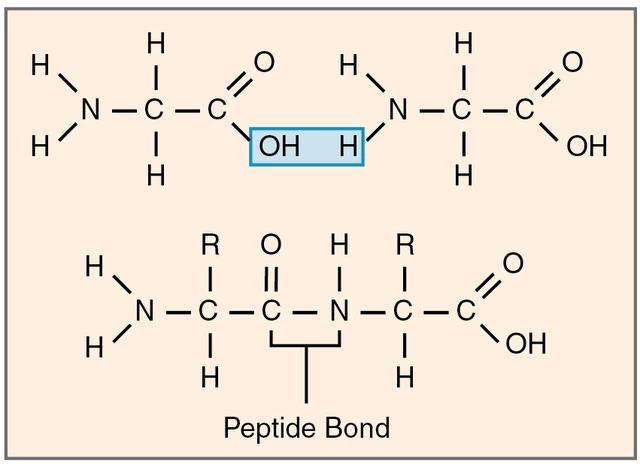
peptide bond
Link amino acids together
Formed by dehydration reactions
Catalyzed by the ribosome peptidyl transferase
Protein has that connect:
Amino (N) terminus
Carboxyl (C) terminus
N-C-C N-C-C
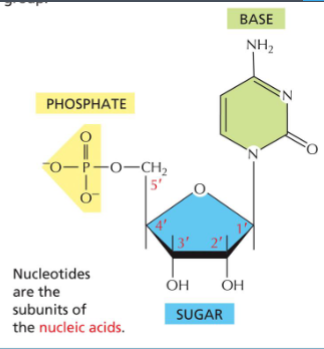
nucleotides
the subunits of DNA and RNA.
made up of Sugar + base + 1–3 phosphate groups
Nucleotides linked by phosphodiester bonds
Bond forms between:
5′ phosphate of incoming nucleotide
3′ hydroxyl of previous nucleotide
Catalyzed by DNA or RNA polymerase
Usually use triphosphate nucleotides
Other Roles :
Store energy (ATP)
Cell signaling (cAMP)
Parts of coenzymes (CoA or coenzyme A)
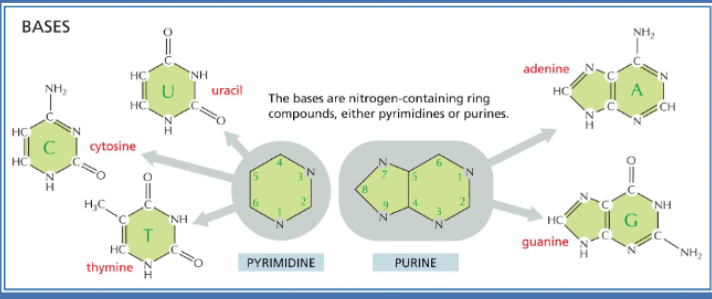
purines
adenine
guanine
have 2 nitrogen rings
A=T
G=-C
A=U
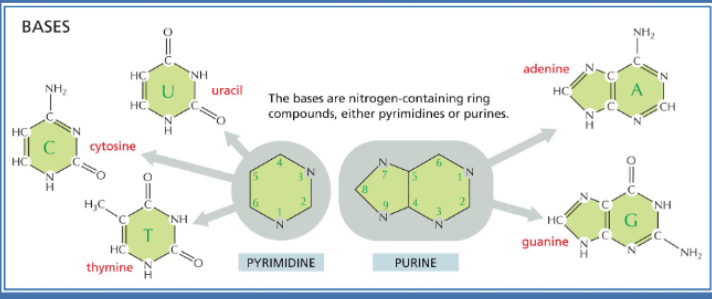
pyrimidines
uracil
cytosine
thymine
one nitrogen ring
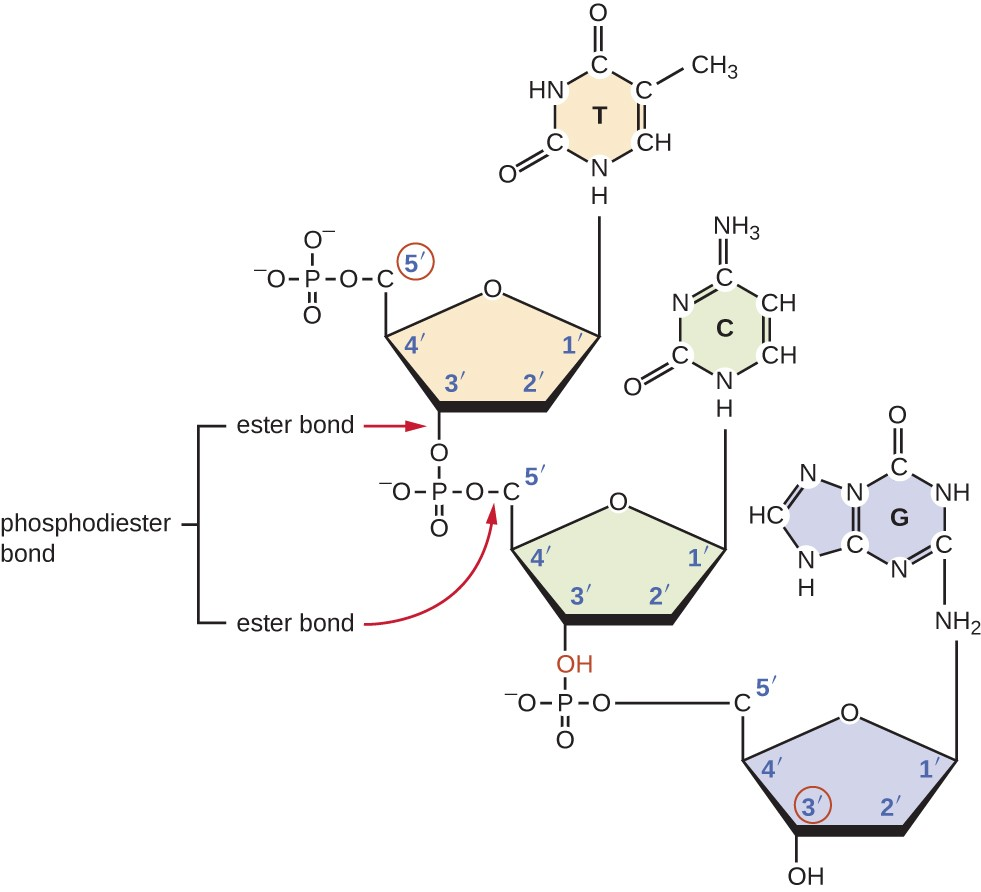
phosphodiester bond
links nucleotides to create DNA and RNA
produced by DNA or RNA polymerases
links 5’P of incoming nucleotide w/ 3’ OH of previous nucleotide
Usually use triphosphate nucleotides used during polymerization
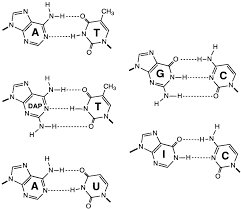
nucleotide base pair bonding
A=T
A=U
G=-C
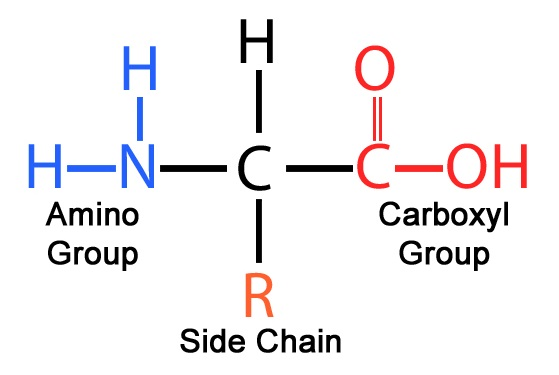
amino acids
Small organic molecule containing both an amino group (-NH2) and a carboxyl group (-COOH)
it serves as the building block of proteins.
All amino acids have an amino group, a carboxyl group, and a side chain (R) attached to their α-carbon atom.
amino acids joined together by peptide bonds to build proteins
nucleic acid chain synthesis
synthesized from energy-rich nucleoside triphosphates by a condensation reaction that releases pyrophosphate—a pair of phosphate groups linked by a single phosphoanhydride bond
noncovalent bonding w/ macromolecules
Noncovalent Bonds Also Allow a Macromolecule to Bind Other Selected Molecules
Noncovalent Bonds Specify the Precise Shape of a Macromolecule
Enzymes recognize their substrates via noncovalent bonds
can also stabilize associations between any two macromolecules
What are the 4 classes of macromolecules and their roles in the cell?
Carbohydrates: Provide energy, store energy, and help with cell recognition and structure.
Lipids: Form cell membranes, store long-term energy, and act in signaling.
Proteins: Carry out most cell functions (enzymes, structure, transport, signaling).
Nucleic acids: Store and transmit genetic information (DNA and RNA).
How do these macromolecules form?
They form through dehydration (condensation) reactions, which remove water to create covalent bonds.
They are broken down by hydrolysis, which adds water.
Does the synthesis of macromolecules require or release energy?
Requires energy (endergonic process), often using ATP or activated molecules.
- condensation rxn
What are the roles of covalent vs noncovalent interactions in the cell?
Covalent bonds hold macromolecules together (e.g., peptide bonds, glycosidic bonds).
Noncovalent interactions (hydrogen bonds, ionic bonds, hydrophobic interactions) stabilize 3D structures and allow flexibility and regulation.