BOC - Chapter 13 (ABCD) - How Cells Obtain Energy from Food
 Call Kai
 Learn
Learn Practice Test
 Spaced Repetition
 Match
Match Flashcards
 Knowt Play
1/185

There's no tags or description
Looks like no tags are added yet.
Name | Mastery | Learn | Test | Matching | Spaced | Call with Kai |
|---|
No analytics yet
Send a link to your students to track their progress
186 Terms
What is the source of all energy?
sun
How is energy processed in plants?
Sunlight -> Photosynthesis -> Glucose
What is sugar break down called
Catabolism
What makes catabolism possible?
Enzymes
Human control sugar break down through catabolism, made possible by enzymes, which created energy called...? (hint: like hard cash for the cell)
ATP
The single most important biochemical reaction to ALL living organisms?
Cellular Respiration
What are the 2 forms of energy?
Stored and usable energy (ATP and activated carrier)
Why is Cellular Respiration so important? (3 reasons)
- Universal to all living organisms
- Converts O2 + sugar --> CO2 + H2O + ATP
- Allows cell to do work under Restricted conditions
ATP is what kind of energy?
Immediate energy for work
Activated Carriers are what kind of energy?
Stored energy for later use
What is needed to FULLY complete catabolism and release max energy in sugars?
sugar --> CO2 + H2O+ATP
O2 (oxygen)
What is the role of Enzymes in Cellular respiration?
- Lowers activation energy = rxn occur with less heat
- enables energy capture into ATP and Activated Carriers
- Prevents energy loss as heat
Enzymes help ______ _______ in small steps, retrieves either ____ or stored ________ _______, and prevents energy loss as_____
- Capture, Energy
- ATP, Activated Carriers
- heat
What is the goal of cellular respiration?
to convert the chemical energy in food (glucose) to chemical energy, ATP (usable cell energy)
In an Anaerobic cell how many stages of Metabolism and how my key processes are used to make chemical energy?
- 2 stages of metabolism
- 1 key process + subprocesses
In an Aerobic cell how many stages of Metabolism and how my key processes are used to make chemical energy?
- 3 Major steps of metabolism
- 4 key processes
In an Anaerobic cell 1 glucose molecules C6H12O6 --> ? and is that break down of the sugar full or partial? (through Glycolysis)
- 2 & 3 carbon molecules
- Partial break down (not full potential)
What are the ATP yields for these?
Anaerobic Glycolysis
Aerobic Respiration (Theoretical)
Aerobic Respiration (Actual)
- 2 ATP
- 38 ATP
- ~ 28 ATP
Why is the actual ATP recovery closer to ~28 ATP?
Due to losses and cellular conditions
What are the key processes of Anaerobic cells
Glycolysis + subprocesses
What are the key processes of Aerobic cells?
Glycolysis -> CAC -> ATC -> ATP synthase
What are the 4 stages of Cellular Respiration?
1. Digestion
2. Glycolysis
3. Citric acid cycle
3.1. Acetyl-CoA, Regulation of Metabolism
4. Oxidative Phosporylation
Where does Digestion occur?
Chemical location?
Enzymes location?
- Outside the cell
- Stomach (HCl)
- mouth, stomach, small intestines
In HIGHER eukaryotes what happens through specialized cells to get the food to cells?
Absorption
Small intestine -> bloodstream -> body's cells
Understand that food needs to be absorbed into the blood stream to get to the...
Cells
During digestion, metabolism of Macromolecules yields...?
Where does this begin?
- Monomers (building blocks)
- Cytoplasm
Where does Glycolysis occur?
cytosol
What are the key products of of glucose after glycolysis?
- 2 pyruvate
- 2 ATP
- 2 NADH
What is a pyruvate? what would 2 pyruvate look like?
A 3 carbon chain, C-C-C
2 pyruvate = C-C-C + C-C-C
Is oxygen necessary for glycolysis ?
Nope, remember Anaerobic cells
If glycolysis of Anaerobic cells yield 2 & 3 carbon molecules, what does Aerobic cells yield?
1C6H12O6 --> 6CO2 + 6H2O + wtv ATP energy is recovered
Where does the Citric Acid cycle take place? (aka: Krebs Cycle)
Mitochondrial matrix
What needs to be inputed in the CAC for it to work and where/what does that thing comes from?
- Acetyl-CoA
- From Pyruvate in Mitochondria
🧠 Analogy
Think of the CAC as a spin cycle in a washing machine.
Acetyl-CoA is the dirty sock, and the cycle spins it around, wringing out energy (NADH, FADH₂) and waste (CO₂). You also get a coin (GTP) to spend immediately.
What is the output per CAC?
3 NADH, 1 FADH₂, 1 GTP (ATP), 2 CO₂
Is O2 required for the CAC? if so, is it direct of indirect?
yes, indirect
Why is Oxygen indirectly needed for the CAC?
Needs it in the ETC, which recycles molecules of NAD+ and FAD to keep running
If no oxygen what stops?
ETC -> NAD+/FAD not regenerated -> CAC stalls
What is Oxidative Phosphorylation?
ETC + ATP synthase
Where does Oxidative Phosphorylation occur?
Inner mitochondrial membrane
What needs to be inputed into Oxidative Phosphorylation
NADH and FADH₂
What is the output of Oxidative Phosphorylation
~28 ATP + H₂O
Is O2 needed during Oxidative Phosphorylation? Direct or indirect? Why?
- Yes
- Direct
- oxygen is the final electron acceptor
🧠 Analogy
Imagine the ETC as a hydroelectric dam.
NADH and FADH₂ are like water flowing downhill, powering turbines (ATP synthase). Oxygen is the drain at the bottom — without it, the system floods and shuts down.
🧠 Dumbed-Down Version + Analogy
What’s happening? Imagine glucose is a $100 bill. Your cell wants to spend it, but it can’t use it directly. So it breaks it down into smaller change (ATP coins) through a series of steps.
- Digestion: Like chewing and swallowing food—big molecules get chopped into bite-sized pieces.
- Glycolysis: Like breaking a $100 bill into $10 bills. You get a little energy (ATP) and some IOUs (NADH).
- Citric Acid Cycle: Those $10 bills go into a machine that squeezes out more IOUs and CO₂ as waste.
- Oxidative Phosphorylation: The IOUs (NADH/FADH₂) get cashed in at the bank (ETC) to make lots of ATP coins.
Oxygen is required for full ____, except_____
Respiration, Glycolysis
What kind of process type is glycolysis?
Major Catabolic pathway --> break down glucose for energy
What are the 3 major catabolic steps for Glycolysis?
1. Energy investment
2. sugar cleavage
3. Energy Generation
What are the major Enzyme classes in Glycolysis?
- Kinase
- Isomerase
- Dehydrogenase
What does Kinase do?
Adds phosphate groups
What does Isomerase do?
Rearrange bonds within a molecule
what does Dehydrogenase do?
Removes H+ and electrons (oxidation)
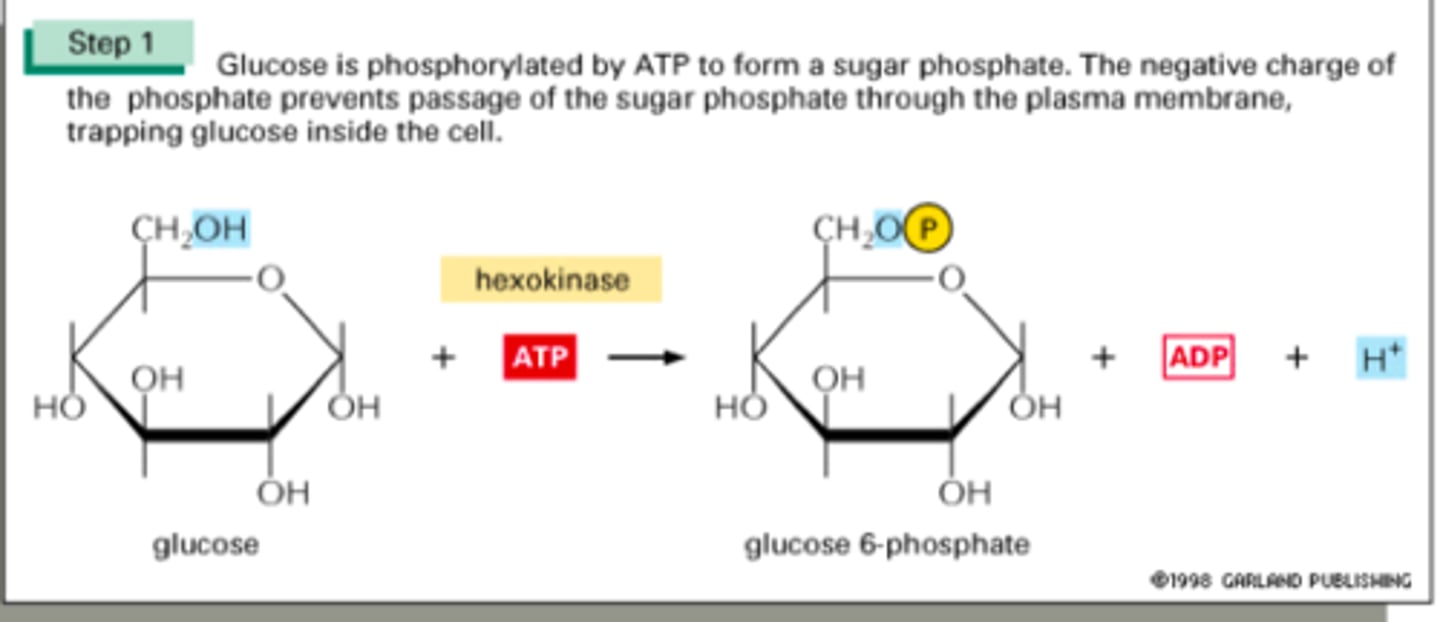
During the Energy Investment Phase, what happens during step 1?
Enzyme =
Energy needed =
Product =
Favorable/Unfavorable =
Irreversible/ Reversible =
Adds phosphate to glucose using ATP
Enzyme = Kinase
Energy needed = 1ATP
Product = Phosphorylated sugar --> forms glucose-6-phosphate (1P)
Favorable/Unfavorable = Favorable
Irreversible/ Reversible = Irreversible
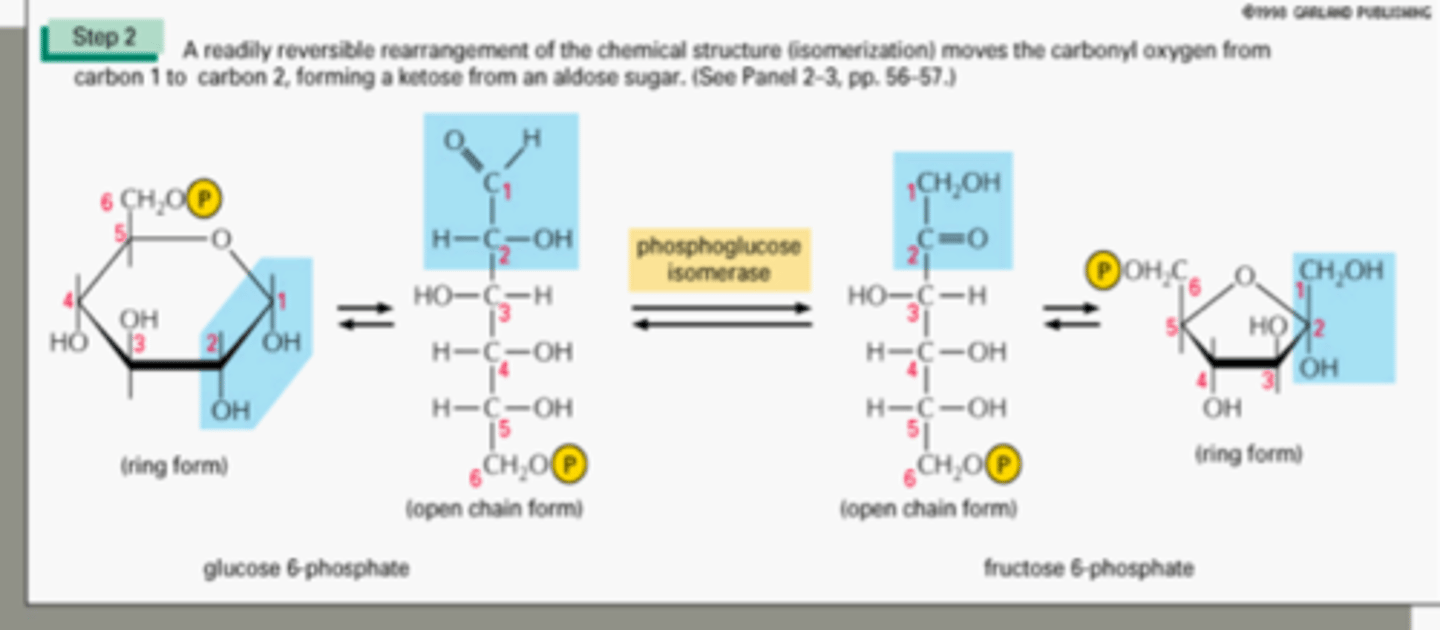
During the Energy Investment Phase, what happens during step 2?
Enzyme =
Energy needed =
Product =
Favorable/Unfavorable =
Irreversible/ Reversible =
Rearranges glucose-6-phosphate
Enzyme = Isomerase
Energy needed = ...
Product = 5 ring, 6C sugar
Favorable/Unfavorable = Near-equillibrium
Irreversible/ Reversible = Reversible
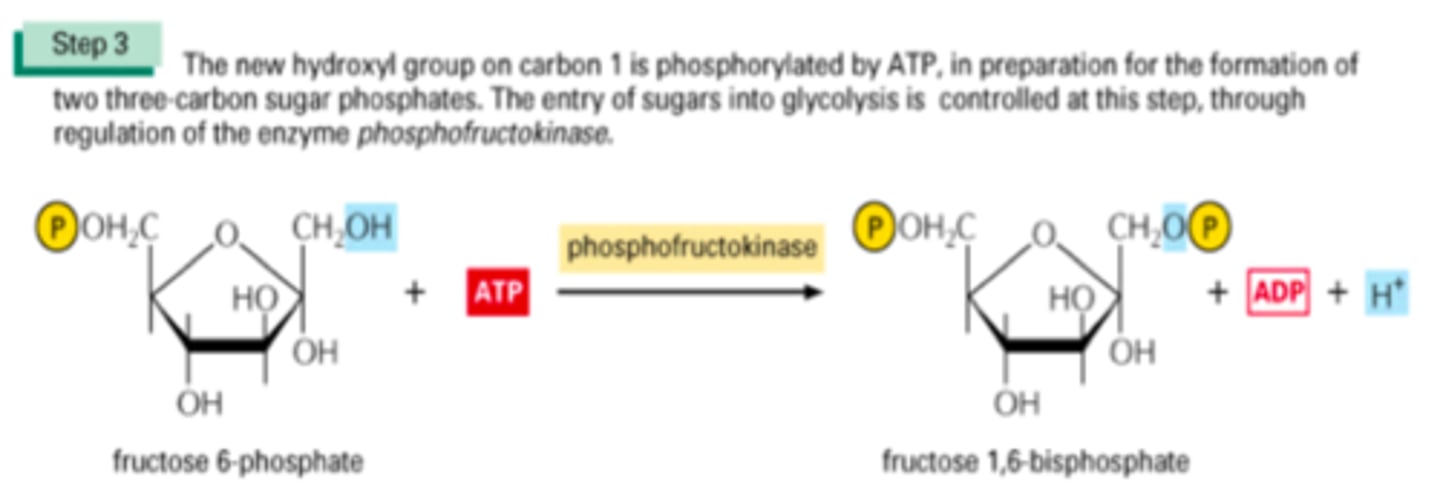
During the Energy Investment Phase, what happens during step 3?
Enzyme =
Energy needed =
Product =
Favorable/Unfavorable =
Irreversible/ Reversible =
Kinase adds another phosphate using ATP (phosphorylation)
Enzyme = Kinase
Energy needed = 1ATP
Product = Forms another sugar like step 1 but has 2 P's on it (2P)
Favorable/Unfavorable = Highly favorable
Irreversible/ Reversible = Irreversible
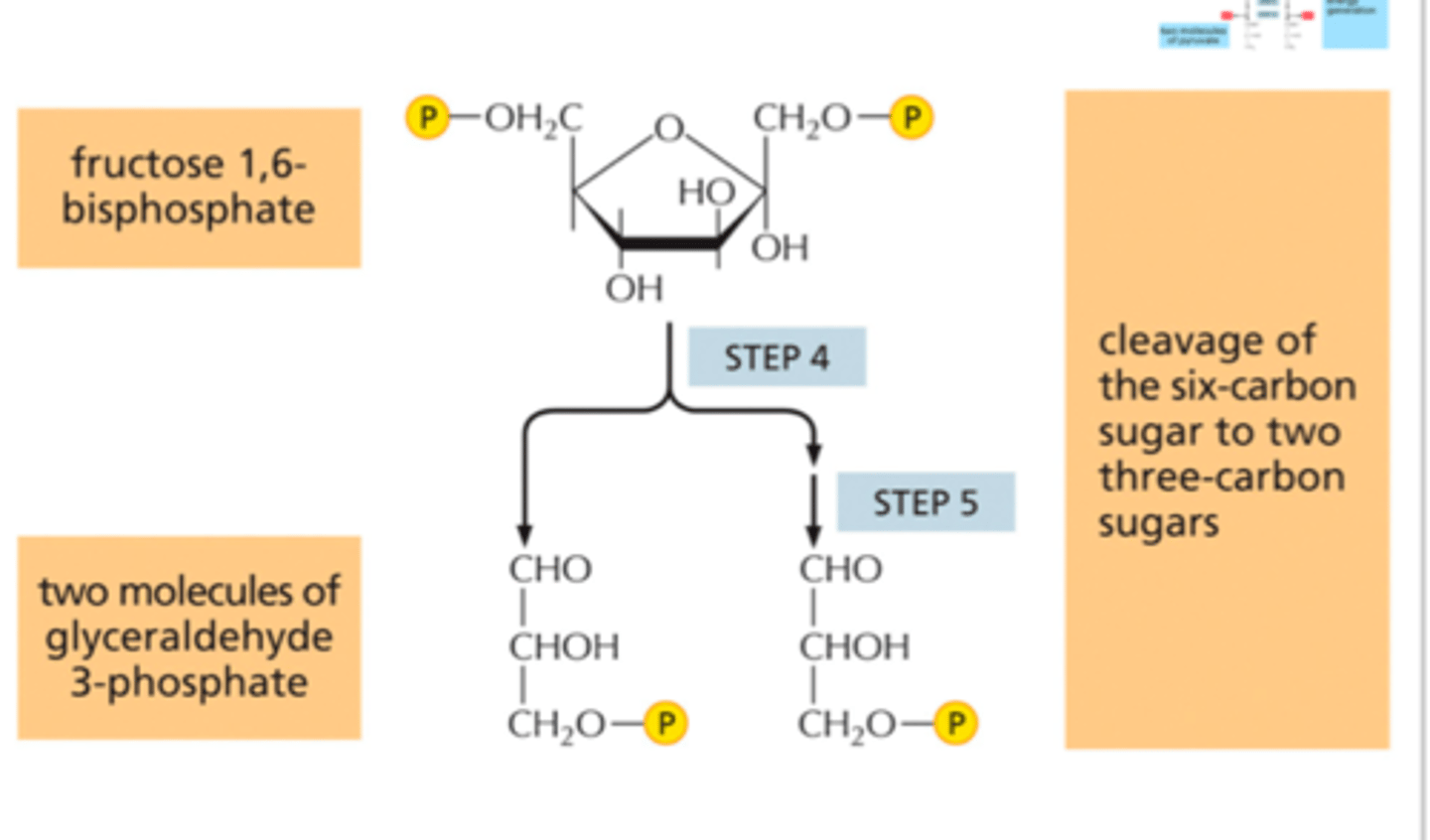
What steps occur in the Sugar cleavage phase?
4 and 5
What happens in step 4 and 5? Is it reversible?
The 2P sugar made in step 3 is now broken into TWO 3 carbon pieces = glyceraldehyde-3-phosphate (G3P)
Yes
Which steps are in the Energy production phase?
6,7,8,9,10
What happens overall in steps 6-10?
G3P --> 1,3-BPG (Dehydrogenase) ---> 1.3-BPG --> 3PG (kinase) ---> 3Pg--> 2PG (Mutase) ---> 2PG --> PEP (enolase) ---> PEP --> Pyruvate (Pyruvate Kinase)
What happens in step 6? (G3P --> 1,3-BPG (Dehydrogenase))
each G3P is oxidized, makes NADH and attaches higher energy phosphate
What happens in step 7? (1,3-BPG → 3PG (Kinase))
Highe E phosphate transferred to ADP --> ATP produce
What happens in step 8 (3PG → 2PG (Mutase))
Phosphate is shifted to a new position
What happens in step 9 (2PG → PEP (Enolase))?
Water is removed, create PEP - very high E molecule
(PEP donates phosphates)
What happens in step 10 (PEP → Pyruvate (Pyruvate kinase))
- Phosphate transferred to ADP --> ATP produced
- Final step, makes pyruvate and locks glycolysis forward
How and Why is glycolysis used in the cell?
Glycolysis is how cells break down sugar (glucose) into smaller pieces (pyruvate) to quickly make energy (ATP)
What does 1 glucose yield? (3 things)
- 2 pyruvate
- 2 NADH
- 2 ATP
How many ATP was USED during the energy investment phase?
How many ATP was MADE during energy generation phase?
What does this mean the net ATP is?
- 2 ATP
- 4 ATP
- 2 Net ATP
In earlier steps, 2 ATP was used to ____ EACH glucose
Catabolize
what does hydrolysis of ATP allow?
Allows non-spontaneous rxn to proceed
Why here the Phosphates from ATP added to intermediates?
- Forms high E phosphate bonds
- Now intermediates have higher energy
How is the 4 ATP made in the later steps?
When the phosphates are cleaved from the intermediates
Type of ATP generation?
Substrate level phosphorylation (SLP) bc no oxygen, so ATP is made directly from the high E intermediates, not via ETC
Why does glycolysis need a “push”?
Some steps are nonspontaneous (positive ΔG), so they need to be coupled with favorable reactions (like ATP hydrolysis) to proceed.
Glycolysis must generate what kind of ATP to be useful?
Whats used to speed up rxn?
Net ATP, enzymes
What does glycolysis rely on to make unfav steps work?
Coupled reactions
What does coupling mean?
Pairing an unfavorable reaction (needs energy) with a favorable one (releases energy) so the total energy change is negative and the process can proceed.
What molecule is and electron carrier for later use?
2 NAD+ --> 2 NADH
4 ADP --> 4 ATP is made via?
SLP
Why is the Net ATP = 2?
bc 2 ATP were used earlier
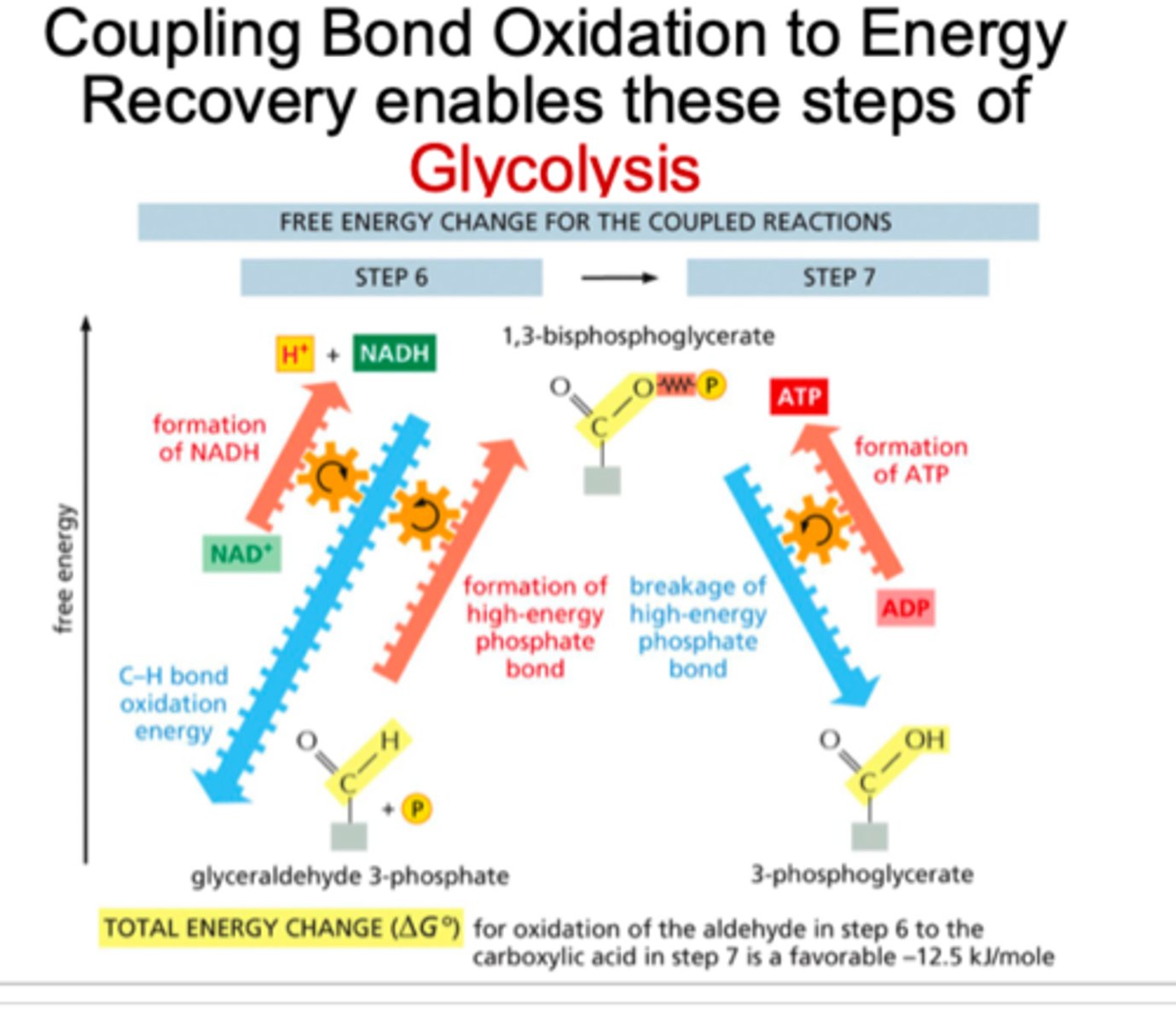
Which steps are coupled? Which one is unfavorable? is the overall rxn favorable?
- 6 and 7
- 6
- yes
Are all rxns energetically fav?
NO
What happens during step 6? Enzyme? output?
- Oxidizes C-H bond --> transfers electrons to NAD+
- G3P Dehydrogenase
- NADH
What happens during step 7? Enzyme? output?
- Uses high E intermediate to make ATP
- Kinase
- ATP
Why are these steps coupled? (67)
Step 6 is unfavorable on its own. Step 7 is favorable and releases enough energy to drive step 6 forward. Together, they work because the total energy change is −3.0 kcal/mol.
What are the 2 ways Aerobic cells make ATP?
Glycolysis and Oxidative Phosphorylation
T/F oxygen is required for Glycolysis?
FALSE. Doesn't need it
T/F oxygen is needed for Oxidative Phosphorylation
TRUE
T/F Anaerobic cells use Glycolysis and metabolism to make ATP
FALSE. Anaerobic cells ONLY use Glycolysis
Since Anaerobic cells use only Glycolysis, is it efficient? and does it produce a lot of ATP?
- Not efficient
- Low yield (2ATP)
Using NADH as a reductant to reduce pyruvate is called?
Fermentation
What is product of fermentation + Glycolysis?
- Lactate (in animals)
- Ethanol + CO2 (in yeast)
- 2 ATP per glucose
Regenerated NAD+ must be ____ to use for glycolysis
Recycled
When does Fermentation happen?
During exercise or in anaerobic organisms (yeast, bacteria, archaea).
Why fermentation?
To regenerate NAD⁺ so glycolysis can keep going — otherwise it would stop when NAD⁺ runs out.
How are food molecules broken down in cells?
In three stages: glycolysis, conversion to Acetyl CoA, and the citric acid cycle.
How does glycolysis extract energy from glucose?
By breaking chemical bonds and using substrate-level phosphorylation, enzymes, and coupled reactions.
What do glycolytic enzymes do?
They couple oxidation to energy storage in carriers like NADH, and help drive ATP production via substrate-level phosphorylation.
What are the main products of glycolysis?
ATP and NADH — both are energy carriers used later in metabolism.
What happens to cleaved glucose if there’s no oxygen?
It goes through fermentation to regenerate NAD⁺ and keep glycolysis running.
What happens to cleaved glucose if oxygen and mitochondria are available?
It continues into the citric acid cycle (CAC) and oxidative phosphorylation for more ATP.

