B2.1 - Membranes and membrane transport
 Call Kai
 Learn
Learn Practice Test
 Spaced Repetition
 Match
Match Flashcards
 Knowt Play
1/21

There's no tags or description
Looks like no tags are added yet.
Name | Mastery | Learn | Test | Matching | Spaced | Call with Kai |
|---|
No analytics yet
Send a link to your students to track their progress
22 Terms
B2.1.1—What are phospholipids? What are their properties? What do they form
Cell membranes are primarily composed of phospholipids;
they are Amphipathic;
meaning they have both hydrophilic and hydrophobic;
phospholipds are made from a polar head, which is hydrophilic;
it contains phosphate and glycerol;
also contains two non-polar fatty acid tails;
which are hydrophobic;
B2.1.1—What structures do phospholipids spontaneously form in water?
Phospholipids spontaneously arrange into a bilayer;
Hydrophobic tail regions face inwards and are shielded from the surrounding polar water/fluid;
the hydrophilic phosphate and glycerol in the head region attracts to the water outside and inside the cell;
Phospholipids are held together in a bilayer by hydrophobic interactions (weak associations) of the fatty acid tails;
B2.1.2—How do lipid bilayers serve as barrier around cells? What is the basis of this?
The lipid bilayers in cell membranes act as selective barriers;
which are impermeable to and block the entry of large molecules, ions, and polar substances;
due to the hydrophobic region in the middle made of fatty acid tails;
This selective permeability is essential for maintaining the internal environment of the cell;
B2.1.3—What molecules can use simple diffusion to cross membranes?
an example of simple diffusion is the exchange of oxygen and carbon dioxide across cell membranes;
these molecules are small and non-polar and can cross the cell plasma membrane easily; without using energy;
following their concentration gradients;
This process is vital for cellular respiration, where oxygen is required for energy production, and carbon dioxide is a waste product to be expelled;
B2.1.4—What are Integral and peripheral proteins in membranes?
Integral proteins are embedded in one or both of the lipid layers of a membrane;
Peripheral proteins are attached to one or other surface of the bilayer.
they have diverse structures, locations and functions; including transport channels (integral proteins only) and receptors (usually inegral as well);
What are some of the functions of proteins in the membrane?
Transport Proteins: Facilitate molecule movement in and out of cells, including channel and carrier proteins.
Channel Proteins: Form pores for molecule passage.
Carrier Proteins: Change shape to transfer molecules across the membrane.
Recognition: Act as cellular 'name tags' for cell-cell recognition, crucial in immune system functioning.
Receptors: Bind to chemical signals like hormones, triggering intracellular reactions.
Enzymes: Catalyse reactions, e.g., glucose-6-phosphatase in the endoplasmic reticulum.
Cell Adhesion & Motility: Aid in cell adherence and movement.
B2.1.5—How do water molecules move across membranes?
Water moves across membranes always via osmosis:
This due the random movement of water molecules;
water moves from areas of lower solute concentration to areas of higher solute concentration;
solutes cannot pass the through the membrane easily as it is not very permeable to them;
water can move through aquaporins;
which are specialized channel proteins facilitating water movement;
B2.1.6—What are channel proteins what process of membrane transport uses them? Give examples
Channel proteins are proteins which cross the plasma membrane;
they allow specific ions to diffuse through when open;
due to the amino acids which make up the inside of the channels, so they only attract certain ions/molecules;
e.g. glucose; through the GLUT channels;
contributing to selective permeability;
B2.1.7—What are pump proteins? What process uses them? Give examples
Active transport is the passage of materials against a concentration gradient (from low to high);
This process requires the use of protein pumps which use the energy from ATP to translocate the molecules against the concentration gradient;
The hydrolysis of ATP causes a conformational change in the protein pump resulting in the forced movement of the substance;
Protein pumps are specific for a given molecule, allowing for movement to be regulated (e.g. to maintain chemical or electrical gradients);
e.g. Na+/K+ pump which is involved in the generation of nerve impulses;
3 sodium pumped out for every 2 potassium pumped in to the axon;
B2.1.8—What is permeability? How are membranes selectively permeable?
Permeability is ability of a membrane to allow molecules to pass through;
selective permeability is when a membrane does not allow the free movement of all molecules and is permeable only to certain molecules;
due to specific channel proteins;
pump proteins;
which only allow specific molecules to pass, e.g. Calcium or sodium ions;
B.2.1.9—What is the structure, function and location of glycoproteins and glycolipids?
Glyoproteins are carbohydrate structures linked to proteins in membranes;
glycolipids are carbohydrate structures linked to lipids in membranes;
They are both exclusively on the extracellular side;
they are used in crucial for cell adhesion;
and cell recognition;
e.g. as receptors;
B2.1.10—What is the fluid mosaic model of membrane structure?
the Fluid mosaic model was proposed by Singer and Nicolson;
it says that both integral and peripheral proteins are embedded in the fluid bilayer, forming a mosaic pattern;
Lipids and proteins can move laterally within the membrane; meaning it is fluid;
Fluidity depends on fatty acid types in phospholipids and the cholesterol content;
Draw a diagram to represent the fluid mosaic structure of the membrane
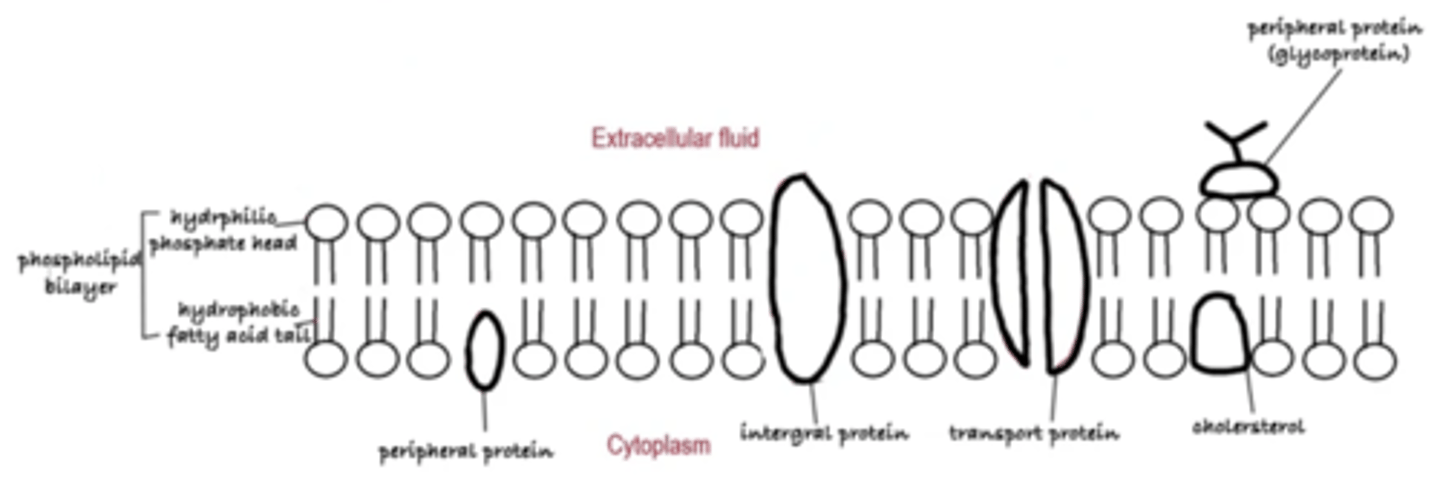
AHL Only - B2.1.11—What is the relationships between fatty acid composition of lipid bilayers and their fluidity?
The fatty acid composition of the membrane can affect its fluidity;
if there are more unsaturated fatty acids;
which contain double bonds, leading to lower melting points;
this makes the lipid bilayer more fluid and flexible;
if there are more saturated fatty acids which do not have double bonds;
this results in higher melting points;
AHL Only - B2.1.12—What is cholesterol? What is the impact of cholesterol on membrane fluidity in animal cells?
Cholesterol is hydrophobic found embedded within the lipid bilayer; between hydrophobic fatty acid tails; as it has a hydrophilic region as well; making it amphipathic;
Function: it acts as a fluidity regulator;
cholesterol reduces fluidity;
making membranes more stable at higher temperatures;
it also prevents crystallisation at lower temperatures;
AHL Only - B2.1.13— What is membrane fluidity?
Fluidity is the ability of the membrane to move in a flexible way;
It also describes the way that membranes can fuse;
and the way membranes can form smaller regions of membrane without breaking;
AHL Only - B2.1.13— What is endocytosis? What is an example?
endocytosis is a process where large amounts of substances can enter the cell;
during endocytosis the membrane can wrap around;
and pinch off;
forming a vesicle;
due to fluidity of membrane; it can remain unbroken;
e.g. phagocytosis of bacteria by phagocytes;
AHL Only - B2.1.13— What is exocytosis? What is an example?
exocytosis is a process where large amounts of proteins; synthesised by rough endoplasmic reticulum;
are packaged into vesicles;
which pinch-off or bud-off; from the rough endoplasmic reticulum;
and are carried to the golgi apparatus;
vesicles fuse with the flattened-sac membranes of the golgi;
modification and processing of proteins to put them in their final form takes place;
vesicles bud-off again;
travel to the plasma membrane;
or other locations in cell;
fuse with the membrane to secrete contents outside the cell;
AHL Only - B2.1.14—How are gated ion channels used in neurons?
voltage-gated channels open and close in response to electrical charge; they are carrier proteins;
if there is a change in voltage around the channel causes it to open;
potassium channel open;
when there are more positive charges inside the cell than outside;
K+ can flow through;
down the concentration gradient;
aids in repolarisation of axon as positive potassium flow down concentration gradient out of cell;
AHL Only - B2.1.15—What is the sodium-potassium pump? How is it an example of as an example of an exchange transporter?
Active transport of sodium and potassium uses energy from ATP to pump;
the Sodium potassium pump transports 3 sodium ions OUT of cell for every 2 potassium ions IN;
sodium ions bind to interior of pump on inside of axon;
ATP hydrolysis allow phosphate to bind to pump;
causes a conformational change (change in shape) of pump;
releasing sodium outside the cell;
2 potassium bind to pump outside of the cell;
causing the release of phosphate;
causing a conformational change in the pump;
releasing potassium inside the cell
AHL Only - B2.1.16—What are sodium-dependent glucose co-transporters? How are they an an example of indirect active transport?
Sodium-dependent glucose co-transporters facilitate glucose transport into cells;
alongside sodium ions;
it is a form of indirect active transport;
sodium ions are pumped out of cells;
leading to a concentration gradient;
as they flow back down their gradient the energy can be used to transport glucose into cells;
AHL Only - B2.1.17—How do cells adhere to form tissues? What are CAMs?
Cell-Adhesion Molecules (CAMs) are proteins that allow cells to adhere to each other, forming stable tissues;
Different forms of CAMs are used in different types of cell-cell junctions;

